Ginger — Benefits Deep Dive
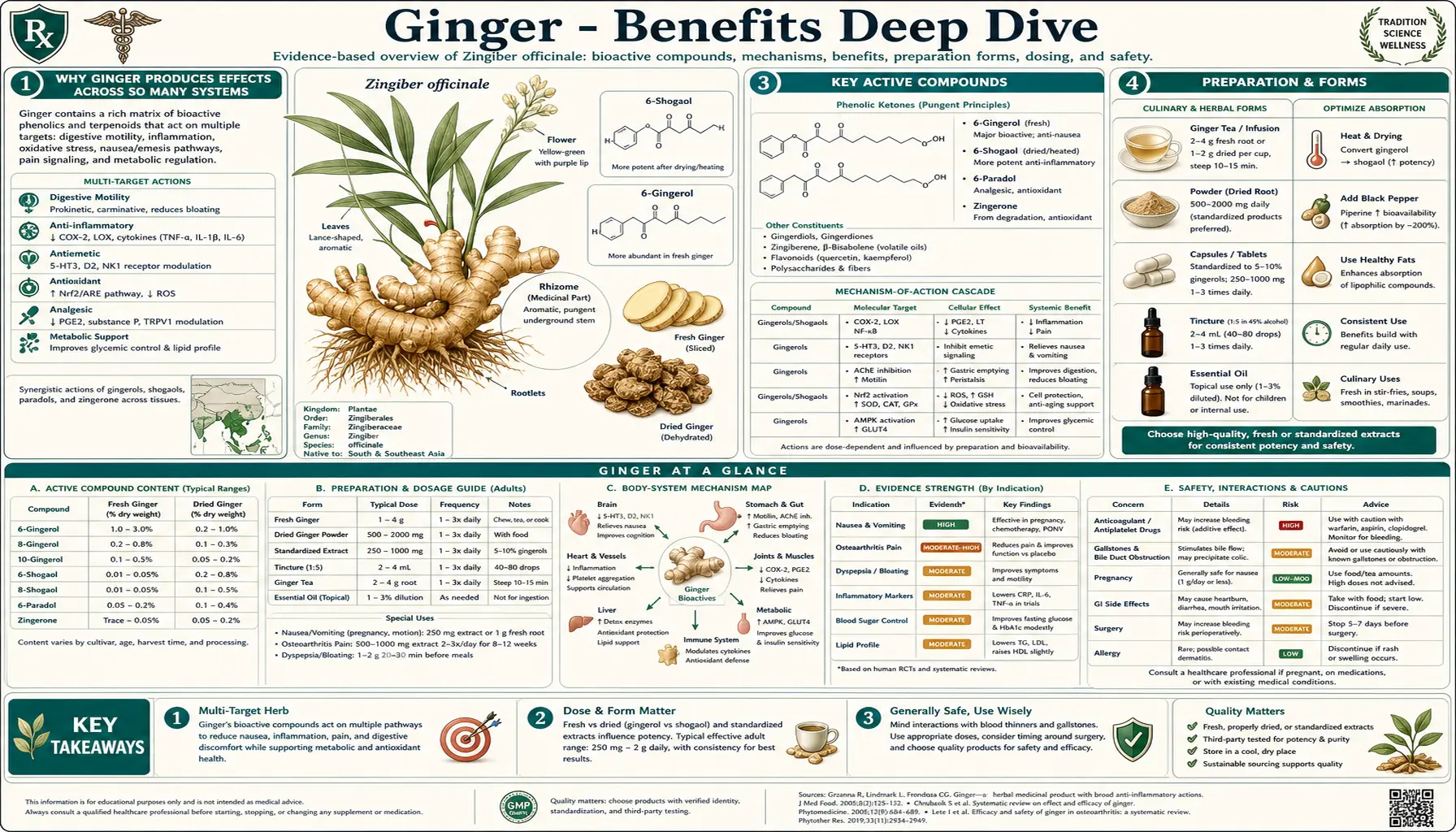
Zingiber officinale is the world's oldest documented medicinal root — over 5,000 years of continuous use in Traditional Chinese Medicine and Ayurveda. What makes ginger pharmacologically remarkable is that drying transforms it into a chemically different drug: fresh rhizome is dominated by 6-gingerol, while drying dehydrates this molecule into 6-shogaol, which is roughly twice as potent at the TRPV1 (capsaicin) receptor and has distinct anti-inflammatory and cytotoxic effects. The same root acts as a 5-HT3 receptor antagonist (the same target as ondansetron / Zofran), a dual COX-1 / COX-2 / 5-LOX inhibitor (broader than aspirin or ibuprofen), and a prokinetic that accelerates gastric emptying through 5-HT3 and muscarinic M3 receptors. Four mechanisms, one root, four distinct categories of clinical benefit explored below.
Deep-Dive Articles
Nausea Relief
Ginger's most evidence-backed indication. The Vutyavanich 1999 Thai obstetric trial established 250 mg four times daily as the foundational dose for hyperemesis gravidarum — the only safe oral antiemetic in pregnancy. Chaiyakunapruk's 2006 meta-analysis of postoperative nausea/vomiting (PONV) and the Marx 2013 meta-analysis of chemotherapy-induced nausea both confirmed clinical efficacy. Mechanism: competitive antagonism at the 5-HT3 receptor (the same target as ondansetron/Zofran) plus motility effects.
Anti-Inflammatory & Osteoarthritis
Gingerols inhibit COX-1, COX-2, and 5-lipoxygenase — a broader prostaglandin/leukotriene blockade than any single NSAID. The Altman 2001 knee-osteoarthritis trial and Bartels's 2015 systematic review document modest but real pain reduction with comparable efficacy to ibuprofen but markedly lower GI side-effect rates. Bliddal 2000 established dose-response. Realistic clinical positioning: a daily anti-inflammatory adjunct, not a rescue analgesic.
Digestive Aid & Gastroparesis
Wu 2008 (European Journal of Gastroenterology & Hepatology) showed 1.2 g ginger powder roughly doubled gastric emptying in healthy volunteers (T½ from 16.1 to 12.3 minutes). Real value: idiopathic and diabetic gastroparesis, functional dyspepsia, and post-viral motility disorders where metoclopramide's neurologic side effects rule it out. Prokinetic mechanism via 5-HT3 antagonism + muscarinic M3 agonism on enteric smooth muscle.
Migraine & Pain
Maghbooli's 2014 Iranian head-to-head trial (Phytotherapy Research) compared 250 mg sublingual ginger powder to 50 mg sumatriptan for acute migraine — statistically equivalent pain reduction at 2 hours with dramatically fewer side effects. Rondanelli 2017 systematic review confirms. The sublingual / dissolve-under-the-tongue route bypasses migraine-impaired gastric absorption. Same gingerols also reduce muscle pain (eccentric-exercise DOMS) and dysmenorrhea.
Table of Contents
- Deep-Dive Articles
- Why Ginger Produces Effects Across So Many Systems
- Research Papers: Nausea & Antiemetic Effects
- Research Papers: Anti-Inflammatory & Osteoarthritis
- Research Papers: Digestive & Gastroparesis
- Research Papers: Migraine & Pain
- Research Papers: Cross-Cutting (Pharmacology, Safety, Drug Interactions)
- External Authoritative Resources
- Connections
- Featured Videos
Why Ginger Produces Effects Across So Many Systems
Most botanical medicines act through a single principal mechanism — turmeric's curcumin is largely a transcription factor (NF-κB) inhibitor; St. John's wort hyperforin is largely a monoamine reuptake inhibitor. Ginger is unusual because it contains at least four pharmacologically distinct compound classes, each with its own primary receptor target, and each maps to a different category of clinical benefit.
- Gingerols (fresh rhizome) — the dominant pungent principle in fresh ginger root. 6-gingerol, 8-gingerol, and 10-gingerol are the most abundant. Mechanism: dual COX-1 / COX-2 inhibition (suppressing prostaglandin synthesis) plus 5-lipoxygenase inhibition (suppressing leukotriene synthesis). This dual prostaglandin-and-leukotriene blockade is broader than NSAIDs (which hit only COX) and explains the osteoarthritis and chronic-pain benefit. Gingerols are also 5-HT3 receptor antagonists — the same molecular target as ondansetron (Zofran), which is the mechanistic basis for the antiemetic effect.
- Shogaols (dried rhizome) — when fresh ginger is dried, the beta-hydroxy ketone of 6-gingerol undergoes dehydration to form 6-shogaol's alpha,beta-unsaturated ketone (an enone). This makes shogaols roughly twice as potent as gingerols at the TRPV1 capsaicin receptor and gives them a much stronger pungent "heat" on the tongue. Shogaols also have more pronounced cytotoxic activity in cancer cell lines (the basis of ongoing oncology research) and stronger neuroprotective signals in models of cerebral ischemia. Practical implication: dried ginger powder, fresh ginger root, and ginger candy are pharmacologically different drugs — not interchangeable in clinical trials.
- Paradols and zingerone — further degradation products. Zingerone (a vanillyl ketone closely related to vanillin and capsaicin) is responsible for the warming aroma of cooked ginger and contributes additional antioxidant capacity. Paradols are formed by reduction of shogaols and have demonstrated anti-inflammatory and cytotoxic activity in preclinical studies. These are minor contributors in fresh rhizome but accumulate during long-term storage, roasting, and traditional Chinese decoction (boiling) preparation methods.
- Prokinetic action on gut smooth muscle — separate from the 5-HT3 antiemetic action in the chemoreceptor trigger zone, ginger compounds act peripherally on enteric smooth muscle through a combination of 5-HT3 antagonism, muscarinic M3 agonism, and direct effects on calcium channels in the longitudinal muscle of the antrum and duodenum. The net effect is acceleration of gastric emptying and improved antral-duodenal coordination — the basis of the gastroparesis and functional dyspepsia benefit.
The therapeutic consequence of having four distinct mechanisms in one root is that ginger's benefit pattern does not collapse to a single indication. A patient with chemotherapy-induced nausea is benefitting primarily from the 5-HT3 antagonism. A patient with knee osteoarthritis is benefitting primarily from the COX/LOX inhibition. A patient with diabetic gastroparesis is benefitting primarily from the prokinetic motility effect. A patient with acute migraine is benefitting from both the 5-HT3 antagonism (for the nausea component) and the prostaglandin-suppression analgesic effect, with the sublingual route bypassing the migraine-impaired gastric absorption that often defeats oral triptans. One root, four mechanisms, four pages of clinical evidence.
Research Papers: Nausea & Antiemetic Effects
- Vutyavanich T et al. (2001). Ginger for nausea and vomiting in pregnancy: randomized, double-masked, placebo-controlled trial. Obstetrics & Gynecology. The foundational 250 mg QID pregnancy trial. — PubMed: Vutyavanich 2001
- Chaiyakunapruk N et al. (2006). The efficacy of ginger for the prevention of postoperative nausea and vomiting: a meta-analysis. American Journal of Obstetrics & Gynecology. — PubMed: PONV meta-analysis
- Marx W et al. (2013). Ginger (Zingiber officinale) and chemotherapy-induced nausea and vomiting: a systematic literature review. Nutrition Reviews. — PubMed: Marx CINV review
- 5-HT3 receptor antagonism mechanism of ginger compounds — PubMed: 5-HT3 antagonism
- Ginger for hyperemesis gravidarum (severe pregnancy nausea) — PubMed: Hyperemesis gravidarum
- Ryan JL et al. (2012). Ginger reduces acute chemotherapy-induced nausea: a URCC CCOP randomized study. Supportive Care in Cancer. — PubMed: Ryan URCC trial
- Lien HC et al. (2003). Effects of ginger on motion sickness and gastric slow-wave dysrhythmias. American Journal of Physiology. — PubMed: Lien motion sickness
- Mowrey DB, Clayson DE (1982). Motion sickness, ginger, and psychophysics. The Lancet. The original 1982 ginger-vs-Dramamine motion-sickness trial. — PubMed: Mowrey Lancet 1982
- Boone SA, Shields KM (2005). Treating pregnancy-related nausea and vomiting with ginger. Annals of Pharmacotherapy. — PubMed: Boone & Shields
- Comparison of ginger with vitamin B6 (pyridoxine) for pregnancy nausea — PubMed: Ginger vs B6 in pregnancy
Research Papers: Anti-Inflammatory & Osteoarthritis
- Altman RD, Marcussen KC (2001). Effects of a ginger extract on knee pain in patients with osteoarthritis. Arthritis & Rheumatism. — PubMed: Altman 2001
- Bartels EM et al. (2015). Efficacy and safety of ginger in osteoarthritis patients: a meta-analysis of randomized placebo-controlled trials. Osteoarthritis and Cartilage. — PubMed: Bartels 2015
- Bliddal H et al. (2000). A randomized, placebo-controlled, cross-over study of ginger extracts and ibuprofen in osteoarthritis. Osteoarthritis and Cartilage. — PubMed: Bliddal dose-finding
- Gingerols as dual COX-1 / COX-2 inhibitors — PubMed: Gingerol COX inhibition
- Ginger and 5-lipoxygenase (5-LOX) leukotriene pathway inhibition — PubMed: 5-LOX inhibition
- Black CD et al. (2010). Ginger reduces muscle pain caused by eccentric exercise. Journal of Pain. — PubMed: DOMS
- Drozdov VN et al. (2012). Influence of a specific ginger combination on gastropathy conditions in patients with osteoarthritis. Journal of Alternative and Complementary Medicine. — PubMed: Ginger-NSAID gastropathy
- Anti-inflammatory mechanism of 6-shogaol vs 6-gingerol — PubMed: Shogaol vs gingerol
- Ginger for primary dysmenorrhea (menstrual pain): systematic review — PubMed: Dysmenorrhea
- Topical ginger / 6-gingerol for inflammation and pain — PubMed: Topical ginger
Research Papers: Digestive & Gastroparesis
- Wu KL et al. (2008). Effects of ginger on gastric emptying and motility in healthy humans. European Journal of Gastroenterology & Hepatology. The 1.2 g doubled-emptying study. — PubMed: Wu 2008
- Hu ML et al. (2011). Effect of ginger on gastric motility and symptoms of functional dyspepsia. World Journal of Gastroenterology. — PubMed: Hu 2011 dyspepsia
- Ginger for diabetic gastroparesis — PubMed: Diabetic gastroparesis
- Ginger and 5-HT3 receptor antagonism on enteric smooth muscle — PubMed: Enteric 5-HT3
- Ginger and muscarinic M3 receptor agonism in gut motility — PubMed: M3 prokinetic
- Ginger for functional dyspepsia (post-prandial fullness, early satiety) — PubMed: Functional dyspepsia
- Ginger for irritable bowel syndrome (IBS) symptoms — PubMed: IBS
- Ginger and lower esophageal sphincter / GERD — PubMed: Ginger and GERD
- Ginger for Helicobacter pylori gastritis — PubMed: H. pylori
- Antiulcer effect of ginger components in animal models — PubMed: Ulcer protection
Research Papers: Migraine & Pain
- Maghbooli M et al. (2014). Comparison between the efficacy of ginger and sumatriptan in the ablative treatment of the common migraine. Phytotherapy Research. The pivotal head-to-head trial. — PubMed: Maghbooli 2014
- Rondanelli M et al. (2017). Clinical trials on pain lowering effect of ginger: a narrative review. Phytotherapy Research. — PubMed: Rondanelli 2017
- Cady RK et al. (2011). A double-blind placebo-controlled pilot study of sublingual feverfew and ginger (LipiGesic M) in the treatment of migraine. Headache. — PubMed: Cady sublingual
- Ginger for primary dysmenorrhea (menstrual pain) — PubMed: Dysmenorrhea
- Black CD et al. (2010). Ginger reduces muscle pain caused by eccentric exercise. Journal of Pain. — PubMed: DOMS
- Mustafa T, Srivastava KC (1990). Ginger (Zingiber officinale) in migraine headache. Journal of Ethnopharmacology. The classic 1990 case-series proposal. — PubMed: Mustafa 1990
- Sublingual / buccal absorption of ginger compounds — PubMed: Sublingual absorption
- Ginger and migraine-associated nausea — PubMed: Migraine nausea
- Anti-nociceptive (pain-blocking) mechanism of 6-shogaol via TRPV1 — PubMed: Shogaol TRPV1
- Ginger and CGRP (calcitonin gene-related peptide) in migraine pathophysiology — PubMed: CGRP
Research Papers: Cross-Cutting (Pharmacology, Safety, Drug Interactions)
- 6-Gingerol and 6-shogaol pharmacokinetics in humans — PubMed: Gingerol PK
- Ginger and platelet aggregation / thromboxane synthesis — PubMed: Platelets and bleeding
- Ginger-warfarin interaction case reports and clinical study — PubMed: Warfarin interaction
- Ginger for blood glucose and HbA1c in type 2 diabetes meta-analysis — PubMed: Diabetes meta-analysis
- Ginger for blood pressure / hypertension — PubMed: Hypertension
- Ginger for lipid profile (LDL, triglycerides) — PubMed: Lipids
- Ginger and weight loss / body composition — PubMed: Weight loss
- 6-Shogaol neuroprotection in models of cerebral ischemia and neurodegeneration — PubMed: Neuroprotection
- Ginger compounds in cancer cell lines (preclinical oncology) — PubMed: Cancer cell lines
- Standardization of ginger extracts (Eurovita EV-77, EV-ext-35) — PubMed: Standardized extracts
External Authoritative Resources
- NCCIH (National Center for Complementary and Integrative Health) — Ginger — NIH's authoritative consumer/clinician summary
- MedlinePlus / NIH — Ginger — uses, dosing, side effects, drug interactions
- Memorial Sloan Kettering — Ginger (Integrative Medicine) — oncology-focused evidence summary, especially CINV
- European Medicines Agency — Zingiberis rhizoma — EMA HMPC monograph (European herbal monograph for ginger root)
- PubMed — All research on Zingiber officinale / ginger (over 4,500 papers)
Connections
- All Herbs
- Ginger (Main Page)
- Ginger for Nausea Relief
- Ginger Anti-Inflammatory & OA
- Ginger Digestive & Gastroparesis
- Ginger for Migraine & Pain
- Turmeric (Sister Anti-Inflammatory Rhizome)
- Garlic
- Cinnamon
- Black Seed
- Nausea and Vomiting
- Migraine
- Arthritis (Osteoarthritis)
- Irritable Bowel Syndrome
- GERD
- Chronic Pain
- Anti-Inflammatory Diet
- Gut Healing
- Cold & Flu Treatments
- Immune Boosting