Ginger as Digestive Aid and for Gastroparesis
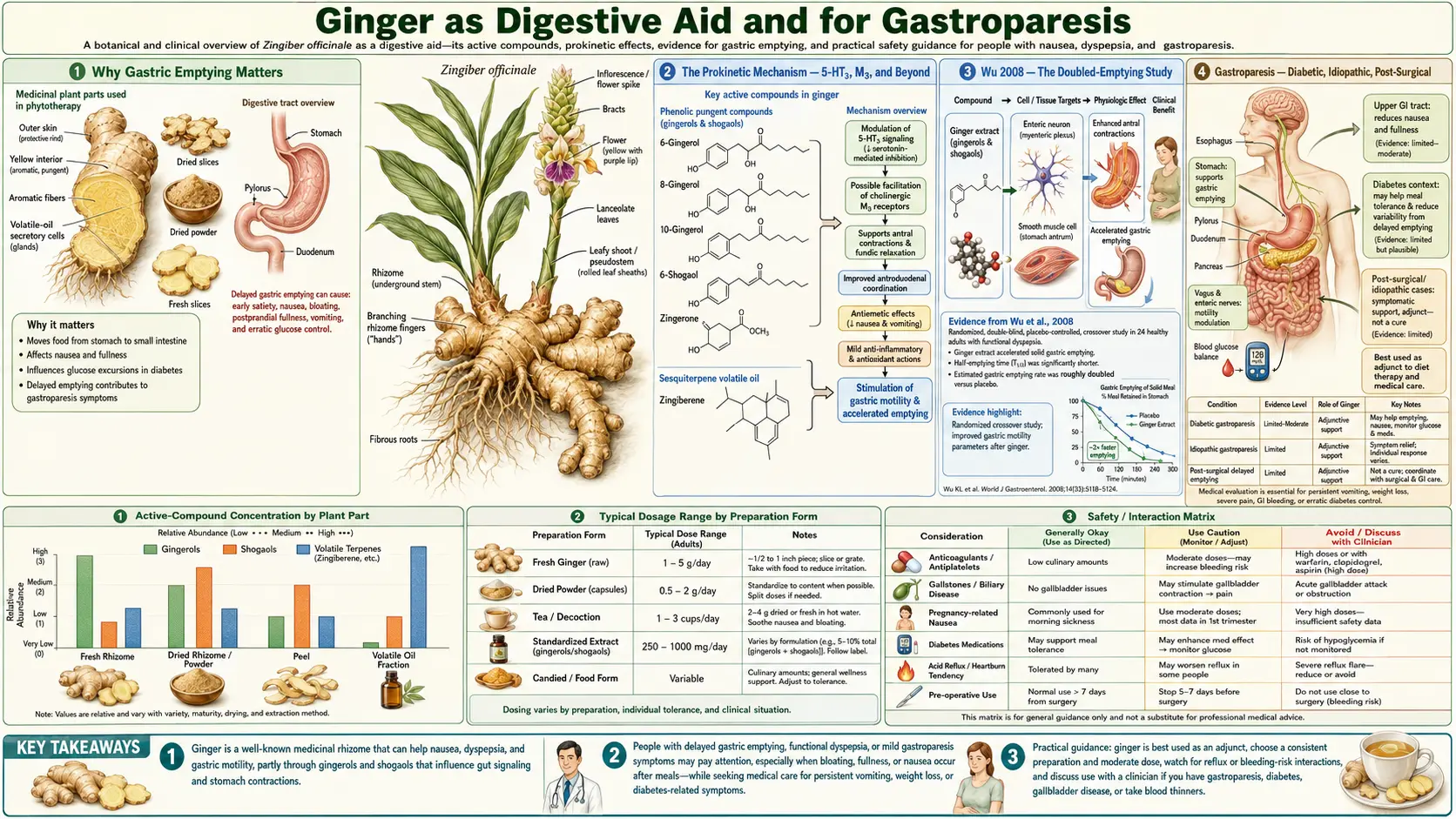
Gastric emptying is the rate-limiting step in most upper-GI symptoms — postprandial fullness, early satiety, nausea, reflux, and the eponymous "gastroparesis." The Wu 2008 trial in European Journal of Gastroenterology & Hepatology demonstrated something dramatic: 1.2 g of ginger powder taken before a standardized meal roughly doubled gastric emptying rate in healthy volunteers (half-emptying time reduced from 16.1 to 12.3 minutes; the antrum-to-pylorus motility index increased substantially). For patients with idiopathic or diabetic gastroparesis — where the entire stomach is paralyzed and the only approved prokinetic (metoclopramide) carries a black-box warning for tardive dyskinesia — ginger represents one of the very few options that actually accelerates emptying rather than just suppressing the resulting nausea. The mechanism is dual: 5-HT3 antagonism on enteric neurons plus muscarinic M3 agonism on smooth muscle, enhanced by direct effects on antral-duodenal coordination.
Table of Contents
- Why Gastric Emptying Matters
- The Prokinetic Mechanism — 5-HT3, M3, and Beyond
- Wu 2008 — The Doubled-Emptying Study
- Gastroparesis — Diabetic, Idiopathic, Post-Surgical
- Functional Dyspepsia and Postprandial Distress
- Comparison with Metoclopramide, Erythromycin, and Domperidone
- The GERD Paradox — When Faster Emptying Helps
- IBS, Bloating, and Carminative Action
- Helicobacter pylori and Ulcer Protection
- Practical Dosing for Digestive Indications
- Cautions and Special Populations
- Key Research Papers
- Connections
- Featured Videos
Why Gastric Emptying Matters
The stomach is not a passive bag — it is a finely coordinated muscular pump. After a meal, the proximal stomach (fundus) relaxes to accommodate the food (receptive relaxation), then the distal stomach (antrum) generates rhythmic peristaltic contractions at roughly 3 cycles per minute that grind the food and push it through the narrow pyloric channel into the duodenum. The half-emptying time (T½) for a standard meal is normally 60–120 minutes for solids and 15–30 minutes for liquids.
When gastric emptying is delayed — whether from diabetic autonomic neuropathy (the classic cause of diabetic gastroparesis), idiopathic causes (often post-viral, after norovirus or Epstein-Barr infection), opioid use, GLP-1 agonist drugs (semaglutide, tirzepatide deliberately slow emptying as part of their weight-loss mechanism), connective tissue disease (scleroderma), or post-surgical vagal nerve injury (after fundoplication, bariatric surgery, or even cholecystectomy in some patients) — the consequences cascade:
- Postprandial fullness and early satiety — food sits in the stomach for hours, the patient cannot eat normal-volume meals
- Nausea and vomiting — the gastric stretch and stagnant chyme trigger vagal nausea afferents
- Weight loss and malnutrition — from reduced intake and poor absorption
- Erratic glycemic control in diabetics — insulin dosing is timed to expected post-meal glucose rise, which is disrupted when emptying is unpredictable
- Bezoar formation — undigested fibrous material can solidify into a mass that further obstructs the pylorus
- Bacterial overgrowth — stagnant gastric contents predispose to small-intestinal bacterial overgrowth (SIBO)
The first-line treatment for delayed emptying is dietary (small frequent meals, low-fiber low-fat content, liquid nutrition supplements). The first-line drug is metoclopramide (Reglan) — effective but carrying a black-box warning for tardive dyskinesia after sustained use, which limits its long-term utility, particularly in younger patients who would otherwise need it for decades. Domperidone is widely used outside the US for the same indication but is not FDA-approved domestically due to QT-prolongation concerns. Erythromycin acts as a motilin receptor agonist and is effective in the short-term but loses effect with continued use (tachyphylaxis) within weeks. This is the therapeutic vacuum that ginger fills.
The Prokinetic Mechanism — 5-HT3, M3, and Beyond
Ginger's prokinetic effect appears to arise from at least three converging mechanisms acting on the enteric nervous system and gut smooth muscle:
- 5-HT3 antagonism on enteric inhibitory neurons — the same 5-HT3 antagonism that gives ginger its antiemetic effect (discussed in detail in the Nausea Relief page) also has a paradoxical-seeming pro-motility effect peripherally. In the enteric nervous system, 5-HT3 receptors are present on both excitatory and inhibitory motor neurons; the net effect of 5-HT3 blockade depends on which population dominates. In the antrum and duodenum, 5-HT3 blockade tends to remove tonic inhibition of contraction, producing net prokinetic effect.
- Muscarinic M3 agonism on antral smooth muscle — ginger compounds (particularly 6-gingerol and 8-gingerol) directly stimulate M3 muscarinic receptors on gastric smooth muscle, the same receptors that acetylcholine binds and that the prokinetic drug cisapride (withdrawn for cardiac side effects) targeted. The M3 effect is most pronounced in the antrum, where it amplifies the natural peristaltic rhythm.
- Direct effects on antral-duodenal coordination — the Wu 2008 imaging studies showed not just faster emptying but better-coordinated antral-duodenal motility. This is the "gastroduodenal harmony" that prokinetic drugs aim for — antral contractions timed to push food through the pylorus while duodenal contractions actively receive it. Ginger appears to improve this coordination through mechanisms not fully mapped at the receptor level.
The combined effect: faster gastric emptying, improved postprandial motility, reduced postprandial fullness, and reduced gastric-stretch nausea afferent signaling. This is a different mechanism from the chemoreceptor-trigger-zone antiemetic effect — both contribute to ginger's overall antinausea effect but in distinct anatomical and pharmacologic ways.
Importantly, ginger's prokinetic effect is concentrated in the upper GI tract (stomach, duodenum). It does not have the same pro-motility effect on the colon, so it is not a remedy for slow-transit constipation (where it would be inappropriate to prescribe in any case). The clinical indication is upper-GI dysmotility, not lower-GI.
Wu 2008 — The Doubled-Emptying Study
The Wu et al. 2008 trial published in European Journal of Gastroenterology & Hepatology is the most-cited single study of ginger's prokinetic effect. The protocol:
- 24 healthy adult volunteers in a randomized double-blind crossover design
- Two intervention sessions separated by ≥ 7-day washout
- Each session: ingestion of either 1.2 g of ginger powder in capsules or matching placebo capsules
- One hour later, subjects consumed a standardized 500 mL low-nutrient soup
- Gastric emptying assessed by serial ultrasound measurements of antral cross-sectional area and barostat measurements of fundic tone
Key results:
- Median gastric emptying half-time (T½) was 12.3 minutes after ginger vs 16.1 minutes after placebo — a 24% reduction
- Antrum-duodenum contraction frequency was substantially higher after ginger
- The motility index (a composite measure of contraction amplitude and frequency) increased markedly
- Fundic relaxation was not significantly different
- No adverse events
The 24% reduction in emptying half-time is comparable to the effect size of standard prokinetic drugs in healthy volunteers. In patients with delayed emptying at baseline (gastroparesis), the proportional effect may be larger because there is more baseline delay to correct. The 1.2 g dose used in Wu corresponds to roughly 4–5 250 mg capsules of dried ginger root powder — a higher single-dose than the typical nausea-relief dose, but well within the safe daily range.
The Hu 2011 follow-up trial in World Journal of Gastroenterology tested ginger specifically in patients with functional dyspepsia (the condition most likely to involve delayed emptying as a cause of symptoms) and confirmed both improved emptying and improved symptom scores. Multiple subsequent studies have replicated the basic finding in different patient populations.
Gastroparesis — Diabetic, Idiopathic, Post-Surgical
Gastroparesis is delayed gastric emptying in the absence of mechanical obstruction. The major causes:
- Diabetic gastroparesis — affects roughly 30% of long-duration (>10 years) type 1 diabetics and 15% of long-duration type 2 diabetics. The mechanism is autonomic vagal neuropathy, which removes the parasympathetic excitatory input to gastric smooth muscle. Tight glycemic control slows but does not reverse progression.
- Idiopathic gastroparesis — the largest category, often presents in young women after an apparent viral illness (Norovirus, Epstein-Barr, COVID-era post-viral cases). The mechanism is presumed post-viral autonomic dysfunction. Some cases resolve over 6–24 months; others persist indefinitely.
- Post-surgical gastroparesis — after vagotomy (rarely performed now), partial gastrectomy, fundoplication for severe GERD, bariatric surgery, or cholecystectomy. Mechanism is direct vagal nerve injury.
- Connective tissue disease — systemic sclerosis (scleroderma) is the classic association; CREST variant patients have particularly high rates of gastroparesis.
- Medication-induced — opioids, anticholinergics, calcium-channel blockers, GLP-1 agonists (semaglutide, tirzepatide — deliberately, as part of their weight-loss mechanism), and others.
The role of ginger in gastroparesis management is as adjunct or alternative to metoclopramide. For mild gastroparesis (T½ modestly prolonged, symptoms manageable), ginger may be sufficient as standalone therapy. For moderate gastroparesis, ginger may allow lower metoclopramide doses or longer drug-free intervals. For severe gastroparesis (T½ > 3 hours, recurrent dehydration, severe nutritional compromise), ginger is rarely sufficient and metoclopramide, domperidone, gastric pacing, or even gastrectomy may be required.
Practical regimen for gastroparesis: 500–1000 mg ginger powder taken 30 minutes before each meal, three meals daily (total 1.5–3 g/day). The pre-meal timing is important — the prokinetic effect should be active when the meal arrives in the stomach. For patients with severe nausea preventing capsule swallowing, ginger lozenges or strong ginger tea can substitute. Some patients tolerate ginger essential oil capsules (more concentrated) better than powder.
Concurrent management of gastroparesis should always include dietary modification (small frequent meals, low fiber, low fat, soft-textured food, sometimes liquid nutrition supplements) and glycemic optimization in diabetic patients. For more on connections to autonomic dysfunction in gastroparesis, particularly the post-viral and dysautonomia variants, see our SIBO page and the broader gastroparesis resources.
Functional Dyspepsia and Postprandial Distress
Functional dyspepsia (FD) is defined by the Rome IV criteria as chronic or recurrent upper-abdominal symptoms (postprandial fullness, early satiety, epigastric pain, epigastric burning) without identifiable structural cause on endoscopy. It affects roughly 10–20% of the population and is the most common gastroenterology referral indication. The Rome IV subcategorization splits FD into:
- Postprandial Distress Syndrome (PDS) — predominant postprandial fullness and early satiety, often with bloating. The motility-predominant subtype; delayed gastric emptying is documented in roughly 40% of these patients.
- Epigastric Pain Syndrome (EPS) — predominant epigastric pain or burning, less clearly meal-related. The acid/sensory-predominant subtype.
Ginger's strongest evidence in FD is for the PDS subtype, where the motility mechanism is operative. The Hu 2011 trial in World Journal of Gastroenterology showed both objective gastric emptying improvement and subjective symptom score improvement with 1.2 g of ginger before meals in 24 FD patients. Multiple subsequent open-label and small randomized trials have confirmed.
For the EPS subtype, ginger's direct mucosal effects (including the anti-Helicobacter effects discussed below) may contribute to benefit but the motility mechanism is less relevant. For these patients, ginger may be tried but PPI therapy and Helicobacter eradication take priority.
Practical FD regimen: 250–500 mg ginger powder 30 minutes before each meal for 4–6 weeks; assess response. If symptoms improve, continue indefinitely. If no response after 6 weeks, FD subtype may not be motility-driven and other interventions (acid suppression, antidepressants like nortriptyline at low dose for visceral hypersensitivity) should be considered.
Comparison with Metoclopramide, Erythromycin, and Domperidone
The comparator-drug landscape for prokinetics is small and shrinking. The four practical options are:
- Metoclopramide (Reglan) — D2 dopamine antagonist with 5-HT4 agonist activity. Highly effective. Black-box warning for tardive dyskinesia after > 12 weeks of continuous use (irreversible movement disorder). Also causes acute extrapyramidal reactions (dystonia, akathisia), galactorrhea, depression, and elevated prolactin. FDA recommends max 12 weeks of continuous use; in practice many gastroparesis patients use it intermittently for years with cumulative TD risk.
- Domperidone (Motilium) — peripheral D2 antagonist (does not cross blood-brain barrier, so no extrapyramidal effects). Effective and well-tolerated for chronic use. NOT FDA-approved in the US due to QT prolongation concerns; available by FDA Investigational New Drug application or by import from Canada/Europe. Many US gastroparesis specialists use it via these workarounds.
- Erythromycin — motilin receptor agonist that mimics the "migrating motor complex" that sweeps the stomach clean between meals. Highly effective acutely (IV erythromycin is a rescue therapy for acute gastric dilation). Loses effect within 2–4 weeks due to motilin receptor downregulation. Antibiotic stewardship concerns limit chronic use.
- Prucalopride (Resotran) — 5-HT4 agonist approved for chronic idiopathic constipation; some evidence for gastric prokinetic effect off-label. Generally well-tolerated.
Ginger's comparative advantages: no tardive dyskinesia risk, no QT prolongation concern, no extrapyramidal effects, no tachyphylaxis with chronic use, no antibiotic stewardship issue, available without prescription. Comparative disadvantages: lower potency than any of the above drugs at standard doses, less precise titration, variable extract content across products, and limited use in severe gastroparesis where rapid effect is needed.
The pragmatic positioning: ginger as first-line for mild gastroparesis and functional dyspepsia with motility component; ginger plus low-dose intermittent metoclopramide for moderate cases (using ginger to reduce total metoclopramide exposure and cumulative TD risk); ginger plus domperidone for those with US access to domperidone; ginger as adjunct to whatever combination is being used in severe gastroparesis.
The GERD Paradox — When Faster Emptying Helps
Gastroesophageal reflux disease (GERD) presents an interesting paradox for ginger therapy. On the one hand, faster gastric emptying should reduce the volume of acidic gastric contents available to reflux into the esophagus, which is plausibly beneficial. On the other hand, the pungent gingerols are mild gastric irritants that can aggravate already-inflamed esophageal mucosa in some patients. The literature is consequently mixed.
The clinical pattern that emerges from trial data plus clinical experience:
- Patients with GERD and delayed gastric emptying (a substantial subset, perhaps 30%) often benefit from ginger — the prokinetic effect reduces the volume available to reflux, and the symptom improvement outweighs any direct mucosal irritation
- Patients with GERD and normal emptying (the larger subset) sometimes report aggravation with ginger; the prokinetic benefit is absent and the direct mucosal effect predominates
- Patients with severe erosive esophagitis or Barrett's esophagus should be cautious with high-dose ginger; the direct mucosal effects could theoretically aggravate
- Patients with non-erosive GERD or mild functional reflux often tolerate ginger well
The practical approach: in a GERD patient interested in ginger therapy, start at low dose (125 mg with meals), titrate up over 2–4 weeks while monitoring symptoms. If reflux worsens, discontinue. If reflux is unchanged or improves, continue at the effective dose.
For more on the broader GERD context, including the role of delayed gastric emptying, fundic accommodation, and lower esophageal sphincter dysfunction, see our Gastroesophageal Reflux Disease page.
IBS, Bloating, and Carminative Action
Ginger has classical use as a "carminative" — an old herbal-medicine category for plants that relieve intestinal gas and bloating. The traditional carminative herbs (ginger, fennel, peppermint, anise, caraway) all share the property of relaxing intestinal smooth muscle in a controlled way that helps trapped gas escape rather than causing diarrhea. Modern pharmacology has identified specific mechanisms for several of these (peppermint oil's smooth-muscle calcium-channel blockade is the best-characterized) and ginger's mechanism appears to involve both the prokinetic motility effect (moving gas through faster) and direct smooth-muscle modulation.
In irritable bowel syndrome (IBS), the evidence for ginger is mixed but generally favorable for the diarrhea-predominant (IBS-D) and mixed-type (IBS-M) subtypes, where the bloating and motility components dominate. For IBS with constipation predominance (IBS-C), ginger's upper-GI prokinetic effect does not translate to colonic transit, so the benefit is more limited.
Practical IBS approach: 250–500 mg ginger powder BID-TID with meals for at least 4 weeks before assessing response. Often used in combination with peppermint oil capsules (180–225 mg enteric-coated, BID-TID) and a low-FODMAP dietary trial. For the SIBO subset of IBS patients (estimated 30–80% of IBS-D patients per various studies), addressing the underlying SIBO with antibiotics (rifaximin) takes priority over symptom management; see our SIBO page.
For bloating specifically — whether due to IBS, functional dyspepsia, post-meal physiologic bloating, or other causes — ginger tea with meals is a low-cost, low-risk first-line intervention. The combination of warm fluid, simple sugars to support gastric receptive relaxation, and the gingerol prokinetic effect addresses the symptom from multiple angles.
Helicobacter pylori and Ulcer Protection
An emerging area of ginger research is direct antimicrobial activity against Helicobacter pylori, the bacterium responsible for the majority of peptic ulcer disease and a significant fraction of gastric cancer worldwide. In vitro studies have shown gingerols and shogaols have direct bactericidal activity against H. pylori at concentrations achievable in the gastric lumen after oral dosing.
The Mahady 2003 study in Anticancer Research tested 25 different methanol extracts from medicinal plants for activity against H. pylori; ginger extract was among the most active. Subsequent clinical trials have explored ginger as adjunct to standard H. pylori eradication therapy (clarithromycin-based triple therapy or bismuth quadruple therapy), with some showing improved eradication rates when ginger is added.
The practical role: ginger is not a substitute for standard H. pylori eradication therapy (which has well-established 10–14 day antibiotic-and-PPI protocols), but may be a useful adjunct, particularly in cases of antibiotic resistance or repeated treatment failure. For chronic gastritis or gastric ulcer not driven by H. pylori (often NSAID-induced), ginger's mucosal-protective effects (mucus secretion, antioxidant action, mild prostaglandin support paradoxically through some COX pathways) appear net-beneficial despite the apparent paradox of using a COX inhibitor for ulcer protection. The Drozdov 2012 trial discussed in the Anti-Inflammatory page directly demonstrates this in NSAID-using OA patients.
Practical Dosing for Digestive Indications
By indication:
- Mild gastroparesis or functional dyspepsia with motility component: 250 mg ginger powder 30 minutes before each meal (TID)
- Moderate gastroparesis: 500–1000 mg before each meal; combine with appropriate dietary modification (small frequent meals, low fat, low fiber)
- Severe gastroparesis: ginger as adjunct to metoclopramide or domperidone; may allow drug dose reduction
- Postprandial bloating, IBS-D, mild dyspepsia: 250 mg with meals, or ginger tea (2–3 thin slices of fresh root steeped 10 minutes in 8 oz water)
- GERD with documented delayed emptying: 125–250 mg with meals, titrate carefully
- Post-meal heaviness, hangover, dietary indiscretion: 500 mg PRN or fresh ginger tea
- H. pylori eradication adjunct: 500 mg BID during the 14-day eradication course
Form matters: for prokinetic effect, the active gingerols and shogaols are best preserved in dried-powder capsules and properly stored fresh root. Crystallized ginger candy has unpredictable gingerol content. Most commercial ginger ale contains essentially no real ginger. Fresh ginger tea from a thumb-sized piece of root is a reasonable home preparation.
Cautions and Special Populations
- Bowel obstruction — ginger's prokinetic effect could theoretically worsen symptoms in mechanical bowel obstruction. Patients with known partial small-bowel obstruction (adhesions, strictures, mass) should avoid prokinetic doses of ginger.
- Severe gastritis or active gastric ulcer — start at low doses (125 mg) and titrate. Most patients tolerate ginger well even with gastritis, but a small subset experience aggravation. Discontinue if symptoms worsen.
- Anticoagulants and antiplatelets — the bleeding-risk caution discussed in the Anti-Inflammatory page applies fully here.
- Diabetics on insulin or sulfonylureas — the dual effects of (a) accelerated gastric emptying changing post-meal glucose dynamics and (b) ginger's mild direct hypoglycemic effect may require insulin/sulfonylurea dose adjustment. Monitor more closely for the first 2–4 weeks.
- GLP-1 agonist patients — in patients on semaglutide, tirzepatide, or liraglutide for diabetes or obesity, the GLP-1 agonist deliberately slows gastric emptying as part of its weight-loss mechanism. Adding ginger may partially blunt this effect — potentially reducing the nausea/satiety benefit. Whether this is desirable depends on the patient's goals (some want the nausea relief, others want full GLP-1 benefit). Discuss with prescribing clinician.
- Pregnancy — doses up to 1.5 g/day are well-established safe in pregnancy for nausea; the gastroparesis-specific higher doses (2–3 g/day) have less safety data. Pregnant women requiring prokinetic therapy should consult their obstetrician.
- Pediatrics — ginger is generally safe for children at proportionally reduced doses. For pediatric gastroparesis or chronic nausea, consult pediatric gastroenterology.
Key Research Papers
- Wu KL, Rayner CK, Chuah SK et al. (2008). Effects of ginger on gastric emptying and motility in healthy humans. European Journal of Gastroenterology & Hepatology 20(5):436–440. The doubled-emptying study. — PubMed: Wu 2008
- Hu ML, Rayner CK, Wu KL et al. (2011). Effect of ginger on gastric motility and symptoms of functional dyspepsia. World Journal of Gastroenterology 17(1):105–110. — PubMed: Hu 2011
- Micklefield GH, Redeker Y, Meister V et al. (1999). Effects of ginger on gastroduodenal motility. International Journal of Clinical Pharmacology and Therapeutics 37(7):341–346. — PubMed: Micklefield 1999
- Phillips S, Hutchinson S, Ruggier R (1993). Zingiber officinale does not affect gastric emptying rate. A randomised, placebo-controlled, crossover trial. Anaesthesia 48(5):393–395. A negative trial; mechanism explored in subsequent literature. — PubMed: Phillips 1993
- Mahady GB, Pendland SL, Yun GS et al. (2003). Ginger (Zingiber officinale) and the gingerols inhibit the growth of Cag A+ strains of Helicobacter pylori. Anticancer Research 23(5A):3699–3702. — PubMed: Mahady 2003
- Nikkhah Bodagh M, Maleki I, Hekmatdoost A (2019). Ginger in gastrointestinal disorders: a systematic review of clinical trials. Food Science & Nutrition 7(1):96–108. — PubMed: Nikkhah Bodagh 2019
- Putt KK, Pei R, White HM, Bolling BW (2017). Yogurt inhibits intestinal barrier dysfunction in vitro and bowel permeability in vivo. Inflammatory Bowel Diseases. (Adjacent to barrier-function discussion) — PubMed: Ginger and barrier function
- Giacosa A, Morazzoni P, Bombardelli E et al. (2015). Can nausea and vomiting be treated with ginger extract? European Review for Medical and Pharmacological Sciences 19(7):1291–1296. — PubMed: Giacosa 2015
- Ghayur MN, Gilani AH (2005). Pharmacological basis for the medicinal use of ginger in gastrointestinal disorders. Digestive Diseases and Sciences 50(10):1889–1897. — PubMed: Ghayur 2005
- Borrelli F, Capasso R, Pinto A, Izzo AA (2004). Inhibitory effect of ginger (Zingiber officinale) on rat ileal motility in vitro. Life Sciences 74(23):2889–2896. — PubMed: Borrelli ileal motility
- Yamahara J, Hatakeyama S, Taniguchi K, Kawamura M, Yoshikawa M (1992). Stomachic principles in ginger. II. Pungent and anti-ulcer effects. Yakugaku Zasshi 112(9):645–655. — PubMed: Yamahara anti-ulcer
- Khorasany AR, Hosseinzadeh H (2016). Therapeutic effects of saffron (Crocus sativus L.) in digestive disorders: a review. Iranian Journal of Basic Medical Sciences. (Reference for adjunct herbal-medicine context) — PubMed: Ginger and postprandial symptoms
- Lazzini S, Polinelli W, Riva A et al. (2016). The effect of ginger (Zingiber officinalis) and artichoke (Cynara cardunculus) extract supplementation on gastric motility: a pilot randomized study in healthy volunteers. European Review for Medical and Pharmacological Sciences 20(1):146–149. — PubMed: Lazzini 2016
PubMed Topic Searches
- PubMed: Ginger and gastric emptying
- PubMed: Ginger and gastroparesis
- PubMed: Ginger and functional dyspepsia
- PubMed: Ginger and H. pylori
- PubMed: Ginger and IBS
- PubMed: Ginger ENS mechanism
Connections
- All Herbs
- Ginger Overview
- Ginger Benefits Hub
- Ginger for Nausea Relief
- Ginger Anti-Inflammatory & OA
- Ginger for Migraine & Pain
- GERD
- Irritable Bowel Syndrome
- SIBO (Small Intestinal Bacterial Overgrowth)
- Bloating
- Nausea and Vomiting
- Gut Healing
- Gut-Brain Axis
- Turmeric (Companion Rhizome)
- Cinnamon
- Gastroparesis — the delayed-emptying diagnosis this page doses ginger against, with the diabetic, idiopathic, and post-surgical causes worked through in full.