How Ivermectin Works: Pharmacology, Dosing, and Safety
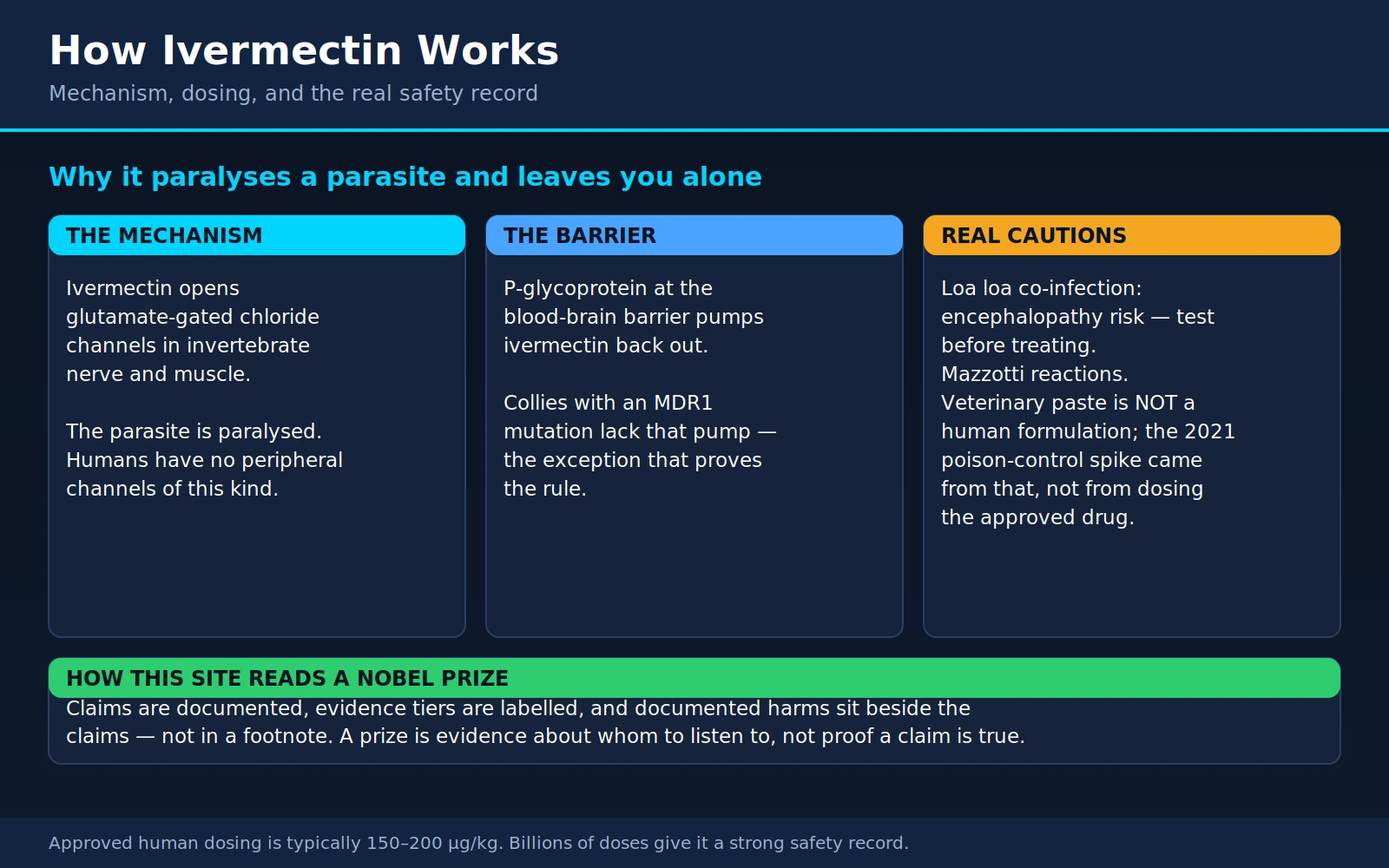
How can one molecule paralyze a worm, kill a mite, drop a mosquito — and leave the person swallowing it unbothered? The answer is one of pharmacology's cleanest stories: ivermectin attacks a molecular target that invertebrates have and you, with an asterisk we will explain, effectively do not. This article walks through that mechanism in plain language, then does what any honest safety page must: it presents the remarkable record — billions of doses over four decades — right beside the real, specific cautions. A drug this safe does not need its risks hidden, and a reader deciding anything deserves both columns of the ledger.
This is part of our Satoshi Ōmura collection. For how the molecule was found, see The Discovery of Ivermectin; for what it did to global disease, see River Blindness and Global Health.
Table of Contents
- Overview
- How Ivermectin Kills Parasites
- Why It Spares You
- The Collie That Proves the Rule
- Approved Uses and Typical Doses
- The Safety Record
- Real Caution #1: Loa loa
- Real Caution #2: The Mazzotti Reaction
- Real Caution #3: The Barn Is Not a Pharmacy
- Pregnancy, Small Children, and Frailty
- Drug Interactions
- Sensible Rules of Thumb
- Key Research Papers
- Connections
- Featured Videos
1. Overview
Three facts organize everything on this page. First: ivermectin's target is a chloride channel found in the nerve and muscle cells of invertebrates — worms, insects, mites — and not, in any drug-reachable way, in you. That is the selectivity. Second: the doses that treat human parasitic disease are tiny — roughly 150 to 200 micrograms per kilogram, a total of about 9 to 15 milligrams for most adults, often once — and formal studies have taken healthy volunteers to ten times that with no serious toxicity. That is the margin. Third: the serious harms on record cluster in three specific, well-understood situations — massive Loa loa co-infection, reactions to dying parasites in heavily infected people, and humans swallowing concentrated veterinary products. That is the fine print, and it is genuinely fine print, not a euphemism for hidden danger.
Understand those three and you understand why the same drug can be handed out by village volunteers to a hundred million people a year, and yet put a self-medicating adult in an intensive-care unit. The dose, the formulation, and the parasite load — not some mystery — decide which story you get.
2. How Ivermectin Kills Parasites
Nerve cells work by controlling the flow of charged atoms — ions — across their membranes. To fire, a nerve or muscle cell must be electrically "excitable"; to silence one, you open a door that lets negative chloride ions flood in, clamping the cell at rest. Invertebrates — roundworms, insects, mites, ticks — run much of their nerve-and-muscle wiring on a door mammals never installed: the glutamate-gated chloride channel (GluCl), identified molecularly in 1994 when Cully and colleagues at Merck cloned it from the laboratory roundworm C. elegans (the paper is in our list below).
Ivermectin binds this channel and does something more sinister than blocking it: it props it open, essentially permanently. Chloride pours in and stays in. The affected cells cannot fire at all. For the parasite this is a systems-level catastrophe: the pharynx — the muscular pump a worm feeds with — stops; body-wall muscles slacken into flaccid paralysis; and in female worms, the reproductive machinery stalls, which is why a single dose shuts down microfilariae production in river blindness for months even though it does not kill the long-lived adults. A starving, paralyzed, sterilized parasite is then the immune system's problem, and the immune system wins.
Two details sharpen the picture. The binding is effectively irreversible on a parasite's timescale — the molecule wedges into the channel's transmembrane machinery — which is part of why one annual dose can do a year's work. And the spectrum follows the target: creatures that run on GluCl (roundworms, insects, arachnids) are exquisitely vulnerable, while creatures that lack it — tapeworms and flukes among parasites, and vertebrates generally — are not. Ivermectin's famous gaps (no effect on flatworms; nothing on bacteria, and no meaningful antiviral action at survivable human doses, as the COVID article details) are not flaws. They are the mechanism, read backwards.
3. Why It Spares You
You have no glutamate-gated chloride channels for ivermectin to open — that is the headline. But an honest account owes you the asterisk: mammals do have a cousin channel, the GABA-A receptor, which also admits chloride and which very high concentrations of ivermectin can potentiate. So why doesn't a normal dose make humans wobbly, sedated, or worse?
Because of geography. Your GABA receptors live almost entirely behind the blood–brain barrier, and that barrier is not just a wall but an active pumping station. Its workhorse is a protein called P-glycoprotein (P-gp, the product of the MDR1/ABCB1 gene), whose job is to grab foreign molecules and throw them back into the bloodstream. Ivermectin happens to be one of P-gp's favorite substrates. Every molecule that drifts toward your brain gets escorted out. The parasite has no such doorman guarding its nervous system — a second, independent layer of selectivity stacked on the first.
The proof is an elegant knockout experiment (Schinkel and colleagues, Cell, 1994, below): mice engineered to lack the P-gp pump became roughly a hundredfold more sensitive to ivermectin, with the drug accumulating in their brains. Same molecule, same doses — remove the doorman, and a comfortable drug becomes a dangerous one. Which brings us to the dogs.
4. The Collie That Proves the Rule
Veterinarians knew something strange about collies long before anyone knew why: ordinary antiparasitic doses of ivermectin that any Labrador shrugs off could send some collies into tremors, coma, even death. In 2001, Katrina Mealey's group found the answer, and it is the P-gp story wearing fur: a substantial fraction of collie-lineage dogs — collies, Australian shepherds, Shelties, and related herding breeds — carry a deletion mutation in the MDR1 gene. Their blood–brain barrier has no working ivermectin pump. The drug walks into their brains and opens the chloride doors it can never reach in yours.
Veterinary medicine responded with genetic testing and the memorable rule of thumb "white feet, don't treat" (imperfect, but it saved dogs while tests spread). Note the reassuring flip side: even most MDR1-mutant dogs tolerate the microscopic 6 µg/kg dose in monthly heartworm preventives — the poisonings involved the far larger doses used against mange, or livestock products licked up in barnyards.
Why give a dog story a whole section on a human health page? Because it is the exception that proves the safety mechanism. Humans essentially never lack P-gp the way MDR1-mutant collies do — while rare variants subtly alter pump efficiency, no human population has the collie's broken barrier. But the collie shows you, in one image, what stands between a safe dose and a toxic one: not luck — a pump. It also explains rationally why stacking huge doses, or co-taking strong P-gp-inhibiting drugs, erodes a margin most people never knew they were relying on. Respect for a drug's mechanism is the adult form of trust in it.
5. Approved Uses and Typical Doses
Human ivermectin (tablets of 3 mg in the US) has a short, specific approved list, plus well-established uses beyond it:
- Strongyloidiasis — FDA-approved; typically 200 µg/kg once, often repeated; the drug of choice. See our practical guide: Ivermectin for Strongyloides.
- Onchocerciasis (river blindness) — FDA-approved; 150 µg/kg once, repeated every 6–12 months; kills microfilariae and suppresses their production, though not the adult worms.
- Scabies — standard worldwide though technically off-label in the US: 200 µg/kg on days 1 and 8 (the second dose catches mites hatched from eggs, which the drug does not kill). Crusted scabies uses multi-dose schedules plus topical treatment.
- Lymphatic filariasis — annual mass-treatment dosing in combination with albendazole (and DEC in triple-therapy settings), per WHO programs.
- Head lice — oral (off-label) for resistant cases; a topical 0.5% lotion is FDA-approved and now over the counter.
- Rosacea — 1% cream (Soolantra), FDA-approved, targeting Demodex mites and inflammation.
For a 70-kg (154-lb) adult, 200 µg/kg is 14 mg — about five small tablets, once. The label says take it on an empty stomach with water; note for context that a fatty meal roughly doubles absorption, one of several details that mattered in the COVID dosing debates. The practical points patients actually ask about: it is generic and inexpensive; a single-dose course is common; and "one dose treats it" is true of several of its indications, which is why it suits mass campaigns so well.
6. The Safety Record
Start with exposure, because no other modern drug has a denominator like this: through the Mectizan Donation Program and national campaigns, ivermectin has been given billions of times since 1987, mostly in places with minimal medical backup, mostly by trained villagers — a deployment model that would be unthinkable for a drug with meaningful routine toxicity. At approved doses in people without heavy parasite loads, side effects run mild and infrequent: headache, dizziness, nausea, loose stools, itch. The 2002 dose-escalation study by Guzzo and colleagues (below) is the formal anchor: healthy volunteers took up to 2,000 µg/kg — ten times the standard dose — with no serious adverse events and no detectable neurotoxicity (the investigators even tracked pupil size as a sensitive CNS marker). A 2020 systematic review of higher-than-approved dosing (Navarro et al., below) reached the same conclusion across trials.
Honesty requires the other column, and it has three entries, each with its own section below: the Loa loa encephalopathy problem, the Mazzotti reaction in heavily infected patients, and self-poisoning with veterinary formulations. Beyond those, pharmacovigilance work (Chandler 2018, below) has flagged rare reports of serious neurological events even outside the classic risk settings — worth knowing, vanishingly uncommon against the denominator, and plausibly involving drug interactions or unusual barrier genetics in some cases.
The summary a fair-minded clinician would sign: at human doses, in human formulations, without massive Loa loa co-infection, ivermectin is one of the best-tolerated prescription drugs in existence — and none of those italicized qualifiers is optional.
7. Real Caution #1: Loa loa
The one truly grave danger on ivermectin's record involves a parasite it was never aimed at. Loa loa, the African eye worm, coexists with river blindness across parts of Central Africa, especially Cameroon and neighboring countries. Some infected people carry staggering loads of Loa microfilariae — tens of thousands per milliliter of blood — usually with few symptoms. Give such a person ivermectin and the mass die-off can precipitate encephalopathy: confusion, collapse, coma, sometimes death, likely from dying microfilariae and inflammatory debris obstructing small brain vessels. The syndrome surfaced during mass campaigns in Cameroon in the 1990s; the Gardon/Boussinesq reports below did the painful work of defining it and its threshold — risk rises steeply above roughly 30,000 microfilariae per milliliter.
What matters as much as the risk is what global health did about it: counted first, then treated. Risk-mapping (the RAPLOA surveys) flagged co-endemic zones, and a field-ready innovation closed the loop — the LoaScope, a smartphone-based microscope that counts Loa microfilariae from a finger-prick in minutes. The landmark "test-and-not-treat" campaign in Cameroon (Kamgno et al., NEJM 2017, below) screened over 16,000 people, withheld ivermectin from the small high-count minority, treated the rest — and recorded no serious neurologic events. That is what respecting a drug's one grave danger looks like at scale, and it is why onchocerciasis elimination continues even in Loa country.
For readers outside Central Africa the practical relevance is essentially nil — you cannot have this complication without heavy Loa loa infection — but we give it a full section because a safety page that buried the drug's worst-case scenario would forfeit the right to be believed about the rest.
8. Real Caution #2: The Mazzotti Reaction
The second caution is subtler and, once understood, oddly reassuring: the most common significant reactions to ivermectin are caused not by the drug touching you but by what it does to the parasites you carry. When microfilariae die in the skin and eyes, the immune system mounts a cleanup response — the Mazzotti reaction: intensified itching, rash, fever, muscle and joint aches, tender swollen lymph nodes, occasionally low blood pressure and, in onchocerciasis, transient eye irritation. Its intensity tracks the parasite load, not the milligrams: heavily infected patients react more, lightly infected patients often not at all, and someone with no such parasites has nothing to Mazzotti with.
This is the same class of phenomenon as the Jarisch–Herxheimer reaction after antibiotics for syphilis or Lyme disease — a die-off response, familiar to any clinician treating heavy infections (and note that ivermectin's version is far gentler than what the older drug DEC provoked, which is precisely why ivermectin replaced it, as told in the river blindness article). Two honest corollaries follow. For treated patients: reactions in the first day or two usually signal the drug working against a real burden, are managed supportively, and fade. And for wellness culture: die-off symptoms require a die-off — someone with no parasitic infection who feels ill after self-dosing is experiencing side effects or something else entirely, and "that's just the parasites dying" is not an explanation, it is a slogan wearing one.
9. Real Caution #3: The Barn Is Not a Pharmacy
The third caution is entirely modern and entirely avoidable. During 2021, as ivermectin became a COVID-19 cause célèbre and prescriptions grew hard to obtain, some people turned to the farm-supply store. US poison-control centers logged a multi-fold spike in ivermectin exposure calls in mid-2021, health departments issued alerts as a large share of cases traced to livestock formulations, and the Oregon case series published in the New England Journal of Medicine (Temple et al., below) put faces on it: confused, ataxic, hallucinating patients, several in intensive care — predominantly after veterinary products or aggressive multi-day self-dosing.
The arithmetic explains everything. Veterinary ivermectin is packaged for animals weighing as much as a small car. A single tube of 1.87% horse paste, sized to deworm a 550–600 kg horse, contains on the order of 110 mg of ivermectin — roughly eight adult human doses in one squeeze — with dosing marks calibrated in hundreds of pounds of horse. Cattle "pour-on" products are concentrated liquids meant for skin application to cattle, in vehicles never tested for human ingestion, and injectable stock solutions are more concentrated still. People took these repeatedly, on protocols traded online, sometimes alongside sedating medications — and delivered themselves exactly the sustained high exposures that erode the P-gp margin described above. The resulting toxicity (nausea, visual disturbance, confusion, stumbling, seizures, coma in the worst cases) is not mysterious; it is the mechanism, obtained the hard way.
The clean way to say it: the human tablet at human doses is among the safest drugs known; the veterinary shelf is a different product, a different concentration, and a different risk universe. If a clinician prescribes ivermectin for a real indication, take it with confidence. If a forum recommends the farm store, close the tab.
10. Pregnancy, Small Children, and Frailty
Three populations get a genuine "not yet" or "not routinely" — from data limits rather than known harm:
- Pregnancy. Mass campaigns exclude pregnant women as a precaution, so controlled data are limited. Reassuringly, follow-ups of women treated before their pregnancies were recognized — including recent analyses of inadvertent periconception exposure from large trials — have not shown a clear signal of harm; still, outside urgent need, treatment is generally deferred and decided case by case with a clinician.
- Small children. The classic cutoff excludes children under 15 kg (roughly under 33 lb) — historically justified by a possibly less mature blood–brain barrier and simple absence of trial data. Research programs (notably in scabies) have been working to extend evidence downward, but the label line stands.
- Severe liver disease and frail elders on many medications. Ivermectin is cleared by the liver (CYP3A4) and handled by P-gp; serious hepatic impairment and heavy polypharmacy both warrant individualized judgment rather than reflex dosing.
11. Drug Interactions
For a drug taken once or twice, ivermectin has a mercifully short interaction list, and its logic follows the two proteins you already know from this page:
- P-glycoprotein inhibitors — some drugs (certain azole antifungals like ketoconazole/itraconazole, some HIV protease inhibitors, ciclosporin, verapamil and cousins) partially disable the efflux pump that keeps ivermectin out of the brain, raising exposure. At standard single doses this rarely matters clinically, but it is the rational reason not to combine high-dose ivermectin with strong P-gp inhibitors casually — the collie lesson, in pharmacology form.
- CYP3A4 inhibitors — the same azoles and protease inhibitors, plus grapefruit in quantity, slow ivermectin's breakdown; the overlap with the P-gp list is large, and the González Canga review below covers the details.
- Warfarin — scattered case reports describe INR elevation (blood thinned further than intended) after ivermectin; anyone on warfarin should simply mention ivermectin to their prescriber and, if treated, keep routine INR monitoring current.
- Sedatives and alcohol — not a formal interaction at normal doses, but in the overdose setting CNS depressants compound the picture; the 2021 case series repeatedly featured such combinations.
12. Sensible Rules of Thumb
- Human formulation, human dose, real indication. Inside that triangle, ivermectin's safety record is about as good as pharmacology gets; outside it, you are volunteering for the exceptions.
- Single microgram-per-kilogram doses have a huge tested margin — ten times the standard dose passed formal safety study — which is exactly why genuine poisoning almost always involves concentrated veterinary products or days of stacked dosing.
- Feeling rotten shortly after treatment for a heavy worm burden is usually the parasites, not the drug — and feeling rotten after self-dosing with no parasites is the drug, not "die-off."
- From an endemic region and facing steroids, biologics, chemotherapy, or transplant drugs? Ask about strongyloidiasis screening or presumptive treatment first — the quietest life-saving fact on this page: details here.
- Tell your prescriber about warfarin and about strong P-gp/CYP3A4 inhibitors; skip the grapefruit binge around dosing day.
- Pregnant, nursing a child under 15 kg, or severely liver-impaired? The default is defer-and-discuss, not dose.
- And for COVID-19 — the evidence has its own full, honest page: Ivermectin and COVID-19. Safety was never the core problem at prescription doses; efficacy was.
13. Key Research Papers
- Cully DF, Vassilatis DK, Liu KK, et al. Cloning of an avermectin-sensitive glutamate-gated chloride channel from Caenorhabditis elegans. Nature 1994;371(6499):707-11
- Schinkel AH, Smit JJ, van Tellingen O, et al. Disruption of the mouse mdr1a P-glycoprotein gene leads to a deficiency in the blood-brain barrier and to increased sensitivity to drugs. Cell 1994;77(4):491-502
- Mealey KL, Bentjen SA, Gay JM, Cantor GH. Ivermectin sensitivity in collies is associated with a deletion mutation of the mdr1 gene. Pharmacogenetics 2001;11(8):727-33
- Guzzo CA, Furtek CI, Porras AG, et al. Safety, tolerability, and pharmacokinetics of escalating high doses of ivermectin in healthy adult subjects. J Clin Pharmacol 2002;42(10):1122-33
- Navarro M, Camprubí D, Requena-Méndez A, et al. Safety of high-dose ivermectin: a systematic review and meta-analysis. J Antimicrob Chemother 2020;75(4):827-834
- González Canga A, Sahagún Prieto AM, Diez Liébana MJ, et al. The pharmacokinetics and interactions of ivermectin in humans — a mini-review. AAPS J 2008;10(1):42-6
- Gardon J, Gardon-Wendel N, Demanga-Ngangue, et al. Serious reactions after mass treatment of onchocerciasis with ivermectin in an area endemic for Loa loa infection. Lancet 1997;350(9070):18-22
- Boussinesq M, Gardon J, Gardon-Wendel N, Chippaux JP. Clinical picture, epidemiology and outcome of Loa-associated serious adverse events related to mass ivermectin treatment of onchocerciasis in Cameroon. Filaria J 2003;2 Suppl 1:S4
- Kamgno J, Pion SD, Chesnais CB, et al. A Test-and-Not-Treat Strategy for Onchocerciasis in Loa loa-Endemic Areas. N Engl J Med 2017;377(21):2044-2052
- Chandler RE. Serious Neurological Adverse Events after Ivermectin — Do They Occur beyond the Indication of Onchocerciasis? Am J Trop Med Hyg 2018;98(2):382-388
- Temple C, Hoang R, Hendrickson RG. Toxic Effects from Ivermectin Use Associated with Prevention and Treatment of Covid-19. N Engl J Med 2021;385(23):2197-2198
- Crump A, Ōmura S. Ivermectin, 'wonder drug' from Japan: the human use perspective. Proc Jpn Acad Ser B Phys Biol Sci 2011;87(2):13-28
Live PubMed Searches
- Ivermectin chloride-channel mechanism
- Ivermectin and P-glycoprotein
- High-dose ivermectin safety
- Loa loa encephalopathy
- Mazzotti reaction
- Veterinary-formulation toxicity in humans
Connections
- Satoshi Ōmura Hub — the discoverer, the Nobel, and the whole story in brief
- The Discovery of Ivermectin — where this mechanism was stumbled upon before it was understood
- River Blindness and Global Health — the diseases these doses defeated
- The COVID-19 Controversy — why in-vitro concentrations became the crux of a global argument
- Beyond Ivermectin — Ōmura's other molecules and their mechanisms
- William C. Campbell — co-laureate; his team connected molecule to mechanism to medicine
- All Notable Doctors
- Parasites & Parasitic Diseases — the site's full section on ivermectin's real targets
- Ivermectin for Strongyloides — dosing, screening before steroids, what to expect
- Ivermectin and Acanthamoeba — an off-label question examined honestly
- Cyclospora and the Ivermectin Question — a parasite outside ivermectin's spectrum: it does NOT treat Cyclospora
- Tu Youyou — artemisinin's very different mechanism against a very different parasite
- Antiparasitic Remedies — the broader toolbox, natural and pharmaceutical