Vestibular Migraine
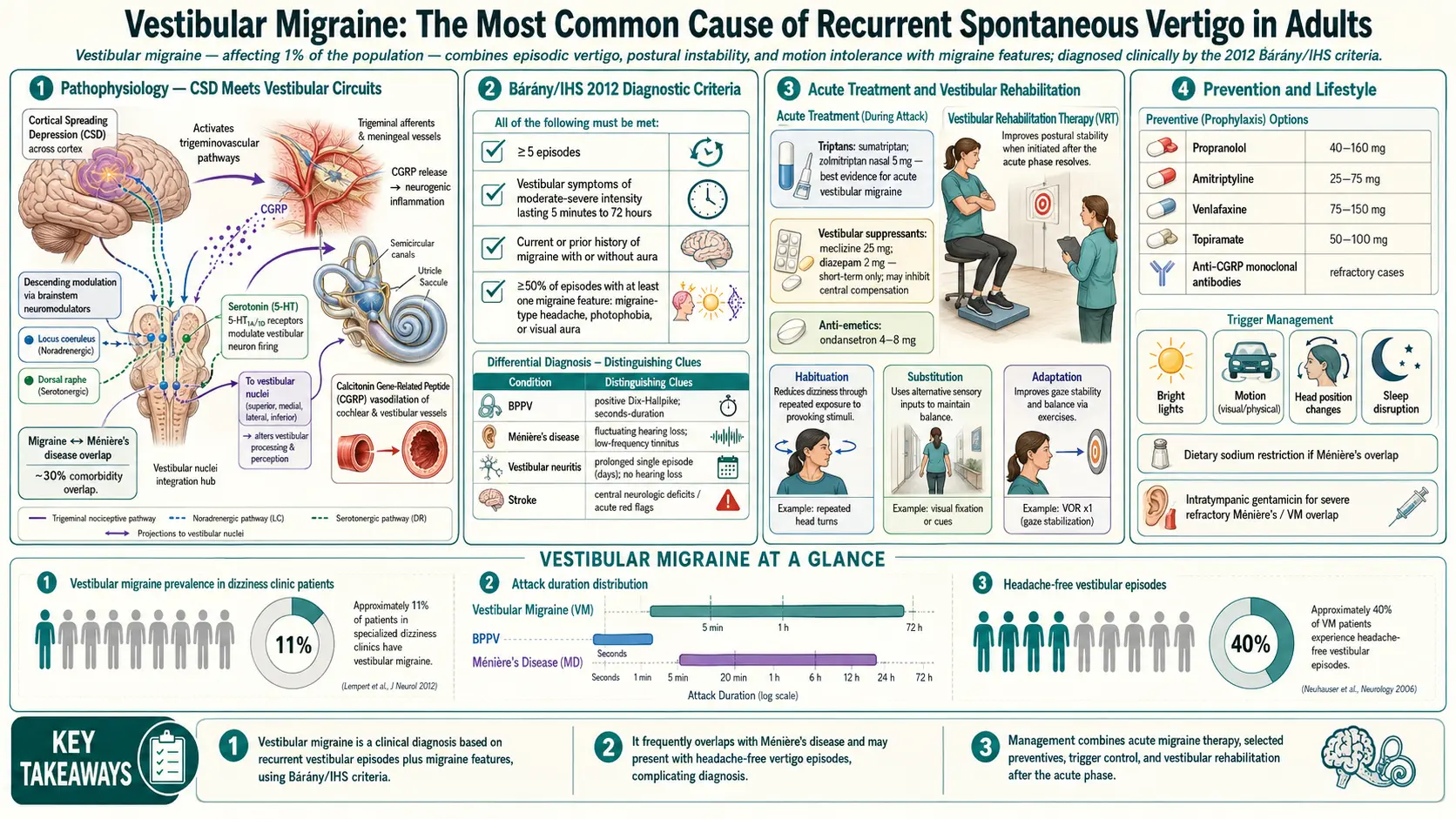
Table of Contents
- What Vestibular Migraine Is
- How Common — and How Often Missed
- The Official Criteria (Bárány & ICHD-3)
- What the Attacks Actually Feel Like
- Attacks Without Head Pain
- What Else It Could Be
- Testing — What to Expect
- Stopping an Attack in Progress
- Preventive Medications
- Vestibular Rehabilitation Therapy
- Visual Motion Desensitization
- Triggers and Daily Habits
- When PPPD Shows Up Too
- The POTS Overlap Trap
- Key Research Papers
- Connections
- Featured Videos
What Vestibular Migraine Is
Vestibular migraine is the dizzy cousin of the classic headache. Instead of — or sometimes in addition to — a throbbing one-sided head pain, the migraine brain generates episodes of vertigo, unsteadiness, and motion intolerance that can last anywhere from five minutes to three days. If you have ever spent an afternoon convinced the room was pitching like a boat while your partner insisted the room was perfectly still, you know the feeling. It is not an ear problem. It is not anxiety. It is a migraine attack that decided to express itself through the balance system instead of the pain system.
The condition has been under the medical radar for decades. Most patients go through two or three ENTs, a cardiologist, and a psychiatrist before a neurologist finally puts the label on it. That matters, because once it has a name, it has a treatment playbook — and most of it is borrowed straight from classic migraine management.
How Common — and How Often Missed
Vestibular migraine affects roughly 1% of the adult population over a lifetime, which makes it the most common neurological cause of recurrent spontaneous vertigo. In specialty dizziness clinics it accounts for about 9% of all patients walking through the door — more than Meniere's disease and more than BPPV in some case series.
Despite being common, it is massively under-diagnosed. The 2001 Neuhauser population study in Germany showed that fewer than 20% of people meeting formal criteria had ever received the correct diagnosis from a physician. The usual fate is a label of "anxiety," "inner ear infection," "chronic sinus problem," or simply "we can't find anything wrong with you." The average patient waits years for a correct answer.
Women are affected roughly three times more often than men, and the peak age of onset clusters in the thirties and forties — often in people who had classic migraine as teenagers, lost the headaches for a decade, and now have dizziness instead. Many patients also have a first-degree relative with migraine.
The Official Criteria (Bárány & ICHD-3)
In 2012 the Bárány Society (the international vestibular-research body) and the International Headache Society jointly published formal diagnostic criteria. They are now embedded in the International Classification of Headache Disorders, 3rd edition (ICHD-3). A diagnosis of definite vestibular migraine requires:
- At least five episodes of vestibular symptoms of moderate or severe intensity.
- Each episode lasting between 5 minutes and 72 hours.
- A current or prior history of migraine with or without aura, by ICHD criteria.
- During at least 50% of the episodes, at least one migraine feature: a migraine-type headache (one-sided, throbbing, moderate-severe, worsened by activity), photophobia and phonophobia, or a visual aura.
- Symptoms not better explained by another vestibular or headache disorder.
The "50% of episodes" rule is what trips up so many patients. You do not need headache with every attack. You just need migraine features with at least half of them — and the features can be any combination of headache, light sensitivity, sound sensitivity, or visual aura. There is also a looser "probable vestibular migraine" category for patients who meet some but not all points. Both categories respond to the same treatments.
What the Attacks Actually Feel Like
Vestibular migraine does not look like one thing. Different attacks in the same person can feel completely different. The common varieties:
- Internal vertigo. A sensation that you are spinning, tilting, rocking, or floating even though you are sitting still. Often described as "being on a boat" or "walking on a trampoline."
- External vertigo. The room spins around you. Less common in vestibular migraine than in BPPV or Meniere's, but it happens.
- Positional vertigo. Symptoms triggered or worsened by head position changes — rolling over in bed, looking up to a shelf, tilting to tie a shoe.
- Motion sensitivity. Car rides, elevators, escalators, and walking on uneven ground set off symptoms. Many patients describe feeling "seasick on land."
- Visual motion intolerance. Grocery-store aisles, scrolling on a phone, busy wallpaper patterns, optical-flow scenes in movies, or driving in the rain all trigger dizziness. This is one of the most specific features.
- Imbalance and gait unsteadiness. A sense of veering, needing to touch walls, or "walking drunk."
- Non-spinning dizziness. Lightheadedness, woozy-head, cognitive fog, and the sense that your brain is running through syrup.
Attacks last anywhere from 5 minutes to 72 hours. Roughly a third of patients have short attacks (minutes to a few hours), a third medium (several hours to a day), and a third longer multi-day events. Between attacks most people feel completely normal — although a meaningful subset develop persistent low-grade dizziness that becomes its own problem (see PPPD).
Attacks Without Head Pain
Here is the single most important fact for under-diagnosed patients: in at least 30% of vestibular-migraine attacks there is no headache at all. Some patients go years with dizzy spells and never have a simultaneous headache, which is why ENTs, cardiologists, and psychiatrists keep striking out — nobody connects the dots to migraine.
What tips it off in headache-free attacks is the other migraine features: light sensitivity that makes you want to close the blinds, sound sensitivity that makes normal conversation feel like an assault, visual aura (zigzag lines, shimmering spots, tunnel vision), food cravings or aversions, nausea, and a post-attack "migraine hangover" of fatigue and foggy thinking for a day or two afterward. If any of those travel with your dizzy spells, vestibular migraine is the diagnosis to push your clinician to consider.
What Else It Could Be
Before settling on vestibular migraine, a good workup rules out the look-alikes:
- BPPV (benign paroxysmal positional vertigo). Loose crystals (otoconia) in the inner ear cause brief, intense spinning with specific head positions — usually rolling over in bed or looking up. Attacks last under a minute and are reliably triggered. The Dix-Hallpike maneuver at the bedside diagnoses it, and an Epley maneuver fixes it in one or two visits. BPPV can coexist with vestibular migraine — treat both.
- Meniere's disease. Episodes of vertigo lasting 20 minutes to 12 hours, accompanied by low-frequency hearing loss, ear fullness, and tinnitus. An audiogram during or shortly after an attack shows the characteristic low-frequency sensorineural hearing loss that vestibular migraine does not. See the vertigo and Meniere's page for the full breakdown.
- PPPD (persistent postural-perceptual dizziness). A chronic, daily dizziness triggered by upright posture, self-motion, and visual motion, lasting three months or longer. Often develops after a vestibular-migraine attack, a concussion, or a vestibular-neuritis episode. PPPD and vestibular migraine commonly coexist.
- Posterior-circulation TIA or stroke. Sudden-onset vertigo with additional neurological symptoms (double vision, slurred speech, numbness, weakness, trouble walking) that persist rather than come and go. This is an emergency. Isolated vertigo without other neurological features is rarely stroke, but new-onset severe vertigo in anyone over 60 with vascular risk factors warrants urgent imaging.
- Vestibular neuritis / labyrinthitis. A one-time, days-to-weeks episode of severe constant vertigo following a viral illness. It does not recur in the typical migraine pattern.
- Medication and alcohol effects. Many drugs cause dizziness. Review your medication list before blaming migraine.
Testing — What to Expect
Vestibular migraine is a clinical diagnosis. There is no blood test, no imaging finding, no electrophysiology result that confirms it. Testing is done mainly to rule out the mimics above. Expect some combination of:
- Audiogram (hearing test). Essential for excluding Meniere's disease. Vestibular migraine audiograms are typically normal; Meniere's shows low-frequency sensorineural hearing loss.
- VNG (videonystagmography). Records eye movements in response to positional changes, warm/cold water in the ears (caloric testing), and visual targets. Often normal between attacks in vestibular migraine; may show minor non-specific findings.
- VEMP (vestibular evoked myogenic potentials). Measures how the inner-ear otolith organs respond to sound. Usually normal in vestibular migraine; can help distinguish from Meniere's and superior canal dehiscence.
- Video head impulse test (vHIT). Rapid head turns with eye-tracking goggles check each of the six semicircular canals. Usually normal in vestibular migraine.
- MRI of the brain (with attention to posterior fossa). Ordered once to rule out structural causes — acoustic neuroma, Chiari malformation, multiple sclerosis plaques, or posterior-fossa tumors. Typically normal in vestibular migraine.
- ECG and orthostatic vitals. If the dizziness has a lightheaded flavor that happens on standing, check for orthostatic hypotension or POTS before assuming migraine.
The frustrating and liberating truth: most of these tests come back normal. That is the diagnostic signature. Normal ear testing plus a personal or family history of migraine plus episodic dizzy spells with migraine features equals vestibular migraine.
Stopping an Attack in Progress
Acute-attack treatment is the weakest part of the vestibular-migraine playbook. Evidence is thin and mostly extrapolated from headache migraine. What is commonly tried:
- Triptans (sumatriptan, rizatriptan, zolmitriptan). Evidence is modest. Some studies show meaningful vertigo relief when taken early in the attack; others show no difference from placebo. Worth trying if you already respond to triptans for classic migraines. Standard cautions apply — avoid with uncontrolled hypertension or coronary disease. See the triptans and gepants page.
- Anti-emetics. The most reliably helpful class. Promethazine (12.5–25 mg), ondansetron (4–8 mg), and prochlorperazine all reduce nausea and have mild vestibular-suppressant effect. They also help you sleep through the attack, which is often the fastest route to ending it.
- Meclizine (12.5–25 mg). An over-the-counter antihistamine with vestibular-suppressant properties. Works for many patients for short attacks. Do not take it daily long-term — chronic vestibular suppression blocks the brain's natural adaptation and can make you worse.
- NSAIDs. Naproxen or ibuprofen early in an attack sometimes aborts the cascade, particularly if headache is part of the picture.
- Rest in a dark, quiet room. Unglamorous but effective. Closing your eyes removes visual motion input and lets the vestibular system settle.
Gepants (rimegepant, ubrogepant) have not been formally studied in vestibular migraine but are used empirically in clinics. If triptans fail or are contraindicated, gepants are a reasonable next step.
Preventive Medications
If attacks are frequent (more than two to four per month), long, or disabling, a daily preventive is the high-yield intervention. The menu mirrors classic migraine preventives:
- Topiramate (25–100 mg daily, titrated up over weeks). Often the first choice. Can cause cognitive slowing, tingling, and weight loss.
- Propranolol (40–160 mg daily, divided or long-acting). A beta-blocker with strong migraine-prevention evidence. Useful if you also have anxiety or high blood pressure. Watch for fatigue and lower heart-rate tolerance in exercise.
- Amitriptyline or nortriptyline (10–50 mg at night). Tricyclic antidepressants at low doses. Helpful if sleep or comorbid tension-type headache is part of the picture.
- Venlafaxine (37.5–150 mg daily). An SNRI that has specific evidence in vestibular migraine and is a good choice when anxiety or depression coexist.
- Flunarizine (5–10 mg at night). A calcium-channel blocker that is first-line in Europe but not available in the US. If you live outside the US, ask about it — it has some of the best vestibular-migraine evidence of any preventive.
- CGRP monoclonal antibodies (erenumab, fremanezumab, galcanezumab) and gepants. Originally studied in classic migraine; small series suggest benefit in vestibular migraine as well. See the CGRP inhibitors page.
- Supplements. Magnesium (400 mg glycinate daily), riboflavin (400 mg daily), and Coenzyme Q10 (100 mg three times daily) have reasonable evidence in migraine generally. See the magnesium and riboflavin page.
Plan on an eight-to-twelve-week trial of any preventive at an adequate dose before judging whether it works. Switching too early is the most common reason preventives "fail." Also keep a headache/dizziness diary during trials — the signal is often clearer in retrospect than day to day.
Vestibular Rehabilitation Therapy
If medications are half the answer, vestibular rehabilitation therapy (VRT) is the other half — and it is routinely under-prescribed. VRT is a structured physical-therapy program delivered by a PT or audiologist trained in vestibular disorders. The goal is to teach your brain to recalibrate when the balance signals from the inner ear, the eyes, and the body (proprioception) disagree.
A typical program runs eight to twelve weeks, with in-person sessions once or twice weekly plus daily home exercises. The work falls into three buckets:
- Habituation exercises. Deliberately, repeatedly exposing yourself to the positions and motions that provoke dizziness, in small doses, so the brain eventually stops over-reacting. Example: the Cawthorne-Cooksey protocol, a graded sequence starting with simple eye movements in bed and progressing to standing, walking, bending, and ball-throwing while moving.
- Gaze stabilization. VOR-x1 and VOR-x2 exercises: staring at a thumb or a letter on the wall while turning your head side-to-side or up-and-down, gradually faster. Retrains the vestibulo-ocular reflex so the visual world stays stable when you move.
- Balance and gait training. Standing on foam, tandem walking, walking with head turns, eyes-closed balance work. Rebuilds the somatosensory and visual contributions that compensate when the vestibular system is glitchy.
The 2016 Alghadir meta-analysis found VRT produced clinically meaningful improvements in dizziness, balance, and quality of life across vestibular disorders, including vestibular migraine. The single strongest predictor of success is daily home practice — skipping the homework kills the effect. Ask for a referral specifically to a "vestibular-trained physical therapist" (not just any PT).
Visual Motion Desensitization
If grocery stores, scrolling phones, busy patterns, or driving in rain are triggers, a specific subset of VRT called visual motion desensitization helps. Therapists use moving optokinetic stripe patterns, VR headsets, or YouTube videos of train rides and grocery-store aisles. You watch, let the discomfort rise, and stay with it until it settles — building tolerance the way exposure therapy builds tolerance in anxiety.
A cheap at-home version: watch two minutes of a first-person rollercoaster video on YouTube with the volume off, once or twice a day, and stop before you get genuinely sick. Progress slowly. This is habituation, not punishment — pushing past severe symptoms backfires.
Triggers and Daily Habits
Vestibular-migraine triggers overlap almost completely with classic migraine triggers:
- Sleep. Both sleep deprivation and sleeping in trigger attacks. Aim for a consistent schedule — same bedtime and wake time seven days a week.
- Stress (and the let-down after stress). Saturday-morning and vacation-day attacks are classic.
- Dehydration and skipped meals. Steady water intake and regular meals matter more than any specific food.
- Hormonal shifts. Many women note flares around menstruation. See the menstrual-migraine page.
- Dietary triggers. Aged cheeses, red wine, cured meats, chocolate, MSG-heavy foods, and artificial sweeteners are common culprits but vary wildly by person. See the diet-triggers page for a structured elimination approach.
- Weather and barometric pressure changes. Real but unavoidable; note them in the diary so you can anticipate high-risk days.
- Visual overload. Long screen hours, fluorescent lighting, busy visual environments. Blue-light filters and breaks every 20–30 minutes help some patients.
- Caffeine. Steady moderate intake is fine; the problem is variability. Skipping your usual cup or doubling it both provoke attacks.
When PPPD Shows Up Too
Persistent postural-perceptual dizziness (PPPD) is a chronic, daily, non-spinning dizziness that often moves in after a vestibular-migraine attack and refuses to leave. The defining features are three months or more of daily symptoms, worse when upright, worse with self-motion, and worse in visually complex environments. The brain gets stuck in a high-alert balance-scanning mode and cannot stand down.
PPPD responds to a combination of SSRI or SNRI medication (sertraline, escitalopram, venlafaxine at migraine-preventive doses), vestibular rehabilitation with a focus on visual-motion desensitization, and cognitive behavioral therapy targeting the hypervigilance. Treating any underlying vestibular migraine at the same time matters — unchecked migraine attacks keep re-seeding the PPPD pattern.
If you have been told your dizziness is "anxiety" but you can articulate that you feel worse in big open stores and on escalators, push for a PPPD evaluation with someone who recognizes the syndrome.
The POTS Overlap Trap
This is the single most common mis-attribution in dizzy-patient land. POTS (postural orthostatic tachycardia syndrome) and vestibular migraine share enormous phenotypic overlap: both produce dizziness, fatigue, brain fog, exercise intolerance, and headache, and both disproportionately affect women in their thirties. Many patients have both. Some have only one but end up treated for the wrong one.
The distinguishing questions:
- Does standing up reliably make it worse within minutes? POTS, yes. Vestibular migraine, usually no.
- Does lying down quickly fix it? POTS, yes. Vestibular migraine, not particularly.
- Is the dizziness spinning or lightheaded? Vestibular migraine is usually spinning or rocking. POTS is usually lightheaded — the kind that precedes a faint.
- Does your heart race when you stand? A sustained ≥ 30 bpm increase within 10 minutes of standing (≥ 40 for teenagers) is the POTS criterion. Check it at home with a pulse oximeter or fitness watch.
- Do visual-motion environments (grocery stores, scrolling) make it worse? Strong vestibular-migraine signal.
- Does salt and fluid loading help? POTS, dramatically. Vestibular migraine, negligibly.
If both are present, treat both. Beta-blockers like propranolol are one of the lucky drugs that help each condition, which makes the decision tree less fraught. See the POTS subtypes page for how to tease apart the flavors of dysautonomia when the overlap is stubborn.
Key Research Papers
- Lempert T, et al. Vestibular migraine: diagnostic criteria. Bárány Society / International Headache Society consensus. J Vestib Res. 2012. — doi:10.3233/VES-2012-0453
- Neuhauser H, et al. The interrelations of migraine, vertigo, and migrainous vertigo. Neurology. 2001. — doi:10.1212/WNL.56.4.436
- Furman JM, et al. Vestibular migraine: clinical aspects and pathophysiology. Curr Neurol Neurosci Rep. 2013. — doi:10.1016/s1474-4422(13)70107-8
- Alghadir AH, et al. Efficacy of vestibular rehabilitation therapy: a systematic review and meta-analysis. Expert Rev Neurother. 2018. Find on PubMed
PubMed Topic Searches
For further reading, the following PubMed topic searches return current peer-reviewed work on vestibular migraine diagnosis, treatment, and comorbidities:
- PubMed: Vestibular migraine diagnosis and Barany criteria
- PubMed: Vestibular migraine preventive treatment
- PubMed: Vestibular migraine acute treatment with triptans
- PubMed: Vestibular rehabilitation therapy in migraine
- PubMed: Vestibular migraine and persistent postural-perceptual dizziness
- PubMed: Vestibular migraine versus Meniere's disease
- PubMed: Vestibular migraine and POTS overlap
- PubMed: Flunarizine for vestibular migraine
Connections
- Pain & Allergy
- POTS
- Migraine Overview
- POTS Subtypes
- Magnesium, Riboflavin, and Supplements
- Menstrual Migraine and Hormonal Triggers
- Diet Triggers and Elimination Protocol
- CGRP Inhibitors and Preventives
- Triptans and Gepants — Acute Treatment
- Vertigo and Meniere's Disease
- Chronic Migraine and Medication Overuse
- Aura and Visual Disturbances
- Mast Cell Activation Syndrome
- Chronic Fatigue Syndrome
- Dizziness
- Anxiety
- Magnesium
- Tinnitus
- Migraine in Pregnancy and Breastfeeding
- Headache — the head-pain symptom that is absent from at least 30% of vestibular-migraine attacks.