Low-Histamine Diet for MCAS
Your doctor said "go low-histamine" and handed you a photocopied list where half the items contradict the list you found online. Welcome to one of the most confusing diets in medicine. The good news: once you understand the two separate mechanisms at work — the histamine in your food and the histamine your own cells release in response to food — the contradictions resolve. This article is written for people reading it at the grocery store, bag of spinach in one hand and phone in the other, wondering whether to put it back.
A few ground rules before we start. A low-histamine diet is a short-term diagnostic tool, not a life sentence. Not every MCAS patient needs one. And the goal at the end is personalization — a customized food list that keeps out your trigger foods, not a permanent lockdown.
Table of Contents
- What Histamine Intolerance Actually Is
- The Two Food Categories You Have to Know
- High-Histamine Foods (The Avoid List)
- Histamine Liberators
- Low-Histamine / Safe Foods (The Allowed List)
- The Fresh-Is-Best, Leftovers-Are-Poison Rule
- DAO Enzyme Supplementation
- The 3-Phase Approach
- Why You Shouldn't Stay Strict Forever
- A Sample Low-Histamine Day
- Grocery Shopping & Cooking Tips
- Restaurant Survival
- Integration with Other MCAS Treatments
- Apps and Resources
- When to Work With a Registered Dietitian
- Key Research Papers
- Research Papers
- Connections
- Featured Videos
1. What Histamine Intolerance Actually Is
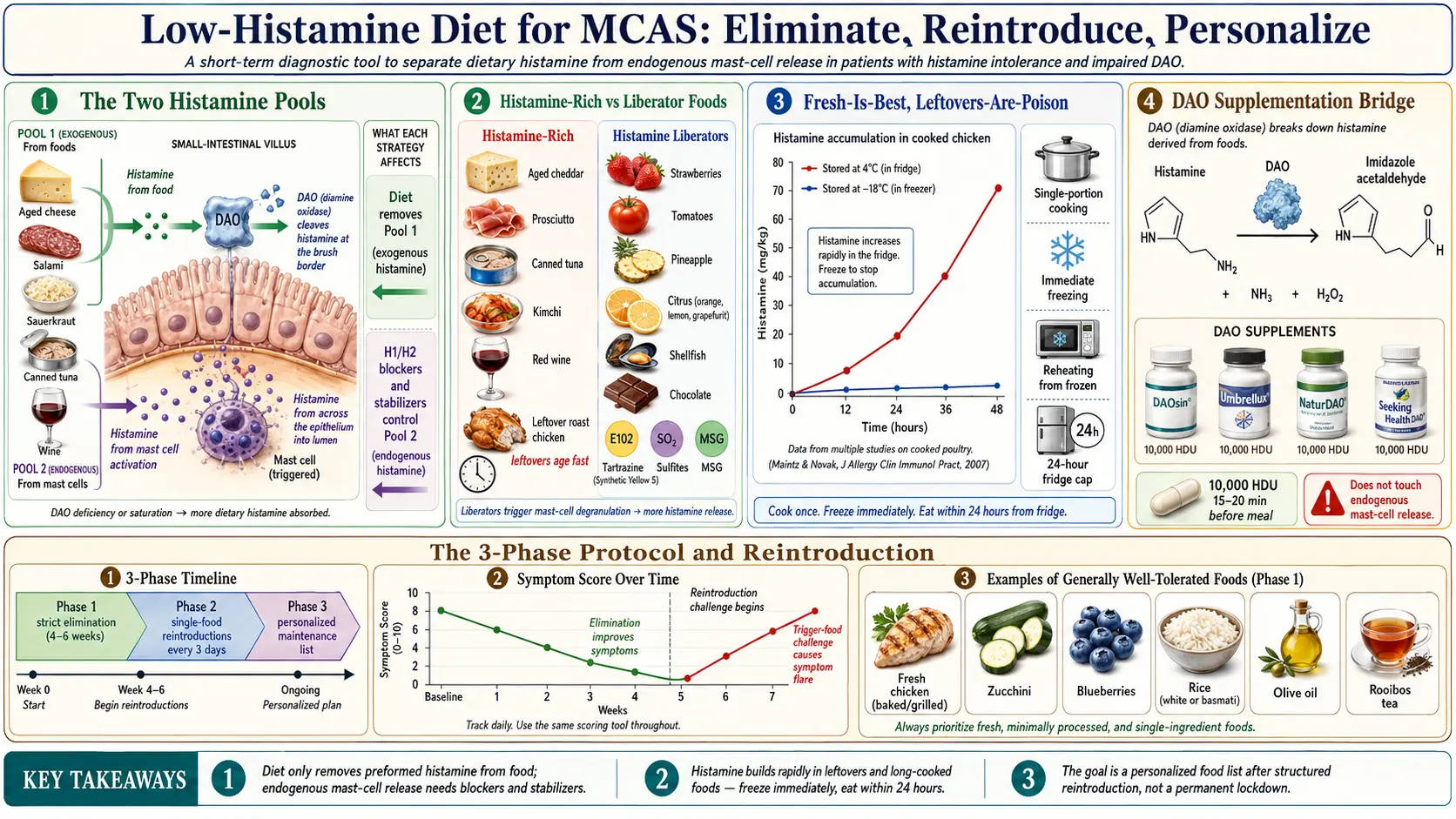
Histamine intolerance is not an allergy. It is a traffic-jam problem: too much histamine entering the body, too little being cleared, or your own cells dumping extra into the system. Three mechanisms collide at once in most MCAS patients.
- Exogenous histamine. Histamine that is already sitting in your food when you eat it. Bacteria produce it as food ages, ferments, or is cured. A fresh steak has almost none; a week-old deli slice can have a lot. This is the histamine a low-histamine diet is designed to remove.
- Endogenous histamine. Histamine your own mast cells release in response to triggers — stress, heat, infection, hormones, certain foods. This is the histamine your H1/H2 blockers and mast cell stabilizers are designed to control. Diet alone cannot touch this pool.
- Impaired DAO (diamine oxidase). DAO is the enzyme in your intestinal lining that breaks down ingested histamine before it reaches circulation. Many MCAS patients have genetically low DAO activity, or gut damage (SIBO, leaky gut, IBD) that knocks DAO down further. With low DAO, even small amounts of dietary histamine push you into symptoms.
Here is the honest truth: not all MCAS needs a strict low-histamine diet. Some patients react overwhelmingly to dietary histamine and feel dramatically better on the diet within a week. Others barely move the needle — their driver is non-food (mold, hormonal cycles, infections, stress) and no amount of dietary restriction helps. The only way to find out which camp you are in is to try it for four to six weeks and see.
2. The Two Food Categories You Have to Know
Every confusing "but that food is on both lists!" moment becomes obvious once you learn the two categories are separate mechanisms:
- Histamine-rich foods. Foods that physically contain preformed histamine. The histamine was built by bacteria during aging, fermenting, smoking, curing, or leftover storage. Examples: aged cheese, salami, canned tuna, sauerkraut, yesterday's chicken.
- Histamine liberators. Foods that contain little or no histamine themselves but provoke your own mast cells to release stored histamine. Examples: strawberries, tomatoes, pineapple, citrus, shellfish, chocolate, alcohol, certain food additives.
The confusion in most online lists comes from mixing these two mechanisms into one giant "avoid" column. For practical shopping, the distinction doesn't matter — both get removed in Phase 1 — but it matters enormously during reintroduction, because some people tolerate liberators fine and some do not.
3. High-Histamine Foods (The Avoid List)
Fermented Foods
- Sauerkraut, kimchi, pickles (brined)
- Yogurt, kefir, buttermilk, sour cream
- Kombucha, water kefir
- Miso, natto, tempeh
- Soy sauce, tamari, fish sauce, Worcestershire
Aged Cheeses
- Parmesan, Romano, aged cheddar, gouda, gruyere
- Camembert, brie, blue cheese, roquefort
- Anything labeled "aged," "cave-aged," or "reserve"
Cured or Processed Meats
- Salami, prosciutto, pepperoni, chorizo
- Ham, bacon, hot dogs, sausage (most)
- Deli-counter sliced turkey and roast beef
- Anything smoked, cured, or dry-aged
Fish & Seafood
- Canned tuna, canned sardines, canned anchovies
- Mackerel, herring, bonito
- Shellfish (shrimp, crab, lobster, mussels, clams) — doubles as a liberator
- Any fresh fish that has been out of the water more than a few hours — fish becomes high-histamine dramatically fast. Frozen-at-sea or flash-frozen is safer than "fresh" from a case that has been sitting since morning.
Alcohol
- All of it in Phase 1. Alcohol is both a direct histamine source (fermented) and a DAO inhibitor.
- Worst: red wine, champagne, beer (especially craft/unfiltered)
- Bad: white wine, rosé, cider
- Least bad (for reintroduction): clear distilled spirits (vodka, gin, tequila) with fresh, non-citrus mixers
Vinegars
- Balsamic, red wine, apple cider, distilled white vinegar
- Rice vinegar is more tolerable for some people
Cooking Methods & Storage
- Long-cooked or slow-cooker foods — histamine rises with cook time. An 8-hour beef stew is a histamine grenade even from fresh meat.
- Leftovers. Histamine continues to build in cooked food as it sits, even in the refrigerator. Yesterday's roast chicken can trigger a flare from food that was safe 18 hours earlier.
Canned & Jarred Vegetables
- Canned tomatoes, tomato paste, tomato sauce
- Olives, pickles, pickled peppers, jarred artichokes
Produce That Is Naturally High or Precursor-Rich
- Tomatoes (fresh and cooked)
- Spinach
- Eggplant
- Avocado (rises fast after cutting)
High-Histamine or Liberator Fruits
- Strawberries, bananas, pineapple, papaya, kiwi
- Citrus (oranges, grapefruit, lemons, limes)
- Pineapple contains bromelain, a known histamine releaser
Other High-Load Items
- Chocolate, cocoa, cacao
- Walnuts, cashews, peanuts (fresh almonds and pistachios are often tolerated)
- Energy drinks, pre-made smoothies, anything with "natural flavors"
4. Histamine Liberators (Don't Contain Histamine But Provoke It)
These foods are the landmines hiding in otherwise "healthy" choices. They don't show up on a histamine-content chart because they don't contain much histamine — they make your own mast cells release it.
- Strawberries, tomatoes, pineapple, citrus fruits
- Shellfish, egg white (especially raw)
- Chocolate, alcohol
- Food additives: tartrazine (yellow #5) and other artificial colors, benzoates (preservatives), sulfites (wine, dried fruit, shrimp), MSG and autolyzed yeast extract, nitrates/nitrites in cured meat
- Broadly: anything with a long ingredient list of artificial colors and flavors
If you have been eating "healthy" with a daily strawberry-spinach-citrus smoothie and still feeling awful, you have found the reason. That smoothie is three liberators and a histamine-rich vegetable in one glass.
5. Low-Histamine / Safe Foods (The Allowed List)
The list is shorter than the avoid list and that is demoralizing for about a week. After that, your palate adjusts and this becomes routine. Print this and take it to the store.
Proteins
- Fresh chicken and turkey (cooked and eaten within 24 hours of cooking)
- Grass-fed beef, cooked fresh (not aged, not dry-aged)
- Lamb, cooked fresh
- Fresh-caught or flash-frozen fish, cooked from frozen, eaten same day (cod, sole, haddock, fresh salmon handled correctly)
- Fresh eggs (yolks are better tolerated than whites)
Dairy (Individual Response Varies)
- Fresh butter, fresh cream
- Mozzarella, ricotta, cottage cheese, cream cheese (short-shelf-life cheeses)
- Many MCAS patients do better dairy-free regardless — lactose intolerance and casein sensitivity are common comorbidities. Try with and without.
Vegetables
- Zucchini, cucumber, summer squash
- Carrots, parsnips, beets (cooked fresh)
- Bell peppers (all colors), broccoli, cauliflower, brussels sprouts
- Kale, lettuces, arugula, bok choy, cabbage (fresh)
- Sweet potato, white potato, pumpkin, winter squash
- Onions, leeks, garlic (fresh, not jarred)
- Asparagus, green beans, snow peas
Fruits
- Apples, pears
- Blueberries
- Mangoes, watermelon, cantaloupe, honeydew
- Cherries, peaches, apricots, nectarines (fresh, in season)
- Grapes (fresh, not dried — raisins are high-histamine)
Grains
- Rice (white, brown, basmati, jasmine)
- Oats (rolled or steel-cut, not instant)
- Quinoa, amaranth, millet, buckwheat, teff
Fats
- Extra-virgin olive oil
- Coconut oil
- Ghee, fresh butter
Herbs & Spices
- Basil, oregano, thyme, rosemary, sage (fresh preferred)
- Parsley, cilantro, chives, dill
- Ginger, turmeric, cumin, coriander (ground fresh)
Beverages
- Water, sparkling water
- Freshly squeezed non-citrus juices (apple, pear, watermelon)
- Herbal teas: rooibos, chamomile, peppermint, ginger
- Freshly brewed coffee in moderation, if tolerated (coffee is a mild liberator for some)
6. The Fresh-Is-Best, Leftovers-Are-Poison Rule
This is the single most important behavioral change on the diet, and the one people underestimate. Histamine is built by bacteria on your food, and refrigeration slows that process but does not stop it. Freezing essentially does stop it.
- Cook just enough for one meal. A single chicken breast. One fillet of fish. One cup of rice.
- Freeze immediately anything you won't eat within 12 to 24 hours. Histamine does not form significantly below 0°C.
- Reheat from frozen, not from the fridge. Don't thaw in the refrigerator for days — that's just slow aging.
- Never eat leftovers that have sat in the fridge more than 48 hours. Many patients cut that to 24 hours. A few can't tolerate leftovers at all.
- Raw meat and fish should be very fresh — caught or butchered the same day is ideal. When shopping, ask the butcher or fishmonger what came in today.
Yes, this means more dishes, more cooking, and smaller portions prepared more often. It is genuinely more work. But the symptom difference between fresh-cooked chicken and day-old chicken is sometimes the entire diagnosis.
7. DAO Enzyme Supplementation
DAO supplements give your gut a topped-up dose of the enzyme that breaks down ingested histamine. They are a bridge, not a cure — useful for meals where you know you'll have some histamine exposure, like eating at a restaurant or a friend's house.
- Brands: DAOsin (European, porcine kidney-derived), Umbrellux DAO, NaturDAO (plant-based, pea-seedling-derived), Seeking Health DAO
- Dose: typically 10,000 HDU (1 to 2 capsules) taken 15 to 20 minutes before the meal
- Cost: roughly $40 to $80 per month at regular use
- What it does: degrades histamine in the gut lumen before absorption
- What it does NOT do: anything about endogenous mast cell release. If your mast cells are dumping histamine from stress or an infection, DAO won't help — that's what stabilizers and blockers are for.
8. The 3-Phase Approach
Like low-FODMAP for SIBO, low-histamine has a structure: eliminate, reintroduce, personalize. Skipping any phase — especially the second — is why so many people end up stuck on a permanently restrictive diet.
Phase 1 — Strict Elimination (4 to 6 weeks)
- Remove all high-histamine foods AND all liberators
- Apply the fresh-is-best rule rigorously
- Keep a daily symptom log: flushing, GI, headaches, brain fog, sleep, skin
- At 4 weeks: assess. If symptoms have improved significantly, diet is a lever for you. If symptoms haven't budged, your main driver is probably non-food.
Phase 2 — Reintroduction (2 to 4 weeks per category)
- Reintroduce one category at a time
- Day 1: small amount (1 strawberry, a few bites of cheese)
- Day 2: moderate amount
- Day 3: full serving
- Watch symptoms for a full 48 to 72 hours after the full serving — reactions can be delayed
- If clean: that category is personally fine, keep it in
- If reaction: pull it back out, wait until baseline, move to the next category
Phase 3 — Personalization (Your Forever Diet)
- A customized list that keeps out only your triggers
- Most MCAS patients ultimately tolerate many of the foods the Phase 1 avoid list forbade
- Periodic re-testing is fine — tolerance can change as mast cell activity settles
9. Why You Shouldn't Stay Strict Forever
Long-term strict low-histamine eating carries real costs that most patient groups don't talk about:
- Nutritional deficiencies: B12, magnesium, fiber, polyphenols, omega-3s (if you are avoiding most fish), calcium (if dairy-free)
- Worsened gut microbiome diversity: many of the excluded foods are fermented probiotics. A less diverse microbiome can paradoxically worsen immune tolerance, which is the opposite of what you want with MCAS.
- Food rigidity and disordered eating: after months of strict avoidance, normal foods start to feel dangerous. This is a documented risk. If food anxiety is growing, that's a signal to loosen up and bring in a dietitian.
- Social isolation: every meal with friends or family becomes a negotiation. Over time that costs relationships.
- It stops teaching you anything. Once you have identified your personal triggers, continued strictness on non-trigger foods gives you no further information.
The goal is personalization, not permanent restriction. If you are six months into strict Phase 1 and scared to reintroduce, that is the moment to work with a professional.
10. A Sample Low-Histamine Day
- Breakfast: steel-cut oats cooked fresh, topped with fresh blueberries, coconut milk, cinnamon
- Snack: fresh apple + a handful of pistachios
- Lunch: fresh chicken breast (cooked that morning), white rice, steamed broccoli, olive oil, fresh basil
- Snack: cucumber slices, carrot sticks, fresh ricotta (if tolerating dairy) or rice crackers
- Dinner: salmon fillet frozen at purchase, thawed just before cooking, pan-seared; roasted sweet potato; kale sauteed in olive oil and garlic
- Beverage: water, rooibos tea; a slice of fresh peach for dessert
That is a full day of protein, complex carbs, vegetables, healthy fats, and fiber — nutritionally complete, no major gaps, no histamine bombs.
11. Grocery Shopping & Cooking Tips
- Buy meat from an actual butcher, not the deli counter. Deli-counter prepackaged cuts are often days old and sliced by machines that process cured meats.
- Freeze fish and meat the moment you get home, even if you plan to cook it tomorrow. Thaw just before cooking.
- Prep-cook once a week in single-meal portions and freeze flat in zip bags. Label with the date.
- Batch-cooking can work — but only if you portion and freeze immediately, never refrigerate a big pot for a week.
- Home-cook almost everything. Restaurant food is usually high-histamine by definition: slow-cooked, marinated, aged, or full of additives.
- Avoid "natural flavors" on ingredient labels — the term legally covers many histamine liberators.
- Fresh herbs in pots on your windowsill pay for themselves. Basil, parsley, chives, cilantro.
12. Restaurant Survival
Eating out on a low-histamine diet is hard but doable. A template that works at most restaurants:
- Order: freshly grilled fish or chicken, plain rice or a plain baked potato, fresh steamed or grilled vegetables, olive oil and (if you tolerate it) a fresh lemon wedge on the side
- Skip: anything fermented, aged, marinated, smoked, slow-cooked, braised, or in a sauce (sauces are usually tomato, wine, or long-reduced stock)
- Skip the bread basket if it's sourdough or has been out for hours
- Pre-dose DAO 15 to 20 minutes before the meal if you're taking it
- Cuisines that are easier: Japanese (plain sashimi from a very fresh source, plain rice, steamed vegetables), simple grill houses, seafood restaurants at the source
- Cuisines that are harder: Italian, French, barbecue, Thai (fish sauce everywhere), delicatessens
13. Integration with Other MCAS Treatments
The diet is one lever, not the only one. It works best as part of a layered approach:
- Medications: a low-histamine diet reduces the exogenous load so your H1 and H2 blocker stacks have less to fight. Patients who combine both often get symptom control neither approach produced alone.
- Stabilizers: cromolyn and ketotifen target the endogenous side that diet can't touch.
- Natural adjuncts: quercetin, luteolin, vitamin C, and DAO support layer onto the diet without adding histamine.
- Non-food triggers: heat, stress, hormones, infections, mold — all unaffected by diet. If these are your main drivers, the diet will disappoint you.
14. Apps and Resources
- Food Intolerances app (Germany) — cross-references histamine, tyramine, salicylate, and sulfite ratings for thousands of foods. The most useful phone app in this space.
- SIGHI Food Compatibility List — the Swiss Interest Group for Histamine Intolerance publishes a free, comprehensive color-coded PDF food chart. The gold standard reference.
- Histamine, Intolerance & Health — book by registered dietitian Dr. Janice Joneja; the deepest clinical treatment of the topic in book form.
- Mast Cell 360 and The Low Histamine Chef — patient-facing blogs with recipes that fit the diet.
15. When to Work With a Registered Dietitian
Phase 1 you can usually manage alone with a good food chart. Phase 2 — the reintroduction — is genuinely hard to do well in isolation, because the reactions can be delayed, subtle, or overlapping with non-food flares. A dietitian can structure the reintro sequence, catch the patterns you miss, and keep an eye on nutritional adequacy.
Look for RDs with specific training in MCAS, histamine intolerance, or integrative/functional nutrition. A generalist dietitian who has never heard of DAO is not the right fit. The Academy of Nutrition and Dietetics and the Integrative and Functional Nutrition Academy (IFNA) both maintain searchable directories.
16. Key Research Papers
- Maintz L, Novak N. Histamine and histamine intolerance. Am J Clin Nutr. 2007;85(5):1185-1196.
- Comas-Basté O, et al. Histamine intolerance: the current state of the art. Nutrients. 2020;13(6):1743.
- Schnedl WJ, et al. Diamine oxidase supplementation improves symptoms in patients with histamine intolerance. Allergy Asthma Clin Immunol. 2020.
- Afrin LB, et al. Diagnosis of mast cell activation syndrome: a global "consensus-2". Diagnosis. 2020.
17. Research Papers
Curated PubMed topic searches of peer-reviewed literature on histamine intolerance, DAO, and MCAS diet. Each link opens a live PubMed query so you always see the most current studies.
- PubMed: Histamine intolerance diet
- PubMed: Diamine oxidase deficiency
- PubMed: Mast cell diet and histamine
- PubMed: Histamine liberator foods
- PubMed: Low-histamine diet and MCAS
- PubMed: Fermented foods and histamine content
- PubMed: DAO supplementation trials
- PubMed: SIGHI and histamine intolerance classification
Connections
- Neurology
- MCAS Overview
- H1/H2 Blocker Stacks
- Natural Mast Cell Stabilizers
- Triggers & Flare Management
- Cromolyn & Ketotifen
- Testing Guide
- Mediators & Symptom Map
- Hereditary Alpha-Tryptasemia
- POTS
- SIBO
- Alpha-Gal Syndrome
- Food Intolerance
- Elimination Diet
- Gut Healing
- Quercetin
- Low FODMAP Diet for IBS
- Diet Triggers and Elimination Protocol
- Hashimoto POTS MCAS Overlap