Psoriasis
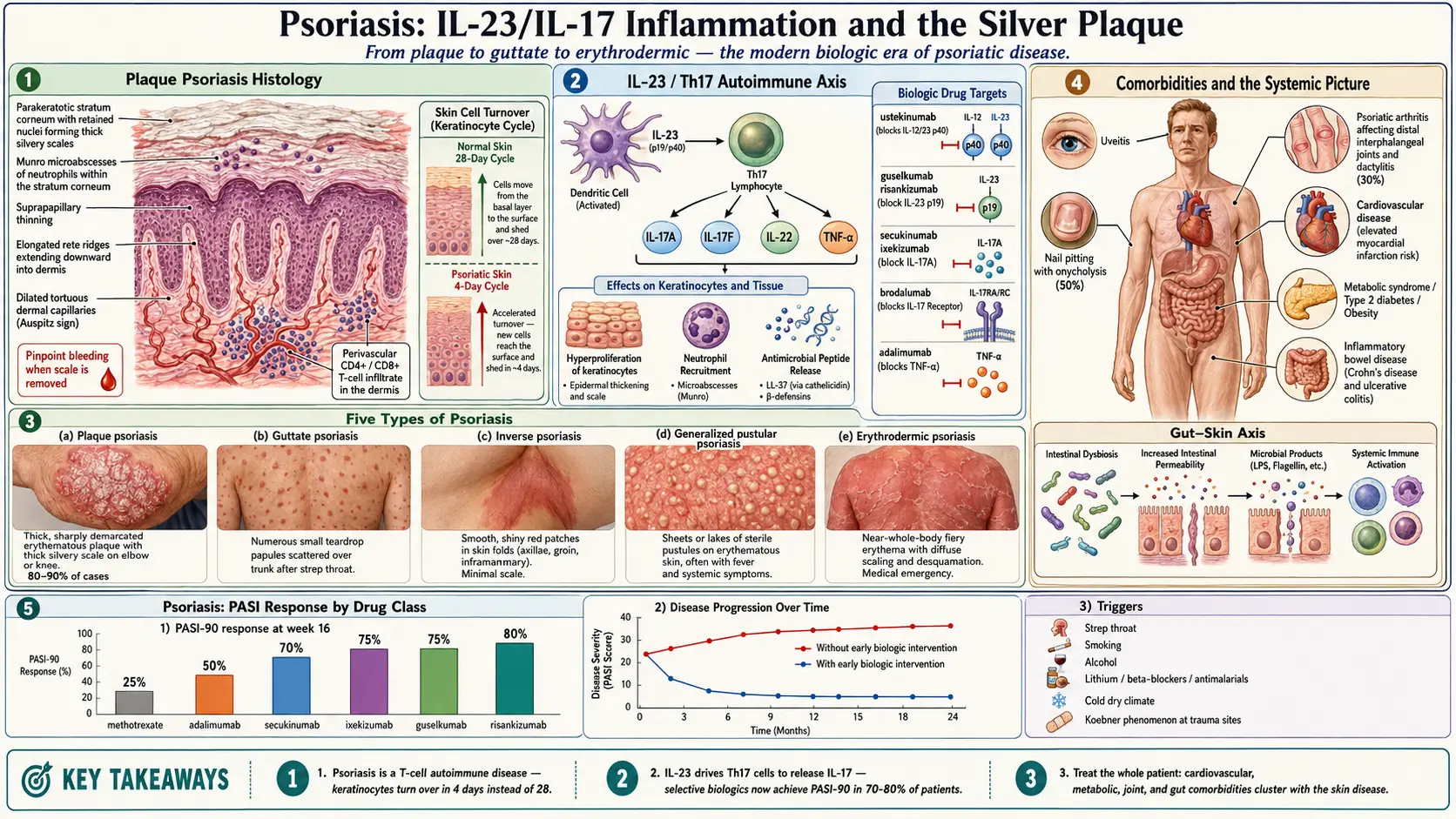
Table of Contents
- What is Psoriasis?
- Types of Psoriasis
- Symptoms of Psoriasis
- Causes and Risk Factors
- Diagnosis
- Treatment Options
- Prevention and Management Strategies
- Complications of Psoriasis
- Research Papers
- Connections
- Featured Videos
What is Psoriasis?
Psoriasis is a chronic autoimmune condition that causes rapid skin cell production, leading to scaling on the skin's surface. It is characterized by red, itchy, and scaly patches, most commonly appearing on the scalp, elbows, knees, and lower back. Psoriasis can be painful and may significantly impact the quality of life.
Types of Psoriasis
1. Plaque Psoriasis
- Most common type, affecting about 80-90% of people with psoriasis.
- Symptoms: Red patches with thick, silvery scales.
- Common areas: Elbows, knees, scalp, and lower back.
2. Guttate Psoriasis
- Characterized by small, drop-shaped spots on the skin.
- Often triggered by infections, such as strep throat.
- Common in children and young adults.
3. Inverse Psoriasis
- Affects skin folds such as under the breasts, groin, or armpits.
- Symptoms: Smooth, red patches of inflamed skin.
- Worsened by friction and sweating.
4. Pustular Psoriasis
- Characterized by white pustules surrounded by red skin.
- Can occur in localized areas, such as the hands and feet, or be more widespread.
5. Erythrodermic Psoriasis
- Rare and severe form that covers large areas of the body.
- Symptoms: Widespread, fiery redness of the skin with severe itching and peeling.
- Requires immediate medical attention due to potential complications.
Symptoms of Psoriasis
- Red patches of skin covered with thick, silvery scales
- Dry, cracked skin that may bleed
- Itching, burning, or soreness
- Thickened or ridged nails
- Swollen and stiff joints (in psoriatic arthritis)
Causes and Risk Factors
- Genetics: Family history increases the risk of developing psoriasis.
- Immune system dysfunction: Psoriasis is an autoimmune disorder where T cells mistakenly attack healthy skin cells.
- Triggers: Infections, stress, cold weather, smoking, heavy alcohol consumption, and certain medications.
Diagnosis
- Physical examination: A dermatologist can often diagnose psoriasis by examining the skin.
- Skin biopsy: A small sample of skin may be taken and examined under a microscope to confirm the diagnosis and rule out other conditions.
Treatment Options
- Topical treatments:
- Corticosteroids: Help reduce inflammation and relieve itching.
- Vitamin D analogs: Slows skin cell growth.
- Coal tar: Reduces scaling, itching, and inflammation.
- Phototherapy:
- UVB light therapy: Exposing the skin to ultraviolet light under medical supervision.
- PUVA therapy: Combines psoralen (a light-sensitizing medication) with UVA light.
- Systemic treatments:
- Oral medications: Such as methotrexate, cyclosporine, and retinoids.
- Biologics: Target specific parts of the immune system (e.g., adalimumab, etanercept).
- Lifestyle changes:
- Moisturizing: Regular use of moisturizers helps manage dryness and reduce scaling.
- Avoid triggers: Identify and avoid known triggers like stress and certain foods.
- Healthy diet and exercise: Supports overall skin health and reduces inflammation.
Prevention and Management Strategies
- Manage stress: Techniques like yoga, meditation, and deep breathing can help reduce flare-ups.
- Maintain a healthy lifestyle: A balanced diet and regular exercise may help reduce inflammation.
- Keep skin moisturized: Use fragrance-free lotions and creams to prevent dryness.
- Avoid smoking and limit alcohol: Both can trigger or worsen symptoms.
Complications of Psoriasis
- Psoriatic arthritis: A condition causing joint pain, stiffness, and swelling.
- Increased risk of other conditions: Such as cardiovascular disease, type 2 diabetes, and obesity.
- Eye conditions: Conjunctivitis and uveitis can be more common in individuals with psoriasis.
- Emotional impact: Psoriasis can lead to depression, anxiety, and low self-esteem due to its visibility and chronic nature.
10. References & Research
Historical Background
Psoriasis was first clearly distinguished from leprosy by the Viennese dermatologist Ferdinand von Hebra in 1841. The disease had been confused with leprosy for centuries, and the term "psoriasis" derives from the Greek "psora" meaning "itch." Robert Willan provided early clinical descriptions in 1809. The autoimmune, T-cell-mediated nature of psoriasis was established in the 1980s and 1990s through the work of James Krueger and colleagues, revolutionizing treatment with the development of biologic therapies.
Key Research Papers
- Boehncke WH, Schon MP. Psoriasis. Lancet. 2015;386(9997):983-994.
- Nestle FO, Kaplan DH, Barker J. Psoriasis. N Engl J Med. 2009;361(5):496-509.
- Menter A, Strober BE, Kaplan DH, et al. Joint AAD-NPF guidelines of care for the management and treatment of psoriasis with biologics. J Am Acad Dermatol. 2019;80(4):1029-1072.
- Griffiths CEM, van der Walt JM,"; Ashcroft DM, et al. Psoriasis. Nat Rev Dis Primers. 2016;2:16082.
- Parisi R, Symmons DP, Griffiths CE, Ashcroft DM. Global epidemiology of psoriasis: a systematic review of incidence and prevalence. J Invest Dermatol. 2013;133(2):377-385.
- Gelfand JM, Neimann AL, Shin DB, et al. Risk of myocardial infarction in patients with psoriasis. JAMA. 2006;296(14):1735-1741.
- Gordon KB, Blauvelt A, Papp KA, et al. Phase 3 trials of ixekizumab in moderate-to-severe plaque psoriasis (UNCOVER-2 and UNCOVER-3). N Engl J Med. 2016;375(4):345-356.
- Takeshita J, Grewal S, Langan SM, et al. Psoriasis and comorbid diseases: epidemiology. J Am Acad Dermatol. 2017;76(3):377-390.
- Lowes MA, Suarez-Farinas M, Krueger JG. Immunology of psoriasis. Annu Rev Immunol. 2014;32:227-255.
- Elmets CA, Leonardi CL, Davis DMR, et al. Joint AAD-NPF guidelines of care for the management and treatment of psoriasis with awareness and attention to comorbidities. J Am Acad Dermatol. 2019;80(4):1073-1113.
- Tsoi LC, Spain SL, Knight J, et al. Identification of 15 new psoriasis susceptibility loci highlights the role of innate immunity. Nat Genet. 2012;44(12):1341-1348.
- Ford AR, Siegel M, Bagel J, et al. Dietary recommendations for adults with psoriasis or psoriatic arthritis from the Medical Board of the National Psoriasis Foundation. JAMA Dermatol. 2018;154(8):934-950.
Research Papers
Curated PubMed topic searches of peer-reviewed literature on Psoriasis. Each link opens a live PubMed query so you always see the most current studies.
- PubMed: IL-17/IL-23 biologics
- PubMed: Psoriasis pathogenesis
- PubMed: Methotrexate in psoriasis
- PubMed: Narrowband UVB therapy
- PubMed: Psoriasis comorbidities
- PubMed: Psoriatic arthritis treatment
- PubMed: Topical calcipotriol
- PubMed: Apremilast in psoriasis
- PubMed: Gut microbiome and psoriasis
- PubMed: Diet and psoriasis
- PubMed: Plaque psoriasis guidelines
- PubMed: Pediatric psoriasis
Connections
- Dermatology
- Psoriatic Arthritis — the inflammatory joint disease that develops in roughly 30% of people with psoriasis.
- Eczema
- Alopecia
- Rosacea
- Celiac Disease
- Gut Healing
- Inflammatory Bowel Disease
- Elimination Diet
- Vitamin D3
- Turmeric
- Arthritis
- Acne
- Fungal Infections
- Vitiligo
- Ankylosing Spondylitis
- Zinc
- Gut-Brain Axis
- Obesity
- Resistant Starches and Gut Microbiome