Arrhythmia
Interactive Visualization The Heart & Circulation — watch a blood cell make the loop Trace a blood cell through all four chambers and both circuits, with a live ECG, chamber pressures, and an exercise mode. Launch → Interactive Visualization Potassium & the Heartbeat — bend the ECG with one slider Slide your blood potassium up and down and watch the ECG morph in real time — peaked T waves and a widening QRS as it climbs, U waves and a stretched QT as it falls. Launch → Interactive Visualization The Heart's Electrical System — trace the spark on the ECG Follow the spark from the SA-node pacemaker across the atria, through the AV-node pause, and down the fast fibres to fire the ventricles — read it live on the ECG, then break it into heart block or fibrillation. Launch →
Table of Contents
- What is Arrhythmia?
- Causes and Risk Factors
- Symptoms of Arrhythmia
- Diagnosis and Treatment
- Prognosis
- Research Papers
- Connections
- Featured Videos
What is Arrhythmia?
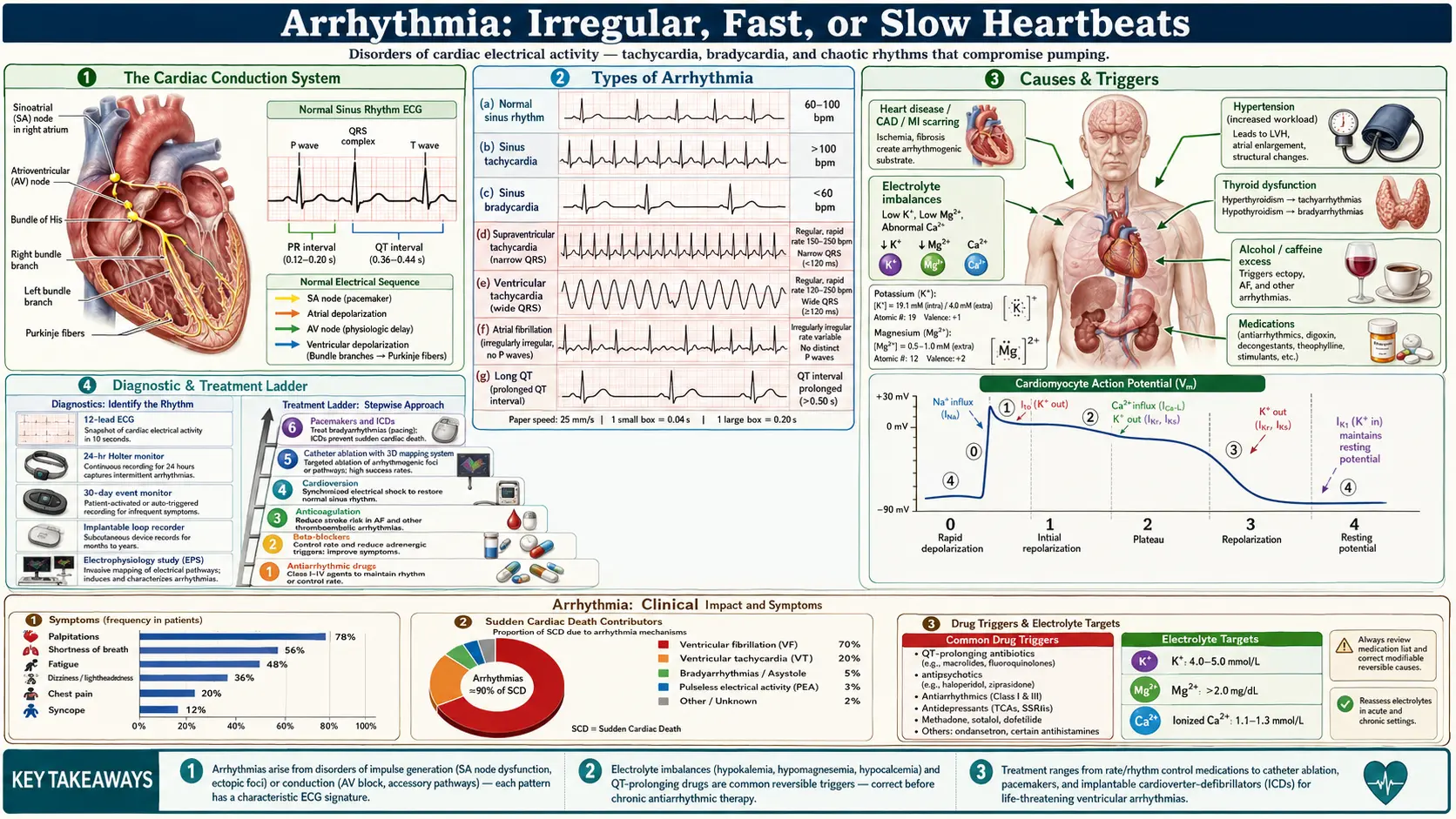
Arrhythmia is a condition characterized by an irregular heartbeat, which can be too fast (tachycardia), too slow (bradycardia), or erratic. It can affect the heart's ability to pump blood effectively.
Causes and Risk Factors
- Heart disease: Coronary artery disease or heart attack can damage heart tissue and lead to arrhythmias.
- High blood pressure: Increases the risk by causing the heart to work harder.
- Electrolyte imbalances: Affect the heart's electrical impulses.
- Medications: Some drugs, including those for treating heart conditions, can trigger arrhythmias.
- Alcohol or caffeine: Excessive intake can lead to irregular heartbeats.
Symptoms of Arrhythmia
Common signs and symptoms include:
- Palpitations (fluttering or pounding in the chest)
- Shortness of breath
- Fatigue
- Dizziness or lightheadedness
- Chest pain
- Fainting (syncope) in severe cases
Diagnosis and Treatment
Diagnostic Tests
To diagnose arrhythmia, doctors may use:
- Electrocardiogram (ECG): A test that records the heart's electrical activity.
- Holter monitor: A portable ECG device worn for a day or more to track heart activity.
- Event monitor: Similar to a Holter monitor but used for longer periods.
- Electrophysiological study: To map electrical pathways in the heart.
Treatment Options
- Medications: Antiarrhythmic drugs, beta-blockers, and anticoagulants to manage the condition.
- Cardioversion: A procedure using electrical shocks to restore a normal heart rhythm.
- Catheter ablation: A minimally invasive procedure to destroy the heart tissue causing the arrhythmia.
- Implantable devices: Pacemakers or implantable cardioverter-defibrillators (ICDs) for severe cases.
Prognosis
The prognosis for arrhythmia depends on the type and underlying cause. Many arrhythmias are manageable with treatment, allowing individuals to lead healthy lives.
Research Papers
The following PubMed topic searches return current peer-reviewed literature relevant to this condition. Each link opens a live PubMed query.
- Cardiac arrhythmia diagnosis
- Supraventricular tachycardia
- Ventricular tachycardia
- Bradyarrhythmia pacemaker
- Arrhythmia pathophysiology
- Antiarrhythmic drugs
- Catheter ablation arrhythmia
- Implantable cardioverter defibrillator
- Sudden cardiac death arrhythmia
- Long QT syndrome
- Arrhythmia electrocardiogram
- Arrhythmia management guidelines
Connections
- Cardiology
- The Heart’s Electrical System & the ECG — interactive animation
- Potassium & the Heartbeat — interactive animation
- The Heart & Circulation — interactive animation
- Atrial Fibrillation
- Heart Failure
- Cardiomyopathy
- Valvular Heart Disease
- Heart Palpitations
- Lightheadedness
- Chest Pain
- Shortness of Breath
- Magnesium
- Potassium
- Calcium
- Omega-3 Fatty Acids
- Stress Management
- Coronary Artery Disease
- POTS
- Lead Poisoning
- Thyroid Disorders
- Obstructive Sleep Apnea
- Cryosurgery and Cryoablation (cardiac cryoablation)
- Palpitations: Causes and Workup — the symptom-side approach, from benign ectopy to ambulatory monitoring.