Thyroid Disorders
What are Thyroid Disorders?
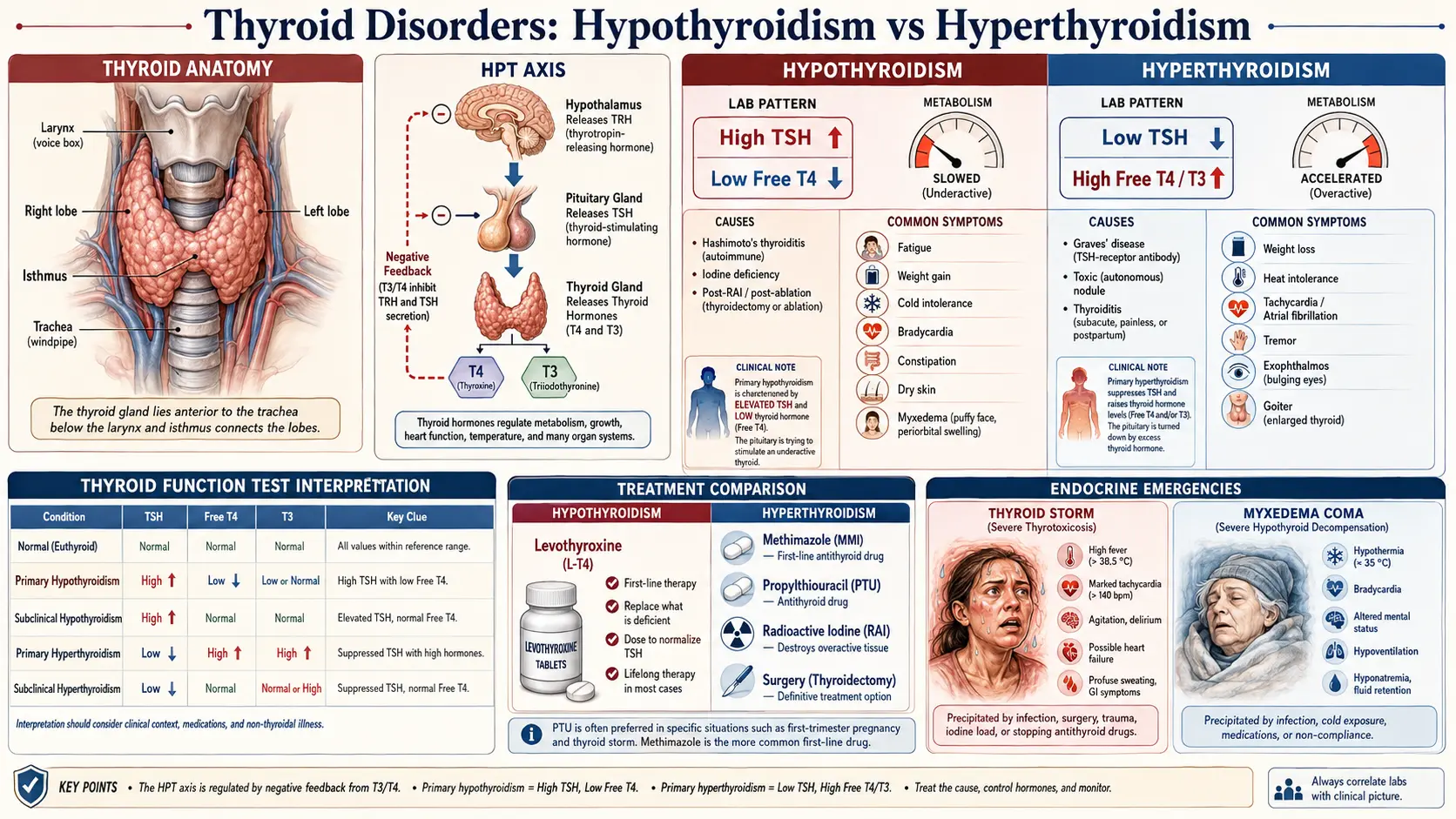
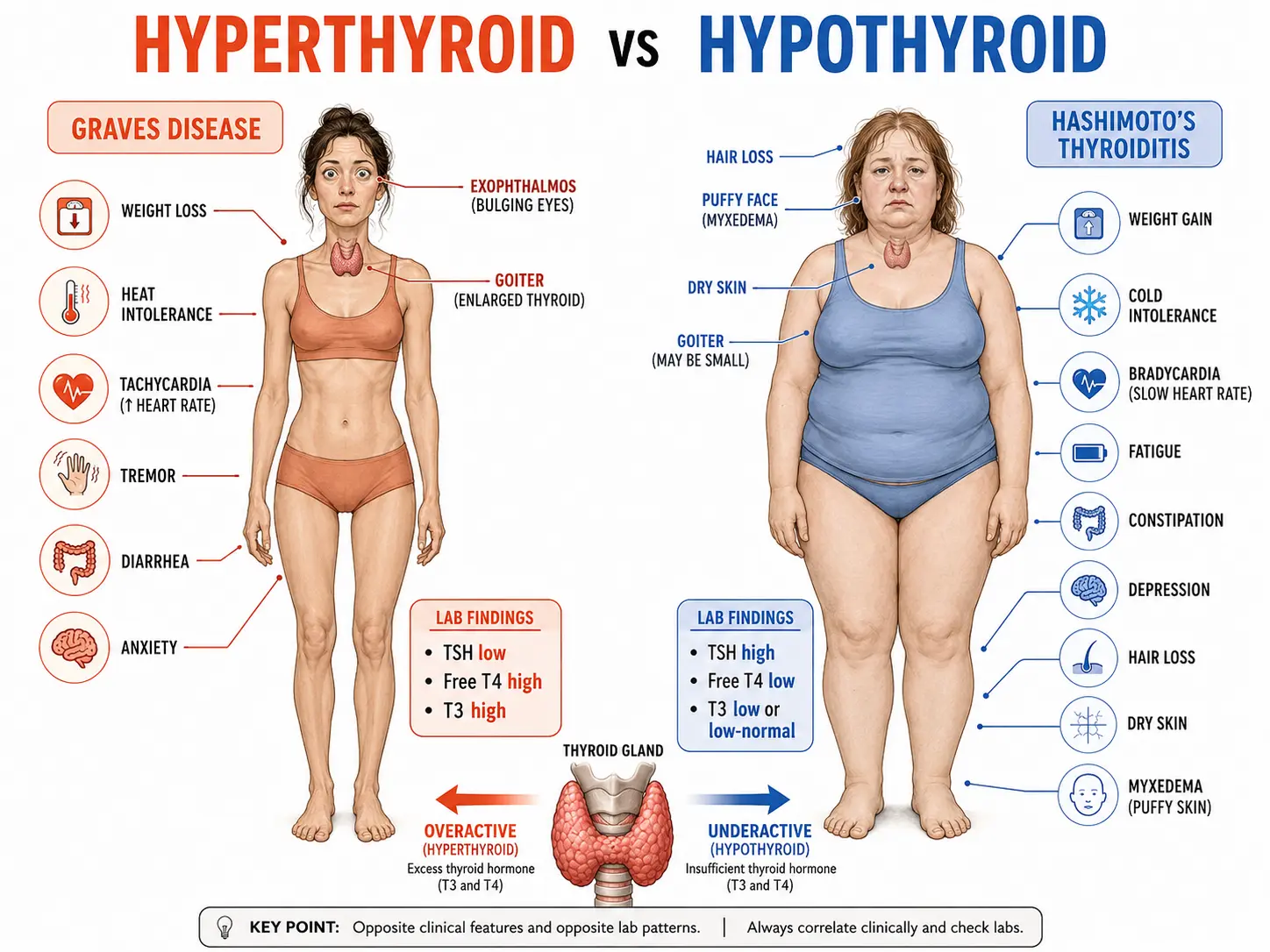
Thyroid disorders refer to a range of conditions that affect the thyroid gland, a small butterfly-shaped gland located in the neck. The thyroid plays a crucial role in regulating the body's metabolism by producing hormones that control how the body uses energy. Thyroid disorders can result in either an overproduction or underproduction of thyroid hormones.
Types of Thyroid Disorders
1. Hypothyroidism
- Definition: A condition where the thyroid gland does not produce enough thyroid hormones.
- Common causes: Hashimoto’s thyroiditis (an autoimmune condition), thyroid surgery, radiation treatment, and iodine deficiency.
- Symptoms:
- Fatigue
- Weight gain
- Cold intolerance
- Dry skin and hair
- Depression
- Constipation
2. Hyperthyroidism
- Definition: A condition where the thyroid gland produces excessive thyroid hormones.
- Common causes: Graves’ disease (an autoimmune disorder), thyroid nodules, and thyroiditis.
- Symptoms:
- Unintentional weight loss
- Increased appetite
- Heat intolerance
- Rapid heartbeat (tachycardia)
- Increased sweating
- Nervousness and irritability
3. Goiter
- Definition: An abnormal enlargement of the thyroid gland.
- Common causes: Iodine deficiency, Graves’ disease, or Hashimoto’s thyroiditis.
- Symptoms:
- Swelling at the base of the neck
- Difficulty swallowing or breathing
4. Thyroid Nodules
- Definition: Lumps that can form in the thyroid gland. Most nodules are benign, but some can be cancerous.
- Symptoms:
- Usually asymptomatic
- In some cases, may cause hyperthyroidism or be felt as a lump in the neck
5. Thyroid Cancer
- Definition: Malignant tumors that can develop in the thyroid gland.
- Types: Papillary, follicular, medullary, and anaplastic thyroid cancer.
- Symptoms:
- Swelling or lump in the neck
- Voice changes or hoarseness
- Difficulty swallowing
Causes and Risk Factors
- Genetics: Family history of thyroid disorders can increase risk.
- Autoimmune diseases: Such as Hashimoto’s thyroiditis or Graves’ disease.
- Iodine intake: Both deficiency and excess can lead to thyroid problems.
- Radiation exposure: Previous radiation treatment to the neck or exposure to radiation from the environment.
- Gender and age: Women and older adults are at a higher risk.
Diagnosis
- Physical examination: To check for enlargement or nodules in the thyroid.
- Blood tests: Measure levels of thyroid hormones (T3 and T4) and thyroid-stimulating hormone (TSH).
- Imaging tests: Such as ultrasound, CT scan, or MRI to visualize the thyroid gland.
- Thyroid scan: Uses radioactive iodine to detect thyroid activity.
- Fine-needle aspiration (FNA) biopsy: To examine thyroid nodules for cancerous cells.
Treatment Options
- Hypothyroidism:
- Thyroid hormone replacement therapy: Levothyroxine is the most commonly prescribed medication.
- Hyperthyroidism:
- Antithyroid medications: Such as methimazole or propylthiouracil.
- Radioactive iodine therapy: To shrink or destroy overactive thyroid cells.
- Surgery: Partial or total thyroidectomy in severe cases.
- Goiter and Thyroid Nodules:
- Observation: Monitoring benign nodules over time.
- Surgical removal: If the nodule or goiter is large or causing symptoms.
- Thyroid Cancer:
- Surgery: Thyroidectomy to remove cancerous tissue.
- Radioactive iodine treatment: To destroy remaining thyroid cells after surgery.
- External beam radiation therapy and chemotherapy: For advanced cases.
Prevention and Management Strategies
- Regular check-ups: For early detection and management.
- Balanced diet: Ensure sufficient iodine intake without excess.
- Medication adherence: For those diagnosed with thyroid disorders to maintain hormone balance.
- Monitor symptoms: Report any new or worsening symptoms to a healthcare provider.
Complications of Thyroid Disorders
- Heart problems: Hyperthyroidism can lead to heart palpitations or arrhythmias.
- Goiter: Enlargement of the thyroid gland, which can cause breathing and swallowing difficulties.
- Osteoporosis: Untreated hyperthyroidism can lead to weakened bones.
- Infertility: Thyroid disorders can affect reproductive health.
- Myxedema coma: A rare, life-threatening condition associated with severe hypothyroidism.
Table of Contents
Historical Background
The thyroid gland was first described anatomically by Andreas Vesalius in 1543, and the term "thyroid" (from the Greek for shield-shaped) was coined by Thomas Wharton in 1656. Graves' disease was described by Robert Graves in 1835 and Carl von Basedow in 1840. The discovery that iodine deficiency causes goiter by David Marine in 1917, and the synthesis of thyroxine (T4) by Edward Kendall in 1914 and Charles Harington in 1926, laid the groundwork for modern thyroidology.
Key Research Papers
Foundational and recent peer-reviewed publications spanning hypothyroidism, hyperthyroidism, autoimmune thyroiditis, thyroid nodules, and thyroid cancer. Author names, paper titles, and journal names appear in plain text; only the year/volume/issue/pages link opens the DOI on the publisher's site.
- Garber JR, Cobin RH, Gharib H, Hennessey JV, Klein I, Mechanick JI, Pessah-Pollack R, Singer PA, Woeber KA. Clinical Practice Guidelines for Hypothyroidism in Adults: Cosponsored by the American Association of Clinical Endocrinologists and the American Thyroid Association. Thyroid. 2012;22(12):1200–1235.
- Ross DS, Burch HB, Cooper DS, Greenlee MC, Laurberg P, Maia AL, Rivkees SA, Samuels M, Sosa JA, Stan MN, Walter MA. 2016 American Thyroid Association Guidelines for Diagnosis and Management of Hyperthyroidism and Other Causes of Thyrotoxicosis. Thyroid. 2016;26(10):1343–1421.
- Haugen BR, Alexander EK, Bible KC, Doherty GM, Mandel SJ, Nikiforov YE, Pacini F, Randolph GW, Sawka AM, Schlumberger M, Schuff KG, Sherman SI, Sosa JA, Steward DL, Tuttle RM, Wartofsky L. 2015 American Thyroid Association Management Guidelines for Adult Patients with Thyroid Nodules and Differentiated Thyroid Cancer. Thyroid. 2016;26(1):1–133.
- Jonklaas J, Bianco AC, Bauer AJ, Burman KD, Cappola AR, Celi FS, Cooper DS, Kim BW, Peeters RP, Rosenthal MS, Sawka AM. Guidelines for the Treatment of Hypothyroidism: Prepared by the American Thyroid Association Task Force on Thyroid Hormone Replacement. Thyroid. 2014;24(12):1670–1751.
- Alexander EK, Pearce EN, Brent GA, Brown RS, Chen H, Dosiou C, Grobman WA, Laurberg P, Lazarus JH, Mandel SJ, Peeters RP, Sullivan S. 2017 Guidelines of the American Thyroid Association for the Diagnosis and Management of Thyroid Disease During Pregnancy and the Postpartum. Thyroid. 2017;27(3):315–389.
- Chaker L, Bianco AC, Jonklaas J, Peeters RP. Hypothyroidism. Lancet. 2017;390(10101):1550–1562.
- De Leo S, Lee SY, Braverman LE. Hyperthyroidism. Lancet. 2016;388(10047):906–918.
- Smith TJ, Hegedüs L. Graves' Disease. New England Journal of Medicine. 2016;375(16):1552–1565.
- Cooper DS. Antithyroid Drugs. New England Journal of Medicine. 2005;352(9):905–917.
- Caturegli P, De Remigis A, Rose NR. Hashimoto Thyroiditis: Clinical and Diagnostic Criteria. Autoimmunity Reviews. 2014;13(4–5):391–397.
- Cibas ES, Ali SZ. The 2017 Bethesda System for Reporting Thyroid Cytopathology. Thyroid. 2017;27(11):1341–1346.
- Vanderpump MPJ. The Epidemiology of Thyroid Disease. British Medical Bulletin. 2011;99(1):39–51.
- Taylor PN, Albrecht D, Scholz A, Gutierrez-Buey G, Lazarus JH, Dayan CM, Okosieme OE. Global Epidemiology of Hyperthyroidism and Hypothyroidism. Nature Reviews Endocrinology. 2018;14(5):301–316.
- Pearce EN, Andersson M, Zimmermann MB. Global Iodine Nutrition: Where Do We Stand in 2013? Thyroid. 2013;23(5):523–528.
Live PubMed Searches
Live PubMed queries that update as new papers are indexed.
- Thyroid disorders review
- Hypothyroidism
- Hyperthyroidism
- Subclinical hypothyroidism
- Subclinical hyperthyroidism
- Thyroid nodule evaluation
- Thyroid cancer
- Thyroid function tests TSH
- Iodine thyroid
- Selenium thyroid
- Pregnancy thyroid disease
- Amiodarone thyroid dysfunction
Connections
- Endocrinology
- Thyroid Nodules
- Graves' Disease
- Iodine
- Selenium
- Hashimoto's Thyroiditis
- Hyperparathyroidism
- TSH, T4 & T3 Optimal Ranges
- Levothyroxine vs NDT vs T3
- Reverse T3 and Low T3 Syndrome
- Thyroid Panel
- Hair Loss
- Zinc
- Vitamin D3
- Thyroid Cancer
- Fatigue
- Cold Hands and Feet
- Infertility
- Perimenopause
- Osteoporosis