PQQ (Pyrroloquinoline Quinone)
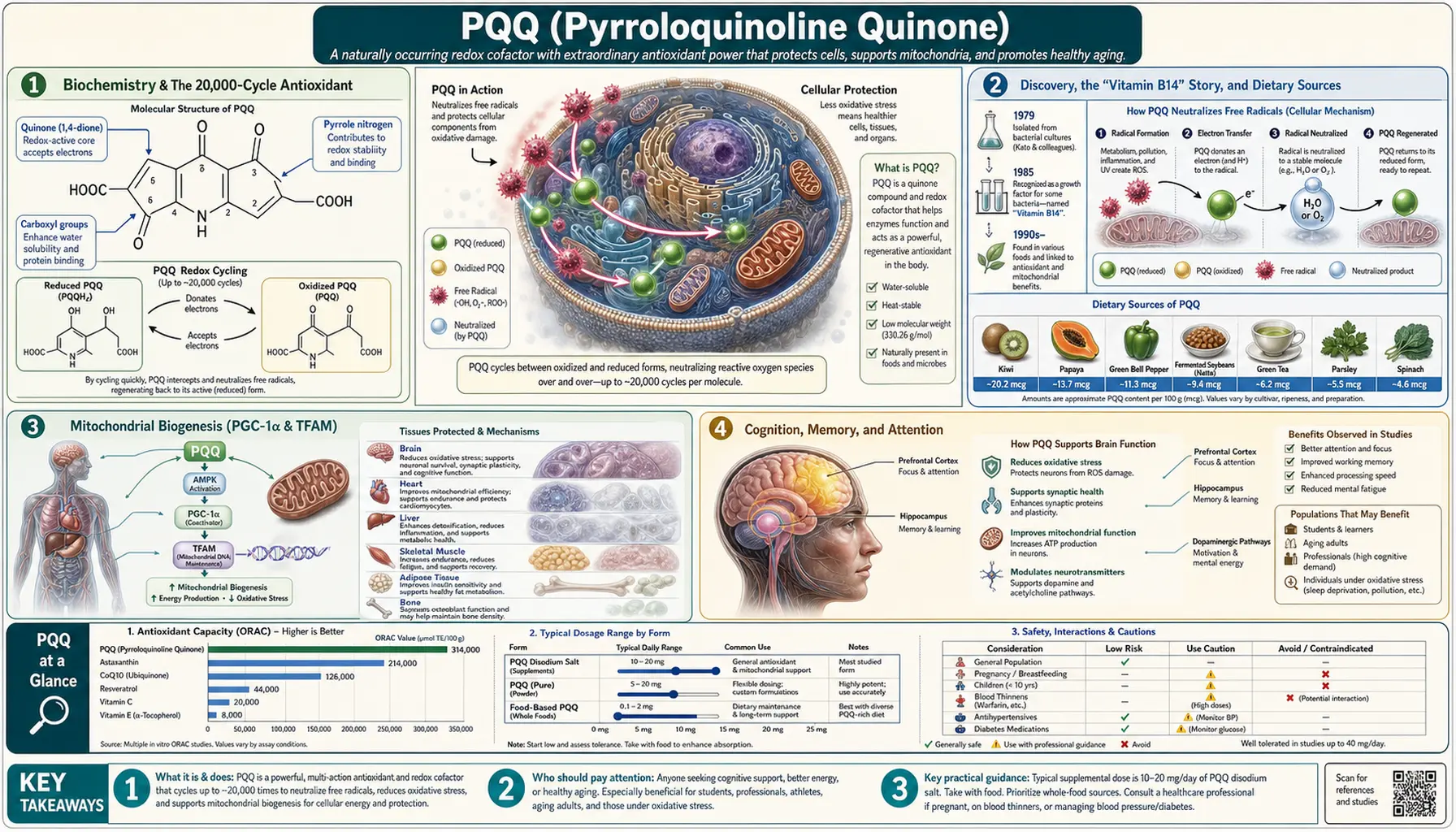
Pyrroloquinoline Quinone (PQQ) is a tricyclic ortho-quinone redox cofactor that is unique among nutritional antioxidants in two ways: it stimulates the growth of new mitochondria through PGC-1α activation (mitochondrial biogenesis), and it can cycle through roughly 20,000 catalytic oxidation-reduction cycles without breakdown — compared to vitamin C's four. This makes very small doses (10-40 mg/day) capable of sustained metabolic effects on energy, cognition, sleep, and cellular aging.
Interactive Visualization Mitochondria & ATP — watch your cells make energy Follow electrons through the transport chain and watch the ATP-synthase motor spin — then block Complex IV and see the chain stall. Launch →
Table of Contents
- Biochemistry & The 20,000-Cycle Antioxidant
- Discovery, the "Vitamin B14" Story, and Dietary Sources
- Mitochondrial Biogenesis (PGC-1α & TFAM)
- Cognition, Memory, and Attention
- Sleep, Mood, and Quality of Life
- Neuroprotection (Amyloid, Glutamate, NMDA)
- Anti-Inflammatory & Cardiovascular Effects
- Reproductive & Developmental Role
- Skin, Collagen, and Hair
- Pairing with CoQ10 and Other Antioxidants
- Forms: BioPQQ vs Generic Disodium Salt
- Recommended Dosage
- Cautions and Contraindications
- Research Papers and References
- Connections
- Featured Videos
Biochemistry & The 20,000-Cycle Antioxidant
PQQ (chemical name 4,5-dihydro-4,5-dioxo-1H-pyrrolo[2,3-f]quinoline-2,7,9-tricarboxylic acid) is a tricyclic ortho-quinone with three fused rings — a pyrrole, a pyridine, and a benzene ring, each carrying carboxylic acid groups. The quinone moiety in the central ring is the redox-active center, capable of accepting two electrons and two protons to become the fully reduced PQQH&sub2; (pyrroloquinoline quinol), and then donating them again when oxidized by a downstream substrate.
What sets PQQ apart from every other biological antioxidant is its catalytic durability. Most antioxidants are consumed once they donate their reducing equivalents and must be regenerated (by glutathione, NADH, lipoic acid, etc.) or replaced (by intake). PQQ, in contrast, can cycle through this oxidation-reduction loop approximately 20,000 times without chemical degradation, compared to vitamin C's ~4 cycles and vitamin E's slightly higher count. This means a small standing concentration of PQQ provides sustained antioxidant capacity at very low dose, and it explains why typical PQQ supplementation (10-40 mg/day) produces measurable biological effects despite being orders of magnitude smaller than most nutrient doses.
Structurally, PQQ behaves both as a direct radical scavenger (quenching superoxide, hydroxyl radicals, peroxynitrite) and as a signaling molecule that engages multiple cellular pathways. Its planar tricyclic structure allows it to cross the blood-brain barrier readily and to engage protein-binding sites including NMDA receptors and the upstream regulators of mitochondrial gene expression.
Discovery, the "Vitamin B14" Story, and Dietary Sources
PQQ's structure was solved in 1979, after which it was long regarded as a strictly bacterial cofactor; a high-profile 2003 claim that it was a mammalian "Vitamin B14" was rebutted within two years, and it has no established classical vitamin status today. It is now best categorized as a conditionally beneficial bioactive compound — not formally essential, but pharmacologically active at supplemental doses. — the fuller story is told in the dedicated History & Discovery article.
Dietary sources
PQQ is widely distributed in plant and animal foods, though usually in trace amounts:
- Highest concentrations: Natto (fermented soybeans), parsley, green peppers, kiwi fruit, papaya
- Moderate concentrations: Spinach, celery, green tea, dark chocolate
- Lower concentrations: Tofu, sweet potato, banana, eggs, dairy
- Notable: PQQ is present in human breast milk at concentrations several times higher than in cow's milk, supporting the developmental-role hypothesis
Estimated typical dietary intake is approximately 0.1-1 mg/day — well below the supplemental doses (10-40 mg) shown to produce mitochondrial and cognitive effects in trials. This gap between dietary intake and pharmacologically active dose is part of why PQQ is studied as a supplement rather than as a recognized micronutrient.
Mitochondrial Biogenesis (PGC-1α & TFAM)
PQQ's most distinctive biological effect — and the one that separates it from all other antioxidants on this site — is the stimulation of mitochondrial biogenesis: the creation of new mitochondria within existing cells.
The seminal mechanistic work was published by Chowanadisai, Bauerly, and colleagues at UC Davis in 2010 (Journal of Biological Chemistry). They showed that PQQ supplementation activates the CREB transcription factor, which in turn upregulates expression of PGC-1α (peroxisome proliferator-activated receptor gamma coactivator 1-alpha) — the master regulator of mitochondrial biogenesis. PGC-1α then upregulates downstream mitochondrial transcription factors including TFAM (mitochondrial transcription factor A) and NRF-1/NRF-2 (nuclear respiratory factors), which together drive the assembly of new mitochondria.
The cascade is the same one engaged by exercise, caloric restriction, and cold exposure — all known mitochondrial-biogenesis triggers. PQQ activates it pharmacologically through a nutritional pathway that doesn't require physical stressors. In their original mouse studies, Chowanadisai found that 8 weeks of PQQ supplementation increased the number of mitochondria per cell by roughly 30% in liver tissue, with parallel increases in respiratory chain protein expression.
This is fundamentally different from the mechanism of CoQ10 (which feeds existing electron transport chains), alpha lipoic acid (which serves as cofactor for existing TCA cycle enzymes), or methylene blue (which provides an alternative electron acceptor when complexes are damaged). PQQ adds more mitochondrial capacity — it grows the factory rather than just supplying the assembly line.
The clinical implications are significant. Mitochondrial density falls with age across most tissues, particularly skeletal muscle, brain, and heart, contributing to declining metabolic capacity and increased ROS leak. An intervention that pharmacologically restores mitochondrial number addresses the upstream problem rather than just buffering the downstream damage. This is why PQQ has become a staple of longevity protocols and why it pairs naturally with CoQ10 (more mitochondria + better-functioning mitochondria).
Cognition, Memory, and Attention
Multiple Japanese trials have evaluated PQQ for cognitive function in older adults with subjective memory complaints. The pattern across trials is consistent: 20 mg/day BioPQQ for 8-12 weeks produces modest but statistically significant improvements in attention, working memory, and information processing speed.
- Itoh et al. (2016, Advances in Experimental Medicine and Biology) — 41 healthy adults age 40-70 with subjective memory complaints, BioPQQ 20 mg/day for 12 weeks vs placebo. The PQQ group showed significantly improved scores on the Stroop test (selective attention) and Wechsler memory subtests, particularly in subjects over age 50. Effect sizes were modest (Cohen's d ~ 0.3-0.5) but consistent across multiple cognitive domains.
- Nakano et al. (2009, Food Style 21) — the original Japanese cognition trial. 71 adults with self-reported forgetfulness, BioPQQ 20 mg/day for 24 weeks. Improvements in higher cognitive function on standardized tests; subjective improvement in mental fatigue and sleep quality.
- Hwang et al. (2018, Annals of Nutrition and Metabolism) — Korean trial of 67 healthy adults age 50-79, PQQ 20 mg/day for 12 weeks. Significant improvements on attention and working memory tasks; biomarker improvements including reduced d-ROMs (oxidative stress) and increased BAP (antioxidant potential).
- Kim et al. (2021) — combination trial of PQQ + CoQ10 (the most common commercial pairing) showing additive effects on cognitive outcomes and mitochondrial function biomarkers in older adults.
The proposed mechanism is the same mitochondrial-biogenesis pathway operating in brain tissue. Older brains have measurably reduced mitochondrial density in cortical neurons; PQQ supplementation appears to partially restore this, with downstream improvements in synaptic energy supply and cognitive performance.
For comparison, the effect size of 20 mg PQQ on cognition in healthy older adults is approximately equivalent to 100-300 mg CoQ10 alone, or to a moderate exercise intervention of similar duration. Combinations (PQQ + CoQ10 + exercise) are additive in trials that have tested them.
Sleep, Mood, and Quality of Life
The Nakano group's Japanese trials reported significant improvements in sleep quality, sleep onset latency, and subjective mental fatigue after 8 weeks of 20 mg/day PQQ. Subjects reported feeling more rested upon waking and experienced less daytime drowsiness. The proposed mechanism involves PQQ's effects on serotonin and melatonin precursors plus reduced HPA-axis activation, though direct mechanistic studies in humans are limited.
A subset of users report that PQQ has a mildly energizing effect when taken in the morning — consistent with improved mitochondrial energy production — and that it should generally not be taken before bed. The mood effects appear modest and gradual over weeks, similar to other mitochondrial nutrients rather than the acute mood elevation of stimulants.
For patients with chronic fatigue or brain fog from acquired mitochondrial dysfunction (long-COVID, chronic Lyme, post-viral syndromes, fibromyalgia, chronic fatigue syndrome), PQQ is a reasonable component of broader mitochondrial-supportive protocols. Effect sizes are typically modest as monotherapy but additive in combination with CoQ10, alpha lipoic acid, B-vitamins, and creatine.
Neuroprotection (Amyloid, Glutamate, NMDA)
PQQ shows multiple lines of neuroprotective activity in preclinical models, with several mechanisms that are particularly relevant to neurodegenerative disease:
- Beta-amyloid protection — PQQ reduces beta-amyloid aggregation in cell-culture models and protects hippocampal neurons from amyloid-induced toxicity. Animal models of Alzheimer's disease show reduced amyloid plaque deposition and improved memory with chronic PQQ supplementation.
- NMDA receptor modulation — PQQ binds to the glutamate-binding site of the NMDA receptor and acts as a mild antagonist, reducing excitotoxic glutamate signaling that contributes to stroke, traumatic brain injury, and neurodegeneration. The effect is modest and does not interfere with normal glutamatergic neurotransmission at supplemental doses.
- Glutamate excitotoxicity — PQQ reduces neuronal death in models of glutamate-induced excitotoxicity, with effect sizes comparable to memantine (the Alzheimer's drug that targets the same pathway).
- Mitochondrial protection in neurons — the same biogenesis effect that operates systemically also operates in neurons, partly restoring the mitochondrial density that declines in aging brains.
- Nerve growth factor (NGF) synthesis — PQQ enhances NGF production in glial cells and astrocytes, supporting neuronal maintenance and synaptic plasticity.
Human trials specific to neurodegenerative disease are limited, but the mechanistic profile supports PQQ as a reasonable component of comprehensive cognitive-aging and neuroprotection protocols. The trials in healthy older adults (Itoh, Nakano, Hwang) provide indirect support for the brain-relevant mechanisms operating in humans at typical supplement doses.
Anti-Inflammatory & Cardiovascular Effects
PQQ supplementation produces measurable reductions in systemic inflammation biomarkers. The Harris 2013 trial (Journal of Nutritional Biochemistry) reported significant reductions in plasma high-sensitivity C-reactive protein (hs-CRP) and IL-6 after 3 weeks of 20 mg/day PQQ in healthy adults, alongside increased mitochondrial biogenesis markers in lymphocytes.
Animal models of cardiovascular ischemia-reperfusion injury show reduced infarct size and improved post-ischemic recovery with PQQ pretreatment. The proposed mechanisms include increased cardiomyocyte mitochondrial density, reduced ROS leak during reperfusion, and direct activation of cytoprotective gene expression.
Human cardiovascular trial data are limited. The biological case is strong enough that PQQ is occasionally included in cardio-mitochondrial supplementation protocols alongside CoQ10, alpha lipoic acid, and omega-3 fatty acids, particularly in patients with heart failure or post-MI recovery.
Reproductive & Developmental Role
One of the original observations that drove PQQ research was that mice fed a PQQ-deficient diet produced smaller litters with lower neonatal survival, smaller pups, fragile skin, and reduced fertility. PQQ-supplemented mothers reversed these defects. This work was central to the (now-withdrawn) "Vitamin B14" proposal.
Mechanistically, PQQ appears to support mitochondrial function in oocytes and developing embryos — both of which are exceptionally mitochondria-dependent. The presence of PQQ in human breast milk at higher concentrations than in cow's milk supports a developmental role in infant growth, though no formal vitamin requirement has been established for humans.
For fertility support — particularly in older women undergoing IVF where oocyte mitochondrial dysfunction is a known contributor to declining success rates — PQQ pairs naturally with CoQ10. The combination addresses both mitochondrial quantity (PQQ-driven biogenesis) and electron transport function (CoQ10) simultaneously. Trials specific to fertility outcomes are limited but the biology is congruent with the CoQ10 fertility evidence base.
Skin, Collagen, and Hair
PQQ supports collagen synthesis through its enzymatic role as a cofactor for lysyl oxidase, the copper-dependent enzyme that cross-links collagen and elastin fibers in the dermis. Topical and oral PQQ have been studied in cosmetic dermatology for skin elasticity, wrinkle reduction, and post-UV-damage recovery, with small trials showing modest improvements over 8-12 weeks.
The mitochondrial-biogenesis mechanism is particularly relevant in skin, where dermal fibroblasts — the cells responsible for collagen production — show declining mitochondrial function with age. Improved fibroblast mitochondrial capacity supports collagen turnover and skin repair.
For hair, the same mechanism applies at the follicle level. PQQ is sometimes included in hair-growth supplement formulations, typically combined with biotin, zinc, and saw palmetto, though direct trials of PQQ for hair outcomes are scarce.
Pairing with CoQ10 and Other Antioxidants
PQQ is most commonly used in combination with CoQ10, and this is more than a marketing convenience — the two work through complementary mechanisms:
- PQQ creates more mitochondria via PGC-1α activation
- CoQ10 enhances the electron transport function of existing (and new) mitochondria by shuttling electrons between Complexes I/II and III
Combined supplementation produces additive effects in trials measuring both mitochondrial density and respiratory chain function. The typical combination is PQQ 10-20 mg/day + ubiquinol 100-200 mg/day.
Other rational pairings:
- PQQ + alpha lipoic acid — biogenesis + TCA cycle cofactor support
- PQQ + NAD+ / NMN — biogenesis + sirtuin activation
- PQQ + methylene blue — biogenesis + alternative electron acceptor (only for advanced longevity protocols)
- PQQ + creatine — biogenesis + ATP buffering capacity (popular for cognitive performance)
- PQQ + nicotinamide riboside (B3 form) — biogenesis + NAD+ precursor
The "mitochondrial stack" used in longevity-focused functional medicine practices typically combines PQQ + CoQ10 + alpha lipoic acid + acetyl-L-carnitine + B-complex + magnesium — addressing biogenesis, electron transport, TCA cycle function, beta-oxidation, methylation cofactors, and ATP synthesis simultaneously.
Forms: BioPQQ vs Generic Disodium Salt
- BioPQQ™ — the original commercial form, manufactured by Mitsubishi Gas Chemical via bacterial fermentation. This is the form used in essentially all the published clinical trials cited above (Itoh, Nakano, Hwang). The fermentation-derived product has a well-characterized purity profile and consistent bioavailability.
- PQQ disodium salt (PureQQ™, generic) — chemically equivalent to BioPQQ in pure PQQ content. Most modern supplements use a synthetic disodium salt that is equally pure and considerably less expensive than the original branded fermentation product. Bioavailability appears comparable on the limited comparative pharmacokinetic data available.
- PQQ free acid — less common; has slightly lower water solubility and is therefore less common in commercial supplements. Both the disodium salt and the free acid are converted to active PQQ once absorbed.
- Combined formulations — PQQ is most commonly sold combined with ubiquinol or ubiquinone (CoQ10) in fixed-dose capsules, often as 10 mg PQQ + 50-100 mg CoQ10. Convenient but locks the ratio; standalone PQQ allows independent dosing.
- Topical formulations — PQQ in skincare serums and creams at 0.5-2% concentrations. Penetration and clinical efficacy data are limited.
Practical guidance: The original BioPQQ trials used 20 mg/day. Generic PQQ disodium salt at the same dose is reasonable for most users at a fraction of the price. Combined PQQ + CoQ10 products are convenient but check the PQQ content carefully — some marketing-heavy products provide only 2-5 mg PQQ, well below the clinically studied dose.
Recommended Dosage
- General antioxidant / mitochondrial support — 10-20 mg/day, taken with breakfast or lunch (not in the evening due to mild energizing effect)
- Cognitive support / aging brain — 20 mg/day BioPQQ or equivalent disodium salt, for at least 8-12 weeks before assessing response (matching the clinical trial protocols)
- Mitochondrial dysfunction / chronic fatigue / brain fog — 20-40 mg/day, divided into two doses (morning + midday), often combined with CoQ10 200-300 mg/day
- Cardiovascular support — 10-20 mg/day combined with ubiquinol 100-200 mg/day
- Fertility / IVF preparation — 20 mg/day combined with ubiquinol 200-400 mg/day for 60-90 days before conception attempts or oocyte retrieval
- Longevity protocols — 10-20 mg/day as part of a broader mitochondrial stack (CoQ10 + ALA + acetyl-L-carnitine + creatine + B-complex)
- Hair & skin (topical) — 0.5-2% PQQ serum applied twice daily; limited efficacy data but minimal harm
Timing. PQQ absorption appears unaffected by food. Take in the morning or midday because of the mild energizing effect — evening dosing can interfere with sleep in some users despite PQQ's sleep-quality benefits in the long-term trials (which typically used morning dosing). Bioavailability is high (estimated 60-80% absorption) and plasma half-life is approximately 1-3 hours, but cellular effects on PGC-1α expression and mitochondrial biogenesis persist much longer than plasma concentration would suggest.
Cautions and Contraindications
PQQ has an excellent safety profile. The 90-day toxicology studies in rats and 12-week human trials at doses up to 60 mg/day have found no significant adverse effects. Key considerations:
- Headache (rare) — a small subset of users report mild headache at higher doses (40 mg+). Usually resolves with dose reduction or splitting the dose into morning + midday.
- Mild stimulant effect — some users notice increased alertness or mild restlessness when starting PQQ. Take in the morning rather than evening to avoid sleep disruption. The effect typically attenuates over 1-2 weeks of consistent use.
- Pregnancy and breastfeeding — PQQ is naturally present in breast milk and there is no documented harm from dietary PQQ, but supplemental dosing during pregnancy lacks formal safety trials. Avoid in the absence of clinical guidance.
- Children — safety data limited; not recommended for pediatric use outside specific clinical scenarios under specialist supervision.
- Bleeding disorders — no documented anticoagulant effect, but theoretical concern based on quinone chemistry; mention to physicians if you take warfarin or DOACs.
- Drug interactions — no significant pharmacokinetic interactions have been documented at supplemental doses.
- Allergic reactions — extremely rare; isolated case reports of skin rash.
- Quality concerns — PQQ is a relatively expensive raw material, so under-dosed and adulterated products are common in the supplement market. Choose third-party-tested products and prefer well-established brands.
Research Papers and References
The following PubMed search links provide curated entry points into the published clinical and mechanistic literature on PQQ.
- PQQ and mitochondrial biogenesis (Chowanadisai mechanism) — PubMed: PQQ mitochondrial biogenesis PGC-1
- PQQ for cognition (Itoh, Nakano, Hwang trials) — PubMed: PQQ cognition memory attention
- PQQ for sleep and mood — PubMed: PQQ sleep mood fatigue
- PQQ neuroprotection: amyloid, glutamate, NMDA — PubMed: PQQ neuroprotection amyloid NMDA
- PQQ anti-inflammatory and CRP / IL-6 reduction (Harris 2013) — PubMed: PQQ CRP IL-6 inflammation
- PQQ cardiovascular ischemia-reperfusion protection — PubMed: PQQ cardiac ischemia reperfusion
- PQQ reproductive role and the "Vitamin B14" story — PubMed: PQQ vitamin B14 reproduction
- PQQ + CoQ10 combination trials — PubMed: PQQ CoQ10 combination
- BioPQQ pharmacokinetics and bioavailability — PubMed: BioPQQ pharmacokinetics
- PQQ in human breast milk (developmental nutrition) — PubMed: PQQ breast milk infant nutrition
- PQQ collagen synthesis and lysyl oxidase — PubMed: PQQ lysyl oxidase collagen
- PQQ chronic fatigue, fibromyalgia, long-COVID mitochondrial dysfunction — PubMed: PQQ chronic fatigue mitochondrial
- PQQ nerve growth factor (NGF) synthesis — PubMed: PQQ nerve growth factor NGF
- PQQ safety, toxicology, and adverse event profile — PubMed: PQQ safety toxicology
- PQQ as bacterial cofactor (Duine 1979, biochemistry origins) — PubMed: PQQ bacterial dehydrogenase Duine
External Authoritative Resources
- Linus Pauling Institute — Micronutrient Information Center
- NCCIH — Herbs and Supplements at a Glance
- MedlinePlus — PQQ (Pyrroloquinoline Quinone)
- PubMed — All research on Pyrroloquinoline Quinone
Connections
- Mitochondria & ATP — interactive animation
- All Antioxidants
- CoQ10 (natural pairing)
- Alpha Lipoic Acid
- Glutathione
- NAC (N-Acetylcysteine)
- NAD+ & NMN
- Methylene Blue
- Oxidative Stress
- Longevity Protocols
- Vitamin B3 (Niacin, NAD+ precursor)
- Vitamin B2 (Riboflavin)
- Vitamin B12
- Magnesium
- Copper (lysyl oxidase cofactor)
- Methionine
- Tyrosine
- Creatine
- Omega-3 Fatty Acids
- Natto (Food Source)
- Kiwi
- Spinach
- Green Tea
- Dark Chocolate
- Fatigue
- Brain Fog
- Chronic Fatigue Syndrome
- Fibromyalgia
- Alzheimer's Disease
- Parkinson's Disease
- Heart Failure
- Reproductive Medicine
- Inflammatory Markers