Brain Fog

Table of Contents
Overview
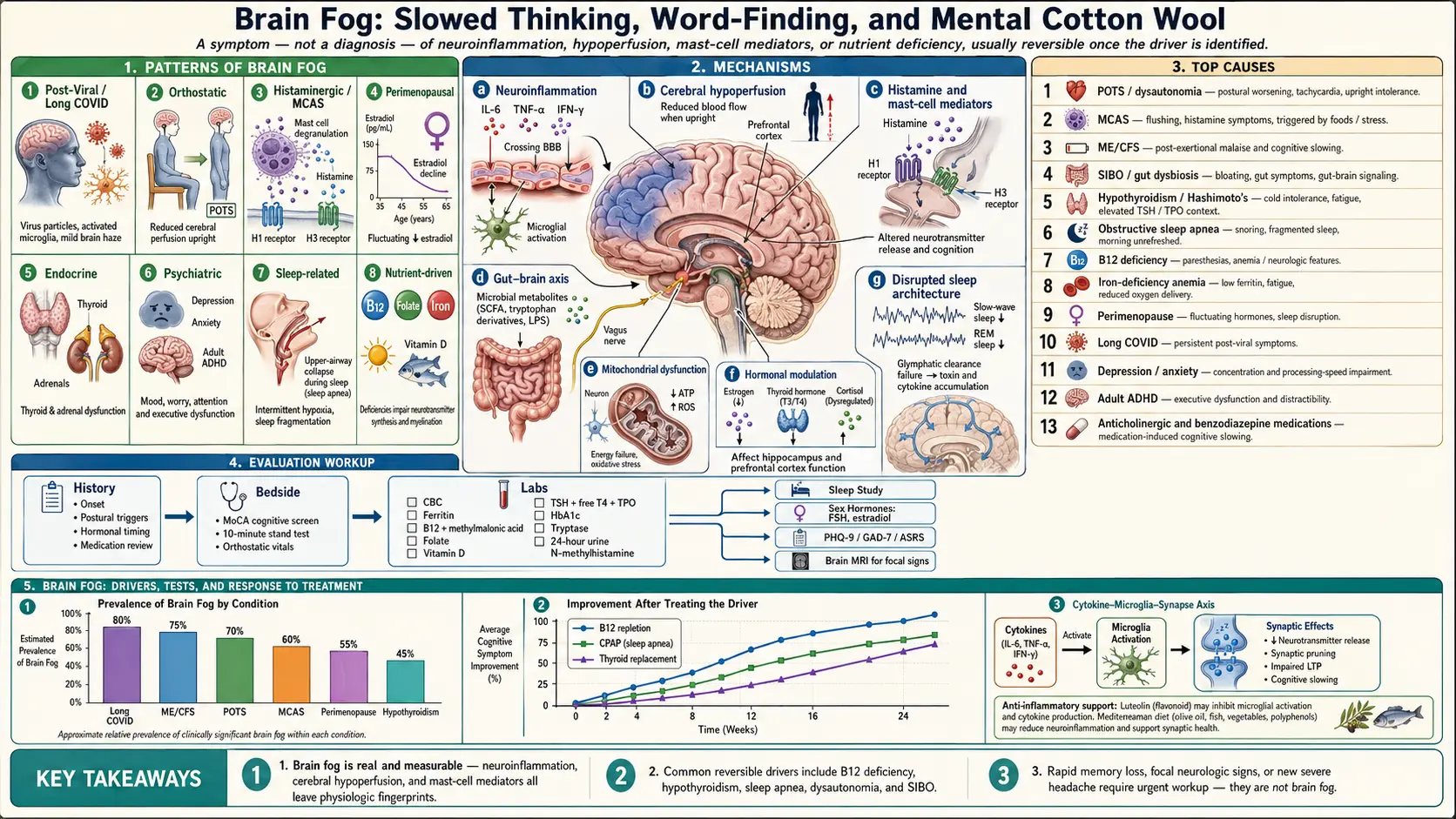
Brain fog is the subjective sense of slowed thinking, poor concentration, word-finding difficulty, and short-term-memory lapses without measurable dementia or focal neurologic deficit. It is a symptom, not a diagnosis — the same complaint can reflect post-viral inflammation, autonomic dysfunction, perimenopausal hormonal shifts, mast-cell activation, untreated sleep apnea, B12 deficiency, depression, or any combination. A frequent feature is a mismatch: people describe thinking through cotton wool while routine cognitive screening tests can look normal. The outlook depends on the cause: in a large study of midlife women, perimenopausal dips in learning rebounded after menopause, and reviews of sleep apnea report cognitive gains with CPAP, whereas in ME/CFS the symptom is often long-lasting.
Patterns of Brain Fog
- Post-viral / post-infectious — cognitive haze persisting weeks to months after a viral illness, often with fatigue and post-exertional malaise. Overlaps with ME/CFS and dysautonomia.
- Orthostatic — worse on standing, in heat, or after meals; common in POTS and orthostatic hypotension and linked to reduced blood flow to the brain when upright. In a survey of 138 young people with POTS, the most-reported triggers were fatigue (91%), lack of sleep (90%) and prolonged standing (87%), and respondents said the fog persisted after lying down (Ross 2013).
- Histaminergic / mast-cell — flares with food triggers, alcohol, stress, or hormonal changes; often accompanies flushing, urticaria, GI symptoms.
- Perimenopausal / menopausal — in the SWAN study of 2,362 midlife women, the usual practice-related gains in processing speed and verbal memory were absent during perimenopause and rebounded to premenopausal levels after menopause (Greendale 2009).
- Endocrine — hypothyroidism, Hashimoto's, adrenal insufficiency, and uncontrolled diabetes all blunt cognition.
- Psychiatric — depression and anxiety produce real, measurable cognitive slowing; ADHD first recognized in adulthood can be described by patients as brain fog.
- Sleep-related — obstructive sleep apnea, insomnia, and shift-work disorder degrade attention and consolidation of memory.
- Nutrient-driven — B12, folate and iron deficiency are established causes of cognitive symptoms; links with low vitamin D and low omega-3 intake come mainly from observational studies.
Common Causes
- POTS and other dysautonomias — standing produces cerebral hypoperfusion and adrenergic surges; in one survey, 132 of 138 people with POTS reported brain fog (Ross 2013).
- Mast cell activation syndrome (MCAS) — Theoharides and colleagues propose that histamine and other mast-cell mediators stimulate microglia and cause focal brain inflammation; this is a hypothesis rather than an established mechanism.
- ME/CFS — the 2015 Institute of Medicine criteria require either cognitive impairment or orthostatic intolerance alongside the core features; symptoms worsen after exertion (post-exertional malaise).
- SIBO and gut dysbiosis — in a small uncontrolled 2018 study of 30 people with brain fog, gas and bloating (all taking probiotics), SIBO and D-lactic acidosis were more common than in 8 people without brain fog, and brain fog resolved in 23 of the 30 after probiotics were stopped and antibiotics given (Rao 2018).
- Hypothyroidism and Hashimoto's — a 2015 meta-analysis of 13 studies linked subclinical hypothyroidism to cognitive impairment only in people younger than 75 and at higher TSH levels, with no significant association across all studies combined (Pasqualetti 2015).
- Obstructive sleep apnea — systematic reviews report deficits in attention/vigilance, delayed memory and executive function; attention problems track with sleep fragmentation and global cognitive function with low oxygen levels (Bucks 2013).
- B12 deficiency and folate deficiency — classic causes of cognitive slowing, sometimes with subacute combined degeneration.
- Iron-deficiency anemia — reduced oxygen delivery to the brain.
- Perimenopause and menopause — falling estrogen is thought to affect hippocampal function and verbal memory.
- Long COVID and post-viral syndromes — an imaging study found blood-brain barrier disruption and sustained systemic inflammation in people with long COVID-associated brain fog (Greene 2024).
- Depression and anxiety — "pseudodementia" of depression and anxiety-driven cognitive narrowing are common and reversible.
- Adult ADHD — described as under-recognized in women; presents with attention and working-memory complaints often labeled "brain fog."
- Medications — anticholinergics, benzodiazepines, opioids, sedating antihistamines and some chemotherapies are associated with cognitive side effects; statins carry post-marketing reports of memory problems, though trial evidence is mixed.
Mechanisms
- Neuroinflammation — inflammatory mediators such as cytokines (IL-6, TNF-alpha), released by immune cells in the body and in the brain, alter neurotransmitter metabolism, reduce neurotrophic factors and disturb the neuronal environment, a pathway reviewed as a basis of fatigue (Dantzer 2014).
- Cerebral hypoperfusion — in dysautonomia, the brain can receive less blood when upright.
- Histamine and mast-cell mediators — histamine acts on H1 and H3 receptors in the CNS, modulating arousal and cognition; in MCAS, other mediators released alongside histamine are proposed to add to the effect.
- Gut-brain axis — vagal signaling, microbial metabolites, and inflammatory tone from the gut all influence cognition; this is one proposed route linking SIBO, IBS and dysbiosis with brain fog.
- Mitochondrial dysfunction — reduced energy production in cells is a proposed, not established, mechanism in ME/CFS and post-viral states.
- Hormonal modulation — estrogen, thyroid hormone, and cortisol all directly affect hippocampal and prefrontal function.
- Sleep architecture — loss of slow-wave and REM sleep impairs memory consolidation; in mice, sleep enlarged the brain's interstitial space by 60% and increased clearance of beta-amyloid (Xie 2013, an animal study).
Evaluation
Clinical reviews describe a workup that commonly includes:
- History — onset, triggers (food, posture, hormones), associated fatigue, sleep, mood, medication review.
- Brief cognitive screening — MoCA or similar, used to distinguish measurable cognitive impairment from subjective brain fog.
- Bloodwork — CBC, ferritin, B12 with methylmalonic acid, folate, vitamin D, TSH with free T4 and thyroid antibodies, comprehensive metabolic panel, HbA1c.
- Sleep study — if any history of snoring, witnessed apneas, or non-restorative sleep.
- Orthostatic vitals or 10-minute stand test — if symptoms worsen with standing or in heat.
- Tryptase, plasma histamine, 24-hour urine N-methylhistamine — if MCAS features (flushing, urticaria, GI, anaphylaxis history) are present.
- Sex hormones — FSH, estradiol if perimenopausal age and timing fits.
- Mental health screening — PHQ-9, GAD-7, adult ADHD screens (ASRS).
- Brain MRI — if focal deficits, headache pattern change, or rapid progression.
Management
Approaches reported in clinical reviews and guidelines depend on the cause:
- Treating the underlying cause — thyroid replacement, B12 injections or sublingual cyanocobalamin, iron repletion, CPAP for sleep apnea, SSRIs for depression, and hormone therapy for menopausal symptoms (in SWAN, hormone use begun before the final menstrual period was linked with better cognitive scores and use begun after it with worse scores — Greendale 2009).
- Anti-inflammatory approaches — Mediterranean-style eating and treatment of underlying inflammatory conditions (autoimmune disease, infection, gut dysbiosis) are described; direct trial evidence for brain fog itself is limited.
- Mast-cell stabilization — H1 + H2 antihistamines, cromolyn, low-histamine diet trial in MCAS or histamine intolerance.
- Dysautonomia measures — salt and fluid loading, compression garments, recumbent-to-upright exercise progression, and beta-blockers or ivabradine are used in POTS.
- Sleep — regular sleep timing, less alcohol, and diagnosis and treatment of sleep-disordered breathing; reviews report that CPAP improves executive function, delayed memory and attention in OSA (Bucks 2013).
- Aerobic exercise — in deconditioning and depression, gentle progressive exercise is used; in ME/CFS, exertion can trigger post-exertional malaise, and pacing within energy limits is the approach described in current guidance.
- Cognitive rehabilitation — structured pacing, environmental modifications, written checklists, and rest schedules.
- Mind-body therapies — mindfulness and cognitive-behavioral therapy are used for stress- and mood-related cognitive complaints; gut-directed hypnotherapy is used in IBS, where it targets visceral hypersensitivity.
Red-Flag Features
Clinical sources list these features as reasons for prompt medical evaluation, because they point to causes other than ordinary brain fog:
- Rapidly progressive memory loss, disorientation to time and place, or personality change.
- New focal neurologic signs (weakness, numbness, vision change, speech difficulty).
- Severe headache that is changing in pattern or accompanied by nausea, vomiting, or vision change.
- Cognitive symptoms with fever, neck stiffness, or confusion (a pattern that raises concern for CNS infection).
- Loss of consciousness, seizure, or sudden severe headache.
- Brain fog with depressive symptoms severe enough to cause suicidal thoughts.
Connections
Key Research Papers
Historical Background
Brain fog was long treated as a vague subjective complaint. Research on inflammation and fatigue (Dantzer 2014), surveys of the symptom in POTS (Ross 2013) and, after 2020, imaging studies in long COVID (Greene 2024, which reported blood-brain barrier disruption) have begun to link it to measurable physiology, though it remains a description of a symptom rather than a defined disease.
Key Research Papers
- Theoharides TC, Cholevas C, Polyzoidis K, Politis A. Long-COVID syndrome-associated brain fog and chemofog: luteolin to the rescue. BioFactors. 2021;47(2):232-241. — doi:10.1002/biof.1726
- Komaroff AL, Bateman L. Will COVID-19 lead to myalgic encephalomyelitis/chronic fatigue syndrome? Frontiers in Medicine. 2020;7:606824. — doi:10.3389/fmed.2020.606824
- Ross AJ, Medow MS, Rowe PC, Stewart JM. What is brain fog? An evaluation of the symptom in postural tachycardia syndrome. Clinical Autonomic Research. 2013;23(6):305-311. — doi:10.1007/s10286-013-0212-z
- Dantzer R, Heijnen CJ, Kavelaars A, Laye S, Capuron L. The neuroimmune basis of fatigue. Trends in Neurosciences. 2014;37(1):39-46. — doi:10.1016/j.tins.2013.10.003
- Greene C, Connolly R, Brennan D, et al. Blood-brain barrier disruption and sustained systemic inflammation in individuals with long COVID-associated cognitive impairment. Nature Neuroscience. 2024;27(3):421-432. — doi:10.1038/s41593-024-01576-9
- Maki PM, Henderson VW. Cognition and the menopause transition. Menopause. 2016;23(7):803-805. — doi:10.1097/gme.0000000000000681
- Theoharides TC, Stewart JM, Hatziagelaki E, Kolaitis G. Brain fog, inflammation and obesity: key aspects of neuropsychiatric disorders improved by luteolin. Frontiers in Neuroscience. 2015;9:225. — doi:10.3389/fnins.2015.00225
- Pasqualetti G, Pagano G, Rengo G, Ferrara N, Monzani F. Subclinical hypothyroidism and cognitive impairment: systematic review and meta-analysis. Journal of Clinical Endocrinology and Metabolism. 2015;100(11):4240-4248. — PubMed PMID: 26305618
- Bucks RS, Olaithe M, Eastwood P. Neurocognitive function in obstructive sleep apnoea: a meta-review. Respirology. 2013;18(1):61-70. — doi:10.1111/j.1440-1843.2012.02255.x
- Smith AD, Refsum H. Homocysteine, B vitamins, and cognitive impairment. Annual Review of Nutrition. 2016;36:211-239. — doi:10.1146/annurev-nutr-071715-050947
- Greendale GA, Huang MH, Wight RG, Seeman T, Luetters C, Avis NE, Johnston J, Karlamangla AS. Effects of the menopause transition and hormone use on cognitive performance in midlife women. Neurology. 2009;72(21):1850-1857. — PubMed PMID: 19470968
- Rao SSC, Rehman A, Yu S, Andino NM. Brain fogginess, gas and bloating: a link between SIBO, probiotics and metabolic acidosis. Clinical and Translational Gastroenterology. 2018;9(6):162. — PubMed PMID: 29915215
- Xie L, Kang H, Xu Q, et al. Sleep drives metabolite clearance from the adult brain. Science. 2013;342(6156):373-377. — PubMed PMID: 24136970
PubMed Topic Searches
Featured Videos