PQQ for NGF Synthesis & Neuroprotection
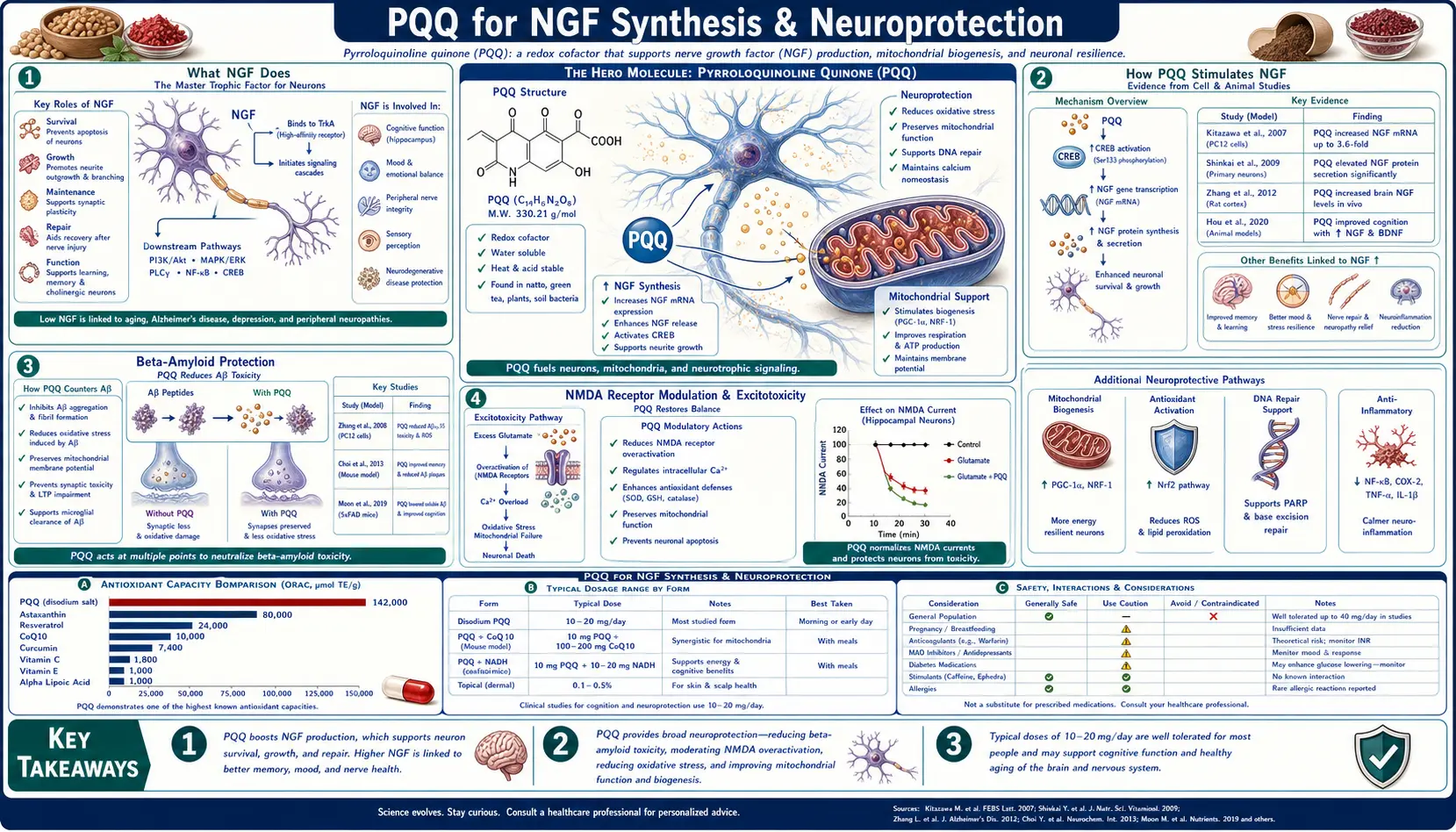
PQQ stimulates nerve growth factor (NGF) production in glial cells and astrocytes, providing a neurotrophic mechanism that supports neuronal maintenance independent of its mitochondrial-biogenesis effect. Combined with beta-amyloid aggregation reduction, mild NMDA receptor antagonism (reducing glutamate excitotoxicity), and direct mitochondrial protection of neurons, PQQ has a layered neuroprotective profile. Animal models of Alzheimer's disease show reduced plaque burden and improved memory; animal stroke models show reduced infarct size and faster post-ischemic recovery. The PQQ + lion's mane combination — two distinct routes to NGF support — has become the most popular neurotrophic stack in the cognitive longevity space.
Table of Contents
- What NGF Does
- How PQQ Stimulates NGF
- Beta-Amyloid Protection
- NMDA Receptor Modulation & Excitotoxicity
- Animal Models of Alzheimer's Disease
- Animal Models of Stroke Recovery
- Layered Neuroprotection: How the Mechanisms Combine
- The PQQ + Lion's Mane Neurotrophic Stack
- Clinical Use & Protocol
- Cautions
- Key Research Papers
- Connections
- Featured Videos
What NGF Does
Nerve growth factor (NGF) is a small secreted protein in the neurotrophin family, first identified by Rita Levi-Montalcini and Stanley Cohen (1986 Nobel Prize in Physiology or Medicine). It is the prototype of a family of trophic factors (NGF, BDNF, NT-3, NT-4) that maintain neuronal survival, support axonal growth, and enable synaptic plasticity throughout life — not just during development.
NGF's key functions in the adult brain:
- Cholinergic neuron maintenance — the basal forebrain cholinergic neurons that project to cortex and hippocampus depend on NGF for survival. These neurons are among the first lost in Alzheimer's disease, and their loss is a major driver of the cholinergic deficit that AD drugs (donepezil, rivastigmine) attempt to compensate for.
- Synaptic plasticity — NGF supports the structural changes at synapses that underlie learning and memory
- Axonal regeneration after injury — following traumatic nerve injury or stroke, NGF promotes axonal sprouting and reconnection
- Sensory neuron maintenance — small-fiber sensory neurons (relevant to peripheral neuropathy and pain syndromes) depend on NGF
NGF production declines with age. The basal forebrain cholinergic system progressively loses both NGF supply and NGF receptor expression, contributing to age-related cognitive decline and increasing vulnerability to AD pathology. Interventions that support NGF production are therefore mechanistically rational for both prevention and treatment of cognitive aging.
Pharmaceutical NGF therapy was attempted in the 1990s using intracerebroventricular NGF infusion, but adverse effects (pain, weight loss) made the approach clinically impractical. Subsequent research has focused on small-molecule NGF inducers — compounds that stimulate endogenous NGF production rather than supplying exogenous NGF. PQQ and lion's mane mushroom (Hericium erinaceus) are the two most prominent natural NGF inducers in this category.
How PQQ Stimulates NGF
PQQ's NGF-stimulating effect was first documented in cell-culture studies showing that PQQ exposure increases NGF mRNA expression and protein secretion in astrocyte and glial cell cultures. The effect is dose-dependent, occurs at physiologically relevant concentrations (consistent with what would be reached in brain tissue from oral supplementation), and is robust across multiple cell types studied.
The molecular mechanism is partly understood:
- PQQ binds glial-cell surface or intracellular targets that activate intracellular signaling cascades. The exact receptors / targets have not been fully characterized.
- Downstream signaling converges on NGF gene transcription. Cell-culture studies have implicated MAP kinase pathways, particularly ERK1/2, in PQQ's effect on NGF expression.
- NGF is secreted into the extracellular space where it acts on TrkA and p75 receptors on cholinergic neurons (and other NGF-responsive cell populations), supporting their survival and function.
The clinical relevance:
- Brain tissue and cerebrospinal fluid NGF levels are not routinely measured in human PQQ trials
- However, the cognitive trials (Itoh, Nakano, Hwang) show improvements consistent with cholinergic system support, which is mechanistically linked to NGF availability
- Animal studies with peripheral PQQ supplementation document increases in NGF expression in brain tissue, supporting the relevance of the cell-culture findings to whole-organism biology
The NGF effect appears to operate in addition to the mitochondrial biogenesis effect, not instead of it. Some PQQ effects on cognition and neuroprotection are best explained by NGF support, others by mitochondrial restoration, and still others by direct antioxidant or NMDA-modulatory mechanisms. The compound has multiple parallel mechanisms operating simultaneously in nervous tissue.
Beta-Amyloid Protection
Beta-amyloid (Aβ) peptides are the pathological hallmark of Alzheimer's disease, accumulating into extracellular plaques that contribute to neuronal dysfunction and death. Multiple aspects of Aβ pathology have been targeted pharmaceutically, with the recent monoclonal antibodies (lecanemab, donanemab) being the first to demonstrate amyloid-clearance and modest clinical effect in mild AD.
PQQ's effects on Aβ biology, established primarily in cell culture and animal models:
- Reduced Aβ aggregation — PQQ binds to Aβ peptides and reduces their tendency to form toxic oligomers and fibrils. The binding interaction has been characterized structurally in some studies.
- Reduced Aβ toxicity to hippocampal neurons — in cell-culture exposure to toxic Aβ concentrations, PQQ pretreatment substantially reduces neuronal death
- Reduced plaque deposition in AD animal models — mouse models of AD pathology (Tg2576, 3xTg-AD, APP/PS1) treated with PQQ show reduced plaque burden and improved cognitive performance
- Reduced tau hyperphosphorylation — some studies extend the protective effect to the tau pathology that accompanies amyloid in AD
The mechanism by which PQQ reduces Aβ aggregation is at least partly direct — the planar tricyclic quinone structure can intercalate into the β-sheet packing that drives Aβ oligomerization, similar to how other small molecules (curcumin, resveratrol, EGCG) interfere with amyloid assembly. The reduction in oxidative stress from improved mitochondrial function adds an indirect contribution because oxidative damage promotes Aβ aggregation.
Human clinical-trial evidence for AD-specific outcomes is limited. The available cognitive trials (Itoh, Nakano, Hwang) were conducted in cognitively healthy adults with subjective complaints, not in diagnosed AD populations. The animal-model evidence is suggestive, but the human translation has not been formally tested in randomized trials.
For users with established AD, the rational positioning is: PQQ + CoQ10 + lion's mane as adjunctive nutritional support alongside (not instead of) FDA-approved AD treatment (donepezil, memantine, and increasingly the anti-amyloid monoclonals where appropriate).
NMDA Receptor Modulation & Excitotoxicity
The NMDA (N-methyl-D-aspartate) receptor is a glutamate-gated ion channel that plays a central role in synaptic plasticity, learning, and memory. It also plays a central role in excitotoxic neuronal death — when glutamate accumulates abnormally (after stroke, traumatic brain injury, in certain neurodegenerative states), excessive NMDA receptor activation drives calcium influx that triggers neuronal death cascades.
The pharmaceutical NMDA receptor antagonist memantine is FDA-approved for moderate-to-severe Alzheimer's disease, where it provides modest cognitive and functional benefit by dampening pathological NMDA activation without blocking normal synaptic signaling.
PQQ's NMDA biology:
- PQQ binds to the glutamate-binding site of the NMDA receptor as a mild competitive antagonist. The binding has been characterized in receptor-binding assays.
- The effect is modest at physiological concentrations. Unlike memantine, PQQ does not produce strong NMDA blockade. At supplemental doses, it produces partial reduction of pathological NMDA hyperactivation without interfering with normal glutamatergic neurotransmission.
- Cell-culture studies of glutamate excitotoxicity show PQQ pretreatment reduces neuronal death with effect sizes comparable to memantine in the same model systems.
- Animal models of excitotoxic injury (NMDA injection, kainic acid injection, ischemia-reperfusion) document neuroprotective effects of PQQ pretreatment.
The clinical interpretation: at typical supplemental doses (20-40 mg/day), PQQ provides mild background NMDA receptor modulation that may contribute to its neuroprotective profile in stroke, traumatic brain injury, and chronic neurodegenerative settings. It is not a substitute for memantine in established AD where stronger NMDA modulation is clinically appropriate, but it adds a layer of background protection that memantine does not duplicate (because memantine has only the NMDA mechanism, while PQQ also has mitochondrial biogenesis and NGF support).
Animal Models of Alzheimer's Disease
Several transgenic mouse models recapitulate aspects of AD pathology: Tg2576 (Swedish APP mutation), APP/PS1 (presenilin + APP), 3xTg-AD (APP + PS1 + tau), and others. These models develop progressive Aβ deposition, synaptic loss, and cognitive impairment with age, allowing testing of disease-modifying interventions.
PQQ in AD mouse models — recurring findings across multiple published studies:
- Reduced amyloid plaque burden — histological measurements show 20-40% reductions in plaque area or count in PQQ-supplemented animals compared to control diet
- Improved memory performance — Morris water maze, novel object recognition, and contextual fear conditioning all show partial preservation of memory in PQQ-treated animals
- Reduced neuroinflammation — microglial activation markers, TNF-α, and IL-6 in brain tissue are lower in PQQ-treated mice
- Preserved cholinergic neuron numbers — consistent with the NGF support mechanism, basal forebrain cholinergic neurons are partially preserved
- Improved mitochondrial function in brain tissue — respiratory chain protein expression and mitochondrial DNA copy number are higher
The translational caveat is substantial: AD mouse models reproduce the amyloid pathology of AD, but they do not reproduce the full clinical syndrome, and many interventions that work beautifully in mouse models fail in human trials. This is a known issue with all preclinical AD research, not specific to PQQ.
For PQQ specifically, the absence of large randomized trials in AD patients means the animal-model evidence is suggestive but not confirmatory. The most defensible clinical position is to use PQQ as nutritional support for cognitive health in older adults (where the cognitive-trial evidence supports the practice) rather than to claim it as an AD treatment.
Animal Models of Stroke Recovery
Ischemic stroke produces a core of necrotic tissue surrounded by a "penumbra" of partially damaged tissue that can be rescued if circulation is restored and excitotoxic / oxidative damage is limited. The penumbra is the target of acute stroke therapies (tPA thrombolysis, mechanical thrombectomy) and of neuroprotective adjuncts that have been studied for decades.
PQQ in animal stroke models (typically middle cerebral artery occlusion in rats or mice):
- Reduced infarct size — pretreated animals show smaller core infarct on histology after standardized ischemia-reperfusion
- Reduced penumbral damage — tissue at risk shows better preservation
- Faster neurological recovery — standardized neurological scoring shows better outcomes in PQQ-treated animals
- Reduced markers of excitotoxic damage — consistent with the NMDA modulation mechanism
- Improved post-ischemic mitochondrial function — respiratory chain integrity is better preserved
The mechanisms operating in stroke models combine PQQ's antioxidant, NMDA-modulatory, mitochondrial-protective, and NGF-supporting effects — all of which are relevant to penumbral tissue rescue. The animal data are consistent across multiple labs and stroke models.
Human translation is again limited. Acute stroke neuroprotection has been a graveyard of pharmaceutical development — dozens of compounds with excellent animal data failed in human trials due to timing issues (humans present to medical care hours after stroke onset, beyond the window when most neuroprotective interventions are effective) and complexity of the human stroke population (mixed etiology, comorbidities, varied infarct location).
The defensible clinical use for PQQ in stroke is as part of long-term post-stroke recovery and secondary prevention — not as acute neuroprotection. In the chronic phase (weeks to years post-stroke), PQQ + CoQ10 + lion's mane is a reasonable adjunct to standard secondary-prevention therapy (anticoagulation as indicated, statin, BP control, lifestyle modification) to support the brain's remaining cognitive capacity and possibly accelerate functional recovery.
Layered Neuroprotection: How the Mechanisms Combine
PQQ's neuroprotective profile is unusual because four mechanisms operate in parallel, each addressing a different facet of neuronal vulnerability:
| Mechanism | Cellular Effect | Most Relevant To |
|---|---|---|
| Mitochondrial biogenesis | More mitochondria; better synaptic energy supply | Cognitive aging, post-stroke recovery |
| NGF synthesis support | Trophic support for cholinergic and other NGF-responsive neurons | AD prevention, cholinergic-system aging |
| NMDA receptor modulation | Reduced glutamate excitotoxicity | Stroke, TBI, chronic neurodegeneration |
| Beta-amyloid protection | Reduced Aβ aggregation and toxicity | AD prevention, mild AD adjunct |
| Antioxidant scavenging | Reduced oxidative damage to neurons; catalytic durability (~20,000 cycles) | All chronic neurological conditions |
The clinical implication of this multi-mechanism profile is that PQQ does not need to be the strongest intervention for any single mechanism to be useful. The cumulative effect of moderate support across five mechanisms produces a meaningful integrated neuroprotective profile that single-mechanism drugs cannot reproduce.
This is why PQQ has become a fixture of comprehensive cognitive-aging protocols. It is not "the AD drug" or "the stroke neuroprotectant" — it is a broad-spectrum nutritional intervention that touches multiple neuronal-vulnerability mechanisms with a consistent safety profile.
The PQQ + Lion's Mane Neurotrophic Stack
The two most prominent natural NGF inducers are PQQ and lion's mane mushroom (Hericium erinaceus). They work through different molecular mechanisms but converge on the same downstream output (NGF availability supporting cholinergic and other NGF-responsive neurons), which makes them a logical combination.
Lion's mane NGF mechanism
Lion's mane mushroom contains two classes of bioactive compounds that stimulate NGF synthesis:
- Hericenones — aromatic compounds in the fruiting body of the mushroom (the part that grows above ground). Hericenones cross the blood-brain barrier and directly stimulate NGF synthesis in neurons and glial cells.
- Erinacines — diterpenoid compounds in the mycelium (the underground "root" network). Erinacines are more potent NGF stimulators than hericenones and have shown effects in animal models of cognitive impairment and peripheral nerve regeneration.
Human clinical trials of lion's mane in mild cognitive impairment (Mori 2009 and follow-up studies) document significant cognitive improvement at 250-500 mg three times daily for 16 weeks, with reversion toward baseline upon discontinuation.
Why the combination is rational
- Different molecular triggers, same downstream output. PQQ activates NGF expression through one signaling pathway (likely ERK/MAPK-mediated); hericenones/erinacines do so through a different pathway. The downstream effect (NGF availability) is additive.
- Complementary additional mechanisms. PQQ adds mitochondrial biogenesis, antioxidant scavenging, NMDA modulation, Aβ protection. Lion's mane adds direct neurogenesis support and broad neuroregenerative effects. The two compounds' non-NGF mechanisms are non-overlapping.
- Tolerability profile. Both compounds are extremely well tolerated with minimal drug interactions. The combination has not generated safety signals in users.
- Functional medicine convention. The PQQ + lion's mane combination is now the standard "neurotrophic stack" in functional medicine cognitive-aging protocols, often combined with CoQ10 for the mitochondrial-function arm.
Typical neurotrophic stack
- PQQ: 20 mg morning
- Ubiquinol (CoQ10): 100-200 mg morning
- Lion's mane mushroom extract: 500-1000 mg morning + 500-1000 mg midday (preferably standardized to hericenone / erinacine content; full-spectrum extract using both fruiting body and mycelium)
- Optional addition: Phosphatidylserine 100 mg, Acetyl-L-carnitine 1000 mg, Alpha-GPC 300 mg
The combination is most appropriate for adults 50+ concerned about cognitive aging, those with subjective cognitive complaints, post-illness cognitive recovery, or as part of broader cognitive-longevity protocols. It is not a substitute for AD treatment in established disease and should be considered preventive / supportive rather than curative.
Clinical Use & Protocol
For cognitive-aging prevention (most common indication)
- PQQ 20 mg + ubiquinol 100-200 mg morning
- Lion's mane 500-1000 mg twice daily
- Mediterranean or MIND diet, aerobic exercise, sleep optimization, B-vitamin status (B12, folate, B6), blood pressure / cholesterol management
- Reassess at 12 weeks; continue indefinitely if subjectively beneficial
For post-stroke cognitive recovery (chronic phase, >1 month post-event)
- The neurotrophic stack above, plus:
- Citicoline 500-2000 mg daily (the one nutritional intervention with the strongest stroke-recovery trial evidence)
- Standard secondary prevention (anticoagulation as indicated, statin, BP control)
- Aggressive rehabilitation (speech, occupational, physical therapy as indicated)
For early MCI or subjective cognitive impairment
- The neurotrophic stack as above
- Specialist referral (neurology, geriatric medicine) for formal cognitive evaluation
- Workup for treatable causes (B12 deficiency, hypothyroidism, depression, sleep apnea, medication effects)
- Lifestyle interventions are the primary lever; supplements are adjunctive
For diagnosed mild AD on FDA-approved drugs
- The neurotrophic stack as adjunctive support, NOT replacement for prescribed AD treatment
- Discuss with prescribing physician before adding supplements (interactions are minimal but coordination matters)
- Realistic expectations: supplements provide supportive benefit, not disease modification
Cautions
- Not a substitute for AD treatment — patients with diagnosed AD should remain on prescribed cholinesterase inhibitors, memantine, and (where appropriate) anti-amyloid monoclonal antibodies. PQQ + lion's mane is adjunctive.
- Not an acute stroke intervention — the neuroprotective animal data on PQQ do not translate to acute stroke care. Call 911 for stroke symptoms; tPA / thrombectomy / stroke unit care are the evidence-based interventions in the acute window.
- Cognitive complaints need primary evaluation — new or progressive cognitive symptoms warrant medical evaluation. Don't self-treat with supplements while ignoring potentially reversible causes (B12 deficiency, hypothyroidism, depression, medication effects, sleep apnea).
- Bleeding considerations — both PQQ and lion's mane have theoretical antiplatelet effects (modest). Mention to physicians if you take warfarin, DOACs, or antiplatelet drugs.
- Lion's mane allergy — rare but reported. Discontinue at first sign of skin rash or respiratory symptoms.
- Quality matters — PQQ is expensive and frequently under-dosed in combination products. Lion's mane quality varies dramatically — mycelium-grown-on-grain products may contain mostly starch with minimal active compounds. Choose third-party-tested fruiting body + mycelium extracts.
- Realistic effect-size expectations — the neurotrophic stack supports cognitive function modestly; it does not produce drug-like cognitive enhancement
Key Research Papers
- PQQ stimulates nerve growth factor synthesis in astrocytes (mechanism studies) — PubMed: PQQ NGF astrocytes
- PQQ neuroprotection: beta-amyloid aggregation reduction — PubMed: PQQ Aβ aggregation
- PQQ NMDA receptor modulation and glutamate excitotoxicity — PubMed: PQQ NMDA excitotoxicity
- PQQ in transgenic AD mouse models (plaque reduction, memory) — PubMed: PQQ in AD mouse models
- PQQ in cerebral ischemia / stroke (infarct reduction) — PubMed: PQQ cerebral ischemia / stroke
- Hericium erinaceus (lion's mane) hericenones and NGF synthesis — PubMed: lion's mane hericenones / NGF
- Erinacines in lion's mane mycelium and neuroprotection — PubMed: erinacines / mycelium / neuroprotection
- Mori K et al. (2009). Lion's mane improves mild cognitive impairment trial — PubMed: Mori 2009 lion's mane MCI
- Memantine NMDA antagonist mechanism (Alzheimer's drug reference) — PubMed: memantine NMDA Alzheimer's
- Basal forebrain cholinergic system and NGF dependence — PubMed: cholinergic system + NGF
- Citicoline in post-stroke cognitive recovery — PubMed: citicoline post-stroke
- NGF therapy for Alzheimer's: historical intracerebroventricular trials — PubMed: NGF intracerebroventricular AD trials
PubMed Topic Searches
- PubMed: PQQ neuroprotection
- PubMed: PQQ NGF
- PubMed: PQQ + lion's mane combination
- PubMed: lion's mane cognitive clinical trials
- PubMed: NGF inducers / small molecules
Connections
- PQQ Overview
- PQQ Benefits Hub
- PQQ for Mitochondrial Biogenesis
- PQQ for Cognition
- PQQ for Sleep & Mood
- Lion's Mane Mushroom
- CoQ10
- ALA for Neuroprotection
- Methylene Blue
- NAD+ & NMN
- All Antioxidants
- Alzheimer's Disease
- Parkinson's Disease
- Brain Fog
- Fatigue
- Chronic Fatigue Syndrome
- Oxidative Stress
- Longevity Protocols
- Vitamin B12
- Magnesium