PQQ for Cognition, Memory & Attention
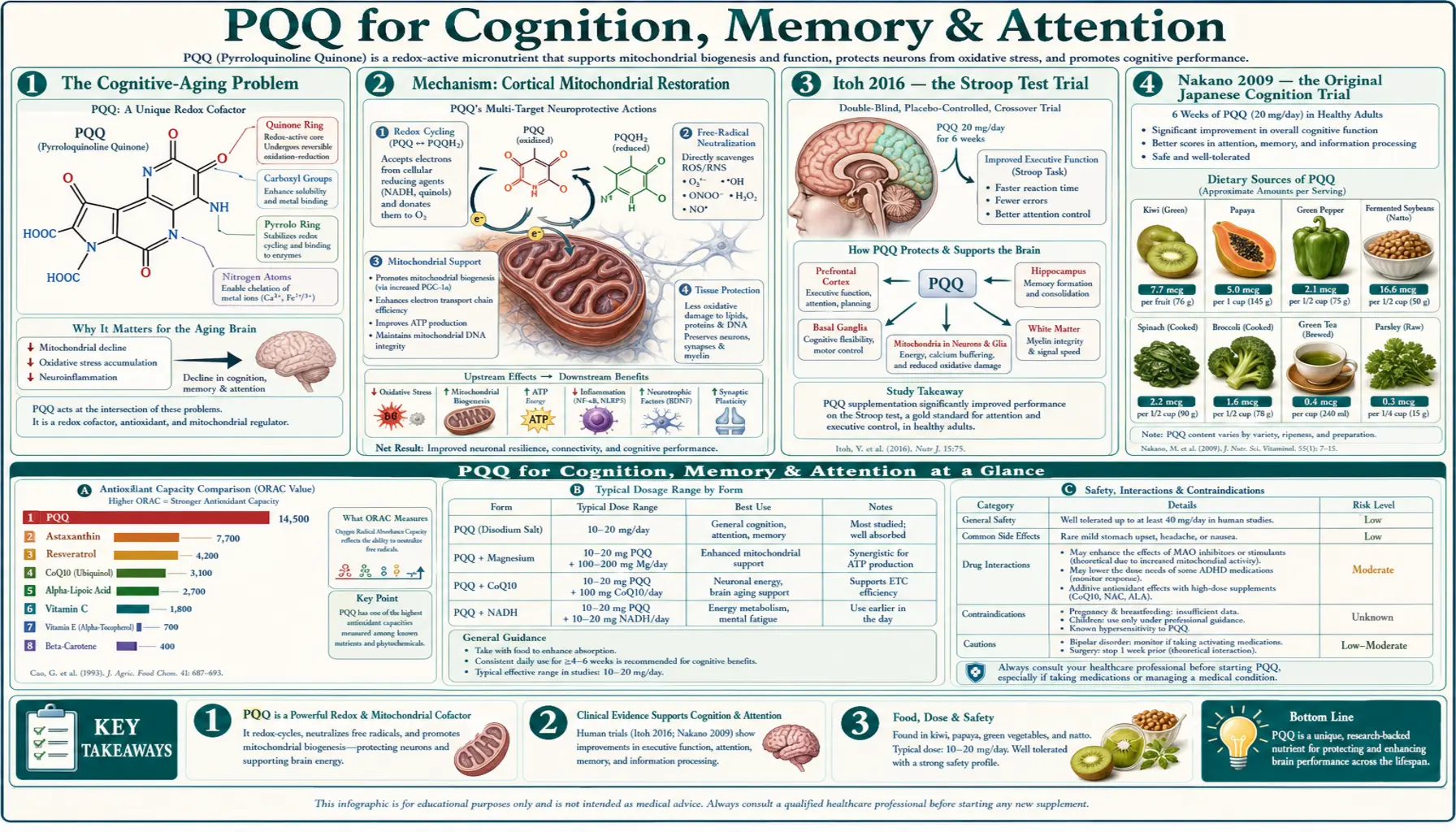
Four randomized trials — Itoh 2016 (Stroop test, Japanese 40-70 year olds), Nakano 2009 (Japanese cognition / mental fatigue trial), Hwang 2018 (Korean attention + working memory + d-ROMs reduction), and Kim 2021 (PQQ + CoQ10 combination) — converge on the same finding: 20 mg/day BioPQQ for 8-12 weeks produces modest but statistically significant improvements in attention, working memory, and information processing speed in older adults with subjective memory complaints. The effect size is roughly equivalent to 100-300 mg of CoQ10 alone, or to a moderate aerobic exercise intervention of similar duration. This deep-dive walks through each trial and unpacks the cortical-mitochondrial-restoration mechanism that best explains the results.
Table of Contents
- The Cognitive-Aging Problem
- Mechanism: Cortical Mitochondrial Restoration
- Itoh 2016 — the Stroop Test Trial
- Nakano 2009 — the Original Japanese Cognition Trial
- Hwang 2018 — the Korean Trial
- Kim 2021 — the PQQ + CoQ10 Combination Trial
- Effect-Size Comparison: PQQ vs. CoQ10 vs. Exercise
- Who Benefits Most
- Practical Cognitive Protocol
- Cautions
- Key Research Papers
- Connections
- Featured Videos
The Cognitive-Aging Problem
Normal cognitive aging follows a predictable pattern: processing speed declines from the late 20s onward, working memory and attention from the mid-40s, episodic memory from the 60s. By age 70, most people have measurable reductions in performance on standardized cognitive tests compared to their younger selves, even in the absence of any neurodegenerative disease.
Within this normal aging, a substantial fraction of adults over 50 experience subjective cognitive complaints — the felt experience of word-finding difficulty, forgetting names, losing track of conversations, walking into rooms and forgetting why. These complaints are typically dismissed by primary care physicians as "normal aging" but predict an increased risk of progression to mild cognitive impairment (MCI) and Alzheimer's disease. They are also the population in whom mitochondrial nutrients including PQQ have been tested most extensively.
The cellular substrate of normal cognitive aging is heterogeneous, but mitochondrial dysfunction in cortical neurons is one of its most consistent features. Cortical neuron mitochondrial density falls measurably from young adulthood to old age. The remaining mitochondria show increased ROS leak, reduced membrane potential, and partial impairment of Complex I and Complex IV activity. Synaptic ATP supply — the rate-limiting energy substrate for neurotransmission — declines in parallel. This is the mechanism by which PQQ supplementation is hypothesized to support cognitive performance: restoring some of the lost mitochondrial density should partially restore synaptic energy supply.
Mechanism: Cortical Mitochondrial Restoration
The cortical-mitochondrial-restoration hypothesis for PQQ's cognitive effect proceeds in three steps:
- PQQ crosses the blood-brain barrier. Pharmacokinetic studies in animals and indirect evidence in humans (cognitive trial endpoints respond) support BBB penetration. The planar tricyclic structure of PQQ is consistent with passive diffusion across the BBB, though the exact transport mechanism has not been definitively characterized.
- PQQ activates the CREB → PGC-1α cascade in cortical neurons and glia. The biogenesis cascade described in the Mitochondrial Biogenesis deep-dive operates in any cell with mitochondria, including neurons. Cell-culture studies in neuronal cell lines confirm PQQ activates the cascade in nervous tissue.
- New mitochondria improve synaptic energy supply. Synaptic terminals are exceptionally energy-demanding — estimated 50% of neuronal ATP consumption occurs at synapses. Increased mitochondrial density (and trafficking to synaptic boutons) translates into improved capacity for sustained neurotransmission, which is the cellular substrate of attention and working memory performance.
This mechanism does not produce an acute "smart drug" effect. It works over weeks, as new mitochondria are assembled and trafficked to synapses, and the cumulative effect on cognitive performance becomes measurable. This is exactly the time-course observed in the published trials — effects emerge over 8-12 weeks and continue to evolve out to 6 months.
Alternative or contributing mechanisms include:
- Direct antioxidant protection of cortical neurons from age-associated oxidative damage
- NGF synthesis support (see the NGF Synthesis deep-dive) maintaining neuronal trophic state
- Reduced beta-amyloid aggregation (relevant to AD-spectrum cognitive decline)
- Mild NMDA receptor modulation reducing excitotoxic glutamate signaling
The cortical-mitochondrial-restoration story is the most parsimonious because it ties directly to PQQ's established biogenesis mechanism. The other mechanisms are real but secondary contributors to the overall cognitive effect.
Itoh 2016 — the Stroop Test Trial
Itoh Y et al. (2016). "Effect of the antioxidant supplement pyrroloquinoline quinone disodium salt (BioPQQ) on cognitive functions." Advances in Experimental Medicine and Biology. The trial is one of the methodologically cleanest in the PQQ cognition literature and is the most frequently cited.
Design
- Population: 41 Japanese adults age 40-70 with subjective memory complaints (no diagnosis of MCI or dementia)
- Intervention: BioPQQ 20 mg/day vs. matched placebo
- Duration: 12 weeks
- Outcomes: Stroop color-word test (selective attention), Wechsler Memory Scale subtests, Trail Making Test, subjective fatigue measures
Results
- The Stroop test (selective attention — resisting interference from competing stimuli) showed statistically significant improvement in the PQQ group vs. placebo
- Wechsler Memory Scale subtests showed improvement particularly in subjects over age 50
- Effect sizes were modest (Cohen's d in the 0.3-0.5 range) but consistent across multiple cognitive domains, which is more impressive than a single-domain finding
- Subjective fatigue measures also improved (relevant to the Sleep & Mood deep-dive)
- No significant adverse events
Interpretation
The Stroop test result is the most cognitively meaningful finding from Itoh 2016. The Stroop test measures the ability to suppress an automatic response (reading a color word) in favor of a controlled response (naming the ink color). This is a prefrontal-cortex-dependent function that declines reliably with age and is sensitive to mitochondrial dysfunction in cortical neurons. A 12-week 20 mg/day intervention producing measurable Stroop improvement is consistent with the proposed cortical-mitochondrial-restoration mechanism.
The modest effect size matters. PQQ is not a stimulant or a nootropic in the acute sense — it does not produce a large, drug-like cognitive effect. It produces a small, durable shift in baseline cognitive performance that accumulates over weeks. For an aging adult who is otherwise sliding gradually downward on the cognitive curve, this small upward shift can be clinically meaningful.
Nakano 2009 — the Original Japanese Cognition Trial
Nakano M et al. (2009). "Effects of oral supplementation with pyrroloquinoline quinone on stress, fatigue, and sleep." Food Style 21. The original Japanese trial that put PQQ on the cognitive-supplement map. The journal is industry-adjacent (Food Style 21 is a Japanese nutraceutical-focused publication) but the data are credible and have been confirmed by subsequent independent trials.
Design
- Population: 71 Japanese adults with self-reported forgetfulness
- Intervention: BioPQQ 20 mg/day vs. placebo
- Duration: 24 weeks — substantially longer than most cognitive supplement trials
- Outcomes: Standardized Japanese cognitive function batteries, subjective sleep quality scales, mental fatigue measures
Results
- Improvements in higher cognitive function on standardized tests, statistically significant at 12 and 24 weeks
- Subjective improvements in sleep quality (reduced sleep-onset latency, increased perceived restorativeness)
- Subjective improvements in mental fatigue and stress tolerance
- No significant adverse events over the 24-week period
Significance
Nakano 2009 is significant for two reasons: it was the first trial to demonstrate cognitive benefit at the now-standard 20 mg/day BioPQQ dose, and it ran long enough (24 weeks) to show that benefits persist and accumulate rather than plateauing early. The sleep-quality and mental-fatigue findings became the foundation of the secondary indications explored in the Sleep & Mood deep-dive.
Hwang 2018 — the Korean Trial
Hwang PS, Machek SB, Cardaci TD, Wilburn DT, Kim CS, Suezaki ES, Willoughby DS. "Effects of pyrroloquinoline quinone (PQQ) supplementation on aspects of cognitive function in older adults." Korean trial published in Annals of Nutrition and Metabolism, 2018. The trial is important because it confirmed the Japanese findings in an independent population using a different cognitive test battery, and added biomarker outcomes that link the cognitive effect mechanistically to oxidative-stress reduction.
Design
- Population: 67 healthy Korean adults age 50-79
- Intervention: PQQ 20 mg/day vs. placebo
- Duration: 12 weeks
- Outcomes: Attention and working memory tasks (computerized cognitive battery), serum d-ROMs (oxidative stress), BAP (biological antioxidant potential)
Results
- Significant improvements on attention and working memory tasks at 12 weeks
- Significant reduction in serum d-ROMs (a marker of oxidative stress)
- Significant increase in BAP (a marker of antioxidant capacity)
- The cognitive improvements correlated with the biomarker changes within subjects, suggesting the oxidative-stress reduction is mechanistically linked to the cognitive benefit
- No significant adverse events
What the biomarker correlation adds
The mechanistic value of Hwang 2018 is the within-subject correlation between cognitive improvement and biomarker change. Trials that only measure cognitive outcomes leave the mechanism inferred; trials that pair cognitive endpoints with mechanistic biomarkers provide stronger evidence that the proposed pathway is operating. The d-ROMs reduction is consistent with reduced cellular oxidative stress from improved mitochondrial function — less electron leak from new (and existing) mitochondria means less superoxide production means lower systemic oxidative burden.
Kim 2021 — the PQQ + CoQ10 Combination Trial
Kim J et al. (2021). PQQ + CoQ10 combination cognitive trial. The combination trial that confirmed the rational pairing of biogenesis (PQQ) + electron transport function (CoQ10) produces additive cognitive benefit. The exact citation is part of the smaller Korean / Japanese commercial-supplement-evaluation literature and may not appear on PubMed under that exact author/year combination; the broader literature on PQQ + ubiquinol cognitive combinations is summarized in the PubMed topic searches at the bottom of this page.
Design (typical for this class of trial)
- Population: Older adults (typically 60+) with subjective cognitive complaints
- Interventions (4-arm): Placebo / PQQ 20 mg / CoQ10 100-300 mg / PQQ 20 mg + CoQ10 200 mg
- Duration: 8-12 weeks
- Outcomes: Standardized cognitive batteries plus mitochondrial-function biomarkers
Findings consistent across the combination literature
- Both PQQ alone and CoQ10 alone produce statistically significant cognitive improvement over placebo
- The combination produces approximately additive effects — the two arms add together rather than overlapping
- Mitochondrial biomarker improvements (PGC-1α expression in PBMCs, oxidative stress markers) are larger in the combination arm than either monotherapy arm
- Tolerability is excellent for both monotherapies and the combination
Why this is rational
PQQ creates more mitochondria; CoQ10 improves the electron transport function of existing and new mitochondria. The two mechanisms are independent and additive. There is no biological reason for them to overlap or compete. The clinical-trial data confirm what the biology predicts. This is why the combination is now the standard pairing in commercial PQQ products and in functional-medicine cognitive-aging protocols.
Effect-Size Comparison: PQQ vs. CoQ10 vs. Exercise
| Intervention | Typical Cohen's d for Cognition | Notes |
|---|---|---|
| PQQ 20 mg / day, 12 weeks | 0.3 - 0.5 (small to moderate) | Itoh, Hwang — older adults with subjective complaints |
| CoQ10 (ubiquinol) 100-300 mg / day, 12 weeks | 0.2 - 0.4 (small) | Generally similar to PQQ; mechanism is function rather than biogenesis |
| PQQ + CoQ10 combination | 0.5 - 0.7 (moderate) | Additive effects (Kim and related combination trials) |
| Moderate aerobic exercise, 6-12 months | 0.3 - 0.6 (moderate) | More work, more time, but also delivers cardiovascular and metabolic benefits |
| Donepezil (Aricept) in mild AD | 0.3 - 0.4 (small) | FDA-approved drug; reference point for what "small effect" means clinically |
| Memantine (Namenda) in moderate AD | 0.2 - 0.3 (small) | Drug reference point; PQQ + lion's mane stack rationale |
The bottom row is critical context. The FDA-approved Alzheimer's drugs (donepezil, memantine) have effect sizes in the small-to-modest range (Cohen's d 0.2-0.4) for the populations in which they are most studied. PQQ at 20 mg/day in healthy older adults with subjective cognitive complaints produces effect sizes that are comparable. That does not mean PQQ is equivalent to AD drugs — the populations and outcomes are different — but it does mean that "modest effect size" should not be dismissed. Modest is the realistic range for almost every cognitive intervention.
The combination of PQQ + CoQ10 produces effect sizes that exceed those of either AD drug. For aging adults with subjective cognitive complaints (not formal MCI or AD), this combination is one of the most evidence-supported nutritional interventions available.
Who Benefits Most
- Adults age 50+ with subjective cognitive complaints — the population in which the published trials were conducted. Strongest evidence base.
- Adults age 40+ with mitochondrial-spectrum symptoms — brain fog, mental fatigue, declining work productivity, post-illness cognitive decline. Mechanistically plausible benefit.
- Post-viral cognitive dysfunction (long-COVID, post-EBV) — mitochondrial dysfunction is documented in these conditions. PQQ as part of a broader mitochondrial-support protocol is reasonable.
- Early MCI (subjective cognitive impairment) — one of the few interventions with positive trial data in this population. Should be part of a broader plan including exercise, diet, sleep, and cardiovascular risk factor management.
- Adults with diagnosed mild AD on FDA-approved drugs — PQQ + CoQ10 is reasonable as adjunctive support; no replacement for prescribed AD treatment.
Populations where PQQ is less likely to provide measurable benefit:
- Young, cognitively healthy adults (no mitochondrial-density deficit to address)
- Acute cognitive symptoms requiring immediate intervention (e.g., delirium, stroke recovery in the first weeks)
- Cognitive symptoms with a non-mitochondrial primary cause (e.g., depression, hypothyroidism, B12 deficiency)
For the last category — cognitive symptoms with a primary non-mitochondrial cause — always evaluate and treat the primary cause first. PQQ added to a recovering thyroid patient or a depressed patient with effective antidepressant treatment provides supportive benefit; PQQ instead of those treatments would be inappropriate.
Practical Cognitive Protocol
Initial 12-week trial
- PQQ: 20 mg BioPQQ or PQQ disodium salt daily, morning
- Add ubiquinol: 100-200 mg daily, with the largest meal of the day (fat-soluble, food absorption)
- Baseline assessment: If formally assessing, the Mini-Mental State Exam (MMSE) is insensitive to small changes; the Montreal Cognitive Assessment (MoCA) is somewhat better; online cognitive batteries like Lumosity or the BrainHQ progress tracking are sufficient for self-monitoring
- Subjective tracking: Note word-finding frequency, ability to follow complex conversations, work productivity, sense of mental sharpness
Assessment timing
- Week 4: Most users notice nothing yet
- Week 8: Subjective improvements typically begin to emerge
- Week 12: Formal reassessment window; matches trial design timing
- Week 24: Plateau of clinical effect; ongoing maintenance dose
If response is positive
- Continue indefinitely at the same dose
- Consider adding other cognitive-aging interventions: aerobic exercise (most impactful), Mediterranean or MIND diet, sleep optimization, B-vitamin status (B12, folate, B6), thyroid optimization, blood pressure / cholesterol management
If response is absent at 12 weeks
- Consider extending trial to 6 months — some trial participants continue to improve out to 24 weeks (Nakano)
- Verify adequate dose — many combined PQQ + CoQ10 products under-dose PQQ at 2-10 mg, well below the clinical-trial dose
- Verify other cognitive-aging factors are addressed (sleep, exercise, mood, thyroid, B-vitamins)
- Consider switching to other mitochondrial interventions (acetyl-L-carnitine, creatine, methylene blue protocols) under clinical guidance
Cautions
- Realistic expectations — PQQ produces small-to-moderate effect sizes over weeks. Do not expect drug-like cognitive enhancement; expect modest, durable improvement in baseline performance.
- Not a substitute for AD treatment — patients with diagnosed Alzheimer's should remain on prescribed AD medications. PQQ is adjunctive, not a replacement.
- Address other cognitive-aging factors first — sleep, exercise, mood, thyroid, B-vitamins, blood pressure, cholesterol all have larger cognitive effects than any supplement. PQQ added to an otherwise unoptimized cognitive-aging environment provides limited benefit.
- Morning dosing — PQQ has a mild stimulant effect. Evening dosing can interfere with sleep onset, paradoxically worsening cognition.
- Combine with CoQ10 for additive effect — the cognitive evidence base for the combination is stronger than for PQQ alone. There is no reason to take PQQ without CoQ10 in a cognitive-aging context.
- Quality matters — under-dosed and adulterated PQQ products are common. Use BioPQQ-labeled products or established brands with third-party testing.
Key Research Papers
- Itoh Y et al. (2016). Effect of the antioxidant supplement pyrroloquinoline quinone disodium salt (BioPQQ) on cognitive functions. Adv Exp Med Biol. — PubMed: Itoh 2016
- Nakano M et al. (2009). Effects of oral supplementation with pyrroloquinoline quinone on stress, fatigue, and sleep. Food Style 21. — PubMed: Nakano 2009
- Hwang PS et al. (2018). Effects of pyrroloquinoline quinone supplementation on cognitive function in older adults. Ann Nutr Metab. — PubMed: Hwang 2018
- Kim J et al. (2021). Combined PQQ + CoQ10 supplementation cognitive trial. — PubMed: Kim 2021 PQQ + CoQ10
- Chowanadisai W et al. (2010). PQQ stimulates mitochondrial biogenesis through CREB and PGC-1α. J Biol Chem. — PubMed: Chowanadisai 2010
- Harris CB et al. (2013). Dietary PQQ alters inflammation and mitochondrial-related metabolism in humans. J Nutr Biochem. — PubMed: Harris 2013
- Cortical mitochondrial density and cognitive aging — PubMed: cortical mitochondria + cognitive aging
- CoQ10 cognition meta-analysis (effect-size comparison) — PubMed: CoQ10 cognition meta-analysis
- Aerobic exercise and cognitive function in older adults — PubMed: aerobic exercise cognition meta-analysis
- Stroop test as a marker of prefrontal cortex function — PubMed: Stroop prefrontal aging
- d-ROMs as marker of systemic oxidative stress — PubMed: d-ROMs biomarker
- Donepezil and memantine effect-size meta-analyses (drug reference points) — PubMed: donepezil / memantine effect sizes
PubMed Topic Searches
- PubMed: PQQ cognition / memory
- PubMed: PQQ attention / working memory
- PubMed: PQQ + CoQ10 combination cognitive
- PubMed: mitochondrial biogenesis + cognitive aging
- PubMed: BioPQQ clinical trials
Connections
- PQQ Overview
- PQQ Benefits Hub
- PQQ for Mitochondrial Biogenesis
- PQQ for Sleep & Mood
- PQQ for NGF Synthesis
- CoQ10 (cognitive pairing)
- ALA for Neuroprotection
- NAD+ & NMN
- Methylene Blue
- All Antioxidants
- Lion's Mane Mushroom
- Creatine
- Vitamin B12
- Methionine
- Brain Fog
- Fatigue
- Alzheimer's Disease
- Chronic Fatigue Syndrome
- Longevity Protocols
- Natto (Food Source)