Vitamin D3 — Benefits Deep Dive
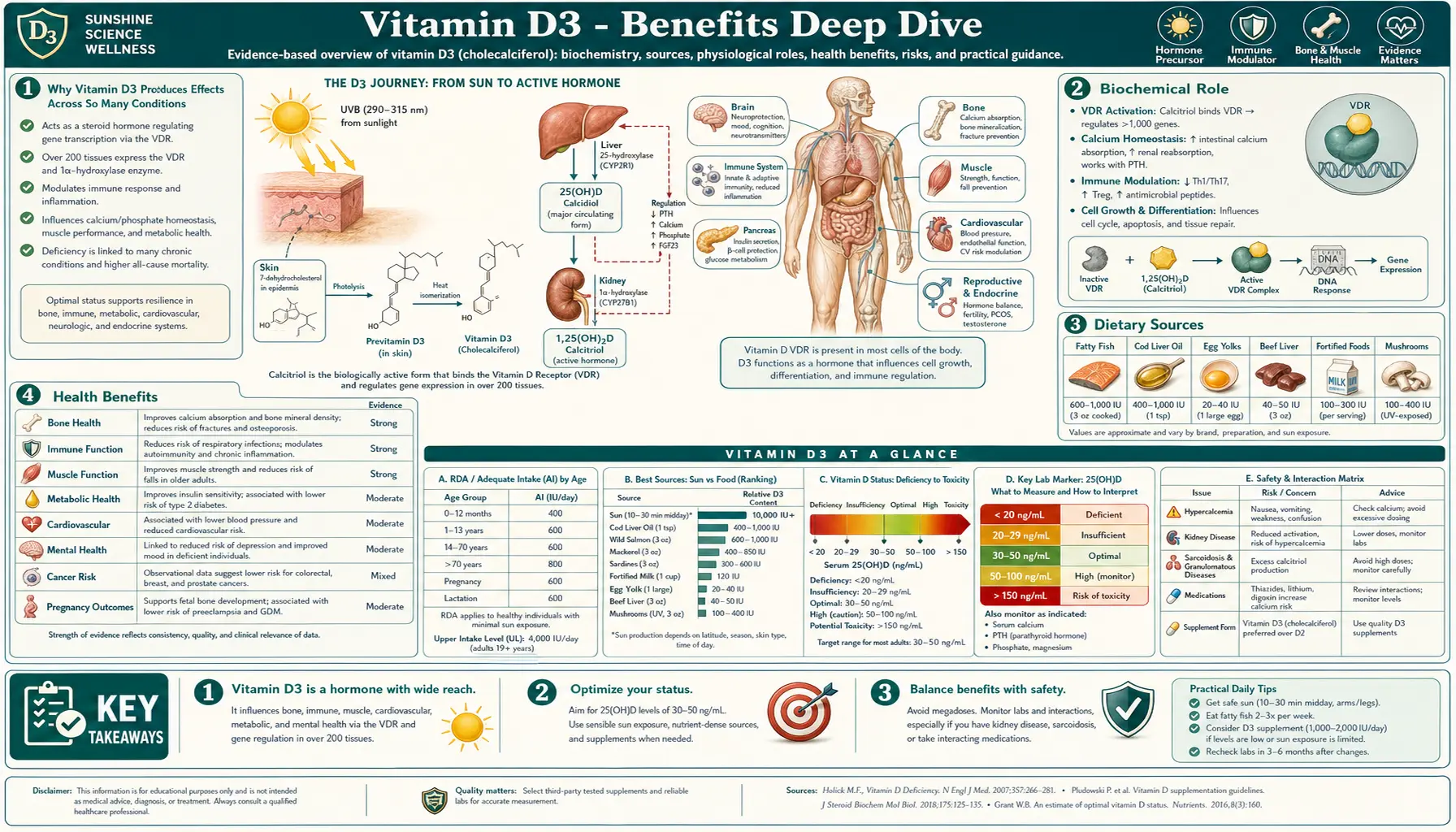
Vitamin D3 (cholecalciferol) produces clinically meaningful effects across an unusually wide range of conditions because it is not really a vitamin at all — it is a secosteroid prohormone whose active form (calcitriol) acts as a nuclear-receptor ligand that regulates the expression of approximately 1,000 genes (roughly 5% of the entire human genome) through Vitamin D Receptors (VDRs) found in virtually every tissue. Each benefit page below explores one major therapeutic application in clinical-trial depth, with target 25(OH)D ranges, dose-response data, and the synergistic-nutrient cofactors (K2, magnesium, vitamin A) that determine whether D3 supplementation will produce the expected benefit.
Deep-Dive Articles
Bone Health & Fracture Prevention
The classical indication. Calbindin and TRPV6 upregulation in intestinal epithelium, PTH suppression, RANKL/OPG osteoclast regulation, and the Bischoff-Ferrari meta-analyses establishing fracture reduction at 25(OH)D > 30 ng/mL. Why the calcium-D3-K2-magnesium quartet is mandatory and why D3 alone without K2 can paradoxically promote arterial calcification.
Immune Function & Respiratory Infection
Calcitriol is the most potent known inducer of cathelicidin LL-37, the broad-spectrum antimicrobial peptide. The Martineau 2017 BMJ individual-patient-data meta-analysis (25% reduction in acute respiratory infection, 70% in the most deficient), the Castillo 2020 Cordoba calcifediol trial in hospitalized COVID-19 patients, and why immune outcomes require 50-80 ng/mL targets rather than the 30 ng/mL minimum used for bone.
Autoimmune Disease
The VITAL extension trial established 22% reduction in incident autoimmune disease at 2,000 IU/day over 5 years. Deep dive through the Ascherio MS cohort and geographic latitude gradient, type 1 diabetes prevention in supplemented Finnish infants, IBD/Crohn's, Hashimoto's antibody reduction, and the Coimbra high-dose protocol used for MS, lupus, and psoriasis under specialist supervision.
Mood & Depression
VDR expression in hippocampus, prefrontal cortex, and cingulate cortex. Calcitriol regulation of TPH2 (tryptophan hydroxylase 2) gating serotonin synthesis in the brain. Sepehrmanesh 2016 RCT (50,000 IU weekly improved BDI scores significantly), seasonal affective disorder, and emerging evidence for anxiety and PMDD.
Table of Contents
- Deep-Dive Articles
- Why Vitamin D3 Produces Effects Across So Many Conditions
- Research Papers: Bone Health & Fracture Prevention
- Research Papers: Immune Function & Respiratory Infection
- Research Papers: Autoimmune Disease
- Research Papers: Mood & Depression
- Research Papers: Cross-Cutting (Mechanism, Cofactors, Safety)
- External Authoritative Resources
- Connections
- Featured Videos
Why Vitamin D3 Produces Effects Across So Many Conditions
Most nutrients have one or two primary mechanisms producing a narrow range of effects. Vitamin D3 is fundamentally different because its active form, calcitriol (1,25-dihydroxyvitamin D3), is a nuclear-receptor ligand — functionally a hormone — and the Vitamin D Receptor (VDR) is expressed in virtually every tissue and cell type in the body. Calcitriol-VDR complexes bind to Vitamin D Response Elements (VDREs) in promoter regions and regulate the transcription of roughly 1,000 genes:
- Mineral homeostasis — calbindin and TRPV6 upregulation drives intestinal calcium absorption from 10-15% to 30-40%; PTH suppression prevents secondary hyperparathyroidism. This is the classical mechanism behind effects on bone health, fracture prevention, and osteoporosis.
- Innate immune induction — calcitriol is the most potent known inducer of cathelicidin (LL-37) and defensins, the body's broad-spectrum antimicrobial peptides. This drives effects on respiratory infections, tuberculosis, and viral resistance.
- Adaptive immune modulation — calcitriol expands regulatory T-cell (Treg) populations and suppresses pro-inflammatory Th1/Th17 responses. This is the mechanism behind the 22% reduction in incident autoimmune disease seen in the VITAL trial extension.
- Neuroendocrine gene regulation — VDRs in hippocampus, prefrontal cortex, and the substantia nigra regulate genes for tryptophan hydroxylase 2 (TPH2, the rate-limiting enzyme for brain serotonin synthesis), tyrosine hydroxylase (dopamine synthesis), and neurotrophic factors. This is the mechanism behind effects on depression, seasonal affective disorder, and cognitive function.
Beyond the four headline mechanisms, calcitriol also regulates cell-cycle genes (cancer prevention), renin gene expression (blood pressure), insulin synthesis in pancreatic beta cells (diabetes prevention), and keratinocyte differentiation (psoriasis treatment). The combination is why vitamin D3 shows up across orthopedics, infectious disease, autoimmunity, psychiatry, oncology, cardiology, endocrinology, and dermatology with a credible mechanistic story in each case — and why the modern epidemic of D3 deficiency (estimated to affect over 1 billion people worldwide) is regarded by many natural-medicine practitioners as the single most impactful and correctable nutritional deficit of our time.
Research Papers: Bone Health & Fracture Prevention
- Bischoff-Ferrari HA et al. (2009). Prevention of nonvertebral fractures with oral vitamin D and dose dependency. Archives of Internal Medicine. — PubMed
- Bischoff-Ferrari HA et al. (2012). A pooled analysis of vitamin D dose requirements for fracture prevention. NEJM. — PubMed
- Calbindin / TRPV6 / TRPV5 intestinal calcium transporters — PubMed
- RANKL/OPG ratio and vitamin D in osteoclast biology — PubMed
- Secondary hyperparathyroidism and PTH suppression by vitamin D — PubMed
- Vitamin K2 (MK-7) and vitamin D synergy: osteocalcin / matrix Gla protein — PubMed
- Magnesium as cofactor for vitamin D hydroxylation — PubMed
- Fall prevention meta-analyses (vitamin D in elderly) — PubMed
- Rickets / osteomalacia resurgence in modern populations — PubMed
- VDR muscle expression and sarcopenia — PubMed
Research Papers: Immune Function & Respiratory Infection
- Martineau AR et al. (2017). Vitamin D supplementation to prevent acute respiratory tract infections: systematic review and meta-analysis of individual participant data. BMJ. — PubMed
- Castillo ME et al. (2020). Effect of calcifediol treatment and best available therapy versus best available therapy alone on ICU admission and mortality among hospitalized COVID-19 patients: pilot RCT. JSBMB. — PubMed
- Cathelicidin LL-37 induction by 1,25(OH)2D in macrophages — PubMed
- VDR expression on monocytes, macrophages, dendritic cells, T cells — PubMed
- Vitamin D and tuberculosis (historical heliotherapy + modern trials) — PubMed
- Vitamin D and influenza prevention (Urashima 2010 Japanese schoolchildren) — PubMed
- Vitamin D and asthma exacerbations — PubMed
- Vitamin D status and COVID-19 outcomes (observational pooled) — PubMed
- Th1/Th17 suppression and Treg expansion by vitamin D — PubMed
Research Papers: Autoimmune Disease
- Hahn J et al. (VITAL extension, 2022). Vitamin D and marine omega-3 fatty acid supplementation and incident autoimmune disease: VITAL randomized controlled trial. BMJ. — PubMed
- Munger KL, Ascherio A et al. Vitamin D intake and risk of multiple sclerosis (Nurses Health Study). Neurology. — PubMed
- Hyppönen E et al. (2001). Intake of vitamin D and risk of type 1 diabetes: a birth-cohort study (Finnish infants). Lancet. — PubMed
- MS latitude gradient and 25(OH)D status — PubMed
- Vitamin D in inflammatory bowel disease (Crohn's, UC) — PubMed
- Vitamin D and Hashimoto's thyroiditis antibody reduction — PubMed
- Vitamin D in systemic lupus erythematosus (SLE) — PubMed
- Topical vitamin D analogues (calcipotriol) in psoriasis — PubMed
- Coimbra Protocol high-dose vitamin D for autoimmune disease — PubMed
Research Papers: Mood & Depression
- Sepehrmanesh Z et al. (2016). Vitamin D supplementation affects the Beck Depression Inventory, insulin resistance, and biomarkers of oxidative stress in patients with major depressive disorder. Journal of Nutrition. — PubMed
- Anglin RES et al. (2013). Vitamin D deficiency and depression in adults: systematic review and meta-analysis. British Journal of Psychiatry. — PubMed
- VDR expression in hippocampus, prefrontal cortex, cingulate — PubMed
- TPH2 (tryptophan hydroxylase 2) regulation by vitamin D — PubMed
- Seasonal affective disorder and 25(OH)D seasonal variation — PubMed
- Vitamin D and cognitive decline / Alzheimer's risk — PubMed
- Vitamin D in premenstrual syndrome (PMS) and PMDD — PubMed
- Vitamin D and anxiety symptoms (trials and observational) — PubMed
- Neonatal vitamin D and schizophrenia risk — PubMed
Research Papers: Cross-Cutting (Mechanism, Cofactors, Safety)
- Holick MF (2007). Vitamin D deficiency. NEJM. (the foundational modern review) — PubMed
- VDR structure and 1,25(OH)2D binding (nuclear receptor biology) — PubMed
- CYP2R1 hepatic 25-hydroxylase and CYP27B1 renal 1α-hydroxylase — PubMed
- Extrarenal 1α-hydroxylase activity in immune and tumor tissue — PubMed
- Vitamin D3 vs D2 (cholecalciferol vs ergocalciferol) potency — PubMed
- Calcifediol (25-hydroxyvitamin D3) supplementation pharmacokinetics — PubMed
- Vitamin D toxicity threshold and hypercalcemia — PubMed
- Vitamin D in sarcoidosis and granulomatous disease — PubMed
- Obesity and vitamin D bioavailability (volumetric dilution) — PubMed
- Hollis BW et al. Vitamin D supplementation during pregnancy: a double-blind RCT (4000 IU). — PubMed
External Authoritative Resources
- Linus Pauling Institute — Vitamin D Micronutrient Information Center — the single most authoritative scientific summary, regularly updated
- NIH Office of Dietary Supplements — Vitamin D Fact Sheet for Health Professionals
- Endocrine Society — Vitamin D Deficiency Clinical Practice Guideline
- PubMed — All vitamin D research (~100,000+ papers as of 2026)
Connections
- All Vitamins
- Vitamin D3 (Main Page)
- D3 for Bone Health
- D3 for Immune Function
- D3 for Autoimmune Disease
- D3 for Mood & Depression
- D3 and Bone Health (legacy)
- D3 and Immune System (legacy)
- D3 and Cancer Prevention (legacy)
- Vitamin K2 (mandatory partner)
- Vitamin A
- Magnesium (mandatory cofactor)
- Calcium
- Vitamin D Test (25-OH-D)
- Osteoporosis
- Depression
- Immune Boosting