Vitamin B7 (Biotin) — Benefits Deep Dive
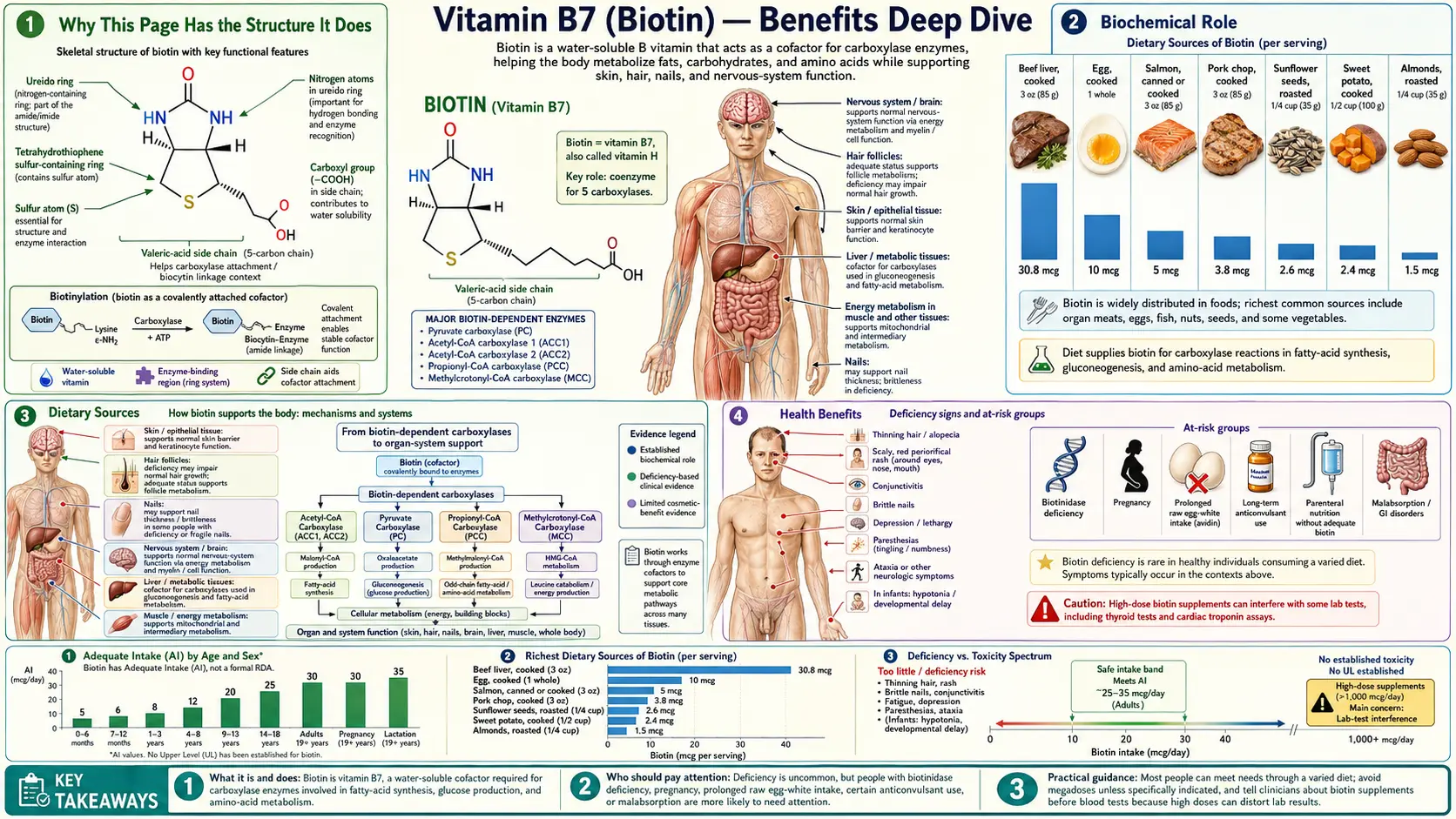
Biotin is a vitamin with a marketing problem. The supplement industry has built a multibillion-dollar hair, skin, and nail category on its name, while the most clinically critical fact about biotin — that supplemental doses cause dangerous, life-threatening interference with hospital laboratory immunoassays (false Graves' disease, missed heart attacks, missed ectopic pregnancies) — is buried in fine print no one reads. This deep-dive separates the evidence base from the marketing, walks through the FDA safety communications every patient and clinician must understand, surveys the rare-but-curable inborn errors of biotin metabolism that newborn screening was designed to catch, and reviews the rise and disappointing fall of high-dose biotin (300 mg/day) as a treatment for progressive multiple sclerosis.
Deep-Dive Articles
Hair, Skin & Nails — Claim vs Evidence
The marketing claim ("biotin grows hair and strengthens nails for everyone") vs the actual evidence base. The Patel 2017 systematic review found only 18 published studies of biotin for hair or nails — all of them either uncontrolled case series or studies in patients with documented biotin deficiency. Where the evidence is real (Hochman 1993 nail brittleness, postpartum telogen effluvium, biotinidase deficiency), where it is weak (already-replete adults seeking cosmetic enhancement), and an honest comparison to dermatology's actual evidence base for trichology.
Lab-Test Interference — The Critical Safety Issue
The most underappreciated supplement safety problem in clinical practice. Biotin breaks streptavidin-biotin immunoassays, producing false TSH that mimics Graves' disease (and prompts inappropriate radioactive iodine), false troponin that hides active heart attacks, false hCG that hides ectopic pregnancies, plus distorted ferritin, 25(OH)D, cortisol, PSA, and tumor markers. The FDA 2017 and 2019 safety communications, the death linked to a missed MI, the correct washout periods, and what to ask before any bloodwork.
Multiple Carboxylase Deficiency
The inborn errors of metabolism where biotin is genuinely lifesaving. Biotinidase deficiency (autosomal recessive, ~1 in 60,000, added to newborn screening in all 50 US states by 2013), holocarboxylase synthetase deficiency, biotin-thiamine-responsive basal ganglia disease (BTBGD), and the four affected carboxylase enzymes (pyruvate, acetyl-CoA, propionyl-CoA, β-methylcrotonyl-CoA). Lifelong 5-20 mg/day biotin treatment that prevents seizures, deafness, optic atrophy, developmental delay, and death.
High-Dose Biotin in Progressive MS
The rise and fall of MD1003 (high-dose biotin, 300 mg/day) for progressive multiple sclerosis. Tourbah 2016 produced an initial positive signal — 12.6% of treated patients achieving sustained disability improvement vs 0% on placebo — that energized a generation of patients and a Phase 3 program. SPI2 (the confirmatory 940-patient, 2-year trial published in 2020) was firmly NEGATIVE. The mechanistic rationale (myelin synthesis + oligodendrocyte energy), why a credible signal disappeared on replication, and where the field is now (no longer recommended for routine MS care).
Table of Contents
- Deep-Dive Articles
- Why This Page Has the Structure It Does
- Research Papers: Hair, Skin & Nail Claims
- Research Papers: Lab-Test Interference (Critical Safety)
- Research Papers: Multiple Carboxylase Deficiency
- Research Papers: High-Dose Biotin in MS
- Research Papers: Mechanism, Forms & Cross-Cutting
- External Authoritative Resources
- Connections
- Featured Videos
Why This Page Has the Structure It Does
Most nutraceutical pages emphasize the breadth of clinical benefit a compound offers. The biotin literature requires a different framing because the gap between marketing claims and evidence-supported clinical benefit is unusually wide, and because biotin is the only common dietary supplement with a well-documented, life-threatening drug-test interaction at consumer-level doses.
The four deep-dive pages below were chosen to map the actual evidence terrain:
- Hair, skin and nails — the marketing flagship indication, the one that drives 90% of consumer use. Honest framing: the evidence is real for biotin-deficient patients and brittle-nail syndrome, but the cosmetic-enhancement claims for biotin-replete adults rest on essentially zero randomized controlled trials. The Patel 2017 systematic review — the definitive analysis — found 18 studies and 0 RCTs in non-deficient subjects.
- Lab-test interference — the single most clinically important fact about biotin and the one least known to consumers. High-dose biotin (5,000-10,000 mcg in many beauty supplements; 300 mg in MS protocols) interferes with streptavidin-biotin immunoassays that dominate hospital laboratory medicine. This produces false hyperthyroid panels (TSH suppressed, free T4 elevated — identical to Graves' disease and prompting inappropriate radioactive iodine ablation), falsely low troponin (a death has been linked to a missed MI), false hCG (ectopic pregnancy can be missed), distorted hormone panels, and distorted tumor markers. The FDA issued safety communications in 2017 and again in 2019.
- Multiple carboxylase deficiency — the conditions where biotin is genuinely lifesaving. Biotinidase deficiency (~1 in 60,000) was added to universal newborn screening across the US between 1984 and 2013 because it's one of the rare inborn errors of metabolism that can be completely prevented by a simple, cheap, oral nutritional intervention (5-20 mg biotin daily for life). Without treatment: seizures, deafness, optic atrophy, developmental delay, sometimes death. With treatment: normal life.
- High-dose biotin in MS — an instructive cautionary tale in clinical research. A mechanistically credible hypothesis (biotin supports myelin synthesis and oligodendrocyte energy metabolism) plus an initial positive trial (Tourbah 2016 MD1003) generated huge patient enthusiasm and a Phase 3 program. The confirmatory SPI2 trial in 2020 was clearly negative. The story illustrates why replication matters and why mechanistic plausibility, by itself, doesn't establish clinical efficacy.
The blood-sugar and cosmetic-marketing topics are covered in depth on the existing sibling pages Biotin and Blood Sugar and Biotin and Hair Health; the Benefits hub does not duplicate them.
Research Papers: Hair, Skin & Nail Claims
- Patel DP et al. (2017) systematic review — biotin for hair and nails — PubMed: Patel 2017 systematic review
- Hochman LG (1993) brittle nail trial — PubMed: Hochman 1993 brittle nails
- Floersheim GL biotin brittle nail study — PubMed: Floersheim brittle nails
- Colombo VE biotin nail electron microscopy — PubMed: Colombo nail EM
- Trueb RM biotin alopecia review — PubMed: Trueb biotin alopecia
- Soleymani T biotin hair loss clinic survey — PubMed: Soleymani biotin survey
- Glynis A oral marine protein/biotin trial — PubMed: Glynis marine protein trial
- Almohanna HM hair loss micronutrient review — PubMed: Almohanna micronutrient hair
- Biotin in postpartum telogen effluvium — PubMed: postpartum telogen effluvium biotin
- Biotin in alopecia areata case reports — PubMed: alopecia areata biotin
Research Papers: Lab-Test Interference (Critical Safety)
- FDA Safety Communication 2017 — biotin interference with laboratory tests — PubMed: FDA biotin safety communication
- FDA Safety Communication 2019 update — troponin interference and death — PubMed: FDA 2019 troponin update
- Kummer S biotin TSH free T4 Graves mimicry — PubMed: Kummer biotin Graves mimicry
- Trambas C biotin streptavidin immunoassay mechanism — PubMed: Trambas biotin immunoassay
- Piketty ML biotin endocrine assay interference — PubMed: Piketty biotin endocrine
- Holmes EW biotin troponin missed myocardial infarction case — PubMed: biotin missed MI
- Mzougui S biotin hCG ectopic pregnancy missed — PubMed: biotin hCG ectopic
- Li D biotin parathyroid hormone PTH interference — PubMed: biotin PTH
- Samarasinghe S biotin tumor marker false elevation — PubMed: biotin tumor markers
- Bowen R biotin 25-hydroxyvitamin D assay — PubMed: biotin 25(OH)D
- Biotin washout period pharmacokinetics — PubMed: biotin washout PK
- Ali M analytical strategies to overcome biotin interference — PubMed: overcoming biotin interference
Research Papers: Multiple Carboxylase Deficiency
- Wolf B biotinidase deficiency review — PubMed: Wolf biotinidase review
- Wolf B newborn screening biotinidase — PubMed: Wolf NBS biotinidase
- Suormala T holocarboxylase synthetase deficiency — PubMed: HCS deficiency
- Tabarki B biotin-thiamine-responsive basal ganglia disease — PubMed: BTBGD Tabarki
- Pyruvate carboxylase deficiency — PubMed: pyruvate carboxylase deficiency
- Propionyl-CoA carboxylase deficiency (propionic acidemia) — PubMed: propionic acidemia
- 3-methylcrotonyl-CoA carboxylase (MCC) deficiency — PubMed: MCC deficiency
- Acetyl-CoA carboxylase deficiency — PubMed: ACC deficiency
- Strovel ET biotinidase deficiency ACMG guidelines — PubMed: ACMG biotinidase guidelines
- SLC19A3 biotin thiamine transporter gene — PubMed: SLC19A3 gene
Research Papers: High-Dose Biotin in MS
- Tourbah A MD1003 MS-SPI Phase 3 (2016) — PubMed: Tourbah MD1003 2016
- Cree BAC MS-SPI2 (2020) confirmatory trial — NEGATIVE — PubMed: Cree SPI2 2020
- Sedel F MD1003 mechanism oligodendrocyte myelin — PubMed: Sedel mechanism
- Birnbaum G high-dose biotin MS open-label experience — PubMed: Birnbaum open-label
- Granella F high-dose biotin Italian cohort — PubMed: Granella Italian cohort
- Branger P high-dose biotin TSH interference in MS trials — PubMed: Branger TSH MS
- Pichon MM safety profile high-dose biotin MS — PubMed: Pichon safety MS
- Sedel F biotin progressive MS pilot 2015 — PubMed: Sedel pilot 2015
- Couloume L biotin MS open-label clinical practice cohort — PubMed: Couloume cohort
- Espiritu AI biotin MS meta-analysis — PubMed: Espiritu meta-analysis
Research Papers: Mechanism, Forms & Cross-Cutting
- Zempleni J biotin biochemistry and metabolism review — PubMed: Zempleni biotin biochemistry
- Said HM biotin intestinal absorption SMVT transporter — PubMed: Said SMVT
- Histone biotinylation epigenetic mechanism — PubMed: histone biotinylation
- Mock DM biotin pregnancy depletion catabolism — PubMed: Mock pregnancy biotin
- Said HM biotin homeostasis and disease — PubMed: Said biotin homeostasis
- Avidin egg white biotin binding affinity — PubMed: avidin egg white
- Anticonvulsant biotin depletion mechanism — PubMed: anticonvulsant biotin
- Biotin and chromium combination type 2 diabetes — PubMed: biotin chromium diabetes
- Biotin alpha-lipoic acid SMVT transporter competition — PubMed: biotin-ALA competition
- Biotin safety toxicity high-dose long-term — PubMed: biotin long-term safety
External Authoritative Resources
- Linus Pauling Institute — Biotin Micronutrient Information Center — the most authoritative scientific summary of biotin biology, biochemistry, and clinical evidence, regularly updated
- NIH Office of Dietary Supplements — Biotin Fact Sheet for Health Professionals
- FDA Safety Communication — Biotin May Interfere With Lab Tests (2019 update)
- MedlinePlus — Biotin
- PubMed — All research on biotin
Connections
- All Vitamins
- Vitamin B7 (Main Page)
- Hair, Skin & Nails (Claim vs Evidence)
- Lab-Test Interference
- Multiple Carboxylase Deficiency
- High-Dose MS Trials
- Biotin and Blood Sugar
- Biotin and Hair Health
- Vitamin B5 (Pantothenic Acid)
- Vitamin B12
- Chromium
- Zinc
- Diabetes
- Graves' Disease
- Multiple Sclerosis
- Hair Loss
- Alopecia
- TSH
- Hemoglobin A1c
- Alpha Lipoic Acid
- Eggs