High-Dose Biotin in Progressive Multiple Sclerosis — The Rise and Fall of MD1003
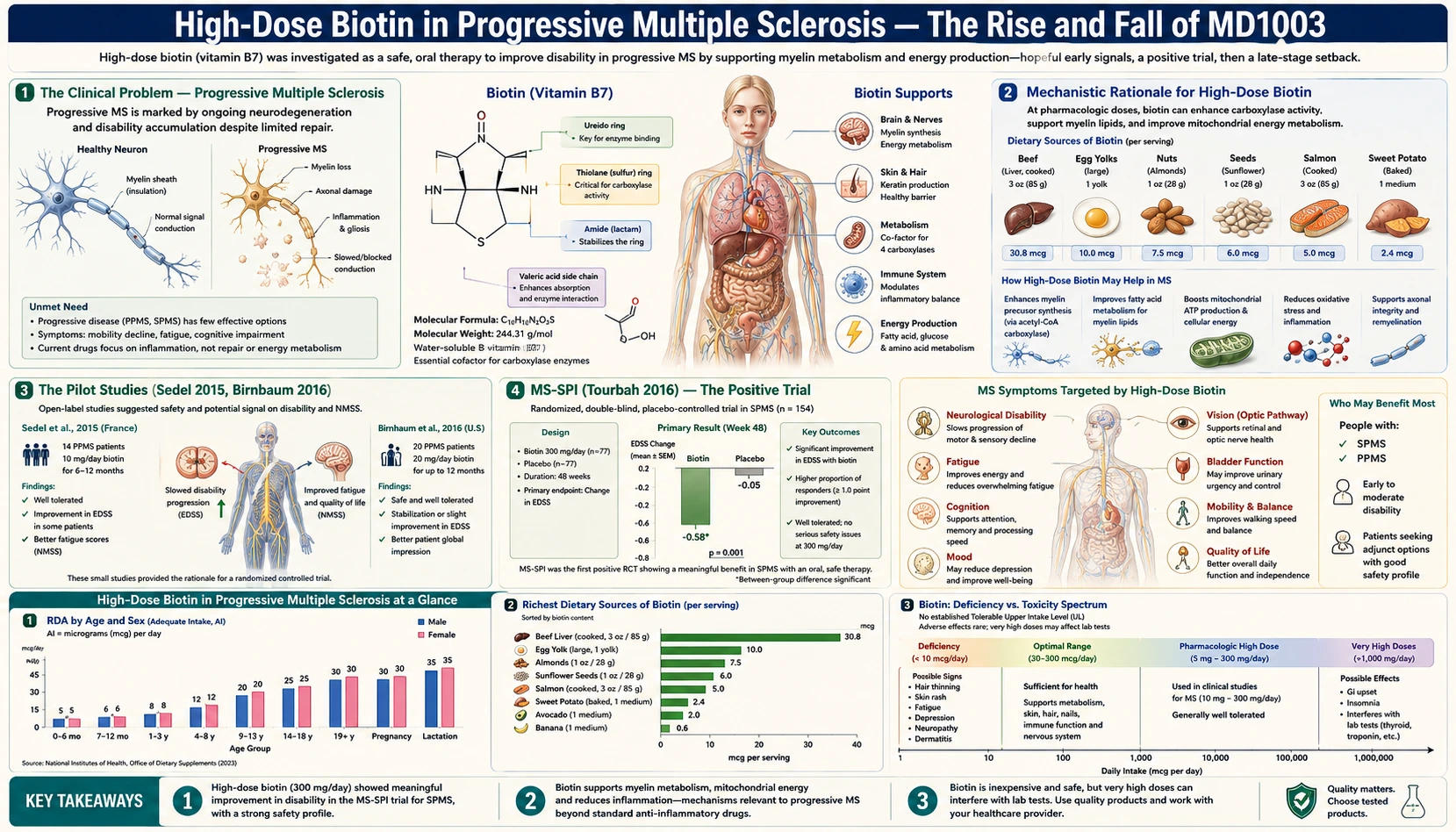
Between 2015 and 2020, the multiple sclerosis community lived through one of the most instructive cycles in modern clinical trials. A mechanistically credible hypothesis — that very high-dose biotin (300 mg per day, 10,000 times the recommended daily intake) could promote remyelination by boosting fatty acid synthesis and oligodendrocyte energy metabolism — was tested in MS-SPI (Tourbah 2016) and produced a striking positive signal: 12.6% of treated progressive MS patients achieved sustained disability improvement vs 0% on placebo. The result energized a generation of patients and a Phase 3 confirmatory program. Five years later, MS-SPI2 — a larger, longer, more rigorous trial — was firmly NEGATIVE. The disconnect produced one of the cleaner examples in modern neurology of why mechanistic plausibility and an initial positive signal do not equal clinical efficacy. This page walks through both trials, the mechanistic rationale, the lab-test interference problem the protocol introduced, and where the field stands today.
Table of Contents
- The Clinical Problem — Progressive Multiple Sclerosis
- Mechanistic Rationale for High-Dose Biotin
- The Pilot Studies (Sedel 2015, Birnbaum 2016)
- MS-SPI (Tourbah 2016) — The Positive Trial
- After MS-SPI — Off-Label Uptake and Compassionate Use
- MS-SPI2 (Cree 2020) — The Negative Confirmatory Trial
- Explaining the Disconnect
- The TSH Lab-Interference Problem the Trials Created
- Where the Field Stands Now
- Lessons for Clinical Research
- Patient FAQ
- Cautions
- Key Research Papers
- Connections
- Featured Videos
The Clinical Problem — Progressive Multiple Sclerosis
Multiple sclerosis has two clinical phenotypes that drive disability accumulation. Relapsing-remitting MS (RRMS) — the more common form, affecting ~85% of patients at diagnosis — is characterized by discrete inflammatory attacks separated by periods of stability or partial recovery. The treatment revolution in RRMS has been enormous: high-efficacy disease-modifying therapies (natalizumab, ocrelizumab, ofatumumab, alemtuzumab, cladribine, the S1P modulators) can suppress relapses by >80% and dramatically slow disability accumulation in most patients.
The other phenotype is progressive MS — either primary progressive (10-15% of patients from onset) or secondary progressive (the evolution of RRMS over years to decades into a progressive phase). Progressive MS is dominated not by acute inflammation but by chronic neurodegeneration: progressive axonal loss, demyelination without effective remyelination, and brain volume loss. Disability accumulates steadily without relapses.
The treatment landscape for progressive MS is sparse. Ocrelizumab modestly slows progression in PPMS. Siponimod modestly slows progression in SPMS with active relapses. Cladribine and rituximab have some effect. But these interventions slow the rate of decline without halting or reversing it. There is no approved therapy that genuinely improves disability in established progressive MS.
This unmet need is the reason any credible candidate for progressive MS receives enormous attention from patients and clinicians. Biotin's emergence as a candidate — combined with its safety, low cost, and oral administration — produced an unusually intense clinical-trial cycle.
Mechanistic Rationale for High-Dose Biotin
Frederic Sedel and colleagues at the Pitie-Salpetriere in Paris articulated the mechanistic hypothesis that motivated the MS trials. Two complementary pathways:
1. Promoting myelin synthesis
Myelin is composed of approximately 70% lipids by dry weight — a higher proportion than essentially any other tissue. The lipid composition is dominated by cholesterol, galactocerebrosides, sphingomyelin, and phosphatidylethanolamine. The synthesis of these lipids requires a steady supply of fatty acids, which in turn requires acetyl-CoA carboxylase (ACC) — one of the biotin-dependent carboxylase enzymes.
The hypothesis: in oligodendrocytes attempting to remyelinate damaged axons, ACC activity becomes a potential rate-limiting step for lipid biosynthesis. Saturating these cells with super-physiological biotin (10,000× RDA) might activate ACC to a greater extent than normal physiology allows, accelerating fatty-acid synthesis and supporting remyelination.
2. Boosting energy metabolism in stressed neurons
Neurons in chronically demyelinated white matter face a substantial energy deficit. Without the saltatory conduction that myelin enables, action-potential propagation costs much more ATP per unit length of axon. Mitochondrial dysfunction further compromises ATP supply. The result is chronic energy failure that eventually drives axonal degeneration.
Biotin activates pyruvate carboxylase (PC) — the enzyme that replenishes the citric acid cycle and supports glucose oxidation. The hypothesis: high-dose biotin boosts mitochondrial energy production in stressed neurons, improving their resilience to the energy deficit of chronic demyelination.
Why "high dose"
Normal physiologic biotin doses (30 mcg/day RDA, even 1 mg/day supplementation) are essentially saturating for the body's normal metabolic needs. The mechanistic hypothesis required supra-physiologic concentrations capable of forcing additional flux through ACC and PC beyond their normal regulated rates. The 300 mg/day dose was chosen empirically as the highest tolerable dose with reasonable pharmacokinetics — 10,000 times the RDA, divided as 100 mg three times daily.
The mechanism was speculative — there was no direct demonstration that ACC or PC was actually rate-limiting in oligodendrocytes or axons, nor evidence that 300 mg/day produced concentrations capable of increasing flux. The rationale was plausible but unproven. The clinical trials would test whether the speculation translated into clinical benefit.
The Pilot Studies (Sedel 2015, Birnbaum 2016)
Sedel et al. published an open-label pilot in 23 patients with progressive MS in 2015. Patients received 100-300 mg/day biotin for up to 36 months. The reported outcomes:
- Improvement in visual function in patients with chronic optic neuritis (visual evoked potentials and visual acuity)
- Improvement in ambulation in some patients (timed 25-foot walk)
- Subjective improvements in fatigue and cognitive symptoms
- No serious adverse events at doses up to 300 mg/day
The pilot was uncontrolled and open-label, with all the limitations that implies: regression to the mean, attention effects, observer bias, selection of patients likely to respond. But the consistency of the findings and the magnitude in some patients was enough to justify a controlled trial.
Birnbaum et al. (2016) published US clinical experience with off-label high-dose biotin in a similar uncontrolled context with similarly suggestive findings. By 2014-2015, a meaningful number of MS specialists were already prescribing high-dose biotin off-label based on the pilot data, awaiting Phase 3 confirmation.
MS-SPI (Tourbah 2016) — The Positive Trial
MS-SPI was the first randomized, placebo-controlled trial of high-dose biotin (sold under the name MD1003 by MedDay Pharmaceuticals) in progressive MS. The trial was published in Multiple Sclerosis Journal in 2016. Key parameters:
- Population: 154 patients with progressive MS (primary progressive or secondary progressive), EDSS 4.5-7.0, with documented disability progression in the prior two years
- Intervention: Biotin 300 mg/day (100 mg three times daily) vs placebo, 2:1 randomization, for 12 months, followed by 12-month open-label extension
- Primary outcome: Proportion of patients with confirmed disability reversal — defined as improvement in EDSS or timed 25-foot walk that was confirmed by repeat assessment 3 months later, at 9 or 12 months
- Secondary outcomes: EDSS change, T25FW time, mean change in Multiple Sclerosis Functional Composite (MSFC), proportion with disability progression
Headline result
- 12.6% of MD1003 patients achieved the primary outcome of confirmed disability reversal at 9 months
- 0% of placebo patients achieved the primary outcome
- p = 0.005
The contrast was striking. The trial also showed signals on T25FW improvement and reduced odds of progression. Treatment was well-tolerated; the main adverse event was lab-test interference (specifically suppressed TSH).
The MS community took notice. A treatment that improved disability — not just slowed progression — in 12.6% of an otherwise-untreatable population was potentially transformative. Off-label biotin uptake accelerated. MedDay launched expanded access programs. France granted temporary authorization (ATU) for MD1003. The European Medicines Agency began review.
After MS-SPI — Off-Label Uptake and Compassionate Use
In the 2016-2019 window between the MS-SPI publication and the larger confirmatory trial, high-dose biotin became widely used in progressive MS:
- Many MS specialists prescribed 300 mg/day biotin off-label, either by writing for compounded preparations or instructing patients to assemble the dose from over-the-counter biotin tablets (often 30-60 tablets of 5 mg or 10 mg per day)
- MedDay's ATU program in France enrolled thousands of patients
- The expanded experience — published as observational cohorts by Granella, Couloume, Birnbaum, and others — produced mixed signals. Some cohorts showed modest benefit; some showed no benefit; some raised concerns about increased relapses or accelerated disability in subsets
- The lab-test interference problem became apparent at scale: TSH and free T4 panels in biotin-treated MS patients required either washout (impractical for those on continuous high-dose therapy) or interpretation accounting for the artifact
The mixed observational data prompted more cautious interpretation among some experts, but a formal Phase 3 confirmatory trial was needed to know whether MS-SPI's headline finding would replicate in a larger, more rigorous study.
MS-SPI2 (Cree 2020) — The Negative Confirmatory Trial
MS-SPI2 (published Cree et al. in Multiple Sclerosis Journal in 2020) was designed to be the definitive Phase 3 confirmatory trial. Key parameters — deliberately larger and longer than MS-SPI:
- Population: 642 patients with progressive MS (PPMS or non-active SPMS), EDSS 3.5-6.5, with documented progression. Importantly, the inclusion criteria were broader than MS-SPI to better reflect the real-world target population.
- Intervention: MD1003 (biotin 300 mg/day) vs placebo, 1:1 randomization, for 27 months (compared to 12 months in MS-SPI)
- Primary outcome: Same as MS-SPI — proportion with confirmed disability reversal at 15 or 27 months
- Secondary outcomes: Multiple disability and patient-reported outcome measures
Headline result
- 12% of MD1003 patients achieved confirmed disability reversal
- 9% of placebo patients achieved confirmed disability reversal
- p = 0.31 — NOT statistically significant
The difference between the active and placebo arms was clinically and statistically meaningless. Secondary outcomes showed no signal favoring biotin. Most strikingly, the placebo response rate in MS-SPI2 (9%) was much higher than in MS-SPI (0%), and the active arm response rate was nearly identical (12% vs 12.6%). The MS-SPI2 findings were unambiguous: high-dose biotin does not produce clinically meaningful improvement in progressive MS beyond placebo.
MedDay's Phase 3 program for MS ended. The European regulatory pathway for MD1003 was terminated. The compassionate-use programs wound down. The MS specialty community largely concluded that high-dose biotin should not be recommended as standard care for progressive MS.
Explaining the Disconnect
Why did MS-SPI show a robust positive signal that disappeared on replication? Multiple hypotheses, none fully resolved:
- Differences in the placebo arm. The 0% placebo response in MS-SPI was strikingly low — it is unusual for any chronic disease trial of disability improvement to have literally zero placebo responders over 12 months. The 9% placebo response in MS-SPI2 is more typical. Some have suggested the MS-SPI placebo arm was unusually stable (perhaps reflecting a more selected population, more aggressive natural history, or chance). The MS-SPI2 placebo arm reflects the more realistic spontaneous-improvement rate in this population.
- Differences in the population. MS-SPI required documented progression over 2 years; MS-SPI2 was somewhat broader. The MS-SPI population may have been more enriched for patients destined to plateau or stabilize, producing a higher apparent treatment effect.
- Regression to the mean. Both trials enrolled patients with recent documented progression, but in MS-SPI the requirement was tighter. Patients with recent rapid progression have a higher than baseline probability of spontaneous stabilization (regression to the mean), and this effect is amplified by selection.
- Statistical artifact. A modestly sized Phase 2 trial (154 patients) is more susceptible to false-positive findings than a larger Phase 3 trial (642 patients). The MS-SPI result may have been a chance excursion that did not reflect the true population effect.
- Differences in MS-SPI vs MS-SPI2 outcome adjudication. Some commentators noted subtle differences in how disability reversal was confirmed across the two trials. The differences likely do not explain the magnitude of the disconnect.
- Pharmaceutical biotin formulation differences. MD1003 was always the same MedDay product; this hypothesis has limited support.
- True clinical heterogeneity. Perhaps biotin works in a minority of progressive MS patients with a specific underlying pathophysiology that is enriched in some populations and not others. This is not testable from the available data and remains speculative.
The most parsimonious interpretation: the MS-SPI signal was a combination of an unusually low placebo response, a modestly enriched treatment-responsive population, and statistical variation that was not reproducible in the larger, longer confirmatory study. The mechanistic rationale, while plausible, did not translate into reliable clinical benefit.
The TSH Lab-Interference Problem the Trials Created
One of the unintended consequences of the MS-SPI trials was the creation of a population of patients on 300 mg/day biotin — a dose 10,000× the RDA and ~30× the typical hair-and-nails supplement dose. This population brought the streptavidin-biotin immunoassay interference problem to clinical attention at unprecedented scale.
Specific problems:
- TSH suppression mimicking Graves'. Almost every patient on MD1003 had a suppressed TSH and elevated free T4 reading. The pattern is biochemically identical to true hyperthyroidism. The Branger et al. publications and many subsequent reports documented the scale: TSH was unreliable in any MD1003 patient. Some patients received inappropriate antithyroid drugs before the cause was recognized.
- The death linked to falsely low troponin. An MD1003-treated patient with acute chest pain presented to the ED. Troponin returned normal due to biotin interference. The myocardial infarction was missed. The patient died. This case was specifically cited by the FDA in the 2019 update to the biotin safety communication and accelerated the regulatory push for biotin-resistant immunoassays.
- Routine laboratory monitoring during the trial. Trial-specific protocols had to either (a) hold biotin for 72+ hours before lab draws (challenging logistically and a possible confound for the trial), (b) use biotin-free assay platforms (not universally available), or (c) interpret results with the known interference accounting. None of these was ideal.
The MS-SPI experience accelerated the clinical-chemistry field's investment in biotin-resistant assay platforms (described on the Lab-Test Interference page). In that sense, the trial had a positive downstream impact even though the primary efficacy question came back negative.
Where the Field Stands Now
Following MS-SPI2's negative result:
- The major MS clinical guidelines (American Academy of Neurology, ECTRIMS, AAN) do not recommend high-dose biotin for progressive MS
- MedDay's MS pipeline for MD1003 has been discontinued
- European regulatory approval was terminated
- Off-label use has substantially decreased but some patients continue, often based on subjective benefit perception or the original positive Phase 2 data
- Most MS specialists who continue to prescribe high-dose biotin do so as a small number of selected patient cases, typically with explicit informed discussion of MS-SPI2's negative result, and with attention to lab-test interference management
- The mechanistic hypothesis itself — that supporting oligodendrocyte energy metabolism could promote remyelination — remains active in the field, but the search for compounds has moved beyond biotin to other candidates (clemastine, opicinumab, GSK239512, and others)
The current best practice: progressive MS patients should be on the approved disease-modifying therapies (ocrelizumab for PPMS, siponimod for active SPMS) where appropriate, plus optimal symptom management (spasticity, fatigue, bladder, gait), plus rehabilitation. High-dose biotin should not substitute for or compete with these interventions.
Lessons for Clinical Research
The MD1003 trajectory illustrates several enduring lessons:
- Mechanistic plausibility is not clinical efficacy. A compelling biochemical story (fatty acid synthesis, oligodendrocyte energy) does not guarantee clinical benefit. The link from mechanism to outcome involves dozens of unknown variables.
- Phase 2 positive signals require Phase 3 replication. Small early trials are prone to false-positive findings — chance excursions, regression to the mean, unblinding artifacts, selection effects. Confirmatory trials are designed to filter these out. About half of Phase 2 positive trials in neurology fail to replicate in Phase 3, and this should be the default expectation, not a surprise.
- Placebo response in chronic disease is variable. The dramatic difference in placebo response between MS-SPI (0%) and MS-SPI2 (9%) illustrates how a "control" arm can vary by population, timing, expectation, and chance.
- Off-label uptake based on Phase 2 data has costs. Years of patient effort, expense, and time were invested in a treatment that did not work. Awareness of this risk should temper enthusiasm for adopting an unconfirmed intervention even when the rationale seems strong.
- Negative trials are important to publish. MS-SPI2 was published promptly and clearly, despite the disappointing result. This transparency allowed the field to recalibrate quickly. Negative trial publication bias remains a problem in clinical research generally; this one was handled well.
- An intervention can fail at the primary outcome while still teaching us something. The lab-test interference problems brought to attention by MD1003 accelerated improvements in clinical chemistry that benefit all biotin users, including the consumer hair-supplement population.
Patient FAQ
Q: I have progressive MS and I am still taking 300 mg/day biotin. Should I stop?
Discuss this with your MS neurologist. The current consensus is that high-dose biotin does not meaningfully alter progressive MS outcomes based on the MS-SPI2 confirmatory trial. Some patients perceive subjective benefit, which may be real (placebo, attention, hope-based improvement in fatigue and mood) or may reflect natural disease variation. If you stop, do so gradually (over weeks) and monitor whether anything changes — both because of the unclear true effect and to manage the lab-test interference washout. Continuing carries minimal medical risk from biotin itself but produces ongoing laboratory-test interference (Graves' mimic, troponin masking) and adds expense.
Q: Why did the trials disagree?
The most likely explanation is that MS-SPI was a small Phase 2 trial with an unusually low placebo response rate (0%) due to chance plus a possibly enriched study population. MS-SPI2 was larger, longer, and had a more representative placebo response (9%). The active-arm response was similar in both (~12%). The MS-SPI2 finding (12% active vs 9% placebo = no meaningful difference) is the more reliable estimate of the true effect.
Q: My MS neurologist still recommends high-dose biotin. Is that reasonable?
Less common after MS-SPI2 but not unreasonable in a specific patient with severe progressive disease, limited other options, and willingness to manage the lab-test interference. The decision should include an explicit informed-consent discussion of the negative confirmatory trial and the lab-test issues. A trial of 6-12 months with predetermined criteria for discontinuation if no benefit is observed is reasonable.
Q: Are there safer doses that could still help my MS?
The proposed mechanism specifically required supra-physiological doses (300 mg/day). Lower doses (1-10 mg/day) are unlikely to engage the mechanism even if it existed. So scaling down does not produce a safer-but-still-active intermediate — it produces a typical biotin supplement dose with no mechanism for MS benefit.
Q: My thyroid panel keeps looking like Graves' disease. Is biotin the cause?
Almost certainly yes, if you are on MD1003 or any 5 mg+ daily biotin. Suppressed TSH and elevated free T4 in a biotin user with no other clinical features of hyperthyroidism is biotin interference until proven otherwise. The diagnostic test is to stop biotin for 5-7 days, retest the panel, and observe normalization. See the Lab-Test Interference page.
Q: What treatments work for progressive MS?
For primary progressive MS: ocrelizumab is FDA-approved and modestly slows progression. For active secondary progressive MS: siponimod is FDA-approved. Other interventions used include rituximab, cladribine, and natalizumab in selected cases. Beyond DMTs, evidence-based interventions include rehabilitation, exercise programs, optimal management of spasticity, fatigue, bladder symptoms, and depression. Discuss the current evidence-based treatment plan with your MS neurologist.
Q: Are there other "remyelination" candidates under investigation?
Yes. Clemastine (an old antihistamine that promotes oligodendrocyte differentiation in vitro and showed modest signal in the ReBUILD trial), opicinumab (anti-LINGO-1), and several other candidates are in various stages of investigation. None has yet achieved Phase 3 success. The remyelination question remains a major unmet need in MS therapeutics.
Cautions
- Lab-test interference dominates the safety profile at 300 mg/day. Patients on this dose will have falsely-suppressed TSH, falsely-elevated free T4 (Graves' mimic), falsely-low troponin (potential to mask MI), falsely-low or -high other immunoassay analytes. Every clinical encounter must include disclosure. See the dedicated page.
- The death linked to missed MI. The FDA 2019 communication explicitly cited a death attributable to falsely-low troponin in a high-dose biotin patient. This is not theoretical risk — it has happened. Any biotin-treated patient presenting with chest pain must have biotin status communicated to ED staff before any troponin draw.
- Biotin does not replace standard MS therapy. Progressive MS patients should be on appropriate FDA-approved disease-modifying therapy (ocrelizumab, siponimod) regardless of biotin status. Biotin should not be a substitute.
- Off-label compounding cost. Without MD1003 commercially available, achieving 300 mg/day from over-the-counter biotin requires 30-60 tablets per day or compounded preparations. Annual cost can run $1,500-$3,000+ for a treatment that did not show clinical benefit in the confirmatory trial.
- Subjective benefit perception is real but uncertain. Some patients report subjective improvement in fatigue, gait, or vision on high-dose biotin. The MS-SPI2 result suggests these are largely placebo effects, but the experience to the individual is real. Stopping the supplement may not produce reciprocal worsening even if it was contributing to perceived improvement.
- Withdrawal in patients with biotinidase deficiency. An MS patient with undiagnosed biotinidase deficiency taking 300 mg/day biotin would have her biotinidase deficiency treated as a side effect. If she stops, the carboxylase deficiency would manifest. This is rare but worth keeping on the differential in any high-dose biotin user with unexpected metabolic findings on discontinuation.
Key Research Papers
- Tourbah A, Lebrun-Frenay C, Edan G et al. (2016). MD1003 (high-dose biotin) for the treatment of progressive multiple sclerosis: a randomized, double-blind, placebo-controlled study. Multiple Sclerosis Journal. — PubMed
- Cree BAC, Cutter G, Wolinsky JS et al. (2020). Safety and efficacy of MD1003 (high-dose biotin) in patients with progressive multiple sclerosis (SPI2): a randomized, double-blind, placebo-controlled, parallel-group trial. Lancet Neurology. — PubMed
- Sedel F, Papeix C, Bellanger A et al. (2015). High doses of biotin in chronic progressive multiple sclerosis: a pilot study. Multiple Sclerosis and Related Disorders. — PubMed
- Sedel F, Bernard D, Mock DM, Tourbah A (2016). Targeting demyelination and virtual hypoxia with high-dose biotin as a treatment for progressive multiple sclerosis. Neuropharmacology. — PubMed
- Birnbaum G, Stulc J (2017). High dose biotin as treatment for progressive multiple sclerosis. Multiple Sclerosis and Related Disorders. — PubMed
- Granella F, Tsantes E, Siena E et al. (2021). High-dose biotin in progressive multiple sclerosis: a prospective study. Acta Neurologica Belgica. — PubMed
- Branger P, Parienti JJ, Sormani MP, Defer G (2020). The Effect of Biotin on TSH Levels in Patients With Multiple Sclerosis. Multiple Sclerosis Journal. — PubMed
- Pichon MM, Schluep M, Lalive PH, Du Pasquier R (2020). High-dose biotin in progressive multiple sclerosis: safety in a Swiss cohort. Multiple Sclerosis and Related Disorders. — PubMed
- Couloume L, Barbin L, Leray E et al. (2021). High-dose biotin in progressive multiple sclerosis: a French multi-center retrospective study. Journal of Neurology. — PubMed
- Espiritu AI, Remalante PPM (2021). Efficacy and tolerability of biotin in patients with progressive multiple sclerosis: a meta-analysis. Acta Neurologica Belgica. — PubMed
- Tourbah A, Gout O, Vighetto A et al. (2018). MD1003 (high-dose pharmaceutical-grade biotin) for the treatment of chronic visual loss related to optic neuritis in multiple sclerosis. CNS Drugs. — PubMed
- Peyro Saint Paul L, Debruyne D, Bernard D, Mock DM, Defer G (2016). Pharmacokinetics and pharmacodynamics of MD1003 (high-dose biotin) in the treatment of progressive multiple sclerosis. Expert Opinion on Drug Metabolism & Toxicology. — PubMed
PubMed Topic Searches
- PubMed: MD1003 biotin MS
- PubMed: high-dose biotin progressive MS
- PubMed: biotin oligodendrocyte remyelination
- PubMed: biotin myelin synthesis
- PubMed: progressive MS remyelination treatment
Connections
- All Vitamins
- Vitamin B7 Overview
- Benefits Hub
- Hair, Skin & Nails
- Lab-Test Interference
- Multiple Carboxylase Deficiency
- Multiple Sclerosis
- Vitamin D (MS connection)
- Vitamin B12 (myelin)
- Vitamin B1 (Thiamine)
- TSH
- Free T4
- Troponin
- Graves' Disease
- Heart Attack
- Optic Neuritis