Biotin (Vitamin B7) Toxicity and Lab Interference: What the Evidence Shows
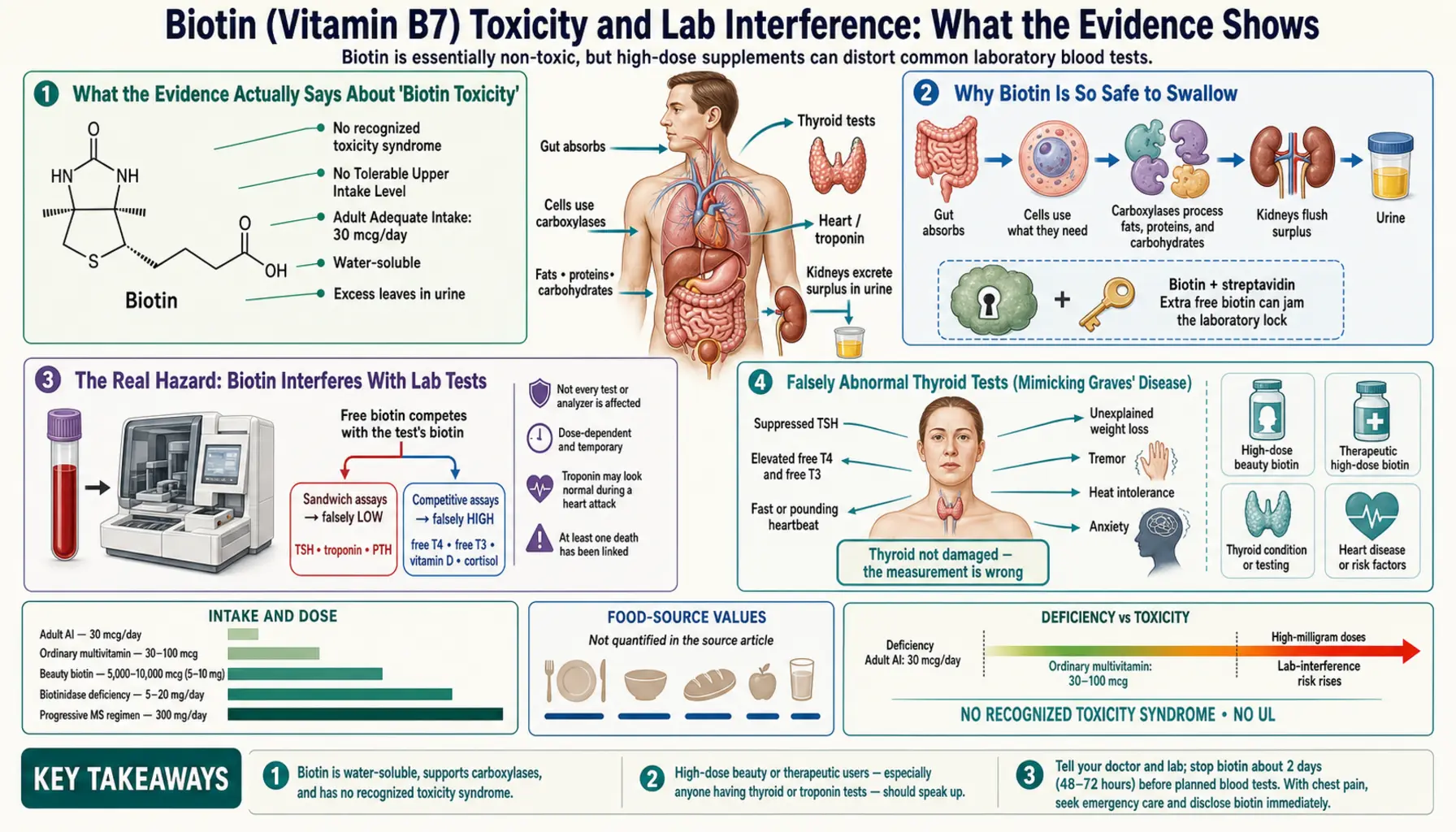
Here is the honest bottom line, stated up front: biotin (vitamin B7) is essentially non-toxic. It is a water-soluble vitamin, so the body simply excretes whatever it does not use in the urine, and there is no recognized biotin-toxicity syndrome in humans — no overdose illness, no organ damage, no established Upper Limit set by the Institute of Medicine or by European authorities, even at the very large doses (10–300 mg/day) sold for hair and nails or used to treat some neurological conditions. So this page will not invent a poisoning that does not exist. But there is one genuinely important, real-world safety hazard worth understanding clearly: high-dose biotin supplements can scramble common laboratory blood tests. Because many lab machines use a biotin–streptavidin chemistry, extra biotin in your blood can produce falsely abnormal results — most notoriously a thyroid panel that mimics Graves' disease, and, far more dangerously, a falsely low troponin that can hide a heart attack. The U.S. Food and Drug Administration issued a safety communication about this, and at least one death has been linked to it. The good news is that the fix is simple and free: tell your doctor and the lab that you take biotin, and stop it for about two days before blood tests. This page explains what the evidence actually shows, why biotin behaves this way, who needs to care, and exactly what to do.
Table of Contents
- What the Evidence Actually Says About "Biotin Toxicity"
- Why Biotin Is So Safe to Swallow
- The Real Hazard: Biotin Interferes With Lab Tests
- Falsely Abnormal Thyroid Tests (Mimicking Graves' Disease)
- The Dangerous One: Falsely Low Troponin and Missed Heart Attacks
- Who Needs to Worry — and Who Doesn't
- What to Do: Simple, Practical Steps
- When to Seek Care / Red Flags
- Key Research Papers
- Connections
- Featured Videos
What the Evidence Actually Says About "Biotin Toxicity"
It is worth being blunt, because the internet is full of "anything in excess is poison" warnings that simply do not apply here: biotin does not have a toxicity syndrome. Decades of use — in ordinary multivitamins, in high-dose "hair, skin, and nails" products, and in genuine medical treatment — have not produced a recognizable illness from taking too much biotin. People have swallowed doses thousands of times the tiny amount the body needs without developing a poisoning.
A few facts make this concrete:
- There is no Tolerable Upper Intake Level (UL) for biotin. When the U.S. Institute of Medicine (now the National Academy of Medicine) reviewed the B vitamins, it set an Adequate Intake for biotin of just 30 micrograms (mcg) per day for adults — but it explicitly declined to set an Upper Limit, because there were no reliable reports of harm from high intakes on which to base one. European food-safety authorities reached the same conclusion. An absent UL is not an oversight; it reflects a genuine lack of toxicity data.
- The doses people actually take are enormous compared with the requirement. Over-the-counter "beauty" biotin is commonly sold at 5,000 to 10,000 mcg (5–10 mg) per pill — roughly 167 to 333 times the 30-mcg daily need. In medicine, even larger doses are used: people with the rare disorder biotinidase deficiency take 5–20 mg/day for life, and a (later disappointing) treatment for progressive multiple sclerosis used 300 mg/day. Across all of these, classic toxicity simply did not appear.
- The body throws the excess away. Biotin is water-soluble. Unlike the fat-soluble vitamins (A, D, E, K), which can accumulate in tissues and genuinely become toxic, water-soluble vitamins like biotin are filtered by the kidneys and leave in the urine when blood levels exceed what the body needs. There is no large storage depot to overflow.
So if you have read elsewhere that you can "overdose" on biotin in the way you can overdose on vitamin A or iron, that is mistaken. The honest summary is that swallowing biotin is remarkably safe. The single legitimate caution is not about the vitamin harming your body directly — it is about biotin fooling the laboratory machines that measure your blood, which is a completely different kind of problem and the real subject of this page.
Why Biotin Is So Safe to Swallow
To understand both why biotin is non-toxic and why it nonetheless causes lab trouble, it helps to know two things about it.
First, it is water-soluble and freely excreted. Biotin dissolves in water rather than fat. Your gut absorbs what it can, your cells use what they need to run a small set of enzymes (called carboxylases, which help your body process fats, proteins, and carbohydrates), and the kidneys flush the surplus out in urine. Because there is no meaningful long-term storage, blood levels of free biotin rise after a big dose and then fall again over a day or two. This is exactly the pattern you want from a vitamin with no toxic ceiling: take too much, and the body just disposes of it.
Second — and this is the twist — biotin sticks to a protein called streptavidin with extraordinary strength. The biotin–streptavidin (and the closely related biotin–avidin) bond is one of the tightest non-covalent attachments known in biology. That tightness is harmless inside your body, but it is precisely what laboratories exploit to build their test kits. Many blood-test machines are designed around the biotin–streptavidin "lock and key" to capture the molecule they are trying to measure. When you flood your bloodstream with extra biotin from a supplement, that free biotin can jam the lock — competing with the test's own biotin and throwing the measurement off. The very property that makes biotin biologically useful and safe to eat is the property that makes it a nuisance in the lab.
Put simply: biotin doesn't poison you — it confuses the test. Keep that distinction in mind, because it is the whole point. The vitamin is benign; the false numbers it can produce are what require care.
The Real Hazard: Biotin Interferes With Lab Tests
This is the part that actually matters for your safety. A large share of modern blood tests — for hormones, vitamins, cardiac markers, infection markers, and more — are run on automated immunoassay analyzers. Many of these analyzers are built on biotin–streptavidin technology. When a blood sample contains a lot of free biotin (because the person is taking high-dose supplements), that biotin can interfere with the chemistry and push the result in the wrong direction.
Crucially, the direction of the error depends on the type of test, and this is why biotin interference is so sneaky:
- "Sandwich" assays read falsely LOW. These are typically used for larger molecules — including thyroid-stimulating hormone (TSH), troponin (the heart-attack marker), PTH, and many others. Excess biotin makes these results read lower than the truth.
- "Competitive" assays read falsely HIGH. These are often used for smaller molecules — including the thyroid hormones free T4 and free T3, vitamin D, cortisol, and some others. Excess biotin makes these read higher than the truth.
You do not need to memorize which test is which. The takeaway is the dangerous pattern that results: in someone on high-dose biotin, the same blood draw can show a low TSH together with high free T4 and free T3 — a combination that looks exactly like an overactive thyroid — even when the thyroid is perfectly normal. And separately, a heart-attack marker can read reassuringly low when it should be high. The error is not random noise; it is a systematic, predictable distortion that can imitate real disease or hide it.
Two honesty notes keep this in proportion. First, not every test is affected, and not every analyzer is equally vulnerable. Manufacturers differ, and since the FDA raised the alarm, many have re-engineered their kits to resist biotin. Some tests are now largely immune; others still are not. Second, the interference is dose-dependent and temporary. Ordinary multivitamin amounts of biotin (the 30-mcg ballpark) rarely cause a problem; the trouble comes from the high-milligram "beauty" and therapeutic doses, and it fades within a day or two of stopping. The risk is real but bounded — which is exactly why a little awareness solves almost all of it.
Falsely Abnormal Thyroid Tests (Mimicking Graves' Disease)
The most famous biotin trap is the thyroid panel. Because TSH is a sandwich assay (reads falsely low with biotin) while free T4 and free T3 are often competitive assays (read falsely high), high-dose biotin can produce a textbook-looking pattern of hyperthyroidism: suppressed TSH with elevated free T4 and free T3. Worse, some of the antibody tests used to diagnose Graves' disease — the most common cause of an overactive thyroid — can also be thrown off, so the lab picture can mimic not just any hyperthyroidism but specifically autoimmune Graves' disease.
This is not theoretical. Published cases describe patients — including children taking high-dose biotin — who were told they had Graves' disease, and in some instances were started down the path toward treatment, when the real problem was the supplement scrambling their bloodwork. Once the biotin was identified and stopped, the "thyroid disease" vanished and repeat testing was normal. Researchers have called this factitious (artificial) hyperthyroidism — a disease that exists only in the test tube.
The danger here is twofold. The obvious harm is overdiagnosis: unnecessary worry, repeat blood draws, possibly an imaging scan, even being started on an anti-thyroid drug for a thyroid that was fine all along. The subtler harm is the mirror image — in a person actually being treated for hypothyroidism, biotin's effect on TSH could muddy whether their dose is right. Either way, the fix is the same and it is simple: if you take biotin and your thyroid numbers look surprising, the supplement should be suspected before anyone concludes you have thyroid disease. If you are getting a thyroid panel, see the Thyroid Panel page for what the test measures, and tell whoever orders it that you take biotin.
One reassuring point worth repeating: a biotin-induced "Graves' pattern" does not mean your thyroid is being damaged. Your thyroid is not the problem — the measurement is. Stop the biotin for a couple of days, retest, and the truth comes back into focus.
The Dangerous One: Falsely Low Troponin and Missed Heart Attacks
If the thyroid mix-up is the most common biotin problem, the troponin problem is the most dangerous — dangerous enough that the FDA built its public safety communication around it. Troponin is a protein released into the blood when heart muscle is injured, and it is the single most important blood test used in emergency rooms to diagnose a heart attack (myocardial infarction). When someone arrives with chest pain, a rising troponin is a key signal that part of the heart is starving for blood; see Coronary Artery Disease for the underlying problem.
Here is the hazard. Most troponin assays are sandwich-type tests, so high-dose biotin pushes the result down. That means a person could be having a genuine heart attack — with truly elevated troponin — yet the lab reports a falsely low or normal number because biotin is interfering. A falsely reassuring troponin can lead a clinician to send a patient home instead of treating a heart attack. The FDA, in its safety communication, reported that biotin interference contributed to a falsely low troponin result in a patient who later died. That is the worst-case scenario this whole page is built to prevent.
It is important to keep the risk honestly calibrated. Real-world studies suggest that with the biotin doses most people take and the assays many hospitals now use, clinically meaningful troponin interference is uncommon, and some newer high-sensitivity troponin assays resist biotin at the levels typically seen. The probability that any given person's heart attack is missed because of biotin is low. But the consequence if it happens is catastrophic and irreversible — and unlike most lab errors, this one can be eliminated almost entirely by a single sentence of information. That asymmetry — small chance, fatal stakes, trivial fix — is exactly why it deserves a clear warning.
The practical message is therefore simple and non-negotiable: if you take biotin and you ever go to an emergency room with chest pain, shortness of breath, or other heart-attack symptoms, tell the medical team immediately that you take biotin. Do not stop to wonder whether it matters. Saying it out loud lets them interpret the troponin correctly, repeat it, or use a method that is not fooled. In a possible heart attack, that one fact can save your life.
Who Needs to Worry — and Who Doesn't
Because biotin itself is harmless to swallow, "who needs to worry" is entirely a question about lab interference, not about the vitamin damaging you. Here is the honest sorting.
You probably don't need to worry much if:
- Your only biotin is in an ordinary multivitamin (typically around 30–100 mcg). At these everyday amounts, interference is uncommon, although it is still good practice to mention any supplement before bloodwork.
- You are not having blood tests at all. If no one is measuring your hormones, troponin, or vitamin levels, the lab issue is moot — and again, the vitamin is not harming your body.
You should be actively aware if:
- You take high-dose "beauty" biotin (commonly 5,000–10,000 mcg / 5–10 mg) for hair, skin, or nails. This is the single most common reason people unknowingly carry interfering biotin levels. (Worth knowing: the evidence that biotin actually improves hair or nails in people who are not deficient is weak — see Biotin and Hair Health — so for many users the lab risk buys little benefit.)
- You take therapeutic high-dose biotin — for biotinidase deficiency, or any very-high-dose regimen prescribed for a neurological condition. These are the largest doses and the highest interference risk; your care team should plan testing around them.
- You have a thyroid condition, or are being worked up for one. Biotin is the most frequent cause of a misleading thyroid panel; flag it every time.
- You have heart disease or risk factors and could end up needing a troponin test. The stakes here are the highest, even if the odds are low.
Notice what is not on either list: "people who took too much biotin and got sick." That category essentially does not exist. The worry is never the vitamin in your body; it is the number on the lab report.
What to Do: Simple, Practical Steps
The whole problem is solved by a handful of easy, no-cost habits. None of them require stopping biotin permanently if you want to take it — they just keep it from corrupting your test results.
- Tell your doctor and the lab that you take biotin. Put it on your medication and supplement list, and say it out loud when blood is being drawn. This single step prevents the great majority of biotin-related errors, because it lets the team interpret a surprising result correctly instead of chasing a disease that is not there.
- Stop biotin for about 2 days (roughly 48–72 hours) before a planned blood test. Because biotin is water-soluble and cleared quickly, a short pause usually lets blood levels fall enough for accurate testing. For very high therapeutic doses (e.g., the multi-hundred-milligram range), a longer pause may be advised — ask the doctor who prescribed it. There is no harm in briefly stopping; you are not "going deficient" over a couple of days.
- In an emergency, speak up immediately. If you go to the ER with chest pain or other heart-attack symptoms, you obviously cannot pre-stop your supplement — so tell the team you take biotin right away. They can repeat the troponin, use a biotin-resistant method, or factor it into their judgment. Do not assume it is irrelevant.
- Be honest with yourself about whether you need high-dose biotin at all. For most people who are not deficient, mega-dose biotin offers little proven benefit for hair or nails. If you do not have a clear reason to take 5–10 mg/day, a normal multivitamin amount sidesteps almost all the lab risk while still covering your needs. (See Vitamin B7 and B7 Benefits for what biotin genuinely does.)
- Don't panic over a single surprising result — ask whether biotin could explain it. If a thyroid panel or another test comes back unexpectedly abnormal and you take biotin, the right next step is usually to stop the supplement and retest, not to start treatment for a brand-new "disease."
That is genuinely the entire management plan. There is no detox, no chelation, no antidote — because there is no poisoning to treat. The only thing to manage is the timing and disclosure around lab tests.
When to Seek Care / Red Flags
Because biotin itself does not cause a toxic illness, there are no "biotin-overdose symptoms" to watch for. The red flags here are about protecting yourself from the lab-interference consequences, and about not ignoring real disease that biotin could mask. Seek or insist on care in these situations:
- Chest pain, pressure, shortness of breath, or other possible heart-attack symptoms — go to emergency care now, and tell them you take biotin. This is the one scenario where biotin interference can be lethal, because it can falsely lower the troponin used to diagnose a heart attack. Never let "I take biotin" go unspoken in the ER.
- Symptoms of a real overactive thyroid that don't fit the lab story — such as a fast or pounding heartbeat, unexplained weight loss, tremor, heat intolerance, or anxiety. If your thyroid numbers say "hyperthyroid" but you take biotin, the numbers may be wrong; conversely, if you feel genuinely unwell, you still deserve a proper evaluation off biotin. Either way, raise the biotin question.
- Any unexpected, dramatically abnormal blood test while you are on high-dose biotin. Before accepting a frightening new diagnosis based on an immunoassay result, ask your clinician whether biotin could be interfering and whether the test should be repeated after stopping it.
- You are about to start treatment (medication, a scan, a procedure) based on a single lab result, and you take biotin. It is reasonable to ask for confirmation off biotin first.
And to keep it in perspective: if you take a normal multivitamin dose of biotin, are not having blood tests, and feel well, there is nothing here to act on. The vitamin is safe. The caution is narrow, specific, and easily handled by communication.
Key Research Papers
- U.S. Food and Drug Administration (2019). Update: The FDA Warns that Biotin May Interfere with Lab Tests — FDA Safety Communication. — FDA Safety Communication
- Barbesino G (2016). Misdiagnosis of Graves' Disease with Apparent Severe Hyperthyroidism in a Patient Taking Biotin Megadoses. The Journal of Clinical Endocrinology & Metabolism;101(9):3251-3255. — DOI: 10.1210/jc.2016-1971
- Kummer S, Hermsen D, Distelmaier F (2016). Biotin Treatment Mimicking Graves' Disease (and More on Biotin Treatment Mimicking Graves' Disease). New England Journal of Medicine;375(17):1698-1699. — DOI: 10.1056/NEJMc1611875
- Piketty ML, Polak M, Flechtner I, et al. (2017). False biochemical diagnosis of hyperthyroidism in streptavidin-biotin-based immunoassays: the problem of biotin intake and related interferences. Clinical Chemistry and Laboratory Medicine;55(6):780-788. — DOI: 10.1515/cclm-2016-0606
- Bowen R, Benavides R, Colón-Franco JM, et al. (2017). Biotin interference on immunoassay methods: sporadic cases or hidden epidemic? Clinical Chemistry and Laboratory Medicine;55(6):777-779. — DOI: 10.1515/cclm-2017-0070
- Trambas C, Lu Z, Yen T, Sikaris K (2018). Characterization of the scope and magnitude of biotin interference in susceptible Roche Elecsys competitive and sandwich immunoassays. Annals of Clinical Biochemistry;55(2):205-215. — DOI: 10.1177/0004563217701777
- Li D, Radulescu A, Shrestha RT, et al. (2018). Biotin Interference in Clinical Immunoassays. The Journal of Applied Laboratory Medicine;2(6):941-951. — DOI: 10.1373/jalm.2017.024257
- Avery G (2019). Biotin interference in immunoassay: a review for the laboratory scientist. Annals of Clinical Biochemistry;56(4):424-430. — DOI: 10.1177/0004563219842231
- Vroemen WHM, van Doorn WPTM, Kimenai DM, et al. (2019). Biotin interference in high-sensitivity cardiac troponin T testing: a real-world evaluation in acute cardiac care. Cardiovascular Research;115(14):1950-1951. — DOI: 10.1093/cvr/cvz277
- Samarasinghe S, Meah F, Singh V, et al. (2020). Chemistry of Biotin–Streptavidin and the Growing Concern of an Emerging Biotin Interference in Clinical Immunoassays. ACS Omega;5(1):10-18. — DOI: 10.1021/acsomega.9b03013
PubMed Topic Searches
- PubMed — Biotin and immunoassay interference
- PubMed — Biotin, thyroid function tests, and factitious Graves' disease
- PubMed — Biotin, falsely low troponin, and myocardial infarction
- PubMed — High-dose biotin safety and tolerability
- PubMed — Biotin–streptavidin immunoassays and interference mitigation
Connections
- All Vitamins
- Vitamin B7 (Biotin) Overview
- Biotin (B7) Deficiency Hub
- Biotin Deficiency: Hair Loss
- Biotin Deficiency: Brittle Nails
- Biotin and Hair Health
- Biotin (B7) Benefits Hub
- Thyroid Panel
- Graves' Disease
- Hyperthyroidism
- Thyroid Disorders
- Coronary Artery Disease
- Lab Tests