Vitamin B6 — Benefits Deep Dive
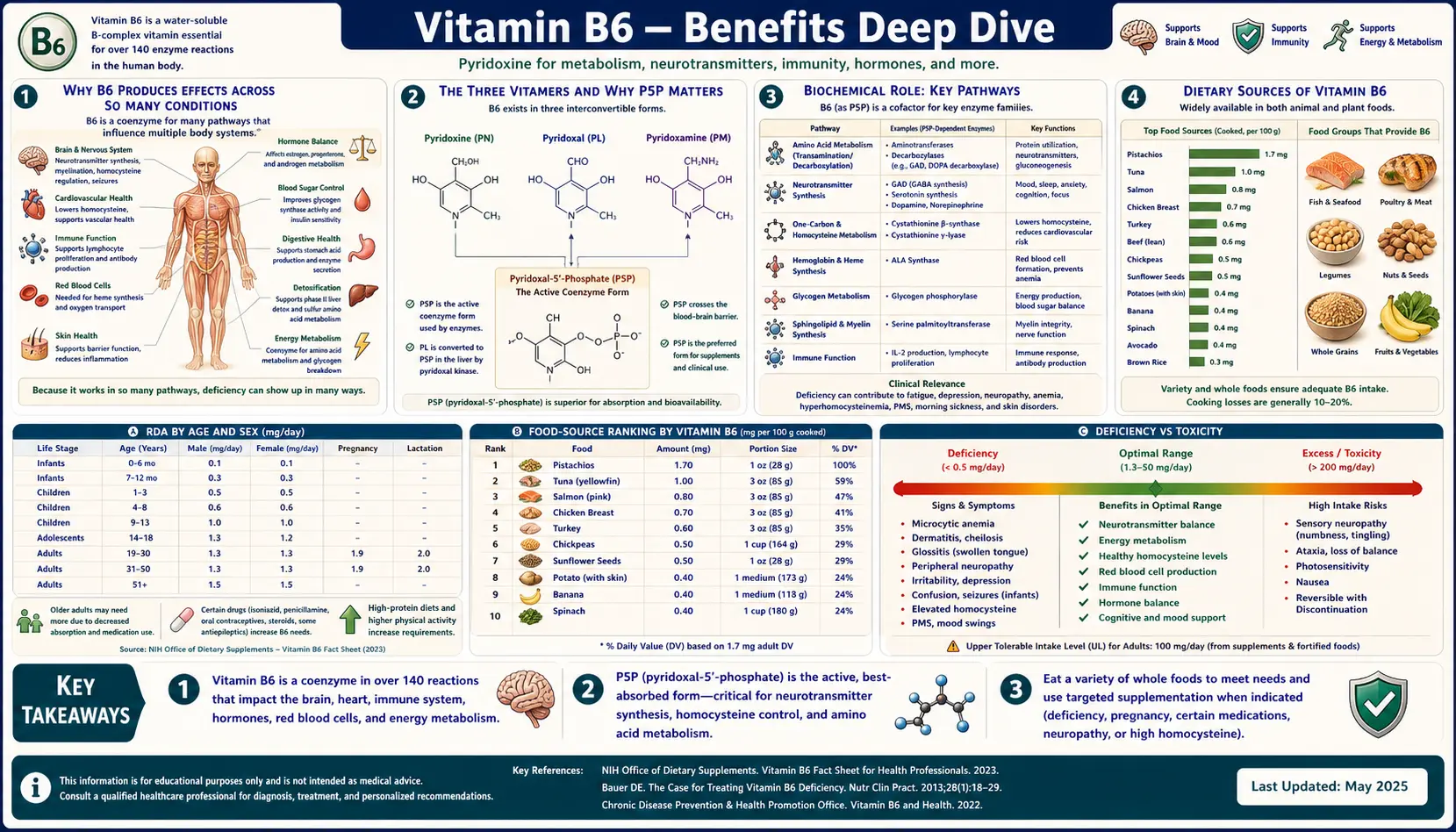
Vitamin B6 is the most metabolically active vitamin in the human body, with its coenzyme form pyridoxal-5-phosphate (P5P) participating in more than 150 enzymatic reactions. That breadth is also its danger: chronic high-dose pyridoxine HCl is the one water-soluble vitamin that reliably causes peripheral sensory neuropathy — a paradoxical mirror of the very deficiency syndrome it normally treats. The four deep dives below cover the most clinically important applications (neurotransmitter synthesis, PMS & hormonal modulation, homocysteine reduction) and the toxicity story every supplementing patient must understand.
⚠ Critical safety note — pyridoxine-induced sensory neuropathy:
Chronic supplementation of pyridoxine HCl above 100 mg/day is associated with a dose- and duration-dependent peripheral sensory neuropathy first reported by Schaumburg in 1983. Cases have been reported at doses as low as 50 mg/day with multi-year use. The FDA Tolerable Upper Intake Level is 100 mg/day. The active form P5P appears safer at equivalent therapeutic effect. Read the full toxicity deep dive before taking more than 50 mg/day.
Deep-Dive Articles
Neurotransmitter Synthesis (Serotonin, Dopamine, GABA)
P5P is the obligate cofactor for aromatic L-amino acid decarboxylase (5-HTP → serotonin, L-DOPA → dopamine) and for glutamate decarboxylase (GAD; glutamate → GABA). This is why severe B6 deficiency triggers seizures and why pyridoxine-dependent epilepsy (ALDH7A1 mutations) is treatable with high-dose B6. Also covers SSRI augmentation, the autism + B6/magnesium protocols of Rimland, depression/anxiety adjunct use, and the norepinephrine/histamine/melatonin downstream effects.
PMS & Hormonal Modulation
The Wyatt 1999 BMJ meta-analysis established 50–100 mg/day pyridoxine for premenstrual mood and depressive symptoms with a NNT of about 3. Mechanisms: dopamine-mediated prolactin suppression, serotonin synthesis support, hepatic estrogen clearance, and progesterone receptor sensitivity. Covers pregnancy morning sickness (the Diclegis / doxylamine + pyridoxine combination), carpal tunnel evidence (weaker), and oral-contraceptive-induced B6 depletion + restoration protocols.
Homocysteine & Cardiovascular
P5P is the cofactor for cystathionine beta-synthase (CBS), the entry enzyme of the transsulfuration pathway that converts homocysteine into cysteine (and downstream glutathione). Folate + B12 + B6 act as an obligate triad; B-complex outperforms any single B vitamin. Walks through HOPE-2, VISP, NORVIT, SEARCH, and why hard cardiovascular endpoints did not move despite homocysteine reduction — plus the cognitive-decline literature where homocysteine lowering DID matter (VITACOG, Smith 2010 Oxford OPTIMA).
Toxicity & Sensory Neuropathy
The unique water-soluble vitamin toxicity story. Schaumburg 1983 NEJM first reported irreversible sensory ataxia in megavitamin users. Dose-response (typically chronic >200 mg/day but cases at 50 mg over years), the paradoxical "deficiency-mimic" mechanism, why P5P appears safer than pyridoxine HCl at equivalent therapeutic effect, the FDA 100 mg/day Upper Limit, distinguishing pyridoxine neuropathy from B12-deficiency neuropathy, and the warning signs that demand immediate discontinuation.
Table of Contents
- Deep-Dive Articles
- Why B6 Produces Effects Across So Many Conditions
- The Three Vitamers and Why P5P Matters
- Research Papers: Neurotransmitter Synthesis
- Research Papers: PMS & Hormonal
- Research Papers: Homocysteine & Cardiovascular
- Research Papers: Toxicity & Sensory Neuropathy
- Research Papers: Cross-Cutting (Forms, Status, Mechanism)
- External Authoritative Resources
- Connections
- Featured Videos
Why B6 Produces Effects Across So Many Conditions
P5P is required for more than 150 enzymatic reactions — more than any other single vitamin cofactor. The breadth comes from a single biochemical feature: P5P forms a Schiff base with the amino group of any amino acid, stabilizing the resulting carbanion intermediate. That one trick enables transamination, decarboxylation, racemization, beta-elimination, gamma-elimination, and retro-aldol cleavage of essentially every amino acid in the body. The clinical implications fall into four broad categories:
- Neurotransmitter synthesis — P5P is the cofactor for aromatic L-amino acid decarboxylase (5-HTP → serotonin, L-DOPA → dopamine), glutamate decarboxylase (glutamate → GABA), and histidine decarboxylase (histidine → histamine). Severe deficiency causes seizures because GABA synthesis fails; pyridoxine-dependent epilepsy (ALDH7A1) is the most dramatic example. Drives effects on depression, anxiety, autism subgroups, and seizure disorders.
- Hormonal & reproductive modulation — through dopamine-mediated prolactin suppression and hepatic estrogen clearance, B6 influences the menstrual cycle, premenstrual symptoms, and pregnancy nausea. Drives effects on PMS, morning sickness, and oral-contraceptive-induced mood symptoms.
- One-carbon metabolism & homocysteine — P5P is the cofactor for cystathionine beta-synthase, the first transsulfuration enzyme converting homocysteine to cysteine. Acts in concert with folate (B9) and cobalamin (B12) in the methylation cycle. Drives effects on homocysteine reduction and cardiovascular/cognitive endpoints.
- Heme synthesis & oxalate metabolism — P5P is the cofactor for aminolevulinic acid synthase (rate-limiting step of heme) and alanine-glyoxylate aminotransferase (oxalate prevention). Drives effects on sideroblastic anemia and primary hyperoxaluria type 1.
The dark side of this breadth is the unique safety profile. Of all the water-soluble vitamins, only B6 has a well-documented adverse-effect ceiling at modest chronic doses. The Schaumburg 1983 New England Journal of Medicine report on megavitamin users with severe sensory ataxia opened a 40-year literature on pyridoxine-induced peripheral neuropathy. See the Toxicity deep dive for the dose-response data, mechanism hypotheses, and recognition/management.
The Three Vitamers and Why P5P Matters
"Vitamin B6" is an umbrella term for three interconvertible forms (vitamers) plus their phosphorylated derivatives:
- Pyridoxine (PN) — the form most commonly used in supplements and food fortification (as pyridoxine HCl). Plant-dominant. Cheap and shelf-stable. Requires two enzymatic activation steps in the liver (phosphorylation by pyridoxal kinase, then oxidation by pyridoxine phosphate oxidase requiring FMN/riboflavin) to become P5P.
- Pyridoxal (PL) — the form predominantly found in animal foods and in human plasma. The intermediate form. Requires only phosphorylation to reach the active P5P.
- Pyridoxamine (PM) — also found in animal foods. Of particular research interest because it inhibits advanced glycation end-product (AGE) formation. Has been studied as a kidney-protective intervention in diabetes.
- Pyridoxal-5-phosphate (P5P, PLP) — the active coenzyme form that participates in all 150+ B6-dependent reactions. P5P circulates bound to albumin in plasma and is the form measured in lab tests. Supplemental P5P bypasses both activation steps and is the preferred form for individuals with riboflavin deficiency, polymorphisms in pyridoxine phosphate oxidase (PNPO), liver dysfunction, or who do not respond clinically to pyridoxine HCl.
For practical supplement selection: pyridoxine HCl is acceptable for healthy adults at doses up to 25 mg/day taken as part of a B-complex. P5P is preferred when therapeutic doses (50 mg+) are needed, when riboflavin status is uncertain, when liver function is impaired, or when there is any concern about pyridoxine-induced neuropathy. P5P typically costs 3–5x more than pyridoxine HCl but is worth it at higher dose ranges.
Research Papers: Neurotransmitter Synthesis
- P5P as cofactor for aromatic L-amino acid decarboxylase (AADC) — PubMed: AADC P5P serotonin dopamine
- Glutamate decarboxylase (GAD) and GABA synthesis — PubMed: GAD pyridoxal phosphate GABA
- Pyridoxine-dependent epilepsy (ALDH7A1 antiquitin mutations) — PubMed: pyridoxine-dependent epilepsy ALDH7A1
- PNPO deficiency and P5P-responsive epilepsy — PubMed: PNPO deficiency P5P epilepsy
- B6 + magnesium in autism spectrum (Rimland and follow-up trials) — PubMed: autism B6 magnesium Rimland
- B6 augmentation of SSRI / antidepressant therapy — PubMed: B6 SSRI augmentation
- Tryptophan-kynurenine pathway and B6 status — PubMed: kynurenine pathway B6
- Histidine decarboxylase and histamine synthesis — PubMed: histidine decarboxylase P5P histamine
- B6 supplementation and anxiety symptoms (Field 2022 RCT) — PubMed: Field B6 anxiety 2022
- P5P and dream recall / REM sleep — PubMed: B6 dream recall REM
Research Papers: PMS & Hormonal
- Wyatt et al. (1999, BMJ) — meta-analysis of B6 for PMS — PubMed: Wyatt 1999 PMS meta-analysis
- Pyridoxine + doxylamine (Diclegis / Diclectin) for nausea of pregnancy — PubMed: doxylamine + pyridoxine pregnancy
- ACOG guidance on pyridoxine for nausea/vomiting of pregnancy — PubMed: ACOG pyridoxine NVP
- Oral contraceptive-induced B6 depletion — PubMed: oral contraceptive B6 depletion
- B6 and depression in women on hormonal contraception — PubMed: B6 depression on OCP
- Dopamine, prolactin, and B6 (mechanism) — PubMed: B6 dopamine prolactin
- B6 for carpal tunnel syndrome (Ellis original trials + later replications) — PubMed: Ellis B6 carpal tunnel
- Estrogen metabolism and B6-dependent enzymes — PubMed: estrogen metabolism B6
- Premenstrual dysphoric disorder (PMDD) and B6 — PubMed: PMDD B6
Research Papers: Homocysteine & Cardiovascular
- HOPE-2 trial (Lonn 2006, NEJM) — B-vitamin therapy and cardiovascular events — PubMed: HOPE-2 Lonn 2006
- VISP trial (Toole 2004, JAMA) — secondary stroke prevention — PubMed: VISP Toole 2004
- NORVIT trial (Bonaa 2006, NEJM) — B vitamins post-MI — PubMed: NORVIT Bonaa 2006
- SEARCH trial — B vitamins post-MI — PubMed: SEARCH trial B vitamins MI
- VITACOG / OPTIMA (Smith 2010, PLOS ONE) — B vitamins, homocysteine, and brain atrophy in MCI — PubMed: VITACOG Smith 2010
- Cystathionine beta-synthase (CBS) and P5P — PubMed: CBS P5P transsulfuration
- Transsulfuration pathway and glutathione synthesis — PubMed: transsulfuration glutathione
- Folate + B12 + B6 triad meta-analyses for homocysteine — PubMed: folate B12 B6 homocysteine meta-analysis
- Homozygous cystathionuria (CBS deficiency) and pyridoxine response — PubMed: homocystinuria pyridoxine-responsive
- B6 status (plasma PLP) as independent CVD risk factor — PubMed: plasma PLP CVD risk
Research Papers: Toxicity & Sensory Neuropathy
- Schaumburg et al. (1983, NEJM) — the original case series — PubMed: Schaumburg 1983 NEJM
- Dose-response of pyridoxine neuropathy (Bendich 1989 review) — PubMed: Bendich pyridoxine dose-response
- Pyridoxine neuropathy at low chronic doses (case reports) — PubMed: pyridoxine neuropathy low dose
- FDA Tolerable Upper Intake Level analysis for B6 — PubMed: B6 UL 100 mg
- Reversibility of pyridoxine-induced sensory neuropathy — PubMed: pyridoxine neuropathy reversibility
- P5P vs pyridoxine HCl safety at high doses — PubMed: P5P vs pyridoxine HCl safety
- Mechanism: pyridoxine excess competes with P5P at neural receptors — PubMed: pyridoxine toxicity mechanism
- Sural nerve biopsy findings in B6 toxicity — PubMed: pyridoxine sural nerve biopsy
- Distinguishing B6 toxicity from B12 deficiency neuropathy — PubMed: B6 vs B12 neuropathy differential
- EFSA / European reassessment of B6 upper limit (2023) — PubMed: EFSA B6 upper limit 2023
Research Papers: Cross-Cutting (Forms, Status, Mechanism)
- Bioavailability comparison: pyridoxine HCl vs P5P — PubMed: PN vs P5P bioavailability
- Plasma PLP as the status biomarker of choice — PubMed: plasma PLP biomarker
- Riboflavin (B2) dependency of pyridoxine activation — PubMed: PNPO riboflavin dependency
- Pyridoxamine inhibition of advanced glycation end-products (AGEs) — PubMed: pyridoxamine AGE inhibition
- Schiff base chemistry of P5P with amino acids — PubMed: P5P Schiff base mechanism
- B6 in inflammation: PLP depletion in rheumatoid arthritis — PubMed: B6 RA inflammation
- B6 in colorectal cancer prevention (epidemiology) — PubMed: B6 colorectal cancer
- Aminolevulinic acid synthase (ALAS) and heme biosynthesis — PubMed: ALAS heme P5P
- Alanine-glyoxylate aminotransferase (AGT) and primary hyperoxaluria type 1 — PubMed: PH1 pyridoxine AGT
- B6 status worldwide: NHANES and EFSA data — PubMed: B6 NHANES status
External Authoritative Resources
- Linus Pauling Institute — Vitamin B6 Micronutrient Information Center — the single most authoritative scientific summary of B6 biology, deficiency, and clinical evidence
- NIH Office of Dietary Supplements — Vitamin B6 Fact Sheet for Health Professionals
- MedlinePlus — Vitamin B6 (Pyridoxine)
- PubMed — All research on Vitamin B6
Connections
- All Vitamins
- Vitamin B6 (Main Page)
- B6 for Neurotransmitter Synthesis
- B6 for PMS & Hormonal
- B6 for Homocysteine & Cardiovascular
- B6 Toxicity & Sensory Neuropathy
- B6 and Homocysteine (Original Article)
- Pyridoxine and Brain Health
- Folate (B9)
- Vitamin B12
- Riboflavin (B2)
- Magnesium
- Homocysteine (Lab Test)
- Depression
- Anxiety
- Insomnia
- Carpal Tunnel Syndrome
- Peripheral Neuropathy
- Anemia (Sideroblastic)
- Tryptophan
- Glycine
- Glutathione