Vitamin B6: History and Discovery
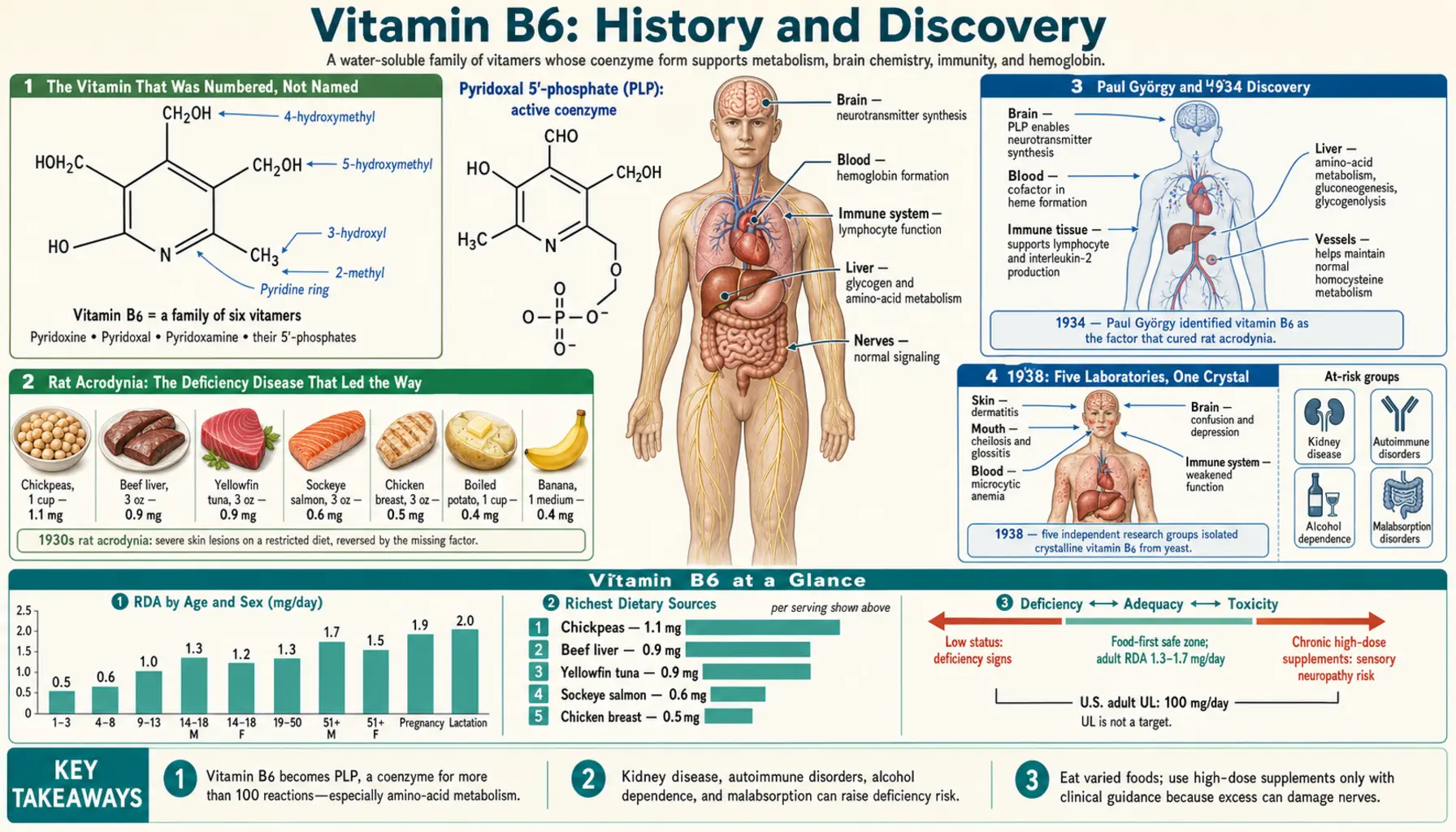
In 1934, a Hungarian-born physician named Paul György noticed that young rats fed a carefully purified diet broke out in an angry, scaly skin disease — a condition that yeast could cure but that neither of the two B vitamins then known could touch. He concluded a new, separate factor was at work, and because the B vitamins were being numbered in the order they were found, he called it vitamin B6. That single, well-documented observation is the seed of everything on this page. Over the next decade the new vitamin was crystallized — by no fewer than five laboratories within a single year — its chemical structure was solved on two continents at once, it was synthesized in the lab, and it was given the name we still use, pyridoxine. This article traces that real story: the deficiency disease that pointed the way, the people who isolated and named the molecule, the near-simultaneous discoveries that make its history a study in scientific coincidence, and the later work that revealed B6 is really a small family of related compounds. Where the historical record is firm, we say so; where credit is genuinely shared, we name everyone involved.
Table of Contents
- The Vitamin That Was Numbered, Not Named
- Rat Acrodynia: The Deficiency Disease That Led the Way
- Paul György and the 1934 Discovery
- 1938: Five Laboratories, One Crystal
- Solving the Structure and Naming Pyridoxine (1939)
- Richard Kuhn and the 1938 Nobel Prize
- Esmond Snell and the Hidden Family: Pyridoxal and Pyridoxamine
- From Vitamin to Coenzyme: Pyridoxal 5′-Phosphate
- Legacy: A Real Vitamin, Honestly Earned
- Research Papers and References
- Connections
- Featured Videos
The Vitamin That Was Numbered, Not Named
The name "vitamin B6" tells you something about how it was found. In the early twentieth century, researchers realised that what they had been calling "vitamin B" was not one substance but a mixture of several water-soluble factors with very different jobs. As each new factor was teased apart, it was given the next number in line — B1 (thiamine), B2 (riboflavin), and so on. Vitamin B6 earned its number simply by being the sixth such factor to be clearly identified, in 1934. The numbers are an accident of history, not a ranking of importance, which is why the sequence has gaps today: several "B" numbers were later assigned to compounds that turned out not to be true vitamins for humans and were quietly dropped.
The word "vitamin" itself has its own origin worth recalling here. In 1912 the Polish-born biochemist Casimir Funk, working in London, proposed the term vitamine — from the Latin vita ("life") plus "amine" — for the trace dietary factors whose absence caused diseases like beriberi and scurvy. He believed these factors were all amines (nitrogen-containing compounds). When it later emerged that not all of them are amines, the final "e" was dropped and the word became vitamin. Vitamin B6 is, as it happens, one of the members of the family that genuinely does contain nitrogen, so Funk's original instinct was not far off in this case. By the time B6 was discovered, Funk's vocabulary had become the standard language of the field, and the new factor slotted straight into it.
Rat Acrodynia: The Deficiency Disease That Led the Way
Like most vitamins, B6 was discovered through a deficiency disease — in this case, one seen not in people but in laboratory rats. In the 1930s, nutrition was being studied by feeding animals "purified" diets: foods broken down into their known components so that researchers could remove one factor at a time and watch what happened. Rats raised on such diets, with vitamins B1 and B2 supplied but something else missing, developed a striking skin condition. Their paws, ears, nose, and tail became red, swollen, scaly, and inflamed. The disorder was named acrodynia (literally "painful extremities"), and because it superficially resembled the human disease pellagra, it was sometimes called the "rat pellagra" or "rat pellagra-like dermatitis."
The crucial clue was that this rat skin disease could be cured by feeding the animals a particular fraction of yeast — yet it was clearly not cured by the two B vitamins already known. According to the historical review by Irwin Rosenberg, earlier work by the British biochemist Rudolf Peters had shown that young rats on a semi-synthetic diet developed rat acrodynia, setting the stage. Whatever was healing the rats was something new. That gap — a real disease, a real cure, but no known vitamin to explain it — is exactly the kind of puzzle that leads to a discovery. Solving it is the story of the next section.
Paul György and the 1934 Discovery
The person who recognised the new factor was Paul György (1893–1976), a Hungarian-born physician and biochemist who trained in Europe and later emigrated, eventually doing much of his career's work in the United States. In 1934, György reported that the substance which cured rat acrodynia was distinct from the known B vitamins, and he defined it as a separate factor — vitamin B6. His short paper, "Vitamin B2 and the pellagra-like dermatitis in rats," published in Nature that year, is the announcement that the field traces the vitamin back to. The somewhat confusing title reflects the moment: he was, in effect, showing that the "B2" complex still contained an unrecognised component, and that this component — not riboflavin — was what healed the rats' skin.
It is worth being precise about what György did and did not do in 1934. He did not yet hold a pure sample of the vitamin in his hand, nor did he know its chemical structure — that came years later. What he did was the essential first step in any vitamin's story: he demonstrated, with a clear experiment, that a specific, previously unrecognised dietary factor existed and was responsible for a specific deficiency disease. That act of definition is why Paul György is consistently credited as the discoverer of vitamin B6. As later sections show, he also stayed with the problem long enough to help crystallize the vitamin and, finally, to give it the name pyridoxine that we still use today. Few discoverers get to see their factor through from a rash on a rat's ear all the way to a named molecule on a chemist's page; György did.
1938: Five Laboratories, One Crystal
Defining a vitamin is one thing; holding the pure substance is another. For four years after György's announcement, vitamin B6 remained a known-but-uncaptured factor in yeast and other foods. Then, in a remarkable burst, it was crystallized in 1938 — and not by one group but by five separate laboratories within the same year, working largely independently and racing toward the same goal. The historical record consistently names these groups together rather than crowning a single winner. They were:
- Samuel Lepkovsky, at the University of California, Berkeley, whose report "Crystalline factor I" appeared in Science in 1938 and is one of the most frequently cited claims to the first crystallization.
- Paul György himself, who published "Crystalline vitamin B6" in the Journal of the American Chemical Society the same year — the discoverer following his own factor through to pure crystal.
- John Keresztesy and Joseph Stevens, chemists at the pharmaceutical company Merck in the United States.
- Richard Kuhn and Gerhard Wendt, working in Germany.
- Atsushi Ichiba and Kazuo Michi, working in Japan.
This is one of the genuinely striking features of B6's history, and it is honest to call it what it was: not a bitter priority dispute with a clear loser, but a case of near-simultaneous, independent discovery. When a problem is ripe — the factor defined, the methods available, the prize obvious — science often solves it in several places at once. Different summaries emphasise different names (Lepkovsky is the one most often singled out for the very first crystals), but the fair reading is that the isolation of crystalline vitamin B6 was a shared achievement of 1938. Pinning it on one laboratory alone would misrepresent the record.
Solving the Structure and Naming Pyridoxine (1939)
Once a vitamin has been crystallized, the next questions are: what is its chemical structure, and can chemists build it from scratch? For vitamin B6 both questions were answered in a single extraordinary year, 1939, and once again on two continents at the same time.
In the United States, chemists at Merck — among them Stanton A. Harris (1902–1992) and Karl Folkers, with structural work also credited to Eric Stiller, John Keresztesy, and Joseph Stevens — determined that vitamin B6 is a derivative of pyridine, a six-membered nitrogen-containing ring. Harris and Folkers then went a decisive step further and chemically synthesized the vitamin, reporting "Synthetic vitamin B6" in Science in 1939. A laboratory synthesis is the ultimate proof of a proposed structure: if you can build the molecule from simple starting materials and it behaves exactly like the natural vitamin, you have almost certainly got the structure right. In Germany, Richard Kuhn and his co-workers reached essentially the same structural conclusion independently and at the same time — another instance of the parallel discovery that runs through this whole story.
With the structure in hand, the vitamin finally got a chemical name. Paul György proposed the term "pyridoxine," chosen to reflect the molecule's close kinship to pyridine (the "pyrid-" root) together with the presence of oxygen and a hydroxyl group. It is a fitting close to his involvement: the same scientist who first defined the factor in 1934 was the one who, five years later, gave its purified molecular form the name it still carries. "Pyridoxine" and "vitamin B6" have been used side by side ever since — the first a chemist's description, the second a nutritionist's tally mark.
Richard Kuhn and the 1938 Nobel Prize
The German chemist Richard Kuhn (1900–1967) appears twice in B6's story — among the 1938 crystallizers and among the 1939 structure-solvers — and he is also the page's one direct link to the Nobel Prize, though the connection deserves an honest qualification. Kuhn was awarded the 1938 Nobel Prize in Chemistry, and the official citation reads "for his work on carotenoids and vitamins." That broad phrase covered his celebrated research on vitamin A, on vitamin B2 (riboflavin), and on the carotenoid pigments; his contributions to vitamin B6 were part of the same prolific vitamin programme but were not the specific reason the prize was given.
There is a sober historical footnote here that should not be left out. Kuhn was forbidden by the Nazi regime from accepting the Nobel Prize at the time it was awarded — Germany had banned its citizens from receiving Nobel honours — and he was only able to receive his diploma and gold medal after the Second World War. So while it is accurate to say that a key figure in the elucidation of vitamin B6's structure was a Nobel laureate, it would be wrong to claim that anyone "won the Nobel Prize for discovering vitamin B6." No Nobel Prize was given specifically for B6. The careful statement is the true one: Richard Kuhn, a 1938 Nobel laureate honoured for his wider work on carotenoids and vitamins, was also one of the scientists who independently helped crystallize vitamin B6 and work out its structure.
Esmond Snell and the Hidden Family: Pyridoxal and Pyridoxamine
For a few years after 1939, "vitamin B6" and "pyridoxine" were treated as one and the same thing. That turned out to be only part of the truth, and the person who uncovered the rest was the American biochemist Esmond E. Snell (1914–2003). In 1942, Snell developed a sensitive microbiological assay for vitamin B6 — a method that used the growth of bacteria to measure how much active vitamin a sample contained. While refining this technique, Snell and his colleagues noticed something odd: tissues and foods sometimes contained far more B6 activity than their pyridoxine content alone could explain. The vitamin, it seemed, came in more than one form.
Pursuing that clue, Snell's laboratory identified two additional natural forms of vitamin B6: pyridoxal (in which an alcohol group of pyridoxine is replaced by an aldehyde) and pyridoxamine (in which it is replaced by an amine group). Pyridoxamine was purified and recognised in 1944, and in 1945 Snell published key work showing that pyridoxal and pyridoxamine could be reversibly interconverted through transamination — a finding that pointed straight at how the vitamin actually does its job in the body. All three forms — pyridoxine, pyridoxal, and pyridoxamine — have broadly similar vitamin activity because the body can convert one into another. Snell's discovery transformed B6 from a single compound into a small family of vitamers, which is exactly how nutrition science describes it today.
Snell's standing in this field is reflected in a description sometimes applied to him and to the Soviet biochemist Alexander Braunstein, a pioneer of transamination chemistry: the two have been called the "fathers of vitamin B6" for revealing not just the vitamin's forms but the biochemistry through which it works. That is a useful reminder that a vitamin's "discovery" is rarely a single moment. György found the factor; five labs crystallized it; Harris, Folkers, and Kuhn pinned down its structure; and Snell showed what it really was and how it functions.
From Vitamin to Coenzyme: Pyridoxal 5′-Phosphate
The final thread of the discovery story is the realisation that none of the three dietary forms of vitamin B6 is the version the body's enzymes actually use. Inside cells, pyridoxine, pyridoxal, and pyridoxamine are converted into a single, phosphate-bearing molecule: pyridoxal 5′-phosphate, almost always abbreviated PLP (and sometimes P5P). PLP is the metabolically active coenzyme form — the shape in which B6 clips into enzymes and does chemistry. The closely related pyridoxamine 5′-phosphate plays a part too, particularly in the transamination reactions that shuffle nitrogen between amino acids.
This insight grew directly out of the work begun by Snell and by transamination pioneers such as Braunstein in the 1940s, and it explains a great deal. It is why all three vitamers "count" as vitamin B6: each is simply a different on-ramp to the same active coenzyme. It is why riboflavin (vitamin B2) matters for B6 to work — a riboflavin-dependent enzyme helps make PLP. And it is why PLP turns up as the essential helper in such an enormous range of reactions, especially those involving amino acids and the building of brain chemicals. The mechanisms, the modern clinical evidence, dosing, food sources, and safety considerations — including B6's unusual capacity, among water-soluble vitamins, to cause harm at very high chronic doses — are covered on the main Vitamin B6 page and across the Vitamin B6 Benefits articles. This history is concerned with how the molecule came to be known in the first place.
Legacy: A Real Vitamin, Honestly Earned
Vitamin B6 occupies an unusually clean place in the history of nutrition. Unlike some of the gaps in the B-vitamin numbering — designations once handed out to compounds that later proved not to be true human vitamins and were dropped — B6 is the genuine article: an essential micronutrient that humans must obtain from food, with a real deficiency disease behind its discovery, a defined chemical structure, a laboratory synthesis, and a clear biochemical job. Its credentials were earned step by careful step.
What makes its story memorable is how much of it happened at once. A new factor defined by one physician in 1934; crystals produced by five laboratories on three continents in 1938; the structure solved and the molecule synthesized in two countries in 1939; the name coined by the original discoverer; and then, in the 1940s, the revelation that the vitamin was really a family of three interconvertible forms acting through a single coenzyme. It is a history with named, verifiable people at every turn — György, Lepkovsky, Keresztesy and Stevens, Kuhn and Wendt, Ichiba and Michi, Harris and Folkers, Snell and Braunstein — and almost no folklore. For a free public-health resource, that is the best kind of story to be able to tell: one where the facts are firm, the credit is fairly shared, and the discovery itself remains the point.
Research Papers and References
The list below combines peer-reviewed historical reviews of vitamin B6 with the original twentieth-century papers that mark each milestone in its discovery, plus curated PubMed topic-search links and an authoritative health-agency resource. Author names, titles, and journals are given as plain text; only the stable DOI, PMID, or archive link is hyperlinked, and each opens in a new tab. Where a figure's contribution is shared or a claim is best read as "near-simultaneous," that is noted in the article above rather than collapsed into a single name.
- Rosenberg IH. A history of the isolation and identification of vitamin B6. Annals of Nutrition and Metabolism. 2012;61(3):236-238. — doi:10.1159/000343113 · PMID: 23183295
- Mooney S, Leuendorf JE, Hendrickson C, Hellmann H. Vitamin B6: a long known compound of surprising complexity. Molecules. 2009;14(1):329-351. — doi:10.3390/molecules14010329 · PMC6253932
- György P. Vitamin B2 and the pellagra-like dermatitis in rats. Nature. 1934;133:498-499. — doi:10.1038/133498a0
- Lepkovsky S. Crystalline factor I. Science. 1938;87(2251):169-170. — doi:10.1126/science.87.2251.169
- Harris SA, Folkers K. Synthetic vitamin B6. Science. 1939;89(2311):347. — doi:10.1126/science.89.2311.347
- Snell EE. The vitamin B6 group. V. The reversible interconversion of pyridoxal and pyridoxamine by transamination reactions. Journal of the American Chemical Society. 1945;67(2):194-197. — doi:10.1021/ja01218a013
- Vitamin B6 discovery, history, and identification — PubMed: vitamin B6 history and discovery
- Pyridoxal phosphate as coenzyme — biochemistry — PubMed: pyridoxal 5′-phosphate coenzyme function
External Authoritative Resources
- NobelPrize.org — The Nobel Prize in Chemistry 1938 (Richard Kuhn)
- MedlinePlus (NIH) — Vitamin B6
- PubMed — All research on vitamin B6 (pyridoxine)
Connections
- All Vitamins
- Vitamin B6
- Vitamin B6 Benefits
- Vitamin B2
- Vitamin B9
- Vitamin B12
- Tryptophan
- Homocysteine