Vitamin B6 Toxicity & Pyridoxine-Induced Sensory Neuropathy
⚠ WARNING — READ THIS PAGE BEFORE TAKING B6 ABOVE 50 mg/day
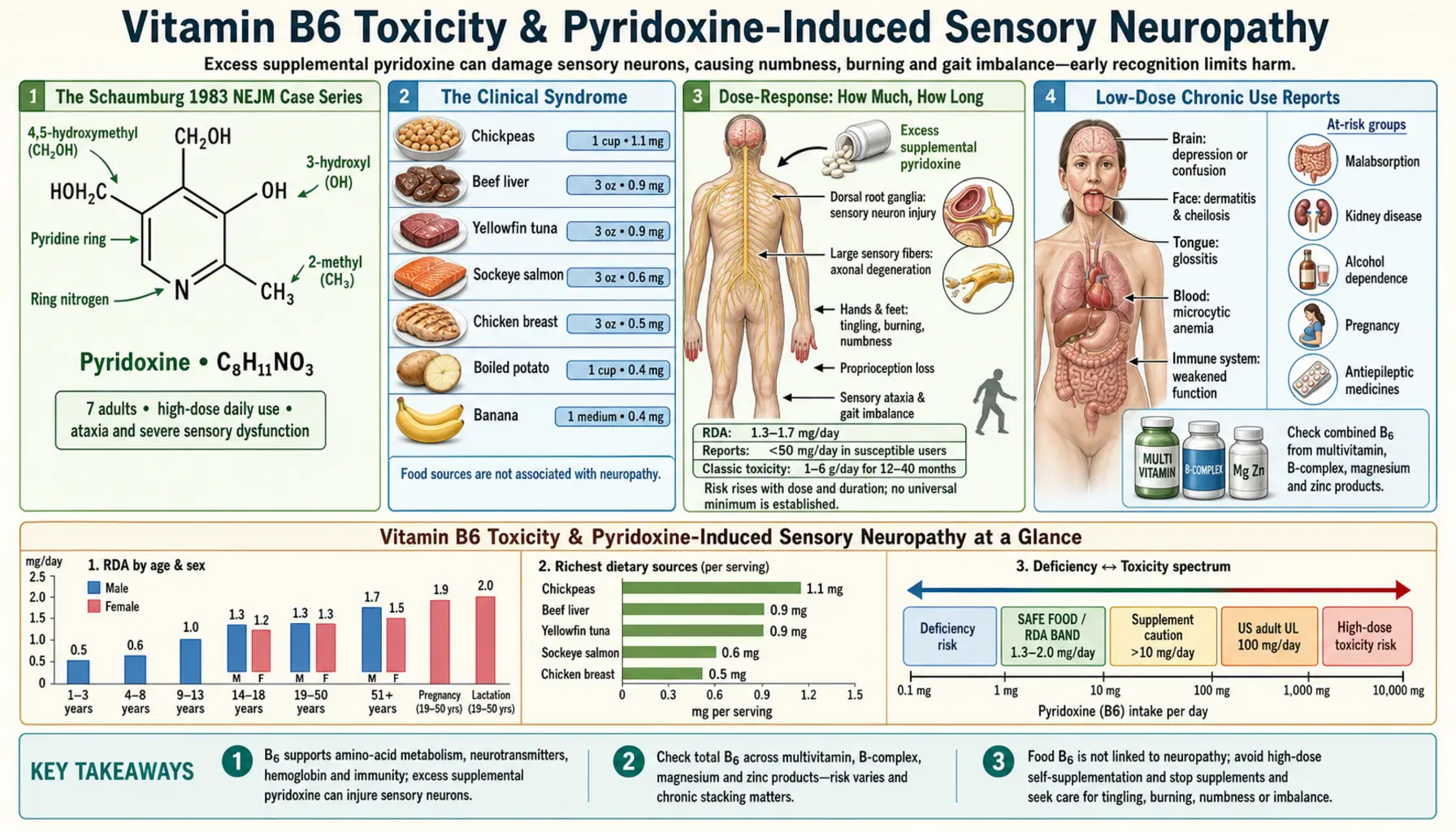
Vitamin B6 is the only water-soluble vitamin with a well-documented adverse-effect ceiling at modest chronic doses. Chronic supplementation of pyridoxine HCl above 100 mg/day — and case reports at doses as low as 50 mg/day with multi-year use — can cause a severe peripheral sensory neuropathy that mimics the very deficiency syndrome it is taken to treat. The toxicity is usually but not always reversible on discontinuation. The FDA Tolerable Upper Intake Level is 100 mg/day. If you are taking a B6 supplement, calculate your total daily intake from ALL sources (single-vitamin supplement, B-complex, multivitamin, fortified food, energy drinks) and confirm it falls below 100 mg/day.
Pyridoxine-induced peripheral sensory neuropathy was first reported in 1983 by Herbert Schaumburg and colleagues in the New England Journal of Medicine. Seven patients taking pyridoxine 2–6 g/day for "ailments" presented with progressive sensory ataxia, paresthesias, and impaired proprioception — clinical findings indistinguishable from advanced syphilitic tabes dorsalis. The subsequent 40-year literature has confirmed the syndrome, characterized its dose-response, identified the rare reports at lower chronic doses, and clarified the mechanism. This deep dive walks through the dose-response data, the proposed mechanism (paradoxical functional deficiency from pyridoxine flooding receptors P5P normally occupies), why P5P appears safer than pyridoxine HCl, the FDA Upper Limit decision, recognition of early symptoms, and the critical differential diagnosis from B12-deficiency neuropathy.
Table of Contents
- The Schaumburg 1983 NEJM Case Series
- The Clinical Syndrome
- Dose-Response: How Much, How Long
- Low-Dose Chronic Use Reports
- The Paradoxical Mechanism — Pyridoxine Flooding
- Why P5P Appears Safer Than Pyridoxine HCl
- The FDA Tolerable Upper Intake Level (100 mg/day)
- EFSA / European Reassessment (2023)
- Early Symptoms — Recognizing Trouble
- Reversibility & Time Course of Recovery
- Differential Diagnosis vs B12-Deficiency Neuropathy
- Hidden B6 Sources: Add Them All Up
- High-Risk Use Patterns to Avoid
- Monitoring Protocol for Therapeutic Doses
- Cautions
- Key Research Papers
- Connections
- Featured Videos
The Schaumburg 1983 NEJM Case Series
Herbert Schaumburg, the chairman of neurology at Albert Einstein College of Medicine, and colleagues published the original report in the August 1983 New England Journal of Medicine under the title "Sensory Neuropathy from Pyridoxine Abuse: A New Megavitamin Syndrome." The paper described seven patients who had taken pyridoxine in doses of 2–6 grams per day — 20–60 times the FDA's eventual Upper Limit — for periods ranging from 2 months to 40 months.
The clinical presentation was striking and stereotyped:
- Progressive sensory ataxia — difficulty walking, especially in the dark or with eyes closed
- Glove-and-stocking distribution of numbness, tingling, and impaired vibration sense
- Severely impaired proprioception (joint position sense)
- Loss of deep tendon reflexes (especially ankle)
- Lhermitte's sign (electric-shock sensation down the spine with neck flexion) in several patients
- Preserved strength and minimal motor involvement
- Romberg sign positive — patients could stand with eyes open but fell with eyes closed
Sural nerve biopsies showed loss of large myelinated fibers consistent with a primary sensory ganglionopathy (damage to the dorsal root ganglia rather than to the peripheral nerve axons themselves). The pathology suggested the dorsal root ganglion neurons — which lie outside the blood-brain barrier — were the primary target.
The clinical course in Schaumburg's patients was sobering: after stopping pyridoxine, all seven patients showed gradual improvement over months to years, but several had persistent residual deficits at 2-year follow-up. This was the first time a water-soluble vitamin was demonstrated to cause clinically significant chronic toxicity at supraphysiologic doses, and it changed the regulatory landscape for vitamin supplementation.
The Clinical Syndrome
The fully developed clinical syndrome of pyridoxine-induced sensory neuropathy has consistent features across multiple case series:
Sensory symptoms (uniformly present)
- Numbness and tingling in the feet, progressing to the calves
- Numbness in the fingertips, progressing to the hands
- Burning pain in the soles of the feet
- Loss of vibration sense (128 Hz tuning fork at the great toe is the most sensitive bedside test)
- Loss of joint position sense at the toes and fingers
- Impaired light touch and pinprick sensation
Coordination (gait) findings
- Sensory ataxia — wide-based gait, particularly worse on uneven surfaces or in the dark
- Positive Romberg test (cannot stand with feet together and eyes closed)
- Difficulty with tandem (heel-to-toe) walking
- Falls, especially nocturnal
Reflex findings
- Diminished or absent ankle jerks
- Diminished knee jerks in more advanced cases
- Upper extremity reflexes generally preserved
Notable absences (helps distinguish from other neuropathies)
- Strength is preserved — this is a pure sensory neuropathy
- Autonomic function is preserved
- Cranial nerves are not involved
- Cognitive function is preserved (helps distinguish from B12-deficiency neuropathy, which can have cognitive features)
Electrodiagnostic findings
- Nerve conduction studies show reduced sensory nerve action potential (SNAP) amplitudes with preserved motor responses
- Most consistent with a sensory neuronopathy (dorsal root ganglion injury) rather than a length-dependent axonal sensory neuropathy
The combination — pure sensory, length-dependent and length-independent, with positive Romberg and preserved strength — is highly suggestive of pyridoxine toxicity in any patient with the relevant supplement history. The differential includes paraneoplastic sensory neuronopathy, Sjogren-related sensory neuronopathy, and platinum chemotherapy neuropathy — all of which produce a similar clinical pattern through similar dorsal-root-ganglion-targeted injury.
Dose-Response: How Much, How Long
The dose-response relationship for pyridoxine neuropathy has been studied in dozens of case series and case reports since 1983. Synthesizing the literature:
- 2 grams per day or more, for weeks — produces neuropathy with high probability. This was the Schaumburg-era megavitamin range.
- 500 mg to 2 grams per day, for months — commonly produces neuropathy after 6–18 months. This was the dose range in autism B6+magnesium trials and in some "natural medicine" treatments.
- 200–500 mg per day, for years — produces neuropathy in a subset of users (estimated 10–30% over multi-year use); time-to-onset is typically 2–5 years.
- 100–200 mg per day, for years — case reports of neuropathy exist but are uncommon; risk appears low but non-zero. Time-to-onset typically 3–10 years.
- 50–100 mg per day, for years — case reports of neuropathy at this dose range exist in the literature, particularly in elderly users and women on chronic B6 for PMS or carpal tunnel. The 2023 Australian TGA review identified hundreds of adverse-event reports at doses below 100 mg/day, leading to a regulatory warning.
- Below 50 mg per day — no convincing case reports of pyridoxine-induced neuropathy in adults with normal renal function.
The pattern: dose AND duration both contribute. Cumulative pyridoxine exposure (mg-years) is the most useful single metric. The Schaumburg paper's patients had cumulative exposures of 100–500 mg-years. Case reports at lower chronic doses tend to involve cumulative exposures of 100–300 mg-years.
Individual susceptibility is highly variable. Some patients tolerate 500 mg/day for years without symptoms; others develop neuropathy at 50 mg/day after 18 months. Risk factors for greater susceptibility include: older age, female sex, renal impairment (reduced pyridoxine clearance), prior subclinical peripheral nerve disease (diabetes, alcohol use), and concurrent neurotoxic medications.
Low-Dose Chronic Use Reports
The most concerning development of the post-Schaumburg era has been the accumulation of case reports of pyridoxine neuropathy at doses well below the FDA Upper Limit of 100 mg/day. The Australian Therapeutic Goods Administration (TGA), which has unusually rigorous post-market surveillance, identified hundreds of adverse-event reports of peripheral neuropathy associated with B6 supplements at recommended doses, leading to a 2022 regulatory warning.
Specific patterns in the low-dose case reports:
- Women on chronic 50–100 mg/day pyridoxine for PMS or carpal tunnel for 5+ years
- Elderly users (>65) on chronic 50–100 mg/day in B-complex formulations
- Patients combining multiple B6-containing supplements (B-complex + separate B6 + multivitamin + energy drink) without realizing the cumulative dose
- Patients on isoniazid-prophylactic pyridoxine continued indefinitely after the TB course was finished
The mechanism for low-dose neuropathy is not fully understood. Hypotheses include cumulative neuronal injury that becomes clinically apparent only after years; individual genetic variation in pyridoxine metabolism (perhaps PNPO polymorphisms or pyridoxal kinase variants); and concurrent subclinical neurologic disease that lowers the symptomatic threshold.
The practical implication: even FDA-Upper-Limit-compliant chronic supplementation carries some risk, and patients on chronic B6 should be aware of early warning signs (see below) and should consider the lowest effective dose, the active P5P form, and time-limited rather than indefinite use whenever possible.
The Paradoxical Mechanism — Pyridoxine Flooding
The mechanism of pyridoxine neuropathy is paradoxical: high pyridoxine causes functional B6 deficiency in nerve tissue. Several lines of evidence support this:
- The clinical syndrome closely resembles B6 deficiency syndromes (e.g. isoniazid-induced peripheral neuropathy)
- Affected patients have elevated plasma pyridoxine but NORMAL or even reduced plasma P5P (the active form)
- Dorsal root ganglion neurons (the primary target) lack the blood-brain barrier and are therefore exposed to high pyridoxine concentrations
- P5P at equivalent therapeutic doses appears safer (see below)
The proposed biochemical mechanism: when supplemental pyridoxine reaches high plasma concentrations, it floods cellular pyridoxal kinase and pyridoxine phosphate oxidase. The activation system saturates and the cell accumulates pyridoxine and pyridoxine phosphate (the inactive intermediate). These molecules occupy P5P binding sites on apoenzymes without providing catalytic activity — effectively displacing P5P and creating a functional B6 deficiency. The dorsal root ganglion neurons, with their high metabolic demand and lack of protective blood-brain barrier, are most susceptible.
An alternative hypothesis: pyridoxine itself may have direct neurotoxic effects independent of P5P competition. The truth is probably both — competitive inhibition of P5P binding plus some direct neurotoxic effect.
This is biologically remarkable: B6 deficiency causes peripheral neuropathy, and B6 toxicity ALSO causes peripheral neuropathy with a clinically similar phenotype. The narrow therapeutic window reflects the inverted-U dose-response curve unique among the water-soluble vitamins.
Why P5P Appears Safer Than Pyridoxine HCl
If the mechanism above is correct, then supplementing the active form (P5P) directly should avoid the kinase/oxidase saturation step that drives the toxicity. The clinical data support this hypothesis, though direct head-to-head trials are lacking:
- Case reports of pyridoxine neuropathy overwhelmingly involve pyridoxine HCl, not P5P
- P5P has been used in pyridoxine-dependent epilepsy and PNPO-deficiency epilepsy at high doses (30–50 mg/kg/day) without the dramatic neuropathy syndrome seen at equivalent pyridoxine HCl doses
- Mechanistically, supplemental P5P bypasses the pyridoxine activation steps that flood when pyridoxine HCl is given
- P5P is more rapidly cleared (does not accumulate as readily as the non-phosphorylated forms)
The integrative-medicine recommendation: at any sustained dose above 25 mg/day, prefer P5P over pyridoxine HCl. The cost difference (P5P is 3–5x more expensive) is justified by the safety advantage at therapeutic doses. Pyridoxine HCl remains acceptable in low-dose B-complex formulations and for short-term use.
Caveats: P5P safety has not been definitively established at very high chronic doses (>200 mg/day for years), and the same fundamental concern about flooding receptor sites applies in theory. P5P is "safer than pyridoxine HCl" but not "safe at unlimited doses." The FDA Upper Limit of 100 mg/day total B6 (from all forms) remains the conservative regulatory ceiling.
The FDA Tolerable Upper Intake Level (100 mg/day)
The Food and Nutrition Board of the Institute of Medicine (now the National Academies) established the Tolerable Upper Intake Level (UL) for Vitamin B6 at 100 mg/day for adults in 1998. The decision was based on review of the dose-response data for sensory neuropathy:
- The Lowest Observed Adverse Effect Level (LOAEL) was estimated at approximately 500 mg/day
- A No Observed Adverse Effect Level (NOAEL) of approximately 200 mg/day was applied with an uncertainty factor of 2 (for individual variation in susceptibility)
- The resulting UL of 100 mg/day was meant to be safe for essentially all adults including elderly and women
The UL applies to total B6 from all sources combined: supplements, fortified foods, B-complex products, multivitamins, and food. Most adults consuming a normal diet get 1–3 mg/day from food; supplement intake is therefore the dominant source.
It is important to note that the 100 mg/day UL has been challenged in both directions. Some safety reviews (particularly from European agencies) have argued the UL should be lower based on accumulating case reports at doses 50–100 mg/day. Conversely, some integrative-medicine groups argue the UL is conservative and that doses 100–200 mg/day are safe with monitoring. The conservative regulatory position remains 100 mg/day, and this is the dose above which a clinician should explicitly justify the supplementation and arrange monitoring.
EFSA / European Reassessment (2023)
The European Food Safety Authority (EFSA) Panel on Nutrition, Novel Foods and Food Allergens completed a major reassessment of Vitamin B6 in 2023. Key findings:
- EFSA reviewed an expanded evidence base including post-1998 case reports of neuropathy at lower chronic doses
- EFSA lowered the Tolerable Upper Intake Level from the previous 25 mg/day (the EFSA limit, much lower than the FDA's 100 mg/day) to 12 mg/day for adults — an even more conservative ceiling reflecting the low-dose chronic case reports
- EFSA acknowledged uncertainty about whether the toxicity threshold is the same for pyridoxine HCl and P5P, but applied the lower limit to total B6 regardless of form
- The EFSA decision drove regulatory tightening of B6 in European supplement formulations
The wide divergence between the FDA UL (100 mg/day) and the EFSA UL (12 mg/day) reflects different weighting of the low-dose chronic case-report literature. Australia's TGA similarly reduced its limits in 2022.
For US-based clinicians and patients: the 100 mg/day FDA UL remains the official ceiling, but the EFSA and TGA reassessments should be understood as the international scientific community's more conservative view. The prudent practice is to keep chronic doses at or below 25 mg/day except for specific indications, and at or below 100 mg/day for any chronic use, with monitoring above 50 mg/day.
Early Symptoms — Recognizing Trouble
The earliest symptoms of pyridoxine-induced neuropathy are often subtle and may be dismissed by patient and physician alike. Vigilant recognition allows discontinuation while the damage is still mostly reversible.
Early symptoms (weeks 1–3 of symptomatic onset)
- Tingling or "pins and needles" in the toes, especially the great toe and the ball of the foot
- Tingling in the fingertips, sometimes only the thumb and index finger
- Mild numbness in the soles of the feet, especially first thing in the morning
- Subtle clumsiness with fine finger movements (buttoning shirts, picking up coins)
- Mild balance disturbance in the dark or with eyes closed
Progressive symptoms (weeks 4–12)
- Spread of numbness up the calf and up the hand into the wrist
- Burning pain in the feet, often worse at night
- Reduced vibration sense at the great toe (the patient cannot feel a vibrating tuning fork that they previously felt easily)
- Loss of joint position sense (cannot tell if the great toe is being moved up or down with eyes closed)
- Tendency to fall or stumble on uneven surfaces
- Difficulty walking in the dark
Advanced symptoms (months to years of continued exposure)
- Severe sensory ataxia — cannot stand with eyes closed
- Loss of vibration sense up to the knees
- Absent ankle and knee reflexes
- Frequent falls
- Lhermitte's sign (electric shock down the spine with neck flexion)
- Persistent symptoms even after discontinuation
The patient action plan: any patient on chronic B6 supplementation who develops new tingling or numbness in the feet or hands should stop the supplement IMMEDIATELY and consult a physician. Do not "wait and see" — continued exposure during the early symptomatic phase converts a reversible neuropathy into a partially irreversible one.
Reversibility & Time Course of Recovery
The good news: pyridoxine neuropathy is generally reversible if caught early. The bad news: recovery is slow and is often incomplete in advanced cases.
Time course of recovery after discontinuation
- Weeks 1–4 after discontinuation: symptoms may briefly worsen (the "coasting" phenomenon, related to continued nerve injury from accumulated tissue pyridoxine). This is alarming but expected.
- Month 2–3: stabilization of symptoms; no further deterioration
- Month 4–12: gradual improvement; tingling decreases, balance improves
- Year 1–2: continued slow recovery; most patients regain substantial function
- Beyond 2 years: any residual deficits at 2 years are likely permanent
Factors associated with better recovery
- Earlier recognition and discontinuation
- Younger age
- Lower cumulative pyridoxine exposure
- Absence of concurrent peripheral nerve disease (diabetes, alcohol use)
- Mild rather than severe initial deficit
Adjuncts that may support recovery
- Continue all other B vitamins at standard doses (riboflavin, folate, B12) — the methylation and energy systems need them. Continue the B-complex; just remove the high-dose B6 component.
- Alpha-lipoic acid — modest evidence as a neuropathy-supportive antioxidant; see the ALA for Diabetic Neuropathy deep dive for protocol
- Acetyl-L-carnitine — some evidence for support of peripheral nerve regeneration
- Methylcobalamin (B12) 1000 mcg/day sublingual — pharmacologic dose of B12 supports peripheral nerve repair regardless of baseline B12 status
- Physical therapy — balance training and proprioceptive exercises (Tai chi, vestibular rehabilitation) can compensate for residual sensory loss and reduce fall risk
Differential Diagnosis vs B12-Deficiency Neuropathy
This is one of the most important and most missed differentials in clinical neurology. B12 deficiency and B6 toxicity both produce sensory neuropathy in elderly patients, but the treatment is exactly opposite: B12 deficiency requires high-dose B12 supplementation, while B6 toxicity requires immediate B6 discontinuation. Confusing the two leads to inappropriate "B-complex" prescribing that worsens B6 toxicity.
| Feature | B6 Toxicity | B12 Deficiency |
|---|---|---|
| Sensory deficit | Pure sensory; large-fiber predominant (vibration, position) | Sensory with prominent posterior column involvement; vibration and position both lost |
| Motor deficit | None | May have spasticity, weakness (subacute combined degeneration) |
| Reflexes | Diminished or absent | May be diminished or hyperactive (UMN involvement) |
| Plantar response | Downgoing (normal) | May be upgoing (Babinski) |
| Cognition | Preserved | May have memory loss, dementia features |
| Lhermitte's sign | Sometimes present | Sometimes present |
| CBC / smear | Normal | Macrocytic anemia with hypersegmented neutrophils |
| Plasma B12 | Normal or high (often very high from supplementation) | Low or low-normal; elevated MMA confirms deficiency |
| Plasma P5P (B6 status) | May be elevated; pyridoxine HCl typically elevated | Variable; often elevated due to B6 supplementation in this population |
| Treatment | DISCONTINUE all B6 | High-dose B12 (sublingual or IM) |
Critical clinical pearl: an elderly patient presenting with sensory neuropathy who is taking a "B-complex" or "B6 supplement" needs a careful supplement history (calculate cumulative B6 exposure), plasma B12 with MMA, and ideally plasma P5P. Empirical "more B-complex" prescribing is the wrong answer until B6 toxicity is excluded.
Hidden B6 Sources: Add Them All Up
Patients frequently underestimate their total daily B6 intake because B6 is in multiple products simultaneously. Common hidden sources:
- Multivitamins — typically 2–25 mg pyridoxine per tablet; megavitamin formulations may have 50–100 mg
- B-complex products — typically 25–100 mg pyridoxine per tablet; "B-50" and "B-100" formulations are 50 and 100 mg respectively
- Single-vitamin B6 supplements — commonly 50–100 mg per tablet; doses up to 500 mg available OTC
- Fortified breakfast cereals — up to 2 mg per serving in some "complete nutrition" cereals
- Energy drinks and shots — commonly 2–40 mg per serving (5-Hour Energy contains 40 mg!)
- Pre-workout supplements — commonly 25–100 mg per serving
- Prenatal vitamins — typically 2–25 mg per tablet
- Whole-food sources — 1–3 mg/day from a normal diet (negligible contribution to total)
Worked example: a woman takes a B-100 complex (100 mg pyridoxine), a multivitamin (5 mg), a single B6 tablet for PMS (50 mg), and drinks a 5-Hour Energy daily (40 mg). Total: 195 mg/day — nearly twice the FDA UL, all "from a healthy supplement routine." This kind of inadvertent megadose is a leading cause of low-dose chronic B6 neuropathy.
Patient instruction: read every supplement and energy-drink label and add up the total B6. Keep the cumulative daily intake at or below 100 mg unless specifically indicated and monitored.
High-Risk Use Patterns to Avoid
- Stacked supplements without intake reconciliation — multivitamin + B-complex + single B6 + energy drink (as above)
- "Megadose" formulations marketed for energy or stress — B-100 and B-150 complexes are not appropriate for chronic use
- Indefinite continuation of pyridoxine after the indication has resolved — PMS B6 continued after menopause; isoniazid-prophylactic pyridoxine continued after the TB course; pregnancy NVP B6 continued postpartum
- Pyridoxine HCl rather than P5P at any sustained dose >25 mg/day
- Pyridoxine in patients with renal impairment without dose adjustment — reduced clearance increases steady-state levels
- Concurrent neurotoxic medications — vincristine, cisplatin, oxaliplatin, paclitaxel, isoniazid, metronidazole, nitrofurantoin all share peripheral nerve toxicity profiles and combine adversely with high-dose B6
- Concurrent peripheral nerve disease — diabetic neuropathy, alcohol-related neuropathy, HIV neuropathy — patients have less reserve and are symptomatic at lower B6 exposures
- Self-prescribed high-dose B6 for chronic conditions not validated by RCT — chronic fatigue, fibromyalgia, autoimmune disease, etc. Many integrative protocols include B6 doses 100–500 mg/day with no convincing evidence base and significant cumulative neuropathy risk.
Monitoring Protocol for Therapeutic Doses
For any patient on chronic B6 above 50 mg/day:
Baseline (before starting)
- Complete supplement reconciliation; calculate total daily B6 from all sources
- Neurological exam including vibration sense (128 Hz tuning fork) at great toes and fingertips, ankle reflexes, Romberg test, tandem gait
- Baseline plasma P5P (optional but useful for follow-up)
- Documentation of indication and target duration of treatment
Follow-up (every 3 months for doses 50–100 mg/day; monthly for doses >100 mg/day)
- Symptom inquiry: any new tingling, numbness, balance changes, falls?
- Neurological exam: vibration sense, reflexes, Romberg, gait
- If any new sensory symptoms or exam findings: stop B6 immediately, refer for full neurology evaluation
- Reassess ongoing indication; consider tapering to lowest effective dose; consider switch to P5P if not already
Annual review
- Reassess whether continued B6 supplementation remains necessary — the most common error is indefinite continuation after the original indication resolves
- Update supplement reconciliation — patients add new supplements without realizing the B6 burden
- Consider time-limited "treatment holiday" of 4–8 weeks to assess whether supplementation is still producing benefit
For doses below 50 mg/day in standard B-complex formulations, annual supplement reconciliation and symptom inquiry is sufficient.
Cautions
- The FDA UL of 100 mg/day is the regulatory ceiling, but the EFSA / TGA reassessments at 12–25 mg/day reflect more conservative international thinking. Use the lowest effective dose, especially for chronic use.
- Calculate total B6 from ALL sources — multivitamin, B-complex, single-B6, fortified foods, energy drinks. Inadvertent megadosing is common.
- Prefer P5P over pyridoxine HCl at any sustained dose >25 mg/day — safety advantage at therapeutic doses justifies the cost.
- Stop B6 immediately at the first sign of new tingling or numbness in feet or hands. Do not "wait and see."
- Elderly patients are at higher risk — reduced renal clearance, smaller neurologic reserve, and polypharmacy raise the risk at any given dose.
- Patients with diabetic neuropathy, alcohol-related neuropathy, or chemotherapy-induced neuropathy have less peripheral nerve reserve and should not be on chronic high-dose B6.
- Coasting phenomenon — symptoms can briefly worsen after discontinuation. This is expected, not a reason to restart B6.
- Recovery is slow — expect months to years for substantial improvement. Document baseline and track over time.
- Do NOT confuse B6 toxicity with B12 deficiency — the two have similar phenotypes but opposite treatments. Get plasma B12 with MMA and plasma P5P in any unexplained sensory neuropathy.
- The active P5P form is safer but NOT safe at unlimited doses — the FDA UL applies to total B6 from all forms.
Key Research Papers
- Schaumburg H, Kaplan J, Windebank A, et al. (1983). Sensory neuropathy from pyridoxine abuse: a new megavitamin syndrome. NEJM. The original case series. — PubMed
- Parry GJ, Bredesen DE (1985). Sensory neuropathy with low-dose pyridoxine. Neurology. The first low-dose chronic case reports. — PubMed
- Bendich A, Cohen M (1990). Vitamin B6 safety issues. Annals of the New York Academy of Sciences. The first systematic safety review. — PubMed
- Bacharach R, Lowden M, Ahmed A (2017). Pyridoxine toxicity small fiber neuropathy with dysautonomia: a case report. Journal of Clinical Neuromuscular Disease. — PubMed
- Institute of Medicine (1998). Dietary Reference Intakes for Thiamin, Riboflavin, Niacin, Vitamin B6, Folate, Vitamin B12, Pantothenic Acid, Biotin, and Choline. The IOM UL document. — PubMed
- Hadtstein F, Vrolijk M (2021). Vitamin B-6-induced neuropathy: exploring the mechanisms of pyridoxine toxicity. Advances in Nutrition. The modern mechanistic review. — PubMed
- Vrolijk MF, Opperhuizen A, Jansen E, et al. (2017). The vitamin B6 paradox: supplementation with high concentrations of pyridoxine leads to decreased vitamin B6 function. Toxicology in Vitro. — PubMed
- Kulkantrakorn K (2014). Pyridoxine-induced sensory ataxic neuronopathy and neuropathy: revisited. Neurological Sciences. A modern clinical review. — PubMed
- Albin RL, Albers JW, Greenberg HS, et al. (1987). Acute sensory neuropathy-neuronopathy from pyridoxine overdose. Neurology. The acute high-dose toxicity report. — PubMed
- EFSA Panel on Nutrition, Novel Foods and Food Allergens (2023). Scientific opinion on the tolerable upper intake level for vitamin B6. EFSA Journal. The 2023 European reassessment. — PubMed
- Australian Therapeutic Goods Administration safety alert (2022). Vitamin B6 (pyridoxine) and risk of peripheral neuropathy. — PubMed
- Foca FJ (1985). Motor and sensory neuropathy secondary to excessive pyridoxine ingestion. Archives of Physical Medicine and Rehabilitation. — PubMed
PubMed Topic Searches
- PubMed: pyridoxine neuropathy toxicity
- PubMed: B6 upper limit safety
- PubMed: P5P vs pyridoxine safety
- PubMed: sensory neuronopathy DRG
- PubMed: peripheral neuropathy B6 vs B12
Connections
- All Vitamins
- Vitamin B6 Overview
- B6 Benefits Hub
- B6 for Neurotransmitter Synthesis
- B6 for PMS & Hormonal
- B6 for Homocysteine
- Peripheral Neuropathy
- Vitamin B12 (for differential)
- Folate (B9)
- Riboflavin (B2)
- Alpha Lipoic Acid for Neuropathy
- Acetyl-L-Carnitine
- Numbness & Tingling
- Chronic Pain
- Toxins (general)