Vitamin B12 — Benefits Deep Dive
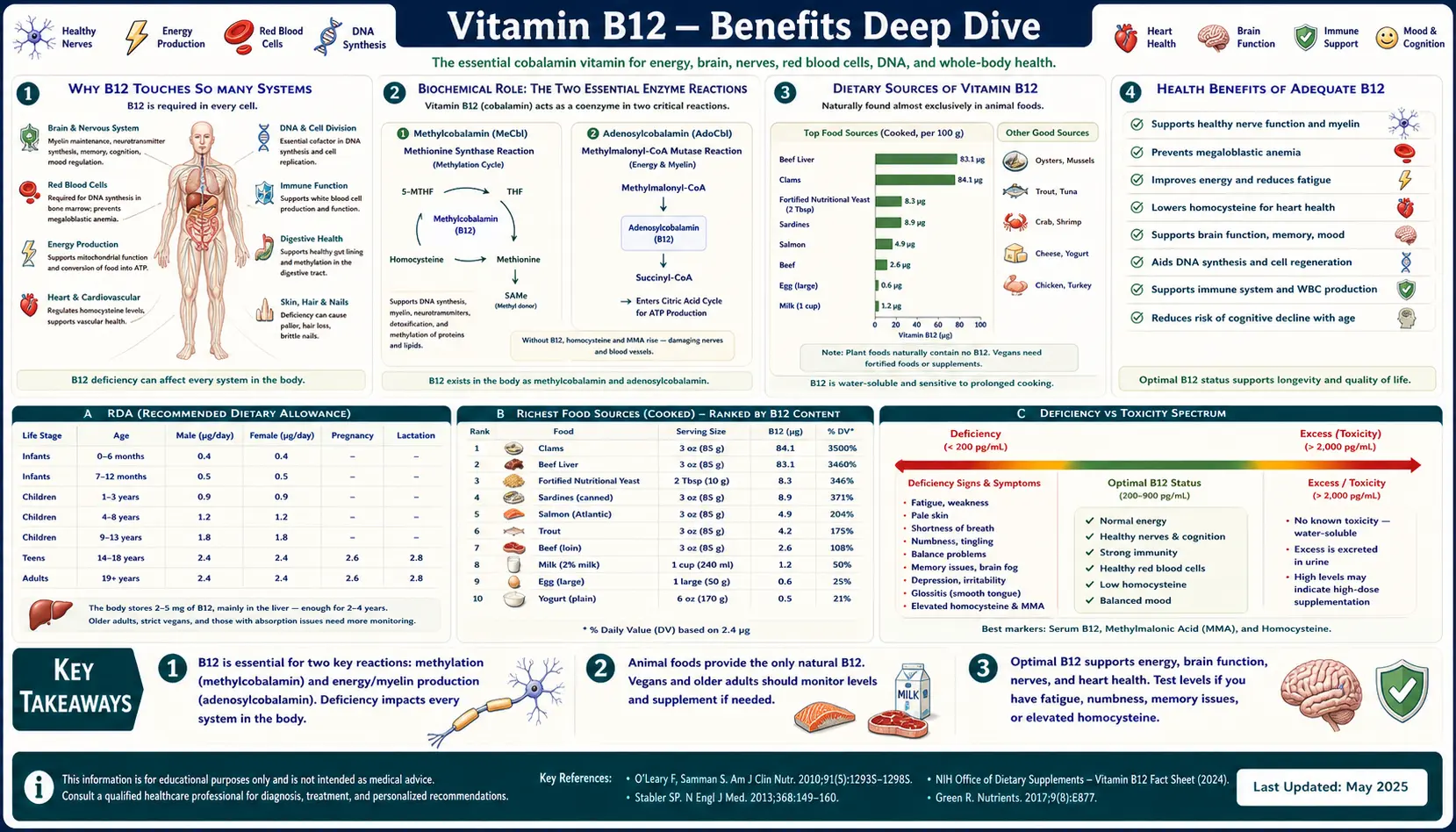
Vitamin B12 (cobalamin) is the largest and most structurally complex vitamin in the human body — a cobalt-cored molecule that no plant produces and that no other nutrient can substitute for. Four distinct biochemical roles operate simultaneously: methionine synthase cofactor driving the methylation cycle (homocysteine clearance, SAMe production, DNA methylation), methylmalonyl-CoA mutase cofactor feeding the Krebs cycle for energy production, myelin synthesis support protecting every nerve in the body from demyelination, and erythroblast DNA synthesis preventing megaloblastic anemia. Each benefit page below explores one specific therapeutic application in clinical depth.
Deep-Dive Articles
Nerve Health & Neuropathy
B12 is the most feared deficiency in clinical neurology because the damage can become permanent. Deep dive into myelin sheath integrity, subacute combined degeneration of the spinal cord, peripheral neuropathy presentations, "the great masquerader" (B12 mimicking MS, dementia, depression), methylmalonic acid (MMA) as the most sensitive marker, and the high-dose 5000 mcg sublingual methylcobalamin protocol for established neuropathy.
Anemia & Hematology
The classic indication. Megaloblastic anemia mechanism (impaired DNA synthesis in erythroblasts via the methyl trap), pernicious anemia (autoimmune intrinsic-factor antibodies), the Schilling test and its modern replacements, IM injection protocols (1000 mcg daily → weekly → monthly), and the Berlin protocol showing high-dose oral B12 (1000-2000 mcg/day) works even in pernicious anemia through passive absorption.
Cognition & Methylation
Methylcobalamin as the methyl donor in homocysteine → methionine remethylation. MTHFR polymorphism interaction with B12 demand. The dementia connection (low B12 in 10-20% of elderly cognitive decline). Depression mechanism through SAMe and monoamine synthesis. The VITACOG trial showing B12 + folate + B6 reduced brain atrophy by 53% in MCI patients with elevated homocysteine.
Vegan & Absorption Issues
The two highest-risk populations: strict vegans (deficiency essentially universal without supplementation; nori and spirulina contain mostly inactive analogues) and patients on PPIs, H2 blockers, or metformin (10-30% of long-term metformin users develop B12 deficiency). Atrophic gastritis in 30% of adults over 60. Optimal supplementation strategies and the methylcobalamin vs. cyanocobalamin debate.
Interactive Visualization Vitamin B12’s Impossible Journey Five stages, two carrier proteins, a working stomach and one specific stretch of gut. Break any link — a PPI, metformin, pernicious anaemia — and absorption collapses. Launch →
Table of Contents
- Deep-Dive Articles
- Why B12 Touches So Many Systems
- Research Papers: Nerve Health & Neuropathy
- Research Papers: Anemia & Hematology
- Research Papers: Cognition & Methylation
- Research Papers: Vegan & Absorption
- Research Papers: Cross-Cutting (Forms, Assays, Safety)
- External Authoritative Resources
- Connections
- Featured Videos
Why B12 Touches So Many Systems
Most vitamins act through a single biochemical mechanism that produces a narrow range of clinical effects. B12 is unusual because it serves as the cofactor for only two enzymes in human biology — methionine synthase and methylmalonyl-CoA mutase — yet those two reactions sit at metabolic crossroads that touch nearly every organ system:
- Methionine synthase (methylcobalamin-dependent) — remethylates homocysteine to methionine using a methyl group donated by 5-methyltetrahydrofolate (5-MTHF). Methionine is then converted to SAMe, the universal methyl donor for more than 200 reactions: DNA methylation (epigenetics), myelin lipid synthesis (phosphatidylcholine, sphingomyelin), neurotransmitter synthesis (serotonin, dopamine, melatonin), creatine production, hormone metabolism. When this reaction fails, folate becomes trapped in its methylated form (the "methyl trap"), homocysteine accumulates, and methylation collapses across the genome. This drives effects on cognition, mood, and cardiovascular health.
- Methylmalonyl-CoA mutase (adenosylcobalamin-dependent) — converts methylmalonyl-CoA to succinyl-CoA, feeding odd-chain fatty acids, valine, isoleucine, threonine, and methionine itself into the Krebs cycle for ATP production. Succinyl-CoA is also the starting substrate for heme synthesis. When this reaction fails, methylmalonic acid (MMA) accumulates — the most sensitive functional biomarker of B12 deficiency.
- Myelin maintenance — downstream of methionine synthase failure. SAMe-dependent methylation of phospholipids is required to build and repair the fatty insulation around every nerve fiber. Without B12, myelin progressively degenerates — first peripheral nerves (numbness, tingling, burning), then the dorsal and lateral spinal columns (subacute combined degeneration), then the brain (white matter lesions, atrophy, dementia). This is the mechanism behind peripheral neuropathy and the irreversible neurological damage that defines untreated B12 deficiency.
- Erythropoiesis — the methyl trap starves rapidly dividing erythroblasts of the thymidine they need for DNA replication, producing oversized, immature macro-ovalocytes — the picture of megaloblastic anemia. This is identical to the anemia of folate deficiency because the underlying defect is the same.
The combination of these mechanisms is why B12 deficiency presents with a bewildering diversity of symptoms across hematology, neurology, psychiatry, cardiology, and dermatology — and why it remains the great masquerader in clinical medicine, mimicking MS, dementia, depression, and chronic fatigue. The complex multi-step absorption process (stomach acid → haptocorrin → intrinsic factor → ileal cubilin-amnionless receptor → transcobalamin II transport) creates vulnerability at every step, which is why absorption-impaired populations — vegans without supplementation, PPI users, metformin users, post-bariatric patients, and adults over 60 with atrophic gastritis — carry such a high prevalence of deficiency.
Research Papers: Nerve Health & Neuropathy
- Subacute combined degeneration of the spinal cord — PubMed: SCD spinal cord B12
- B12 deficiency peripheral neuropathy review — PubMed: B12 peripheral neuropathy
- Methylcobalamin vs cyanocobalamin in neurological dosing — PubMed: methyl vs cyano neurological
- Methylmalonic acid as functional B12 marker — PubMed: MMA functional deficiency
- High-dose methylcobalamin 5000 mcg for diabetic neuropathy — PubMed: high-dose methylcobalamin neuropathy
- B12 deficiency neurological symptoms without anemia — PubMed: Lindenbaum neuro w/o anemia
- Nitrous oxide-induced B12 inactivation — PubMed: N2O B12 myeloneuropathy
- B12 optic neuropathy — PubMed: B12 optic neuropathy
- B12 autonomic neuropathy presentations — PubMed: B12 autonomic neuropathy
- B12 and diabetic peripheral neuropathy adjunctive therapy — PubMed: B12 + diabetic neuropathy
Research Papers: Anemia & Hematology
- Pernicious anemia pathophysiology and intrinsic factor antibodies — PubMed: pernicious anemia IF antibodies
- Megaloblastic anemia mechanism and the methyl trap — PubMed: megaloblastic methyl trap
- Schilling test historical and modern alternatives — PubMed: Schilling vs holoTC
- Berlin protocol — oral high-dose B12 in pernicious anemia — PubMed: oral B12 in pernicious anemia
- IM injection protocols for severe deficiency — PubMed: IM B12 dosing protocol
- Holotranscobalamin as earliest deficiency marker — PubMed: holoTC early marker
- Hypersegmented neutrophils as sensitive indicator — PubMed: hypersegmented neutrophils
- Pancytopenia from severe B12 deficiency — PubMed: B12 pancytopenia
- Reticulocyte response to B12 repletion — PubMed: reticulocyte response
- Folic acid masking B12 deficiency hematology — PubMed: folate masking B12
Research Papers: Cognition & Methylation
- VITACOG trial — B vitamins reduce brain atrophy in MCI — PubMed: VITACOG Smith Oxford
- B12 and Alzheimer's disease risk — PubMed: B12 Alzheimer's risk
- MTHFR polymorphism and B12 demand — PubMed: MTHFR x B12 interaction
- B12 deficiency in elderly cognitive decline (10-20% prevalence) — PubMed: B12 elderly cognitive
- SAMe in depression and monoamine synthesis — PubMed: SAMe depression
- Methionine synthase reaction and homocysteine remethylation — PubMed: methionine synthase reaction
- B-vitamin supplementation and stroke prevention — PubMed: B vitamins stroke
- White matter hyperintensities and B12 status — PubMed: WMH and B12
- Pseudodementia from B12 deficiency — PubMed: B12 pseudodementia
- Methylation cycle and DNA methylation epigenetics — PubMed: methylation epigenetics
Research Papers: Vegan & Absorption
- Vegan B12 deficiency prevalence — PubMed: vegan B12 prevalence
- Nori and spirulina B12 analogues (pseudovitamin B12) — PubMed: plant B12 analogues
- PPI and H2 blocker B12 absorption impairment — PubMed: PPI B12 deficiency
- Metformin-induced B12 deficiency (10-30% long-term users) — PubMed: metformin B12 deficiency
- Atrophic gastritis in elderly and B12 malabsorption — PubMed: atrophic gastritis B12
- B12 in vegan pregnancy and infant deficiency — PubMed: vegan pregnancy infant B12
- Post-bariatric surgery B12 supplementation — PubMed: bariatric B12
- H. pylori and B12 absorption — PubMed: H. pylori B12
- Methylcobalamin vs cyanocobalamin bioavailability — PubMed: methyl vs cyano forms
- Sublingual vs oral B12 absorption — PubMed: sublingual vs oral B12
Research Papers: Cross-Cutting (Forms, Assays, Safety)
- Hydroxocobalamin for cyanide poisoning (Cyanokit) — PubMed: hydroxocobalamin cyanide
- B12 storage and depletion kinetics (3-5 year stores) — PubMed: B12 storage kinetics
- Adenosylcobalamin and mitochondrial function — PubMed: adenosylcobalamin mitochondria
- Cubilin-amnionless ileal absorption receptor — PubMed: cubilin-amnionless receptor
- B12 safety at high doses (no UL established) — PubMed: B12 high-dose safety
- Transcobalamin II transport polymorphism — PubMed: TCN2 polymorphism
- B12 reference range adequacy debate (200-900 pg/mL too broad) — PubMed: B12 reference range
- Enterohepatic recirculation of B12 — PubMed: enterohepatic B12 cycling
- Folic acid fortification and masking of B12 deficiency — PubMed: fortification + B12
- Nitrous oxide recreational use and B12 myeloneuropathy — PubMed: N2O whippets myeloneuropathy
External Authoritative Resources
- Linus Pauling Institute — Vitamin B12 Micronutrient Information Center — the most authoritative scientific summary of B12 biology and clinical evidence, regularly updated
- NIH Office of Dietary Supplements — Vitamin B12 Fact Sheet for Health Professionals
- MedlinePlus — Vitamin B12
- PubMed — All research on vitamin B12 / cobalamin
Connections
- All Vitamins
- Vitamin B12’s Impossible Journey — interactive animation
- Vitamin B12 (Main Page)
- B12 for Nerve Health & Neuropathy
- B12 for Anemia & Hematology
- B12 for Cognition & Methylation
- B12 for Vegans & Absorption Issues
- B12 Deficiency Diagnosis
- B12 and the Nervous System
- Vitamin B9 (Folate)
- Vitamin B6
- Vitamin B2 (Riboflavin)
- Anemia
- Peripheral Neuropathy
- Alzheimer's Disease
- Dementia
- Depression
- Homocysteine
- Vitamin B12 Test
- Complete Blood Count
- Methionine
- ALA for Diabetic Neuropathy