Dementia
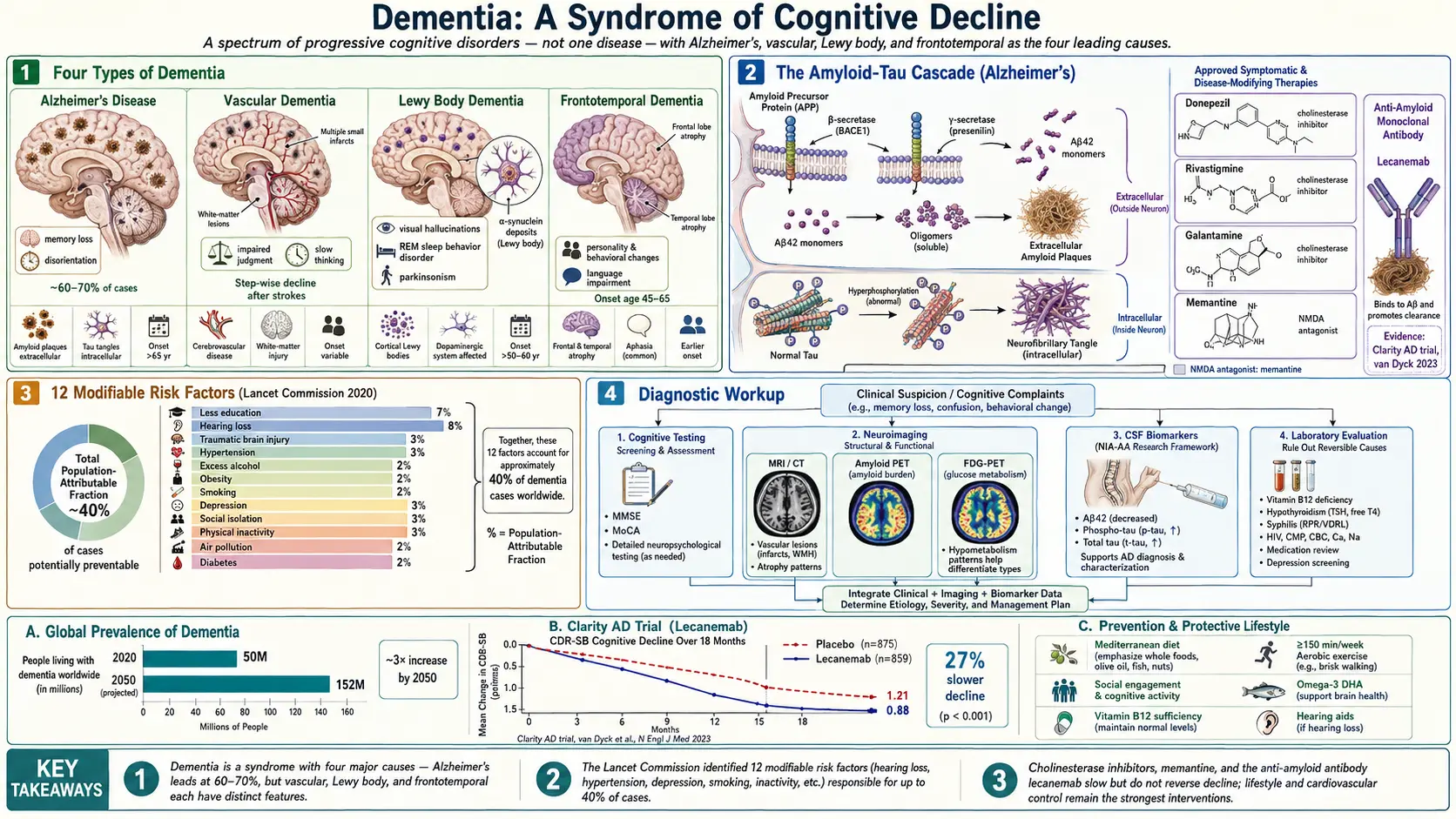
Table of Contents
- What is Dementia?
- Types of Dementia
- Common Symptoms of Dementia
- Causes and Risk Factors
- Diagnosis
- Treatment Options
- Prevention Strategies
- Complications of Dementia
- Research Papers
- Connections
- Featured Videos
What is Dementia?
Dementia is a general term for a decline in cognitive function severe enough to interfere with daily life. It affects memory, thinking, communication, and the ability to perform everyday activities. Dementia is not a single disease but a syndrome with various underlying causes.
Types of Dementia
1. Alzheimer's Disease
- Most common type of dementia.
- Symptoms: Memory loss, confusion, difficulty with language, and disorientation.
- Cause: Abnormal buildup of proteins (amyloid plaques and tau tangles) in the brain.
2. Vascular Dementia
- Second most common type, caused by reduced blood flow to the brain.
- Common after a stroke or series of mini-strokes.
- Symptoms: Impaired judgment, difficulty planning, and slower thinking.
3. Lewy Body Dementia
- Associated with abnormal protein deposits called Lewy bodies in the brain.
- Symptoms: Visual hallucinations, sleep disturbances, and movement problems.
- Overlaps with Parkinson’s disease.
4. Frontotemporal Dementia (FTD)
- Affects the frontal and temporal lobes of the brain.
- Symptoms: Changes in personality, behavior, and language difficulties.
- Occurs at a younger age than other types of dementia, often between 45 and 65 years old.
Common Symptoms of Dementia
Symptoms vary depending on the type of dementia but often include:
- Memory loss that disrupts daily life.
- Difficulty communicating or finding words.
- Impaired reasoning and judgment.
- Confusion and disorientation.
- Changes in mood and behavior, including depression and anxiety.
- Difficulty with visual and spatial abilities, such as getting lost.
- Inability to perform familiar tasks or handle complex tasks.
Causes and Risk Factors
- Age: The risk increases significantly after 65 years old.
- Family history: Genetics can play a role, especially in early-onset dementia.
- Health conditions: Such as high blood pressure, diabetes, and high cholesterol.
- Lifestyle factors: Smoking, poor diet, and lack of exercise can increase risk.
- Brain injury: Traumatic brain injuries can elevate the risk of developing dementia.
Diagnosis
- Medical history and physical examination: To assess symptoms and medical background.
- Cognitive and neuropsychological tests: To evaluate memory, reasoning, and problem-solving skills.
- Imaging tests: MRI or CT scans to detect brain abnormalities or damage.
- Lab tests: To rule out other conditions such as vitamin deficiencies or thyroid problems.
- Neurological examination: To evaluate brain and nervous system function.
Treatment Options
- Medications:
- Cholinesterase inhibitors: Such as donepezil, rivastigmine, and galantamine for Alzheimer's and other dementias.
- Memantine: Helps manage moderate to severe dementia symptoms by regulating glutamate activity.
- Therapies:
- Cognitive stimulation therapy: Engages memory and thinking skills.
- Occupational therapy: Helps individuals maintain independence in daily tasks.
- Lifestyle changes:
- Regular physical activity: Supports overall brain health.
- Social engagement: Helps improve mood and cognitive function.
- Healthy diet: Emphasizing fruits, vegetables, and omega-3 fatty acids.
Prevention Strategies
- Maintain cardiovascular health: Managing blood pressure, cholesterol, and diabetes.
- Stay mentally active: Engaging in puzzles, reading, and other brain-stimulating activities.
- Regular physical exercise: Promotes healthy blood flow to the brain.
- Healthy diet: A balanced diet, such as the Mediterranean diet, may help reduce risk.
- Avoid smoking and limit alcohol intake.
Complications of Dementia
- Reduced quality of life: Affects daily functioning and independence.
- Increased risk of injury: Due to impaired judgment and coordination.
- Malnutrition and dehydration: Difficulty eating or forgetting to eat and drink.
- Pneumonia: Swallowing difficulties can lead to aspiration and lung infections.
- Death: Advanced dementia can result in severe health complications that contribute to mortality.
Research Papers
Historical Background
Dementia has been recognized since ancient times, but the modern understanding began with Alois Alzheimer, who in 1906 described the first case of the disease that now bears his name after examining the brain of Auguste Deter. The term "dementia" itself derives from the Latin "de" (out of) and "mens" (mind), and was used in medical literature as early as the 18th century by Philippe Pinel.
Key Research Papers
- Prince M, et al. The global prevalence of dementia: a systematic review and metaanalysis. Alzheimer's & Dementia. 2013;9(1):63-75.
- Livingston G, et al. Dementia prevention, intervention, and care: 2020 report of the Lancet Commission. The Lancet. 2020;396(10248):413-446.
- Scheltens P, et al. Alzheimer's disease. The Lancet. 2016;388(10043):505-517.
- Jack CR, et al. NIA-AA Research Framework: toward a biological definition of Alzheimer's disease. Alzheimer's & Dementia. 2018;14(4):535-562.
- van Dyck CH, et al. Lecanemab in early Alzheimer's disease (Clarity AD trial). New England Journal of Medicine. 2023;388(1):9-21.
- Birks JS, Harvey RJ. Donepezil for dementia due to Alzheimer's disease. Cochrane Database of Systematic Reviews. 2018;6:CD001190.
- McKhann GM, et al. The diagnosis of dementia due to Alzheimer's disease: recommendations from the National Institute on Aging-Alzheimer's Association workgroup. Alzheimer's & Dementia. 2011;7(3):263-269.
- Jansen IE, et al. Genome-wide meta-analysis identifies new loci and functional pathways influencing Alzheimer's disease risk. Nature Genetics. 2019;51(3):404-413.
- McKeith IG, et al. Diagnosis and management of dementia with Lewy bodies: fourth consensus report of the DLB Consortium. Neurology. 2017;89(1):88-100.
- O'Brien JT, Thomas A. Vascular dementia. The Lancet. 2015;386(10004):1698-1706.
- Hardy J, Selkoe DJ. The amyloid hypothesis of Alzheimer's disease: progress and problems on the road to therapeutics. Science. 2002;297(5580):353-356.
- Norton S, et al. Potential for primary prevention of Alzheimer's disease: an analysis of population-based data. The Lancet Neurology. 2014;13(8):788-794.
PubMed Topic Searches
- PubMed: dementia epidemiology global
- PubMed: Alzheimer disease pathology
- PubMed: vascular dementia
- PubMed: Lewy body dementia
- PubMed: dementia prevention lifestyle
- PubMed: dementia exercise
- PubMed: dementia Mediterranean diet
- PubMed: dementia omega-3 DHA
- PubMed: dementia vitamin B12
- PubMed: dementia vitamin D
- PubMed: dementia sleep
- PubMed: dementia hearing loss
Connections
- Psychiatry
- Alzheimer's Disease
- Depression
- Vitamin B12
- Omega-3 Fatty Acids
- Insomnia
- Magnesium
- Vitamin D3
- Vitamin E
- Turmeric
- Sleep Hygiene
- Anxiety
- Stroke
- Diabetes
- Bacopa Monnieri
- Stress Management
- Creatine
- Methylene Blue
- Vitamin B9
- Hearing Loss
- Urinary Incontinence
- Vascular Dementia
- Lewy Body Dementia
- Turmeric for Brain Health and Cognition — curcumin trial evidence on memory, amyloid, and cognitive decline.