Vitamin B12: Food Sources & Daily Intake
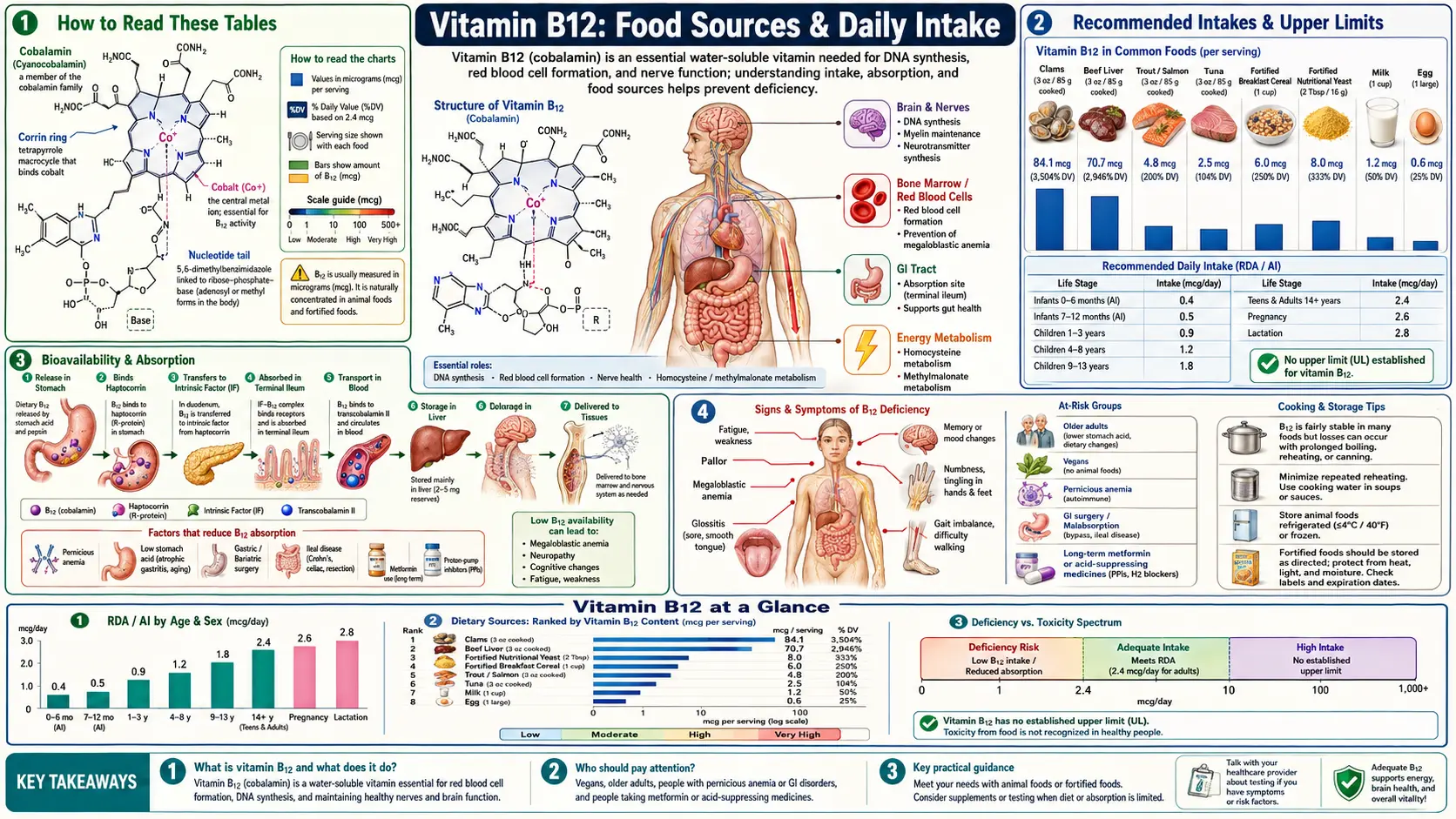
Vitamin B12 (cobalamin) is the one vitamin you cannot get from plants in nature. It is made by microbes and concentrated up the food chain, so in an unfortified diet it comes only from animal foods — shellfish, liver, fish, meat, eggs and dairy. Plants contain essentially none, which makes B12 the single nutrient that vegans and most vegetarians must plan for deliberately, through fortified foods or a supplement. The body needs B12 to make red blood cells, to build the myelin that insulates nerves, and to recycle folate; a long-running shortfall causes a particular anemia and, if it continues, nerve damage that can become permanent.
| Vitamin B12: Food Sources & Daily Intake | ||||||
|---|---|---|---|---|---|---|
| Rank | Food (serving) | Per 100 g | %DV / 100g | Glucose | Fructose | Notes |
| 1 | Clams 3 oz / 85 g | 99 mcg | 🟢 4,121% | — | — | By far the richest food source of B12 — a single small serving covers many days’ worth. |
| 2 | Beef Liver 3 oz / 85 g | 71 mcg | 🟢 2,942% | 0 | 0 | Extraordinarily B12-dense; one serving far exceeds a day’s need. |
| 3 | Beef Organ Meats 3 oz / 85 g | 25 mcg | 🟢 1,038% | 0 | 0 | Nutrient-dense organ meat. |
| 4 | Blue Mussels 3 oz / 85 g | 24 mcg | 🟢 1,000% | — | — | |
| 5 | Atlantic Mackerel 3 oz / 85 g | 19 mcg | 🟢 792% | — | — | An oily fish that is also rich in omega-3s. |
| 6 | Oysters 3 oz / 85 g | 18 mcg | 🟢 729% | 1.2 | 0 | |
| 7 | Sardines, Canned (With Bone) 3 oz / 85 g | 8.9 mcg | 🟢 372% | 0 | 0 | Also a notable source of calcium and vitamin D. |
| 8 | Pork Organ Meats 3 oz / 85 g | 7.8 mcg | 🟢 325% | — | — | Nutrient-dense organ meat. |
| 9 | Salmon (Sockeye) 3 oz / 85 g | 4.5 mcg | 🟢 186% | 0 | 0 | |
| 10 | Rainbow Trout 3 oz / 85 g | 4.1 mcg | 🟢 171% | 0 | 0 | |
| 11 | Swiss Cheese 1 oz / 28 g | 3.1 mcg | 🟢 128% | 0 | 0 | The most B12-rich common cheese. |
| 12 | Tuna, Light, Canned In Water 3 oz / 85 g | 3.0 mcg | 🟢 125% | 0 | 0 | Inexpensive and B12-dense. |
| 13 | Beef Meat 3 oz / 85 g | 2.7 mcg | 🟢 114% | 0 | 0 | |
| 14 | Chicken Organ Meats 3 oz / 85 g | 1.1 mcg | 🟡 48% | — | — | Nutrient-dense organ meat (giblets). |
| 15 | Egg, Whole 1 large / 50 g | 1.1 mcg | 🟡 46% | — | — | Most of the B12 is in the yolk. |
| 16 | Milk, Whole 1 cup / 244 g | 0.5 mcg | 🟡 19% | 0 | 0 | |
Interactive Visualization Vitamin B12’s Impossible Journey Five stages, two carrier proteins, a working stomach and one specific stretch of gut. Break any link — a PPI, metformin, pernicious anaemia — and absorption collapses. Launch →
Table of Contents
- How to Read These Tables
- Recommended Intakes & Upper Limits
- Bioavailability & Absorption
- Cooking & Storage
- Vegetarian & Vegan Sources
- Who Needs to Pay Attention
- Data Sources & References
- Connections
- Featured Videos
How to Read These Tables
- Tiny targets, huge serving numbers. The daily requirement is measured in micrograms (millionths of a gram) and is only about 2.4 mcg for adults — so a single serving of clams, liver or oily fish can deliver many days’ worth. A high %DV here is normal and not a concern: there is no upper limit and the surplus is simply excreted or stored in the liver.
- %DV vs RDA. The %DV column compares a serving against the FDA Daily Value of 2.4 mcg. Your personal target (the RDA) is also 2.4 mcg for adults, a little higher in pregnancy (2.6 mcg) and lactation (2.8 mcg) — see the second table. There is no UL.
- Per 100 g vs per serving. Per-100 g lets you compare foods fairly; the serving size shown beside each food is what you actually eat. Note how the shellfish at the top dwarf everything else — while milk, cheese, eggs and chicken supply smaller, steady amounts that add up across a day.
Recommended Intakes & Upper Limits
Your personal target depends on age, sex and pregnancy. The Daily Value used for the %DV column above is a single label figure; the table below is the age-specific guidance.
| Life stage | RDA / AI (mcg/day) | Upper limit (mcg/day) |
|---|---|---|
| Infants 0–6 mo | 0.4* (AI) | Not set |
| Infants 7–12 mo | 0.5* (AI) | Not set |
| Children 1–3 y | 0.9 | Not set |
| Children 4–8 y | 1.2 | Not set |
| Children 9–13 y | 1.8 | Not set |
| Teens 14–18 y | 2.4 | Not set |
| Adults 19+ y | 2.4 | Not set |
| Pregnancy | 2.6 | Not set |
| Lactation | 2.8 | Not set |
Bioavailability & Absorption
With B12, getting enough in your mouth is only half the story — the harder step is absorbing it. Food-bound B12 must first be freed by stomach acid and enzymes, then handed to a protein called intrinsic factor that the stomach makes; only the B12–intrinsic-factor complex is taken up, far down in the small intestine (the terminal ileum). Anything that lowers stomach acid or intrinsic factor cuts absorption. That is why older adults (stomach acid naturally declines with age; roughly 10–30% of people over 60 absorb food-bound B12 poorly), people on long-term metformin for diabetes, and people on acid-reducing drugs — proton-pump inhibitors and H2 blockers — are all prone to falling short even on a meat-rich diet. The B12 added to fortified foods and supplements is not bound to food protein, so it does not need stomach acid to be freed and is generally absorbed more easily — one reason fortified foods and supplements are recommended for these groups.
Cooking & Storage
B12 is reasonably heat-stable compared with the more fragile vitamins like C and folate, so normal cooking — baking, roasting, gentle frying — keeps most of it. Some is lost with very high heat, prolonged cooking, or microwaving milk, and because B12 is water-soluble a little can leach into cooking water or the liquid that drains from canned fish (so using the pan juices or eating canned fish with its liquid recovers some). In practice the bigger determinant of how much B12 you actually get is absorption, not cooking losses.
Vegetarian & Vegan Sources
This is the most important section on the page for plant-based eaters. There is no reliable natural plant source of vitamin B12. Foods sometimes claimed to supply it — algae and spirulina, fermented foods, mushrooms, unwashed organic produce — either contain none or contain inactive analogues that the body cannot use and that may even interfere with measuring true B12. Vegans, and most vegetarians who eat little dairy or eggs, must get B12 from fortified foods or a supplement — this is not optional. Dependable options are fortified plant milks (almond, oat), fortified nutritional yeast (look specifically for “B12” or cobalamin on the label — not all nutritional yeast is fortified), and a B12 supplement (cyanocobalamin is well studied, inexpensive and effective; a common approach is a higher weekly dose or a smaller daily one). Because the body stores B12 in the liver, a deficiency can take months or years to appear — which is exactly why it is dangerous: by the time symptoms show, nerve damage may already be underway. Anyone eating a plant-based diet without a fortified source or supplement risks megaloblastic anemia and irreversible nerve damage. Pregnant and breastfeeding vegans, and their infants, are at particular risk and should be especially careful to supplement.
Who Needs to Pay Attention
Beyond vegans, several groups are prone to B12 deficiency even on a normal diet — almost always because of poor absorption rather than poor intake. Pernicious anemia is an autoimmune condition in which the body attacks the stomach cells that make intrinsic factor; without it, dietary B12 cannot be absorbed and treatment is typically high-dose or injected B12 for life. Atrophic gastritis and low stomach acid (common with age, and with H. pylori infection) blunt absorption similarly. People who have had stomach or intestinal surgery — including gastric-bypass weight-loss surgery or removal of part of the ileum (as in Crohn’s disease) — often cannot absorb enough and need supplements or injections. Long-term metformin and acid-reducing drugs (PPIs, H2 blockers) lower B12 over years of use. Deficiency first shows as fatigue, weakness, pale skin and a sore tongue from megaloblastic anemia, but the more serious threat is to the nervous system: numbness and tingling in the hands and feet, balance problems, memory and mood changes. Caught early these reverse with treatment; left long enough, the nerve damage can be permanent — so persistent symptoms in anyone in a high-risk group deserve a blood test. On the safety side there is no Tolerable Upper Intake Level: B12 has very low toxicity and excess is excreted, which is why doctors can prescribe the large doses used to overcome absorption problems.
Data Sources & References
- NIH Office of Dietary Supplements — Vitamin B12 Fact Sheet for Health Professionals (DV, RDA/AI, no UL, absorption, risk groups)
- Linus Pauling Institute — Vitamin B12 Micronutrient Information Center
- PubMed — vitamin B12 (cobalamin) deficiency, absorption and dietary requirements
Connections
- All Vitamins
- Vitamin B12’s Impossible Journey — interactive animation
- Vitamin B12 (Main Page)
- Vitamin B12 Benefits
- Vitamin B12 History
- Vitamin B9 (Folate) — works with B12 in red-cell formation
- Vitamin B6
- Salmon
- Eggs