Rous & Huggins: The Cancer Virus, and the First Hormone Therapy
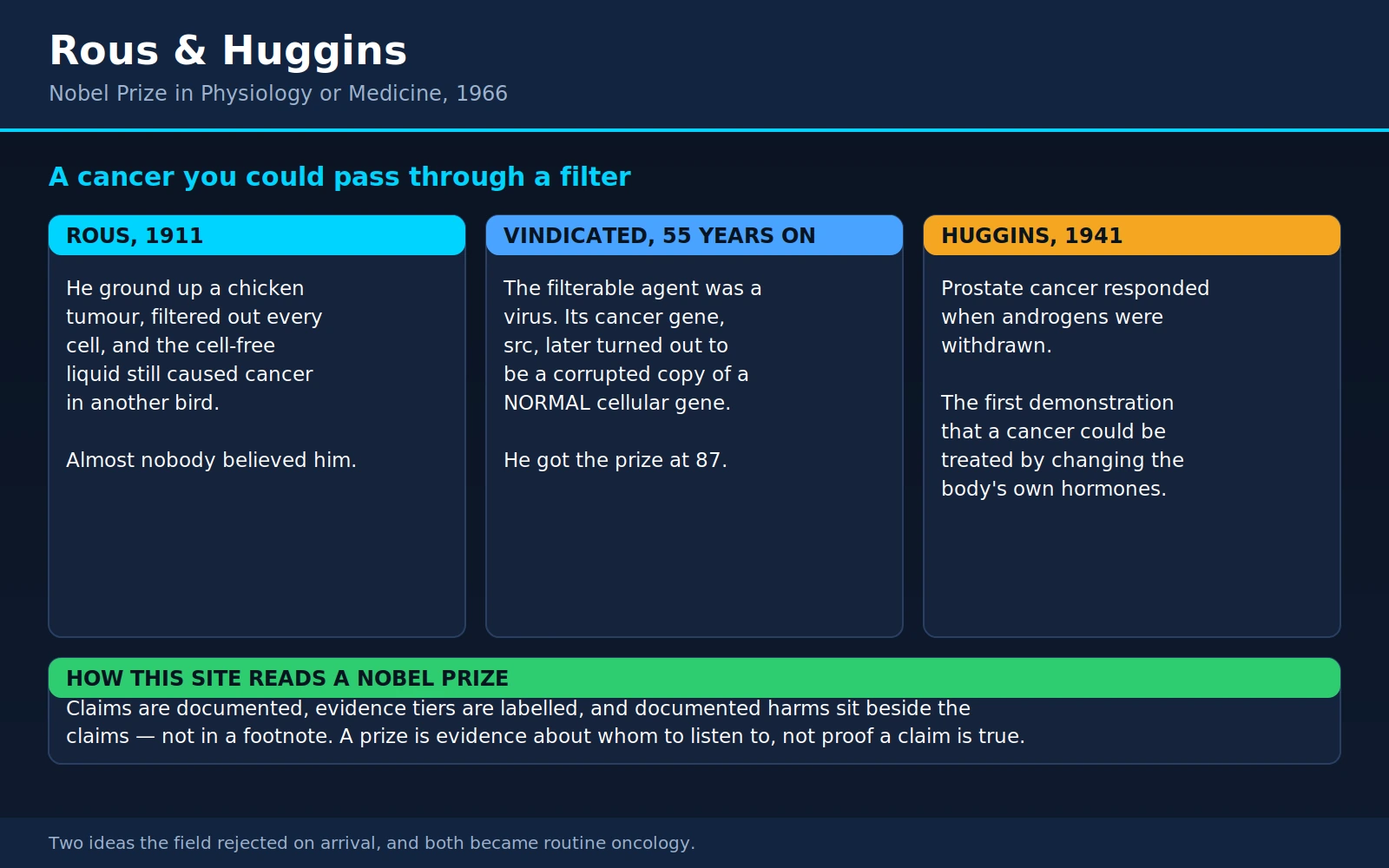
Table of Contents
- The Prize and the Two Men
- Rous and the Chicken
- Why Nobody Believed Him
- Vindication: From Filterable Agent to Oncogene
- Viruses and Human Cancer Today
- Huggins and the Prostate
- Androgen Deprivation Therapy Today
- The Same Idea in Breast Cancer
- What This Does Not Mean
- Huggins's Honest Complications
- What This Means for You Today
- Where Mainstream Medicine Agrees / What Remains Debated
- Key Research Papers
- Connections
- Featured Videos
1. The Prize and the Two Men
The 1966 Nobel Prize in Physiology or Medicine was split between two men whose work had almost nothing in common except that both had been told, at length and by serious people, that they were wrong.
Peyton Rous (1879–1970) received his half "for his discovery of tumour-inducing viruses." He had made that discovery in 1911. The prize came fifty-five years later, when he was eighty-seven — one of the longest gaps between discovery and recognition in the history of the prize, and the single best illustration in medicine of how long a field can take to catch up with a fact it is not ready to hold. Rous was not slow. Everyone else was.
Charles Brenton Huggins (1901–1997) received his half "for his discoveries concerning hormonal treatment of prostatic cancer." A Canadian-born surgeon at the University of Chicago, he had been handed urology as a specialty almost by accident and had gone on, in 1941, to demonstrate something no one had ever shown: that a cancer already spread through a man's skeleton could be pushed into retreat by changing the hormonal environment it was living in. No knife, no radium. Just the removal of a signal the tumour depended on.
Put side by side, the two halves of that prize describe the two great non-surgical routes into cancer that the twentieth century opened. Rous's route led to the genes — through the astonishing discovery, decades later, that his chicken virus caused cancer by carrying a stolen copy of a normal chicken gene. Huggins's route led to systemic drug therapy — the idea that you can treat a cancer everywhere in the body at once by altering its chemical surroundings. Between them, they set up most of what oncology has been doing ever since.
Both stories also carry warnings that matter to a reader today, and this page does not skip them. Rous's story is regularly over-read into the claim that viruses cause most cancer, which they do not. Huggins's story is regularly over-read into the claim that because prostate and breast cancers are "hormone-sensitive," they can be managed with dietary or supplemental hormone manipulation, which they cannot. Sections 5 and 9 deal with both directly.
2. Rous and the Chicken
In the autumn of 1909, a farmer carried a barred Plymouth Rock hen into the Rockefeller Institute for Medical Research in New York. The bird had a large, hard mass in her right breast muscle. She was valuable, she was sick, and the farmer wanted to know what was wrong with her.
The man who took the bird was thirty, newly arrived, and had been given a laboratory almost nobody wanted. Peyton Rous had trained at Johns Hopkins, had contracted tuberculosis from a contaminated cadaver during his training and spent a long convalescence on a Texas ranch, and had been recruited by Simon Flexner to run cancer research at the Institute — a subject then regarded as a graveyard for careers. Rous had no particular reason to be interested in a chicken. He examined the tumour, found it to be a spindle-cell sarcoma — a malignancy of connective tissue — and did the obvious first experiment.
The obvious experiment was transplantation. He took fragments of the tumour and implanted them into other hens. Tumours grew. He reported this in the Journal of Experimental Medicine in 1910 under the title "A transmissible avian neoplasm (sarcoma of the common fowl)." That by itself was interesting but not revolutionary; transplantable animal tumours were already known, and the obvious explanation was that living tumour cells had simply taken root in a new host, which is what a graft does.
Then Rous did the experiment that changed biology. He ground the tumour up, suspended it in salt solution, spun out the debris, and passed the fluid through a Berkefeld filter — a porcelain filter with pores fine enough to hold back every cell and every bacterium then known. What came through the other side was, by every test available in 1911, cell-free and sterile. He injected that cell-free filtrate into healthy hens of the same flock.
They grew the same sarcoma.
The paper is short, plainly written, and one of the most consequential in the history of medicine: "A sarcoma of the fowl transmissible by an agent separable from the tumor cells," Journal of Experimental Medicine, April 1911, volume 13, pages 397–411. Rous was careful in it. He did not announce a virus — the word barely meant anything yet, and he had no way to see one. He described an agent: something submicroscopic, something that survived filtration, something that could be passed from bird to bird indefinitely, and something that produced a cancer at the other end. He explicitly left open what it was.
The agent is now called Rous sarcoma virus (RSV). It is a retrovirus, and it is still one of the most heavily used tools in molecular biology.
3. Why Nobody Believed Him
The reception of that paper is not a footnote to the story. It is the story, and it is the part worth understanding if you want to know how medical knowledge actually moves.
The objections were not stupid. Three of them were serious, and all three were wrong for reasons nobody could have supplied in 1911.
First, cancer was understood as an intrinsic derangement of the cell. The dominant frame — owed largely to Rudolf Virchow's nineteenth-century pathology — held that a tumour was the body's own tissue gone wrong from within. A cancer was a cell that had lost its discipline. Something arriving from outside and causing that loss of discipline did not fit the picture. It sounded like a category error, like proposing that a house catches fire because fire is contagious.
Second, it was a chicken. Birds are not mammals, connective-tissue sarcomas are not the carcinomas that kill most people, and pathologists of the period were not fully convinced that avian tumours were even the same class of disease as human ones. "Chicken cancer" became a way of dismissing the whole line of work without engaging it. Rous spent years being told his finding was a curiosity of poultry.
Third, nobody could reproduce it in mammals — not because the principle was false, but because the specific virus is largely restricted to birds, and because the mammalian tumour viruses that would have vindicated him had not been found yet. Attempts to filter mammalian tumours and transmit them failed. Every failure looked like evidence against Rous.
There was also a fourth problem, which is the deepest one: the finding had no mechanism attached to it. Rous could show that something invisible transmitted the disease. He could not say what that something did once it got inside a cell, because in 1911 nobody knew what a gene was made of, nobody knew that DNA carried heredity, and nothing existed that could bridge "a filterable agent" and "a cell that will not stop dividing." A result with no plausible mechanism is very hard to hold onto, and the field simply set it down.
Rous set it down too. By around 1915 he had largely stopped working on the fowl sarcoma agent, and he did not seriously return to tumour virology until the mid-1930s, when Richard Shope's discovery of a papillomavirus causing warts in wild cottontail rabbits finally handed him a mammalian system — one in which Rous went on to study how those benign papillomas progressed to invasive carcinoma. That work fed into his later and still-useful framework of cancer arising in stages, with an initiating event followed by promoting influences.
The blood-bank detour, which saved more lives than the Nobel
What Rous did in the intervening years deserves to be better known than it is, because on any body count it dwarfs his prize-winning work.
During the First World War, working with J. R. Turner, Rous attacked the problem of storing blood. Blood clots within minutes outside the body; transfusion in 1915 meant arm-to-arm transfer, donor and recipient in the same room at the same moment, which is close to useless on a battlefield. Rous and Turner worked out that a solution of sodium citrate (to chelate calcium and prevent clotting) combined with glucose (to feed the cells) would keep red blood cells alive and transfusable for weeks in a refrigerator. They published the method in the Journal of Experimental Medicine in February 1916, in two back-to-back papers — one on the preservation methods, one on transfusing the stored cells.
That is the technical foundation of the blood bank. Oswald Robertson used it to establish the first stored-blood depots on the Western Front in 1917. Citrate-glucose preservative solutions, refined but recognisably descended from that work, are why an ambulance can carry blood and why an operating theatre can have units waiting. The number of lives that has saved is not calculable, and it is certainly enormous. Rous never got a Nobel Prize for it. He also, for nearly half a century, edited the Journal of Experimental Medicine — which is to say that while the field ignored his best idea, he was quietly setting the standard of evidence for everyone else's.
4. Vindication: From Filterable Agent to Oncogene
The road back took fifty years and ran through three stages.
Stage one: it happens in mammals too
In 1936, John Bittner reported in Science (volume 84, issue 2172, page 162) that the high mammary-tumour incidence of certain mouse strains was not carried in the mother's genes alone: foster-nursing pups on a low-tumour mother changed their tumour risk. Something was being transmitted in milk. The "milk factor" turned out to be a virus — mouse mammary tumour virus. In 1951, Ludwik Gross reported in Proceedings of the Society for Experimental Biology and Medicine (volume 76, issue 1, pages 27–32) that cell-free extracts from leukaemic mice, injected into newborn mice of a low-leukaemia strain, produced leukaemia. That was murine leukaemia virus. Gross had to fight for it much as Rous had; his early papers were rejected and his findings doubted, and part of what made them work was the insistence on inoculating newborn animals, before the immune system matured.
So the principle was not a poultry curiosity. Mammals could get virus-caused cancer too. Rous, by then in his seventies, was still in his laboratory when the tide turned.
Stage two: what the virus actually carries
Rous sarcoma virus is a small retrovirus, and by the early 1970s virologists had worked out that its cancer-causing power sat in a single identifiable gene, named src (pronounced "sarc"). Strip src out and the virus still replicates but stops transforming cells. Put it back and cells turn malignant. Here at last was the mechanism the 1911 paper had lacked: the virus was not poisoning the cell or irritating it. It was delivering a gene.
Stage three: the gene was ours all along
Then came the result that reorganised cancer biology. In 1976, Dominique Stehelin, Harold Varmus, J. Michael Bishop and Peter Vogt published in Nature a paper whose title says the whole thing: "DNA related to the transforming gene(s) of avian sarcoma viruses is present in normal avian DNA." They made a radioactive DNA probe specific to src and asked whether it would find a match in the DNA of ordinary, uninfected birds.
It did. Normal chickens carry src. So, it turned out, do we — the gene is present, in recognisable form, across the animal kingdom.
The implication is worth stating slowly, because it is the single most important idea on this page. The virus did not invent a cancer gene. It stole one. Somewhere in its evolutionary past, an ancestral retrovirus integrated next to a normal chicken gene — a gene whose ordinary job is to help relay growth signals inside a healthy cell — and carried away a copy. The copied version, freed from its normal controls and jammed permanently into the "on" position, is a cancer gene. The original version, sitting quietly in every normal cell, is not. Bishop and Varmus received the 1989 Nobel Prize "for their discovery of the cellular origin of retroviral oncogenes."
That is where the words oncogene and proto-oncogene come from. A proto-oncogene is a normal gene that runs some part of the cell's growth machinery — a receptor, a signalling enzyme, a transcription factor. An oncogene is that same gene after something has broken its off-switch: mutation, amplification, or a chromosomal rearrangement that fuses it to the wrong control sequence. The virus was simply the first vehicle in which biologists ever caught one in transit.
So here is Rous's real legacy, and it is not the one people usually name. It is not that viruses cause most cancer — they do not, and section 5 gives the honest figures. It is that tumour viruses were the instrument that revealed the genes that do. Every cancer gene you have heard of — RAS, MYC, ERBB2/HER2, ABL, EGFR — belongs to the family of normal cellular genes that this line of work uncovered, and the great majority of human cancers arise when those genes are damaged with no virus involved anywhere. A chicken sarcoma in 1911 opened the door to the molecular understanding of a disease that mostly has nothing to do with chickens or with viruses. Rous lived to see it start; he died in 1970, six years before the Nature paper that completed the argument. He was still writing about cancer at ninety.
There is a companion story on this site about the machinery those genes control: Hartwell, Hunt & Nurse worked out the cell-cycle control system — the checkpoints and cyclins that a broken proto-oncogene overrides.
5. Viruses and Human Cancer Today
Now the honest scope, because this is where Rous's story gets exaggerated in both directions — some people believe cancer is basically infectious, and others believe infection is a trivial contributor. Neither is right, and the true figure is more interesting than either.
The best global estimate comes from the International Agency for Research on Cancer. Analysing worldwide incidence for 2018, de Martel and colleagues found that about 2.2 million new cancer cases were attributable to ten infectious agents classified as human carcinogens. Against a global total of roughly 17–18 million new cancers that year, that is approximately 13% — call it one cancer in eight worldwide. (The 2.2 million figure is the paper's own; the percentage is an approximation obtained by dividing it into the global total, and different denominators move it a point either way.)
The rank order surprises people who assume viruses lead the list:
- Helicobacter pylori — about 810,000 cases. A bacterium, not a virus, and the single largest infectious contributor to cancer on earth, chiefly through stomach cancer and a lymphoma of the stomach lining. See Barry Marshall, who drank a culture of it to prove the point, and Helicobacter pylori.
- Human papillomavirus (HPV) — about 690,000 cases: essentially all cervical cancer, plus large fractions of anal, vulvar, vaginal, penile and oropharyngeal cancers. See Harald zur Hausen, who proved the link, and HPV.
- Hepatitis B virus — about 360,000 cases, almost all liver cancer. See Baruch Blumberg, who found the virus and co-developed the vaccine, and Hepatitis B.
- Hepatitis C virus — about 160,000 cases, again mostly liver cancer. See Alter, Houghton & Rice and Hepatitis C.
- Epstein–Barr virus — Burkitt lymphoma, some Hodgkin lymphoma, nasopharyngeal carcinoma, a subset of gastric cancers.
- Kaposi's sarcoma herpesvirus (HHV-8), HTLV-1 (adult T-cell leukaemia/lymphoma), and the liver flukes and Schistosoma haematobium that drive bile-duct and bladder cancers in specific regions.
The burden is not spread evenly. It is highest in eastern Asia and sub-Saharan Africa and lowest in northern Europe; China alone accounted for about a third of the world's infection-attributable cancers in that analysis, driven by H. pylori and hepatitis B. The HPV share tracks national income almost perfectly in the wrong direction — roughly 6.9 cases per 100,000 person-years in high-income countries against 16.1 in low-income countries, because screening and vaccination follow money.
The part that deserves to be said louder
Here is the practical consequence, and it is under-appreciated to a degree that is hard to justify: a meaningful share of the world's cancer is preventable by vaccination and by treating infection. Not detected earlier — prevented. This is unusual. Very little else in oncology can say it.
- HPV vaccination. A Swedish national study following 1.67 million girls and women aged 10–30 found that quadrivalent HPV vaccination was associated with a substantially reduced rate of invasive cervical cancer — not just precancerous lesions, the cancer itself. After adjustment, the incidence rate ratio was 0.37 overall, and 0.12 among those vaccinated before age 17. That last number means roughly an 88% lower rate in girls vaccinated early. It is one of the strongest cancer-prevention results ever recorded.
- Hepatitis B vaccination. Universal infant vaccination programmes reduce chronic carriage, and chronic carriage is what causes liver cancer decades later. This is the first cancer vaccine ever deployed at scale.
- Hepatitis C treatment. Direct-acting antivirals cure the great majority of infections in eight to twelve weeks, which removes the driver of ongoing liver injury.
- H. pylori eradication. A one- to two-week antibiotic regimen clears the organism, and eradication reduces subsequent gastric-cancer risk — the effect is largest when it is done before extensive precancerous change has set in.
None of that would have been thinkable if the field had permanently accepted, in 1911, that "chicken cancer" was irrelevant to human beings.
6. Huggins and the Prostate
Charles Huggins came to the problem sideways, which is often how this works.
He qualified in medicine at Harvard in 1924, trained in general surgery, and arrived at the new University of Chicago medical school in 1927 at the age of twenty-six. He was told he would be doing urology. He had no training in urology and, by his own later account, not much enthusiasm for it. What he did have was a habit of asking physiological questions about surgical organs.
The question he asked was about the prostate: what does it secrete, and what controls the secretion? To find out, he developed a surgical technique in dogs that brought the prostatic ducts to the skin so that the gland's fluid could be collected continuously in a conscious animal. Dogs, it happens, are one of the very few species besides humans that develop prostate disease spontaneously. And when Huggins castrated these dogs, the result was unmistakable: the prostate shrank, and the secretion stopped. Give androgen back, and the gland regrew and resumed secreting.
The prostate, in other words, is not an autonomous organ. It is a hormone-dependent one. It lives on a signal, and if you cut the signal, it withers.
The leap was to ask whether prostate cancer had kept that dependence. There was reason to think a measurable answer was possible: work in the late 1930s had shown that men with metastatic prostate cancer had elevated acid phosphatase in the blood, an enzyme released by prostate tissue. Huggins now had a blood marker that tracked the tumour.
In 1941 he and Clarence V. Hodges published the result in Cancer Research (volume 1, pages 293–297): "Studies on prostatic cancer. I. The effect of castration, of estrogen and of androgen injection on serum phosphatases in metastatic carcinoma of the prostate." A companion paper with the clinical outcomes appeared the same year in Archives of Surgery: "Studies on prostatic cancer: II. The effects of castration on advanced carcinoma of the prostate gland."
In men with metastatic prostate cancer, they removed the androgen supply — by surgical castration (orchiectomy) or by giving oestrogen, which shuts down the pituitary signal that tells the testes to make testosterone. And in men who were bedbound with bone pain, who had been given weeks to live, the effects were rapid and visible: pain eased, appetite returned, men who had not walked got up, and the acid phosphatase in their blood fell. Give androgen back, and the disease flared again — the reverse experiment, which is what made the argument airtight.
Nothing like this had been done before. Consider what the alternatives were in 1941. If a cancer was localised you could cut it out, or you could irradiate it. If it had spread, you could do essentially nothing; cytotoxic chemotherapy did not exist, and would not begin to exist until nitrogen mustard was tried on lymphoma later in the decade. Huggins had shown that a cancer distributed through a man's entire skeleton could be pushed into retreat by manipulating the chemical environment it depended on — a treatment that reaches every deposit everywhere in the body at once, without touching any of them.
That is the birth of systemic medical oncology: the idea that cancer can be treated as a whole-body condition with a whole-body intervention. Everything downstream — chemotherapy, targeted therapy, immunotherapy such as the checkpoint blockade developed by Allison and Honjo — sits on the principle Huggins established with a small series of desperately ill men and a blood test.
A footnote on the original paper worth knowing about, since this site cares about citations: the 1941 Cancer Research article predates the indexing that PubMed and Crossref cover, and it has no record in either. What you will find online are reprints — in CA: A Cancer Journal for Clinicians in 1972 and in the Journal of Urology in 2002. The reprint is what the research list below links to, and it is labelled as such.
7. Androgen Deprivation Therapy Today
Huggins's idea is now called androgen deprivation therapy (ADT), and it is still the backbone of treatment for advanced prostate cancer eighty-plus years on. This section is the practical one. If you or someone you love is starting ADT, this is what it is, what it does, and what it costs — and that last part is routinely under-discussed.
How it is done now
Surgical castration still works perfectly well and is immediate, permanent, cheap and needs no follow-up injections. It is rarely chosen in wealthy countries, for obvious reasons, but it remains a legitimate option and some men prefer it.
GnRH agonists — leuprolide (Lupron, Eligard), goserelin (Zoladex), triptorelin — are the standard. They are depot injections or implants given every one, three, four or six months. They work by a paradox: continuously stimulating the pituitary's GnRH receptor exhausts and downregulates it, so after an initial burst the pituitary stops sending the signal, and testosterone falls to castrate levels (below 50 ng/dL).
The flare. That "initial burst" is a real clinical problem and it is why an antiandrogen usually comes first. In the first one to two weeks, a GnRH agonist causes a surge of luteinising hormone and therefore a surge of testosterone. In a man with extensive bone metastases, spinal disease, or urinary obstruction, that surge can mean a spike in bone pain, worsening urinary retention, or — rarely and seriously — spinal cord compression. So an antiandrogen such as bicalutamide is started a few days before the first agonist injection and continued for a couple of weeks, to block the receptor while the surge passes. If you are told to start tablets before your first injection, that is why. Take them.
GnRH antagonists avoid the flare entirely by blocking the receptor rather than over-stimulating it. Degarelix is a monthly subcutaneous injection; in the pivotal 610-man trial, testosterone was at castrate level within three days in about 96% of men on degarelix and in none of the men on leuprolide, and no antiandrogen cover was needed. The trade-off is injection-site reactions, which occurred in about 40% of degarelix injections versus under 1% for intramuscular leuprolide. Relugolix is an oral antagonist — a tablet once a day. In the HERO trial (930 men), 96.7% on relugolix maintained castration through 48 weeks versus 88.8% on leuprolide; 56% were at castrate testosterone by day 4 versus 0% on leuprolide; and testosterone recovered much faster after stopping (mean 288 ng/dL at 90 days off relugolix versus 59 ng/dL off leuprolide). HERO also reported fewer major adverse cardiovascular events on relugolix (2.9% versus 6.2%, hazard ratio 0.46) — a striking finding, though it was one trial and this remains an area of active argument rather than a settled fact.
The newer agents layered on top
ADT alone is no longer the whole answer for advanced disease. Adding a second drug up front improves survival:
- Abiraterone blocks CYP17, the enzyme that makes androgens — not just in the testes but in the adrenal glands and inside the tumour itself. It is given with prednisone or prednisolone. In STAMPEDE (1,917 men), ADT plus abiraterone reduced deaths compared with ADT alone (hazard ratio 0.63). In LATITUDE (1,199 men with newly diagnosed metastatic hormone-sensitive disease), median overall survival was not reached in the abiraterone group versus 34.7 months on ADT alone (hazard ratio 0.62).
- Enzalutamide, apalutamide and darolutamide are androgen-receptor inhibitors — they block the receptor rather than the hormone. In PREVAIL (1,717 men with metastatic castration-resistant disease, chemotherapy-naive), enzalutamide reduced the risk of death by 29% (hazard ratio 0.71) and radiographic progression by 81% versus placebo.
- Docetaxel chemotherapy added at the start of ADT for metastatic hormone-sensitive disease extended median survival by 13.6 months in the CHAARTED trial.
Now the honest picture
ADT is effective and it is not a cure on its own. Almost everyone responds at first. Almost everyone eventually progresses. When the cancer starts growing again despite testosterone at castrate levels, it is called castration-resistant prostate cancer (CRPC), and it is not the tumour becoming indifferent to androgens — it is the tumour finding workarounds: amplifying the androgen receptor, mutating it so other steroids activate it, making its own androgens inside the tumour, or splicing out the part of the receptor the drugs bind to. That is precisely why abiraterone and enzalutamide work in CRPC: they attack the workarounds. The timeline varies enormously between individuals, and adding an agent up front pushes it out further.
The side-effect burden, stated in full
You are removing the principal male hormone from a man's body. That has consequences everywhere, and they are frequently glossed over in the consultation where ADT is started. From a comprehensive review of ADT harms and their management:
- Hot flushes — extremely common, and for some men genuinely disabling in frequency.
- Loss of libido and erectile function — near-universal, and not fully reversible in everyone even after ADT stops.
- Fatigue — often the complaint men rank as worst, and easy for a clinician to under-weight.
- Loss of muscle mass and strength, with gain in fat mass; body composition changes noticeably within months.
- Bone density loss with real fracture risk — this one is measurable and treatable, see below.
- Metabolic change — weight gain, increased insulin resistance, and an observed association with new diabetes.
- Cardiovascular effects — observational studies suggest increased cardiovascular events, although most published studies have not found ADT linked to greater cardiovascular mortality. This is genuinely unsettled and worth discussing individually if you already have heart disease.
- Anaemia, which compounds the fatigue.
- Gynaecomastia and breast tenderness, and reduced testicle size.
- Mood changes and cognitive complaints — depression, irritability, and difficulty concentrating are reported often; the cognitive research is mixed and harder to pin down than the physical effects, which is not the same as it not being real for the man experiencing it.
What actually helps — with evidence, not just sympathy
The same review catalogued the interventions that have randomised-trial support, and this is the part to bring to your appointment:
- Bone protection. Bisphosphonates, denosumab and selective oestrogen receptor modulators all have randomised evidence for bone loss on ADT. In a trial of 1,468 men on ADT for non-metastatic prostate cancer, denosumab increased lumbar spine bone density by 5.6% at 24 months while placebo lost 1.0%, and reduced new vertebral fractures at 36 months from 3.9% to 1.5%. Ask about a baseline DEXA scan, and about calcium and vitamin D sufficiency.
- Exercise — both resistance and aerobic. This is not a wellness platitude here; resistance and aerobic training have randomised evidence specifically for the muscle loss ADT causes, and exercise and diet have evidence for the metabolic changes. Of everything on this list, structured resistance training is the intervention most consistently under-prescribed relative to its evidence.
- Hot flushes — venlafaxine, medroxyprogesterone, cyproterone acetate and gabapentin all have trial support. You do not have to simply endure them.
- Gynaecomastia — tamoxifen, or prophylactic radiation to the breast tissue before starting, both have evidence.
- Metabolic syndrome markers — exercise, diet, and metformin have been studied.
Intermittent versus continuous — an open question, not a solved one
Because the side effects are so heavy, it is natural to ask whether ADT can be given in cycles, stopping when PSA is low and restarting when it rises. This has been tested, and the result is regularly misreported as "intermittent is just as good." It is not what the trial found.
In the largest study (3,040 men enrolled, 1,535 randomised, median follow-up 9.8 years), median survival was 5.8 years on continuous therapy and 5.1 years on intermittent, with a hazard ratio for death on intermittent therapy of 1.10 (90% confidence interval 0.99 to 1.23). The authors' own conclusion was that the findings were statistically inconclusive: the confidence interval crossed the pre-specified boundary, so a 20% greater risk of death with intermittent therapy could not be ruled out — and neither could significant inferiority be established. Intermittent therapy gave small quality-of-life gains: better erectile function and mental health at three months, but not thereafter.
So: intermittent ADT is a reasonable conversation to have, particularly for a man whose side effects are severe, and it is offered in practice. But it should be had knowing that in metastatic disease the survival question was left genuinely open, not answered in its favour.
8. The Same Idea in Breast Cancer
Huggins gets the Nobel and the textbook credit for hormonal cancer therapy, but a Glasgow surgeon got there forty-five years earlier and deserves to be named.
In 1896, George Thomas Beatson published in The Lancet "On the treatment of inoperable cases of carcinoma of the mamma: suggestions for a new method of treatment, with illustrative cases" — a paper that ran across two consecutive issues that July. Beatson had noticed that removing the ovaries of cows altered lactation, and reasoned from that to the idea that the ovaries might exert some control over breast tissue. He performed oophorectomy on women with inoperable advanced breast cancer, and in at least one case saw a striking, prolonged regression of the disease.
He did this twenty-seven years before oestrogen was isolated. He had no idea what the ovary was sending, no receptor to point at, no marker to follow. He simply observed that removing an organ made a distant cancer shrink, and published it. Beatson's result was inconsistent in other hands — because, as nobody could know then, only some breast cancers are hormone-dependent — and the approach faded until the biology caught up.
The modern descendants
Tamoxifen blocks the oestrogen receptor in breast tissue. The Early Breast Cancer Trialists' Collaborative Group pooled individual patient data from 20 trials (21,457 women) of about five years of adjuvant tamoxifen. In oestrogen-receptor-positive disease, recurrence was roughly halved in the first five years (rate ratio 0.53 in years 0–4), and breast cancer mortality was reduced by about a third across fifteen years — and crucially, the benefit persisted long after the five years of tablets ended. In ER-negative disease, tamoxifen had little or no effect on recurrence or mortality. The meta-analysis found ER status to be the only recorded factor importantly predictive of the size of the proportional benefit.
Aromatase inhibitors (anastrozole, letrozole, exemestane) take a different route: they block the enzyme that converts androgens into oestrogens in fat and other peripheral tissue, which is the main oestrogen source after menopause. Pooling 31,920 postmenopausal women with ER-positive early breast cancer, five years of an aromatase inhibitor reduced 10-year breast cancer mortality compared with five years of tamoxifen (12.1% versus 14.2%). The trade-offs are concrete and worth knowing: more fractures (5-year risk 8.2% versus 5.5%) and more joint symptoms, but fewer endometrial cancers (10-year incidence 0.4% versus 1.2%) and less thromboembolism. In premenopausal women, ovarian suppression is added when an aromatase inhibitor is used.
The concept that matters most to a reader
Hormone-receptor status determines whether hormonal therapy can work at all. This is not a nuance; it is the whole thing. When a pathologist reports ER, PR and HER2 on a breast cancer specimen, that report is not descriptive trivia — it decides the treatment:
- ER-positive (roughly two-thirds to three-quarters of breast cancers) — endocrine therapy is indicated and works, as the tamoxifen data show.
- ER-negative — endocrine therapy does essentially nothing, and giving it means side effects with no benefit.
- HER2-positive — a different axis entirely, treated with HER2-directed antibodies and drugs. (ERBB2/HER2, incidentally, is one of the proto-oncogenes the tumour-virus work led biologists to.)
- Triple-negative — ER-negative, PR-negative, HER2-negative — neither endocrine nor HER2-directed therapy applies, and treatment is chemotherapy-based with immunotherapy in some settings.
If you have a breast cancer diagnosis and do not know your receptor status, that is the first thing to ask for. See our Breast Cancer page for the fuller picture.
Huggins himself extended his own principle into breast cancer: in the early 1950s he showed that adrenalectomy — removing the adrenal glands, the other significant source of sex-steroid precursors — could produce regression in advanced breast cancer. It was a brutal operation that drug therapy has entirely replaced, but the reasoning was the same reasoning, and it worked.
9. What This Does Not Mean
Prostate and breast cancer attract more supplement marketing than almost any other diagnoses, and the marketing leans hard on exactly the fact this page has spent two sections establishing: these cancers respond to hormones. The implied leap is that if hormones drive the cancer, then foods and supplements that "affect hormones" must treat it.
They do not. Here is the evidence, stated as it is rather than as either side would prefer.
Soy and phytoestrogens — the fear is not supported by the data
The worry runs: soy contains isoflavones, isoflavones are weak plant oestrogens, oestrogen drives ER-positive breast cancer, therefore soy is dangerous for breast cancer survivors and may interfere with tamoxifen. It is a reasonable-sounding chain, and it has been studied directly.
The Shanghai Breast Cancer Survival Study followed 5,033 women with breast cancer for a median of 3.9 years. Comparing the highest with the lowest quartile of soy protein intake after diagnosis, the hazard ratio was 0.71 for total mortality and 0.68 for recurrence — that is, soy intake was associated with lower risk, not higher. Four-year mortality was 10.3% in the lowest intake quartile and 7.4% in the highest. The association held in both ER-positive and ER-negative disease, and in both tamoxifen users and non-users. A later systematic review and meta-analysis (12 studies, 37,275 women) found pre-diagnosis soy intake associated with better overall survival (hazard ratio 0.84), with the breast-cancer-specific survival estimate in the same direction but not statistically significant (0.89, confidence interval 0.74–1.07), and post-diagnosis estimates likewise favourable but not statistically significant. Its own conclusion was that the evidence is limited.
The honest summary: the observational evidence in breast cancer survivors is neutral to favourable, and does not support the fear. The caveats are real and should be stated too — these are observational cohorts, not randomised trials; the strongest data come from Chinese populations whose soy intake is lifelong, from traditional foods, and far higher than a Western supplement habit; and "not associated with harm" is not the same as "treats the disease."
Supplemental isoflavone extracts are a different question from food. A concentrated isoflavone capsule delivers a dose and a chemical profile that no dietary study measured, and there is no outcome-trial evidence for it. Treating "soy foods look fine in cohort studies" as permission for high-dose isoflavone supplements is an unearned leap.
A note on this site's own position: myhealthcare.com's whole-food recommendations do not include soy foods, as a general editorial line applied across our food lists for reasons unrelated to this question. That line governs what we recommend. It does not license misstating what the trials found, and it has not been allowed to here: the survivorship data are what they are, and a woman who eats tofu and has had breast cancer has no reason to be frightened by these numbers.
DIM and I3C
Indole-3-carbinol (I3C) comes from cruciferous vegetables — broccoli, cabbage, kale — and condenses in stomach acid into 3,3'-diindolylmethane (DIM). These are sold heavily for "oestrogen metabolism," "hormone balance," and prostate and breast health.
What exists: short studies in humans showing that these compounds shift the ratio of oestrogen metabolites in urine, and laboratory work in cells and animals. What does not exist: any randomised trial showing that DIM or I3C changes cancer incidence, recurrence, or survival in human beings. A shift in a urinary metabolite ratio is a biochemical observation, not a demonstrated clinical benefit, and the history of oncology is thick with markers that moved in the right direction while outcomes did not. I3C is also a potent inducer of liver drug-metabolising enzymes, which means real potential to alter blood levels of other medications — a genuine concern if you are on an anticancer drug whose dose matters. Eat the vegetables, which are excellent; be sceptical of the capsules.
Saw palmetto
Saw palmetto (Serenoa repens) is the most-used supplement for prostate symptoms, and its evidence base is one of the more instructive failures in botanical medicine, because it was tested properly and it failed properly.
- STEP (2006): 225 men over 49 with moderate-to-severe benign prostatic hyperplasia symptoms, randomised to saw palmetto 160 mg twice daily or placebo for one year. No significant difference in symptom score (mean difference 0.04 points, confidence interval −0.93 to 1.01), urinary flow rate, prostate size, residual volume, or quality of life.
- CAMUS (2011): 369 men, saw palmetto at up to three times the standard dose, escalating over 72 weeks. Symptom scores improved 2.20 points on saw palmetto and 2.99 points on placebo — the difference of 0.79 points favoured placebo. No secondary outcome favoured saw palmetto either.
Both were well-conducted, adequately powered, placebo-controlled trials, and both were null — the second having specifically tested whether the earlier failure was a dosing problem. It was not. Saw palmetto also appears safe, with no clearly attributable adverse effects in CAMUS, so this is a story about lack of efficacy rather than danger.
And separately from all of that: saw palmetto is not a treatment for prostate cancer. BPH and prostate cancer are different diseases; a supplement that fails to relieve urinary symptoms from a benign enlargement has no claim whatever on a malignancy. One further practical point: any agent that lowers PSA can mask a rising PSA, which is why finasteride and dutasteride require an interpretation adjustment. Tell whoever orders your PSA test what you are taking.
Testosterone replacement after prostate cancer — genuinely nuanced
This one does not deserve a slogan in either direction. For decades the rule was absolute: a man with any history of prostate cancer must never receive testosterone, on the direct logic of Huggins's finding — androgens feed prostate cancer, so adding androgens must feed it.
That absolute has softened, on evidence. A systematic review and meta-analysis of 21 studies of testosterone replacement in men treated for localised prostate cancer with curative intent (surgery, radiation, brachytherapy, cryotherapy or HIFU) found a pooled biochemical-recurrence rate of 0.01, suggesting no association between testosterone therapy and recurrence, with consistent results in both the surgery and radiation subgroups.
Read that carefully, because the caveats carry as much weight as the finding. These are observational studies, not randomised trials. The men in them were selected — treated with curative intent, disease apparently controlled, and judged suitable by their urologists. The finding says nothing about men with active, untreated, or metastatic disease, and it certainly says nothing about men currently on ADT, for whom testosterone would directly undo the treatment. What it supports is that for a man with genuinely symptomatic hypogonadism and a successfully treated localised cancer, this is a decision to be made with a urologist weighing symptoms against uncertainty — not an automatic prohibition, and not a green light either.
The plain statement
No supplement has been shown to substitute for androgen deprivation therapy, or for endocrine therapy in breast cancer. Not soy, not DIM, not saw palmetto, not any combination sold as a "natural hormone protocol." Stopping ADT or tamoxifen in favour of supplements is a decision with a known and unfavourable outcome. Supplements can have a supportive role — vitamin D and calcium adequacy genuinely matter for the bone loss ADT causes — and that role is worth taking seriously. It is a different role from treatment.
10. Huggins's Honest Complications
Two things about Huggins should be recorded alongside the achievement, briefly and without either excusing or inflating them.
He was reportedly a forceful, sometimes autocratic figure, confident to the point of dismissiveness about approaches other than his own — and in particular he was, for a long period, dismissive of cytotoxic chemotherapy at a time when it was becoming genuinely useful. Scientific conviction of the kind that lets a man ignore a hostile field for years is the same trait that makes him wrong about the next thing, and the profession was slower to adopt some combination approaches because of it.
The second point is about consent, and it belongs to the era more than to any individual. Orchiectomy in the 1940s was performed under standards of disclosure that would not be accepted today — a surgeon's judgement of what a patient needed to know was, in practice, the whole of the process. Men were castrated for cancer without the kind of documented, informed, alternatives-explained consent that is now the legal and ethical baseline. That the treatment worked, and that many of those men lived longer and in less pain because of it, does not settle the separate question of whether they were properly asked. Both things are true.
11. What This Means for You Today
What a PSA is, and what it is not
Prostate-specific antigen is a protein made by prostate epithelial cells — normal ones as well as cancerous ones. Some leaks into the blood, where it is measured in nanograms per millilitre.
It is specific to the prostate. It is not specific to cancer. That single distinction resolves most of the confusion around it. PSA rises with benign prostatic enlargement, with prostatitis, with urinary retention, after ejaculation, after a long bicycle ride, and after instrumentation such as catheterisation or biopsy. It falls — by roughly half — on finasteride or dutasteride, which is why men on those drugs need their result interpreted against an adjusted scale. A single elevated value is a reason for a conversation, not a diagnosis.
Where PSA is genuinely excellent is as a tracking measure in a man already diagnosed: watching it fall on ADT, watching for the rise that signals recurrence or castration resistance. Its use as a screening test in healthy men is a different and much more contested proposition — see section 12. Our PSA Test page covers interpretation in detail.
Why the pathology report is the most important document you will be given
For breast cancer, the ER/PR/HER2 status on that report determines whether endocrine therapy can help you at all. For prostate cancer, the Gleason grade group, stage and PSA determine whether the disease needs treating now, monitoring, or intensifying. Ask for a copy of your pathology report. Ask someone to walk you through it line by line. Patients who understand their own report ask better questions for the next ten years.
Questions worth asking if you are starting ADT
- Agonist or antagonist — and if an agonist, what is my flare cover? If you have extensive bone disease or spinal involvement, this matters urgently.
- Am I having a baseline DEXA bone density scan? And at what point would you add denosumab or a bisphosphonate?
- Are my vitamin D and calcium adequate? This is cheap, checkable, and relevant to the bone loss that is coming.
- Can you refer me to a supervised exercise programme? Resistance and aerobic training have randomised evidence for the muscle loss and metabolic change ADT causes. Ask specifically; it is under-prescribed.
- What do we do about hot flushes if they become disabling? Venlafaxine, gabapentin and progestational agents all have trial support. You should not be told to just live with them.
- Should I be on an added agent — abiraterone, an androgen-receptor inhibitor, or docetaxel — and why that one?
- Is intermittent therapy an option for me, and what did the trial actually show? (See section 7; the answer is "inconclusive," not "equivalent.")
- What is my cardiovascular and diabetes risk, and who is monitoring it?
- Who do I talk to about sexual function and about mood? These get raised last or not at all, and they are frequently what men mind most.
And the prevention point from section 5
If a meaningful share of the world's cancer is caused by infection, then HPV vaccination for your children, hepatitis B vaccination, hepatitis C testing if you have any risk factor, and H. pylori testing if you have persistent upper-abdominal symptoms are all cancer prevention, in the literal sense. They are among the very few interventions that stop a cancer from ever existing rather than finding it early.
12. Where Mainstream Medicine Agrees / What Remains Debated
Broad agreement
- Certain viruses and one bacterium cause a substantial minority of human cancers, and vaccination or eradication of those agents prevents the cancers they cause.
- Cancer is fundamentally a disease of damaged growth-control genes, and tumour viruses were the tool that revealed those genes.
- Prostate cancer growth is androgen-dependent, and androgen deprivation produces reliable initial responses in advanced disease.
- Adding abiraterone, an androgen-receptor inhibitor, or docetaxel to ADT improves survival in appropriately selected men with advanced disease.
- ADT causes substantial harm across bone, metabolic, sexual, cognitive and body-composition domains, and those harms should be actively managed rather than tolerated.
- Bone-protective therapy (denosumab, bisphosphonates) prevents fractures in men on ADT.
- In breast cancer, ER status determines whether endocrine therapy works; five years of tamoxifen in ER-positive disease cuts breast cancer mortality by about a third over fifteen years; aromatase inhibitors improve on tamoxifen in postmenopausal women at the cost of more fractures.
Genuinely debated
- PSA screening. The large randomised screening trials disagreed with each other, and the disagreement has never been fully resolved. The core tension is real and not a matter of interpretation: screening finds cancers, and a meaningful proportion of those cancers would never have caused symptoms or death, while the treatment for them causes incontinence and impotence. Shared decision-making is now the standard recommendation precisely because there is no answer that is right for every man. Active surveillance for low-risk disease has substantially reduced the overtreatment problem without resolving the screening question.
- Intermittent versus continuous ADT. Inconclusive in metastatic disease, as described in section 7. Reasonable clinicians differ.
- Which intensification, for whom, and when. Docetaxel, abiraterone, or an androgen-receptor inhibitor — and increasingly whether to use two of them together on top of ADT. Trials have shown benefit for several strategies; direct comparisons between them are limited, and the choice often turns on toxicity profile, comorbidity and cost.
- Cardiovascular differences between GnRH agonists and antagonists. The HERO signal (2.9% versus 6.2% major cardiovascular events) is striking but comes from one trial as a secondary observation. Whether antagonists should be preferred in men with existing cardiovascular disease is actively argued.
- Duration of endocrine therapy in breast cancer. Five years, seven, ten — extending it reduces recurrence and adds side effects, and the balance depends on individual risk.
- Soy and phytoestrogens. The observational data are reassuring, but the absence of randomised outcome trials means positions still differ, and the extrapolation from Asian dietary cohorts to Western supplement use is a real weakness that both enthusiasts and alarmists tend to skate over.
- How much of the residual cancer burden is infection-related. The 13% estimate depends on attribution methods, and candidate associations for other agents are still being investigated.
13. Key Research Papers
Every citation below was verified against PubMed or Crossref before publication. Where a paper predates modern indexing and has no record in either database, that is stated explicitly rather than papered over with a guessed identifier.
- Rous P. A sarcoma of the fowl transmissible by an agent separable from the tumor cells. J Exp Med 1911;13(4):397-411
- Rous P, Turner JR. The preservation of living red blood cells in vitro: I. Methods of preservation. J Exp Med 1916;23(2):219-37
- Rous P. The challenge to man of the neoplastic cell (Nobel Lecture). Science 1967;157(3784):24-8
- Stehelin D, Varmus HE, Bishop JM, Vogt PK. DNA related to the transforming gene(s) of avian sarcoma viruses is present in normal avian DNA. Nature 1976;260(5547):170-3
- Huggins C, Hodges CV. Studies on prostatic cancer. I. The effect of castration, of estrogen and of androgen injection on serum phosphatases in metastatic carcinoma of the prostate. Originally Cancer Research 1941;1:293-297, which has no PubMed or Crossref record; linked here is the verified 2002 reprint: J Urol 2002;168(1):9-12
- Huggins C. Studies on prostatic cancer: II. The effects of castration on advanced carcinoma of the prostate gland. Not indexed in PubMed; verified by Crossref DOI: Arch Surg 1941;43(2):209
- Huggins C. Endocrine-induced regression of cancers (Nobel Lecture). Science 1967;156(3778):1050-4
- Beatson GT. On the treatment of inoperable cases of carcinoma of the mamma: suggestions for a new method of treatment, with illustrative cases. Not indexed in PubMed; verified by Crossref DOI: Lancet 1896;148(3802):104-107 (concluded in the following issue, 148(3803):162-165)
- de Martel C, Georges D, Bray F, Ferlay J, Clifford GM. Global burden of cancer attributable to infections in 2018: a worldwide incidence analysis. Lancet Glob Health 2020;8(2):e180-e190
- Lei J, Ploner A, Elfström KM, et al. HPV vaccination and the risk of invasive cervical cancer. N Engl J Med 2020;383(14):1340-1348
- Klotz L, Boccon-Gibod L, Shore ND, et al. The efficacy and safety of degarelix: a 12-month, comparative, randomized, open-label, parallel-group phase III study in patients with prostate cancer. BJU Int 2008;102(11):1531-8
- Shore ND, Saad F, Cookson MS, et al. Oral relugolix for androgen-deprivation therapy in advanced prostate cancer (HERO). N Engl J Med 2020;382(23):2187-2196
- James ND, de Bono JS, Spears MR, et al. Abiraterone for prostate cancer not previously treated with hormone therapy (STAMPEDE). N Engl J Med 2017;377(4):338-351
- Fizazi K, Tran N, Fein L, et al. Abiraterone plus prednisone in metastatic, castration-sensitive prostate cancer (LATITUDE). N Engl J Med 2017;377(4):352-360
- Beer TM, Armstrong AJ, Rathkopf DE, et al. Enzalutamide in metastatic prostate cancer before chemotherapy (PREVAIL). N Engl J Med 2014;371(5):424-33
- Sweeney CJ, Chen YH, Carducci M, et al. Chemohormonal therapy in metastatic hormone-sensitive prostate cancer (CHAARTED). N Engl J Med 2015;373(8):737-46
- Hussain M, Tangen CM, Berry DL, et al. Intermittent versus continuous androgen deprivation in prostate cancer. N Engl J Med 2013;368(14):1314-25
- Nguyen PL, Alibhai SM, Basaria S, et al. Adverse effects of androgen deprivation therapy and strategies to mitigate them. Eur Urol 2015;67(5):825-36
- Smith MR, Egerdie B, Hernández Toriz N, et al. Denosumab in men receiving androgen-deprivation therapy for prostate cancer. N Engl J Med 2009;361(8):745-55
- Early Breast Cancer Trialists' Collaborative Group (Davies C, Godwin J, et al). Relevance of breast cancer hormone receptors and other factors to the efficacy of adjuvant tamoxifen: patient-level meta-analysis of randomised trials. Lancet 2011;378(9793):771-84
- Early Breast Cancer Trialists' Collaborative Group. Aromatase inhibitors versus tamoxifen in early breast cancer: patient-level meta-analysis of the randomised trials. Lancet 2015;386(10001):1341-1352
- Shu XO, Zheng Y, Cai H, et al. Soy food intake and breast cancer survival. JAMA 2009;302(22):2437-43
- Qiu S, Jiang C. Soy and isoflavones consumption and breast cancer survival and recurrence: a systematic review and meta-analysis. Eur J Nutr 2019;58(8):3079-3090
- Bent S, Kane C, Shinohara K, et al. Saw palmetto for benign prostatic hyperplasia (STEP). N Engl J Med 2006;354(6):557-66
- Barry MJ, Meleth S, Lee JY, et al. Effect of increasing doses of saw palmetto extract on lower urinary tract symptoms: a randomized trial (CAMUS). JAMA 2011;306(12):1344-51
- Kardoust Parizi M, Abufaraj M, Fajkovic H, et al. Oncological safety of testosterone replacement therapy in prostate cancer survivors after definitive local therapy: a systematic literature review and meta-analysis. Urol Oncol 2019;37(10):637-646
Live PubMed Searches
- Rous sarcoma virus oncogene
- Infection-attributable cancer, global
- Androgen deprivation therapy adverse effects
- Soy isoflavones and breast cancer survival
- Saw palmetto and benign prostatic hyperplasia
Connections
- Notable Doctors — the full index of physicians and researchers profiled on this site.
- Nobel Prize in Physiology or Medicine — the complete roll of laureates, 1901 to the present.
- Harald zur Hausen — proved HPV causes cervical cancer, the discovery that made a cancer vaccine possible.
- Baruch Blumberg — found the hepatitis B virus and co-developed the first vaccine against a human cancer.
- Alter, Houghton & Rice — identified hepatitis C, now curable, and a major driver of liver cancer.
- Barry Marshall — drank Helicobacter pylori to prove a bacterium causes ulcers; it is also the world's largest infectious cause of cancer.
- Hench, Kendall & Reichstein — the other great "hormones as drugs" story, cortisone in rheumatoid arthritis.
- Hartwell, Hunt & Nurse — the cell-cycle control machinery that a broken proto-oncogene overrides.
- Allison & Honjo — checkpoint immunotherapy, the newest branch of the systemic treatment Huggins began.
- Oncology — the full cancer section of this site.
- Prostate Cancer — staging, treatment options, active surveillance, and living with ADT.
- Breast Cancer — including what ER, PR and HER2 status mean for treatment.
- Cervical Cancer — the cancer HPV vaccination is now measurably preventing.
- Stomach Cancer — the largest share of the world's infection-attributable cancer burden.
- Liver Cancer — driven chiefly by chronic hepatitis B and C infection.
- PSA Test — what prostate-specific antigen measures, what raises it, and how to read a result.
- Testosterone — the hormone at the centre of Huggins's discovery, and how it is measured.
- Saw Palmetto — the supplement most used for prostate symptoms, and the two null trials that tested it properly.
- Helicobacter pylori — testing, eradication, and why clearing it lowers gastric cancer risk.
- HPV — transmission, vaccination and screening.