Hench, Kendall & Reichstein: Cortisone and the Double-Edged Gift of Steroids
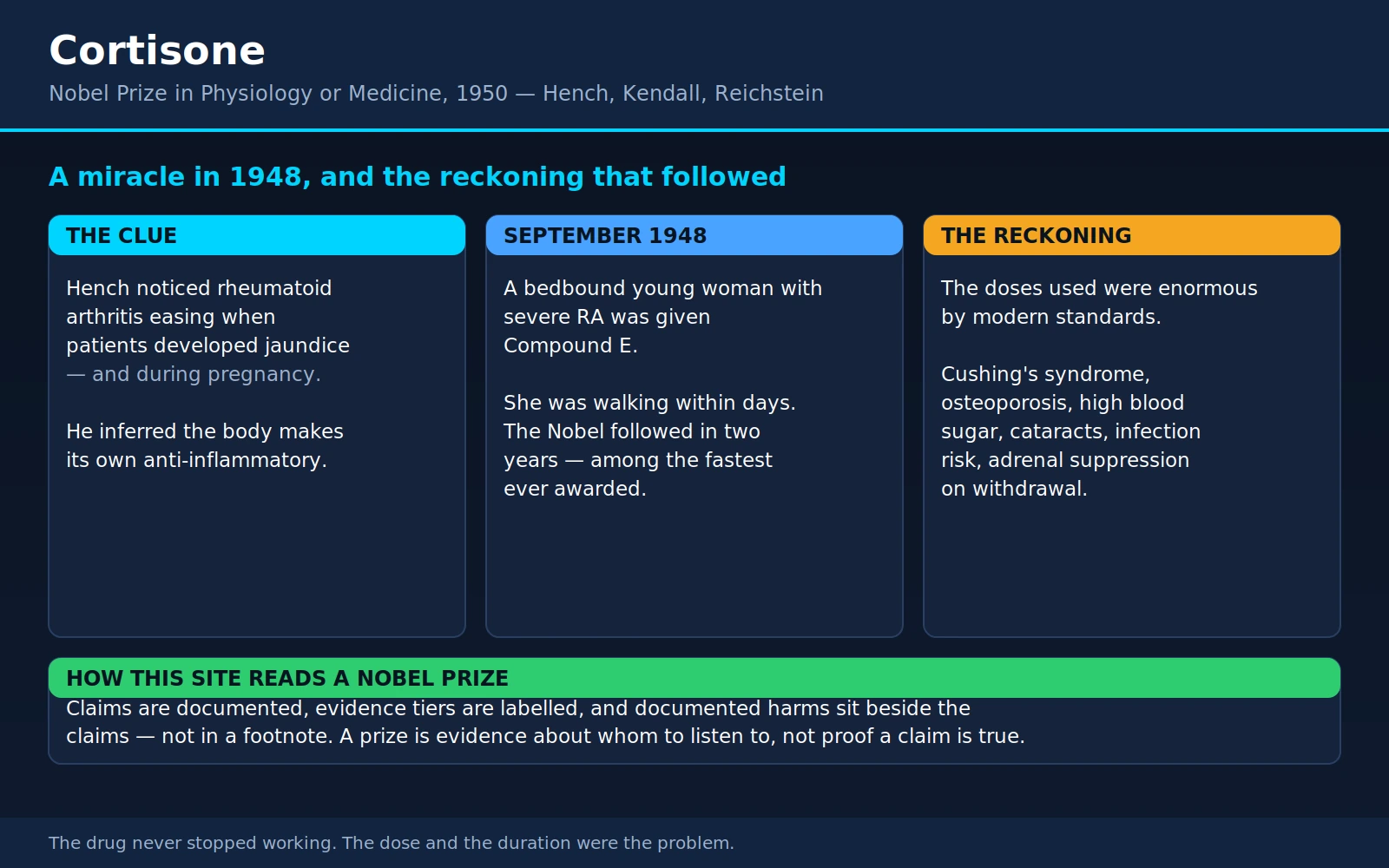
Table of Contents
- The Prize and the Three Men
- Hench's Clue: Jaundice, Pregnancy, and "Substance X"
- Kendall's Compounds: A Through F
- September 21, 1948: The First Patient
- The Crash: What the Miracle Cost
- What Steroids Actually Do
- Where Steroids Are Unambiguously Right
- The Modern Rules That Came Out of the Crash
- Cortisone Shots, Honestly
- If You Are Facing a Steroid Course
- "Natural Cortisol Support," Tiered
- Where Mainstream Medicine Agrees — and What Remains Debated
- Key Research Papers
- Connections
- Featured Videos
1. The Prize and the Three Men
The 1950 Nobel Prize in Physiology or Medicine went to three men — an American clinician, an American biochemist, and a Polish-born Swiss chemist — "for their discoveries relating to the hormones of the adrenal cortex, their structure and biological effects." In plain terms: they worked out what the outer rind of the adrenal gland makes, got those substances into a bottle in pure form, and put one of them into a woman who could not walk.
Philip Showalter Hench (1896–1965) was a rheumatologist at the Mayo Clinic and head of its rheumatic diseases service. He was not a chemist and never claimed to be. What he had was twenty years of stubborn observation of a disease that in the 1930s was essentially untreatable: rheumatoid arthritis, an autoimmune attack on the joint lining that deformed hands, fused spines, and put people in bed for life. Aspirin and gold salts were the state of the art, and neither did much.
Edward Calvin Kendall (1886–1972) ran biochemistry at Mayo and was already famous: in 1914 he isolated thyroxine from thirty tons of hog thyroid glands.
Tadeus Reichstein (1897–1996), born in Russian Poland and educated in Switzerland, worked at the ETH in Zurich and then the University of Basel, doing the same adrenal separation as Kendall independently and in parallel. He had also, in 1933, devised the first practical industrial synthesis of vitamin C. The Reichstein process — glucose to sorbitol, a bacterial oxidation, then chemistry to ascorbic acid — is why vitamin C went from a curiosity that Albert Szent-Györgyi had extracted painstakingly from paprika into a commodity costing pennies a gram. With a second fermentation step added, it is still how the world's vitamin C is made.
2. Hench's Clue: Jaundice, Pregnancy, and "Substance X"
The story starts in 1929. A 65-year-old man with rheumatoid arthritis so severe he could barely move came down with jaundice — skin and eyes yellowed by a blocked bile duct. Within days his joint pain melted away, and he stayed better for weeks. Then the jaundice cleared and the arthritis came roaring back.
Most physicians would have filed that as a curiosity. Hench collected cases. Over the next decade and a half he documented dozens of rheumatoid patients who remitted during jaundice — and a second pattern with nothing to do with the liver: pregnancy did the same thing. Women with severe RA routinely improved in the later trimesters and relapsed within weeks of giving birth.
He asked what a jaundiced man and a pregnant woman could possibly have in common. Not the bile pigment; he tested that and it did nothing. Not the disease subtype; the effect crossed several rheumatic conditions. What they shared, he concluded, was a physiological state in which the body was flooded with something it normally made in smaller amounts. He gave it a placeholder name: "Substance X."
That was a remarkable inference — that rheumatoid arthritis is not permanent structural ruin but a reversible biochemical condition, and that the body owns an off switch for its own inflammation and occasionally throws it by accident. He published the argument in 1949 as "Potential Reversibility of Rheumatoid Arthritis." Almost nobody believed it; rheumatologists then considered RA deformity a one-way road.
By the late 1930s he had a suspect. He and Kendall talked over lunch about the adrenal cortex — known to make something essential to life, because animals whose adrenals were removed died. Kendall was sitting on a shelf of lettered crystals pulled from that very gland.
3. Kendall's Compounds: A Through F
Kendall's task through the 1930s was brute-force separation chemistry. The adrenal cortex secretes not one hormone but a family of similar steroids in tiny quantities, and before chromatography, telling them apart meant crystallizing them one at a time from extract made from staggering amounts of tissue. His team collected cattle adrenals by the ton; the yield of any single pure compound was fractions of a gram.
He labeled them in order of isolation: Compound A, B, C, D, E, F; Reichstein was doing the same in Basel with his own lettering, and between them they identified around two dozen adrenal steroids. In modern names, Compound B is corticosterone, Compound E is cortisone, and Compound F is hydrocortisone — what we now call cortisol, the body's principal glucocorticoid.
Then the Second World War intervened in one of the strangest ways in the history of medicine. In 1941 American intelligence circulated a report that German fighter pilots were being given adrenal cortical extract to fly above 40,000 feet without blacking out, and that Germany was buying Argentine cattle adrenals in bulk. The report was false — no such program existed. But it landed in wartime Washington at exactly the right angle, and the National Research Council elevated adrenal steroid synthesis to a top-priority war project, ahead of antimalarials and close behind penicillin.
That funding is what made cortisone possible. The problem was never knowing what Compound E was but making enough to give a human being. The breakthrough came from the chemist Lewis Sarett at Merck, who in 1944 synthesized it from deoxycholic acid, a bile acid from ox bile, in roughly three dozen steps — a genuine medical revolution funded by false intelligence and delivered by a 36-step synthesis from cow bile. By 1948 there were only a few grams in the world.
4. September 21, 1948: The First Patient
On September 21, 1948, at the Mayo Clinic, a 29-year-old woman with severe rheumatoid arthritis received the first dose of Compound E ever given to a human being. She had been ill about five years, was bedbound, and could not turn herself over.
Hench and his colleague Charles Slocumb gave her 100 mg of cortisone acetate intramuscularly each day. Nothing happened for two days. On the third she woke and could move. By the fourth she got out of bed and walked. Within a week she left the hospital and went shopping in downtown Rochester — a detail retold so often it sounds apocryphal, and it is not.
Thirteen more patients followed with the same result. Hench, Kendall, Slocumb, and Howard Polley published in April 1949 in the Proceedings of the Staff Meetings of the Mayo Clinic (the first paper cited below).
What detonated the story was not the paper but the film. Hench had shot motion pictures of his patients beforehand — barely able to rise from a chair, hands frozen — and again after. When he showed it at the Mayo staff meeting and then at the international rheumatology congress, physicians who had spent careers watching this disease do only one thing reportedly stood and applauded.
The reaction was immediate and total: magazine covers within months, then shortages, waiting lists, and a black market. The Nobel Prize arrived in 1950 — two years after that first injection, among the shortest intervals between a discovery and its Nobel in the prize's history. The committee did not wait to see how the story ended.
5. The Crash: What the Miracle Cost
It ended badly, and the honest version of this page has to say so.
The doses used in those first years were enormous by any modern standard. A hundred milligrams of cortisone a day, sustained indefinitely, is roughly the anti-inflammatory equivalent of 20–25 mg of prednisone daily, and some patients were pushed higher. Today "low-dose" long-term prednisone in rheumatoid arthritis means about 5 mg a day, and 20 mg is a burst measured in days. In 1949 there was no reason to think a ceiling existed. The drug worked; more worked faster; patients begged for it.
Within two to three years the bill came due, in every organ system at once:
- Cushingoid appearance — "moon face," the buffalo hump, central weight gain with thinning limbs. The syndrome Harvey Cushing described in people whose bodies overproduced cortisol was now made by prescription; Hench named the iatrogenic version "chronic hypercortisonism."
- Osteoporosis and fractures — vertebral compression fractures in patients whose arthritis was, meanwhile, in remission.
- Hyperglycemia and steroid-induced diabetes — glucocorticoids raise blood sugar by design; that is part of what "gluco-" means.
- Cataracts and glaucoma — posterior subcapsular cataract is a signature long-term effect.
- Thin, fragile skin, easy bruising, poor wound healing, stretch marks.
- Infection risk — the suppression that quiets the joints quiets the defenses, and masks fever, so infections are found late.
- Avascular necrosis — death of bone tissue, classically the femoral head.
- Mood and sleep disturbance — insomnia and agitation; in a minority, steroid psychosis or severe depression.
- Adrenal suppression on withdrawal — the most dangerous and most easily missed. Cortisol from outside tells the pituitary to stop signaling the adrenals, which shrink from disuse; stop abruptly after months and the body has no cortisol at all for days to weeks. That is adrenal crisis: collapse, vomiting, low blood pressure, death if untreated.
Hench was a hero in 1950 and a cautionary tale by 1955, and died in 1965 having watched his miracle become the thing rheumatologists warned each other about. He deserves better than that verdict: he did not defend the overuse. His 1957 paper in Annals of Internal Medicine on the diagnosis, treatment, and prevention of chronic hypercortisonism is a physician documenting, in detail, the harm his own discovery was causing.
And here is the sentence usually lost in the retelling: the drug never stopped working. It was not exposed as a fraud, not withdrawn, not a placebo; it suppressed rheumatoid inflammation in 1949 and suppresses it today, exactly as advertised. What was wrong was the dose and the duration. Nearly everything modern medicine knows about using steroids well is a set of rules derived from that mistake.
6. What Steroids Actually Do
Cortisol is not a foreign drug. Your adrenal glands make roughly 10–20 mg of it a day, and you would be dead within days without it. It is the body's master regulator of stress, fuel, and inflammation: it raises blood sugar in a crisis, maintains blood pressure, and holds the inflammatory response inside sensible bounds. When people say "stress hormone," this is the hormone they mean — but "inflammation brake" describes its day job just as accurately. Our Cortisol Test page covers how it is measured.
Cortisone, the compound Hench injected, is inactive as given. It is a prodrug: the enzyme 11β-HSD1, mostly in the liver, converts it to cortisol, which does the work. The reverse enzyme, 11β-HSD2, inactivates cortisol back to cortisone in tissues that need protecting from it — a detail that matters a great deal when we get to licorice.
The mechanism in plain language: cortisol enters a cell, binds a glucocorticoid receptor in the cytoplasm, and the pair travels into the nucleus and sits down on DNA. There it switches off the master inflammatory programs — interfering with the transcription factors NF-κB and AP-1, the switchboards for the genes encoding inflammatory cytokines and prostaglandin-building enzymes — and switches on anti-inflammatory genes such as annexin A1. Two consequences follow.
First, it is a genuine rescue. Steroids do not block one mediator; they shut down transcription of the whole program upstream. Compare what John Vane showed aspirin does — inhibit one enzyme, cyclooxygenase, and with it one branch of the response. When inflammation is what is about to kill someone — an airway swelling shut, a transplant being rejected, lungs filling in severe pneumonia — nothing else does it as fast.
Second, it is a blunt instrument. The glucocorticoid receptor sits in nearly every cell in the body. There is no way to tell a swallowed tablet to act on the knuckles and leave the bone, the lens of the eye, the skin, the pancreas, and the hypothalamus alone. Every harm in the previous section is the same mechanism working where you did not want it — not a formulation flaw, but the drug working correctly in the wrong place.
Cortisol also runs on a circadian rhythm — the molecular clock whose gears Hall, Rosbash, and Young worked out. Levels are lowest near midnight, climb through the early hours, peak sharply 30–45 minutes after waking, then decline all day. This is why oral steroids are usually taken once, in the morning: a morning dose rides the natural peak and disturbs the hypothalamic-pituitary-adrenal loop less than the same amount split through the day or taken at night, which suppresses the axis harder and wrecks sleep. If a prescription says "take in the morning," that instruction is doing real work.
7. Where Steroids Are Unambiguously Right
This site is skeptical of overprescribing, and the last two sections were unsparing. So, without hedging: corticosteroids save lives every day, in hospitals everywhere, and a reflexive refusal of them can kill a person.
- Severe asthma attacks — oral steroids during an asthma exacerbation reduce relapse and admission; inhaled corticosteroids are the largest reason asthma deaths fell across the developed world.
- COPD exacerbations — a short course, typically five days of prednisone, shortens recovery and reduces treatment failure in COPD flares.
- Anaphylaxis — adjunctive, after adrenaline, which is always the first drug.
- Autoimmune flares — lupus nephritis, vasculitis, giant cell arteritis (where same-day steroids can prevent permanent blindness), inflammatory bowel disease, autoimmune hepatitis. In several, delay costs organs.
- Transplant rejection — part of the immunosuppression that makes organ transplantation possible at all.
- Some cancers — dexamethasone and prednisone are components of standard regimens in lymphoma, leukemia, and myeloma.
- Croup in children — a single dose of dexamethasone for the barking cough and stridor of viral croup is among the highest-yield, lowest-risk interventions in pediatrics.
- Adrenal insufficiency — in Addison's disease and other forms of adrenal insufficiency, hydrocortisone is not an anti-inflammatory drug at all. It is replacement of a hormone the body can no longer make, at roughly 15–25 mg a day, and as optional as insulin is for type 1 diabetes — someone with Addison's who stops it will die. If you take one distinction from this page, take this one: replacement dosing and immunosuppressive dosing are different medicines that share a molecule.
- Severe COVID-19 — the clearest modern demonstration. The RECOVERY trial found that 6 mg of dexamethasone daily for up to ten days cut 28-day mortality in ventilated patients from 41.4% to 29.3%, and in those on supplemental oxygen from 26.2% to 23.3% — while showing no benefit, and a signal of possible harm, in patients needing no respiratory support. That last clause is this whole page in one trial: the same drug at the same dose helps enormously in one group and not at all in another, and the difference is how much inflammation is driving the illness.
A drug class with that ledger is not something to be "against." It is something to be precise about.
8. The Modern Rules That Came Out of the Crash
Every rule below was written in response to what happened between 1949 and 1955.
Lowest effective dose, shortest possible duration. Toxicity tracks cumulative exposure — dose multiplied by time — far more than any single dose. A week of high-dose prednisone and two years of a small daily dose are different propositions, and the second is the more dangerous one.
Steroid-sparing agents. Steroids are now used as a bridge: control the flare fast while a slower disease-modifying drug takes hold, then taper off. Methotrexate is the anchor drug in rheumatoid arthritis; hydroxychloroquine, sulfasalazine, and leflunomide are the other conventional options; biologics and JAK inhibitors follow when those are not enough. The goal is to get the patient off steroids, and for most people with RA it is achievable — the largest difference between 1950 and now, since Hench had nothing else to reach for.
Bone protection with any long course. Anyone expected to take meaningful doses for three months or more should have fracture risk assessed and, at minimum, adequate calcium and vitamin D; those at moderate or high risk are usually offered a bisphosphonate. Steroid-induced bone loss raises fracture risk within the first few months.
Never stop a long or high-dose course abruptly. After roughly three weeks of supraphysiologic dosing, the adrenal glands may not restart immediately. The taper gives the axis time to wake up; the 2024 joint guideline from the European Society of Endocrinology and the Endocrine Society, cited below, is the current standard for doing it. Anyone on long-term steroids should also carry a steroid emergency card and know their sick-day rules — illness, injury, surgery, or vomiting may require a temporarily higher dose, and vomiting means the tablets are not being absorbed at all, which is an emergency-room situation.
Short bursts differ from chronic use. Five days of prednisone for an asthma flare carries small risk, but repeated bursts over years accumulate into something closer to chronic exposure; large population studies link even frequent short courses to increased fracture, sepsis, and venous thromboembolism. If you are getting bursts three or four times a year, the right response is to ask why the underlying disease is not controlled.
The honest gray zone. Whether a small daily dose of prednisone — around 5 mg — belongs in long-term RA treatment is still genuinely debated, and anyone who says it is settled is overselling. The GLORIA trial (2022) randomized RA patients aged 65 and over to add-on prednisolone 5 mg daily or placebo for two years. The steroid arm had better disease control and less radiographic joint damage — and about 24% more patients with adverse events, mostly non-severe infections. That is a real trade-off, and different patients weigh it differently.
9. Cortisone Shots, Honestly
Far more readers will meet a cortisone shot for a knee, shoulder, hip, or trigger finger than a two-year course of prednisone.
What is actually injected is usually a long-acting corticosteroid — triamcinolone or methylprednisolone — often mixed with a local anesthetic. The anesthetic is why the joint may feel wonderful within minutes and then ache again that evening; the steroid takes a few days to work.
What the evidence supports. For an acutely inflamed joint or bursa, injected steroid gives real relief over weeks to a few months — a legitimate and often excellent choice for getting through a flare or completing physical therapy. For trigger finger, de Quervain's tenosynovitis, and carpal tunnel syndrome, the response is often durable.
Where the evidence gets uncomfortable. For knee osteoarthritis specifically, the long-term picture is worse than the short-term one. In a two-year randomized trial in JAMA in 2017, McAlindon and colleagues gave patients either 40 mg of intra-articular triamcinolone or saline every twelve weeks. The steroid group lost significantly more cartilage volume on MRI — and had no better pain relief at two years. One trial does not settle a field, and it tested a fixed schedule rather than as-needed use. But it is the strongest evidence available, and it points in an unwelcome direction.
A practical tier.
- Reasonable: an occasional injection for a genuine flare, particularly if it lets you do rehabilitation you otherwise could not.
- Use caution: a standing schedule of injections every three months in a knee, indefinitely — the pattern the JAMA trial calls into question.
- Ask hard questions: injection into a weight-bearing tendon, the Achilles or patellar especially, because steroid weakens tendon tissue and rupture is a documented risk. Injection around such a tendon is a different and more defensible procedure; ask which is planned.
- Worth knowing: blood sugar can rise for several days afterward, which matters if you have diabetes. Joint infection is rare but serious — a joint that turns hot, swollen, and much more painful two or three days after an injection needs to be seen the same day.
10. If You Are Facing a Steroid Course
Questions worth asking before you start: What is this treating, and what happens if I don't take it? How many days, and is there a taper? Is this a bridge to something else — what, and when? What dose, and how does that compare with a "low" dose? Do I need bone protection? Will this affect my blood sugar? What symptoms mean I should call rather than wait?
What to watch for while on it: unusual thirst or urination (blood sugar), any infection that lingers (the steroid may mask it), new mood swings or insomnia, persistent blurred vision, unusual bruising, and new hip or groin pain on weight-bearing during longer courses. On a long course, vomiting or an inability to keep tablets down is urgent.
On the instinct to refuse. Plenty of readers of a site like this one arrive with a strong prior: I'd rather avoid steroids entirely. That instinct is understandable and often right — for a mild flare, a chronic ache, anything where time and a steroid-sparing strategy would do the job. But the situations where it is wrong tend to be the ones that do permanent damage: giant cell arteritis threatening vision, a severe asthma attack, active vasculitis, a serious lupus flare, hospitalization with severe COVID-19. There, refusing or delaying is the more dangerous choice. The useful stance is not "never" and not "sure, whatever" — it is this drug, for this reason, for this length of time, with this exit plan.
A rheumatoid-arthritis-specific note, because it comes up constantly. Marine omega-3 fatty acids at an adequate dose — the trials showing benefit generally use at least 2.7 g of combined EPA and DHA daily for twelve weeks or more — do reduce joint tenderness and morning stiffness in RA, and their best-documented effect is reducing how much NSAID a person needs. That is not nothing, given what long-term NSAID use does to stomachs and kidneys. What omega-3 does not do is slow the joint erosion that makes RA disabling: it is not disease-modifying and not a substitute for methotrexate or a biologic. Take it alongside proper treatment, not instead of it. Our Rheumatoid Arthritis page covers dosing and evidence in detail.
11. "Natural Cortisol Support," Tiered
Search anything about cortisol and you land in a large commercial ecosystem selling adrenal support. It deserves a tiered answer, not blanket dismissal or blanket endorsement.
"Adrenal fatigue" as a diagnosis. We will say this plainly and, we hope, kindly. The proposed condition — that chronic stress gradually exhausts the adrenal glands into producing insufficient cortisol, causing fatigue, brain fog, salt cravings, and difficulty waking — is not supported by the evidence and is not recognized by endocrinology. A 2016 systematic review by Cadegiani and Kater examined 58 studies and found no consistent link between the symptom cluster and any measure of adrenal function; the diagnostic methods varied so widely the studies could not be compared. The Endocrine Society's position is the same. Three things follow, and all three matter:
- The symptoms are real. Nobody is inventing exhaustion. Being told a proposed mechanism is wrong is not being told you are imagining your fatigue, and a clinician who conflates the two is doing it badly.
- The symptoms have causes worth finding. Persistent fatigue of this kind has a real differential: obstructive sleep apnea, iron deficiency, hypothyroidism, depression, celiac disease, vitamin D or B12 deficiency, poorly managed diabetes, medication effects, and chronic pain fragmenting sleep — a workup chasing those is far more likely to help.
- True adrenal insufficiency is a specific, testable, dangerous disease, and not what the supplement industry is describing. Addison's disease presents with weight loss, low blood pressure, low sodium and high potassium, often with skin darkening, and is diagnosed with a morning cortisol and an ACTH stimulation test — not a saliva panel. It is life-threatening and entirely treatable, so if your symptoms genuinely fit it, the answer is a real test, not a supplement. Our Adrenal Fatigue page examines the claim in more depth.
This site does document one framework in this territory: Morley Robbins on the adrenal-cortisol-mineral connection, which argues for a relationship between copper, iron, and magnesium status and adrenal function. We link it as documentation of what that framework claims, not as an endorsement; it sits outside the mainstream endocrine literature, and readers should weigh it against the sources cited here.
Licorice root: a genuine pharmacological effect, and a genuine hazard. This is the one item in the "natural" category with an unambiguous action on cortisol biology — which is precisely why it needs a warning rather than a recommendation. Glycyrrhizin in licorice becomes glycyrrhetinic acid, which inhibits 11β-HSD2, the kidney enzyme that locally inactivates cortisol. Blocked, cortisol accumulates and begins stimulating the mineralocorticoid receptor as if it were aldosterone. The result is apparent mineralocorticoid excess: sodium and water retention, high blood pressure, potassium loss, and metabolic alkalosis. Severe cases have caused muscle weakness, arrhythmias, and hospitalization, and the published case reports include people eating black licorice candy daily — not exotic doses. It is dose- and duration-dependent and generally reverses on stopping, though blood pressure can take weeks to settle, and it matters most for anyone with hypertension, heart failure, or kidney disease, or taking diuretics or digoxin. Deglycyrrhizinated licorice (DGL) has the glycyrrhizin removed and does not carry this risk. A licorice supplement is a real drug with a real mechanism; treat it as one.
Adaptogens, by tier.
- Some human trial evidence, modest: ashwagandha (Withania somnifera) has several randomized trials reporting reduced perceived-stress scores and modest falls in serum cortisol over 6–8 weeks. The trials are small, often industry-funded, and use varied extracts; rare liver injury has been reported, and it should be avoided in pregnancy.
- Preliminary or mixed: rhodiola (Rhodiola rosea) for fatigue — small positive trials, inconsistent replication. Holy basil and Panax ginseng, similar.
- Plausible but not established as a cortisol intervention: phosphatidylserine, magnesium, vitamin C at ordinary doses.
- No good evidence: "adrenal glandular" products made from animal adrenal tissue — and some tested products have contained actual steroid hormone, meaning an unlabeled, unmeasured dose of exactly the drug this page has spent ten sections explaining the dangers of.
What genuinely regulates cortisol is unglamorous and free: consistent sleep timing, morning daylight, exercise that stops short of overtraining, and treating whatever is driving the stress — a real intervention on the circadian axis described in section 6, and it outperforms every bottle on this list.
12. Where Mainstream Medicine Agrees — and What Remains Debated
Agreed, and not seriously contested:
- Corticosteroids are effective anti-inflammatory and immunosuppressive drugs, and first-line, life-saving therapy in a long list of acute conditions.
- Toxicity is driven by cumulative dose and duration; the harms in section 5 are well documented and dose-related.
- Hydrocortisone replacement in adrenal insufficiency is life-sustaining, and a different use of the molecule from immunosuppression.
- Long or high-dose courses must be tapered; patients need sick-day rules and an emergency card.
- Steroid-sparing strategies are the standard of care in chronic inflammatory disease.
- "Adrenal fatigue" is not an established diagnosis; the underlying symptoms deserve a proper workup.
- Glycyrrhizin from licorice causes apparent mineralocorticoid excess — a real clinical hazard.
Genuinely debated:
- Whether low-dose long-term prednisone (around 5 mg daily) belongs in routine RA management — GLORIA showed real benefit and real added adverse events.
- Whether repeated joint injections for knee osteoarthritis accelerate cartilage loss in as-needed practice, or only on the fixed schedule the 2017 JAMA trial tested.
- Optimal taper speed, and how to identify who will and will not recover adrenal function.
- How to weigh steroids' cardiovascular risk against that of the untreated inflammation they suppress — in RA, uncontrolled inflammation is itself a cardiac risk factor.
- Whether selective glucocorticoid receptor modulators can ever deliver the anti-inflammatory effect without the metabolic one. Several exist; none has replaced prednisone.
13. Key Research Papers
- Hench PS, Kendall EC, Slocumb CH, Polley HF. The effect of a hormone of the adrenal cortex (17-hydroxy-11-dehydrocorticosterone; compound E) and of pituitary adrenocorticotropic hormone on rheumatoid arthritis. Proc Staff Meet Mayo Clin 1949;24(8):181-97
- Glyn J. The discovery and early use of cortisone. J R Soc Med 1998;91(10):513-7
- Rhen T, Cidlowski JA. Antiinflammatory action of glucocorticoids — new mechanisms for old drugs. N Engl J Med 2005;353(16):1711-23
- Oray M, Abu Samra K, Ebrahimiadib N, et al. Long-term side effects of glucocorticoids. Expert Opin Drug Saf 2016;15(4):457-65
- RECOVERY Collaborative Group. Dexamethasone in hospitalized patients with Covid-19. N Engl J Med 2021;384(8):693-704
- Boers M, Hartman L, Opris-Belinski D, et al. Low dose, add-on prednisolone in patients with rheumatoid arthritis aged 65+: the pragmatic randomised, double-blind placebo-controlled GLORIA trial. Ann Rheum Dis 2022;81(7):925-936
- McAlindon TE, LaValley MP, Harvey WF, et al. Effect of intra-articular triamcinolone vs saline on knee cartilage volume and pain in patients with knee osteoarthritis: a randomized clinical trial. JAMA 2017;317(19):1967-1975
- Beuschlein F, Else T, Bancos I, et al. European Society of Endocrinology and Endocrine Society joint clinical guideline: diagnosis and therapy of glucocorticoid-induced adrenal insufficiency. J Clin Endocrinol Metab 2024;109(7):1657-1683
- Cadegiani FA, Kater CE. Adrenal fatigue does not exist: a systematic review. BMC Endocr Disord 2016;16(1):48
- Omar HR, Komarova I, El-Ghonemi M, et al. Licorice abuse: time to send a warning message. Ther Adv Endocrinol Metab 2012;3(4):125-38
Live PubMed Searches
- Cortisone discovery history
- Glucocorticoid adverse effects, long term
- Intra-articular corticosteroid, knee osteoarthritis
- Adrenal fatigue evidence
- Licorice, glycyrrhizin, blood pressure
The award's official summary: nobelprize.org — 1950 Prize in Physiology or Medicine.
Connections
- All Notable Doctors
- Nobel Prize in Physiology or Medicine — the complete roll of laureates
- Rheumatoid Arthritis — the disease cortisone was first given for; modern treatment and omega-3 dosing
- Cortisol Test — how cortisol is measured and the limits of saliva panels
- Endocrinology — the hormone diseases, including the adrenal conditions here
- Addison's Disease — adrenal failure, where hydrocortisone is replacement, not immunosuppression
- Cushing's Syndrome — the cortisol excess high-dose steroids reproduce by prescription
- Asthma — where inhaled and oral steroids are unambiguously the right answer
- Licorice — glycyrrhizin, 11β-HSD2, and the blood-pressure and potassium risk
- John Vane — prostaglandins and aspirin: the narrow anti-inflammatory tool beside the blunt one
- Hall, Rosbash & Young — the circadian clock that sets cortisol's rhythm
- Albert Szent-Györgyi — who isolated vitamin C, which Reichstein taught the world to manufacture
- Vitamin C — still made, in essence, by the Reichstein process of 1933
- Morley Robbins: Adrenal, Cortisol & the Mineral Connection — documented as a framework, weighed against the literature above