Allison & Honjo: Checkpoint Immunotherapy, Releasing the Brakes on Cancer
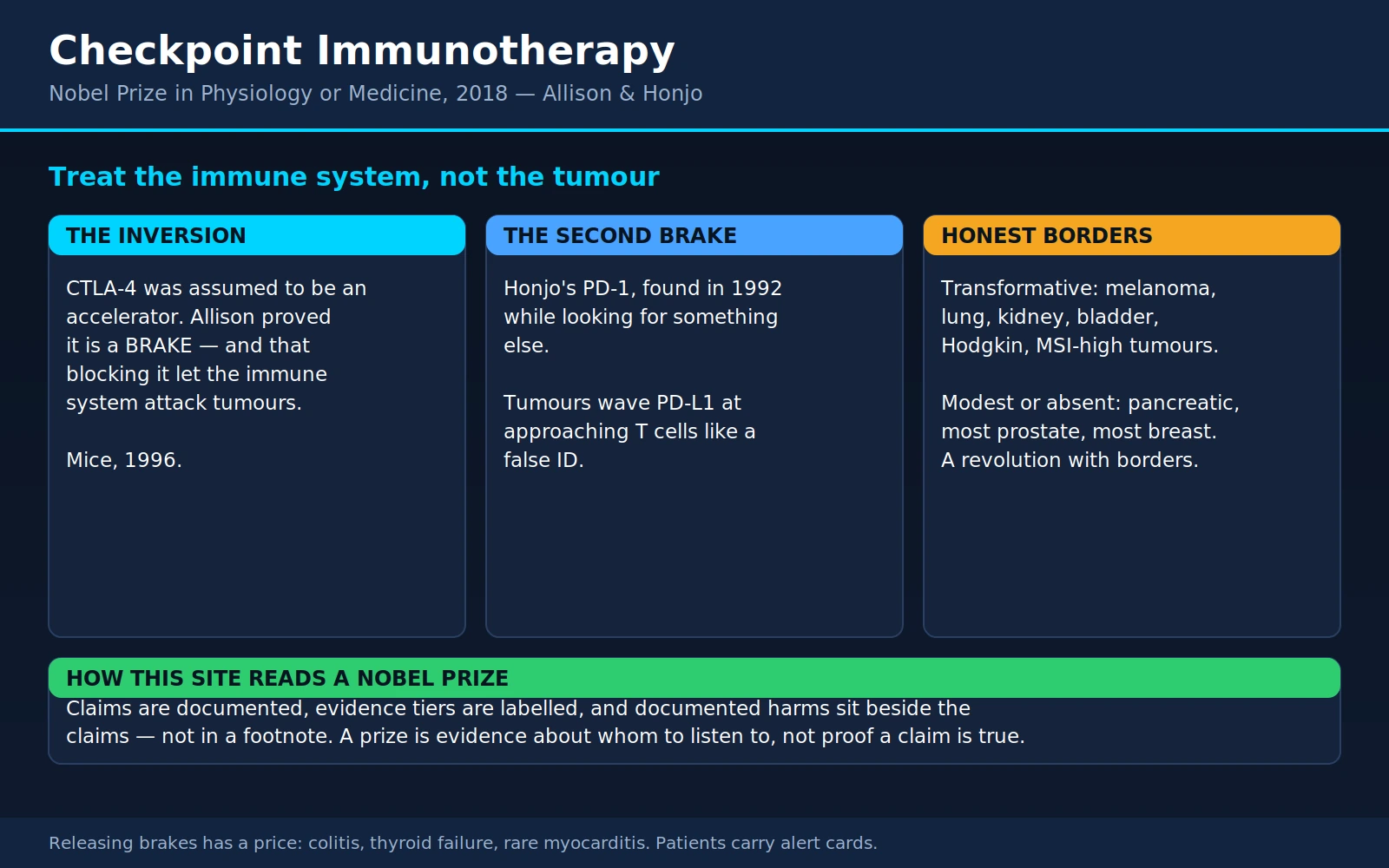
Table of Contents
- The Prize and the Two Men
- A Century of a Beautiful Idea Failing
- The Brake Nobody Knew Was a Brake
- Honjo's PD-1: A Second Brake, Found by Accident
- From Mice to Melanoma
- Where Checkpoint Drugs Actually Work
- The Price of Releasing the Brakes
- Your Gut Bacteria Are in This Story
- "Immune Boosting" vs. Immunotherapy
- Where Mainstream Medicine Agrees — and What Remains Hard
- Key Research Papers
- Connections
- Featured Videos
1. The Prize and the Two Men
On October 1, 2018, the Nobel Assembly at the Karolinska Institute awarded the Nobel Prize in Physiology or Medicine jointly to James P. Allison and Tasuku Honjo "for their discovery of cancer therapy by inhibition of negative immune regulation." Strip away the committee language and the idea is startlingly simple: your immune system is fully capable of destroying cancer, but it drives with the brakes on. Allison and Honjo each found one of those brakes — two different molecules, on two different continents, for two different reasons — and each realized that releasing the brake, rather than stepping harder on the gas, could let the body's own T cells do what a century of medicine had failed to make them do.
James Allison is the harmonica-playing Texan of the pair — born in 1948 in the small town of Alice, Texas, a blues harp player since childhood who has jammed onstage with Willie Nelson and still fronts a band of immunologists called The Checkpoints. Cancer is not an abstraction to him. His mother died of lymphoma when he was eleven years old, holding his hand; two of his uncles died of cancer after her, one of lung cancer and one of melanoma, and he later lost his brother to prostate cancer and has himself been treated for three different cancers. Yet Allison has always insisted he did not set out to cure anything. He was a basic T-cell scientist to his bones — the kind of researcher who spent the 1980s working out what the T cell's ignition switch looks like (his lab was among the first to characterize the T-cell receptor) and what its gas pedal is (a molecule called CD28) purely because he wanted to know how the machine worked. The cure fell out of the curiosity, which is a lesson in itself.
Tasuku Honjo, born in Kyoto in 1942, is the counterpoint: a formal, ferociously disciplined Kyoto University immunologist who had already earned a place in the textbooks before PD-1 — he discovered the enzyme that lets antibodies switch classes, one of the deepest mechanisms in all of immunology. His origin story is quieter than Allison's but cut from the same cloth: as a young man he watched a medical-school classmate die of stomach cancer, and the helplessness of it stayed with him. Honjo is famous in Japan for two things besides the Nobel — his golf game, and the fact that well into his eighties he was still running his laboratory at Kyoto University. Asked what the prize meant to him, he gave an answer worth keeping: the real reward, he said, is when a patient tells him, "I'm alive because of you."
Neither man is a physician-hero in the storybook sense. They are laboratory scientists who followed molecules. That is precisely why this page exists in a series about notable doctors: their work rewired what every oncologist on Earth can now offer a patient.
2. A Century of a Beautiful Idea Failing
The idea that the immune system might fight cancer is old — older than chemotherapy, older than radiation. In the 1890s a New York bone surgeon named William Coley noticed that a sarcoma patient's tumor had melted away after a raging skin infection. Reasoning that the fever and the immune storm had done the work, Coley began deliberately injecting cancer patients with bacteria, and later with killed bacterial mixtures that became known as Coley's toxins. Sometimes — genuinely, verifiably — tumors regressed. Mostly they did not, and nobody could say why, or reproduce the successes on demand. When radiation and then chemotherapy arrived with results you could count on, Coley's approach was shelved as a curiosity.
The pattern repeated for a hundred years: occasional miracles, mostly disappointment. Interferon made the cover of national magazines around 1980 as the coming cure for cancer; it turned out to help in a handful of settings and to fail, with punishing flu-like misery, in most. High-dose interleukin-2 in the 1980s and 90s produced complete, durable remissions in metastatic melanoma and kidney cancer — in roughly five to ten percent of patients, at the cost of ICU-level toxicity that limited it to the youngest and fittest. (One immune therapy quietly worked all along: BCG, a weakened tuberculosis vaccine instilled into the bladder, became and remains standard care for early bladder cancer. It was treated as an oddity rather than a signpost.)
By the 1990s, mainstream oncology had largely given up on immunology. Grant reviewers rolled their eyes; drug companies had a phrase — tumor immunology was where careers went to die. The failures made sense only in hindsight. From Élie Metchnikoff and Paul Ehrlich onward, everyone had tried to stimulate the immune system — more antigen, more cytokines, more alarm bells. Nobody knew that the system carries built-in brakes, and that a tumor's survival trick is not hiding from the immune response so much as keeping those brakes pressed. You cannot fix a car that won't move by pouring in more fuel while the parking brake is on. Until someone found the brake, every accelerator was doomed to disappoint.
3. The Brake Nobody Knew Was a Brake: Allison and CTLA-4
The molecule at the center of Allison's story, CTLA-4, was discovered in 1987 by French researchers who had no idea what it did — only that it appeared on the surface of activated T cells. Because it looked structurally like CD28, the T cell's known gas pedal, most of the field assumed CTLA-4 was a second accelerator. Through the early 1990s that was the respectable position, and at least one company was exploring how to stimulate it.
Allison's lab at Berkeley, and independently Jeffrey Bluestone's in Chicago, proved the respectable position exactly backwards. CTLA-4 is not an accelerator. It is a brake — an inhibitory receptor that appears on a T cell a day or two after activation and shuts the response down. It even works by theft: CTLA-4 grips the same docking molecules the gas pedal CD28 needs, and grips them harder, starving the accelerator of fuel. Evolution installed it for a good reason. An immune response with no off-switch is called autoimmune disease. The brake is not a design flaw; it is the price of not being destroyed by your own defenses.
Allison's leap was the question nobody was asking: what if cancer patients' T cells are not weak, but braked? In late 1994 he had a postdoc, Dana Leach, inject tumor-bearing mice with an antibody that physically blocks CTLA-4 — jamming the brake so it cannot engage. Over Christmas break the treated mice's tumors stopped growing, shrank, and disappeared, while every untreated mouse died. Allison, suspicious of anything that clean, had the experiment repeated blinded. Same result: rejection of the tumors and, remarkably, immunity to re-challenge — the cured mice could not be given the same cancer again. The paper, Enhancement of antitumor immunity by CTLA-4 blockade, ran in Science in March 1996 and is three pages long.
Notice what the antibody in that experiment never touches: the tumor. Every prior cancer drug — chemotherapy, radiation, the new targeted pills — attacks the cancer cell itself. Allison's antibody binds only to T cells. The inversion is total: treat the immune system, not the tumor, and let the immune system treat the cancer. That single inversion is what the Nobel was for. It took Allison years of knocking on pharmaceutical doors to find anyone willing to develop the idea — the field's century of failure had poisoned the well — until a small biotech, Medarex, built the human version of the antibody. Its eventual name was ipilimumab.
4. Honjo's PD-1: A Second Brake, Found by Accident
Honjo's molecule entered the world in 1992 with no connection to cancer at all. A young scientist in his Kyoto lab, Yasumasa Ishida, was hunting for genes involved in programmed cell death — the orderly suicide program cells run when they are no longer needed. One cloned gene switched on as cells were dying, so it was named PD-1, "programmed death 1." The name turned out to be wrong about the biology — PD-1 does not run the death program — but it stuck, which is why the most hopeful drugs in modern oncology carry the grimmest name in the pharmacy.
What followed was the unglamorous part of science: nearly a decade of patient mouse genetics. Honjo's group bred mice lacking PD-1 and watched what went wrong. The animals developed autoimmune disease — lupus-like kidney inflammation in one strain, destruction of the heart muscle in another. A missing gene that produces too much immunity can only be one thing: a second brake, distinct from CTLA-4. Where CTLA-4 acts early and centrally, in the lymph nodes where T-cell responses are first authorized, PD-1 acts late and locally — out in the tissues, on veteran T cells, as a final identity check before they kill.
Then came the discovery that made PD-1 a cancer story. Working with Gordon Freeman's group in Boston, Honjo's team identified the molecule that presses this brake: a ligand named PD-L1. And PD-L1 shows up somewhere it has no business being — on the surface of tumor cells. This is the tumor's con trick, and it deserves a plain description: an approaching T cell, primed to kill, checks its target; the cancer cell holds up PD-L1 like a false ID — a forged badge reading "normal tissue, stand down" — and the T cell, obeying a rule that exists to protect your organs, stands down. The tumor is not outfighting your immune system. It is defrauding it. In 2002 Honjo's group showed in mice that blocking this handshake let T cells see through the forgery and attack. Honjo then pushed — hard, and for years — to convince industry to build a human anti-PD-1 antibody; the result, developed by Ono Pharmaceutical with Medarex, became nivolumab.
Because PD-1 blockade intervenes only at the scene of the crime — the tumor and its immediate surroundings — rather than loosening immune discipline body-wide the way CTLA-4 blockade does, it proved both gentler (fewer severe autoimmune side effects) and broader (active in more cancer types) than Allison's brake. Neither man could have predicted that. It is why the two discoveries together, and not either alone, remade oncology.
5. From Mice to Melanoma
The proving ground was metastatic melanoma — historically among the grimmest diagnoses in medicine, with median survival well under a year and, by 2010, no drug ever shown to extend life. That year, the phase 3 trial of Allison's antibody ipilimumab reported in the New England Journal of Medicine: median survival roughly ten months versus six and a half in the comparison arm. Ten months does not sound like a revolution until you know it was the first survival improvement in the history of the disease. The FDA approved ipilimumab in March 2011.
The deeper revelation was hiding in the shape of the survival curve. Chemotherapy curves fall to zero; a chemo response buys months. The ipilimumab curve fell — and then, at roughly 20% of patients, flattened. It is what oncologists now call the long tail: a fraction of patients whose disease simply stops progressing and stays stopped, year after year, because a re-armed immune system, unlike a drug, remembers. Follow-up of the earliest patients ran past ten years with the tail still flat. For those patients the honest word — used cautiously, in a disease where it had been forbidden — is cure.
The PD-1 drugs arrived in 2014: nivolumab (approved first in Japan, fittingly, given Honjo) and pembrolizumab, with higher response rates and milder side effects than ipilimumab. Then came the audacious move: block both brakes at once. The combination trial reported in 2015, and its final ten-year results, published in early 2025, are numbers worth reading slowly: median survival on nivolumab-plus-ipilimumab of about six years in a disease whose median was once under one, with roughly 43% of patients alive at ten years — around half when deaths from causes other than melanoma are set aside — most of them off all treatment for years. Patients who reached the three-year mark without progression almost never lost ground afterward.
The public learned the word "immunotherapy" from a 90-year-old Sunday-school teacher. In August 2015, former President Jimmy Carter announced that melanoma had spread to his liver and his brain — a death sentence in any previous decade, and he said as much, calmly, at a press conference. He received surgery, targeted radiation, and pembrolizumab. By December his brain scans showed no cancer. Carter lived nine more years, dying in December 2024 at the age of one hundred. One famous patient is an anecdote, not a statistic — but as an anecdote for what the statistics had begun to show, there has never been a better one.
6. Where Checkpoint Drugs Actually Work — an Honest Map
Checkpoint inhibitors are a revolution with borders, and anyone facing cancer deserves the map rather than the headline. As of the mid-2020s:
- Transformative: melanoma (as above), Merkel cell carcinoma, and Hodgkin lymphoma, where response rates run extraordinarily high because the tumor's own signature genetic lesion mass-produces the PD-L1 false ID.
- Strong and standard-of-care: non-small-cell lung cancer (for many patients these drugs, alone or with chemotherapy, have replaced chemotherapy alone), kidney cancer, bladder cancer, head and neck cancers, and any tumor — from any organ — that is MSI-high (mismatch-repair deficient). That last approval, in 2017, was the first in FDA history granted by a tumor's genetics rather than its address in the body.
- Modest or largely absent: pancreatic cancer, most prostate cancer, most breast cancer (with a foothold in triple-negative disease), glioblastoma, and the majority of colorectal cancers (those that are not MSI-high).
If you or someone you love is in the third group, the question "why not mine?" deserves a real answer, kindly put. Checkpoint drugs do not kill cancer; they un-handcuff T cells that already recognize it. Recognition depends on mutations — each mutation can create a "foreign" flag (a neoantigen) for T cells to spot. Melanoma (sun-damaged) and lung cancer (smoke-damaged) are among the most mutated of all human tumors, bristling with flags. Pancreatic and most prostate cancers carry few mutations, and some tumors are immune deserts — walled in scar-like tissue, with few T cells anywhere nearby to release. Where there is no besieging army, opening the gates changes nothing. That is not a moral failing of anyone's immune system, and it is not the end of the story: making "cold" tumors hot — with vaccines, radiation, engineered T cells, and drug combinations — is now one of the largest research enterprises in medicine.
7. The Price of Releasing the Brakes
The brakes exist to protect you. Release them, and the immune system does not only attack the tumor — in a substantial minority of patients it attacks healthy tissue too. These immune-related adverse events are not the nausea-and-hair-loss of chemotherapy; they are miniature autoimmune diseases, and they can involve nearly any organ:
- Colitis — immune inflammation of the colon: severe diarrhea that, ignored, can perforate the bowel. More common with ipilimumab.
- Thyroid failure — the commonest endocrine casualty; often permanent, managed lifelong with a daily thyroid hormone tablet.
- Rash and itch — the most frequent event overall, usually mild.
- Hypophysitis — inflammation of the pituitary, the body's hormonal master gland; presents vaguely (crushing fatigue, headache) and is easily missed.
- Pneumonitis and hepatitis — inflamed lungs or liver, requiring prompt treatment.
- Myocarditis — immune attack on the heart muscle: rare (well under 1%), but the most feared, because fulminant cases are fatal in a substantial fraction even with modern care.
Severe (grade 3–4) events occur in very roughly one in six patients on a PD-1 drug alone, one in four on ipilimumab alone, and over half on the double-brake combination — the price of its superior survival numbers. The counterweight is corticosteroids: high-dose steroids re-apply a brake, and most events, caught early, are fully reversible (the endocrine ones being the notable exception — a destroyed gland does not regrow, though its hormone can be replaced). This is why patients on checkpoint therapy carry alert cards: a patient who shows up in an emergency department with diarrhea or breathlessness looks routine unless the team knows the immune brakes are off, and the treatment (steroids, promptly) is the opposite of watchful waiting. Report every new symptom, however trivial, to the oncology team — on these drugs there is no such thing as an uninteresting symptom.
Honesty also requires naming the other toxicity: cost. In the United States these antibodies list at well over $150,000 per year, and "financial toxicity" is now a measured, published harm of cancer care. Globally, most people with the cancers on the map above will never receive the drugs at all. A Nobel-winning mechanism does not distribute itself.
8. Your Gut Bacteria Are in This Story
Here the story bends back toward this site's home territory. In January 2018, two papers in a single issue of Science reported something almost nobody expected: the bacteria living in a patient's gut help decide whether checkpoint drugs work. A Texas group studying melanoma patients found that responders and non-responders carried measurably different gut flora — responders' guts were more diverse and enriched in particular families such as Faecalibacterium; when the researchers transplanted stool from responding patients into germ-free mice, the mice gained the ability to fight tumors under PD-1 blockade. A French group found the same pattern in lung and kidney cancer patients (their signature organism was Akkermansia muciniphila), plus a sobering clinical correlate: patients who had taken antibiotics around the start of immunotherapy — wiping out gut flora at exactly the wrong moment — relapsed sooner and died earlier.
Then came the interventional test. In 2021, two small trials — one in Pittsburgh, one in Israel — took patients whose melanoma had already failed PD-1 therapy, gave them fecal microbiota transplants from patients who had responded dramatically, and re-treated them with the same drug that had just failed. A minority — roughly a third to two-fifths across the two studies — converted into responders. These are tiny trials and the field is young; larger studies, and attempts to replace transplants with defined bacterial cocktails, are underway. The fair label is promising, not proven.
What should a reader actually do with this? Three careful things. First, never refuse a genuinely needed antibiotic — but if you are starting immunotherapy, make sure the oncologist knows about any recent or planned course, because the association is consistent enough to factor into timing. Second, the same research group's follow-up work found that patients eating a high-fiber diet (vegetables, legumes, whole grains including brown rice) responded better — while, counterintuitively, commercial probiotic supplements were associated in that observational data with worse responses. Feeding your resident bacteria appears wiser than parachuting in store-bought ones. Third, savor the historical rhyme: Élie Metchnikoff, the founder of cellular immunology, spent his final years insisting — to general amusement — that the bacteria in fermented milk shape human health. A century later, the highest-technology cancer therapy in existence turns out to lean on the ecosystem he championed. His story, and the modern evidence on cultured foods, lives on our yogurt page.
9. "Immune Boosting" vs. Immunotherapy — a Distinction This Site Owes You
Because this website covers herbs, vitamins, and traditional remedies, we owe you a clear line here, and we will draw it bluntly: checkpoint immunotherapy is not "immune boosting," and nothing sold as "immune boosting" is checkpoint immunotherapy.
Checkpoint blockade is a precision act: a manufactured antibody removes one specific molecular brake, in monitored patients, with oncologists standing by to re-apply the brake with steroids when the released response turns on healthy organs. Its power and its danger are the same fact. A supplement that vaguely "supports immune function" does none of this — and marketing that borrows immunotherapy's Nobel glow ("activate your body's cancer-fighting cells, naturally") is trading on a mechanism it does not touch. Worse, the borrowed language obscures the real lesson of Allison and Honjo's work: for a century, "stimulate the immune system harder" was the intuitive idea, and it failed; the breakthrough came from understanding a specific brake, not from general revving. If a product's claim would have been equally at home in a 1970s interferon-era advertisement, that is the tier of evidence it has earned, and our individual herb and mushroom pages label such claims accordingly — documented tradition, mechanistic hints, and honest nulls, side by side.
What genuinely supports a person through immunotherapy is less glamorous and better proven: adequate protein and calories (cancer cachexia is a real enemy), the high-fiber whole-food pattern from the section above, as much physical activity as the disease allows (exercise is one of the few interventions with consistent evidence for treatment tolerance and fatigue), sleep, and staying current on vaccinations before therapy begins where possible — standard inactivated vaccines like the flu shot are considered safe on checkpoint drugs. And one hard rule: tell your oncologist about every supplement and herb you take. Not because all of them are dangerous, but because on a drug whose side effects are autoimmune, anything that muddies the picture — an herb that can inflame the liver, say, mimicking immune hepatitis — can cost you a needless treatment interruption. On checkpoint therapy, your medical team can only steer what they can see.
10. Where Mainstream Medicine Agrees — and What Remains Hard
Where the agreement is total: checkpoint inhibitors are standard of care, written into every major guideline, across more than fifteen cancer types; the 2018 Nobel ratified what the survival curves had already proven. The long tail is real — a meaningful fraction of patients with formerly terminal cancers are alive a decade later, off treatment. The drugs are moving earlier: given before or after surgery in melanoma and lung cancer, they are now preventing recurrences, not just treating the incurable. No serious oncologist anywhere disputes any of this, and the pipeline built on the brake-release principle — new checkpoints, combinations with vaccines and engineered cells — is the largest in the history of cancer medicine.
What remains genuinely hard: most patients treated still do not get the long-tail outcome — the revolution's borders (Section 6) are drawn through the majority of cancer diagnoses. Medicine still cannot reliably predict, before treatment, who will respond, who will relapse after responding, and who will pay with a lifelong autoimmune condition; the biomarkers in use are honest approximations, not oracles. Resistance — tumors that respond and then learn a new disguise — is rising as more patients are treated. The side-effect medicine of Section 7 is itself a young specialty. The cost problem is unsolved. And the microbiome findings of Section 8, the most intriguing frontier, await the large trials that separate a promising signal from a usable therapy. Two brakes have been found and released. Nobody who works in this field believes they were the last.
11. Key Research Papers
- Leach DR, Krummel MF, Allison JP. Enhancement of antitumor immunity by CTLA-4 blockade. Science 1996;271(5256):1734-6
- Ishida Y, Agata Y, Shibahara K, Honjo T. Induced expression of PD-1, a novel member of the immunoglobulin gene superfamily, upon programmed cell death. EMBO J 1992;11(11):3887-95
- Hodi FS, O'Day SJ, McDermott DF, et al. Improved survival with ipilimumab in patients with metastatic melanoma. N Engl J Med 2010;363(8):711-23
- Larkin J, Chiarion-Sileni V, Gonzalez R, et al. Combined nivolumab and ipilimumab or monotherapy in untreated melanoma. N Engl J Med 2015;373(1):23-34
- Wolchok JD, Chiarion-Sileni V, Rutkowski P, et al. Final, 10-year outcomes with nivolumab plus ipilimumab in advanced melanoma. N Engl J Med 2025;392(1):11-22
- Postow MA, Sidlow R, Hellmann MD. Immune-related adverse events associated with immune checkpoint blockade. N Engl J Med 2018;378(2):158-168
- Gopalakrishnan V, Spencer CN, Nezi L, et al. Gut microbiome modulates response to anti-PD-1 immunotherapy in melanoma patients. Science 2018;359(6371):97-103
- Routy B, Le Chatelier E, Derosa L, et al. Gut microbiome influences efficacy of PD-1-based immunotherapy against epithelial tumors. Science 2018;359(6371):91-97
- Davar D, Dzutsev AK, McCulloch JA, et al. Fecal microbiota transplant overcomes resistance to anti-PD-1 therapy in melanoma patients. Science 2021;371(6529):595-602
- Baruch EN, Youngster I, Ben-Betzalel G, et al. Fecal microbiota transplant promotes response in immunotherapy-refractory melanoma patients. Science 2021;371(6529):602-609
Live PubMed Searches
- CTLA-4 blockade antitumor
- PD-1 checkpoint inhibitor
- Immune-related adverse events
- Gut microbiome and immunotherapy response
- Checkpoint inhibitor long-term survival in melanoma
Connections
- All Notable Doctors
- Nobel Prize in Medicine — the laureates wing this page belongs to
- Élie Metchnikoff — immunology's founding laureate, whose yogurt obsession this story vindicates
- Paul Ehrlich — the magic-bullet ancestor; checkpoint antibodies are his idea aimed at our own cells
- Otto Warburg — cancer seen through metabolism rather than immunity
- Shinya Yamanaka — Kyoto's other modern laureate; reprogramming cells rather than releasing them
- Oncology — every cancer type on the map in Section 6
- Immunology — what happens when the brakes fail on their own
- Melanoma — the disease that proved checkpoint therapy
- Lung Cancer — the biggest killer these drugs now reach
- Kidney Cancer — from IL-2's brutal miracles to PD-1 standard of care
- Lymphoma — Hodgkin disease, checkpoint therapy's highest response rates
- Yogurt — Metchnikoff's fermented-milk legacy, now entangled with immunotherapy response