Harald zur Hausen: HPV, Cervical Cancer, and the Virus Nobody Believed In
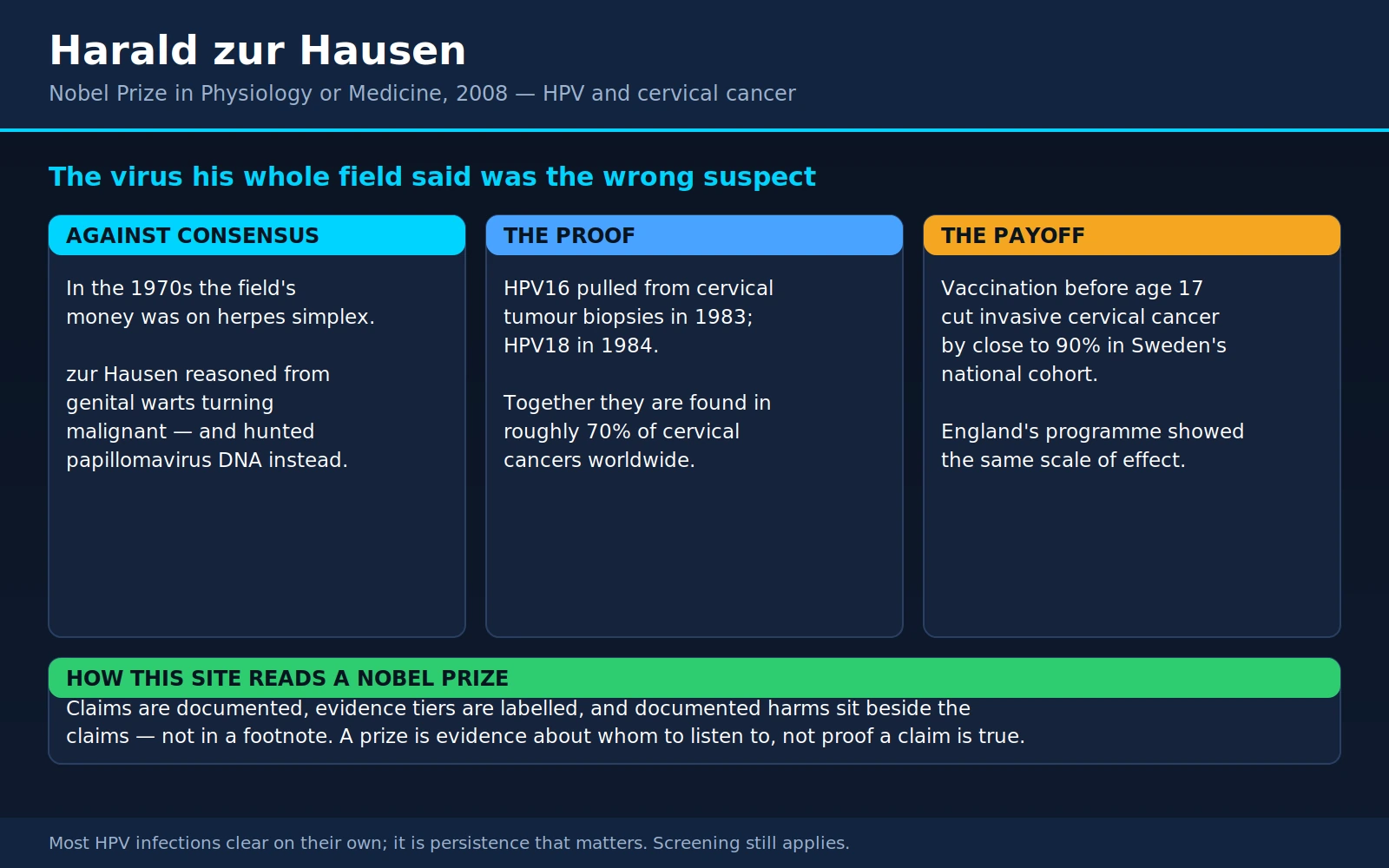
Table of Contents
- Who He Was
- What Everyone Believed
- The Heretical Hypothesis
- The Decade-Long Hunt
- How the Virus Causes Cancer
- From Discovery to Vaccine
- Screening Still Matters
- Documented Concerns, Tiered
- The Late Heresy That Hasn't Landed
- Where Mainstream Medicine Agrees — and What the Record Complicates
- Key Research Papers
- Connections
- Featured Videos
1. Who He Was
Harald zur Hausen (1936–2023) was the German virologist who proved that cervical cancer is caused by a virus — the human papillomavirus, HPV — at a time when the cancer-research establishment was betting on a different virus. He was right, they were wrong, and the consequence is a vaccine now driving one of the deadliest cancers of women toward elimination in the countries that use it. In 2008 he received half of the Nobel Prize in Physiology or Medicine "for his discovery of human papilloma viruses causing cervical cancer"; the other half honored Françoise Barré-Sinoussi and Luc Montagnier for the discovery of HIV. The Nobel committee's summary is worth reading in full: nobelprize.org — 2008 Prize in Physiology or Medicine.
He was born on March 11, 1936, in Gelsenkirchen, a coal-and-steel city in Germany's Ruhr valley, which meant his childhood ran straight through the Second World War: the Ruhr's mines and factories made it a primary target of Allied bombing, and his schooling was repeatedly interrupted as the city around him was flattened. He came out of that childhood with a naturalist's obsession with birds and biology, studied medicine at Bonn, Hamburg, and Düsseldorf, and earned his MD in 1960. The decisive detour came in 1966, when he joined the laboratory of Werner and Gertrude Henle in Philadelphia — the couple then proving that Epstein-Barr virus causes infectious mononucleosis and studying its link to Burkitt lymphoma. In that lab zur Hausen helped show that the viral DNA was physically present inside the tumor cells themselves, persisting in every cell of the cancer. That experience installed the conviction that guided the rest of his life: if you think a virus causes a cancer, opinions and antibody statistics are not enough — find the viral DNA in the tumor.
Back in Germany he rose quickly — Institute of Virology at Würzburg, a chair at Erlangen-Nürnberg in 1972, a chair at Freiburg in 1977, where the critical HPV work was done. From 1983 to 2003 he served as chairman and scientific director of the German Cancer Research Center (DKFZ) in Heidelberg, twenty years spent turning it into one of Europe's leading cancer institutes while keeping his own lab running. He stayed scientifically active — and provocative, as we will see — nearly to the end. He died in Heidelberg on June 28, 2023, at 87.
His story belongs on this site for a simple reason: it is one of medicine's cleanest documented cases of a lone dissenter against a confident consensus who turned out to be right — and a case study in how a dissenter earns being right: not by rhetoric, but by a decade of unglamorous bench work. Both halves of that lesson matter here.
2. What Everyone Believed
Start with the disease, because its scale is the reason this story matters. Cervical cancer is cancer of the cervix, the neck of the uterus. It grows slowly, usually silently, from precancerous surface changes into invasive cancer over years to decades. Globally it is the fourth most common cancer in women: in 2020 the World Health Organization counted about 604,000 new cases and about 342,000 deaths — a toll that continues essentially unchanged into the mid-2020s, at roughly 340,000–350,000 deaths a year. Around nine in ten of those deaths happen in low- and middle-income countries, for a blunt reason: this is a cancer that screening can catch early and vaccination can prevent, so it now kills mainly where screening and vaccination are scarce. In the era before either existed, it was among the leading cancer killers of women everywhere. Our Cervical Cancer page covers the disease itself in depth.
By the 1960s, the epidemiology of cervical cancer was practically shouting that something transmissible was involved. The pattern had been visible for over a century: in 1842 the Italian physician Rigoni-Stern, combing the death registers of Verona, noticed that uterine and cervical cancer was common in married women and prostitutes and strikingly rare in nuns. Twentieth-century studies sharpened the point — risk tracked with earlier sexual activity and more partners. Whatever caused cervical cancer looked, for all the world, like a sexually transmitted infection.
The field thought it knew which one. The fashionable candidate of the late 1960s and 1970s was herpes simplex virus type 2 (HSV-2), the genital herpes virus. The circumstantial case looked strong: women with cervical cancer carried HSV-2 antibodies more often than women without it, and herpesviruses had genuine cancer credentials — Epstein-Barr virus, a herpes cousin, was already tied to Burkitt lymphoma. Serious money and serious careers were committed to the herpes hypothesis. It was not a foolish idea; it was a reasonable idea that happened to be wrong — the antibody link was a confounder, because the same sexual exposure that transmits HSV-2 also transmits the real culprit. A large prospective Czech study in the early 1980s finally found that HSV-2 infection did not predict who developed cervical disease, and the hypothesis quietly deflated. But that was later. Through the 1970s, herpes was the consensus, and consensus had the funding, the podiums, and the benefit of every doubt.
3. The Heretical Hypothesis
Zur Hausen came at the problem from the opposite direction. Applying his Philadelphia standard — the viral DNA must be in the tumor — he looked for herpes DNA in cervical cancer biopsies. He could not find it. Others reported traces; his hybridization experiments, run carefully, kept coming up empty. To zur Hausen that silence was data: if HSV-2 truly drove these tumors, its genetic material should be sitting in the malignant cells, the way Epstein-Barr virus DNA demonstrably sat in Burkitt lymphoma cells. It wasn't there.
What he proposed instead came from reading old clinical literature most virologists ignored. Case reports scattered across the decades described genital warts — condylomata acuminata, unmistakably sexually transmitted, known to be caused by a wart virus — occasionally turning into invasive squamous cell carcinoma, the same cell type as most cervical cancers. A rare inherited condition, epidermodysplasia verruciformis, showed the same dark trick: lifelong flat warts that progressed to skin cancer. Wart viruses — the papillomavirus family — were considered medical trivia, causes of harmless nuisances. Zur Hausen's reading said otherwise: here was a sexually transmitted virus family with a documented, if rare, habit of malignant conversion. In 1974–1976 he put the hypothesis in print, including a short, now-famous 1976 note in Cancer Research, "Condylomata acuminata and human genital cancer," proposing that human papillomaviruses — not herpes — were the agent behind cervical cancer.
The field's response is best described as polite hostility. The emblematic scene came at a 1974 conference in Key Biscayne, Florida, a meeting largely devoted to the herpes hypothesis. Zur Hausen stood up after a presentation claiming herpes DNA in cervical tumors and reported that he had looked for it and could not find it — and then suggested the field consider wart viruses instead. The reception, by every account including his own, was chilly: not argument, just silence and the collective judgment that the young German was chasing a triviality. Notice the texture of that moment: nobody refuted him — there was no counter-evidence to refute him with — the consensus simply did not feel obliged to engage. Self-correction eventually worked, but "eventually" took a decade, and it took that decade because zur Hausen kept working rather than kept arguing.
One thing separates a productive heretic from a crank, and zur Hausen had it: he held his own idea to the same bar herpes had failed. His hypothesis made a falsifiable prediction — papillomavirus DNA would be found in cervical tumor tissue — and he committed his laboratory to a test that could have humiliated him instead.
4. The Decade-Long Hunt
Testing the prediction was brutally hard, for a reason that also explains why the field had ignored papillomaviruses: HPV could not be grown in the laboratory. Papillomaviruses complete their life cycle only in skin or mucosa that is actively maturing, layer by layer — a process no 1970s cell culture could reproduce. No culture meant no easy virus stocks, no serology worth much, none of virology's standard tools. If you wanted HPV, you had to go fishing for its DNA directly in human tissue, with the era's slow molecular methods.
So zur Hausen's group — with key colleagues including Lutz Gissmann and Ethel-Michele de Villiers — spent years building their own tackle. First they isolated papillomavirus DNA from the accessible lesions: plantar warts, then HPV6 from genital warts in 1980, then HPV11 from a laryngeal papilloma in 1982. Each new type became a DNA probe — a piece of viral genetic material that will stick to matching sequences in a sample. And here came the decisive craft move: probing cervical cancer biopsies under relaxed ("low-stringency") conditions, so a probe would latch onto sequences that were merely similar, not identical — a net for unknown cousins of the wart viruses in hand. It was needed, because one of the early disappointments was that the known wart types largely weren't in the tumors: HPV was not one virus but a large family (about 200 types are now catalogued), and the types causing visible warts were not the types causing cancer.
In 1983 the net closed. Matthias Dürst, in zur Hausen's Freiburg lab, pulled a new papillomavirus genome out of a cervical carcinoma biopsy: HPV16. It showed up in roughly half of cervical-cancer biopsies — German, Kenyan, and Brazilian alike. The next year Michael Boshart in the same lab cloned HPV18, found in a further 10–20 percent of tumors and — a detail with its own historical shiver — in HeLa cells, the world's oldest and most famous cancer cell line, grown from the cervical cancer that killed Henrietta Lacks in 1951. Her tumor's cause had been sitting in laboratory freezers worldwide for three decades, unrecognized. Together, HPV16 and HPV18 account for roughly 70 percent of cervical cancers worldwide; a dozen or so related "high-risk" types account for nearly all the rest. By 1999, refined methods found high-risk HPV DNA in 99.7 percent of a worldwide sample of cervical cancers — the paper's title calls HPV a "necessary cause," a phrase epidemiology almost never gets to use. No virus, no disease.
The vindication arrived without theater — two dense molecular-biology papers, in PNAS and the EMBO Journal, both linked below. Pair him with Barry Marshall, the other great infection-causes-cancer heretic: Marshall drank his bacteria and was vindicated within a few years; zur Hausen's road was slower, quieter, and paved entirely with hybridization filters. Different temperaments, same destination — a "known" disease reassigned to an infectious cause, over the field's objections, by direct evidence.
5. How the Virus Causes Cancer
The molecular story, worked out by many labs over the following decade, is almost elegant. Your cells carry built-in brakes against becoming cancer, and two of the most important are p53 — "the guardian of the genome," which halts damaged cells and orders hopeless ones to self-destruct — and Rb, a gatekeeper deciding whether a cell may divide at all. Most cancers must break these two guardians somehow, usually by slowly accumulating mutations. High-risk HPV does it directly. Two small viral proteins, E6 and E7, act as molecular handcuffs: E6 grabs p53 and marks it for destruction; E7 seizes and disables Rb. With the guardian gone and the gate unlocked, the infected cell keeps dividing when it should stop and surviving when it should die — and every division risks new damage no guardian is left to catch. The virus is not malicious; it needs dividing cells to copy itself in, and cancer is the occasional catastrophic by-product, decades late, of that hijack. Tellingly, cervical tumor cells keep E6 and E7 switched on permanently — the cancer stays addicted to the proteins that created it.
Now the number that keeps everything in proportion: most HPV infections never cause cancer — not even close. Genital HPV is the most common sexually transmitted infection on Earth; most sexually active people acquire it at some point, and in roughly nine of ten infections the immune system clears the virus on its own within one to two years — no treatment, no symptoms, no consequences. (That immune role is why immunosuppression — organ transplantation, untreated HIV — sharply raises risk; our Immunology section covers the machinery.) The danger is not infection but persistence — the minority of high-risk infections that smolder for years, driving cells through precancerous stages (CIN, grades 1–3) that typically take a decade or more to reach invasive cancer. A long, slow escalator with exits — precisely what screening exploits. Smoking roughly doubles the odds that a persistent infection progresses.
Cervical cancer is HPV's largest crime scene but not its only one: the same high-risk types cause most cancers of the anus, vagina, vulva, and penis, and a rising share of throat (oropharyngeal) cancers — more below. All told, HPV is behind roughly 5 percent of all human cancers, and zur Hausen spent his later career arguing the broader theme: infections of all kinds — viruses, bacteria like Helicobacter pylori, parasites — account for roughly one human cancer in five or six, most of it preventable in principle.
6. From Discovery to Vaccine
Here the story turns from vindication to consequence — through a detour that says something uncomfortable about how medicines get made. In the mid-1980s, with HPV16 and HPV18 in hand, zur Hausen went to the pharmaceutical industry and proposed a vaccine. The companies ran their market analyses and declined: too uncertain, too little projected demand. One of the most consequential vaccines in history was, on first pitch, judged commercially uninteresting. He kept advocating into the 1990s while the causal evidence hardened; industry came around — helped decisively by a technical breakthrough elsewhere.
That breakthrough deserves its credit. In 1991 at the University of Queensland in Brisbane, Ian Frazer and Jian Zhou showed that L1, the virus's main shell protein, will self-assemble into "virus-like particles" (VLPs) — empty shells that look exactly like the virus to the immune system but contain no viral DNA at all. They cannot infect and cannot cause cancer; there is nothing inside them. Work at the U.S. National Cancer Institute (Douglas Lowy and John Schiller) carried VLPs to a practical vaccine. Zhou died in 1999, at 42, before seeing what his particles became. Zur Hausen, characteristically, spent his Nobel press events redistributing credit — to Gissmann, Dürst, Boshart, de Villiers, and the vaccine developers.
Gardasil (Merck, covering HPV 6, 11, 16, 18) was approved in 2006, Cervarix (GSK, covering 16 and 18) in 2007; Gardasil 9 (2014) extends coverage to types behind roughly 90 percent of cervical cancers. The pivotal trials were emphatic — in the FUTURE II trial of over 12,000 women, the vaccine prevented 98 percent of high-grade cervical precancers caused by the covered types in women not previously exposed to them.
Trials measure precancers; the real question was cancer itself, and it took national registries a decade to answer. Sweden, 2020 (New England Journal of Medicine): among nearly 1.7 million girls and women, those vaccinated before age 17 had an 88 percent lower rate of invasive cervical cancer. England, 2021 (The Lancet): girls vaccinated at 12–13 went on to have 87 percent less cervical cancer and 97 percent less severe precancer than expected — in the youngest cohorts the disease is all but erased. Australia, which started school-based vaccination first (2007) and pairs it with HPV-based screening, is on modelled track to cross the "elimination as a public health problem" threshold years ahead of the world. These are not projections; they are counted cancers that did not happen. Both papers are linked below.
And the boys: most programs now vaccinate them too, for reasons beyond protecting partners. HPV — overwhelmingly HPV16 — causes a large, rising share of oropharyngeal (throat) cancers, which strike men about four times as often as women; in the United States, HPV-positive throat cancer rose over 200 percent between the late 1980s and mid-2000s and has overtaken cervical cancer as the country's most common HPV-caused cancer (see Head & Neck Cancer). There is no screening test for the throat — no throat Pap exists — so vaccination is the only tool on that board.
7. Screening Still Matters
This section is deliberately practical, because the vaccine's success has created a genuine misunderstanding: that screening is now optional. It is not, and here is the honest map.
If you are vaccinated: still get screened. The vaccines cover types causing about 70 percent (older versions) to 90 percent (Gardasil 9) of cervical cancers — excellent, not total — and vaccination does not remove an infection already acquired. Screening is the safety net under the vaccine, and it works: the humble Pap smear (checking cervical cells for early changes) cut cervical-cancer deaths by well over half everywhere it was deployed systematically. Its modern upgrade is HPV testing — checking directly for high-risk viral DNA — which pooled follow-up of four European randomized trials found prevents 60–70 percent more invasive cancers than Pap-based screening. Many countries now use the HPV test as the primary screen every five years or so, with cytology as follow-up; self-collection kits, where available, remove the biggest barrier of all. A positive HPV test is not a cancer diagnosis — it usually reflects an infection being cleared, and simply earns follow-up. Precancer found early is treated in an outpatient visit and is close to universally curable. That is the gift of a slow cancer: years of chances to catch it, if you show up.
If you (or your kids) are not yet vaccinated: the standard schedule targets ages 11–12 (it can start at 9) — the point is to vaccinate before exposure, which is why the youngest cohorts in Sweden and England did best. Catch-up is routinely recommended through age 26. Between 27 and 45 it is approved and worth an honest conversation with your doctor: average benefit shrinks with age because many adults have met some covered types — but "some exposure" is not "all exposure," and circumstances such as new relationships can make it worthwhile. Started before 15 it is two doses; later, three — and the WHO has concluded even a single dose protects strongly in young people, which is transforming rollout in poorer countries. The honest limits, plainly: this is a preventive vaccine, not a treatment. It does not clear an existing infection, fix an abnormal Pap, or treat cancer. Past the vaccine's best window, screening is your tool — and it is a genuinely good one.
The global stakes are formal policy now. In 2020 every WHO member state adopted the first-ever commitment to eliminate a cancer: the cervical cancer elimination initiative and its "90–70–90" targets — 90 percent of girls vaccinated by 15, 70 percent of women screened with a high-performance test by 35 and again by 45, 90 percent of cervical disease treated. The disease has been solved twice over — once by zur Hausen's virology, once by the screening pioneers; what remains is delivery.
8. Documented Concerns, Tiered
HPV vaccination has attracted persistent safety controversy, and this site's policy is to document concerns at their strongest and answer them with the record — not to wave them away. Here is that record, tiered by evidence.
Real and mechanical: fainting after injection. Adolescents faint after needles — any needles — at appreciable rates, occasionally injuring themselves falling. This is a vasovagal reflex, not a property of the vaccine's contents, and it is why the standard practice is to vaccinate seated and observe for 15 minutes. Sore arms, headache, and brief fever are likewise real, common, and short-lived. This tier is uncontested.
Investigated and not confirmed causal: POTS and CRPS clusters. In 2013–2015, case clusters of postural orthostatic tachycardia syndrome (POTS, a disabling racing-heart-on-standing disorder) and complex regional pain syndrome (CRPS, severe regional limb pain) were reported in vaccinated girls, most prominently from a Danish syncope clinic and from Japan — where televised footage led the government to suspend its proactive recommendation in June 2013, collapsing coverage from about 70 percent to under 1 percent. The European Medicines Agency formally reviewed both syndromes in 2015 and concluded the evidence does not support a causal link: rates in vaccinated girls were no higher than the background rates in unvaccinated adolescents — and both syndromes naturally begin in exactly the adolescent years when the vaccine is given, so temporal coincidences among tens of millions of doses are a statistical certainty (each one still a real personal tragedy deserving care, not dismissal). The strongest published skeptical case — a critique arguing the EMA leaned too heavily on manufacturer analyses — is by Jefferson and Jørgensen, included in the papers below so you can read the challenge as well as the verdict. The verdict has independent legs: a registry cohort of nearly one million girls in Denmark and Sweden found no credible increase across dozens of autoimmune, neurological, and clotting outcomes (BMJ 2013;347:f5906), and the WHO's global safety committee has repeatedly re-affirmed the profile. Japan's epilogue is the cautionary tale: modelling in The Lancet Public Health estimated the nine-year pause would cost thousands of preventable cervical-cancer deaths, and Japan restored its recommendation in 2022.
Theoretical and not borne out: adjuvant fears. Claims that the vaccines' aluminum-salt adjuvants cause chronic autoimmune illness ("ASIA syndrome") circulate widely. Aluminum adjuvants have been used across billions of doses since the 1930s; the proposed syndrome has no accepted diagnostic criteria and has not survived controlled study; and the million-girl cohort above — exactly where an adjuvant-driven autoimmune surge would appear — shows none. Tier: hypothesis, tested, unsupported.
The asymmetry to hold in mind. On one side: syndromes occurring at background rates whether or not the person was vaccinated. On the other: a cancer killing around 340,000 women a year, and vaccinated national cohorts in which it is 87–88 percent rarer. That is not a close call — but respecting the question enough to show the receipts, as above, is how the call deserves to be made.
9. The Late Heresy That Hasn't Landed
Zur Hausen spent his final decade on a second heresy, and intellectual honesty requires telling it the same way we told the first one — including the part where the evidence, this time, has not come in on his side.
The observation that nagged him was epidemiological: colorectal cancer rates are highest in populations eating beef and dairy from Eurasian domestic cattle, and lower where those foods were historically absent; Japan's and Korea's rates climbed as beef consumption westernized. Mainstream science attributes red- and processed-meat risk to chemistry — heme iron, high-temperature cooking compounds, curing nitrosamines, the basis of the IARC's 2015 processed-meat classification. Zur Hausen thought the chemistry insufficient and proposed, with his wife and lifelong collaborator Ethel-Michele de Villiers, a specific infectious agent: small circular DNA elements isolated from cow's milk, dairy, and bovine serum, named "bovine meat and milk factors" (BMMF) — acquired in infancy through dairy exposure, establishing a chronic low-grade presence in gut tissue, with decades of resulting inflammation indirectly raising cancer risk (speculative extensions reached breast cancer). His group reported BMMF DNA and proteins in tissue near colorectal tumors, announced by DKFZ to real media attention in 2019. His practical corollary was gentle rather than alarmist: longer breastfeeding before cow's-milk exposure — never a claim that meat gives you cancer next week.
Where does it stand? Unproven, and short of mainstream traction. Critics note that the BMMF sequences closely resemble known bacterial plasmids — raising the mundane possibility of contamination or commensal passengers rather than a novel infectious agent; that similar elements turn up in healthy tissue; and that independent replication of the causal chain has not materialized. No cancer agency recognizes BMMF as a carcinogen. The live literature is small and genuinely open: judge it yourself on PubMed.
This page documents the claim faithfully and labels its tier, endorsing nothing: the HPV work is settled fact; BMMF is an unconfirmed hypothesis — labels that come from the evidence, not from the man. It is tempting to argue "his last heresy was right, so trust this one"; resist it, in both directions. A maverick's track record buys his next idea a fair hearing — zur Hausen of all people earned that — but it cannot buy the verdict. What vindicated him in 1983 was not that he had been scorned; it was that the DNA was in the tumor. By his own standard, BMMF's burden of proof is unmet. He died with the question open — an honorable way for a scientist to leave a hypothesis: on the table, awaiting data.
10. Where Mainstream Medicine Agrees — and What the Record Complicates
Where mainstream medicine agrees — which is nearly everywhere. Zur Hausen's central claims are as settled as biomedical science gets: high-risk HPV is the necessary cause of cervical cancer (found in 99.7 percent of cases worldwide); E6 and E7 disabling p53 and Rb is textbook molecular oncology; the vaccines are effective against cancer itself, on national-registry evidence from multiple countries; and global surveillance across hundreds of millions of doses supports their safety. The 1974 heretic's position is the establishment position now — the WHO's plan to eliminate a major cancer is, structurally, a plan built on his lab's 1983–84 clones. He shares with Barry Marshall the strange distinction of having been right against the room so completely that the room now contains nothing else.
What the record complicates, told fairly. Weeks after the 2008 announcement, Swedish authorities opened a preliminary inquiry into the selection's surroundings: AstraZeneca had recently taken a commercial stake in HPV-vaccine royalties (through acquiring a patent-holding biotech) while also sponsoring the Nobel Foundation's media subsidiaries, and two figures in the prize's orbit had AstraZeneca ties, one sitting on the company's board. The inquiry was closed in early 2009 with no charges, and two things can be held at once: the optics were poor enough that investigating them was proper, and the science was so solid — a 25-year-old discovery confirmed thousands of times over — that no serious observer thought the award itself unearned. Zur Hausen was accused of nothing. The episode's lesson was about sponsorship hygiene around prize institutions, not about HPV.
A second, gentler complication: Nobel Prizes flatten teams into names. The bench triumphs belonged also to Gissmann, Dürst, Boshart, and de Villiers; the vaccine also to Frazer, the late Jian Zhou, and Lowy and Schiller at the NCI. Zur Hausen said so himself, repeatedly and by name. The record supports both the committee's judgment that the vision and the stubbornness were his, and his own insistence that the achievement was plural.
11. Key Research Papers
Every PMID below was verified against the National Library of Medicine at the time of writing — these are the real papers, from the 1983 discovery to the modern cancer-registry receipts, including the strongest published version of the safety critique.
- Dürst M, Gissmann L, Ikenberg H, zur Hausen H. A papillomavirus DNA from a cervical carcinoma and its prevalence in cancer biopsy samples from different geographic regions. Proc Natl Acad Sci U S A 1983;80(12):3812-5 — the discovery of HPV16.
- Boshart M, Gissmann L, Ikenberg H, Kleinheinz A, Scheurlen W, zur Hausen H. A new type of papillomavirus DNA, its presence in genital cancer biopsies and in cell lines derived from cervical cancer. EMBO J 1984;3(5):1151-7 — the discovery of HPV18, including in HeLa cells.
- Walboomers JM, Jacobs MV, Manos MM, et al. Human papillomavirus is a necessary cause of invasive cervical cancer worldwide. J Pathol 1999;189(1):12-9 — HPV DNA in 99.7% of cervical cancers.
- zur Hausen H. Papillomaviruses and cancer: from basic studies to clinical application. Nat Rev Cancer 2002;2(5):342-50 — his own definitive review of the whole arc.
- FUTURE II Study Group. Quadrivalent vaccine against human papillomavirus to prevent high-grade cervical lesions. N Engl J Med 2007;356(19):1915-27 — the pivotal Gardasil efficacy trial.
- Lei J, Ploner A, Elfström KM, et al. HPV vaccination and the risk of invasive cervical cancer. N Engl J Med 2020;383(14):1340-8 — Sweden: 88% less cervical cancer when vaccinated before 17.
- Falcaro M, Castañon A, Ndlela B, et al. The effects of the national HPV vaccination programme in England, UK, on cervical cancer and grade 3 cervical intraepithelial neoplasia incidence: a register-based observational study. Lancet 2021;398(10316):2084-92 — 87% reduction in the youngest vaccinated cohort.
- Jefferson T, Jørgensen L. Human papillomavirus vaccines, complex regional pain syndrome, postural orthostatic tachycardia syndrome, and autonomic dysfunction — a review of the regulatory evidence from the European Medicines Agency. Indian J Med Ethics 2017;2(1):30-7 — the safety concerns' strongest published case, cited here so both sides are on the table.
- Ronco G, Dillner J, Elfström KM, et al. Efficacy of HPV-based screening for prevention of invasive cervical cancer: follow-up of four European randomised controlled trials. Lancet 2014;383(9916):524-32 — why HPV testing is replacing the Pap as the primary screen.
- Chaturvedi AK, Engels EA, Pfeiffer RM, et al. Human papillomavirus and rising oropharyngeal cancer incidence in the United States. J Clin Oncol 2011;29(32):4294-301 — the throat-cancer surge that put boys in the vaccination programs.
Live PubMed Searches
- HPV cervical cancer discovery
- HPV vaccine effectiveness against cancer
- HPV E6 E7 p53
- Cervical cancer screening with HPV testing
- HPV vaccine safety surveillance
Connections
- All Notable Doctors
- Nobel Prize in Medicine — the laureates' wing this page belongs to
- Barry Marshall — the other infection-causes-cancer Nobel: H. pylori, ulcers, and gastric cancer
- Emil von Behring — the first Medicine Nobel, and the vaccination lineage this story completes
- Élie Metchnikoff — the immune cells that clear most HPV infections were his discovery
- James Allison & Tasuku Honjo — releasing the immune system's brakes against cancer
- Katalin Karikó & Drew Weissman — the next generation of vaccine technology
- Cervical Cancer — the disease itself: symptoms, staging, treatment
- Head & Neck Cancer — where HPV's rising throat-cancer share lands
- Oncology — all cancer pages on this site
- Immunology — the immune machinery that clears nine in ten HPV infections
- Infectious Disease — the wider world of pathogens and the illnesses they cause
- Reproductive Medicine — women's health conditions beyond the cervix