Baruch Blumberg: Hepatitis B and the First Anti-Cancer Vaccine
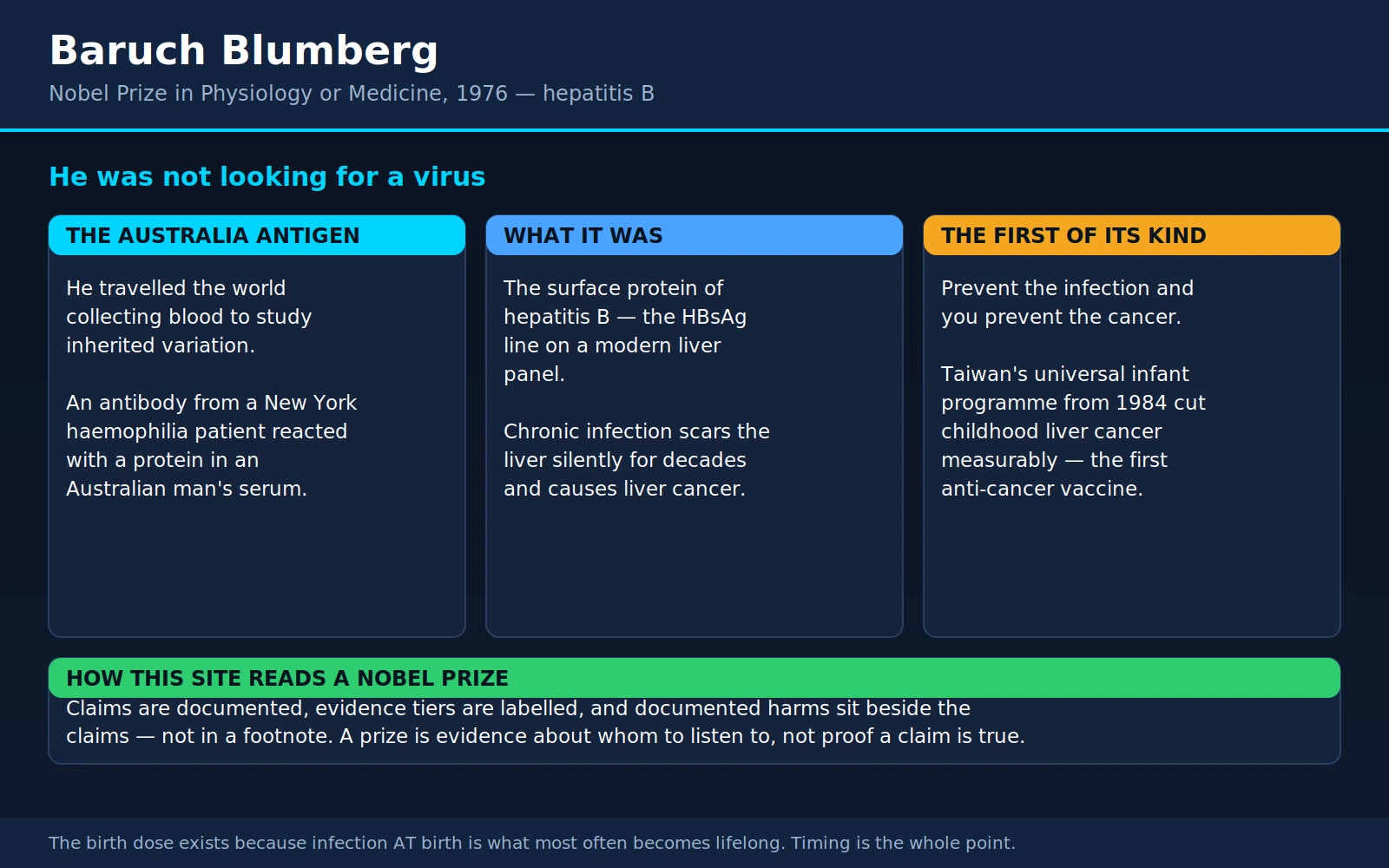
Table of Contents
- The Prize and the Man
- The Australia Antigen, 1963
- What It Turned Out to Be
- Why Hepatitis B Matters
- The Vaccine Nobody Thought Possible
- The First Anti-Cancer Vaccine
- The Birth Dose, and Why Timing Is Everything
- Living with Hepatitis B Today
- Liver "Detox" and Supplement Claims
- The Scientist's Method
- Where Mainstream Medicine Agrees — and What Remains Hard
- Key Research Papers
- Connections
- Featured Videos
1. The Prize and the Man
Baruch Samuel Blumberg (1925–2011) — "Barry" to everyone who worked with him — won the 1976 Nobel Prize in Physiology or Medicine for discovering the hepatitis B virus. That sentence is true and slightly misleading, because he was not looking for a virus. He was travelling the world collecting blood samples to study why populations inherit different susceptibilities to disease, and walked into one of the great public-health discoveries of the twentieth century sideways.
Born in Brooklyn, he served in the US Navy in the Second World War, then took an MD at Columbia in 1951 and — unusually for a physician — a doctorate in biochemistry at Balliol College, Oxford. The formative experience came in between. As a medical student in 1950 he spent several months at a clinic in Moengo, a mining town in Suriname, among a population drawn from an unusual number of ancestries. What struck him was not the diseases but the variation: people in the same town, drinking the same water, bitten by the same mosquitoes, had strikingly different outcomes from the same infections.
That inherited differences shape who gets sick became his life's question, and his method for pursuing it was almost eccentric by modern standards: go to remote populations, ask permission, collect blood, bring it home, and compare the proteins in it. From 1957 he ran the Geographic Medicine and Genetics Section at the National Institutes of Health; from 1964 he was at the Institute for Cancer Research in Philadelphia, now the Fox Chase Cancer Center.
The rest of his life was as unconventional as the start. From 1989 to 1994 he was Master of Balliol College, Oxford, the first American to hold the post; from 1999 to 2002, in his mid-seventies, he became founding director of NASA's Astrobiology Institute, arguing that recognising life you have never seen before is the same problem as looking for a disease agent nobody has described. He died in April 2011, aged 85, shortly after a keynote lecture at a NASA conference.
He shared the 1976 prize with D. Carleton Gajdusek, the award framed as being for "discoveries concerning new mechanisms for the origin and dissemination of infectious diseases." Gajdusek had shown that kuru, a fatal neurological disease among the Fore people of Papua New Guinea, was transmissible through ritual mortuary practices, despite an incubation period measured in years and no immune response at all. He called the agent a "slow virus." It was not; two decades later Stanley Prusiner showed kuru belongs to the prion diseases. Gajdusek was later convicted of child sexual abuse, pleading guilty in 1997 and serving a prison term; the fact belongs in the record, and we state it once and move on.
2. The Australia Antigen, 1963
The trick Blumberg was using is worth understanding. A person who receives many transfusions is repeatedly exposed to the slightly different protein variants carried by hundreds of donors, and sometimes makes antibodies against them — which makes such a patient's serum a ready-made detector for inherited protein differences. He tested it against his worldwide samples by immunodiffusion: two wells cut in a plate of agar gel, serum in one and sample in the other, and if an antibody meets a matching antigen they precipitate where they meet and a thin white line appears.
In 1963, working with a young NIH colleague named Harvey Alter and technician Sam Visnich, Blumberg found a line he could not explain. Serum from a haemophilia patient in New York precipitated with a protein in the serum of an Australian Aboriginal man, and reacted with nothing else in the panel. There was no name for it, so they gave it a geographical one in the plain style of the time: the Australia antigen, abbreviated Au.
Alter's presence in that room matters. He went on to win the 2020 Nobel Prize with Michael Houghton and Charles Rice for discovering the hepatitis C virus — the agent behind the "non-A, non-B" hepatitis that remained once Blumberg's virus and hepatitis A were accounted for. The man who helped find the first line in the agar in 1963 spent fifty years hunting the viruses it did not explain; together the two stories are how transfusion medicine became safe. See Alter, Houghton and Rice.
Blumberg's initial reading was that Au was what he had been hunting: an inherited serum protein variant, harmless in itself, common in some populations and rare in others. Roughly one in a thousand healthy Americans and Western Europeans carried it, but it was relatively common in parts of Asia, Africa and the Pacific — exactly the pattern an inherited marker would show. Then it turned up disproportionately in patients with leukaemia, producing the title of the first paper, in JAMA in 1965: "A 'new' antigen in leukemia sera."
It also appeared at high frequency in institutionalised patients with Down syndrome. An inherited marker linked to trisomy 21 was not impossible, but the pattern had a rival explanation a geneticist hunting polymorphisms was not primed to see: leukaemia patients receive many transfusions, and residents of crowded institutions live in intense person-to-person contact. Neither group was genetically unusual. Both were heavily exposed.
3. What It Turned Out to Be
Between 1966 and 1968 the picture inverted completely, driven by two observations the "inherited variant" hypothesis could not survive. The first came from the Down syndrome cohort. Blumberg's group had been testing the same residents repeatedly over time — not something you normally bother to do with an inherited marker, since your genotype does not change. One young man who had tested Au-negative came back Au-positive, and shortly afterward developed hepatitis. A gene does not switch on in a teenager and then give him jaundice. Something had been acquired.
The second happened to the laboratory itself. Barbara Werner, a technician in Blumberg's own group who had been running the Au assays, fell ill with hepatitis. She knew the test better than almost anyone alive, so she ran it on her own serum. She was Au-positive, having previously been negative. The antigen she had been studying as an inherited curiosity had infected her.
From there the evidence assembled quickly. The 1967 paper in the Annals of Internal Medicine laid out the hepatitis association alongside the leukaemia and Down syndrome findings, and the interpretation shifted from genetics to infection. Au appeared in patients with acute hepatitis and disappeared as they recovered, and it was concentrated in the groups with the most blood exposure. Testing donated blood for Au and discarding the positive units cut post-transfusion hepatitis dramatically. By 1970 David Dane in London had seen the whole virus particle under an electron microscope, and the Australia antigen was recognised as its outer coat.
This is where medical history becomes something you may be holding in your hand. The Australia antigen is the hepatitis B surface antigen, and on any modern hepatitis panel it is written HBsAg. When a doctor orders a hepatitis B test in pregnancy, before chemotherapy, or in a routine screen, the first line on the result is the same protein Blumberg found precipitating in a plate of agar in 1963. A positive HBsAg means the virus is in your blood right now. Our Hepatitis Panel and Liver Function Tests pages cover the rest of the workup.
The virus is genuinely peculiar: a hepadnavirus, a small partially double-stranded circular DNA virus that replicates through an RNA intermediate using its own reverse transcriptase — a DNA virus that copies itself the way a retrovirus does. And it makes an enormous surplus of its own coat. Chronically infected blood contains not only complete virions but vast numbers of empty 22-nanometre spheres and filaments made purely of surface antigen: harmless, non-infectious, outnumbering the real virus by orders of magnitude. Nobody knew what that surplus was for. Blumberg realised what it was good for.
4. Why Hepatitis B Matters
The direction is stark. Roughly 9 in 10 infants infected at or around birth go on to chronic, lifelong infection; among children infected between one and five, on the order of a quarter to a half do; among healthy adults, fewer than 1 in 20. (These are standard public-health approximations that vary between sources; treat them as the shape of the risk, not exact numbers.) A newborn does not mount the aggressive immune response that clears the virus in an adult, so the infection settles in quietly and stays. The paradox is that the mildest infection — the one with no symptoms, in a baby who never looks ill — is the dangerous one.
Hepatitis B does not usually destroy liver cells directly. Most damage is immune-mediated: the immune system attacks infected cells, and over decades that repeated injury and repair lays down scar tissue. Enough scarring becomes cirrhosis — a liver so distorted that blood cannot flow through it, producing portal hypertension, fluid accumulation and eventually liver failure.
And chronic hepatitis B causes liver cancer — specifically hepatocellular carcinoma. The link was established beyond argument by R. Palmer Beasley's prospective study in Taiwan, published in The Lancet in 1981, which followed 22,707 men and found hepatocellular carcinoma occurring overwhelmingly in the HBsAg-positive carriers, at a relative risk over a hundredfold. Hepatitis B can also cause liver cancer without cirrhosis first, because the virus integrates fragments of its DNA into the host cell's own genome.
It spreads more readily than people expect, through blood and body fluids: mother to infant at birth, unsterile medical or dental equipment, shared injection equipment, sexual contact, and historically transfusion before donor screening. It reaches extremely high concentrations in blood and it is tough, surviving on a dried surface for at least a week. Per exposure it is commonly cited as being on the order of 50 to 100 times more infectious than HIV (an approximation). This is why healthcare workers are vaccinated as a condition of employment, and why a hepatitis B exposure is an urgent event rather than a wait-and-see one.
The Polaris Observatory Collaborators' 2018 modelling study estimated that roughly 290 million people were living with chronic hepatitis B in 2016; more recent World Health Organization estimates put it around 250 to 260 million. All these figures are approximate. What is not in dispute is the second finding: only about 10 percent had been diagnosed, and of those, only a small minority were receiving treatment. The overwhelming majority of people living with hepatitis B do not know they have it. Deaths run to roughly a million a year, virtually all from cirrhosis and liver cancer.
5. The Vaccine Nobody Thought Possible
Every vaccine before this one followed one of two recipes. You grew the pathogen and killed it (the Salk polio vaccine), or you grew it and weakened it (Sabin polio, measles, yellow fever). Both start the same way: grow the pathogen. Hepatitis B could not be grown. It infects human liver cells and essentially nothing else — not standard cell culture, not eggs, not mice — so by the logic of the entire field there was no way to make a vaccine.
Blumberg's solution came from that surplus of empty coats. If a chronic carrier's blood is already full of non-infectious 22-nanometre particles made entirely of surface antigen — the exact protein the immune system needs to learn, in vast excess, with no viral genome inside — then the manufacturing problem has already been solved by the virus. You do not need to grow it. You need to purify what is already circulating.
Working with Irving Millman, a microbiologist who joined the Fox Chase laboratory in 1967, Blumberg developed a method to separate those particles from carrier plasma, purify them, and treat them so that any live virus along for the ride was destroyed. They filed a patent in 1969; it was granted in 1972. It is hard to overstate how strange the proposal sounded: a vaccine made by collecting blood from infected people, extracting the shell of the virus, and injecting that into the healthy. Several manufacturers declined to pursue it.
Merck did, under Maurice Hilleman, whose team spent years developing an inactivation process rigorous enough to satisfy regulators, applied on the assumption that the plasma contained live hepatitis B and anything else a donor might carry. The pivotal efficacy trial was run by Wolf Szmuness at the New York Blood Center and published in the New England Journal of Medicine in 1980: a randomised, double-blind, placebo-controlled trial in over a thousand men at high risk, showing efficacy above 90 percent. The plasma-derived vaccine, Heptavax-B, was licensed by the FDA in 1981.
It was safe — the inactivation process was validated, and no recipient was ever shown to have acquired hepatitis B or HIV from it. But it launched into the worst possible moment. The early 1980s were the opening years of the AIDS epidemic, the source material was human plasma, and one group the vaccine most urgently needed to reach was one the epidemic was hitting hardest. The fear was understandable and it was not correct, but fear does not need to be correct to destroy uptake.
The answer came from genetic engineering. In 1984 a Merck team led by William McAleer, with Hilleman, reported in Nature that they had produced hepatitis B surface antigen in baker's yeast. The gene for HBsAg was inserted into Saccharomyces cerevisiae, and the yeast manufactured the protein, which self-assembled into the same 22-nanometre particles — from a defined organism, with no human blood anywhere in the process. Recombivax HB was licensed in 1986, the first recombinant vaccine ever approved for human use, and that is what made hepatitis B vaccination global. Blumberg and Millman assigned the patent royalties to the Fox Chase Cancer Center.
6. The First Anti-Cancer Vaccine
The claim in this page's title needs stating precisely. The hepatitis B vaccine is not a vaccine against cancer cells; it does nothing for a cancer that already exists. The logic is one step longer, and each step is solid: chronic hepatitis B causes hepatocellular carcinoma; the vaccine prevents chronic hepatitis B; therefore it prevents a proportion of liver cancers that would otherwise occur. It is cancer prevention by removing the cause, which is the most reliable kind there is.
Demonstrating that in a population is harder than stating it, because the cancer arrives thirty to fifty years after the infection. Taiwan did the experiment early enough that the answer arrived within a working lifetime. It had a severe burden — a large fraction of adults were chronic carriers, most infected at birth — and in July 1984 launched the world's first nationwide universal infant hepatitis B vaccination programme.
Thirteen years later, Mei-Hwei Chang and the Taiwan Childhood Hepatoma Study Group published the result in the New England Journal of Medicine. Tracking hepatocellular carcinoma in children from 1981 to 1994, they found the average annual incidence in ages 6 to 14 fell from 0.70 per 100,000 in 1981–1986, to 0.57 in 1986–1990, to 0.36 in 1990–1994, with mortality falling in step. Among children aged 6 to 9 it dropped from 0.52 for those born in 1974–1984 to 0.13 for those born in 1984–1986. The absolute numbers are small, because childhood liver cancer is rare; the significance is in the shape, and it stands as one of the cleanest population-level demonstrations of cancer prevention in the history of medicine.
For about twenty years, hepatitis B was the only vaccine that prevented a human cancer. The second came from Harald zur Hausen, who spent the 1970s and 1980s arguing, against the settled view of his field, that cervical cancer was caused by human papillomavirus — and was proved right, winning the 2008 Nobel Prize. The HPV vaccines that followed prevent cervical cancer and a share of anal, penile and oropharyngeal cancers by the same logic. Two vaccines, two viruses, two cancers.
7. The Birth Dose, and Why Timing Is Everything
Worldwide, the main route to chronic hepatitis B is not sex, not needles, and not medical procedures. It is transmission from mother to baby at the moment of birth. The mother is very often unaware she is infected, because chronic hepatitis B usually causes no symptoms for decades. The baby is exposed to maternal blood during delivery, and because a newborn's immune system cannot clear the virus, the infection becomes lifelong in roughly nine cases out of ten. This chain has one narrow point where it can be broken, and the window is measured in hours.
A dose of hepatitis B vaccine given within 24 hours of birth — ideally within the first few hours — can stop the infection establishing. The virus takes time to reach the liver and begin replicating; the vaccine provokes an immune response that gets there first. Where the mother is known to be HBsAg-positive, the birth dose is combined with hepatitis B immune globulin (HBIG), ready-made antibodies that give immediate protection while the vaccine response develops.
The evidence is unusually crisp, and it is old. Beasley's randomised trial in Taipei, published in The Lancet in 1983, enrolled infants born to HBeAg-positive carrier mothers — the highest-risk group there is. Among untreated controls, 88 percent became chronic carriers. Among infants given HBIG plus vaccine, only 9 of 159 (6 percent) did. Combined efficacy was 94 percent, better than HBIG alone (71 percent) or vaccine alone (75 percent). Nearly nine in ten children destined for a lifelong infection were spared it by an injection given in the delivery room.
Modern practice adds two refinements. Every pregnant woman should be screened for HBsAg in each pregnancy — standard antenatal care in most countries, and the step that identifies who needs HBIG. And for mothers with a high viral load, antiviral treatment in the third trimester (usually tenofovir) lowers what the baby is exposed to and reduces the residual failures further. Infants born to positive mothers should be tested after the vaccine series to confirm it worked.
If you are hesitant about this one
The birth dose is one of the most commonly deferred vaccines, and the reasons people give are not stupid ones. A newborn is small and new. The first hours of life feel like the wrong moment for a needle. And a parent who knows their own hepatitis B status is negative may reasonably ask what the point is. Here is the honest reasoning, so you can weigh it yourself.
The timing is not arbitrary and cannot be made up later. Most vaccines protect against something a child might meet over years, so a few weeks' delay changes the risk only slightly. This one is different: the exposure, if it comes, happens during delivery. A dose at two months is a good vaccine given after the event it was meant to prevent.
Maternal screening is excellent but not perfect. A negative result in pregnancy is reassuring, and it is why HBIG is not given to every baby. But screening can be missed in an unbooked or precipitate delivery, a result can be mislabelled, and a mother can acquire hepatitis B after her screening test. The birth dose is the layer that does not depend on the paperwork being right. It also protects against non-maternal exposure — a household member who does not know they are a carrier is a documented route of infection in early childhood.
The safety record is one of the largest that exists. Billions of doses have been given since 1981, in every country. The recombinant vaccine contains a single yeast-made protein and an aluminium adjuvant; it contains no virus, live or killed, and cannot cause hepatitis B. Serious adverse events are very rare. The specific historical concerns — human plasma as a source, and thiomersal as a preservative — are both obsolete.
And what is prevented is not a bad week. It is a lifelong infection acquired invisibly, carrying a raised risk of cirrhosis and liver cancer in adulthood, in a person who will not know they have it until decades later. Discussing the timing with your midwife or paediatrician is entirely reasonable, and they will have had the conversation many times. What we would ask is that the decision be made knowing what the 24-hour window is actually for — because it is the detail most often left out, and the one the whole strategy rests on.
8. Living with Hepatitis B Today
If you have just been told you are HBsAg-positive, the first useful thing to know is that "hepatitis B" is not one condition. It covers several quite different situations with very different outlooks, and the point of the follow-up testing you are about to have is to work out which one you are in.
Acute infection that clears. An adult who catches hepatitis B typically has a few weeks of fatigue, nausea, aching joints, dark urine, sometimes jaundice, sometimes nothing noticeable — and then clears the virus completely. HBsAg disappears, protective antibody appears, and the person is immune for life. This happens in more than 19 out of 20 immunocompetent adults, and there is no specific treatment; the immune system does the work.
The inactive carrier state. Many people with chronic infection are HBsAg positive but have low viral load, normal enzymes, and little or no ongoing injury. They generally do not need antiviral treatment — but they do need monitoring, because the state can reactivate with age or immune suppression, and a small ongoing cancer risk remains.
Active chronic hepatitis. Here the immune system and the virus are locked in a slow fight that is damaging the liver: high viral load, elevated enzymes, accumulating fibrosis. This is the group that needs treatment, and treatment is genuinely effective.
Reading the panel
The hepatitis B panel confuses almost everyone the first time. Three lines carry most of the meaning.
- HBsAg (surface antigen — Blumberg's Australia antigen) — you have the virus now. Positive results more than six months apart define chronic infection.
- Anti-HBs (antibody to surface antigen) — you are protected. The neutralising antibody, from either vaccination or a cleared infection.
- Anti-HBc (antibody to core antigen) — you have met the real virus. The core protein sits inside the virion and is not in the vaccine, so this antibody appears only after genuine infection, and usually persists for life.
Those three resolve the question people most often ask. Anti-HBs positive, anti-HBc negative means you were vaccinated and never infected. Both positive means you caught hepatitis B, cleared it, and are now immune. HBsAg positive with anti-HBc positive means current infection. HBeAg and anti-HBe track how actively the virus is replicating, and HBV DNA is the viral load that drives treatment decisions.
One practical warning belongs here because it saves lives and is easy to miss. If you are anti-HBc positive — even with no current infection — and you are about to start chemotherapy, rituximab, high-dose steroids or another strongly immunosuppressive treatment, tell the prescribing team. Hepatitis B can reactivate from a dormant reservoir once immune control is removed, occasionally with fatal liver failure. It is entirely preventable with antiviral cover started beforehand — but only if someone knows to look.
Treatment: suppression, not cure
The mainstays are tenofovir and entecavir: nucleos(t)ide analogues taken as one daily tablet, extremely well tolerated, suppressing hepatitis B to undetectable levels in the great majority of patients. In a five-year open-label follow-up of tenofovir published in The Lancet in 2013, patients had liver biopsies at the start and at year five, and among those with cirrhosis at baseline, roughly three-quarters no longer met the histological definition of cirrhosis — scarring the field had assumed permanent had partly reversed once the driving injury stopped. In a large Japanese cohort published in Hepatology the same year, entecavir-treated patients had substantially lower cumulative rates of liver cancer than a matched untreated group.
Now the honest limitation. These drugs suppress the virus; they very rarely eliminate it, and the reason has a name: cccDNA. When hepatitis B infects a liver cell it converts its genome into a stable circular minichromosome — covalently closed circular DNA — that sits in the nucleus as a permanent template. The drugs block the step that makes new viral genomes, so production stops, but nothing touches the cccDNA already there; stop the tablets and production usually restarts. Fragments of HBV DNA are also integrated into the host chromosomes, which is why cancer risk falls with treatment but does not vanish. Sustained loss of HBsAg — "functional cure" — happens at roughly 1 percent per year or less, so for most people treatment is indefinite. It also works: an indefinitely suppressed virus does very little damage.
People often ask why hepatitis C can be cured and hepatitis B cannot, and the answer is the cccDNA. Hepatitis C is an RNA virus that never makes a DNA copy and never establishes a nuclear reservoir; interrupt its replication long enough and it is gone entirely. Modern direct-acting antivirals cure well over 95 percent of patients in eight to twelve weeks of tablets — the achievement that earned Alter, Houghton and Rice the 2020 Nobel Prize. Hepatitis B is the harder problem, and it is the one that has a vaccine. Our Hepatitis C page covers that side.
Monitoring, and what genuinely helps
Because hepatitis B can cause liver cancer without cirrhosis, surveillance is recommended more broadly than for other liver diseases: abdominal ultrasound every six months, often with an alpha-fetoprotein blood test, for everyone with cirrhosis and for defined higher-risk groups without it. Hepatocellular carcinoma caught small is often curable by resection, ablation or transplant, and caught late usually is not. If you have chronic hepatitis B and nobody has discussed surveillance with you, ask.
Day to day: take the antiviral every day if you are on one. Avoid alcohol — alcohol and hepatitis B injure the liver in the same direction, making this the single largest modifiable factor. Keep your weight in a healthy range, because fatty liver stacked on viral hepatitis accelerates fibrosis. Get vaccinated against hepatitis A. Make sure household members and sexual partners are tested and vaccinated. And keep your appointments — here the routine six-monthly blood test genuinely is the treatment plan.
9. Liver "Detox" and Supplement Claims
Hepatitis B attracts an enormous amount of alternative-medicine marketing, for reasons easy to understand. It is chronic, it usually causes no symptoms, conventional treatment is indefinite rather than curative, and the liver has a folk reputation as the organ that can be "cleansed."
Milk thistle (Silybum marianum) is the most-studied herbal liver remedy in the world, and it is not a fringe claim. Its extract, silymarin, is a mixture of flavonolignans, and there is real pharmacology behind it: a genuine antioxidant, apparently membrane-stabilising against certain toxins, with antifibrotic activity in animal models. Its strongest credential is one most people have never heard of: intravenous silibinin is used in Amanita phalloides (death cap mushroom) poisoning, where it appears to block amatoxin uptake into liver cells.
Now the tier. The best-designed trial of silymarin in chronic viral hepatitis was published in JAMA in 2012 by Fried and colleagues: a multicentre, double-blind, placebo-controlled study in 154 patients with chronic hepatitis C, at 420 mg or 700 mg three times daily — higher than typical over-the-counter dosing — for 24 weeks. The trial was negative. Neither dose beat placebo on the primary endpoint. For hepatitis B the evidence is thinner still: no trial shows that silymarin clears HBsAg, suppresses HBV DNA, reverses fibrosis, or reduces liver cancer risk.
Tier: plausible mechanism, real pharmacology, one genuine hospital application — and no demonstrated benefit against hepatitis B. Milk thistle is not dangerous at usual doses and we are not telling anyone to throw it out. We are saying it does not do the job people buy it for. If you take it, take it alongside the antiviral, never instead.
Dandelion (Taraxacum officinale) has a long European and Chinese history as a liver and gallbladder herb, and the traditional reasoning is coherent: bitter compounds stimulate bile flow, and bile is one route by which the liver excretes waste. Laboratory and rodent studies report antioxidant and hepatoprotective effects against chemical liver injury, and the plant is a nutritious food with a good safety profile. Tier: traditional use plus preclinical data, and essentially no human trial evidence in viral hepatitis at all. It is a pleasant, safe green and a reasonable bitter tonic; it is not treatment.
Commercial liver-cleanse protocols — olive-oil-and-lemon-juice flushes, coffee enemas, multi-day "detox" regimens — are a different category, and here we will be blunt, because the claims are testable and they fail. The soft green-brown pellets produced by an olive-oil-and-citrus flush and presented as expelled "stones" have been analysed and are soap-like precipitates formed in the gut from the oil and juice themselves; they are not gallstones and they did not come from the liver. Coffee enemas carry documented risks of electrolyte disturbance, bowel injury and infection, with no demonstrated benefit. The deeper problem is conceptual: the liver is not a filter that clogs, but a chemical plant that transforms compounds enzymatically and excretes them.
The useful advice is not nothing, and the most effective things are not pharmaceutical at all.
- Alcohol. Stopping is the single highest-value change available to someone with chronic hepatitis B. The two injuries compound, raising cirrhosis and liver-cancer risk well beyond either alone.
- Weight and metabolic health. Fat accumulating in a liver that is also fighting a virus accelerates fibrosis measurably, so losing excess weight and controlling blood sugar are genuine liver interventions.
- Avoiding aflatoxin where it is a local issue — mould toxins on poorly stored grains and nuts multiply hepatitis B's cancer risk.
- Coffee — observational data across many cohorts associate regular drinking with slower fibrosis progression and less liver cancer. It is observational, so do not over-read the effect size.
- Real food, adequate protein, and not over-supplementing. A liver under strain does better with fewer novel compounds to metabolise.
And the framing that matters most: antivirals do the thing the herbs are advertised to do. They suppress the virus to undetectable levels, allow fibrosis to regress, and measurably reduce liver-cancer incidence. No herbal regimen has been shown to do any of those things for hepatitis B. If you like milk thistle, keep it. Take the tablet too.
10. The Scientist's Method
Blumberg described how his discovery actually happened rather than tidying it into the shape a grant application would expect. His starting point was what he called a hypothesis-free search for polymorphisms. He was not testing a proposition about hepatitis; he was collecting variation and looking at it. The logic was closer to natural history than to experiment: gather broadly, look carefully, and pay attention when something does not fit. The Australia antigen was exactly such a thing.
What he did next is where most anomalies die. His working theory — an inherited variant marking susceptibility to leukaemia — was coherent, publishable, and consistent with a decade of his own prior work. It was also wrong, and he let it go and followed the data. Abandoning a good hypothesis you are personally invested in is not luck; it is a discipline, and it is rarer than it should be.
It is tempting to tell this as a parable about luck, and equally tempting to insist there was none. Both are wrong. There was real chance in it: the particular haemophilia patient's serum, the particular Australian sample, the fact that the two happened to be tested against each other. But the reaction in the agar would have meant nothing without a worldwide sample collection to place it in, and without the freedom to spend years chasing an unexplained precipitin line. Twelve years separate the first white line from a working vaccine method, and another twelve separate that from Taiwan's programme. Blumberg did not find a vaccine. He found an anomaly and then spent a career refusing to let go of it.
Would it be funded today? A modern grant application requires a specific hypothesis, a defined endpoint, preliminary data supporting it, and a timeline; "collect blood from many populations and examine inherited protein variation to see what turns up" satisfies none of them. But the hypothesis-driven system exists for good reasons: open-ended collecting produces a great deal of expensive nothing, and we only tell the stories of the exploratory programmes that worked, which makes exploration look far more reliable than it is. The conclusion is not "abolish hypotheses" but that a research system needs a deliberate fraction of its budget committed to curiosity-led work whose payoff cannot be specified in advance.
11. Where Mainstream Medicine Agrees — and What Remains Hard
Some pages on this site have to navigate real disagreement between conventional and alternative views. This one does not. There is no serious controversy about any of the following:
- Hepatitis B causes liver cancer. Established by large prospective cohorts and never seriously challenged since.
- The vaccine prevents infection. Randomised trials from 1980 onward, confirmed by four decades of population data.
- Preventing infection prevents cancer. Taiwan's programme showed falling childhood liver-cancer rates within thirteen years.
- The birth dose works, and the timing is the mechanism. Beasley's 1983 trial, and everything since.
- Antiviral suppression changes outcomes. Fibrosis and even established cirrhosis can regress, and liver-cancer incidence falls.
- Blood-donor screening for HBsAg made transfusion vastly safer.
What remains genuinely hard is a different list. There is still no cure. The cccDNA reservoir in the hepatocyte nucleus, and the integration of viral DNA into host chromosomes, mean current antivirals suppress rather than eradicate. A great deal of research targets this — capsid assembly modulators, RNA interference, gene-editing approaches to cccDNA, therapeutic vaccines — and some is in clinical trials, but none has yet produced a reliable cure, and it would be dishonest to imply otherwise.
Most infected people have never been diagnosed. The Polaris modelling put diagnosis at roughly one in ten worldwide, and treatment coverage at a small fraction of that. A silent disease with effective treatment and a poor diagnosis rate is a public-health failure of a specific and fixable kind, and it is arguably the largest gap in the whole hepatitis B story.
Birth-dose coverage lags badly. Global coverage of the three-dose infant series is well over 80 percent, but coverage of the timely birth dose, the one that actually interrupts mother-to-child transmission, has historically sat below half worldwide and much lower in some regions. The dose that matters most is the hardest to deliver.
Access is unequal, and stigma is a live problem. Tenofovir and entecavir are off-patent and can be made very cheaply, yet in many high-burden countries the diagnostic pathway — viral load testing, fibrosis assessment, specialist review — is the real barrier rather than drug cost. And chronic hepatitis B carries substantial social stigma in several high-prevalence regions, including employment and marriage discrimination, which discourages exactly the testing that would find the people who need treatment.
The World Health Organization has set a target of eliminating viral hepatitis as a public-health threat, and the modelling work on what that would require is clear that the tools already exist. The obstacle is not scientific. Blumberg supplied the science half a century ago; the rest is delivery.
12. Key Research Papers
- Blumberg BS, Alter HJ, Visnich S. A "new" antigen in leukemia sera. JAMA 1965;191:541-6
- Blumberg BS, Gerstley BJ, Hungerford DA, London WT, Sutnick AI. A serum antigen (Australia antigen) in Down's syndrome, leukemia, and hepatitis. Ann Intern Med 1967;66(5):924-31
- Szmuness W, Stevens CE, Harley EJ, et al. Hepatitis B vaccine: demonstration of efficacy in a controlled clinical trial in a high-risk population in the United States. N Engl J Med 1980;303(15):833-41
- Beasley RP, Hwang LY, Lin CC, Chien CS. Hepatocellular carcinoma and hepatitis B virus. A prospective study of 22 707 men in Taiwan. Lancet 1981;2(8256):1129-33
- Beasley RP, Hwang LY, Lee GC, et al. Prevention of perinatally transmitted hepatitis B virus infections with hepatitis B immune globulin and hepatitis B vaccine. Lancet 1983;2(8359):1099-102
- McAleer WJ, Buynak EB, Maigetter RZ, Wampler DE, Miller WJ, Hilleman MR. Human hepatitis B vaccine from recombinant yeast. Nature 1984;307(5947):178-80
- Chang MH, Chen CJ, Lai MS, et al. Universal hepatitis B vaccination in Taiwan and the incidence of hepatocellular carcinoma in children. N Engl J Med 1997;336(26):1855-9
- Marcellin P, Gane E, Buti M, et al. Regression of cirrhosis during treatment with tenofovir disoproxil fumarate for chronic hepatitis B: a 5-year open-label follow-up study. Lancet 2013;381(9865):468-75
- Hosaka T, Suzuki F, Kobayashi M, et al. Long-term entecavir treatment reduces hepatocellular carcinoma incidence in patients with hepatitis B virus infection. Hepatology 2013;58(1):98-107
- Fried MW, Navarro VJ, Afdhal N, et al. Effect of silymarin (milk thistle) on liver disease in patients with chronic hepatitis C unsuccessfully treated with interferon therapy: a randomized controlled trial. JAMA 2012;308(3):274-82
- Polaris Observatory Collaborators. Global prevalence, treatment, and prevention of hepatitis B virus infection in 2016: a modelling study. Lancet Gastroenterol Hepatol 2018;3(6):383-403
Live PubMed Searches
- Australia antigen hepatitis B discovery
- Hepatitis B vaccine and hepatocellular carcinoma
- Hepatitis B birth dose and transmission
- Tenofovir in chronic hepatitis B: outcomes
- Silymarin in liver disease: trials
The Nobel Foundation's own account of the 1976 prize is worth reading alongside these: nobelprize.org — 1976 Prize in Physiology or Medicine.
Connections
- All Notable Doctors
- Nobel Prize in Physiology or Medicine — the full roll of laureates, 1901 to the present
- Alter, Houghton and Rice — hepatitis C: Harvey Alter was in the room in 1963, and spent fifty years on the virus this one did not explain
- Harald zur Hausen — HPV and cervical cancer, the second vaccine that prevents a human cancer
- Stanley Prusiner — prions, and what Blumberg's 1976 co-laureate Carleton Gajdusek had really found in kuru
- Emil von Behring — serum therapy and antitoxin: the beginning of the lineage that ends in a birth-dose vaccine
- Barré-Sinoussi and Montagnier — HIV: the other blood-borne virus that reshaped transfusion medicine
- Liver & Kidney Diseases — the full hepatology and nephrology section
- Hepatitis C — the curable one, and why the difference comes down to cccDNA
- Cirrhosis — what decades of untreated hepatitis B does to liver architecture
- Liver Disease — the overview page: causes, symptoms and staging
- Liver Cancer — hepatocellular carcinoma, surveillance and treatment
- Hepatitis Panel — HBsAg, anti-HBs and anti-HBc explained line by line
- Liver Function Tests — ALT, AST, bilirubin and albumin, and what they actually measure
- Milk Thistle — silymarin: the traditional case, the pharmacology, and the negative trial
- Dandelion — the bitter liver tonic: traditional use and what the evidence supports
- Covered in depth on its own page: Hepatitis B