Alter, Houghton & Rice: Hepatitis C, from Mystery Virus to Cure
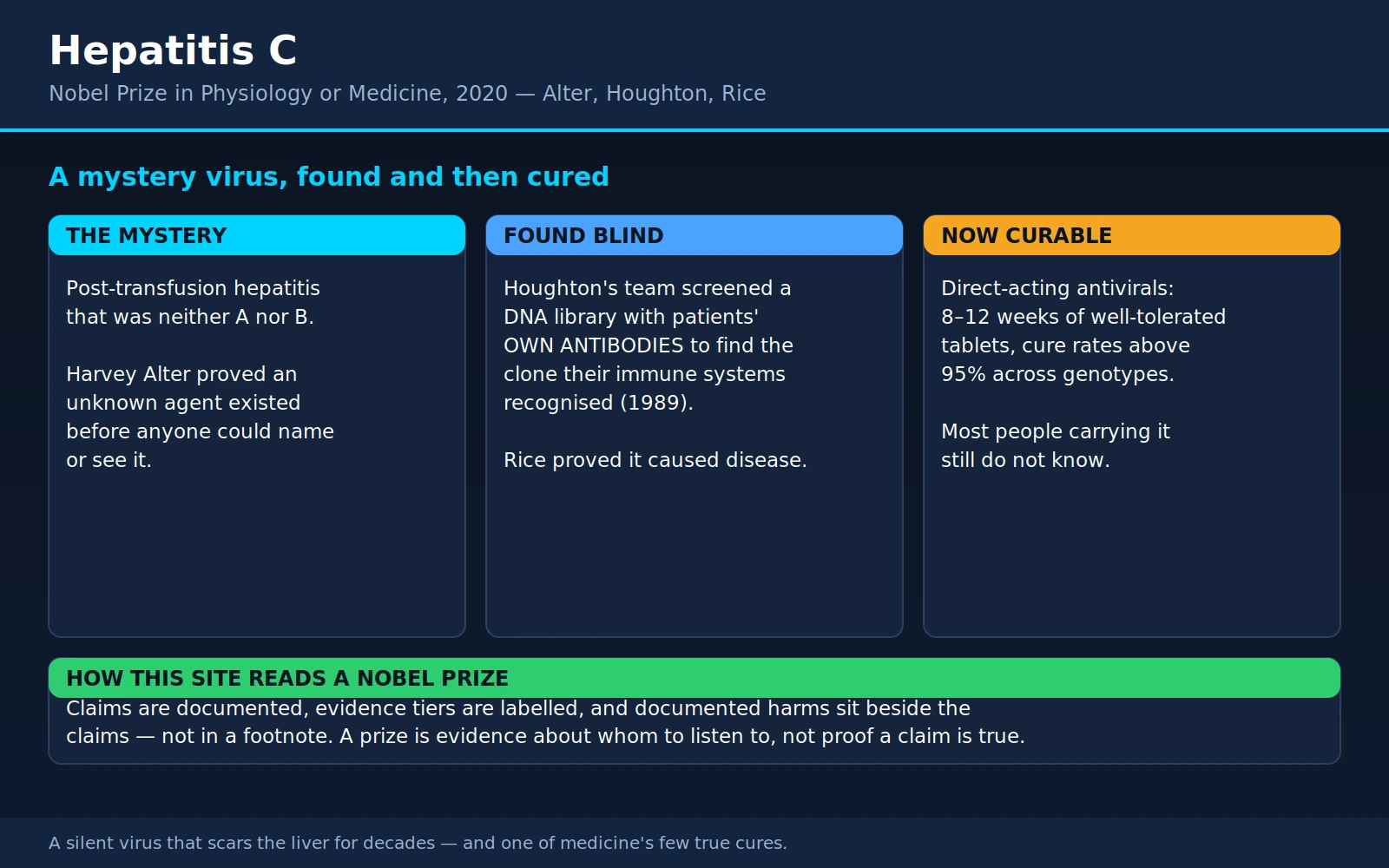
Table of Contents
- The Prize and the Three Men
- The Transfusion Mystery
- Why It Mattered: A Silent Virus
- Houghton's Needle in a Haystack, 1989
- Rice Completes the Proof, 1997
- Blood Screening: The First Payoff
- The Cure
- The Unfinished Business
- What This Means for You
- Where Mainstream Medicine Agrees — and What Remains Hard
- Key Research Papers
- Connections
- Featured Videos
1. The Prize and the Three Men
On October 5, 2020, the Nobel Assembly at the Karolinska Institute announced the Prize in Physiology or Medicine to Harvey J. Alter, Michael Houghton, and Charles M. Rice, with a citation of unusual bluntness: "for the discovery of Hepatitis C virus." No mechanism, no receptor — just a virus nobody could see, grow, or name. It could only have happened as a relay: each man solved a problem unsolvable with the tools of the man before him, and each handed over what the next one needed.
Harvey J. Alter (born 1935) spent his career in transfusion medicine at the National Institutes of Health Clinical Center in Bethesda; in the 1960s he co-discovered, with Baruch Blumberg, the "Australia antigen" — hepatitis B surface antigen. Alter is the clinical detective here: he proved, with stored blood samples nobody else thought to keep, that a third virus had to exist. He never cloned it. He made its existence impossible to argue with.
Michael Houghton (born 1949 in the United Kingdom) is a molecular biologist who worked at Chiron Corporation in Emeryville, California — a biotechnology company rather than a university. With colleagues Qui-Lim Choo and George Kuo, and infectious material from Daniel W. Bradley at the CDC, he did something close to unthinkable in 1989: identified a virus without ever seeing it or growing it.
Charles M. Rice (born 1952) was a virologist at Washington University in St. Louis, and from 2001 at The Rockefeller University. Rice answered the question Houghton's discovery left open — you have a sequence, but does that sequence, by itself, cause the disease? In 1997 he showed that it does, then built the laboratory systems that let drug hunters go to work. Hepatitis C is, so far, the only chronic viral infection of humans that medicine can reliably cure.
2. The Transfusion Mystery
In the 1960s a substantial fraction of people who received blood in the United States developed hepatitis afterward — in some closely followed series, on the order of a third of recipients. Moving from paid donors to volunteers helped, and so did donor screening for hepatitis B around 1970–72. Then the numbers stopped falling, at a level still far too high.
By the mid-1970s there were tests for hepatitis A (food- and water-borne, acute, never chronic) and hepatitis B (blood-borne, sometimes chronic). Alter's group ran both on their post-transfusion cases and found what should have been impossible: most were neither. In 1975 Feinstone, Kapikian, Purcell, Alter, and Holland published the observation in the New England Journal of Medicine under a title that is simply a statement of the problem — "Transfusion-associated hepatitis not due to viral hepatitis type A or B."
That archive turned an anecdote into an argument. It showed the illness tracking with specific donors, behaving like an infection rather than a reaction, and — decisively — that serum from affected patients transmitted the disease to chimpanzees, which developed the same liver injury; Alter and colleagues reported the transmissible agent in 1978. Filtration suggested something very small; organic solvents destroyed its infectivity, implying a lipid envelope.
The field named it in a way that is really an admission of defeat: "non-A, non-B hepatitis" — a diagnosis by exclusion, made of two negatives. For eleven years that was the state of the art. It would not grow in culture, could not be seen under an electron microscope, and no animal but the chimpanzee would take it. The classical playbook — isolate, grow, look, then make a test — had run out of moves.
3. Why It Mattered: A Silent Virus
Why care so much about a hepatitis most patients seemed to shrug off? They did not shrug it off. They just did not notice for twenty years.
Acute infection is usually asymptomatic or nearly so, and roughly a quarter to a half of people clear the virus spontaneously within six months. Everyone else — the majority — becomes chronically infected. The virus replicates in liver cells, the immune response produces a low-grade grinding inflammation lasting decades, and inflammation drives fibrosis. No symptom marks the transition from one stage of scarring to the next.
Over twenty to thirty years, on the order of 15 to 30 percent of chronically infected people progress to cirrhosis — faster with alcohol, obesity and fatty liver disease, or co-infection with hepatitis B or HIV. Once cirrhosis is established, so is the risk of hepatocellular carcinoma, primary liver cancer, arising at roughly one to four percent per year. For decades hepatitis C was the leading reason for liver transplantation in the United States and much of Europe.
Set twenty symptomless years beside transmission in blood and the urgency is obvious. Every donated unit was a coin flip nobody could call: a donor could be infected, feel entirely well, pass every existing test, and transmit a disease that would surface as cirrhosis two decades later. Screening is impossible when the thing you are screening for has no name.
4. Houghton's Needle in a Haystack, 1989
Houghton's team worked on the problem for about seven years. The strategy they finally used is one of the most elegant pieces of reasoning in virology, and its elegance comes entirely from what it refuses to require.
Conventional virus hunting needs the virus: grow it, purify it, look at it, sequence it. Houghton's team had none of that. They had plasma from a chimpanzee Bradley had infected, carrying an unusually high concentration of the agent — and, the key, blood from patients who had the disease, which necessarily contained antibodies against the unknown virus. The insight was to let the patients' own immune systems do the identification.
In outline: extract all the nucleic acid from the infectious plasma, indiscriminately, convert it to complementary DNA, and clone the fragments into a bacteriophage expression vector so each clone manufactures a small piece of protein from whatever fragment it carries. That yields a library of roughly a million clones, almost all meaningless chimpanzee genome. Then wash serum from a patient with chronic non-A, non-B hepatitis over the library and find the one clone whose protein the patient's antibodies recognize — because the only relevant exposure that immune system has had is the unknown virus.
It very nearly failed; the team screened repeatedly with nothing. Eventually one clone, designated 5-1-1, reacted. It was not chimpanzee DNA and matched no known human sequence. It came from an RNA genome, and walking outward from that fragment the team assembled about 9,600 nucleotides: a positive-sense, single-stranded RNA virus, distantly related to the flaviviruses.
They named it the hepatitis C virus. The two 1989 papers in Science — Choo and colleagues on the clone, Kuo and colleagues on an antibody assay built from it within months — ended eleven years of "non-A, non-B." The name arrived before anyone had ever seen the virus.
A matter of credit deserves to be said plainly rather than smoothed over. Qui-Lim Choo and George Kuo are first authors on the two founding papers, and Kuo pushed the immunoscreening strategy when others thought it unlikely to work. Nobel Prizes cannot be divided more than three ways, and the 2020 prize named Houghton alone from that team. In 2013 Houghton was awarded the Canada Gairdner International Award and declined it, because Choo and Kuo were not recognized alongside him. He accepted the Nobel while publicly crediting them.
5. Rice Completes the Proof, 1997
By 1990 hepatitis C had a name, a genome sequence, and a blood test. It did not have proof: a viral sequence found in the blood of infected people is a strong association, not a demonstration that this virus, and nothing else in that plasma, causes the disease. Koch's postulates, laid down by Robert Koch, require growing the organism in pure culture and reproducing the disease with it. Hepatitis C failed that step absolutely: there was no pure preparation to inject.
Rice's answer was to satisfy the spirit of the postulates by a wholly modern route: if you cannot purify the virus, build it from its own sequence. Take the genome as written, synthesize RNA from a DNA copy, put that RNA into a liver, and see whether a virus assembles itself and causes hepatitis. If it does, the sequence alone is sufficient — as clean a proof of causation as virology can offer.
Several laboratories tried through the early 1990s and reliably failed. Rice found two reasons. The published genome was incomplete — sequences ended too early at the 3′ end, and his laboratory established that a conserved region at the very tail had been missed, without which the virus cannot replicate. And HCV replicates sloppily, producing a swarm of variant genomes in every infected person — a quasispecies — so most individual sequences pulled from a patient carry inactivating mutations. Rice's group therefore built a consensus genome engineered to eliminate them.
In 1997 Kolykhalov, Agapov, Blight, Mihalik, Feinstone, and Rice reported in Science that RNA transcribed from this corrected clone, injected directly into chimpanzee liver, produced a genuine infection: virus in the blood, hepatitis in the animal. A sequence written out on paper had become a live, transmissible, disease-causing virus. Causation was settled.
Then came the part that arguably saved more lives than the proof did: a virus you cannot grow is a virus you cannot test drugs against. In 1999 Volker Lohmann and Ralf Bartenschlager reported the first HCV replicon — a self-replicating fragment of the genome that multiplies inside a human hepatoma cell line. Rice's laboratory contributed the adaptive mutations that made replicons work and the Huh-7.5 cell line that supports them best; by 2005 several groups had systems running the complete viral life cycle in culture. A company could now drop a compound onto infected cells and get an answer in days.
6. Blood Screening: The First Payoff
The benefit did not wait for the cure. The first-generation anti-HCV test, built on an antigen derived from Houghton's clone, entered donor screening in the United States in 1990; a better second-generation assay followed in 1992; and from 1999 blood centers added nucleic acid testing, looking for viral RNA directly rather than the recipient's antibody response.
The effect is one of the largest public-health improvements attributable to a single laboratory discovery. Post-transfusion hepatitis fell to a residual risk estimated at roughly one per two million units where modern screening is in place — a risk once measured in percentages, now in parts per million. Alter's 1989 paper in the New England Journal of Medicine, testing the very samples his group had been freezing for years, showed the new assay picking out the non-A, non-B cases he had documented for a decade.
The honest part is the part before 1990, because screening did not undo the harm already done. An entire generation of people with hemophilia was infected through clotting-factor concentrates made from pooled plasma, where one donor could contaminate a batch used by thousands; many acquired HIV in the same products. Transfusion recipients through 1991, dialysis patients, and organ recipients were exposed to a risk nobody could screen for. Nobody was concealing a known virus — but "nobody could have known" and "an enormous number of people were harmed" are both true at once, which is why anyone transfused before 1992 should be tested at least once, however well they feel.
7. The Cure
The interferon era, and why people remember it with dread
For roughly twenty years after the discovery, treatment meant interferon alfa — later pegylated interferon, needing only weekly injection — usually with the oral antiviral ribavirin. It was not targeted therapy; interferon is a broad immune-signaling protein that makes the body's antiviral defenses more aggressive, and it worked, when it worked, by brute force.
The cost was severe. Patients injected for 24 to 48 weeks and typically endured sustained flu-like illness — fever, chills, aching muscles, profound fatigue — plus weight loss and depression serious enough in some to need psychiatric care; ribavirin added hemolytic anemia and is teratogenic. For all that, the cure rate for the commonest genotype in North America and Europe was on the order of 40 to 50 percent. Understand this for one reason above all: if someone you know was treated before about 2014, failed, and swore never again, they were treated with a fundamentally different medicine.
Direct-acting antivirals: what changed
The cell-culture systems built on Rice's work let developers attack the virus's own machinery. HCV's polyprotein is cut into parts, three of which proved excellent drug targets: the NS3/4A protease (the scissors that cut the polyprotein), the NS5A protein (essential for assembling the replication complex), and the NS5B polymerase (the enzyme that copies the genome).
The breakthrough compound was sofosbuvir, an NS5B nucleotide inhibitor approved by the FDA in December 2013: a chain terminator the polymerase incorporates into the growing RNA strand and then cannot continue past. Because it targets a part of the enzyme nearly identical across genotypes, which cannot mutate freely without crippling the virus, it works broadly and has a high barrier to resistance. Lawitz and colleagues reported in 2013 that sofosbuvir-based treatment cured about 90 percent of untreated patients in twelve weeks. Then interferon was dropped entirely, and fixed-dose all-oral combinations — sofosbuvir with ledipasvir or velpatasvir, glecaprevir with pibrentasvir — produced the profile that defines treatment today:
- 8 to 12 weeks of treatment for most people, with no injections.
- One or two tablets once a day.
- Cure rates consistently above 95 percent, in many trials above 97 percent.
- Pangenotypic options that work across all major genotypes, so genotype testing is often no longer needed.
- Side effects usually limited to mild headache or fatigue. Most people work, exercise, and parent normally throughout.
- Effective in groups previously considered untreatable — compensated cirrhosis, HIV co-infection, chronic kidney disease, prior treatment failure.
What "cure" means, and what it does for the liver
The formal endpoint is sustained virologic response — no detectable HCV RNA twelve weeks after finishing treatment, written SVR12. People who achieve it essentially never relapse; late recurrence is rare enough that SVR is accepted as cure rather than remission. The virus does not integrate into human chromosomes the way HIV does, so there is no reservoir waiting to reactivate.
Removing the virus removes the inflammation driving the scarring, and fibrosis frequently regresses after cure. Van der Meer and colleagues, studying advanced fibrosis in the interferon era, found SVR associated with markedly lower all-cause mortality; Carrat and colleagues' large French cohort reported direct-acting antiviral treatment associated with reduced mortality and reduced liver cancer risk (Lancet 2019).
Now the part that must be said plainly, because optimism here can cost a life. If cirrhosis is already established when you are cured, liver-cancer risk falls but does not fall to zero. The architectural damage, and the genetic changes accumulated in those cells over decades, do not reverse. Anyone cured who had cirrhosis needs continued liver-cancer surveillance — in standard practice an ultrasound roughly every six months, indefinitely. Being cured of the virus is not being discharged from liver care.
8. The Unfinished Business
A cure exists. Most people who need it are not getting it.
Price and access
Sofosbuvir launched in the United States in late 2013 at a list price of roughly $1,000 per tablet — about $84,000 for a twelve-week course — prompting a US Senate Finance Committee investigation and rationing by public insurers, who restricted treatment to patients who had already developed advanced fibrosis.
What followed is genuinely mixed. The manufacturer issued voluntary licenses to generic producers, chiefly in India, covering a long list of low- and middle-income countries, and generic competition drove a full curative course there to the low hundreds of dollars. Egypt negotiated hard on price, screened tens of millions of citizens, and treated millions. Against that: middle-income countries excluded from the licenses often pay far more, and prior authorization, sobriety preconditions and specialist-only prescribing all delay treatment for exactly the populations in which it prevents the most onward transmission.
The numbers, and the diagnostic gap
The World Health Organization estimates around 50 million people living with chronic hepatitis C worldwide, roughly a million new infections a year, and on the order of a quarter of a million annual deaths; the Polaris Observatory's modelling work documents both real progress and its limits.
The number that should stop you is the diagnostic gap. Most people living with hepatitis C do not know they have it — the proportion ever diagnosed is well under half, and the proportion treated lower still. A disease with no symptoms for twenty years does not bring people to the doctor, so the only way to find it is to look for it in people who feel fine. WHO's 2030 elimination targets — 90 percent fewer new infections, 65 percent fewer deaths against a 2015 baseline — are globally not on track. The bottleneck is diagnosis and delivery, not pharmacology.
Stigma, and why it is a clinical problem
In most high-income countries today the great majority of new infections occur through injection drug use — shared needles, and also shared cookers, filters, water and ties. Stigma here is not a matter of hurt feelings; it is an epidemiological force. People who expect to be judged do not get tested, and people treated with contempt in a clinic do not return for the RNA confirmation. Programs requiring documented abstinence before prescribing — a condition imposed on no other curative therapy in medicine — withheld cure from precisely the people whose treatment would prevent the most transmission. People who inject drugs achieve cure rates comparable to everyone else when treatment is actually offered, and exposure is often ancient and brief: many were infected decades ago from a single episode of injecting and have lived entirely sober lives since.
Why there is still no vaccine
HCV is extraordinarily variable — seven or eight major genotypes differing by roughly a third of their sequence, and within a single person a constantly shifting quasispecies, so the immune system chases a target that has already changed. The envelope protein E2 carries a hypervariable region that mutates rapidly and acts as a decoy, while the conserved receptor-binding surfaces beneath are shielded by attached sugars and by host lipoproteins. People who clear HCV spontaneously can be reinfected, so natural immunity is incomplete, and chimpanzee research — on which the early field depended — has ended on ethical grounds, correctly, but at a real scientific cost. A viral-vector prime-boost regimen tested in people who inject drugs generated T-cell responses but did not prevent chronic infection. Houghton spent much of his later career at the University of Alberta on this problem.
9. What This Means for You
Who should be tested
Because the infection is silent and the cure is excellent, the balance tips overwhelmingly toward testing. The US Preventive Services Task Force recommends one-time screening for all adults aged 18 to 79 (JAMA 2020), and the CDC recommends universal adult screening at least once plus testing in every pregnancy. Testing is specifically warranted if any of the following apply:
- You ever injected drugs, even once, even decades ago. This is the single most commonly missed exposure.
- You received a blood transfusion, blood product, or organ transplant before 1992. People with hemophilia treated before the mid-1980s should be considered exposed.
- You have ever been on long-term hemodialysis.
- You have had a needlestick or sharps injury, or mucosal exposure to blood, in a healthcare setting.
- You have HIV, or take pre-exposure prophylaxis.
- You have persistently or unexplainedly elevated liver enzymes — ALT or AST above normal more than once without an obvious cause. See Liver Function Tests.
- You were born to a mother with hepatitis C.
- You have had tattooing or piercing in an unregulated setting, or procedures where sterilization standards may not have been maintained.
- You have ever been incarcerated.
Antibody test versus RNA test
The anti-HCV antibody test is the screening test: has your immune system ever encountered this virus? A negative result in someone without recent exposure means no hepatitis C. A positive antibody test does not mean you have hepatitis C now — it means you met the virus at some point, and antibodies persist for life after spontaneous clearance and after successful treatment.
The HCV RNA test (a PCR test, sometimes reported as viral load) is the confirmatory test: is the virus in your blood right now? So the sequence is antibody reactive → RNA test. RNA detected means current, chronic infection, and you should be referred for treatment. RNA not detected means past infection, now resolved, and no antiviral treatment is needed, though reinfection remains possible. If your antibody test is positive, ask specifically whether the RNA test has been done.
An honest note on liver "detox," milk thistle, and supplements
Milk thistle (Silybum marianum) and its extract silymarin are the most-used herbal products in chronic liver disease worldwide, and unlike most supplement claims this one has been put to a proper test. Fried and colleagues randomized 154 patients with chronic hepatitis C who had failed interferon therapy to oral silymarin at 420 mg or 700 mg three times daily — higher than customary doses — or placebo, for 24 weeks, and published the result in JAMA in 2012. Silymarin did not significantly reduce serum ALT compared with placebo and did not reduce HCV RNA levels. It was well tolerated, so the honest summary is safe but not effective against the virus, not "dangerous." The tiers of evidence:
- Proven to cure the infection: direct-acting antiviral tablets, 8–12 weeks, above 95 percent cure. The only intervention here that eliminates the virus.
- Traditionally used, tested, and negative for this purpose: silymarin/milk thistle — a long history of use in liver complaints and plausible antioxidant mechanisms in the laboratory, but no effect on liver enzymes or viral load in a well-conducted randomized trial. Its separate evidence base in amanita mushroom poisoning does not transfer to viral hepatitis.
- Genuinely helpful, but not antiviral: stopping or minimizing alcohol, which independently accelerates fibrosis; addressing obesity and fatty liver; vaccination against hepatitis A and hepatitis B; caution with high-dose acetaminophen; and caution with iron supplementation, since iron overload worsens liver injury in hepatitis C.
- No evidence of benefit, some potential for harm: "liver flush" and juice-cleanse protocols, coffee enemas, and high-dose herbal combinations of unverified composition. Herbal hepatotoxicity is real, and an inflamed liver is the organ least able to absorb an unexpected chemical insult.
10. Where Mainstream Medicine Agrees — and What Remains Hard
Firmly established, not seriously disputed: hepatitis C virus exists and causes chronic hepatitis, cirrhosis, and liver cancer; it is transmitted through blood; blood-supply screening virtually eliminated transfusion transmission where implemented; direct-acting antivirals cure the great majority of people who take them; sustained virologic response is durable; and cure reduces mortality and cancer risk. These claims rest on the discovery record, on very large randomized trials, and on population data from multiple countries.
Still genuinely hard:
- Finding the undiagnosed. The scientific problem is solved; the logistical one is not.
- Access and price outside the licensed generic territories. A cure costing a hundred dollars in one country and tens of thousands in the next is a policy failure, not a scientific one.
- Vaccine development. Viral diversity, immune evasion, incomplete natural immunity, and the loss of the chimpanzee model.
- Cancer risk after cure in established cirrhosis. Reduced, not abolished. Stopping surveillance because you were cured is a recurring cause of late-diagnosed liver cancer.
- Reinfection. Cure confers no immunity, so where exposure continues, treatment must be paired with harm-reduction services.
- Extrahepatic disease. Mixed cryoglobulinemia, certain kidney diseases, some lymphomas and insulin resistance — how completely these resolve after cure is not fully worked out.
A disease invisible in 1975, named in 1989, proven in 1997, curable by 2014: the relay ran its full length. What is left is not discovery but delivery.
11. Key Research Papers
- Feinstone SM, Kapikian AZ, Purcell RH, Alter HJ, Holland PV. Transfusion-associated hepatitis not due to viral hepatitis type A or B. N Engl J Med 1975;292(15):767-70
- Choo QL, Kuo G, Weiner AJ, Overby LR, Bradley DW, Houghton M. Isolation of a cDNA clone derived from a blood-borne non-A, non-B viral hepatitis genome. Science 1989;244(4902):359-62
- Kuo G, Choo QL, Alter HJ, et al. An assay for circulating antibodies to a major etiologic virus of human non-A, non-B hepatitis. Science 1989;244(4902):362-4
- Alter HJ, Purcell RH, Shih JW, et al. Detection of antibody to hepatitis C virus in prospectively followed transfusion recipients with acute and chronic non-A, non-B hepatitis. N Engl J Med 1989;321(22):1494-500
- Kolykhalov AA, Agapov EV, Blight KJ, Mihalik K, Feinstone SM, Rice CM. Transmission of hepatitis C by intrahepatic inoculation with transcribed RNA. Science 1997;277(5325):570-4
- Lohmann V, Körner F, Koch J, Herian U, Theilmann L, Bartenschlager R. Replication of subgenomic hepatitis C virus RNAs in a hepatoma cell line. Science 1999;285(5424):110-3
- Lawitz E, Mangia A, Wyles D, et al. Sofosbuvir for previously untreated chronic hepatitis C infection. N Engl J Med 2013;368(20):1878-87
- Afdhal N, Zeuzem S, Kwo P, et al. Ledipasvir and sofosbuvir for untreated HCV genotype 1 infection. N Engl J Med 2014;370(20):1889-98
- van der Meer AJ, Veldt BJ, Feld JJ, et al. Association between sustained virological response and all-cause mortality among patients with chronic hepatitis C and advanced hepatic fibrosis. JAMA 2012;308(24):2584-93
- Fried MW, Navarro VJ, Afdhal N, et al. Effect of silymarin (milk thistle) on liver disease in patients with chronic hepatitis C unsuccessfully treated with interferon therapy: a randomized controlled trial. JAMA 2012;308(3):274-82
- Polaris Observatory HCV Collaborators. Global change in hepatitis C virus prevalence and cascade of care between 2015 and 2020: a modelling study. Lancet Gastroenterol Hepatol 2022;7(5):396-415
The Nobel Assembly's own account of the discovery, including its scientific background document, is at nobelprize.org — 2020 Prize in Physiology or Medicine.
Live PubMed Searches
- Hepatitis C virus discovery
- Direct-acting antiviral sustained virologic response
- Hepatitis C screening guidelines
- Silymarin hepatitis C trial
- Hepatitis C elimination WHO
Connections
- All Notable Doctors
- Nobel Prize in Medicine — the full roll of laureates, 1901 to the present
- Robert Koch — the postulates Rice had to satisfy by a wholly modern route, since HCV would not grow in culture
- Harald zur Hausen — the other virus-causes-cancer laureate: HPV and cervical cancer, the same argument made for a different organ
- Barry Marshall — another chronic disease that turned out to be an infection, and another slow fight to prove it
- Karl Landsteiner — blood groups, the beginning of the blood-safety lineage that Alter's screening work continues
- Hepatitis C — the disease page: transmission, staging, treatment regimens, and monitoring
- Cirrhosis — what decades of untreated inflammation build, and why cure does not end surveillance
- Hepatocellular Carcinoma — the cancer that arises in a cirrhotic liver, and the six-month ultrasound rule
- Liver Cancer — the broader picture of primary and secondary liver malignancy
- Hepatitis B — the virus Alter helped identify first, and the one whose screening left the mystery behind
- Hepatitis A — the food-and-water route, vaccine-preventable, and worth vaccinating against if you have HCV
- Fatty Liver Disease — the co-factor that accelerates fibrosis and outlives the cured infection
- Alcoholic Hepatitis — the other great driver of scarring, and the one most worth removing alongside the virus
- Liver Function Tests — what ALT, AST, bilirubin and albumin actually tell you
- Hepatitis Panel — the antibody and antigen tests, and how to read a reactive result
- Milk Thistle — the traditional liver herb, and the randomized trial that tested it against hepatitis C
- Dandelion — another traditional liver-support herb, reviewed on the same evidentiary terms
- Liver & Kidney Diseases — the full hepatology section
- Covered in depth on its own page: Hepatitis C