Black, Elion & Hitchings: Designing Drugs Instead of Finding Them
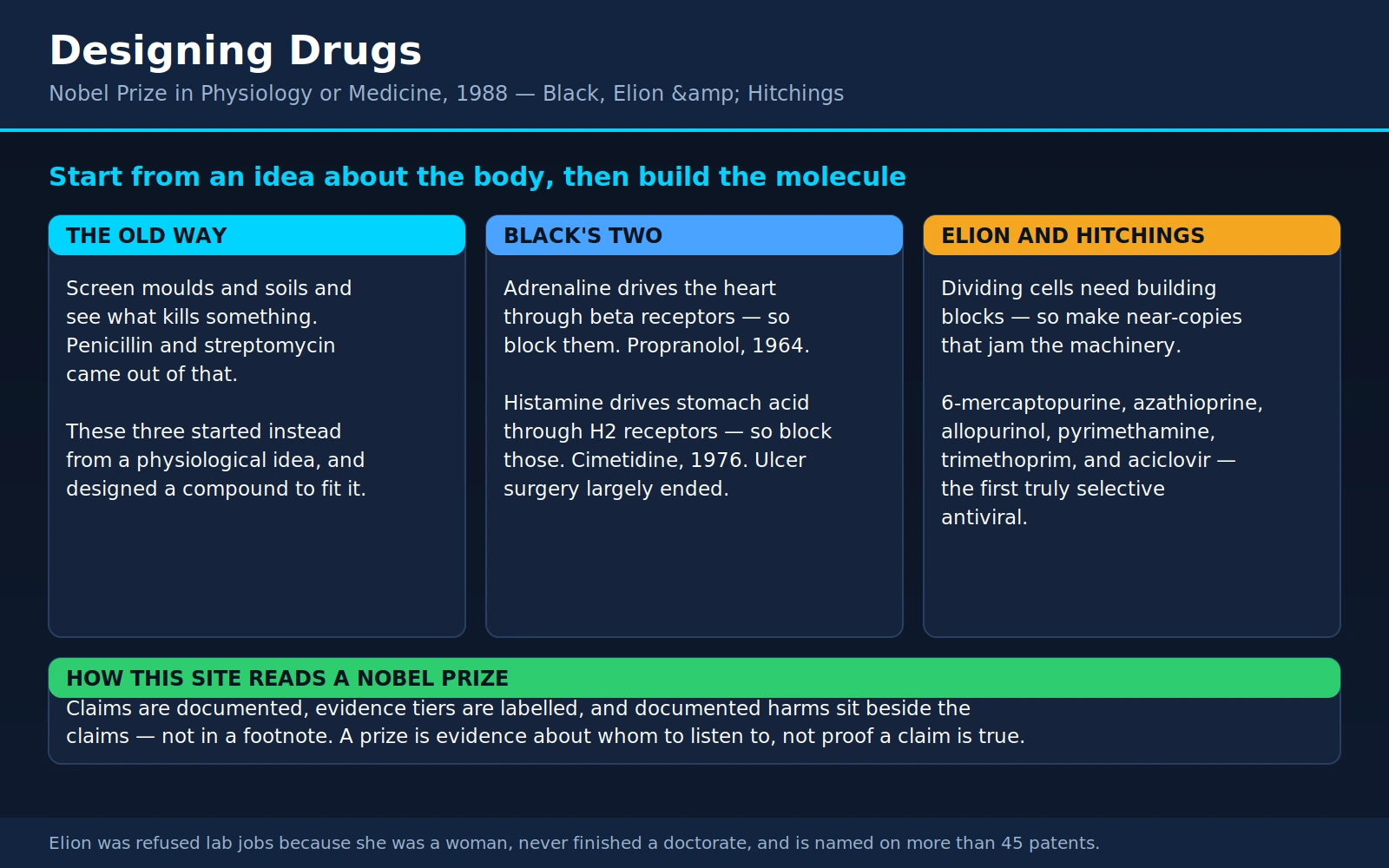
If you take a pill for your blood pressure, your heartburn, your gout, your Crohn's disease, or your shingles, there is a strong chance that the reasoning behind it traces back to three people who shared one Nobel Prize in 1988. The citation was oddly modest — "for their discoveries of important principles for drug treatment" — and it is the only Nobel Prize in Physiology or Medicine awarded not for a disease, an organ, or a molecule, but for a method of thinking. This page is about that method, the drugs it produced, and how to use several of those drugs well.
Table of Contents
- The Prize and the Three People
- What "Designing" a Drug Meant Then
- James Black and the Beta-Blocker
- Black Again: Cimetidine and the Stomach
- Hitchings and Elion: The Antimetabolite Method
- The Drug List, and What Each One Is For
- After the Prize: Nucleosides, Thioguanine and AZT
- What "Rational Drug Design" Means Now
- Practical: Taking a Beta-Blocker
- Practical: Allopurinol and Gout
- Practical: Azathioprine and the TPMT Test
- What This Does Not License
- Where Mainstream Medicine Agrees, and What Remains Debated
- Key Research Papers
- Connections
- Featured Videos
1. The Prize and the Three People
The 1988 Nobel Prize in Physiology or Medicine went jointly to Sir James W. Black, Gertrude B. Elion and George H. Hitchings. They had never worked together. Black was a Scottish physician-turned-pharmacologist working in British industry; Elion and Hitchings were American biochemists who had shared a laboratory bench in North Carolina since 1944. The Nobel Assembly at the Karolinska Institute put them in the same prize because they had, independently and by different routes, done the same unusual thing: they had reasoned their way to a drug instead of stumbling onto one.
The Assembly's own summary is worth quoting, because it says the thing plainly: "While drug development had earlier mainly been built on chemical modification of natural products they introduced a more rational approach based on the understanding of basic biochemical and physiological processes."
James Black (1924–2010)
Black was the fourth of five sons of a colliery manager in Fife, in the Scottish coalfields. He described himself as coasting and daydreaming through school until a mathematics teacher, Dr Waterson at Beath High School, "more or less man-handled" him into sitting the entrance examination for the University of St Andrews. He won a residential scholarship at fifteen, studied medicine, and graduated in 1946.
His route to fame ran through some genuinely bleak years. He and his wife Hilary left for Singapore in 1947 because of debts and, in his own words, "pitiful academic prospects," returning in 1950 with "no home, no income of any kind and no prospects whatsoever." A chance meeting on Oxford Street led to a job starting a physiology department at the Glasgow veterinary school, and it was there — working with the surgeon George Smith on the problem of getting more oxygen to a heart with narrowed arteries — that he had the idea that would define him.
He then did something British academics of the period rarely did: he went to industry on purpose. He joined ICI Pharmaceuticals at Alderley Park, Cheshire, in 1958, moved to Smith, Kline & French in 1964, held the chair of pharmacology at University College London from 1973, joined the Wellcome Foundation in 1977 at the invitation of John Vane (himself a 1982 Nobel laureate), and finished at King's College London. He was knighted in 1981 and admitted to the Order of Merit in 2000.
George Hitchings (1905–1998)
Hitchings was born in Hoquiam, Washington, into a family of shipbuilders. His father, a marine architect, died after a long illness when Hitchings was twelve, and he chose the life of Pasteur as the subject of his high-school graduation oration — "the blending of Pasteur's basic research and practical results remained a goal throughout my career." He read chemistry at the University of Washington, took his doctorate at Harvard in the department of biological chemistry, spent nine unsettled years in temporary academic posts, and in 1942 joined Burroughs Wellcome in Tuckahoe, New York, as the sole member of its biochemistry department.
What he brought was a hypothesis rather than a compound. In 1942 the enzymology of nucleic acids barely existed — the structure of DNA was eleven years away. Hitchings reasoned that if every dividing cell must assemble DNA and RNA out of purine and pyrimidine building blocks, then molecules that impersonate those building blocks ought to jam the assembly line, and ought to jam it hardest in whatever cell is dividing fastest. He then spent decades finding out which cells could be jammed selectively.
Gertrude Elion (1918–1999)
Elion was born in New York City to immigrant parents — her father a Lithuanian-born dentist who was bankrupted in the 1929 crash. She has become a symbol, and the symbol is usually told with more sentiment than the facts require. The facts are better told flatly.
She entered Hunter College in 1933 at fifteen, and chose chemistry partly because her grandfather had died of cancer when she was fifteen. She graduated in 1937. She could not go on to graduate school — there was no money — and applied to a number of universities hoping for an assistantship or fellowship. In her own Nobel autobiography she records what happened next in one sentence: "Jobs were scarce and the few positions that existed in laboratories were not available to women." That is her own account, published by the Nobel Foundation, and it is the reason to state the point as documented rather than inferred.
What she did instead: three months teaching biochemistry to nurses at the New York Hospital School of Nursing, then a year and a half as an unpaid and later barely paid laboratory assistant (eventually "the magnificent sum of $20 a week"), then two years as a trainee and substitute teacher of chemistry, physics and general science in New York City secondary schools while doing her master's research at night and at weekends. She took her MSc in chemistry from New York University in 1941 — the only woman in her graduate chemistry class.
The war changed her prospects, and the change is instructive: with chemists suddenly scarce she was "finally able to get a job in a laboratory, but it was not in research." It was analytical quality control for a major food company — checking the acidity of pickles and the colour of egg yolks, as she described it elsewhere. She left when the work stopped teaching her anything, spent six months at a Johnson & Johnson laboratory that was then disbanded, and in 1944 took a position as assistant to George Hitchings.
She never completed a doctorate. She enrolled at Brooklyn Polytechnic Institute and commuted at night for several years until the school told her she would have to give up her job and study full time. She chose the job. She called it "a critical decision in my life," and noted dryly that three honorary doctorates later she decided it had probably been the right one.
She was promoted repeatedly, and in 1967 was appointed Head of the Department of Experimental Therapy at Burroughs Wellcome — a department she described as a "mini-institute" containing chemistry, enzymology, pharmacology, immunology, virology and a tissue-culture laboratory — a post she held until she retired in 1983. She is credited on more than 45 patents. In 1991 she became the first woman inducted into the United States National Inventors Hall of Fame. She was named on the compounds that treat childhood leukaemia, gout, transplant rejection, malaria, bacterial infection and herpes.
The honest reading of that career is not that talent always finds a way. It is that a chemist good enough to end up with a Nobel Prize spent her twenties testing pickles because laboratories would not hire her, and got her chance largely because a war emptied the laboratories of men. What was lost in the meantime is not recoverable and should not be smoothed over.
2. What "Designing" a Drug Meant Then
To see why this prize was given, you have to see what the alternative looked like.
Before the middle of the twentieth century, essentially every useful drug arrived by one of three routes. The first was traditional use: someone noticed centuries ago that willow bark eased pain, that foxglove helped dropsy, that cinchona bark broke malarial fevers — and chemists later isolated the active molecule from the plant. The second was screening: test thousands of substances against an organism or an animal and see what happens. This is how Selman Waksman found streptomycin, by systematically culturing soil microbes and testing what they secreted; it is how Gerhard Domagk found Prontosil, by feeding dye after dye to infected mice. The third was serendipity: Alexander Fleming came back from holiday to a contaminated Petri dish.
All three routes work. Between them they produced most of the pharmacopoeia. But all three share a defect: you do not know what you are looking for. You test, you observe, and only afterwards — sometimes decades afterwards — do you work out why the thing worked. The compound comes first and the understanding comes second, which means you cannot ask for a drug that does a particular job. You can only ask what the compounds you happen to have will do.
Black, Hitchings and Elion inverted the order. They began with a statement about biology — this receptor drives that effect, or this enzyme sits at that step in this pathway — deduced what a molecule would have to look like to interfere at that exact point, and then set chemists to build it. The compound came last. When the compound worked, it also confirmed the biology; when it failed, it usually told you which part of your reasoning was wrong.
The intellectual ancestor of all this is Paul Ehrlich, who around 1900 proposed both the side-chain (receptor) theory — that cells carry specific chemical anchors that drugs and toxins latch onto — and the idea of the Zauberkugel, the "magic bullet" that hits the parasite and spares the host. Ehrlich's own compounds were found by screening; he tested hundreds of arsenicals to arrive at Salvarsan. What Black, Hitchings and Elion added was a way to act on Ehrlich's theory rather than merely admire it.
One qualification, because the story is often told too cleanly: none of this was pure deduction. Black's beta-blocker programme depended on a compound (dichloroisoprenaline) that chemists at Eli Lilly had made by accident while chasing a bronchodilator; Black himself called it the lead his team had been looking for. Elion and Hitchings synthesised and screened hundreds of purines, and the great majority of them did nothing. The difference was not that they stopped experimenting. It was that they knew, in advance, what a success would mean.
3. James Black and the Beta-Blocker
In 1948 the American pharmacologist Raymond Ahlquist had proposed that adrenaline and noradrenaline act on two different kinds of receptor, which he called alpha and beta — a tidy explanation for why the same hormone could constrict one blood vessel and relax another. The alpha receptors already had blockers. The beta receptors did not.
Black's reasoning, worked out at Glasgow by 1956, went like this:
- Angina is chest pain caused by a mismatch between how much oxygen the heart muscle is demanding and how much the coronary arteries can deliver.
- Every existing treatment attacked the supply side — nitrates to widen vessels, surgery to reroute blood.
- But the equation has two sides. Adrenaline drives the heart faster and harder through beta receptors, which raises demand.
- Therefore: block the beta receptor, cut the demand, and the mismatch closes from the other end.
Stated now, that is obvious. In 1956 it was close to heretical — deliberately weakening a diseased heart sounded like the opposite of treatment, and Black records that the programme was "initially controversial" and survived because his research director at ICI kept fighting for it.
His team produced pronethalol in 1962, which worked but caused tumours in mice, and then propranolol, reported in The Lancet in May 1964 under the flat title "A new adrenergic beta-receptor antagonist." Propranolol became one of the most successful drugs ever made, and the clinical pharmacologist Brian Pritchard promptly found something Black had not designed it for: it lowered blood pressure.
A note on the story about his father
Black's motivation is very often told through his father: a colliery manager who had angina and died of a heart attack after a minor road accident while Black was a medical student, leaving Black wondering whether the surge of adrenaline from the crash had killed him. That account appears in obituaries and profiles and it is not invented.
It is worth knowing, though, that Black's own Nobel autobiography does not mention it. There he traces the programme to Ahlquist's receptor hypothesis and to his laboratory work with George Smith on coronary oxygen supply, and in a filmed interview he credits the crucial practical lead to the accidental Eli Lilly compound. Both things can be true — a personal wound and a chain of technical reasoning — but a reader deserves to know which one the man himself put on the record.
What beta-blockers do today
Sixty years on, the class has spread far beyond angina:
- Angina — still a first-line preventive treatment, working exactly as Black intended.
- Arrhythmia — slowing conduction through the atrioventricular node, which is why they are a rate-control mainstay in atrial fibrillation.
- Heart failure with reduced ejection fraction — see below; this is the reversal.
- After a heart attack — long a reflex prescription, now being re-examined.
- Essential tremor — propranolol is among the best-established treatments and is recommended in the American Academy of Neurology's guideline update (Neurology 2011;77(19):1752-5). See Essential Tremor.
- Migraine prevention — propranolol carries a Level A recommendation for episodic migraine prophylaxis (Neurology 2012;78(17):1337-45). Nobody designed it for this.
- Performance anxiety — a single dose before a recital or a viva blunts the physical end of stage fright (racing heart, shaking hands, quavering voice) without sedating. Musicians have used propranolol this way for decades. It does not treat generalised anxiety disorder and is not a substitute for treatment that does.
- Thyroid storm and symptomatic hyperthyroidism — controlling the adrenergic symptoms while the underlying gland is treated.
- Portal hypertension and glaucoma (as timolol eye drops) round out an improbably wide list.
The heart-failure reversal — a real one
For thirty years, beta-blockers were considered contraindicated in heart failure, and the logic was sound: a failing heart is leaning on adrenergic drive to keep output up, so blocking that drive should push the patient over a cliff. Textbooks said so.
They were wrong, and three large trials in three years settled it. CIBIS-II randomised 2,647 patients to bisoprolol or placebo and was stopped early: all-cause mortality 11.8% versus 17.3%, hazard ratio 0.66 (Lancet 1999;353(9146):9-13). MERIT-HF randomised 3,991 patients to metoprolol CR/XL and was also stopped early: mortality 7.2% versus 11.0% per patient-year, relative risk 0.66 (Lancet 1999;353(9169):2001-7). COPERNICUS then showed the same for carvedilol in severe heart failure (N Engl J Med 2001;344(22):1651-8).
The resolution turned out to be about time: chronic adrenergic drive is itself toxic to heart muscle, so blocking it hurts for a few weeks and helps for years. That is why beta-blockers in heart failure are started at a very low dose and titrated up slowly — and why feeling worse in week two is expected rather than a reason to stop. A drug moved from "contraindicated" to "standard of care" on the strength of evidence. Medicine does occasionally reverse itself, and this is one of the clean examples.
And a reversal in the other direction
Most people are surprised to learn that beta-blockers are no longer recommended as first-line therapy for uncomplicated high blood pressure in most major guidelines. First-line now means a thiazide-type diuretic, a calcium-channel blocker, or an ACE inhibitor or ARB.
The turn came largely from a meta-analysis by Lindholm and colleagues, which pooled trials of beta-blockers as first-line antihypertensives and found a relative risk of stroke about 16% higher than with other agents (Lancet 2005;366(9496):1545-53). Much of the beta-blocker data came from atenolol, and the debate over whether that indicts the whole class or one drug has never fully closed.
This does not mean beta-blockers are bad blood-pressure drugs, and it certainly does not mean you should stop yours. It means that when hypertension is the only problem, something else is a better opening move. If you also have angina, a previous heart attack, an arrhythmia, heart failure or migraine, a beta-blocker may still be exactly the right drug — it is doing two jobs at once. See Hypertension.
The re-examination has continued. REDUCE-AMI randomised 5,020 patients who had had a heart attack but retained a normal ejection fraction (≥50%) to a beta-blocker or to none, and after a median 3.5 years found no difference in death or new infarction — 7.9% versus 8.3%, hazard ratio 0.96 (N Engl J Med 2024;390(15):1372-1381). The older trials that established lifelong post-infarction beta-blockade were done before stents, statins and modern antithrombotics. Note the boundary carefully: this trial says nothing about beta-blockers in heart failure with a reduced ejection fraction, where the benefit is not in doubt.
4. Black Again: Cimetidine and the Stomach
The remarkable thing about Black is not that he did it once. It is that he did it twice, in an unrelated organ system, using the same template.
By 1963 he was restless. The antihistamines of the day blocked some effects of histamine but conspicuously failed to block one of the most important — histamine's powerful stimulation of stomach acid. Black's inference was structural: the existing antihistamines must be the equivalent of alpha-blockers, and there must be a second class of histamine receptor, unblocked, sitting on the acid-secreting cells of the stomach. If so, a molecule built to fit it would turn acid production down.
He moved to Smith, Kline & French to run the project. It took nine years and it was, again, controversial at the start. The team — Black with Bill Duncan, Mike Parsons, Graham Durant, Robin Ganellin and John Wyllie — worked forwards from the histamine molecule itself, and Black later called the years with Ganellin "the most sustained, intellectually exciting and productive period of medicinal chemistry I have ever experienced." The paper that announced the result, "Definition and antagonism of histamine H2-receptors," appeared in Nature in April 1972 (Nature 1972;236(5347):385-90). Note what the title claims: not a drug, but the definition of a receptor. The drug was the proof.
Cimetidine reached patients in the United Kingdom in 1976 and the United States in 1977, under the name Tagamet. Black had already left the company.
What it changed
It is hard now to convey what peptic ulcer disease meant before 1976. It was a chronic, relapsing, sometimes fatal condition, and the definitive treatment was surgery — vagotomy, pyloroplasty, partial gastrectomy: operations that cut the nerves driving acid secretion or removed part of the stomach outright, with lifelong consequences for digestion. Bleeding and perforated ulcers killed people.
Cimetidine turned that into a prescription. Elective ulcer surgery collapsed within a decade. The drug also became the first medicine in history to pass one billion dollars in annual sales, in 1986 — the original blockbuster, and the event that taught the pharmaceutical industry what a designed drug could be worth commercially.
Then two things happened to it
First, a better drug. Proton pump inhibitors — omeprazole and its successors — block the final common step of acid secretion, the H+/K+-ATPase pump itself, rather than one of the signals upstream. They suppress acid more completely and for longer, and they largely displaced H2 blockers for ulcer healing and reflux disease. H2 blockers such as famotidine remain in use — on demand, at night, in children, and for people who do badly on PPIs — but they are no longer the centre of the field. (Cimetidine itself has largely been replaced within its own class, because it inhibits several cytochrome P450 enzymes and therefore interacts with a long list of other drugs; famotidine does not.)
Second, and far more interesting: the disease turned out to be an infection. In the early 1980s Barry Marshall and Robin Warren in Perth showed that a spiral bacterium living in the stomach lining — now Helicobacter pylori — was present in the great majority of peptic ulcers, and that eradicating it cured them. Marshall drank a culture of the organism to make the point. They received the Nobel Prize in 2005.
Sit with that sequence, because it is one of the most instructive in modern medicine:
- A brilliantly reasoned drug, built from first principles about receptor physiology, made a terrible disease manageable and made its inventor a Nobel laureate.
- It was, all along, treating a symptom. Acid was the mechanism of injury, not the cause of the illness.
- The cause was a bacterium that nobody was looking for, found by a route Black would have recognised — observation, stubbornness, and a willingness to be laughed at.
- Neither insight cancels the other. Acid suppression is still needed to heal an ulcer while the antibiotics work, and PPIs are part of every eradication regimen. But the definitive treatment for most ulcers today is a course of antibiotics.
The lesson is not "rational drug design is overrated." It is that a mechanism is not a cause, and that understanding the pathway a disease travels down does not tell you where the journey started. Black closed the loop on the physiology perfectly and the aetiology was still elsewhere.
5. Hitchings and Elion: The Antimetabolite Method
Six hundred miles south, and starting earlier, Hitchings and Elion were working a different seam of the same idea.
Their premise: every cell that divides must build new DNA and RNA, and to do that it must obtain purines (adenine, guanine) and pyrimidines (cytosine, thymine, uracil) — the bases that spell out the genetic code. Some cells make these from scratch; some salvage them from their surroundings; different organisms do it by different enzymes and different routes.
Their method: build molecules that look enough like a natural base to be picked up by the machinery, but are wrong enough to gum it up. These are antimetabolites — counterfeit currency for the cell.
Their key insight, and the one that earned the prize: the differences between species and cell types in how they handle these bases are large enough to exploit. A bacterium's folate metabolism is not a human's. A malaria parasite's dihydrofolate reductase is not a human's. A leukaemic blast is not a resting hepatocyte. If you can find a counterfeit that the target enzyme accepts and the human version rejects, you have Ehrlich's magic bullet — and you have arrived at it by argument rather than by testing 606 arsenicals.
The practical problem in the 1940s was that nobody knew what the pathways were. Elion described the work as being "like a mystery story in that we were constantly trying to deduce what the microbiological results meant, with little biochemical information to help us." Their standard assay was the growth of Lactobacillus casei — a bacterium whose purine requirements they could manipulate — and they inferred biochemistry from what starved it and what did not. The papers from that period read like a serial: "Antagonists of nucleic acid derivatives" ran from Part I through Part VII and beyond. Part VI, on purines, is Elion, Hitchings and Vanderwerff, 1951 (J Biol Chem 1951;192(2):505-18). Part VII, on 2,4-diaminopyrimidines, is the seed of both pyrimethamine and trimethoprim (J Biol Chem 1952;199(1):43-56).
When the purine biosynthesis pathways were finally mapped in the mid-1950s by Buchanan, Greenberg, Kornberg and others, Elion wrote, "many of our findings began to fall into place." They had been navigating by dead reckoning and the map arrived to confirm the position.
6. The Drug List, and What Each One Is For
This is the practical spine of the whole story. Most readers will recognise several of these, and may be taking one.
6-Mercaptopurine (6-MP)
Synthesised in 1951 — a purine in which an oxygen has been swapped for a sulfur. That single substitution turns a building block into a saboteur: the cell takes it up, converts it as though it were a real purine, and ends up with metabolites that block purine synthesis and get misincorporated into DNA. Rapidly dividing cells suffer most.
Joseph Burchenal and colleagues at Memorial Hospital in New York reported the first clinical results in 1953 (Blood 1953;8(11):965-99). Children with acute leukaemia — then almost uniformly fatal within months — went into remission. The remissions did not last on 6-MP alone, but 6-MP became a component of the combination regimens that turned childhood acute lymphoblastic leukaemia into a disease most children survive. It is still used, seventy years later, in the long maintenance phase of ALL treatment.
Azathioprine
Developed in 1957 as a slow-release prodrug: azathioprine is 6-MP with a chemical handle attached that is cleaved off in the body. Its importance turned out to lie somewhere nobody had planned.
Lymphocytes multiply furiously when they encounter something foreign — including a transplanted organ. In 1959–60 Robert Schwartz and William Dameshek showed 6-MP could suppress an antibody response, and Roy Calne, then a surgical registrar, showed that 6-MP prolonged the survival of kidney grafts in dogs (Lancet 1960;1(7121):417-8). Calne took the work to Boston, where azathioprine plus corticosteroids became the first chemical immunosuppression that made transplantation between people who were not identical twins a realistic proposition. Before it, the only reliably successful kidney transplants were between identical twins — see Joseph Murray and E. Donnall Thomas, who shared the 1990 Nobel Prize for transplantation.
Azathioprine is now used far beyond transplantation: in inflammatory bowel disease (both Crohn's and ulcerative colitis), in autoimmune hepatitis, lupus nephritis, myasthenia gravis, vasculitis, and as a steroid-sparing agent in many other autoimmune conditions. Its dosing is the subject of section 11.
Allopurinol
Allopurinol (1963) arrived sideways, and the story is a good one. 6-MP is broken down in the body by the enzyme xanthine oxidase, which limited how much drug reached the leukaemia. Elion's group looked for a xanthine oxidase inhibitor to protect it, and found one. It worked — and it also did something else, because xanthine oxidase is the enzyme that makes uric acid. Block it and uric acid falls.
Excess uric acid crystallises in joints and causes gout. Rundles and colleagues published the definitive early clinical account in 1966 (Ann Intern Med 1966;64(2):229-58). Allopurinol remains the first-line urate-lowering drug worldwide, sixty years on, and is also used to prevent tumour lysis syndrome and certain kidney stones. Section 10 covers how to take it.
Pyrimethamine
From the diaminopyrimidine line. It inhibits dihydrofolate reductase — an enzyme every organism needs to recycle folate for DNA synthesis — but binds the parasite's version far more tightly than the human one. That selectivity is the whole point. Pyrimethamine treats malaria (its role now much reduced by resistance) and, combined with sulfadiazine and folinic acid, remains the standard treatment for toxoplasmosis, which matters most in pregnancy and in immunocompromised patients.
Trimethoprim
The same trick aimed at bacteria: trimethoprim inhibits bacterial dihydrofolate reductase some thousands of times more avidly than the human enzyme. It is one of the most-prescribed antibiotics in the world, largely for urinary tract infections.
Its usual partner is a sulfonamide — the drug class Gerhard Domagk opened with Prontosil, for which he won the 1939 Nobel Prize (see Gerhard Domagk). The pairing is elegant: sulfonamides block an earlier step in folate synthesis, trimethoprim blocks a later one, and hitting the same short pathway twice is far more effective than hitting it once — and much harder for a bacterium to escape by a single mutation. The combination, co-trimoxazole (trimethoprim–sulfamethoxazole), treats urinary infections, some skin and soft-tissue infections including MRSA, and is the drug of choice for Pneumocystis pneumonia. The Nobel Assembly singled this synergy out by name in 1988.
Aciclovir — the magic bullet, actually built
Aciclovir (acyclovir), reported in 1977–78, is the one to understand properly, because it is Ehrlich's idea reduced to a small molecule.
Earlier antivirals existed — idoxuridine, vidarabine — but they poisoned host cells nearly as readily as infected ones and could really only be used on the surface of the eye or in desperate systemic situations. The problem was structural: viruses replicate using the host cell's own machinery, so there is very little that belongs to the virus alone to aim at.
Aciclovir solves this with a two-stage lock, and it is worth walking through slowly:
- Aciclovir as swallowed is inert. It is a guanosine analogue missing most of its sugar ring — a nucleoside with a piece cut out. It cannot be incorporated into anything until it is phosphorylated.
- Human thymidine kinase essentially ignores it. So in an uninfected cell, nothing happens. The drug sits there.
- Herpesviruses carry their own thymidine kinase, and that viral enzyme will phosphorylate aciclovir — the demonstration is Fyfe and colleagues, 1978 (J Biol Chem 1978;253(24):8721-7). So the drug is switched on only inside a cell the virus has already infected.
- Host enzymes then add two more phosphates, and aciclovir triphosphate inhibits the viral DNA polymerase far more strongly than the human one — a second layer of selectivity.
- Because aciclovir lacks the 3′-hydroxyl that the next nucleotide would attach to, once it is incorporated the growing viral DNA chain simply stops.
Two independent selectivity filters in series, in a molecule small enough to take by mouth. Elion's group published the selectivity analysis in 1977 (Proc Natl Acad Sci U S A 1977;74(12):5716-20) and Schaeffer's group the antiviral activity in Nature in 1978 (Nature 1978;272(5654):583-5).
Aciclovir and its better-absorbed successor valaciclovir treat genital and oral herpes, herpes encephalitis, chickenpox, and shingles — where starting within 72 hours of the rash shortens the illness and reduces the duration of acute pain. It does not eradicate latent virus, which lives in nerve ganglia where there is nothing dividing to attack. Elion herself regarded aciclovir as the discovery that most vindicated the whole approach: it proved that a virus could be attacked selectively at all, which had been genuinely in doubt.
7. After the Prize: Nucleosides, Thioguanine and AZT
Thioguanine, a sibling of 6-MP, came out of the same 1950–51 work and is still used in leukaemia. But the line most people have heard of is the one that ran to HIV, and it needs stating carefully, because it is routinely overclaimed.
What is accurate:
- AZT (zidovudine) was not invented by Elion. It was first synthesised in 1964 by Jerome Horwitz at the Michigan Cancer Foundation, as a candidate anticancer drug. It failed at that and was shelved for twenty years. Horwitz's 1964 synthesis paper appeared in the Journal of Organic Chemistry and has no PubMed record; it is cited here from the chemical literature rather than as a verified index entry.
- What Elion and Hitchings built was the place where it could be recognised. Their department at Burroughs Wellcome had spent forty years on nucleoside and nucleotide analogues, on the enzymes that activate them, and — after aciclovir — on the specific question of how to make a nucleoside analogue that a viral polymerase would accept and a human one would not. When AIDS appeared and its cause was identified as a retrovirus, that laboratory was among the very few on earth already holding both the compound library and the assay expertise.
- The identification was collaborative. AZT's activity against the virus was reported in 1985 by Hiroaki Mitsuya and Samuel Broder's group at the National Cancer Institute together with Burroughs Wellcome scientists (Proc Natl Acad Sci U S A 1985;82(20):7096-100). Two of the Wellcome co-authors, Phillip Furman and Martha St Clair, had worked on the aciclovir programme — Furman is a co-author on Elion's 1977 selectivity paper. That personnel overlap is the concrete, checkable form of the lineage.
- Elion had formally retired as department head in 1983, before the AIDS work, and remained as Scientist Emeritus and consultant. She did not lead the AZT programme. She built the discipline it came out of, which is a real claim and does not need inflating.
The first controlled trial, reported in 1987, showed a mortality difference so large that it was stopped early (N Engl J Med 1987;317(4):185-91). AZT as monotherapy was toxic and the virus escaped it within months; it only became genuinely useful once combination therapy arrived in the mid-1990s. But it was the first drug that did anything at all to HIV, and it opened the nucleoside reverse-transcriptase inhibitor class that still anchors HIV treatment today. For the virus itself, see Barré-Sinoussi & Montagnier; for the enzyme AZT inhibits, see Baltimore, Temin & Dulbecco, who discovered reverse transcriptase.
Elion's own Nobel lecture, "The purine path to chemotherapy," traces the whole forty-year arc in her own voice (Science 1989;244(4900):41-7). Hitchings's is on the dihydrofolate reductase inhibitors (In Vitro Cell Dev Biol 1989;25(4):303-10). Black's Nobel lecture, "Drugs from emasculated hormones: the principle of syntopic antagonism," was published in Science in 1989 but has no PubMed record; it is available through the Nobel Foundation.
8. What "Rational Drug Design" Means Now
The phrase has moved on several times since 1988, and each generation has been oversold.
Structure-based design. Once X-ray crystallography could show the actual three-dimensional shape of a target protein's binding site, chemists could design a molecule to fit that specific pocket. The signature successes are real and important: HIV protease inhibitors, the leukaemia drug imatinib, some influenza neuraminidase inhibitors. This is Black's idea with the blindfold removed — he had to infer the receptor's shape from how molecules behaved; now you can look at it.
High-throughput and virtual screening. Robotics made it possible to test millions of compounds a week, and computation made it possible to dock millions more in silico before synthesising anything. Note the irony: this is screening, the very thing rational design was contrasted with, brought back at industrial scale — but now aimed at a defined molecular target rather than at a whole animal.
Machine learning. The current wave. Models trained on protein structures and chemical libraries now propose candidate molecules; structure prediction has genuinely transformed how quickly a target can be visualised. Several AI-originated compounds have entered clinical trials.
Now the honest part. None of this has solved drug discovery. Bringing a new drug to market still takes on the order of a decade and costs on the order of a billion dollars, and the great majority of candidates that enter human trials never reach a pharmacy. The failures are mostly not chemistry failures — the molecule usually does bind its target. They are biology failures: the target turned out not to matter as much as thought, or it mattered in tissues nobody wanted to affect, or the effect in humans did not follow the effect in mice.
That is precisely the lesson of section 4. Black could design a perfect H2 antagonist and still be treating the wrong thing, because the design was flawless and the causal model was incomplete. Every subsequent generation of "rational" design inherits that vulnerability. Better tools for hitting a target do not tell you whether the target was worth hitting. When you read that artificial intelligence is about to make drug discovery fast and cheap, this is the claim to hold it against.
9. Practical: Taking a Beta-Blocker
If you are on propranolol, metoprolol, bisoprolol, atenolol, carvedilol or nebivolol, this section is the useful part of the page. None of it replaces your own prescriber's instructions.
Do not stop abruptly
This is the single most important thing on this page. Blocking beta receptors for weeks causes the body to compensate by making more of them — receptor up-regulation. Remove the blocker suddenly and all those extra receptors are exposed to normal circulating adrenaline at once. The result is rebound: racing heart, rising blood pressure, tremor, anxiety, and — in people with coronary disease — worsening angina, heart attack, or sudden death. The phenomenon was documented in 1975 and has been confirmed many times since (N Engl J Med 1975;293(9):416-8).
Practically: beta-blockers are tapered over one to two weeks or longer, not stopped. If you have run out of tablets, treat that as urgent rather than an inconvenience. If a surgeon or dentist tells you to stop everything before a procedure, name the beta-blocker specifically and ask.
Cardioselective versus non-selective, and why it matters in asthma
There are two main beta receptor subtypes in this context. Beta-1 receptors are concentrated in the heart. Beta-2 receptors sit in bronchial smooth muscle, blood vessels, liver and skeletal muscle. (The signalling that happens once a beta receptor is occupied — the cyclic AMP second-messenger cascade — is Earl Sutherland's Nobel work, and that page covers the receptor pharmacology in more depth.)
- Cardioselective (beta-1 preferring): metoprolol, bisoprolol, atenolol, nebivolol.
- Non-selective (beta-1 and beta-2): propranolol, nadolol, timolol, and — with added alpha-blockade — carvedilol and labetalol.
Blocking beta-2 receptors in the airway can cause bronchoconstriction, which is why beta-blockers were long treated as forbidden in asthma. That blanket rule has been substantially revised. A meta-analysis by Salpeter and colleagues pooled trials of cardioselective beta-blockers in patients with reactive airway disease: a single dose reduced FEV1 by about 7.5% but produced no increase in symptoms, and with continued treatment over three days to four weeks there was no significant change in FEV1, symptoms or inhaler use versus placebo, while the response to a beta-agonist reliever was actually preserved or improved (Ann Intern Med 2002;137(9):715-25). The authors concluded that cardioselective beta-blockers should not be withheld from patients with mild to moderate reactive airway disease who need them.
Read the boundaries of that carefully. It applies to cardioselective agents, in mild to moderate disease, started at low dose with monitoring. It is not a licence for propranolol in severe brittle asthma. If you have asthma and are offered a beta-blocker, the questions worth asking are: is this one cardioselective, why is it needed, and what should I watch for in the first fortnight?
Fatigue, cold hands, and exercise
Beta-blockers cap your maximum heart rate. That is the therapeutic effect, and it is also why people feel it during exertion — the heart cannot climb the way it used to. Common, genuine, dose-related effects include tiredness, reduced exercise capacity, cold hands and feet, vivid dreams and disturbed sleep (more with lipid-soluble agents like propranolol that cross into the brain), and in men, some erectile difficulty.
Useful things to know: many of these ease over the first month; heart-rate-based training targets become meaningless, so use perceived exertion instead; a different agent within the class may suit you far better than the one you started on; and if the fatigue is genuinely disabling, that is worth saying out loud rather than quietly stopping the tablets.
Diabetes and hypoglycaemia awareness
This one is under-explained and matters. The early warning symptoms of a low blood sugar — trembling, palpitations, anxiety, sweating — are largely adrenergic: they are your body's adrenaline response to falling glucose. A beta-blocker blunts them. So a person on insulin or a sulfonylurea can drop lower before noticing, and the first sign may be confusion rather than shakiness. Sweating is the one warning that tends to survive, because it is mediated differently.
Non-selective agents blunt the response more than cardioselective ones, and can also slightly slow recovery from a hypo by interfering with glucose release from the liver. The practical response is not to refuse beta-blockers — people with diabetes often have exactly the heart conditions that make them valuable — but to prefer a cardioselective agent where there is a choice, and to lean harder on glucose monitoring, especially in the first weeks and at night.
"Beta-blockers cause depression" — what the evidence actually shows
This is one of the most widely repeated claims in clinical folklore, it appears in patient leaflets, and it is much weaker than its reputation.
The most thorough test is a systematic review and meta-analysis of 285 randomised, double-blind, placebo-controlled trials covering more than 53,000 participants and 24 different beta-blockers (Hypertension 2021;77(5):1539-1548). Depression was indeed the most frequently reported psychiatric adverse event, with roughly 1,600 cases — but it did not occur more often on a beta-blocker than on placebo. The events that were associated with beta-blockers were sleep disturbance and abnormal or vivid dreams.
Two caveats the authors themselves raise, and they are fair ones. Most of the included trials were in hypertension, and many were conducted more than twenty years before the analysis. And people who are prescribed beta-blockers — after a heart attack, in heart failure, with atrial fibrillation — are people with serious cardiovascular disease, who have a higher background rate of depression for reasons that have nothing to do with any tablet. That confounding is almost certainly where the folklore came from: a real association, wrongly assigned a cause. (The paper carries a published erratum, Hypertension 2022;79(3):e72; the findings summarised here are those of the article of record.)
What to do with this: if you feel low after starting a beta-blocker, you are not imagining the timing and you should say so — individual reactions exist even where the average is null, and the sleep disruption is real and can itself flatten mood. But "I can't take beta-blockers because they cause depression" is not supported as a general rule, and declining a drug that reduces mortality in heart failure on that basis is a poor trade.
10. Practical: Allopurinol and Gout
Gout is one of the few genuinely curable forms of arthritis, and it is treated badly almost everywhere. In one UK trial, only about 40% of patients with gout were on urate-lowering therapy at all, and those who were had usually never been titrated to a target. Here is what good treatment looks like.
Dose to a number, not to a habit
Allopurinol should be titrated until the blood urate reaches a target — conventionally below 6 mg/dL (about 360 µmol/L), and below 5 mg/dL where there are visible tophi — and then continued at whatever dose achieves that. It should not be left at 100 mg or 300 mg forever because that is where it started.
The reason is physical rather than statistical. Urate crystals dissolve below a saturation threshold and do not dissolve above it. Get under the line and the existing crystal deposits slowly redissolve over months to years; sit above it and they persist no matter how many flares you treat with anti-inflammatories.
Two trials make the case. Stamp and colleagues randomised people whose urate was still above target to continue their current dose or escalate monthly: at twelve months, 69% of the escalation group were under 6 mg/dL versus 32% of controls, with no excess of serious adverse events, including in the half of participants with reduced kidney function (Ann Rheum Dis 2017;76(9):1522-1528). Doherty and colleagues compared nurse-led gout care — education, shared decision-making, and treat-to-target titration — against usual general-practice care: at two years, 95% versus 30% were at target, every secondary outcome favoured the nurse-led group, and it cost about £5,000 per quality-adjusted life-year (Lancet 2018;392(10156):1403-1412).
That second trial is worth pausing on. The intervention was not a new drug. It was taking a sixty-year-old drug and using it properly.
Starting it can trigger a flare — this is expected
The most counterintuitive fact in gout, and the reason many people abandon treatment in the first month: lowering urate can set off an attack. As deposits begin to dissolve, crystals are shed into the joint space and the immune system reacts to them. It feels like the drug caused the gout.
Two consequences follow, and they are the opposite of what instinct suggests:
- Prophylaxis during initiation. Guidelines recommend an anti-inflammatory alongside the urate-lowering drug for the first three to six months — usually low-dose colchicine, or an NSAID, or low-dose prednisone — specifically to cover this period (Arthritis Care Res 2020;72(6):744-760; the same guideline is co-published in Arthritis & Rheumatology 2020;72(6):879-895).
- Start low, go slow. Beginning at 100 mg daily or less (50 mg or less in significant kidney disease) and titrating upward reduces both flares and the risk of hypersensitivity.
Once established, do not stop it during a flare
If you are already on allopurinol and a flare hits, keep taking it and treat the flare separately. Stopping and restarting yo-yos the urate level, which provokes more crystal shedding and more flares. This is standard guideline advice and it is routinely got wrong, by patients and prescribers alike, because "the drug isn't working" is such a natural inference.
Equally: allopurinol is not a painkiller and does nothing for an acute attack. Flares are treated with NSAIDs, colchicine or steroids; allopurinol is playing a much longer game.
HLA-B*58:01 and severe skin reactions
Allopurinol's rare but dangerous adverse effect is a severe cutaneous adverse reaction — Stevens–Johnson syndrome, toxic epidermal necrolysis, or DRESS — which can be fatal. Risk is strongly linked to a single genetic variant, HLA-B*58:01, first identified in Han Chinese patients in 2005 (Proc Natl Acad Sci U S A 2005;102(11):4134-9).
Carriage varies sharply by ancestry — common in Han Chinese, Korean and Thai populations and in people of African descent, much less so in Europeans — which is why guidelines recommend testing before starting allopurinol in patients of Southeast Asian or African ancestry rather than universally. A Taiwanese national prospective cohort screened 2,910 people: 19.6% tested positive and were steered to another drug; among the 2,339 who tested negative and took allopurinol, no severe cutaneous reactions occurred at all, against roughly seven expected from historical incidence (BMJ 2015;351:h4848). The pharmacogenomic guidance is set out by the Clinical Pharmacogenetics Implementation Consortium (Clin Pharmacol Ther 2016;99(1):36-7).
A research note, since this page is partly about how to check things: if you search a database for HLA-B*58:01 with the asterisk intact, many systems — PubMed included — treat the asterisk as a truncation wildcard rather than as part of the allele name, and silently return a different result set. Search HLA-B 5801 or HLA-B 58:01 instead. This is an easy way to convince yourself a literature is thinner or thicker than it is.
The febuxostat question, honestly
Febuxostat is the main alternative xanthine oxidase inhibitor, useful when allopurinol cannot be used or cannot get someone to target. Its cardiovascular safety has been genuinely contested.
CARES (6,190 patients with gout and existing cardiovascular disease) met its primary non-inferiority endpoint — major cardiovascular events were no more common on febuxostat — but found higher all-cause mortality (hazard ratio 1.22, 95% CI 1.01–1.47) and cardiovascular mortality (1.34, 1.03–1.73) on febuxostat (N Engl J Med 2018;378(13):1200-1210). That prompted a boxed warning in the United States.
Two things about CARES deserve emphasis, and this is exactly the kind of reading that separates a headline from a finding. The mortality signal was a secondary endpoint, not what the trial was designed and powered to test. And the trial had extraordinary attrition — 56.6% discontinued the study drug and 45.0% stopped follow-up altogether. When nearly half the participants are lost, mortality comparisons become fragile.
FAST then randomised 6,128 patients aged 60 and over with at least one cardiovascular risk factor, with far better retention (about 6% withdrawal), and found febuxostat non-inferior for the primary cardiovascular endpoint (hazard ratio 0.85, 95% CI 0.70–1.03) and no excess of death: 222 deaths (7.2%) on febuxostat versus 263 (8.6%) on allopurinol (Lancet 2020;396(10264):1745-1757).
Where that leaves a patient: allopurinol remains first choice, both on cost and on the weight of evidence. Febuxostat is a reasonable second line, and the alarm raised by CARES has been substantially, though not universally, allayed by FAST. If you are on febuxostat and well controlled, this is a conversation to have at a routine appointment, not a reason for alarm.
11. Practical: Azathioprine and the TPMT Test
If you are about to start azathioprine or mercaptopurine — for Crohn's disease, ulcerative colitis, autoimmune hepatitis, a transplant, or a rheumatological condition — you will probably be asked for a blood test first. Here is why it exists and what it is doing.
Why a test before the first tablet
Thiopurines like azathioprine are prodrugs: the body converts them along competing routes, some producing the active nucleotides that suppress the immune system, others disposing of the drug. Thiopurine methyltransferase (TPMT) sits on one of the disposal routes. People inherit two copies of the TPMT gene, and loss-of-function variants are common enough to matter.
- Normal metabolisers (two working copies) — the large majority — take a standard dose.
- Intermediate metabolisers (one working copy) — roughly one in ten people of European ancestry — accumulate more active metabolite and are usually started at a reduced dose.
- Poor metabolisers (no working copies) — roughly one in 300 — can develop severe, life-threatening bone-marrow suppression on a standard dose. Their white cells and platelets collapse, sometimes within weeks, and the consequence is overwhelming infection or bleeding. These patients need a drastically reduced dose (on the order of a tenth of standard, or given three times a week) or a different drug entirely.
This is a genuine emergency waiting to happen and it is preventable by a test that costs very little.
NUDT15 — and why TPMT alone is not enough
For years TPMT was tested alone, and it did not explain the myelosuppression seen in East Asian patients, where TPMT variants are uncommon but marrow toxicity was not. The missing piece was a second enzyme, NUDT15, which degrades the active thiopurine nucleotides. As the Clinical Pharmacogenetics Implementation Consortium puts it, loss-of-function alleles in NUDT15 "are common in Asians and Hispanics and reduce the degradation of active thiopurine nucleotide metabolites, also predisposing to myelosuppression" (Clin Pharmacol Ther 2019;105(5):1095-1105).
Current guidance is therefore to genotype both before starting azathioprine, mercaptopurine or thioguanine, and to set the starting dose from the combined result. If you are of East Asian, South Asian or Hispanic ancestry and were tested for TPMT only, NUDT15 is a fair thing to ask about.
There is a small piece of history here too. TPMT testing was the first practice to be dropped by a previous version of this guidance and reinstated; the 2018 update is the one that added NUDT15 and is the current standard. Testing informs the starting dose — it does not replace blood-count monitoring, which continues for as long as you take the drug, because plenty of marrow suppression happens in people with entirely normal genotypes.
Why this is the flagship example of pharmacogenomics
Personalised medicine is promised constantly and delivered rarely. Thiopurine dosing is one of the few places where genotype-guided prescribing is genuinely routine, embedded in guidelines, available in ordinary hospitals, and demonstrably preventing serious harm. The reasons it worked here are worth naming, because they explain why so many other pharmacogenomic promises have not:
- The gene has a large effect, not a 12% risk modification — a poor metaboliser on a standard dose is in real danger.
- The drug has a narrow therapeutic window, so getting the dose wrong matters immediately.
- There is a clear action attached to each result: reduce the dose by this much, or use a different drug.
- The toxicity is severe and fast, so prevention is obviously worth the test.
Notice that all four conditions trace back to the same source: azathioprine is a 1957 antimetabolite that works by being mistaken for a natural building block. Its therapeutic window is narrow precisely because it is a counterfeit purine, and the enzymes that decide your fate on it are the same purine-handling enzymes Elion and Hitchings spent the 1940s and 1950s characterising. The modern test is the direct descendant of the old biochemistry.
12. What This Does Not License
Two things get inferred from this story that the story does not support.
"Natural xanthine oxidase inhibitors" for gout
Allopurinol works by inhibiting xanthine oxidase. Many plant compounds — quercetin, various anthocyanins, assorted flavonoids — also inhibit xanthine oxidase in a test tube. It does not follow that eating them treats gout, and here the evidence tiers need stating plainly.
The best-known human data concern cherries. A case-crossover study of 633 people with gout, followed online for a year, found that cherry intake over a two-day period was associated with a 35% lower risk of a gout attack (odds ratio 0.65, 95% CI 0.50–0.85), with a similar association for cherry extract, and a 75% lower risk when cherry intake was combined with allopurinol use (Arthritis Rheum 2012;64(12):4004-11).
That is a real result and it is worth knowing. It is also, precisely:
- Observational, not randomised. Nobody was assigned to eat cherries.
- Self-reported, by internet questionnaire, about both the cherries and the attacks.
- Vulnerable to the obvious confounding — people who eat cherries because they have read that cherries help gout are also the people managing their gout attentively in other ways.
- About flare frequency, not about dissolving crystal deposits. Note that the largest effect in the study was cherries plus allopurinol.
- Explicitly framed by its own authors as findings that "suggest" an association and warrant a randomised trial — which has still not been done at adequate scale.
So: eating cherries or drinking tart cherry juice is harmless, cheap, and may help a little. It is a reasonable adjunct. It is not a substitute for urate-lowering therapy, it will not get a urate of 9 mg/dL below 6, and it will not dissolve tophi. If you have gout badly enough to be reading this section, the treat-to-target approach in section 10 is what changes the disease. See Tart Cherry: Uric Acid and Gout for the fuller evidence review, and Uric Acid for what the blood test means.
"It inhibits the enzyme in vitro" is a starting line, not a finish
The broader point, and it applies to every category on this site: a compound that inhibits an enzyme in a dish has cleared the first hurdle of drug development, not the last. Between that dish and a clinical effect sit questions the dish cannot answer:
- Does it get in? Most molecules are poorly absorbed from the gut, or are destroyed by stomach acid, or are metabolised by the liver before reaching the circulation.
- At what concentration? A compound that inhibits an enzyme at 100 micromolar in a dish may never reach one micromolar in your blood, however much of it you eat.
- Does it get to the right place? Plasma is not a joint, a brain, or the inside of an infected cell.
- What else does it hit? Selectivity is the hard part; this is exactly what Black, Elion and Hitchings spent careers on.
- Does the effect matter clinically? Lowering a biomarker is not the same as preventing an event — a lesson medicine has relearned repeatedly.
Allopurinol took a decade from that first dish to Rundles's clinical series. Cimetidine took nine years from concept to market. The distance is not bureaucratic padding; it is where most promising compounds are found out.
13. Where Mainstream Medicine Agrees, and What Remains Debated
Agreed, and not seriously contested
- Beta-blockers reduce mortality in heart failure with reduced ejection fraction. Multiple large randomised trials; a reversal of prior doctrine that the evidence forced.
- Beta-blockers should be tapered, not stopped abruptly, particularly in coronary disease.
- H2 blockers and proton pump inhibitors reduce gastric acid effectively; most peptic ulcers are caused by H. pylori or by NSAIDs, and testing and treating for the organism is standard.
- 6-mercaptopurine remains part of curative-intent therapy in childhood acute lymphoblastic leukaemia.
- Azathioprine is an effective immunosuppressant, and TPMT and NUDT15 genotyping before starting it is recommended practice.
- Allopurinol is first-line urate-lowering therapy, dosed to a serum urate target rather than a fixed dose, with anti-inflammatory prophylaxis during initiation.
- HLA-B*58:01 screening before allopurinol reduces severe cutaneous reactions in the ancestries where the allele is common.
- Aciclovir is effective and remarkably safe for herpes simplex and varicella-zoster infections, and its selectivity mechanism is well characterised.
- Trimethoprim–sulfamethoxazole works by sequential blockade of the folate pathway and is first-line for several specific infections.
Genuinely debated, or unsettled
- Beta-blockers after an uncomplicated heart attack with preserved ejection fraction. REDUCE-AMI found no benefit; several further trials are reporting, and guidelines are actively moving. Do not act on this alone — it is a live question.
- Whether the hypertension evidence indicts the whole beta-blocker class or mainly atenolol. Vasodilating agents such as nebivolol and carvedilol have different haemodynamic profiles and less trial data as first-line antihypertensives.
- Febuxostat's cardiovascular safety. CARES and FAST disagree, for reasons that are at least partly methodological. Regulatory positions differ between countries.
- Whether asymptomatic hyperuricaemia should be treated at all, in the absence of gout or stones. Most guidelines say no; a persistent minority argues that urate is doing cardiovascular and renal harm before it ever crystallises.
- How long to continue thiopurines in inflammatory bowel disease once remission is established, weighed against a small but real long-term risk of lymphoma and non-melanoma skin cancer.
- Long-term proton pump inhibitor safety. Large observational studies report associations with fracture, kidney disease, dementia and infection; randomised data are much more reassuring; the confounding is severe in both directions.
- Whether computational and machine-learning drug design will materially change attrition rates. Promising, heavily promoted, not yet demonstrated at the level that matters — approved drugs.
Not supported
- That beta-blockers cause depression as a class effect. The largest analysis found no excess over placebo.
- That dietary xanthine oxidase inhibitors can replace urate-lowering therapy in established gout.
- That allopurinol should be stopped during an acute flare once it is already established.
- That a low-purine diet alone is adequate treatment for gout in most patients — diet typically moves serum urate by around 1 mg/dL, which is rarely enough on its own.
14. Key Research Papers
Every citation below was verified against the PubMed record for journal, year, volume, issue and pages at the time of writing. Where a paper is a reprint, a letter, or a co-publication, that is stated in the text rather than hidden.
- Black JW, Crowther AF, Shanks RG, Smith LH, Dornhorst AC. A new adrenergic betareceptor antagonist. Lancet 1964;1(7342):1080-1 — propranolol.
- Black JW, Duncan WA, Durant CJ, Ganellin CR, Parsons EM. Definition and antagonism of histamine H2-receptors. Nature 1972;236(5347):385-90 — the paper behind cimetidine.
- Elion GB, Hitchings GH, Vanderwerff H. Antagonists of nucleic acid derivatives. VI. Purines. J Biol Chem 1951;192(2):505-18 — the purine antimetabolite work that produced 6-mercaptopurine.
- Burchenal JH, Murphy ML, Ellison RR, et al. Clinical evaluation of a new antimetabolite, 6-mercaptopurine, in the treatment of leukemia and allied diseases. Blood 1953;8(11):965-99.
- Calne RY. The rejection of renal homografts. Inhibition in dogs by 6-mercaptopurine. Lancet 1960;1(7121):417-8 — the observation that opened chemical immunosuppression.
- Elion GB, Furman PA, Fyfe JA, de Miranda P, Beauchamp L, Schaeffer HJ. Selectivity of action of an antiherpetic agent, 9-(2-hydroxyethoxymethyl) guanine. Proc Natl Acad Sci U S A 1977;74(12):5716-20.
- Schaeffer HJ, Beauchamp L, de Miranda P, Elion GB, Bauer DJ, Collins P. 9-(2-hydroxyethoxymethyl) guanine activity against viruses of the herpes group. Nature 1978;272(5654):583-5 — aciclovir.
- Fyfe JA, Keller PM, Furman PA, Miller RL, Elion GB. Thymidine kinase from herpes simplex virus phosphorylates the new antiviral compound, 9-(2-hydroxyethoxymethyl)guanine. J Biol Chem 1978;253(24):8721-7 — the mechanism of aciclovir's selectivity.
- Mitsuya H, Weinhold KJ, Furman PA, et al. 3'-Azido-3'-deoxythymidine (BW A509U): an antiviral agent that inhibits the infectivity and cytopathic effect of human T-lymphotropic virus type III/lymphadenopathy-associated virus in vitro. Proc Natl Acad Sci U S A 1985;82(20):7096-100 — AZT against HIV.
- Elion GB. The purine path to chemotherapy. Science 1989;244(4900):41-7 — her Nobel lecture, and the best single account of the method in her own words.
- CIBIS-II Investigators and Committees. The Cardiac Insufficiency Bisoprolol Study II (CIBIS-II): a randomised trial. Lancet 1999;353(9146):9-13 — beta-blockade in heart failure.
- Riemer TG, Villagomez Fuentes LE, Algharably EAE, et al. Do β-blockers cause depression? Systematic review and meta-analysis of psychiatric adverse events during β-blocker therapy. Hypertension 2021;77(5):1539-1548 — 285 trials, no excess depression versus placebo. An erratum was published at Hypertension 2022;79(3):e72.
- Stamp LK, Chapman PT, Barclay ML, et al. A randomised controlled trial of the efficacy and safety of allopurinol dose escalation to achieve target serum urate in people with gout. Ann Rheum Dis 2017;76(9):1522-1528.
- White WB, Saag KG, Becker MA, et al. Cardiovascular safety of febuxostat or allopurinol in patients with gout. N Engl J Med 2018;378(13):1200-1210 — the CARES trial. Note the high attrition described in section 10; a same-title authors' reply letter also exists in the same journal and is not the article of record.
- Relling MV, Schwab M, Whirl-Carrillo M, et al. Clinical Pharmacogenetics Implementation Consortium guideline for thiopurine dosing based on TPMT and NUDT15 genotypes: 2018 update. Clin Pharmacol Ther 2019;105(5):1095-1105.
- Hung SI, Chung WH, Liou LB, et al. HLA-B*5801 allele as a genetic marker for severe cutaneous adverse reactions caused by allopurinol. Proc Natl Acad Sci U S A 2005;102(11):4134-9.
- Zhang Y, Neogi T, Chen C, Chaisson C, Hunter DJ, Choi HK. Cherry consumption and decreased risk of recurrent gout attacks. Arthritis Rheum 2012;64(12):4004-11 — observational, case-crossover; see section 12 for how to read it.
Further papers cited inline in the text above — MERIT-HF, COPERNICUS, REDUCE-AMI, the Lindholm hypertension meta-analysis, the Salpeter airway meta-analysis, the propranolol withdrawal report, the Doherty nurse-led gout trial, the FAST febuxostat trial, the Taiwanese HLA-B*58:01 screening cohort, the CPIC allopurinol guidance, the ACR gout guideline, the AAN tremor and migraine guidelines, the 1952 diaminopyrimidine paper, the Rundles allopurinol series, Hitchings's Nobel lecture and the 1987 AZT trial — were verified the same way.
Live PubMed Searches
- Beta-blocker receptor antagonist history
- H2 receptor antagonist cimetidine
- Allopurinol treat-to-target gout
- TPMT NUDT15 thiopurine dosing
- Acyclovir selective antiviral mechanism
Connections
- All Notable Doctors — the full index of physicians and scientists profiled on this site
- Nobel Prize in Physiology or Medicine — the complete roll of laureates, 1901 to the present
- Paul Ehrlich — the receptor idea and the magic bullet, forty years before anyone could act on either
- Earl Sutherland — cyclic AMP and what actually happens after a beta receptor is occupied
- Barry Marshall & Robin Warren — the bacterium that turned out to cause the ulcers cimetidine was treating
- Joseph Murray & E. Donnall Thomas — transplantation, which azathioprine made possible between unrelated people
- Gerhard Domagk — the sulfonamides, trimethoprim's partner in sequential folate blockade
- Alexander Fleming — discovery by serendipity, the contrast case
- Selman Waksman — discovery by systematic screening, the other contrast case
- Baltimore, Temin & Dulbecco — reverse transcriptase, the enzyme AZT was built to jam
- Barré-Sinoussi & Montagnier — identifying HIV, the target the nucleoside chemistry was aimed at
- John Vane — aspirin's mechanism, and the man who brought Black to the Wellcome Foundation
- Cardiology — the category index for heart disease
- Hypertension — where beta-blockers are no longer the opening move, and why
- Heart Failure — where they moved from contraindicated to standard
- Angina — the problem propranolol was designed for
- Gout — allopurinol's home ground, and a curable arthritis usually treated too timidly
- Uric Acid — the blood test you titrate allopurinol against
- Tart Cherry: Uric Acid and Gout — the honest evidence tier on the best-studied dietary approach
- Peptic Ulcer Disease — the surgical disease cimetidine turned into a medical one
- Helicobacter pylori — and then the cause turned out to be a bacterium
- Inflammatory Bowel Disease — where azathioprine is still widely used, and TPMT testing is routine
- Shingles — aciclovir's most common modern indication
- Migraine — propranolol prophylaxis, an indication nobody designed it for