Earl Sutherland: Cyclic AMP, and How a Hormone Talks to a Cell
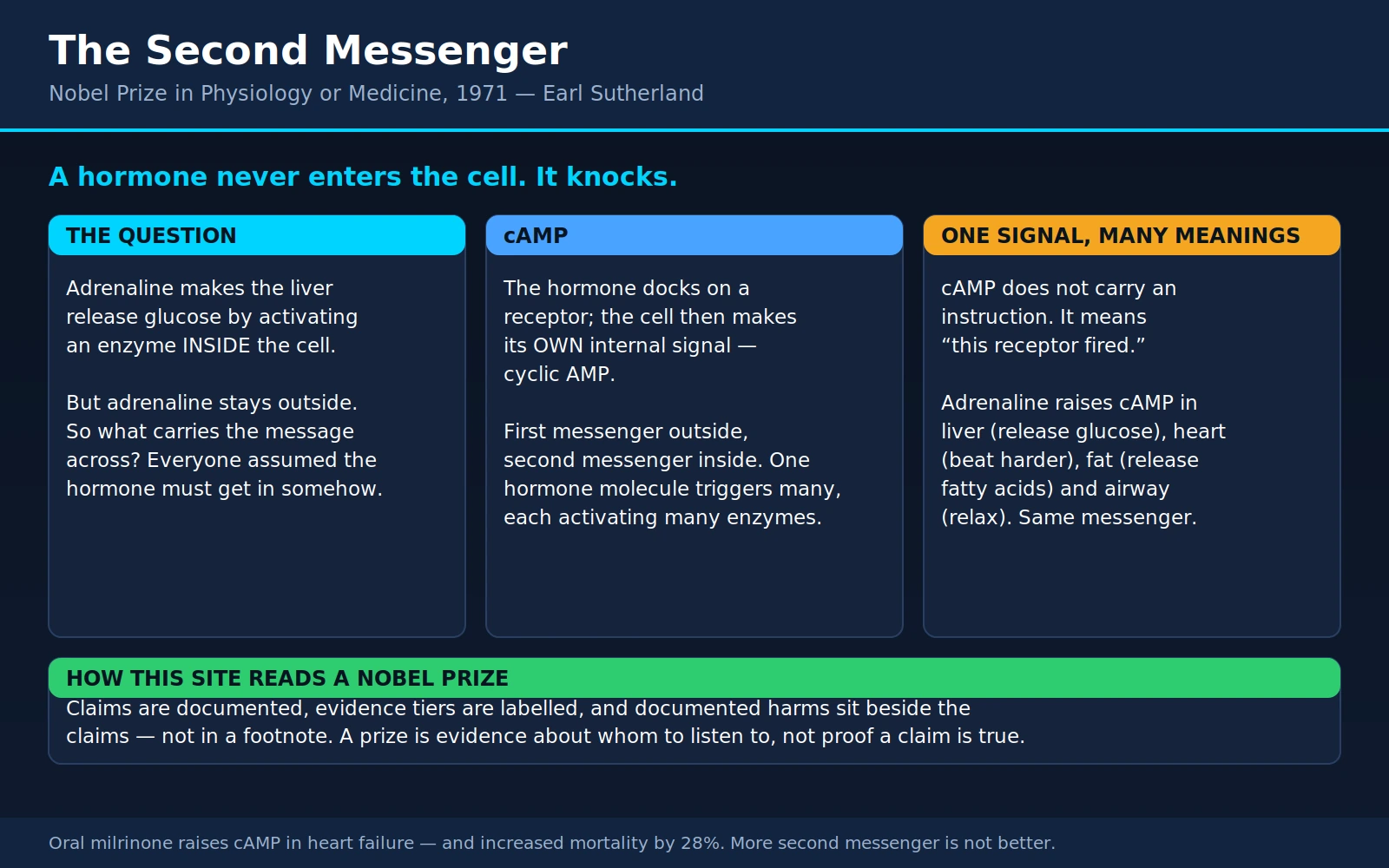
Table of Contents
- The Man from Burlingame, Kansas
- The Question He Inherited from the Coris
- The Broken-Cell Experiment
- Cyclic AMP: First Messenger, Second Messenger
- The Cascade, and Why Amplification Matters
- Why One Messenger Can Mean Different Things
- Caffeine, Theophylline, and the Phosphodiesterase Drugs
- Beta-Agonists and Beta-Blockers Through This Lens
- G Proteins: The Link Sutherland Could Not See
- What This Does Not License: Forskolin and "cAMP Boosting"
- Sutherland's Own View
- Where Mainstream Medicine Agrees — and What Remains Debated
- Key Research Papers
- Connections
- Featured Videos
1. The Man from Burlingame, Kansas
Earl Wilbur Sutherland, Jr. (November 19, 1915 – March 9, 1974) answered a question that had sat unanswered under the whole of endocrinology: how does a hormone circulating in the blood change what an enzyme does inside a cell it never enters? His answer — that the cell manufactures its own internal signal in response to the hormone at its surface — is the second-messenger concept, and it is now one of the load-bearing ideas in medicine. It explains adrenaline, glucagon, thyroid-stimulating hormone, ACTH, vasopressin, the drug that opens your airways during an asthma attack, the drug that slows your heart, cholera, and a great deal else besides.
He was born in Burlingame, a small farming town in eastern Kansas, the fifth of six children. His father had briefly attended Grinnell College, farmed in New Mexico and Oklahoma, and then ran a dry goods store in Burlingame for forty years; his mother, Edith Hartshorn, had some practical nursing training and, by the account of the man who later wrote Sutherland's biographical memoir, was the strongest influence on his early development. The Depression took the family's prosperity. Sutherland entered Washburn College in Topeka in 1933 and worked as a hospital orderly to pay for it, graduating with a B.S. in 1937.
He then entered Washington University School of Medicine in St. Louis — and this is where the story properly begins, because the man teaching second-year pharmacology was Carl Cori. Cori was impressed enough by the student to offer him a paid assistantship in the department. Sutherland, with a young family and very little money, took it. He received his M.D. in 1942 and interned at Barnes Hospital, then served roughly two years in the Second World War as a battalion surgeon in Patton's army and afterwards in a hospital in Germany.
He came back to St. Louis in 1945 undecided about whether to practise medicine or do research. In his Nobel lecture he credited Cori with the decision: "Cori convinced me, not so much by anything he said so much as by his example, that research was the right direction for me to take." He stayed in the biochemistry department from 1945 to 1953, rising from instructor to associate professor, in what was then one of the densest concentrations of biochemical talent anywhere — Herman Kalckar, Severo Ochoa, Luis Leloir, Arthur Kornberg, Edwin Krebs, Victor Najjar, Rollo Park, Theodore Posternak and Christian de Duve all worked in that building for a time. With de Duve he showed that the "hyperglycemic-glycogenolytic factor" contaminating commercial insulin preparations came from the alpha cells of the pancreatic islets, which established it as a hormone in its own right. We now call it glucagon, and it would run right through the rest of his career.
In 1953 he left for Western Reserve University (now Case Western Reserve) in Cleveland as chairman of pharmacology, and it was there, between 1953 and 1963, that cyclic AMP was found. In 1963 he moved to Vanderbilt University in Nashville, freed from administration by a Career Investigatorship from the American Heart Association and surrounded again by St. Louis friends — Rollo Park, Sidney Colowick, Victor Najjar. He received the Lasker Award in 1970 and the Nobel Prize in Physiology or Medicine in 1971. In July 1973 he moved to the University of Miami. In March 1974, following a massive esophageal hemorrhage and an infection that could not be controlled, he died at 58 — three years after the prize, and, as his memorialist put it, "still at the height of his productivity."
The 1971 prize was unshared, awarded to Sutherland alone "for his discoveries concerning the mechanisms of the action of hormones." That is unusual. Most Nobel Prizes in Physiology or Medicine are split two or three ways, because most discoveries are made by several groups converging. An unshared prize is the committee saying that a whole conceptual framework belongs to one person. It is worth adding one honest footnote to that: the chemical identification of the molecule was a near-simultaneous dead heat with a second, entirely independent group, and Sutherland always said so in print. What was unambiguously his was the idea — that the molecule was a general-purpose internal messenger, and that this is how hormones work.
The most useful single source on his life is the National Academy of Sciences Biographical Memoir (1978), and there is a nice symmetry in who wrote it: Carl Cori, his old teacher, describing the student who took the question the Cori laboratory could not answer and answered it.
2. The Question He Inherited from the Coris
To see what Sutherland was actually chasing, you have to start with the work of Carl and Gerty Cori, who won the 1947 Nobel Prize for working out how the body stores and releases sugar.
Here is the short version. Your liver keeps a reserve of glucose stored as a branched polymer called glycogen. When you need glucose in a hurry — you are frightened, you are exercising, you have not eaten — the adrenal glands release adrenaline (epinephrine) into the bloodstream, and the liver breaks glycogen down and dumps glucose into the blood. The enzyme that performs the actual dismantling is glycogen phosphorylase. The Coris showed that phosphorylase exists in two interconvertible forms: an active one and a much less active one. Something switches it on.
So the physiology was clear and the biochemistry was clear, and between them sat an enormous hole. Adrenaline is in the bloodstream, on the outside of the liver cell. Phosphorylase is inside the liver cell. The two never meet. How does the message cross?
Everyone assumed there had to be some way for the hormone to get in, or that something about the intact, undisturbed cell was essential to the transaction. And the experimental evidence appeared to back that up, which is exactly why the hole stayed open for years.
The system Sutherland worked with was liver slices. Add adrenaline or glucagon to liver slices in a dish and they release more glucose — a beautifully sensitive assay. Cori recorded that a half-maximal response was obtained with adrenaline at a dilution of about one part in twenty million. Other catecholamines worked in proportion to how strongly they raise blood sugar in a living animal. Sutherland's group traced the rate-limiting step of glucose production in those slices to the phosphorylase system, then showed directly that the hormones were converting inactive phosphorylase to active phosphorylase, with the activity restored within about four minutes.
Then came the experiment that shut the door. Freeze the liver slices and thaw them, so that the cell structure is disrupted, and the hormone effect disappears entirely. No response to adrenaline. No response to glucagon. And every attempt to get a hormone response out of a liver extract, or out of semipurified phosphorylase, had failed as well.
The natural reading of that result — the reading almost everybody took, including Cori — is that an intact cell is required. Whatever the hormone does, it needs the cell's architecture to be whole. Break the cell and you break the mechanism, so the mechanism cannot be studied in a test tube.
Sutherland refused the conclusion. In Cori's words: "He held on to the idea that the action of a hormone could be demonstrated in a cell-free system in vitro." That refusal is the whole discovery. It was not, at the time, the reasonable position.
3. The Broken-Cell Experiment
Two things had to come together first, and both were about understanding the switch before you could ask what flips it.
At the University of Washington in Seattle, Edwin Krebs and Edmond Fischer showed that reactivating inactive muscle phosphorylase required ATP and magnesium and, crucially, a dedicated enzyme — a kinase (Fischer & Krebs, J Biol Chem 1955;216(1):121-32; Krebs & Fischer, Biochim Biophys Acta 1956;20(1):150-7). Independently, Sutherland's group used radioactive ATP to show that a phosphate group is physically attached to liver phosphorylase when it is reactivated, and he and Walter Wosilait had found the opposing enzyme, a phosphatase that strips that phosphate off again. Krebs and Fischer would share the 1992 Nobel Prize for reversible protein phosphorylation.
So by the mid-1950s the switch was understood: phosphorylase is turned on by adding a phosphate group and turned off by removing it, with a separate enzyme running each direction. Now you could ask a sharper question. Not "how does adrenaline release glucose?" but "how does adrenaline reach the kinase?"
Sutherland and Theodore Rall began adding hormones to inactive liver phosphorylase preparations in the presence of ATP and magnesium. What happened next is the decisive sequence, and it is worth walking through slowly, because it is a genuinely beautiful piece of experimental reasoning.
- Crude liver homogenate + adrenaline or glucagon → phosphorylase activates. The cells are smashed. There is no intact architecture left. And the hormone still works. That alone contradicted the freeze-thaw result and the belief built on it.
- Spin the homogenate to clear out the cellular debris, then add hormone → nothing. The response vanishes. This is exactly the earlier failure, reproduced.
- Add the discarded particulate fraction back → the response returns. So the thing that was lost in the centrifuge is a necessary component. It is not "intactness." It is a physical fraction you can hold in a tube.
- The decisive experiment: incubate the particulate fraction alone with the hormone. Then remove the particles and add the leftover fluid to the supernatant fraction → phosphorylase activates.
Read step 4 again, because it does something no previous experiment had done: it separates one hormone response into two consecutive reactions. The hormone acts on the particles. The particles make something. That something — and not the hormone — acts on the enzyme. The messenger has been caught in the middle, in a tube, with the hormone no longer present.
The substance was heat-stable and dialyzable: it survived boiling and it passed through a membrane. Both facts said the same thing. It was not a protein. It was a small molecule.
Why the broken preparation was the right move, and why that is counterintuitive. The instinct in biology is that if a phenomenon needs the living cell, you must preserve the living cell. Sutherland went the other way and deliberately took the system further apart. The insight is that "the hormone needs an intact cell" and "the hormone needs one particular piece of the cell" produce identical results in an all-or-nothing experiment — and the way to tell them apart is not to be gentler, but to break the cell into fractions you can recombine. A whole-cell experiment can only ever answer yes or no. A fractionated experiment tells you which part. The earlier freeze-thaw failure had not been evidence that the cell must be intact; it had been evidence that freezing and thawing destroyed something, and nobody had asked what.
What the particulate fraction turned out to be is the cell membrane, carrying the enzyme that makes the messenger — later named adenylyl cyclase (adenylate cyclase). Sutherland and Davoren nailed that down using pigeon red blood cells, and in doing so opened the field of isolating and characterising cell-surface receptors. The hormone had never needed to get in. It only ever needed to touch the outside of the door.
4. Cyclic AMP: First Messenger, Second Messenger
Identifying the heat-stable factor took years, for two reasons that are themselves informative. The concentration of the compound in tissue is minuscule — it is a signal, not a fuel, and cells do not stockpile it. And it is destroyed almost as fast as it is made, by a dedicated enzyme called a phosphodiesterase. A molecule that is both scarce and rapidly degraded is a nightmare to purify, and a superb messenger. Those are the same property seen from two sides: a signal is only useful if it can be switched off.
The finish was a photo. In July 1957 two preliminary communications appeared back to back in the same issue of the Journal of the American Chemical Society. One was Sutherland and Rall's, describing the nucleotide their cellular particles made from ATP and magnesium in response to adrenaline or glucagon (J Am Chem Soc 1957;79:3608). The other was from William Cook, David Lipkin and Roy Markham, who had produced the same compound by an entirely different route — digesting ATP with barium hydroxide — and proposed the same structure (J Am Chem Soc 1957;79:3607-8). Neither group knew of the other until Leon Heppel, from whom both had asked to borrow the same enzyme, realised they were chasing the same unknown and put them in touch. They exchanged samples, confirmed the compounds were identical, and published together.
There is a nice piece of scientific honesty in that pair of papers. The chemists' first structural assignment was a cyclic dimer — the title of their communication calls it a "cyclic dianhydrodiadenylic acid." The correct structure, a single nucleotide with a phosphate bridging the 3' and 5' positions of the ribose ring, was established two years later (Lipkin, Cook & Markham, J Am Chem Soc 1959;81:6198-203). The molecule is adenosine 3',5'-cyclic monophosphate — cyclic AMP, or cAMP.
The two full-length papers came in 1958, again back to back in the same issue of the Journal of Biological Chemistry: Rall & Sutherland on the formation of the cyclic nucleotide by tissue particles, and Sutherland & Rall on fractionating and characterising it.
The idea that made the molecule matter
Finding a new nucleotide is chemistry. What made this a Nobel Prize was the framework Sutherland built on top of it, which he and G. Alan Robison set out with the first diagram of the concept in a 1966 review (Pharmacol Rev 1966;18(1):145-61):
- The first messenger is the hormone. It travels through the blood, arrives at the target cell, and docks on a receptor on the outer surface of the membrane. It does not enter.
- That docking changes the activity of the membrane-bound adenylyl cyclase on the inside face of the same membrane.
- The cyclase converts ATP — which the cell has plenty of — into cyclic AMP. This is the second messenger: an internal signal the cell manufactures for itself, in response to an external event.
- Cyclic AMP then acts on machinery inside the cell. What that machinery is depends on the cell.
The elegance of this is easiest to see in a fact that is otherwise inexplicable. Glucagon is a peptide — a small protein. Adrenaline is a tiny catecholamine. Chemically they have nothing in common. Yet applied to a liver cell they produce qualitatively the same effect: glycogen breaks down, glucose comes out. If either hormone were doing the work inside the cell, that coincidence would be bizarre. Under Sutherland's scheme it is obvious: two different keys, two different locks on the outside of the door, one shared bell on the inside.
Sutherland later proposed four criteria for deciding whether a given hormone actually works this way: the hormone should stimulate adenylyl cyclase in intact tissue and in broken-cell preparations; tissue cAMP should rise in a proper dose-response and time relationship to the hormone; drugs that inhibit the phosphodiesterase (he named theophylline) should act synergistically with the hormone; and it should be possible in principle to mimic the hormone by supplying cAMP or a membrane-permeable derivative directly. That last one is often defeated in practice, because cAMP crosses membranes poorly — a nuisance in the laboratory, and a fact worth remembering when someone tries to sell you cAMP in a capsule.
One further discovery from the Cleveland years put the whole thing in perspective. R. S. Makman and Sutherland found that Escherichia coli makes cyclic AMP in response to glucose depletion. A bacterium has no hormones and no endocrine system. Cyclic AMP is therefore not a vertebrate invention bolted on to hormone signalling; it is a very old general-purpose regulator that hormones later learned to use.
5. The Cascade, and Why Amplification Matters
Trace the adrenaline signal end to end in a liver cell and you get this:
- One molecule of adrenaline binds a beta-adrenergic receptor on the cell surface.
- The activated receptor switches on adenylyl cyclase, which keeps running while the receptor is occupied, converting many molecules of ATP into cyclic AMP.
- Cyclic AMP binds the regulatory subunits of protein kinase A (PKA, cAMP-dependent protein kinase), releasing the catalytic subunits to work. PKA was isolated from rabbit skeletal muscle by Walsh, Perkins and Krebs in 1968 — the receiver Sutherland's messenger had been looking for.
- Each freed PKA molecule phosphorylates many molecules of phosphorylase kinase, switching them on.
- Each phosphorylase kinase phosphorylates many molecules of glycogen phosphorylase b, converting them to the active phosphorylase a — exactly the interconversion the Coris had described.
- Each phosphorylase a then chews many glucose units off glycogen.
Every "many" in that list is a multiplication. This is a cascade, and its purpose is amplification. Chemistry that would otherwise require a hormone concentration high enough to physically coat the target enzyme instead runs off a whisper. Cori's figure for the liver-slice assay — half-maximal response at roughly one part adrenaline in twenty million — is the amplification made visible. The hormone is a rumour; the cascade is the newspaper.
There is a second reason this design is used, and it is about control rather than power. A cascade with several steps has several places to intervene. The cell can adjust the gain at the receptor, at the G protein, at the cyclase, at the phosphodiesterase, at PKA, and at each substrate. A single-step switch offers one lever. This one offers six. Nearly every drug discussed on the rest of this page works by pulling one of them.
And the cascade does two opposite things at once, which is the part people usually miss. PKA switches on glycogen breakdown and simultaneously switches off glycogen synthase, the enzyme that builds glycogen. If it did not, the liver would build and demolish the same molecule at the same time, burning ATP for nothing. One messenger, one kinase, two opposite instructions delivered together — because the useful unit of biological control is not "do X" but "do X and stop doing not-X."
The link back to the Coris is exact. The enzyme this whole cascade was first traced to is glycogen phosphorylase, and the reaction it was traced to is the phosphorylase a / phosphorylase b interconversion the Cori laboratory had characterised without being able to explain what controlled it. Sutherland began as the student in that laboratory and finished by supplying the missing half.
6. Why One Messenger Can Mean Different Things
This is the section most readers find genuinely clarifying, and it resolves an objection almost everyone raises when they first hear about second messengers: if every hormone just makes cyclic AMP, how does the cell know which hormone arrived?
It does not. And it does not need to.
Cyclic AMP does not carry a specific instruction. It is not a sentence. It is closer to a doorbell: it means "a receptor of this class was just activated here." What happens next has nothing to do with the message and everything to do with which house the bell is in — that is, which enzymes, channels and structural proteins that particular cell happens to contain for PKA to act on.
Adrenaline reaches every tissue in your body within seconds and raises cyclic AMP in a great many of them. Here is what that identical signal produces:
- Liver. PKA drives the phosphorylase cascade above and suppresses glycogen synthesis. Result: glucose is released into the blood.
- Heart muscle. PKA phosphorylates L-type calcium channels, phospholamban and troponin I. Result: the heart beats faster and harder, and also relaxes faster between beats. Sutherland's group provided the first evidence that cAMP mediated this in 1962, and by the 1966 review he concluded the evidence supported it — while carefully noting that the force-of-contraction effect has no direct connection to cardiac phosphorylase. Same messenger, different downstream target, in the same organ.
- Fat tissue. PKA phosphorylates hormone-sensitive lipase and the proteins coating the fat droplet. Result: stored triglyceride is broken down and fatty acids are released.
- Bronchial smooth muscle. cAMP, acting through PKA and a second effector called Epac, opposes contraction. Result: the airway relaxes and opens. This is the entire basis of reliever inhalers (Billington et al., Pulm Pharmacol Ther 2013;26(1):112-20).
- Thyroid. Not adrenaline here but TSH — a completely different hormone, same second messenger. Result: thyroid hormone is released.
- Adrenal cortex. ACTH raises cAMP. Result: steroid hormones are made. This is the pathway behind the cortisol story told on the Hench, Kendall & Reichstein page.
- Kidney collecting duct. Vasopressin raises cAMP. Result: water is reabsorbed and urine concentrates.
Adrenaline in liver means "release glucose." Adrenaline in heart means "beat harder." Adrenaline in fat means "release fuel." Adrenaline in airway means "open up." These are not four messages. They are one message arriving in four differently furnished rooms — and, read together, they are a single coherent emergency plan: fuel into the blood, pump harder, breathe deeper.
Two refinements make the picture honest rather than tidy.
Cyclic AMP does not only turn things up. In his Nobel lecture Sutherland listed thirty-six processes known by then to be influenced by cyclic AMP; in at least nine of them the effect was to slow the process, not speed it. Airway relaxation is one such case: more cAMP, less contraction.
And there is a hormone whose job is to lower it. Insulin's anti-lipolytic action in fat tissue goes with a marked fall in tissue cyclic AMP, and Sutherland's own group showed that injecting anti-insulin serum into normal rats causes an immediate rise in liver cyclic AMP. His view was that the liver's glucose output reflects a running balance between hormones that raise cAMP — principally glucagon and the catecholamines — and insulin, which lowers it. That balance is the hinge of everything on the diabetes page. It is also why Banting and Best's insulin and Sutherland's cyclic AMP are two halves of one story.
What a stuck switch looks like. The most vivid demonstration that cAMP is a volume knob is cholera. Cholera toxin locks adenylyl cyclase in the intestinal lining permanently on. Cyclic AMP goes up and stays up; the cells pour salt and water into the gut lumen and cannot stop. The catastrophic diarrhoea of cholera is a second-messenger system with the off switch destroyed. Nothing else about the cell is damaged.
The same logic scales into the brain, which is where Paul Greengard took it. Greengard showed that neurotransmitters — dopamine in particular — work through exactly this architecture: receptor, second messenger, protein kinase, phosphorylated target proteins, changed cell behaviour. He shared the 2000 Nobel Prize for it. Sutherland's liver cell and Greengard's neuron run the same machine.
7. Caffeine, Theophylline, and the Phosphodiesterase Drugs
If cyclic AMP is made by adenylyl cyclase, something has to destroy it — otherwise the first hormone pulse would be the last message the cell ever received. That something is phosphodiesterase (PDE), which cleaves the cyclic phosphate ring and leaves ordinary, inert AMP.
This gives you a second, entirely separate way to raise cyclic AMP. Instead of turning the tap on harder, block the drain. Sutherland's own group established that methylxanthines competitively inhibit the phosphodiesterase, which retrospectively explained an old, previously unexplained observation: methylxanthines had long been known to potentiate hormone action on liver slices, and nobody had known why.
Caffeine is a methylxanthine. So here is the textbook story, which you will find in a great many otherwise reputable places: caffeine inhibits phosphodiesterase, so cyclic AMP persists longer, so cells stay stimulated, so you feel alert.
Where that story is wrong, stated precisely
The mechanism is real. It is not the mechanism of your morning coffee.
At the blood levels an ordinary coffee or tea drinker actually reaches, caffeine's alerting effect is dominated by a completely different action: it blocks adenosine receptors. Adenosine is a naturally accumulating brake on brain activity — it builds up across a long waking day and pushes you toward sleep. Caffeine occupies the A1 and A2A receptors adenosine would otherwise use and releases that brake. You do not feel stimulated because caffeine added energy; you feel alert because it silenced a signal telling you to stop.
Two lines of evidence make this more than an assertion:
- Reviewing the pharmacology, Fredholm, Yang and Wang (Mol Aspects Med 2017;55:20-5) conclude that caffeine at low doses is an antagonist of adenosine at A1, A2A and A2B receptors, and that high-dose effects are not merely bigger but qualitatively different, with a different underlying mechanism. They warn explicitly against using high-dose experiments to reason about ordinary consumption. Fredholm's earlier and much-cited review of caffeine in the brain (Pharmacol Rev 1999;51(1):83-133) laid out the same case at length.
- More pointedly, Choi, Shamim, Padgett and Daly (Life Sci 1988;43(5):387-98) compared a family of caffeine analogues on adenosine-receptor blockade, phosphodiesterase inhibition, and actual behaviour in mice. IBMX, a potent phosphodiesterase inhibitor, produces behavioural depression, not stimulation. Analogues that were strong adenosine antagonists and weak PDE inhibitors increased activity; an analogue that was an equally strong adenosine antagonist but a much stronger inhibitor of the relevant brain PDEs produced depression instead. If PDE inhibition drove the buzz, this result would be upside down.
So the honest formulation is: phosphodiesterase inhibition by caffeine is a real pharmacological property and a minor contributor at dietary doses; adenosine-receptor antagonism is the dominant mechanism for the alertness effect. This is one of those cases where the simple textbook story is not a harmless simplification — it names the wrong mechanism, and the wrong mechanism has been used to sell things.
None of which makes coffee uninteresting. Our coffee pages cover what it does and does not do, including why people metabolise caffeine at such different rates and how late in the day it stops being free.
The drugs that really do work this way
Where Sutherland's drain-blocking mechanism genuinely earns its keep is in a whole family of prescription medicines. The trick that makes them drugs rather than blunt instruments is that there is not one phosphodiesterase — there are eleven families, distributed differently across tissues and specific to cAMP, to cGMP, or to both. Inhibit a particular PDE and you raise a cyclic nucleotide in a particular tissue.
Theophylline (asthma and COPD) is caffeine's close chemical relative, and it is the clean resolution of the caffeine argument — because at the plasma concentrations used in treatment it does inhibit phosphodiesterase. Barnes (Am J Respir Crit Care Med 2013;188(8):901-6) sets out the anatomy: bronchodilation comes from inhibiting PDE3; a separate anti-inflammatory effect at lower concentrations appears to come from inhibiting PDE4 and activating histone deacetylase-2; and the side effects split along mechanism too — nausea, vomiting and headache from PDE inhibition, and at higher concentrations cardiac arrhythmias and seizures from adenosine A1-receptor antagonism. Both mechanisms in one molecule, separated by dose. Theophylline's use declined as inhaled beta-2 agonists arrived, because the doses needed for bronchodilation cause frequent side effects and the therapeutic window is narrow. It survives as add-on therapy.
Roflumilast (COPD) is a selective PDE4 inhibitor, taken by mouth. In two matched 52-week placebo-controlled trials pooling 1,537 patients on roflumilast against 1,554 on placebo, pre-bronchodilator FEV1 improved by 48 mL versus placebo, and moderate-or-severe exacerbations fell from 1.37 to 1.14 per patient per year — a 17% reduction (95% CI 8-25%) (Calverley et al., Lancet 2009;374(9691):685-94). Real but modest, and it is not free: adverse events were more common than with placebo, more patients stopped the drug, and there was a mean 2.17 kg greater weight loss in the roflumilast group. See our COPD page.
Apremilast (psoriasis and psoriatic arthritis) is also a PDE4 inhibitor. In the phase III ESTEEM 1 trial of 844 patients, 33.1% on apremilast reached a 75% improvement in the Psoriasis Area and Severity Index at week 16 versus 5.3% on placebo (Papp et al., J Am Acad Dermatol 2015;73(1):37-49). A useful oral option, plainly weaker than the injectable biologics. See psoriasis.
Sildenafil and tadalafil inhibit PDE5, and here the cyclic nucleotide is not cAMP but its cousin cGMP — which Sutherland himself spent his last years studying. cGMP in vascular smooth muscle is made downstream of nitric oxide, the pathway worked out by Furchgott, Ignarro and Murad (1998 Nobel Prize). Block PDE5 and cGMP persists, and the vessel stays relaxed. Approved indications now include erectile dysfunction, lower urinary tract symptoms, and pulmonary arterial hypertension (Andersson, Br J Pharmacol 2018;175(13):2554-65). This is also the origin of the single most important drug interaction in the class: nitrates (nitroglycerin, isosorbide) push the same pathway from the other end, and combining them with a PDE5 inhibitor can drop blood pressure catastrophically. The nitric oxide page covers that interaction in detail; it is one to know if you carry a nitrate spray.
Milrinone (heart failure) inhibits PDE3 in cardiac muscle, raising cAMP and making the heart contract harder — the same lever adrenaline pulls. It works, and it is used intravenously for short periods in acute decompensation. But it also carries the most important cautionary result in this entire field. The PROMISE trial randomised 1,088 patients with severe chronic heart failure to oral milrinone or placebo on top of standard therapy. Milrinone increased all-cause mortality by 28% (95% CI 1-61%, P = 0.038) and cardiovascular mortality by 34%, with the harm greatest in the sickest patients (Packer et al., N Engl J Med 1991;325(21):1468-75). Better haemodynamics; more deaths.
Hold on to that last one, because it is the honest lesson of the whole page. Raising cyclic AMP is not the same as doing good. Cyclic AMP is a signal, and signals are supposed to be transient. A failing heart driven continuously to contract harder is a heart being spent faster. This point comes back in section 10, and it is the single best reason to be sceptical of anything sold as a "cAMP booster."
8. Beta-Agonists and Beta-Blockers Through This Lens
Two of the most widely prescribed drug classes in the world sit at opposite ends of Sutherland's pathway. Understanding them as one mechanism running in two directions makes a lot of clinical advice stop being arbitrary.
Beta-2 agonists: turning the pathway up in the airway
Salbutamol (called albuterol in the United States) is a blue-inhaler reliever. It is a beta-2 receptor agonist. Inhaled, it lands mostly on airway smooth muscle, activates beta-2 receptors, switches on adenylyl cyclase, raises cyclic AMP, and — through PKA and Epac — opposes contraction. The muscle wrapped around your bronchi relaxes. The airway opens. That is the whole of it: Sutherland's cascade, deliberately triggered, in about five minutes (Billington et al. 2013).
Three practical consequences fall straight out of the mechanism:
- It relieves; it does not treat. Relaxing muscle does nothing about the inflammation underneath, which is why long-acting beta-2 agonists (salmeterol, formoterol) are given with an inhaled corticosteroid rather than alone. Needing the reliever more often is information — it means the underlying inflammation is not controlled.
- The shakes and the racing heart are the same drug doing the same thing elsewhere. Beta-2 receptors are also on skeletal muscle and, in smaller numbers, on the heart. Tremor and palpitations after a heavy reliever dose are the pathway working in the wrong room. Uncomfortable; expected; not a sign the inhaler is harming you.
- Receptors get tired. Continual beta-2 stimulation causes receptor desensitisation and tachyphylaxis — the response weakens with heavy repeated use. This is a general property of the pathway, not a defect in one drug.
Beta-blockers: turning the pathway down in the heart
Beta-blockers do the mirror image. Bisoprolol, metoprolol, atenolol, carvedilol and propranolol occupy beta receptors and prevent adrenaline and noradrenaline from activating them. In the heart, blocking beta-1 receptors means less cyclic AMP, less PKA activity, less calcium entry per beat: the heart beats more slowly and less forcefully, and its oxygen demand falls. That is why they treat angina, why they control rate in atrial fibrillation, why they are used in hypertension, and why they improve survival in heart failure.
That last one is worth pausing on next to PROMISE. In chronic heart failure, the drug that raises cardiac cAMP increased mortality; the drugs that lower it prolong life. The failing heart is already drowning in adrenaline. Turning the volume down is what helps.
Why the selectivity matters — and what the evidence actually shows
Here is the collision. If beta-2 activation opens the airway, then beta-2 blockade should close it — and beta-blockers that are not selective, such as propranolol, block beta-1 and beta-2 alike. This is the origin of the long-standing warning against beta-blockers in asthma. It is a mechanistically sound worry, and it extends further than people expect: timolol eye drops for glaucoma are a non-selective beta-blocker, and enough is absorbed systemically to matter.
But the clinical evidence refines the rule rather than confirming it wholesale, and the refinement is worth knowing because the old blanket prohibition cost lives.
A meta-analysis of 19 single-dose and 10 continued-treatment trials of cardioselective (beta-1 selective) beta-blockers in people with reactive airway disease found that a single dose reduced FEV1 by 7.46% (95% CI 5.59-9.32%) with no increase in symptoms, and actually improved the response to a beta-agonist afterwards. With continued treatment over three days to four weeks, there was no significant change in FEV1 (-0.42%, 95% CI -3.74 to 2.91%), no increase in symptoms and no increase in inhaler use. The authors concluded that cardioselective beta-blockers "should not be withheld" from patients with mild to moderate reactive airway disease, given their demonstrated benefit in heart failure, arrhythmia and hypertension (Salpeter, Ormiston & Salpeter, Ann Intern Med 2002;137(9):715-25).
So the practical summary, stated carefully:
- Non-selective beta-blockers — propranolol and relatives, including timolol eye drops — are the genuine concern in asthma, because they oppose the exact receptor your reliever inhaler needs.
- Cardioselective beta-blockers in mild-to-moderate airway disease are far safer than the old blanket warning implied, and withholding a life-prolonging heart drug on that basis is itself a harm.
- Severe or brittle asthma is a different conversation from mild asthma, and the trials above do not settle it.
- Never stop a beta-blocker abruptly. Receptors up-regulate during blockade, and sudden withdrawal can produce rebound tachycardia, hypertension and angina. This is a taper, made with the prescriber.
- Tell every prescriber about every drug, including eye drops. The glaucoma-drop interaction is invisible unless someone mentions it.
None of this is a reason to change a prescription on your own. It is a reason to be able to ask a specific question: "is this beta-blocker cardioselective, and given my lungs, is it the right one?"
9. G Proteins: The Link Sutherland Could Not See
Sutherland's scheme had a gap in the middle, and he knew it. The receptor is on the outside of the membrane. The cyclase is on the inside. What physically connects them? For years the diagram simply had the two boxes next to each other.
The answer came from two laboratories in the decade after his death. Martin Rodbell found that the coupling required GTP — that there was an energy-consuming, information-carrying step between hormone binding and enzyme activation, which he framed as a biological transducer (Nature 1980;284(5751):17-22). Alfred Gilman's group then purified the missing component itself: the regulatory protein that sits between receptor and cyclase (Northup, Sternweis, Smigel, Schleifer, Ross & Gilman, Proc Natl Acad Sci USA 1980;77(11):6516-20). These are the G proteins, and Gilman and Rodbell shared the 1994 Nobel Prize in Physiology or Medicine for them. Gilman's 1987 review remains the standard summary (Annu Rev Biochem 1987;56:615-49).
A G protein is a molecular relay that sits idle holding GDP. An activated receptor makes it swap GDP for GTP; it then splits, and its subunits go and act on the cyclase; a built-in timer hydrolyses the GTP back to GDP and the relay resets. Two details make it powerful:
- One activated receptor can switch on many G proteins before the hormone leaves. That is another multiplication step in the cascade — amplification begins before cAMP is even made.
- There is more than one kind. Gs stimulates adenylyl cyclase; Gi inhibits it. So the same second messenger can be pushed up by one receptor and pulled down by another on the same cell. This is how the cell gets two-directional control out of a single molecule, and it is why opioid receptors, muscarinic receptors and alpha-2 adrenergic receptors lower cAMP.
Receptors of this type are called G-protein-coupled receptors (GPCRs), and their structures were finally solved by Robert Lefkowitz and Brian Kobilka, who shared the 2012 Nobel Prize in Chemistry for it.
The most drugged target class in medicine
The scale of what Sutherland walked into is easiest to state as a number. Reviewing the public drug-target databases, Sriram and Insel (Mol Pharmacol 2018;93(4):251-8) found that, as of November 2017, 134 GPCRs were targets of drugs approved in the United States or European Union, that roughly 700 approved drugs act at GPCRs, and that this amounts to approximately 35% of all approved drugs. Note the distinction, because it is often garbled: GPCRs are about 35% of approved drugs, but only about 12% of the distinct protein targets those drugs act on — a small number of receptors, hit over and over. Either way, GPCRs are the largest single protein family targeted by approved medicines.
Roughly a third of the contents of a pharmacy work through the door Sutherland found. Beta-blockers, beta-agonists, antihistamines, opioids, antipsychotics, triptans for migraine, most antiemetics, ACE-adjacent angiotensin receptor blockers, and the GLP-1 agonists now used for diabetes and obesity are all GPCR drugs. And the estimate is conservative in one direction: of roughly 360 human non-sensory GPCRs, about 100 are still "orphans" with no known natural signal — unopened doors.
10. What This Does Not License: Forskolin and "cAMP Boosting"
Every genuinely important mechanism eventually gets sold back to the public in capsule form, and cyclic AMP is no exception. The site's duty here is to be precise rather than dismissive, because in this case the mechanism is real — and the leap from mechanism to product is where it goes wrong.
Forskolin is a compound from the root of Coleus forskohlii (also called Plectranthus barbatus). It activates adenylyl cyclase directly, bypassing the receptor and the G protein entirely. That is not marketing; it is why forskolin is a standard reagent in cell biology laboratories worldwide, used precisely when you want to raise cAMP without going through a receptor. Nobody disputes it. Our page on forskolin and cyclic AMP covers the pharmacology.
The marketing argument runs: cAMP activates hormone-sensitive lipase → lipase breaks down stored fat → forskolin raises cAMP → forskolin burns fat. Each arrow is individually defensible. The chain is not, and here is what the human evidence actually consists of.
The trial that is always cited. Godard, Johnson and Richmond (Obes Res 2005;13(8):1335-43) randomised 30 overweight and obese men — 15 per group — to 250 mg of a 10% forskolin extract twice daily (about 50 mg forskolin a day) or placebo for 12 weeks. Body fat percentage and fat mass fell significantly versus placebo on DXA; bone mass changed; serum free testosterone rose; lean body mass showed a non-significant trend upward (p = 0.097). Read the reported outcomes carefully: this is a body-composition result in fifteen men, not a demonstration of weight loss. The authors' own conclusion is that forskolin is a "possible therapeutic agent" — appropriately hedged language that the supplement industry has not preserved.
The trial that is almost never cited. Henderson and colleagues (J Int Soc Sports Nutr 2005;2(2):54-62) ran the same commercial extract at the same dose for the same 12 weeks in 23 mildly overweight women — 7 on forskolin, 12 on placebo. There were no significant differences in fat mass (p = 0.16), fat-free mass (p = 0.21) or body fat percentage (p = 0.40). There was a non-significant trend toward mitigating weight gain. Their conclusion: forskolin "does not appear to promote weight loss but may help mitigate weight gain."
The tier, stated plainly. Two small 12-week trials, both published in 2005, both using the same proprietary extract, with fewer than sixteen people in either active arm, pointing in different directions. There is no adequately sized trial, no long-term data, and no meta-analysis to fall back on. That is preliminary evidence — hypothesis-generating, not established. It is not nothing, and it is not a basis for buying a fat-loss product. Our page on forskolin weight-loss claims examines the marketing in more detail, including how the testosterone finding acquired a second life in advertising aimed at men that has nothing to do with weight.
The deeper problem with "cAMP boosting" as a concept
Set the trials aside for a moment, because there is a structural objection that applies to the whole framing.
Cyclic AMP is not a "burn fat" signal. It is a "this receptor was activated here" signal. Everything in section 6 says that what cAMP does depends entirely on which cell it is raised in. Raising it in fat cells promotes lipolysis. Raising it in the heart makes the heart work harder. Raising it in the gut lining does what cholera toxin does. A compound that activates adenylyl cyclase directly does not choose a tissue; it is a master key, not a room key.
Second, the body spends real machinery holding cAMP down. Eleven families of phosphodiesterase, a whole class of inhibitory Gi-coupled receptors, and receptor desensitisation all exist to terminate this signal quickly. That is not a design flaw waiting to be corrected by a supplement. A signal that cannot be switched off is not a stronger signal; it is a broken one.
Third, we already know what happens when you raise cAMP chronically and systemically in humans, because it has been tested properly. PROMISE tested exactly that hypothesis in the heart, with a pharmaceutical-grade drug at a controlled dose in 1,088 patients, and found a 28% increase in mortality. "More cyclic AMP" is not a health goal.
And forskolin is not inert: it has genuine cardiovascular activity, has been investigated as a topical agent in glaucoma, and can lower blood pressure. Anyone on blood-pressure medication, on anticoagulants, or with a heart condition should treat it as a drug and say so to their prescriber. See cardiovascular interactions and safety.
The same reasoning applies to any product marketed on the strength of "boosting cyclic AMP," "activating adenylate cyclase" or "enhancing cellular signalling." The mechanism being real is the beginning of the argument, not the end of it. What you want to know is: in which tissue, at what dose, for how long, measured how, in how many people?
11. Sutherland's Own View
Sutherland's position on his own discovery was that it was much bigger than the audience initially believed — and he was right, which is rarer than the sentence makes it sound.
When he began, cyclic AMP was one obscure nucleotide explaining one hormone's action on one enzyme in one organ. By the time of his Nobel lecture he could list thirty-six distinct physiological processes known to be regulated by it, in nine of which the effect was inhibitory rather than stimulatory. In his presentation address in Stockholm, Peter Reichard suggested that cyclic AMP is involved in the regulation of essentially all life processes. That has held up.
He was also careful about the limits, in a way that is worth quoting. In the 1971 monograph he wrote with G. Alan Robison and Reginald Butcher — a comprehensive survey of a field he had personally created — they wrote: "In a very real sense, our ignorance regarding the mode of action of cyclic AMP reflects our ignorance of the nature of basic cell processes in general." That is a man at the top of his subject saying he does not know how it works. He also abandoned his own proposed "third messenger" terminology for the hormones cAMP causes to be released, on the grounds that it created more semantic confusion than it resolved — a small thing, but the same instinct.
On motivation he was disarming. Accepting the Lasker Award in 1970, he said: "Let me confess here, lest I leave a false impression, that I did not have the welfare of future generations primarily in mind when I began my research on the hyperglycemic action of glucagon and the catecholamines. Rather, my motivation was primarily directed to satisfying my curiosity about how these hormones acted."
Cori's memoir names the qualities he thought made Sutherland work: intuition strong enough to set up the right experiment without yet knowing why; tenacity strong enough to hold a position the evidence appeared to contradict; a prodigious memory for his own past experiments; and originality — he did not follow current lines of thought. He is also described as carrying his laboratory problems constantly in his head, with only fishing offering any competition. He claimed some of his best ideas came on the water.
He spent his last years on cyclic GMP, convinced there was a second cyclic nucleotide messenger with a role of its own. He could not prove it. The physiological pathway that made sense of cGMP — nitric oxide, soluble guanylyl cyclase, vascular relaxation — was worked out over the following two decades and won the 1998 Nobel Prize. Sildenafil, a drug that does nothing except stop cGMP being destroyed, arrived the same year. Sutherland's last unfinished project became a drug class he never saw.
He died on March 9, 1974, three years after the prize, at 58. His final summing-up in the Nobel lecture was characteristically plain: "A life in research can be a most enjoyable life with many frontiers to explore."
12. Where Mainstream Medicine Agrees — and What Remains Debated
Settled, and not seriously questioned by anyone
- Hormones act at cell-surface receptors without entering the cell, for the large class of hormones that work this way. (Steroid and thyroid hormones do enter cells and act on receptors inside; that is a genuinely different mechanism, not an exception that undermines this one.)
- Cyclic AMP is a second messenger, made from ATP by adenylyl cyclase at the membrane and destroyed by phosphodiesterases.
- PKA is its principal effector, and phosphorylation cascades amplify a small external signal into a large internal response.
- Receptor, G protein and cyclase form the canonical signalling module, and GPCRs are the most heavily drugged protein family in medicine.
- The drug classes built on this are standard care: beta-agonists, beta-blockers, PDE5 inhibitors, PDE4 inhibitors, theophylline, and short-term intravenous PDE3 inhibitors.
- Caffeine's alerting effect at dietary doses is adenosine-receptor antagonism, not phosphodiesterase inhibition.
Genuinely open
- Compartmentation. The original picture had cAMP diffusing freely through the cytoplasm. It is now clear that it is organised into local nanodomains, shaped by where the cyclases and the individual phosphodiesterases sit, so that two receptors on the same cell can raise cAMP in different places and get different results. How finely this is resolved, and how much of it can be exploited pharmacologically, is an active research area rather than a settled account.
- PKA versus Epac. PKA is not the only cAMP effector; Epac proteins and cyclic-nucleotide-gated ion channels also read the signal. How the labour is divided between them, tissue by tissue, is unresolved.
- Whether PDE4 inhibition is worth its side effects in COPD. Roflumilast's benefit is real and modest; the gastrointestinal effects, weight loss and discontinuation rate are also real. Where it belongs in the treatment ladder is still argued.
- Low-dose theophylline for steroid resistance. The proposal that low-dose theophylline restores corticosteroid sensitivity in COPD by activating histone deacetylase-2 was mechanistically attractive and did not survive a proper test: in the TWICS trial, 1,578 patients on inhaled corticosteroids were randomised to low-dose theophylline or placebo, and exacerbations were identical (adjusted incidence rate ratio 0.99, 95% CI 0.91-1.08), with more nausea and headache on theophylline (Devereux et al., JAMA 2018;320(15):1548-59). A good example of a beautiful mechanism failing a clinical endpoint.
- Whether "cAMP tone" is a coherent therapeutic target at all, as opposed to tissue-specific and PDE-isoform-specific intervention. PROMISE is the strongest argument that it is not.
- Forskolin for body composition. Two small, contradictory 12-week trials from 2005. Unresolved, and unlikely to be resolved by anyone with a commercial interest in the answer.
Not supported
- That coffee's alertness works by phosphodiesterase inhibition. Real mechanism, wrong dose range.
- That raising cyclic AMP is inherently beneficial, or that "cAMP boosting" is a coherent health goal.
- That oral cyclic AMP or its precursors can meaningfully raise intracellular cAMP. Cyclic AMP crosses membranes poorly — a limitation Sutherland himself listed as the reason his fourth criterion so often fails in the laboratory.
13. Key Research Papers
- Berthet J, Rall TW, Sutherland EW. The relationship of epinephrine and glucagon to liver phosphorylase. IV. Effect of epinephrine and glucagon on the reactivation of phosphorylase in liver homogenates. J Biol Chem 1957;224(1):463-75
- Sutherland EW, Rall TW. The properties of an adenine ribonucleotide produced with cellular particles, ATP, Mg++, and epinephrine or glucagon. J Am Chem Soc 1957;79:3608 — the first announcement; not indexed in PubMed, verified via Crossref.
- Rall TW, Sutherland EW. Formation of a cyclic adenine ribonucleotide by tissue particles. J Biol Chem 1958;232(2):1065-76
- Sutherland EW, Rall TW. Fractionation and characterization of a cyclic adenine ribonucleotide formed by tissue particles. J Biol Chem 1958;232(2):1077-91
- Lipkin D, Cook WH, Markham R. Adenosine-3':5'-phosphoric acid: a proof of structure. J Am Chem Soc 1959;81:6198-203 — the independent chemists' correction of their own first assignment; verified via Crossref.
- Sutherland EW, Rall TW. The relation of adenosine-3',5'-phosphate and phosphorylase to the actions of catecholamines and other hormones. Pharmacol Rev 1960;12:265-99 — not indexed in PubMed; verified via Crossref.
- Sutherland EW, Robison GA. The role of cyclic-3',5'-AMP in responses to catecholamines and other hormones. Pharmacol Rev 1966;18(1):145-61 — carries the first published diagram of the first-messenger/second-messenger scheme.
- Walsh DA, Perkins JP, Krebs EG. An adenosine 3',5'-monophosphate-dependant protein kinase from rabbit skeletal muscle. J Biol Chem 1968;243(13):3763-5
- Sutherland EW. Studies on the mechanism of hormone action. Science 1972;177(4047):401-8 — the Nobel lecture.
- Northup JK, Sternweis PC, Smigel MD, Schleifer LS, Ross EM, Gilman AG. Purification of the regulatory component of adenylate cyclase. Proc Natl Acad Sci USA 1980;77(11):6516-20
- Choi OH, Shamim MT, Padgett WL, Daly JW. Caffeine and theophylline analogues: correlation of behavioral effects with activity as adenosine receptor antagonists and as phosphodiesterase inhibitors. Life Sci 1988;43(5):387-98
- Packer M, Carver JR, Rodeheffer RJ, et al. Effect of oral milrinone on mortality in severe chronic heart failure (the PROMISE study). N Engl J Med 1991;325(21):1468-75
- Barnes PJ. Theophylline. Am J Respir Crit Care Med 2013;188(8):901-6
- Sriram K, Insel PA. G protein-coupled receptors as targets for approved drugs: how many targets and how many drugs? Mol Pharmacol 2018;93(4):251-8
Sutherland's life is documented in Carl F. Cori's National Academy of Sciences Biographical Memoir (1978), which is the source for the biographical detail, quotations and laboratory chronology on this page. Additional studies cited in the text above — Fredholm on caffeine, Calverley on roflumilast, Papp on apremilast, Andersson on PDE5 inhibitors, Salpeter on cardioselective beta-blockers, Godard and Henderson on forskolin, Devereux on theophylline — are linked at the point where each is discussed.
Live PubMed Searches
- Cyclic AMP second messenger discovery
- Phosphodiesterase inhibitor mechanism
- Caffeine adenosine receptor mechanism
- GPCR drug targets proportion
- Forskolin body composition
14. Connections
- All Notable Doctors
- Carl & Gerty Cori — glycogen, the Cori cycle and phosphorylase; the laboratory Sutherland trained in and the question he inherited
- Carlsson, Greengard & Kandel — Greengard carried second-messenger signalling into the brain and shared the 2000 prize for it
- Furchgott, Ignarro & Murad — nitric oxide and cGMP: the other cyclic nucleotide, the PDE5 inhibitors, and the nitrate interaction
- Guillemin & Schally — the hypothalamic releasing hormones that sit upstream of the cAMP-driven pituitary and thyroid steps
- Hench, Kendall & Reichstein — cortisol and the adrenal cortex, where ACTH works through this exact pathway
- Frederick Banting — insulin, the hormone whose job is to push cyclic AMP back down
- Nobel Prize in Physiology or Medicine — the complete roll, including the 1994 prize to Gilman and Rodbell for G proteins
- Endocrinology — the hormone system this page explains the machinery of
- Diabetes — the glucagon/adrenaline versus insulin balance, seen as a cyclic AMP balance
- Cardiology — beta-blockers, heart failure, and why raising cardiac cAMP chronically kills
- Heart Failure — the PROMISE result, and why turning the pathway down prolongs life
- Asthma — beta-2 agonists, the reliever inhaler, and the beta-blocker question
- COPD — roflumilast, theophylline, and PDE4 inhibition in practice
- Psoriasis — apremilast and oral PDE4 inhibition
- Coffee — what caffeine actually does, and at what dose
- Coleus forskohlii — forskolin: a real adenylyl cyclase activator with thin human evidence behind the marketing