Baltimore, Temin & Dulbecco: Reverse Transcriptase, and the Rule That Broke
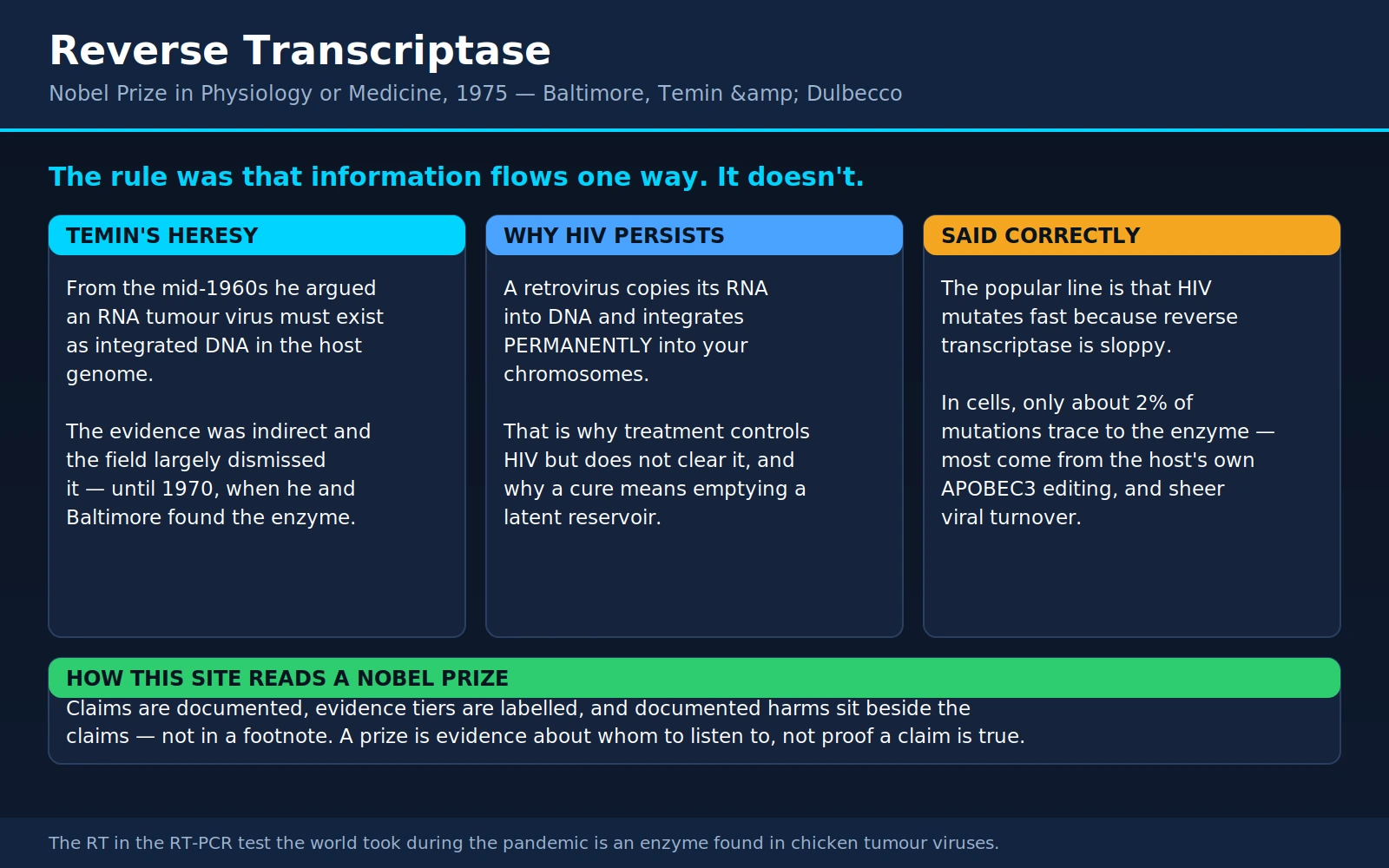
In June 1970, two short papers appeared back to back in the same issue of Nature. Between them they broke what almost every biologist then alive had been taught was one of the fixed rules of life: that genetic information flows from DNA to RNA to protein, and never backwards. One paper came from a laboratory in Wisconsin, the other from a laboratory in Massachusetts. Neither group knew what the other had found. Both had found the same thing — an enzyme, carried inside a virus particle, that reads RNA and writes DNA.
Five years later, David Baltimore, Howard Temin and Renato Dulbecco shared the Nobel Prize in Physiology or Medicine. The enzyme they had identified is now called reverse transcriptase, and if you have ever taken an HIV medication, a hepatitis B medication, or a COVID-19 PCR test, you have used it or used a drug aimed at it. This page is about what they found, why it was considered impossible, and the very long list of practical consequences that followed.
Table of Contents
- The Prize and the Three Men
- The Central Dogma, and Why This Mattered
- Temin's Long Unpopularity
- 1970: Two Papers, One Issue
- What Retroviruses Actually Do
- The Drugs: From AZT to One Pill a Day
- Why HIV Mutates So Fast
- Reverse Transcriptase as a Laboratory Tool
- Endogenous Retroviruses: The Virus in the Placenta
- What This Does Not License
- Dulbecco's Other Legacy
- Where Mainstream Medicine Agrees — and What Remains Debated
- Key Research Papers
- Connections
- Featured Videos
1. The Prize and the Three Men
The 1975 Nobel Prize in Physiology or Medicine was awarded jointly to David Baltimore, Renato Dulbecco and Howard Martin Temin — in the Nobel Foundation's words, "for their discoveries concerning the interaction between tumour viruses and the genetic material of the cell." That phrasing is broad on purpose. It covers two related but distinct bodies of work: Dulbecco's, which built the tools that made animal virology a quantitative science, and Baltimore's and Temin's, which used those tools to find an enzyme nobody believed existed.
Renato Dulbecco (1914–2012)
Dulbecco was born in Catanzaro, in the far south of Italy, and grew up in Liguria on the northwest coast. He took a medical degree at Turin, where two of his fellow students were Salvador Luria and Rita Levi-Montalcini — an extraordinary coincidence, since all three would eventually receive Nobel Prizes. He was conscripted as a medical officer and served on the French and then the Russian fronts during the Second World War, was wounded, and later joined the Italian resistance. In 1947 Luria, by then in the United States, invited him over. Dulbecco arrived at Indiana University, moved with Luria's circle into the orbit of the "phage group" — the small band of physicists-turned-biologists who were using bacterial viruses to work out the physical basis of heredity — and then took a position at Caltech.
What Dulbecco did there sounds technical and is actually foundational. Bacteriophage researchers could count individual virus particles precisely, because a single phage landing on a lawn of bacteria clears a visible hole — a plaque. Animal virologists had nothing equivalent. They measured virus by injecting dilutions into animals and seeing how many got sick, which is slow, expensive, imprecise, and impossible to do genetics with. In 1952 Dulbecco showed that a single particle of an animal virus could produce a countable plaque in a monolayer of cultured animal cells, and in 1954, with Marguerite Vogt, he extended the method to poliovirus and used it to isolate pure viral lines. Animal virology stopped being descriptive and started being quantitative in roughly the space of two years.
Dulbecco went on to study how DNA tumour viruses — polyoma and SV40 — transform normal cells into cancerous ones, and established that they do it by inserting their DNA into the host cell's chromosomes. That insight is the direct ancestor of Temin's provirus idea. Dulbecco was also, at different times, the head of the laboratories in which both Temin and Baltimore trained: Temin did his doctorate with Dulbecco at Caltech, and Baltimore spent a formative period working in Dulbecco's group at the Salk Institute. The prize is often described as one man and his two students, which is not quite right in detail but is close enough in spirit.
Howard Temin (1934–1994)
Temin was born in Philadelphia, went to Swarthmore, and took his PhD under Dulbecco at Caltech, working on Rous sarcoma virus — the chicken tumour virus discovered by Peyton Rous in 1911, and itself the subject of a Nobel Prize that arrived fifty-five years after the work. In 1960 Temin moved to the McArdle Laboratory for Cancer Research at the University of Wisconsin–Madison, where he stayed for the rest of his life. He was, by every account, a careful, quiet, relentlessly honest experimentalist. He was also, for most of the 1960s, close to alone in believing what he believed.
Temin never smoked. He died of lung cancer — specifically adenocarcinoma — in 1994 at the age of fifty-nine. He spent part of his own Nobel banquet speech in 1975 attacking tobacco, in front of an audience that included a substantial number of smokers, which tells you something about the man.
David Baltimore (born 1938)
Baltimore grew up in Queens and Great Neck, New York, went to Swarthmore (like Temin, a few years behind him), and did his doctoral work on poliovirus replication. He was twenty-two when he first understood that RNA viruses had to be carrying or making enzymes the cell did not supply, and much of his early career was spent identifying those enzymes. He was thirty-two when he found reverse transcriptase, thirty-seven when he received the Nobel Prize, and he went on to become one of the most influential figures in American biology — a co-organiser of the 1975 Asilomar conference on recombinant DNA safety, founding director of the Whitehead Institute, president of Rockefeller University, and then president of Caltech from 1997 to 2006.
His career also included a long and bitter public dispute, and this page states it plainly rather than skipping it. In 1986 Baltimore co-authored a paper in Cell on immunoglobulin gene expression in transgenic mice; the lead immunology work was done in the laboratory of Thereza Imanishi-Kari, a co-author. A postdoctoral researcher, Margot O'Toole, raised concerns that some of the data in the paper were not supported by the underlying laboratory records. What followed — often called "the Baltimore affair," although the disputed data were not his — ran for roughly a decade, took in the National Institutes of Health, the newly created federal research-integrity offices, the Secret Service (which examined the laboratory notebooks forensically), and a congressional subcommittee. Baltimore defended his co-author throughout, and was widely criticised for the combativeness of that defence; the paper was retracted in 1991, and he resigned the Rockefeller presidency the same year. In 1996 a Department of Health and Human Services appeals panel reviewed the case and cleared Imanishi-Kari of every charge of scientific misconduct, finding that the government had not proved its case. Baltimore was later elected president of the American Association for the Advancement of Science.
Two things are worth saying about this and then we will move on. First, the dispute concerned a 1986 immunology paper, not the 1970 work for which he received the Nobel Prize; nobody has ever questioned the reverse transcriptase result, which was independently confirmed within weeks by laboratories all over the world and is now checked, indirectly, every time an HIV drug works. Second, the episode is a genuine and uncomfortable part of the history of research integrity, and the final outcome was exoneration on appeal after years of accusation. Both of those are true at once.
2. The Central Dogma, and Why This Mattered
To understand why two very short papers caused an uproar, you need to know what they contradicted.
By the mid-1960s molecular biology had settled into a picture of breathtaking simplicity. DNA stores the information. DNA is transcribed into RNA. RNA is translated into protein. Three letters of RNA specify one amino acid; the amino acids string together into a protein; the protein does the work. That sequence — DNA to RNA to protein — became known as the central dogma of molecular biology, and by the time it reached undergraduate textbooks it had hardened into a one-way arrow with a strong flavour of physical law.
It is worth being precise about what Francis Crick actually said, because the textbook version and the original are not the same thing. Crick's formulation, first stated in 1958 and restated carefully in 1970, was about sequence information: once information has passed into protein, it cannot get out again. That is a claim about the impossibility of protein-to-nucleic-acid transfer. Crick explicitly did not rule out information moving from RNA back to DNA; he simply regarded it as not known to occur. He later said, with some irritation, that he had chosen the word "dogma" badly — he had meant something like "a grand hypothesis that we shall assume until told otherwise," and it had been read as "an article of faith."
But that careful distinction lived in Crick's papers, not in the working assumptions of the field. In practice, in laboratories, in review articles, in the way graduate students were taught, the arrow ran one way. An enzyme that copied RNA into DNA was not a live hypothesis to be tested; it was the kind of thing you would need extraordinary evidence to propose, and proposing it marked you out. There was no known enzyme that did it. There was no obvious reason a cell would need one. And there was a general sense that the flow of information in biology was solved, in the way the structure of the atom was solved.
This is a pattern that recurs across this site's Notable Doctors section, and it recurs because it is how science actually behaves. A framework that is basically correct and enormously productive also determines what questions look sensible. Barry Marshall spent years being told that bacteria could not live in stomach acid. Barbara McClintock spent decades being told that genes did not move. In each case the objection was not stupid — it followed from the best available theory. It was just wrong.
3. Temin's Long Unpopularity
Temin's problem started with an observation that did not fit.
Rous sarcoma virus is an RNA virus. It infects chicken cells and transforms them — the cells lose their normal growth restraint, pile up instead of forming a flat sheet, and become, in effect, cancerous. What struck Temin, working through the late 1950s and early 1960s, was how permanent and how heritable that change was. Once a cell was transformed, all of its descendants were transformed, indefinitely, generation after generation. That is not how a transient RNA infection behaves. That is how a change to the cell's own genes behaves.
So in 1964 Temin proposed the DNA provirus hypothesis: that the RNA virus, on entering a cell, is somehow converted into a DNA copy, and that this DNA copy is integrated into the cell's chromosomes, where it is inherited by every daughter cell forever after. The transformed phenotype is stable because the viral information has become part of the cell's genome.
The evidence he had was real but indirect, and indirect evidence is exactly what a field discounts when a hypothesis is unwelcome. His main lines of argument were:
- Actinomycin D experiments. Actinomycin D blocks DNA-dependent RNA synthesis — that is, it stops the cell reading DNA into RNA. If Rous sarcoma virus were replicating purely as RNA, actinomycin D should not stop it. Temin showed in 1963 that actinomycin D did inhibit production of the virus in infected cells. The implication is that at some point the virus is being read off DNA.
- Inhibitors of DNA synthesis. Compounds that block DNA replication blocked establishment of infection early on, in the window when — on his hypothesis — the DNA copy would have to be made.
- Nucleic acid hybridisation. In 1964 he published evidence in the Proceedings of the National Academy of Sciences of sequence homology between RNA from Rous sarcoma virus and DNA extracted from Rous-sarcoma-virus-infected cells — that is, the infected cell's DNA contained sequences matching the virus's RNA. This is the closest he came to a direct demonstration, and it is remarkably good work for 1964.
The reception was poor. Every one of those results had an alternative explanation available to a determined sceptic: actinomycin D has effects beyond the obvious one; inhibitor experiments are notoriously indirect; hybridisation in 1964 was technically difficult and vulnerable to contamination and to low-stringency false positives. The hypothesis also required an enzyme nobody had ever seen, doing a job nobody thought needed doing. Temin presented the provirus idea repeatedly at meetings through the 1960s and, by his own later account and that of many who were there, it was received with something between polite indifference and open ridicule. Grant reviewers were not enthusiastic. Papers were hard to place.
He kept going for six years. That is the part worth sitting with. He was not a maverick outsider with nothing to lose — he had a good position at a serious cancer laboratory, and he could have worked on something else and been perfectly successful. He kept working on the unpopular idea because he thought the data were telling him something, and because the alternative explanations, taken together, were becoming more strained than the hypothesis they were meant to avoid.
There is a detail here that is easy to miss and worth stating: Temin did not, in the 1960s, propose a specific enzyme. He proposed a process — RNA information ending up in cellular DNA. The enzyme was the mechanism he eventually went looking for, and the reason he found it in 1970 is that he had spent six years being told the process could not happen and had decided the only way to settle it was to find the machine that did it.
4. 1970: Two Papers, One Issue
In the spring of 1970, Temin and a postdoctoral researcher in his Wisconsin laboratory named Satoshi Mizutani made a straightforward decision. If a DNA copy of the viral RNA has to be made immediately on infection, and if the cell has no enzyme capable of making it, then the enzyme must be inside the virus particle itself — carried in, like a tool in a toolbox. So: take purified Rous sarcoma virus particles, break them open, add the four DNA building blocks and see whether DNA gets made.
It did. The reaction required an RNA template, it was destroyed by treating the preparation with an enzyme that degrades RNA, and it produced DNA. Mizutani ran the decisive experiments. His name is on the paper as second author, and he does not share the Nobel Prize — a common and often unfair feature of these stories, and one worth naming rather than passing over. The Nobel Prize can be split three ways at most, and postdoctoral researchers are routinely the people whose hands were actually on the pipette.
At almost exactly the same moment, in an entirely separate laboratory at the Massachusetts Institute of Technology, David Baltimore was doing the same experiment for different reasons. Baltimore had been working on how RNA viruses replicate, and had been systematically cataloguing the polymerases that different RNA viruses carry with them. He tested two RNA tumour viruses — Rauscher murine leukaemia virus and Rous sarcoma virus — for polymerase activity and found an enzyme that used the viral RNA as a template to make DNA.
The two groups learned of each other's results shortly before publication, and both papers ran in Nature on 27 June 1970, in the same issue, on consecutive pages: Baltimore's at pages 1209–11, Temin and Mizutani's at 1211–13. The titles are almost identical. Reading them side by side is one of the more remarkable experiences in the primary literature of the twentieth century — two laboratories, no coordination, one answer.
The immediate response was scepticism, then a scramble to reproduce, then near-universal acceptance within a matter of months. The experiment is simple enough that many laboratories could run it immediately, and it worked. Nature's editor at the time coined the name that stuck, in an accompanying commentary: the enzyme reversed transcription, so it was a reverse transcriptase, and the viruses that carry it eventually became retroviruses.
Temin's provirus hypothesis, dismissed for six years, was correct. Five years after the papers, all three men were in Stockholm.
5. What Retroviruses Actually Do
Here is the life cycle in plain language, because everything practical on this page depends on it.
A retrovirus particle carries two things you need to care about: a small genome made of RNA, and a few copies of the enzymes it will need — including reverse transcriptase and a second enzyme called integrase. It does not carry DNA.
- Entry. The virus attaches to a specific protein on the surface of a target cell and fuses with it, releasing its contents into the cell.
- Reverse transcription. Reverse transcriptase reads the viral RNA and writes a DNA copy of it. This is the step that was thought impossible. The result is a double-stranded DNA version of the virus.
- Integration. The DNA copy travels to the nucleus, and integrase cuts the cell's own chromosome and stitches the viral DNA into it. The viral genome is now physically part of the cell's genome. In this state it is called a provirus — Temin's word, from 1964.
- Transcription and assembly. From then on, the cell's own machinery reads the integrated viral DNA exactly as it reads any of its own genes, producing viral RNA and viral proteins. New particles assemble and bud off.
- Inheritance. When that cell divides, the provirus is copied along with the rest of the chromosome, into both daughter cells. Permanently.
Step 3 is the one with the enormous clinical consequence, and it is worth being blunt about it.
Integration is why HIV cannot simply be cleared. Modern antiretroviral therapy is genuinely superb: it can drive the amount of virus in the blood below the limit of detection and keep it there for decades, restore the immune system, give a person with HIV a normal life expectancy, and reduce sexual transmission to effectively zero when viral suppression is sustained. What it cannot do is remove the proviruses that are already sewn into the chromosomes of long-lived resting immune cells.
In 1997, a team including Diana Finzi and Robert Siliciano demonstrated this directly: in patients on effective combination therapy, replication-competent virus could still routinely be recovered from resting CD4+ T cells, at a low frequency, and that frequency did not fall with longer time on treatment. Those cells are not making virus. They are not visible to the immune system as infected. Antiretroviral drugs, which work on the steps of the replication cycle, have nothing to act on in a cell that is not replicating anything. The provirus simply sits there, indefinitely, as a stretch of the cell's own DNA.
This is the latent reservoir, and it is the reason that stopping treatment leads to viral rebound, usually within weeks. It is why "cure" in HIV research does not mean killing circulating virus — the drugs already do that — but means eliminating or permanently silencing a small, stable, extremely well-hidden population of integrated proviruses. The handful of people described as cured of HIV were all cured incidentally, through bone-marrow transplantation for blood cancers, using donor cells carrying a mutation that blocks HIV entry — a procedure with a mortality risk that makes it entirely inapplicable to someone whose HIV is well controlled on a daily tablet.
All of that follows from what Baltimore and Temin found. The reason HIV is a lifelong infection rather than a curable one is a direct consequence of an enzyme discovered in chicken tumour viruses. For the discovery of HIV itself, see Françoise Barré-Sinoussi and Luc Montagnier.
6. The Drugs: From AZT to One Pill a Day
This section is the practical payoff, and the scale of it is hard to overstate. Reverse transcriptase was the first successful drug target in HIV, it remains a component of nearly every first-line regimen, and it is also — a fact that surprises most people — the target of the standard treatments for chronic hepatitis B.
Why the enzyme is such a good target
The general principle of antiviral drug design is to find something the virus needs that you do not have. A drug that blocks a process shared by human cells will poison the patient along with the virus; that is why antibacterial drugs are relatively easy (bacteria have cell walls and distinctive ribosomes) and antiviral drugs are relatively hard (viruses mostly borrow the cell's machinery).
Reverse transcriptase is an unusually clean target because human cells have no enzyme whose ordinary job is copying an RNA genome into DNA. There is no cellular process that depends on doing this. Block it completely and, in principle, nothing of yours stops working. That is a much wider therapeutic window than most antiviral targets offer.
Two honest qualifications. First, human cells are not entirely free of reverse transcriptase activity — telomerase, the enzyme that maintains the ends of chromosomes, is a reverse transcriptase, and the LINE-1 retrotransposons scattered through our genome encode one too. They are different enough in structure that selective drugs are achievable, but "no human equivalent" is a simplification. Second, and more practically, the earliest reverse transcriptase inhibitors were not free of toxicity, and understanding why matters.
Zidovudine (AZT), 1987
Zidovudine was synthesised in 1964 as a candidate anticancer drug, failed at that, and sat unused for twenty years. In 1985 it was found to block HIV replication in cell culture. It is a nucleoside analogue: it looks enough like a normal DNA building block that reverse transcriptase picks it up and incorporates it into the growing DNA chain — but it lacks the chemical group needed to attach the next building block, so the chain stops dead. This is called chain termination, and it is still the mechanism of most of the drugs in this class.
The pivotal trial, published in the New England Journal of Medicine in July 1987 by Margaret Fischl and colleagues, randomised 282 patients with AIDS or advanced AIDS-related complex to zidovudine or placebo. The dose was 250 mg by mouth every four hours — around the clock, alarm clocks in the night, for everybody. The trial was stopped early. Over 8 to 24 weeks of observation, 19 patients in the placebo group died, compared with 1 in the zidovudine group. Opportunistic infections occurred in 45 placebo patients versus 24 on the drug.
Against the background of 1987, when a diagnosis of AIDS was close to a death sentence and there was nothing at all to offer, that result was extraordinary. The US Food and Drug Administration approved zidovudine in March 1987, on a timeline compressed far beyond anything normal at the time. It was the first drug approved for HIV anywhere in the world.
The companion paper, published in the same issue by Douglas Richman and colleagues from the same trial, documented what the drug cost. Bone marrow suppression was severe and common: anaemia with haemoglobin below 7.5 g/dL developed in 24% of zidovudine recipients versus 4% on placebo, 21% versus 4% required repeated red-cell transfusions, and neutropenia below 500 cells per cubic millimetre occurred in 16% versus 2%. Nausea, muscle pain, insomnia and severe headaches were all more frequent. The long-standing explanation for the marrow and mitochondrial effects of this drug class is off-target inhibition of the mitochondrial DNA polymerase, though that account has been questioned and refined over the years and is probably not the whole story.
And then there was the second problem, which was worse. Zidovudine used alone did not hold. Benefit faded over months to a couple of years as resistant virus emerged. Section 7 explains exactly why.
The classes that followed
Drug development after 1987 went in two directions, both still aimed at the same enzyme:
- NRTIs — nucleoside and nucleotide reverse transcriptase inhibitors. Chain terminators, like zidovudine but progressively better tolerated: lamivudine, emtricitabine, abacavir, and the tenofovir compounds (tenofovir disoproxil fumarate and the later tenofovir alafenamide). The older members of the class — stavudine, didanosine, zalcitabine — caused peripheral neuropathy, pancreatitis and lipoatrophy, and have been retired from routine use in favour of the newer ones.
- NNRTIs — non-nucleoside reverse transcriptase inhibitors. A completely different chemical strategy: instead of impersonating a building block, these bind a pocket adjacent to the enzyme's active site and jam its moving parts. Nevirapine, efavirenz, rilpivirine, doravirine. Because they work at a different site, resistance to an NNRTI does not confer resistance to an NRTI, which makes them useful partners in a combination.
Later classes attacked other steps: protease inhibitors (blocking the maturation of new particles), integrase strand-transfer inhibitors such as dolutegravir and bictegravir (blocking step 3 of the cycle above), and entry inhibitors. Modern first-line therapy is typically an integrase inhibitor plus two NRTIs.
Combination therapy, and one pill a day
The decisive trial was AIDS Clinical Trials Group 320, published in 1997: 1,156 patients with advanced HIV were randomised to two nucleoside analogues, or to those two plus the protease inhibitor indinavir. Progression to AIDS or death occurred in 6% of the three-drug group versus 11% of the two-drug group, and mortality was 1.4% versus 3.1%. The three-drug principle was established, and HIV in wealthy countries turned from a terminal illness into a chronic one within about two years.
The trajectory of the pill burden is its own kind of medical history. A person on early combination therapy might take twenty or more tablets a day on three separate schedules, some with food and some without, some requiring refrigeration. Today the standard is a single tablet, once daily, and often only three active ingredients — and it is worth noticing that in a very widely used modern single-tablet regimen (bictegravir with emtricitabine and tenofovir alafenamide), two of the three drugs are reverse transcriptase inhibitors. Fifty-five years after the 1970 papers, the enzyme is still doing most of the work.
The part almost nobody realises: hepatitis B
Hepatitis B virus is not a retrovirus. It is a DNA virus. But it replicates through an RNA intermediate, and its polymerase is a reverse transcriptase — which means the same drug class works, and does so spectacularly well.
The two first-line oral treatments for chronic hepatitis B worldwide, tenofovir and entecavir, are both nucleos(t)ide reverse transcriptase inhibitors. Tenofovir is literally the same molecule used in HIV therapy. Entecavir was developed for hepatitis B specifically. A person taking a daily tablet for chronic hepatitis B is taking a drug aimed at the enzyme Baltimore and Temin found, whether or not anyone has ever told them so.
The results are among the better outcomes in hepatology. In two phase 3 trials reported in 2008, tenofovir suppressed hepatitis B DNA below 400 copies/mL at 48 weeks in 93% of hepatitis B e antigen–negative patients (versus 63% on adefovir) and in 76% of e antigen–positive patients (versus 13%), with no tenofovir resistance mutations detected at 48 weeks. More striking is what happened over five years. In a 2013 open-label follow-up published in The Lancet, 348 patients had liver biopsies at both baseline and week 240; 87% showed histological improvement and 51% showed regression of fibrosis. Of the 96 patients who had cirrhosis at baseline, 71 — that is 74% — no longer met the criteria for cirrhosis after five years of treatment.
Cirrhosis was taught for a century as an end state. A daily tablet aimed at a reverse transcriptase reversed it in three-quarters of the patients who had it. For more on hepatitis B and the discovery of the virus behind it, see Baruch Blumberg; for hepatitis C, whose cure is a different story with a different enzyme, see Alter, Houghton and Rice.
7. Why HIV Mutates So Fast
This is one of the clearest cause-and-effect chains in all of medicine, and it starts with a missing part.
When your own cells copy DNA, they use a polymerase that has two functions: it adds the next building block, and it proofreads. If the wrong base goes in, a separate enzymatic activity built into the same protein — a 3′-to-5′ exonuclease — clips it back out and the polymerase tries again. This is why human DNA replication is astonishingly accurate.
Reverse transcriptase has no proofreading function. It puts bases in and moves on. Whatever it gets wrong, stays wrong.
Now the consequences, and here it is important to be exact, because the popular version of this story overshoots and the real version is more interesting.
What the measurements actually show
In 1995, Louis Mansky and — fittingly — Howard Temin himself built an assay to measure HIV-1's mutation rate during a single replication cycle in living cells. They found a forward mutation rate of 0.000034 mutations per base pair per cycle — about 3.4 errors for every hundred thousand bases copied. The HIV-1 genome is roughly 9,700 bases, so as simple arithmetic that is roughly one mutation for every three genomes copied. Compared with two other retroviruses tested the same way, HIV-1's rate was three and seven times higher.
But Mansky and Temin also found something that complicates the textbook story: the in vivo rate was about twenty-fold lower than the error rate of purified HIV-1 reverse transcriptase measured in a test tube on the same target sequence. In other words, the enzyme on its own in a cell-free system is sloppier than the virus actually is inside a cell. The famous "error-prone enzyme" figure quoted in reviews is a test-tube number, and the biological reality is more constrained.
A 2015 study by José Cuevas and colleagues went further and measured mutations in HIV-1 DNA inside infected cells from patients, finding a rate of 0.0041 per base per cell — roughly four mutations for every thousand bases, which they described as the highest reported for any biological entity. The surprise in that paper is the source of those mutations: reverse transcriptase accounted for only about 2% of them. The other 98% came from the patient's own APOBEC3 cytidine deaminases — host antiviral enzymes that chemically edit the viral genome to destroy it. Mutation frequency in virus recovered from plasma was 44 times lower, because most of those heavily edited genomes are lethally damaged and never make it out of the cell.
So the honest picture is: reverse transcriptase's lack of proofreading is real and is the enzyme-level reason a retroviral genome is inherently unstable, but the total mutational churn in an infected person is substantially a product of the immune system's own antiviral editing machinery fighting back.
Why that still means combination therapy
The clinical conclusion survives all of that nuance intact, and it was laid out with unusual clarity by John Coffin in Science in 1995. Coffin's key point was that the dominant driver of HIV's genetic variation is not the per-copy error rate at all — it is the sheer number of replication cycles happening inside one person. The clinically quiet years of HIV infection are not quiet; cells are being infected and dying continuously, in vast numbers, for years.
Multiply an imperfect copying step by an enormous number of copying events and you get a population of virus in one patient that is not a strain but a swarm — millions of slightly different genomes, collectively containing, in all probability, every single-base change that the genome can tolerate. Which leads to Coffin's conclusion, and to the design principle of every HIV regimen since:
- Resistance to one drug is not created by that drug — it is selected by it. The resistant variant almost certainly already existed in the patient before the first dose. The drug does not cause the mutation; it clears the field of everything else and lets the pre-existing variant take over. This is why zidovudine monotherapy failed within months to a couple of years. It was never really a race between drug and mutation; it was a selection experiment with a foregone conclusion.
- Combination therapy works because it demands the improbable. If a virus needs one specific mutation to escape one drug, that variant probably exists today. If it needs three specific mutations simultaneously — at three different sites, hitting three drugs with three different mechanisms — the probability of any single genome carrying all three at once collapses. And because the drugs also suppress replication almost completely, the number of new copying events (and therefore new mutations) falls to near zero. Resistance stops being generated.
- This is also why adherence matters so much. Missed doses let drug levels fall into a window where replication resumes but selection pressure remains — the one condition in which resistance is efficiently bred. The single-tablet once-daily regimen is not a marketing convenience; it is a resistance-prevention strategy.
- And it is a large part of why an HIV vaccine has been so hard. A vaccine trains the immune system against a target. HIV's envelope protein is one of the most variable proteins known, differing substantially between individuals and drifting within a single infected person over time, on top of being shielded by a dense coat of host-derived sugars. There is no single fixed target to aim at. Forty years of effort have produced no licensed vaccine, and this is the central reason.
An enzyme missing a proofreading domain, discovered in a chicken tumour virus in 1970, explains why HIV therapy comes as a combination, why it must be taken every day without fail, and why there is still no vaccine. That chain is worth reading twice.
8. Reverse Transcriptase as a Laboratory Tool
The discovery gave virologists an explanation. It gave molecular biologists something arguably bigger: a machine.
Once you can buy reverse transcriptase in a tube, you can convert any RNA into DNA whenever you want. That single capability underwrites a startling proportion of modern biology and diagnostics.
cDNA: reading the genes a cell is actually using
DNA copied from RNA is called complementary DNA, or cDNA. It is different from the gene it came from in a way that turned out to be enormously useful: in human cells the RNA has already had its non-coding stretches (introns) spliced out, so cDNA is a clean, continuous record of the protein-coding sequence, with none of the interruptions present in the chromosomal gene.
That property is what made it possible to take a human gene and get it working in a bacterium, which has no splicing machinery of its own. The route to recombinant human insulin, human growth hormone, clotting factors, and most first-generation biotechnology drugs runs through cDNA. A cDNA library — a collection of cDNA copies of every RNA a particular tissue was making — became the standard way to find and clone a gene when all you knew was that some tissue expressed it.
RT-PCR, and the test the whole world took
The polymerase chain reaction, developed in the 1980s, amplifies DNA exponentially, so that a handful of molecules becomes billions and can be detected. PCR is a DNA technique. It cannot read RNA.
Put reverse transcriptase in front of it and it can. Convert RNA to cDNA, then amplify the cDNA. That is RT-PCR, and the "RT" is reverse transcription — Baltimore's and Temin's enzyme, sold by the milligram, in the first step of the reaction.
Add a fluorescent readout that reports amplification cycle by cycle as it happens, and you get quantitative real-time RT-PCR, which measures not just whether an RNA is present but how much. It is the workhorse method for measuring gene expression — when a paper says a treatment "upregulated" some gene, this is usually how they know. The field eventually had to publish formal reporting standards (the MIQE guidelines, 2009) because the method is so sensitive that sloppy technique produces confident nonsense.
And then, in January 2020, a group led by Victor Corman and Christian Drosten published a validated RT-PCR workflow for a newly emerged coronavirus — designed, remarkably, before any virus isolate was available, using synthetic nucleic acid and the genetic similarity to SARS-CoV. That protocol, and the many that followed it, became the diagnostic backbone of the pandemic.
Which is worth stating as plainly as possible: the test that billions of people took during COVID-19 runs on an enzyme discovered in chicken tumour viruses in 1970. SARS-CoV-2 is an RNA virus; PCR cannot read RNA; so every one of those tests began by reverse-transcribing the viral RNA into DNA. Nobody swabbing a nose in 2021 was thinking about Rous sarcoma virus, but the first step in the tube was Howard Temin's provirus hypothesis, industrialised.
The same is true of HIV viral load testing, hepatitis C viral load testing, influenza subtyping, many cancer diagnostics that measure gene expression, and the sequencing of RNA viruses generally. Reverse transcriptase is one of the half-dozen enzymes that modern biology simply could not function without.
9. Endogenous Retroviruses: The Virus in the Placenta
If a retrovirus integrates into a cell's chromosome, and that cell happens to be one that becomes an egg or a sperm, then the provirus is inherited by the resulting offspring — and by every cell in that offspring's body, and by its descendants.
This has happened. Repeatedly. Over tens of millions of years. The results are called endogenous retroviruses, and they are sitting in your genome right now.
The scale became clear when the human genome was sequenced. Analyses of the draft sequence found that roughly 45% of human DNA consists of transposable elements of various kinds, and that around 8% of the genome is derived from sequences resembling infectious retroviruses — recognisable by the characteristic retroviral gene arrangement and the flanking long terminal repeats. Both of those figures are approximate and depend on how aggressively you count degraded, barely recognisable fragments; different analyses using different detection thresholds give somewhat different answers. But the order of magnitude is not in doubt. Something in the region of one base in twelve of your DNA is the wreckage of ancient retroviral infections that happened to our ancestors.
Almost all of it is dead. These sequences have been accumulating mutations for millions of years with no selection pressure to keep them functional. Analysis of the draft human genome found only three endogenous retroviruses retaining complete open reading frames for all three essential viral genes, and at least one of those is mutated at a critical residue. No human endogenous retrovirus is known to produce infectious virus. They are fossils, not sleeping infections.
Syncytin: the domesticated virus your birth depended on
Then there is the exception that makes the whole subject remarkable.
In 2000, a team led by Sha Mi reported in Nature the characterisation of a human gene they named syncytin. Syncytin is the envelope gene of a defective human endogenous retrovirus called HERV-W. In an ordinary retrovirus, the envelope protein sits on the particle's surface and fuses the viral membrane with the target cell's membrane — that is how the virus gets in.
In humans, this captured viral gene is expressed most strongly in the placental syncytiotrophoblast: the layer of the placenta where individual fetal cells fuse together into one enormous multinucleated sheet, which is the surface across which everything the fetus receives from its mother must pass. Mi's group showed that expressing syncytin in a wide range of cell types made those cells fuse into giant multinucleated masses, and that antibody against syncytin blocked fusion in a human trophoblast cell line.
The virus's membrane-fusion machinery had been captured and repurposed to build the placenta.
This is not a one-off oddity. Syncytin-like genes have since been identified independently in many mammalian lineages — a second one in humans (syncytin-2, from a different endogenous retrovirus), and separate captures in mice, rabbits, carnivores, ruminants and others, in each case a retroviral envelope gene domesticated for placental fusion. The capture happened over and over, from different viruses, in different lineages. Placental mammals appear to have repeatedly solved the same problem by stealing the same tool from whatever retrovirus was to hand.
Which means, put as directly as it deserves: mammalian pregnancy as we know it depends on genes we acquired from viruses. Every person reading this developed behind a placental barrier built in part by a domesticated retroviral protein.
Beyond syncytin, endogenous retroviral sequences have been co-opted more subtly across the genome. Their long terminal repeats contain promoter and enhancer elements, and a good number have been recruited over evolutionary time as regulatory switches for neighbouring host genes — particularly, it turns out, in the innate immune system and in early embryonic development.
The parallel to Barbara McClintock is exact and worth drawing. McClintock discovered mobile genetic elements in maize in the 1940s and was disregarded for about thirty years, because a genome was supposed to be a stable, orderly library. Temin was disregarded for six years for proposing that information could run backwards into that library. Between them they described a genome that is not a library at all but something closer to a very old city — built, rebuilt, scavenged, with foreign material load-bearing in the walls.
10. What This Does Not License
The phrase "retroviruses in your DNA" turns up regularly in wellness marketing and in online conspiracy material, usually attached to a detox protocol, a supplement, or a claim about vaccines. This site's duty is to be precise about what the science says, so here it is, without heat.
On endogenous retroviruses
Endogenous retroviral sequences in the human genome are ancient, inherited, and structurally part of your chromosomes. They were not acquired from anything you ate, breathed, injected or were exposed to. They arrived in your ancestors' germlines over a period spanning tens of millions of years, and you received them the same way you received your eye colour.
They are overwhelmingly defective — degraded by mutation past the point of functioning as viruses — and none is known to produce infectious virus in humans. Some are transcribed, and elevated transcription of certain families has been reported in various cancers and autoimmune conditions; whether that is a cause, a consequence, or a marker of the disordered gene regulation typical of those diseases is genuinely unsettled and is being actively studied. It is not settled in either direction, and anyone selling you a product on the basis that it is settled is ahead of the evidence.
What is not in doubt: no supplement, herb, diet, cleanse, chelation protocol or device removes endogenous retroviral sequences from your genome. Doing so would mean editing millions of loci across every cell in your body. Nothing available in a bottle can do it, nothing available in a clinic can do it, and if something could, the result would not be health — you would be deleting regulatory elements and, in the case of syncytin, a gene with an essential function. There is nothing there to detoxify.
On mRNA vaccines and DNA integration
The specific claim is that mRNA COVID-19 vaccines reverse-transcribe into DNA and integrate into the human genome. Here is the actual state of the evidence, point by point.
- The vaccines contain no reverse transcriptase and no integrase. Retroviral integration requires both enzymes, delivered by the virus itself, because host cells do not supply them for that purpose. mRNA vaccines contain a modified messenger RNA and a lipid nanoparticle to deliver it. There is no polymerase and no integrase in the vial. This is not a matter of interpretation — it is the composition of the product.
- RNA does not integrate on its own. There is no chemistry by which an RNA molecule inserts itself into a DNA double helix. Integration is an enzymatic reaction requiring a DNA substrate and an integrase to catalyse the strand transfer.
- mRNA is degraded quickly and does not enter the nucleus. Messenger RNA is translated in the cytoplasm and broken down by ordinary cellular ribonucleases within days. The DNA is in the nucleus. The two do not meet in a way that permits what is being claimed.
- The paper usually cited does not show what it is said to show. The reference is almost always a small 2022 in vitro study (Aldén and colleagues, Curr Issues Mol Biol 2022;44(3):1115-26) which exposed Huh7 cells — an immortalised human liver cancer cell line — to the BNT162b2 vaccine and reported detecting a vaccine-derived DNA sequence within six hours, along with changes in the expression of LINE-1, an endogenous reverse transcriptase. Read the paper's own conclusion carefully: it reports intracellular reverse transcription of the mRNA in that cell line. It does not report integration into the genome. Detecting a DNA copy in a preparation of genomic DNA is not the same as showing it was stitched into a chromosome, and the study contains no integration-site analysis, no evidence of a heritable insertion, and no data from any vaccinated person. It used a cancer cell line and a very large in vitro exposure. It is not evidence that this happens in a human body, and it does not claim to be.
- The related SARS-CoV-2 paper is about the virus, not the vaccine, and is contested. A 2021 study from Rudolf Jaenisch's laboratory (Proc Natl Acad Sci U S A 2021;118(21):e2105968118) reported that fragments of SARS-CoV-2 RNA could be reverse-transcribed and integrated into cultured human cells via LINE-1 machinery, and proposed this as an explanation for prolonged positive PCR tests after recovery. Note three things. It concerns natural infection with the virus, not vaccination. The authors state explicitly that only subgenomic fragments were found, so no infectious virus can be produced from them. And the paper drew multiple published technical critiques arguing the signal could reflect artefacts of the method used, which the authors have disputed; it is not a settled result.
The genuinely interesting fact underneath all this is one that neither side of the argument usually mentions: your cells do contain a reverse transcriptase, encoded by LINE-1 elements, and it is active at a low level. This is normal human biology, described long before COVID-19, and it operates on cellular RNAs continuously without producing any of the effects being claimed. Its existence is not a hidden mechanism recently discovered — it is textbook, and it is precisely why researchers such as Jaenisch's group could design an experiment to test the question in the first place.
For the actual science of how mRNA vaccines were made possible — a story with its own long chapter of rejection and dismissal that this site finds genuinely worth telling — see Katalin Karikó and Drew Weissman.
11. Dulbecco's Other Legacy
Dulbecco's share of the 1975 prize is sometimes treated as the senior-figure portion. It was not. His contribution was the methodological floor that everything else stood on, plus one piece of advocacy with consequences that are still unfolding.
The plaque assay, and making virology quantitative
Before 1952, if you wanted to know how much animal virus was in a sample, you diluted it and injected animals and counted how many became infected. That gives you a statistical estimate, expensive and slow, and it is very difficult to do genetics that way — you cannot isolate a pure viral clone from a sick mouse.
Dulbecco's 1952 paper showed that a single particle of an animal virus, placed on a monolayer of cultured cells under a semi-solid overlay, kills the cells around it and produces a visible, countable plaque. One particle, one plaque. Count the plaques, know the titre. Pick a single plaque, and you have a pure clonal line descended from one virus particle. His 1954 work with Marguerite Vogt applied this to poliovirus and demonstrated the isolation of pure lines — work that fed directly into the standardisation and quality control of poliovirus preparations at exactly the moment vaccine development needed it. See Enders, Weller and Robbins for the cell-culture breakthrough that made growing poliovirus possible in the first place.
Everything downstream depended on this. You cannot measure how well an antiviral drug works without a way to quantify virus. You cannot study viral genetics without pure clonal lines. You cannot do the transformation experiments Dulbecco went on to do with polyoma and SV40, or the ones Temin did with Rous sarcoma virus, without the ability to count and clone. Baltimore's careful catalogue of viral polymerases and Temin's provirus experiments were both built on tools Dulbecco made.
Dulbecco's own subsequent research established that DNA tumour viruses transform cells by integrating their DNA into the host chromosome — work that made the idea of an integrated provirus thinkable, and that is why the citation for the shared prize is phrased around "the interaction between tumour viruses and the genetic material of the cell" rather than around the enzyme alone.
Arguing for the Human Genome Project
In March 1986, Dulbecco published a one-and-a-half-page essay in Science titled "A turning point in cancer research: sequencing the human genome." Its argument was simple and, at the time, radical: cancer research had been proceeding gene by gene, painstakingly, and was going to keep hitting the same wall — you cannot understand what is broken without a reference for what unbroken looks like. Rather than continue piecemeal, sequence the entire human genome, once, and give every researcher the complete parts list.
The reaction was substantially hostile. The cost estimates were enormous, the sequencing technology of 1986 was not close to adequate, and a great many biologists regarded the whole idea as an industrial-scale data-collection project that would drain money from hypothesis-driven science — "big science" invading a field that had thrived on small laboratories and clever experiments.
Dulbecco's essay is widely credited as one of the most influential single arguments in shifting that opinion, partly because of who was making it: a Nobel laureate in exactly the field the project was meant to serve, saying that his own discipline had reached the limit of what it could do without the reference sequence. The Human Genome Project was formally launched in 1990. The draft sequence was published in 2001 — and it was that sequence, as section 9 describes, which revealed how much of our own DNA is retroviral in origin.
There is a pleasing closure in that. The man who built the tools that let Temin and Baltimore find reverse transcriptase also pushed for the project that ultimately showed how thoroughly reverse transcriptase has rewritten the human genome over evolutionary time.
12. Where Mainstream Medicine Agrees — and What Remains Debated
Settled, and not seriously disputed by anyone
- Reverse transcriptase exists, and retroviruses use it to convert their RNA genome into DNA. Confirmed within months of the 1970 papers and thousands of times since.
- Retroviral DNA integrates into the host chromosome as a provirus and is inherited by daughter cells.
- Integration is the reason HIV infection is lifelong on current therapy, and the reason interrupting therapy leads to rebound.
- Reverse transcriptase inhibitors are effective drugs, in HIV and in hepatitis B. This is not marginal — it is the foundation of two of the largest treatment programmes in global medicine.
- Combination therapy prevents resistance where monotherapy does not, and the reason is population genetics acting on a virus with an error-prone copying step and an enormous replication rate.
- RT-PCR is a valid and central diagnostic and research method.
- Roughly 8% of the human genome derives from endogenous retroviral sequences (approximate, method-dependent), and syncytin, a retrovirally derived gene, is essential to normal placental development.
Genuinely open questions
- How to eliminate the HIV latent reservoir. Strategies under active investigation include "shock and kill" (deliberately waking latent proviruses so that drugs and immunity can clear the cells), "block and lock" (permanently silencing them instead), broadly neutralising antibodies, and gene-editing approaches to excise or disable integrated provirus. None has produced a reliable cure. A recurring difficulty is that the reservoir is far more stable, and far less easily provoked into activity, than early models assumed — and that measuring it accurately is itself an unsolved technical problem, since the great majority of integrated proviruses are defective and irrelevant while a small minority are intact and matter enormously.
- Whether endogenous retrovirus reactivation causes disease. Elevated transcription of particular HERV families — HERV-W and HERV-K especially — has been reported in multiple sclerosis, amyotrophic lateral sclerosis, several cancers, schizophrenia and various autoimmune conditions. Whether this is causal, a consequence of the epigenetic disruption that accompanies those diseases, or an epiphenomenon is unresolved. Clinical trials of antibodies against a HERV-W envelope protein in multiple sclerosis have been conducted; the field is early and the results so far do not establish causation.
- The therapeutic potential of endogenous retroviruses in cancer. A more optimistic line of work is investigating whether deliberately de-repressing HERV transcription in tumours could make them look "viral" to the immune system and improve responses to immunotherapy. Interesting; unproven.
- An HIV vaccine. Still unsolved after four decades, for the reasons in section 7. Long-acting injectable antiretroviral prevention has, in the meantime, become highly effective in trials — which changes the practical picture considerably even though the vaccine problem itself remains open.
- How much LINE-1 activity matters in normal human physiology and ageing. Endogenous reverse transcription happens; what it does across a human lifetime, particularly in the brain and in ageing tissue, is an area of real and unsettled research.
13. Key Research Papers
- Baltimore D. RNA-dependent DNA polymerase in virions of RNA tumour viruses. Nature 1970;226(5252):1209-11
- Temin HM, Mizutani S. RNA-dependent DNA polymerase in virions of Rous sarcoma virus. Nature 1970;226(5252):1211-3
- Temin HM. Homology between RNA from Rous sarcoma virus and DNA from Rous sarcoma virus-infected cells. Proc Natl Acad Sci U S A 1964;52(2):323-9
- Temin HM. The DNA provirus hypothesis. Science 1976;192(4244):1075-80
- Dulbecco R. Production of plaques in monolayer tissue cultures by single particles of an animal virus. Proc Natl Acad Sci U S A 1952;38(8):747-52
- Dulbecco R. A turning point in cancer research: sequencing the human genome. Science 1986;231(4742):1055-6
- Fischl MA, Richman DD, Grieco MH, et al. The efficacy of azidothymidine (AZT) in the treatment of patients with AIDS and AIDS-related complex. A double-blind, placebo-controlled trial. N Engl J Med 1987;317(4):185-91
- Richman DD, Fischl MA, Grieco MH, et al. The toxicity of azidothymidine (AZT) in the treatment of patients with AIDS and AIDS-related complex. A double-blind, placebo-controlled trial. N Engl J Med 1987;317(4):192-7
- Hammer SM, Squires KE, Hughes MD, et al. A controlled trial of two nucleoside analogues plus indinavir in persons with human immunodeficiency virus infection and CD4 cell counts of 200 per cubic millimeter or less. N Engl J Med 1997;337(11):725-33
- Mansky LM, Temin HM. Lower in vivo mutation rate of human immunodeficiency virus type 1 than that predicted from the fidelity of purified reverse transcriptase. J Virol 1995;69(8):5087-94
- Cuevas JM, Geller R, Garijo R, et al. Extremely high mutation rate of HIV-1 in vivo. PLoS Biol 2015;13(9):e1002251
- Finzi D, Hermankova M, Pierson T, et al. Identification of a reservoir for HIV-1 in patients on highly active antiretroviral therapy. Science 1997;278(5341):1295-300
- Marcellin P, Gane E, Buti M, et al. Regression of cirrhosis during treatment with tenofovir disoproxil fumarate for chronic hepatitis B: a 5-year open-label follow-up study. Lancet 2013;381(9865):468-75
- Mi S, Lee X, Li X, et al. Syncytin is a captive retroviral envelope protein involved in human placental morphogenesis. Nature 2000;403(6771):785-9
Also referenced in the text above: Coffin JM, Science 1995;267(5197):483-9 (HIV population dynamics and the origin of drug resistance); Marcellin P et al., N Engl J Med 2008;359(23):2442-55 (tenofovir versus adefovir in chronic hepatitis B); Griffiths DJ, Genome Biol 2001;2(6):REVIEWS1017 (the 8% figure and the state of endogenous retroviruses in the draft genome); Corman VM et al., Euro Surveill 2020;25(3):2000045 (the first widely deployed SARS-CoV-2 RT-PCR protocol); Siliciano JD & Siliciano RF, Annu Rev Pathol 2022;17:271-94 (latent reservoir dynamics and cure strategies).
Live PubMed Searches
- Reverse transcriptase discovery retrovirus
- HIV latent reservoir cure
- Reverse transcriptase inhibitor hepatitis B
- Human endogenous retrovirus syncytin
- RT-PCR diagnostic method
14. Connections
- All Notable Doctors
- Nobel Prize in Physiology or Medicine — the full roll of laureates, 1901 to the present
- Peyton Rous & Charles Huggins — Rous sarcoma virus, the chicken tumour virus where this entire story begins
- Françoise Barré-Sinoussi & Luc Montagnier — the discovery of HIV, the retrovirus that made reverse transcriptase a drug target
- Baruch Blumberg — hepatitis B, whose polymerase is a reverse transcriptase and whose treatment uses the same drug class
- Alter, Houghton & Rice — hepatitis C, a curable viral hepatitis with a different enzyme and a different story
- Katalin Karikó & Drew Weissman — mRNA vaccines, and another long chapter of an idea being dismissed before it was proved
- Barbara McClintock — mobile genetic elements, and thirty years of being ignored for saying the genome moves
- Watson, Crick & Wilkins — the double helix, and the central dogma these three men amended
- Enders, Weller & Robbins — growing viruses in cell culture, the step before Dulbecco could count them
- Harald zur Hausen — HPV and cervical cancer: another virus that causes cancer by putting its genes into ours
- HIV & AIDS — the disease page: transmission, testing, treatment and prevention
- Hepatitis B — the infection treated with reverse transcriptase inhibitors
- Genetics & Genetic Disorders — how genes work, and what happens when they change