Selman Waksman: Streptomycin, Soil Microbes, and the First Cure for Tuberculosis
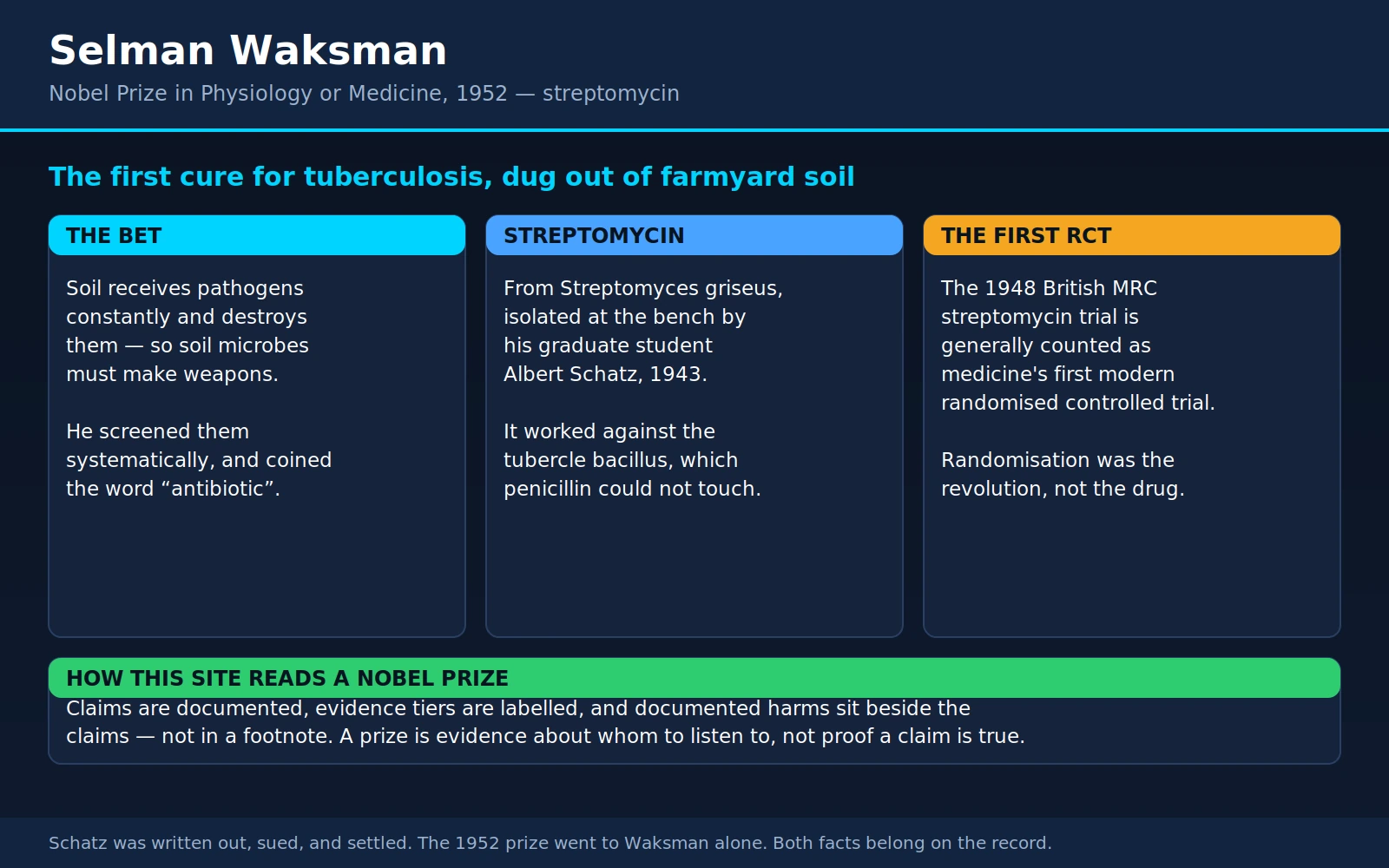
Table of Contents
- Who He Was
- The Idea: The Answer Was in the Dirt
- The Screening Machine
- Streptomycin: A Basement Lab and a Chicken's Throat
- Proving It Worked: Guinea Pigs, Patricia T., and the First Modern Trial
- The Schatz Affair
- What the Royalties Built
- Tuberculosis Then and Now
- Where Mainstream Medicine Agrees — and What the Record Complicates
- What Waksman's Work Means for You Today
- Key Research Papers
- Connections
- Featured Videos
1. Who He Was
Selman Abraham Waksman (1888–1973) received the 1952 Nobel Prize in Physiology or Medicine for streptomycin — the first drug that could actually cure tuberculosis, the disease that had killed more human beings than any other in recorded history. And he found it, quite literally, in dirt: in the teeming microbial world of farmyard soil that he had spent thirty years studying before anyone imagined it held medicine.
He was born on July 22, 1888, in Nova Pryluka, a small market town in Ukraine, then part of the Russian Empire. His family was Jewish; his mother ran a dry-goods stall, and the town sat on the famous black-earth steppe — some of the richest soil on the planet. Waksman later wrote that his lifelong fascination began there, with the question of why that dark earth was so extravagantly fertile. Opportunity for a Jewish boy in the tsar's empire was rationed and shrinking, and in 1910, at twenty-two, shortly after his mother's death, he sailed for America.
He landed with little money and went to stay on a cousin's farm in New Jersey — a stroke of luck disguised as an ordinary one, because it put him near Rutgers College, where a fellow Ukrainian émigré, the soil scientist Jacob Lipman, ran the agriculture program. Waksman won a scholarship, earned his degrees in agriculture, took a doctorate in biochemistry at the University of California, Berkeley, and returned to Rutgers in 1918. He never really left again: lecturer, professor, head of the microbiology department, a forty-year career on one campus in New Brunswick, New Jersey.
Here is the detail that makes his story unusual among the Nobel laureates of medicine: Waksman was not a physician. He never examined a patient, never wrote a prescription, and by his own account never wanted to. He was a soil microbiologist — the world's leading authority on humus, the dark organic matter of soil, and on a then-obscure group of filamentous, earthy-smelling microbes called actinomycetes. His 1927 textbook Principles of Soil Microbiology was the bible of the field. For most of his career, his work mattered to farmers, composters, and almost nobody's doctor. Then, in his fifties, the humus specialist became the twentieth century's greatest antibiotic prospector, and the microbes he had catalogued for decades turned out to be the best pharmaceutical chemists on Earth.
When he died in 1973, he was buried near the sea at Woods Hole, Massachusetts. His gravestone carries a line from Isaiah, in Hebrew and English: "The earth will open and bring forth salvation." It is hard to imagine a more precise epitaph.
2. The Idea: The Answer Was in the Dirt
To feel the weight of what streptomycin meant, you have to feel the weight of tuberculosis first. TB — consumption, the White Plague — was the single deadliest infection of the nineteenth and early twentieth centuries. When Robert Koch stood up in Berlin in 1882 and proved that a bacterium, Mycobacterium tuberculosis, caused the disease, he opened his lecture by noting that one death in seven, across all of Europe, was from tuberculosis. John Bunyan had called the disease "the captain of all these men of death" two centuries earlier, and it still was.
Koch's discovery was one of the great moments in medicine — and then came a sixty-year anticlimax. Knowing the germ did not kill the germ. Koch's own attempted remedy, tuberculin, failed as a cure. Doctors could offer rest, food, mountain air in a sanatorium, and surgery to collapse a diseased lung — ways of helping the body fight, not weapons against the invader. Well into the 1940s, a diagnosis of advanced pulmonary TB was, more often than not, a slow death sentence. Even Alexander Fleming's penicillin, the wonder drug of the war years, was helpless here: the tubercle bacillus, wrapped in its waxy coat, shrugged it off completely.
Waksman's route to the answer started from a question that sounds like a child's: why doesn't soil make us sick? Humanity has always dumped its most dangerous material into the ground — sewage, manure, carcasses, the bodies of people dead of infection. Soil should be a graveyard of surviving pathogens. It is not. Disease bacteria poured into living soil dwindle and vanish, and researchers (including Waksman's own group) had shown that the tubercle bacillus itself dies out in soil. Something down there was killing it. Soil is not passive dirt; it is a battlefield where billions of microbes in every gram compete for food and space — and, Waksman reasoned, some of them must be fighting with chemistry: secreted substances that inhibit or destroy their neighbors. If you could find the microbes that made those substances and harvest their weapons, you would have drugs.
Two events convinced him the bet could pay. In 1939 his own former graduate student, René Dubos, working at the Rockefeller Institute, deliberately fished a germ-killing substance (tyrothricin, containing gramicidin) out of a soil bacterium — proof that the mining operation worked, even though that particular find was too toxic to inject. And penicillin — a chance observation by Fleming in 1928, resurrected by Florey and Chain around 1940 — was showing what a microbe-derived drug could do to gram-positive infections. Where Fleming's discovery had been an accident, Waksman resolved to make discovery systematic: not waiting for a lucky spore to drift onto a plate, but interrogating soil microbes by the thousand, on purpose, with an assembly line. In 1939–1940 he turned his Rutgers department over to the hunt.
He also gave the hunt its name. In 1941 Waksman coined the word "antibiotic" as a noun — from the Greek for "against life" — and later defined it: a chemical substance produced by a microorganism that has the capacity to inhibit or destroy other microorganisms. Every time you fill a prescription for one, you are using his word. There is an older thread here, too: Paul Ehrlich had dreamed at the century's start of "magic bullets" — chemicals that kill the microbe but spare the patient. Waksman's insight was that nature had been manufacturing magic bullets for a billion years, and burying them underfoot.
3. The Screening Machine
What Waksman built at Rutgers was less a laboratory experiment than a production line for discovery — the template that pharmaceutical companies would copy for the next forty years. The routine ran like this:
- Collect and plate. Soil samples — from fields, compost, manure piles, wherever — were diluted and spread on culture plates. Colonies of actinomycetes, Waksman's specialty microbes, were picked out one by one.
- Challenge. Each candidate was streaked in a line across a plate, and disease bacteria were streaked at right angles to it — the cross-streak test. If the pathogens' growth stopped dead in a clear zone around the candidate, the candidate was making a weapon.
- Extract. Promising microbes were grown in broth by the flask-full, and the active substance was chemically teased out and concentrated.
- Test. The extract went up against a panel of pathogens in glassware, and then — the step where most candidates died — into animals, to ask the question that decides everything: does it kill the germ without killing the patient?
By Waksman's own accounting, the program sifted on the order of ten thousand cultures to find a handful worth pursuing. Out of that funnel, across two decades, his small team of graduate students pulled roughly twenty antibiotics — a strike rate no lottery player would envy, and exactly why nobody had done it before. The early finds taught hard lessons. Actinomycin (1940, with H. Boyd Woodruff) was ferociously potent and ferociously toxic — useless as an antibiotic, though a form of it, dactinomycin, later found a second life as one of the first chemotherapy drugs and still helps cure childhood kidney cancer today. Streptothricin (1942) looked for a while like the jackpot: it killed gram-negative bacteria and even the tubercle bacillus. Then the treated animals, seemingly fine, began dying days later of delayed kidney damage. It was a brutal, invaluable lesson — a drug that merely kills germs is nothing; the toxicity testing is the discovery — and it meant that when the next candidate came along, the team knew precisely what to check.
The machine kept producing long after its famous hit: neomycin (1949, with Hubert Lechevalier) proved too hard on kidneys and hearing to inject, but as a topical antibiotic it is almost certainly in your medicine cabinet right now, in first-aid triple-antibiotic ointments. Candicidin and others followed. But the machine's masterpiece arrived in the autumn of 1943.
4. Streptomycin: A Basement Lab and a Chicken's Throat
The hands at the bench belonged to Albert Schatz, a 23-year-old PhD student from a poor Connecticut farm family, newly discharged from the wartime Army on medical grounds and back at Rutgers on a stipend of $40 a month. Schatz volunteered for the project nobody envied: hunting for an antibiotic active against gram-negative bacteria and — the real prize — the tubercle bacillus. Because virulent TB cultures frightened people, he worked in a basement laboratory of the administration building, largely alone, sometimes sleeping in the lab to tend his cultures. Waksman, by his own account, never worked with the virulent TB strain himself and — as Schatz pointedly told the story ever after — did not come down to that basement while the dangerous work was under way. Directly above, on the third floor, the professor directed the program, reviewed the results, and supplied the method, the funding, and the forty years of actinomycete expertise that told everyone where to dig.
In October 1943, after three and a half months of obsessive work, Schatz had two actinomycete strains that stopped gram-negative pathogens cold. One, strain 18-16, came from heavily manured field soil. The other, strain D-1, had an origin story no novelist would dare invent: fellow graduate student Doris Jones, working on poultry diseases, had swabbed the throat of a healthy chicken, and handed Schatz the plate. Both strains were Streptomyces griseus — a species Waksman himself had first described back in 1915, in the genus he had helped name. On October 19, 1943, Schatz judged the new substance real and reproducible. They called it streptomycin.
The announcement came in a January 1944 paper by Schatz, Elizabeth Bugie, and Waksman — Schatz's name first, a point that would matter enormously later. What the paper described was the profile the whole field had been praying for. Streptomycin killed the gram-negative rods that penicillin could not touch — the agents of typhoid, dysentery, urinary infections, plague, tularemia. It was remarkably non-toxic in animals compared with everything before it. And in the follow-up work Schatz ran through the winter, it did the thing that made history: it stopped Mycobacterium tuberculosis — including the virulent human strain H37Rv at his basement bench — the germ no drug in sixty years of trying had ever touched in a usable way.
Chemically, streptomycin turned out to be the founding member of the aminoglycoside family. It works by jamming the bacterial ribosome — the machine that reads genetic instructions and builds proteins — binding its small subunit so the instructions are misread and the cell poisons itself with garbled proteins. Human ribosomes are built differently, which is the margin of safety. It was, in the precise sense Ehrlich had imagined, a magic bullet — with flaws that would surface soon enough, but a bullet all the same.
5. Proving It Worked: Guinea Pigs, Patricia T., and the First Modern Trial
A substance that kills TB in glassware is a headline; a cure is something else. The bridge was built at the Mayo Clinic by two researchers whose names deserve to be far better known: William Feldman, a veterinary pathologist, and H. Corwin Hinshaw, a physician. Feldman had visited Rutgers and pressed Waksman for a candidate to test properly; when streptomycin emerged, he got it. In April 1944 the pair began treating guinea pigs riddled with tuberculosis — the first batch of drug, about ten grams, being close to the entire world supply. The results were unlike anything in the disease's history: in treated animals the infection was arrested and the lesions healed. Merck & Co., which had been backing Waksman's program, threw its wartime engineering muscle into scaling up production from thimblefuls to kilograms.
On November 20, 1944, at a Minnesota sanatorium, streptomycin went into its first tuberculosis patient: "Patricia T." — Patricia Thomas, twenty-one years old, with far-advanced pulmonary TB and a prognosis of months. Over repeated courses her disease reversed. She left the sanatorium, married, and raised three children. By 1946 Hinshaw, Feldman, and their colleagues had published results on a hundred patients, and desperate families were besieging Rutgers and Merck by letter and telegram for a drug still scarcer than gold. Feldman, in a grim occupational irony, developed tuberculosis himself in 1948 — and recovered, treated in part with the drug he had helped prove.
Then came the study that changed not just tuberculosis but the entire method of medicine. Britain, nearly bankrupt after the war, could afford only a small amount of streptomycin — far too little for every patient who needed it. The Medical Research Council turned scarcity into scientific rigor: if not everyone can get the drug, the fair way to decide is a lottery — and a lottery happens to be perfect science. In the 1948 MRC trial, 107 patients with comparable pulmonary TB were assigned by sealed random numbers to streptomycin plus bed rest, or bed rest alone. Nobody — not the patient, not the admitting doctor — could steer sicker or healthier patients into either arm. That is the whole revolution in one sentence: randomization makes the two groups alike in everything except the treatment, so whatever difference appears must be the treatment's doing. Doctors' impressions, hand-picked comparisons, and glowing case series had been fooling medicine for two thousand years; this design could not be fooled. It is widely regarded as the first properly randomized controlled trial in medicine, the founding document of what we now call evidence-based medicine — and it is worth pausing on the fact that the founding document of evidence-based medicine is a tuberculosis trial. At six months, 7 percent of the streptomycin patients had died, against 27 percent of the controls; over half the treated patients showed major improvement on X-ray, against 8 percent.
The same trial delivered the story's dark twist with equal clarity: in most treated patients whose bacilli were retested, the germs had become resistant to streptomycin within months, and much of the early survival advantage eroded as resistant disease relapsed. The bacterium was evolving out from under the drug in real time — exactly the danger Fleming was warning about for penicillin in those same years. The answer arrived almost immediately: pair streptomycin with a second drug that kills by a different route, so a mutant that shrugs off one is caught by the other. Combined with PAS (para-aminosalicylic acid, developed by Jörgen Lehmann in Sweden in 1944), resistance plummeted; when isoniazid arrived in 1952, triple therapy began curing patients reliably, and physicians like John Crofton in Edinburgh showed that with strict combination treatment, cure — not containment, cure — could be the expected outcome. This is why tuberculosis is treated with multiple drugs at once to this day, and why your doctor is unbending about it for TB, for HIV, for hepatitis C: the principle was paid for in relapses in 1948.
6. The Schatz Affair
This site keeps honest records, and the honest record here is uncomfortable: the streptomycin story is at once a triumph of science and one of the most instructive injustices in the history of scientific credit. It needs telling straight, fairly to both men.
The facts of contribution are not really in dispute. Schatz did the isolation at the bench, alone, in the basement, including the dangerous TB work, and his name stands first on the discovery papers. The 1945 patent application names Waksman and Schatz together as co-inventors, and both men signed their rights over to the Rutgers Research and Endowment Foundation — each, formally, for one dollar — with, Schatz understood, neither man profiting personally. The program, method, funding, strain expertise, and institutional machine that made the discovery findable were Waksman's, built over decades; strain screening of this kind was not a solo student project, and dozens of workers cycled through the effort. Both of these things are true at once. The trouble is what happened next.
As streptomycin became a global blockbuster, Waksman's telling of the story changed. In interviews, in his autobiography, in the program's official memory, the graduate student at the bench shrank into anonymous "hands," while — unknown to Schatz — Waksman had quietly arranged with the Rutgers foundation to receive 20 percent of the royalties personally, even as he assured his former student in writing that no one was getting rich. By the late 1940s hundreds of thousands of dollars had flowed to Waksman — several million in today's money. When Schatz learned of it, he did the almost unthinkable: in 1950, a young unknown sued his famous mentor and Rutgers. Establishment science was horrified — at Schatz. But the documents were the documents. The case settled that December: Schatz received a share of the royalties (3 percent) and — the part he always said mattered most — formal legal recognition as co-discoverer of streptomycin. The settlement had one genuinely graceful clause: 7 percent of the royalties was divided among more than two dozen others who had worked on the program, from senior colleagues down to the lab's bottle-washers. Elizabeth Bugie, whose name sits between Schatz's and Waksman's on the discovery paper but who had been left off the patent — told, as her daughters later recounted, that it didn't matter because she would one day marry — was among them.
Two years later, in 1952, the Nobel committee awarded the prize to Waksman alone, "for his discovery of streptomycin, the first antibiotic effective against tuberculosis." Schatz wrote to the committee protesting; he was brushed aside as a student assistant who had merely worked under a great scientist's direction. At the ceremony, the presenter hailed Waksman as "one of the greatest benefactors to mankind," and pointedly praised the systematic program of soil research — a formulation that acknowledged, without naming, the dispute everyone in the room knew about. Feldman and Hinshaw, who had proved the cure in animals and humans, were not honored either. The lawsuit had made Schatz radioactive: American microbiology departments would not hire the man who had sued his professor, and he spent years in exile from his own field — a small agricultural college, then Chile, eventually a professorship in science education at Temple University. He spent the rest of his long life pressing his case, sometimes bitterly. He was still pressing it in 1994 when Rutgers, on the discovery's fiftieth anniversary, formally made amends and awarded him the Rutgers University Medal, its highest honor. He died in 2005.
The modern consensus of historians who have gone through the archives — Kingston's and Wainwright's papers in the reading list below are the places to start — is roughly this: Schatz was genuinely wronged, on money and, worse, on memory; and Waksman's program was genuinely the reason there was anything to discover. The Nobel committee had room within its own rules to recognize up to three people, and the record — a co-signed patent, a first-authored discovery paper, a legal settlement naming a co-discoverer — was public. What the episode teaches is not that Waksman was a fraud; he wasn't. It is something more unsettling and more useful: a person can be a great scientist and unjust, and institutions will usually side with the powerful one. Every graduate student who has ever watched credit float upward knows this story without being told it. Science runs on trust between mentors and students, and this — the field's most famous breach of it — is why authorship, patents, and credit are policed so carefully today.
7. What the Royalties Built
For all the ugliness over its division, the streptomycin money mostly went somewhere admirable. Waksman had persuaded Merck, remarkably, to hand its exclusive rights back to the Rutgers foundation so that any qualified company could license the drug — production soared, competition drove the price of a gram down from luxury-good territory to pocket change within a few years, and a public university found itself with one of the great royalty streams in academic history — millions of dollars at mid-century value.
Waksman insisted the bulk of it be plowed back into science. The result opened in 1954 as the Rutgers Institute of Microbiology, which he directed until his retirement and which today bears his name as the Waksman Institute of Microbiology, still a working research institution. From his personal share — the share the lawsuit had trimmed to 10 percent — he endowed a Foundation for Microbiology to fund fellowships and lectureships. Whatever one concludes about how he treated Schatz, Waksman did not retire to count his money; he built laboratories with it.
And there is a direct line from that model to a Nobel Prize sixty-three years later. Satoshi Ômura, the Japanese microbiologist who shared the 2015 prize with William Campbell, is Waksman's most consequential heir: another soil-actinomycete prospector, screening Streptomyces by the thousand — one scoop of Japanese soil yielding the microbe behind ivermectin, which beat back river blindness across two continents — and another scientist who piped the resulting royalties straight back into his institute's research. The playbook — dig, screen, extract, test, reinvest — is Waksman's, running two generations later almost unchanged.
8. Tuberculosis Then and Now
It is hard now to feel what changed. In 1940, tuberculosis treatment meant years in a sanatorium bed, collapse therapy, rib-removing surgery, and odds not much better than a coin flip for advanced disease. Within roughly a decade of streptomycin's debut, TB had become a curable outpatient illness in the developed world. The sanatoria — whole cities of them, an entire architecture of managed dying — emptied and closed. Along with clean water and vaccines, the antibiotic conquest of TB sits among the largest single subtractions of suffering in human history. Streptomycin itself was gradually pushed out of first-line therapy — it must be injected, it can permanently damage hearing and balance (a toll many early patients paid), and resistance to it spread — replaced by the modern six-month, four-drug oral regimen built on rifampicin and isoniazid. But every drug in that regimen stands on the combination-therapy principle learned from streptomycin's failures, and streptomycin remains on the shelf as a reserve TB drug and the standard treatment for plague and tularemia.
Now the uncomfortable present: tuberculosis is not a historical disease. It remains, in most years, the world's deadliest single infectious disease — roughly ten million people fall ill each year, and on the order of 1.25 million die, overwhelmingly in low- and middle-income countries, deaths from a disease that has been curable for seventy years. Worse, the resistance story that began in the 1948 trial has compounded: multidrug-resistant TB (MDR-TB, resistant to the two best first-line drugs) infects hundreds of thousands of people a year, and extensively drug-resistant strains (XDR-TB) go further. The old cause is the old cause: interrupted, incomplete, or low-quality treatment lets the hardiest mutants survive and spread. Treating resistant TB long meant two years of toxic drugs; newer all-oral regimens (built on bedaquiline and pretomanid) have shortened that to about six months for many patients — real progress, and also a reminder that we are now inventing drugs to replace drugs the bacterium has beaten.
Which is why the least glamorous sentence on this page may be the most important: if you or someone you love is ever treated for TB, take every dose and finish the full course, even months after feeling completely well. Stopping early is not a private shortcut; it is how resistant strains are manufactured. The bacilli that survive a half-course are, by definition, the toughest ones — and they are what gets coughed into the world next. Every MDR-TB ward on Earth is downstream of abandoned pill bottles. The 1948 trial taught medicine this lesson at the cost of its patients' relapses; it should not have to be learned again one household at a time.
9. Where Mainstream Medicine Agrees — and What the Record Complicates
Where the agreement is total: streptomycin worked, and works — its efficacy against tuberculosis was established by the most rigorous trial design medicine possesses, a design it helped invent. Waksman's systematic soil-screening paradigm is among the most productive research strategies ever devised: the aminoglycosides, tetracyclines, macrolides like erythromycin, chloramphenicol, vancomycin, rifamycins (the backbone of TB therapy today), antifungals, and the first chemotherapy antibiotics all came out of soil microbes — most of them from Streptomyces, Waksman's own genus — in the two decades after his lab showed the way. The MRC trial's randomized method is now the global standard of proof for every therapy, conventional or alternative, discussed anywhere on this site. And combination therapy against resistance, born from streptomycin's collapse as a single agent, is bedrock infectious-disease practice. None of this is contested anywhere in medicine.
What the record complicates is the story people were told about it. The official version — one wise professor discovers a wonder drug — required erasing a graduate student whose name was first on the paper and on the patent, a master's student edited off the patent altogether, a colleague's chicken-swab plate, and the two Mayo Clinic researchers who actually proved the cure; the Nobel committee compounded the simplification by honoring one man alone, and much of the scientific establishment then punished the junior man for objecting. The record also complicates the wonder-drug arc itself: streptomycin deafened some of the patients it saved, bred resistant bacilli within months, and was rescued as a cure only by being combined with other drugs — a fact worth remembering whenever any therapy, natural or pharmaceutical, is sold as a standalone miracle. None of this diminishes what happened in that basement in 1943. It does mean the true story has more people in it, and more warnings, than the legend — and this site prefers the true story.
10. What Waksman's Work Means for You Today
Open your bathroom cabinet. The triple-antibiotic first-aid ointment there almost certainly contains neomycin — discovered by Waksman and Lechevalier in 1949, still guarding scraped knees eight decades on (and, a practical aside: if a treated cut grows an itchy red rash, neomycin is one of the most common contact allergens, and single-ingredient bacitracin or plain petrolatum is a reasonable switch to discuss with your pharmacist). If anyone in your family ever needs gentamicin or amikacin in a hospital, those are streptomycin's direct descendants; if a child you know was cured of Wilms kidney tumor, dactinomycin from Waksman's "failed" 1940 antibiotic may be part of why. The soil-screening idea itself furnished shelves far beyond antibiotics: ivermectin came from a Japanese soil microbe, the transplant drug cyclosporine from a soil fungus, the cardiology mainstay class of statins from mold metabolites, rapamycin from the soil of Easter Island. It is fair to say a working pharmacy is, in meaningful part, a curated soil sample.
There is also a lesson here for how this site's readers weigh evidence. Waksman's story is often told as "the cure was in nature all along" — and that is true, and it is a genuine argument for taking natural antimicrobial chemistry seriously; plants wage the same chemical warfare microbes do, which is why pages like Antibacterial Herbs, Garlic, and Goldenseal exist here. But notice what nature-provided did not mean: streptomycin went through toxicity screens that killed its predecessor candidates, animal proof, human trials, and the most rigorous comparison design ever invented before anyone called it a cure — and even then it needed partner drugs to stay one. "Natural" bought streptomycin its origin, not its pass; the trial did that. Demand the same of anything you are asked to swallow.
And one last image, free of charge. That smell after rain — the rich, earthy scent of wet ground — is largely geosmin, a molecule released by Streptomyces, the very genus that gave us streptomycin, neomycin, tetracycline, and ivermectin's parent. When you smell it, you are smelling the most productive drug factory in history, still running, still mostly unexplored. Waksman's deepest legacy may be the reframing: dirt is not dead. It is the most crowded, most inventive chemistry lab on Earth — and it has been holding cures over our heads, or rather under our feet, all along.
11. Key Research Papers
- Schatz A, Bugie E, Waksman SA. Streptomycin, a substance exhibiting antibiotic activity against gram-positive and gram-negative bacteria. Proc Soc Exp Biol Med 1944;55:66-69 — the discovery paper, with the graduate student's name first
- Medical Research Council. Streptomycin treatment of pulmonary tuberculosis. Br Med J 1948;2(4582):769-82 — the first modern randomized controlled trial
- Hinshaw HC, Feldman WH, Pfuetze KH. Treatment of tuberculosis with streptomycin; a summary of observations on one hundred cases. J Am Med Assoc 1946;132(13):778-82
- Waksman SA. Streptomycin: background, isolation, properties, and utilization. Science 1953;118(3062):259-66 — his Nobel lecture, as published
- Comroe JH Jr. Pay dirt: the story of streptomycin. Part I. From Waksman to Waksman. Am Rev Respir Dis 1978;117(4):773-81
- Comroe JH Jr. Pay dirt: the story of streptomycin. Part II. Feldman and Hinshaw; Lehmann. Am Rev Respir Dis 1978;117(5):957-68
- Wainwright M. Streptomycin: discovery and resultant controversy. Hist Philos Life Sci 1991;13(1):97-124
- Kingston W. Streptomycin, Schatz v. Waksman, and the balance of credit for discovery. J Hist Med Allied Sci 2004;59(3):441-62
- Crofton J. The MRC randomized trial of streptomycin and its legacy: a view from the clinical front line. J R Soc Med 2006;99(10):531-4
- Krause KM, Serio AW, Kane TR, Connolly LE. Aminoglycosides: an overview. Cold Spring Harb Perspect Med 2016;6(6):a027029
- Lange C, Dheda K, Chesov D, Mandalakas AM, Udwadia Z, Horsburgh CR Jr. Management of drug-resistant tuberculosis. Lancet 2019;394(10202):953-966
The official Nobel record is at nobelprize.org — 1952 Prize in Physiology or Medicine.
Live PubMed Searches
- Streptomycin discovery history
- MRC streptomycin trial 1948
- Schatz Waksman controversy
- Actinomycetes antibiotic screening
- Multidrug-resistant tuberculosis treatment
Connections
- All Notable Doctors
- Robert Koch — identified the tuberculosis germ in 1882; Waksman's drug finished the job sixty years later
- Alexander Fleming — penicillin, the other half of the antibiotic revolution, and the resistance warning both stories share
- Paul Ehrlich — the "magic bullet" idea that soil antibiotics finally fulfilled
- Satoshi Ômura — Waksman's direct heir: soil actinomycetes, ivermectin, and royalties turned back into research
- William Campbell — Ômura's partner in the 2015 Nobel for ivermectin
- Nobel Prize in Medicine — the laureates covered on this site, and how the prize gets credit right and wrong
- Mycobacterium Tuberculosis — the organism itself: transmission, symptoms, and modern treatment
- All Bacteria — the site's guide to the pathogens antibiotics were built against
- Antibacterial Herbs — the plant kingdom's own antimicrobial chemistry, reviewed honestly
- Garlic — allicin and the best-studied kitchen antimicrobial
- Goldenseal — berberine and the tradition of botanical antisepsis