Murray & Thomas: Transplantation, from an Identical Twin to a Routine Operation
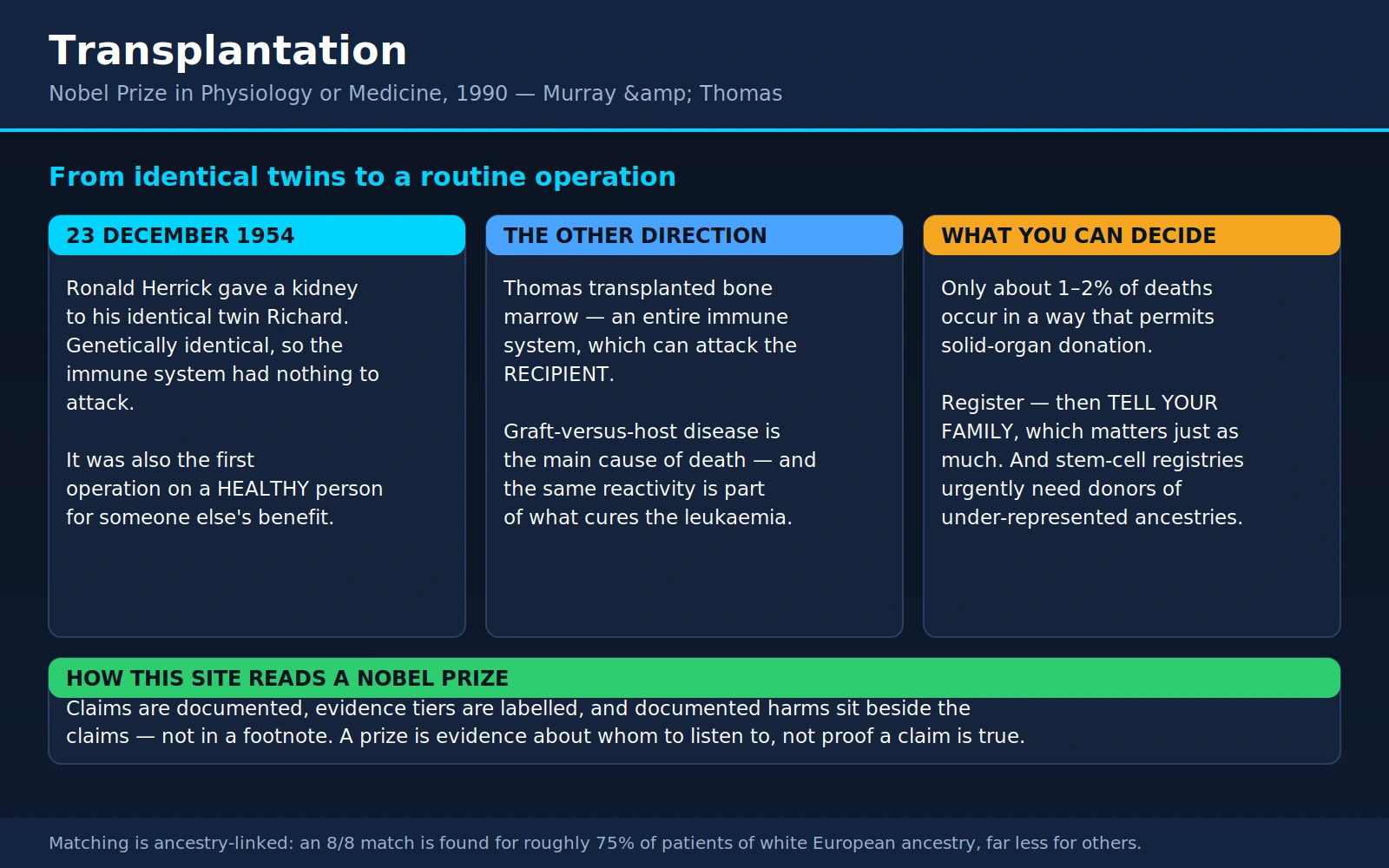
Table of Contents
- The Prize and the Two Men
- Why the Body Rejects
- 23 December 1954: The Herrick Twins
- Beyond Twins: The Drugs That Made Strangers Possible
- Thomas and Bone Marrow: A Different Problem Entirely
- Graft-Versus-Host, and the Twist
- Where Transplantation Is Today
- The Waiting List, and What You Can Actually Do
- Xenotransplantation and the Current Frontier
- Myths, Fears, and Misinformation
- Where Mainstream Medicine Agrees — and What Remains Debated
- Key Research Papers
- Connections
- Featured Videos
1. The Prize and the Two Men
The 1990 Nobel Prize in Physiology or Medicine went to two American surgeons and physicians — Joseph E. Murray and E. Donnall Thomas — "for their discoveries concerning organ and cell transplantation in the treatment of human disease." That phrasing is worth reading twice, because it contains the whole shape of the thing. Organ transplantation was Murray: a kidney lifted out of one body and stitched into another. Cell transplantation was Thomas: bone marrow, which is not an organ at all but a suspension of cells dripped into a vein, from which an entire blood and immune system regrows.
Both men spent decades doing something that most of their colleagues considered a waste of a career. Transplanting tissue between two different human beings was not merely difficult in the 1950s; it was widely held to be biologically impossible, in the way that perpetual motion is impossible. The body would reject the graft, that was simply what bodies did, and no amount of surgical skill would change it. Both Murray and Thomas were told, repeatedly and by serious people, to stop.
Joseph Murray (1919–2012)
Murray was born in Milford, Massachusetts, and trained as a plastic surgeon — which is the detail that explains everything else. During the Second World War he was assigned to Valley Forge General Hospital in Pennsylvania, where the badly burned came home: airmen who had been pulled out of burning aircraft, men missing most of their skin. The standard treatment was skin grafting, and when a patient did not have enough of his own skin left, surgeons used skin from cadaver donors as a temporary biological dressing.
Those grafts always failed eventually. But Murray noticed something that turned out to matter enormously: in the sickest, most badly burned patients, the donor skin lasted longer before it sloughed off. A patient whose body had been devastated by injury seemed to reject foreign tissue more slowly than a healthy one. Murray drew the correct inference. Rejection was not a property of the tissue — it was an active biological process carried out by the recipient. And an active process is something you might, in principle, interfere with.
He spent the rest of his career at the Peter Bent Brigham Hospital in Boston, working out how. Murray later wrote an unusually reflective account of the whole arc — scientific, surgical, and ethical — in a 1992 Science paper that is still one of the clearest first-hand summaries of how the field actually happened. He was also, notably, a man who returned to reconstructive surgery for children with facial deformities after the transplant work was done, and who did not seem especially interested in being famous.
E. Donnall Thomas (1920–2012)
Thomas, born in the small town of Mart, Texas, was the son of a country doctor. He trained in internal medicine and haematology rather than surgery, and his problem was different: leukaemia, a cancer of the blood-forming cells in the marrow, which in the 1950s killed essentially everyone who had it.
The logic he pursued was brutal and simple. If the disease lives in the bone marrow, destroy the bone marrow — with radiation, with chemotherapy, with both. The problem is that destroying a person's marrow kills them, because marrow makes red cells, platelets, and every white cell of the immune system. Unless, of course, you can give them somebody else's marrow afterwards.
Thomas began this work at the Mary Imogene Bassett Hospital in Cooperstown, New York, and continued it in Seattle at the University of Washington and what became the Fred Hutchinson Cancer Research Center. His own account of the journey, delivered as his Nobel lecture in 1990, is candid about how long the failure lasted. For roughly a decade, nearly every patient died.
What they have in common
Neither man discovered a molecule. Neither had a single flash of insight that appears in textbooks as a moment. What they did was keep going through a period when the results were, by any ordinary reading, evidence that the idea was wrong — and they kept going because they had a mechanistic reason to think the failures were solvable rather than fundamental. That is a specific and underrated kind of scientific courage, and it is the reason a person diagnosed today with kidney failure or leukaemia has options that a person diagnosed in 1950 did not.
2. Why the Body Rejects
To understand what Murray and Thomas were up against, you need one idea: your immune system spends its entire existence asking a single question about every cell it meets — is this me, or is this not me?
The answer is written on the surface of nearly every cell in your body in a set of protein markers called the HLA system (human leukocyte antigens; the same family of molecules is called MHC, the major histocompatibility complex, in other species). Think of HLA proteins as a molecular ID badge. Your T cells were trained in the thymus, before you were born and through early life, to recognise your particular badge and to ignore anything wearing it. Anything not wearing it is, by definition, foreign — a virus-infected cell, a bacterium, a parasite, a tumour cell that has gone strange — and is attacked.
This system is superbly good at its job, and its job has nothing to do with transplantation. It evolved to deal with infection. A surgeon sewing a stranger's kidney into your abdomen is, from your T cells' point of view, presenting them with an enormous mass of foreign tissue that is not wearing your badge. They respond exactly as they would to an infection: within days, the graft is infiltrated, its blood vessels are attacked, and it dies. This is acute rejection, and in the early 1950s it was reliable, rapid, and unstoppable.
The HLA genes are also the most variable genes in the human genome. There are thousands of known variants at the major loci, and you inherit a set from each parent. Two unrelated people almost never match. Two siblings have roughly a one-in-four chance of matching at the key loci, because the genes sit close together on chromosome 6 and are inherited as a block. Two identical twins match perfectly, because they are genetically the same person.
Medawar's principle
The intellectual groundwork was laid by Peter Medawar, working in Britain, who had also come to the problem through burn victims and skin grafts. Medawar established that graft rejection was an immunological phenomenon — it showed memory (a second graft from the same donor was rejected faster) and specificity, the two signatures of an immune response.
Then, with Rupert Billingham and Leslie Brent, he showed something more surprising. If mouse embryos were exposed to cells from another mouse strain before birth, while the immune system was still learning what "self" meant, those mice would accept skin grafts from that strain as adults, permanently and without any drugs. The immune system had simply added the foreign badge to its list of acceptable ones. They published this as "Actively acquired tolerance of foreign cells" in Nature in 1953, and Medawar shared the 1960 Nobel Prize with Frank Macfarlane Burnet for it.
This is the concept that made transplantation thinkable rather than absurd. Rejection was not fate; it was a learned behaviour, and learned behaviours can in principle be changed. Sixty years later the same idea — that the immune system contains dedicated machinery for standing down — would be worked out in molecular detail as regulatory T cells and the FOXP3 gene, and the search for genuine, drug-free transplant tolerance is still, seventy years on, one of the central goals of the field.
The other kind of matching
HLA is not the only compatibility system that matters. Blood group matters too, because the ABO antigens sit on the endothelial cells lining a graft's blood vessels, and a recipient with pre-formed antibodies against them will destroy a mismatched organ within minutes — hyperacute rejection, on the operating table. That whole layer of the problem was solved decades earlier by Karl Landsteiner, whose discovery of the ABO blood groups is the reason a transplant surgeon knows, before making an incision, that the organ will not be destroyed the instant blood flows into it. Every transplant programme in the world still begins where Landsteiner did: with the question of whether the donor and the recipient are compatible at all.
3. 23 December 1954: The Herrick Twins
Richard Herrick was 23 years old and dying. He had chronic glomerulonephritis — progressive, irreversible destruction of the filtering units of both kidneys — and in 1954 there was no long-term dialysis. He was hypertensive, swollen, confused, and had weeks to live. His physicians at the Public Health Service Hospital wrote to the Brigham in Boston, where a team was known to be interested in kidney transplantation, more or less as a last gesture.
The letter contained one sentence that changed medical history: Richard had an identical twin brother, Ronald.
Murray and his colleagues — the nephrologist John Merrill, the urologist J. Hartwell Harrison, and others — understood immediately what that meant. If the twins were genuinely monozygotic, they carried the same HLA badge. There would be nothing for Richard's immune system to recognise as foreign. The single obstacle that had defeated every previous attempt would simply not be present.
They checked carefully. Fingerprints were compared. Blood groups were matched. And in the most direct test available, a small skin graft was taken from Ronald and placed on Richard; it took, and stayed taken, week after week, which no graft between two different people ever did. The twins were identical.
On 23 December 1954, Harrison removed Ronald's left kidney, and Murray transplanted it into Richard's lower right abdomen, connecting it to the iliac vessels and the bladder. (The recipient's own failed kidneys were left in place — the new organ goes in the pelvis, not in the kidney bed, which remains standard practice today.) The kidney turned pink and began producing urine.
Richard Herrick recovered. His blood pressure came down, his uraemia resolved, and he went on to marry a nurse who had cared for him on the ward and to have two children. He lived roughly eight more years, dying in 1963 — his original kidney disease, which was a disease of his immune system rather than of the kidney itself, eventually damaged the transplanted organ too. Ronald, the donor, lived with one kidney for another fifty-six years and died in 2010 at the age of seventy-nine.
The part that was genuinely new — and it was not the surgery
The vascular technique Murray used was not, in itself, revolutionary; the plumbing of transplanting a kidney had largely been worked out decades earlier. What was new, and what has never entirely stopped being uncomfortable, is this:
For the first time in the history of medicine, surgeons deliberately performed a major operation on a completely healthy person, entirely for someone else's benefit.
Ronald Herrick had nothing wrong with him. The operation could not help him. It could only harm him — anaesthetic risk, surgical risk, the permanent loss of a functioning organ, and whatever the long-term consequences of living with one kidney turned out to be, which nobody in 1954 knew. Every principle a surgeon is trained on says you do not do this. Primum non nocere — first, do no harm — is not a slogan; it is the load-bearing wall of surgical ethics, and this operation walked straight through it.
The Brigham team took the problem seriously in a way that reads well seventy years later. They sought legal opinion. They involved clergy. They spoke to Ronald repeatedly and separately from his brother, and they told him plainly that he could refuse, that no one would think less of him, and that Richard would then die. Ronald reportedly wavered — which is the human and honest response — and then went through with it.
The ethical framework that came out of this is the one still in use. A living donor must give informed consent, which means understanding the real risks and not merely being told them. Donors are assessed by an independent donor advocate whose loyalty is to the donor, not to the recipient or the transplant programme. A donor must be able to withdraw at any moment, up to the door of the operating theatre, and programmes will provide a medical excuse to cover a withdrawal so that a donor is not exposed to family pressure. None of that existed on 23 December 1954. All of it exists because of what happened that day.
4. Beyond Twins: The Drugs That Made Strangers Possible
The Herrick operation was a triumph and a dead end at the same time. Identical twins are about 0.4% of births, and only a fraction of those will ever have one twin in kidney failure and the other healthy and willing. If transplantation was going to help more than a handful of people, the immune system had to be dealt with directly.
Irradiation: the brutal approach, and its failure
The first serious attempt was total-body irradiation. The reasoning was crude but not stupid: lymphocytes are exquisitely radiosensitive, so irradiate the recipient, wipe out the immune system, put the kidney in, and hope the marrow recovers enough to keep the patient alive without recovering enough to reject the graft.
It very nearly always failed. Murray's group in Boston and Jean Hamburger's group in Paris ran these attempts through the late 1950s, and the patients died — of infection, of bleeding, of marrow failure — because the dose that reliably prevented rejection also reliably destroyed the ability to survive. The therapeutic window was, in practice, almost nonexistent.
There was one striking exception. In January 1959 the Brigham team transplanted a kidney between fraternal (non-identical) twins after sublethal total-body irradiation, and it worked: the recipient kept the graft and lived for decades. It was the first successful transplant between two genetically different people, and it proved that the barrier could be crossed. It did not prove that irradiation was the way to cross it, and after a long run of deaths, most groups abandoned the approach. Several stopped transplanting altogether.
6-mercaptopurine, then azathioprine
The way through came from cancer chemistry. In 1959 Robert Schwartz and William Dameshek showed that 6-mercaptopurine, a drug developed by Gertrude Elion and George Hitchings for leukaemia, blunted the antibody response in rabbits — a drug that suppressed immunity without destroying the marrow outright. Roy Calne in Britain and Charles Zukoski in the United States independently found that 6-MP prolonged kidney graft survival in dogs.
Elion and Hitchings then produced a derivative, azathioprine (Imuran), which was better tolerated. Murray's group began using it in humans. The early results were poor, then less poor, then — as they learned to adjust dosing rather than treat the drug as a fixed recipe — genuinely good.
In April 1962, Murray transplanted a kidney from a deceased, unrelated donor into a patient maintained on azathioprine, and the graft worked for more than a year. That is the moment transplantation stopped depending on the accident of having a genetically identical relative. It is arguably a more consequential operation than the Herrick transplant, because it is the one that generalises. Murray, Merrill, Harrison and colleagues published the series in the New England Journal of Medicine in 1963 under the deliberately unexcited title "Prolonged survival of human-kidney homografts by immunosuppressive drug therapy."
Steroids, and then the drug that changed everything
The next increment was corticosteroids. Thomas Starzl, in Denver, showed that adding high-dose prednisone to azathioprine — and using steroid pulses to reverse rejection episodes as they happened, rather than accepting them as terminal — transformed one-year kidney graft survival. Steroids remain part of most immunosuppressive regimens six decades later, and their double-edged character — extraordinarily effective, and cumulatively damaging — is the subject of our page on Hench, Kendall and Reichstein, who won the 1950 Nobel Prize for cortisone.
Then came ciclosporin (cyclosporine, cyclosporin A). It was found in a soil fungus, Tolypocladium inflatum, collected during a routine antibiotic-screening programme at Sandoz in Switzerland; it was a poor antibiotic, but Jean-François Borel found that it suppressed T-lymphocyte responses with a selectivity nothing else had. Rather than poisoning all dividing cells, it interfered specifically with the signalling that activates T cells — it left the rest of the marrow comparatively alone.
Roy Calne took it into patients in Cambridge. His 1978 Lancet report on ciclosporin in recipients of cadaver-donor kidneys, and the 1979 follow-up in 34 recipients of cadaveric organs in which ciclosporin was used initially as the only immunosuppressant, are the papers that ended the heroic era. One-year kidney graft survival went from roughly half to something well above 80%. Liver and heart transplantation, which had been near-experimental, became viable programmes rather than occasional gambles.
This is the honest answer to "who made transplantation routine?" Murray made it possible; ciclosporin made it ordinary. The drug has since been largely replaced by tacrolimus, a related calcineurin inhibitor, usually combined with an antiproliferative agent such as mycophenolate and often a steroid — but the principle Calne demonstrated, selective and continuous suppression of T-cell activation, is still the principle.
5. Thomas and Bone Marrow: A Different Problem Entirely
It is tempting to think of bone marrow transplantation as kidney transplantation with a smaller graft. It is not. It is a categorically harder problem, and the reason is worth stating precisely.
When you transplant a kidney, you transplant a passive organ. It filters blood. It has no opinion about its new surroundings. The only immunological conflict runs in one direction: host versus graft — the recipient attacks the organ.
When you transplant bone marrow, you transplant an entire immune system. Every T cell in the graft, and every T cell the graft later manufactures, was trained on the donor's HLA badge. Put that system into a recipient with a different badge and it will do exactly what it was built to do: recognise the surrounding body as foreign and attack it. The conflict now runs in both directions, and the second direction — graft versus host — is the one that can kill the patient outright, because the target is not a single organ but the skin, the gut, the liver, and the lungs.
The decade of failure
Thomas's first human attempt is documented in a short paper in the New England Journal of Medicine in 1957. Six patients with advanced disease were given radiation and chemotherapy and then infused intravenously with marrow from donors. Nothing lasting happened. There was some transient evidence of engraftment in a couple of cases, and all the patients died. The paper is remarkable mainly for how plainly it reports a total failure while arguing that the approach is nonetheless sound.
What followed was roughly a decade of work in dogs rather than in people, which is the part of the story that gets skipped and shouldn't. The canine model let Thomas's group ask the questions that mattered: How much irradiation is needed? Does it matter which donor you use? What happens if you give drugs after the transplant as well as before? Can you predict which pairs will succeed?
The answers, painfully assembled, were: yes, matching matters enormously; methotrexate given after the graft reduces the severity of graft-versus-host disease; and the dog leukocyte antigen system predicts outcome in dogs exactly as HLA does in humans. Littermate dogs matched at DLA did well. Unmatched dogs died. It was a direct model of the human problem, and it is why the human results, when they finally came, came quickly.
HLA typing, and the matched sibling
The enabling technology was HLA typing in humans, developed through the 1960s by Jean Dausset (who received the 1980 Nobel Prize for it), Jon van Rood, Rose Payne and others. Once you could type a patient and their siblings, you could look for the roughly one-in-four sibling who matched, and transplant only into that pairing.
From 1969 onward, Thomas's Seattle group began transplanting patients with advanced leukaemia from HLA-matched siblings. In a 1977 report in Blood covering the first hundred such patients — all of them with end-stage acute leukaemia that had exhausted every other treatment — a small group became long-term, disease-free survivors. In context that is an extraordinary result: these were patients whose expected survival was measured in weeks, and some of them were simply cured. It was the first demonstration that a marrow transplant could eradicate a leukaemia rather than delay it.
Thomas's group then made the argument that mattered clinically: if transplantation works better in patients who are less sick, transplant them earlier — in first remission rather than after relapse. That change moved allogeneic transplantation from a last resort into a curative strategy, and it is where it still sits for several diseases.
What a marrow transplant actually involves
Stated plainly, so the rest of this page makes sense:
- Conditioning. High-dose chemotherapy, sometimes with total-body irradiation, to destroy the diseased marrow and suppress the recipient's immune system enough that it will not reject the incoming cells. Reduced-intensity ("mini") conditioning, developed later, does less damage and made transplantation possible for older and frailer patients.
- Infusion. The donor stem cells go in through a vein, like a transfusion. There is no surgery for the recipient. The cells find their own way to the marrow cavities — a homing process that still seems slightly implausible when you watch it work.
- Engraftment. Roughly two to four weeks during which the recipient has almost no functioning immune system and very few platelets. This is the dangerous window: infection and bleeding are the immediate threats, and patients are kept in protective isolation.
- The long tail. Immune reconstitution takes a year or more. Graft-versus-host disease may appear early or late. Vaccinations have to be given again from scratch, because the recipient's immunological memory belonged to a marrow that no longer exists.
The donor's side has changed enormously since Thomas's day, and section 8 covers it — briefly, most donors are no longer taken to an operating theatre at all.
The results have improved substantially too, and not only because of better drugs. A Seattle analysis published in 2010 compared patients transplanted in the early 1990s with those transplanted a decade later and found day-200 mortality roughly halved, driven largely by fewer fatal infections, less severe graft-versus-host disease, and less organ damage — incremental supportive care rather than any single breakthrough. Matching improved as well: high-resolution HLA typing across eight loci was shown to predict unrelated-donor transplant survival much better than the coarser typing used before it, which is why registries now type donors at that resolution as a matter of course.
6. Graft-Versus-Host, and the Twist
Graft-versus-host disease (GVHD) is what happens when the donated immune system decides the recipient is the enemy. It is the defining complication of allogeneic transplantation and, along with infection and relapse, one of the leading causes of transplant-related death.
Acute GVHD typically appears in the first weeks to months and attacks three organs above all: the skin (a rash that can progress to blistering and sloughing over large areas), the gut (profuse, sometimes bloody diarrhoea, with fluid losses measured in litres), and the liver (rising bilirubin, jaundice). It is graded I to IV; grades III and IV carry high mortality.
Chronic GVHD appears later and behaves less like an infection response and more like an autoimmune disease. It causes dry eyes and dry mouth, tight and thickened skin resembling scleroderma, joint contractures, obliterative bronchiolitis in the lungs, and liver disease. It can persist for years and is the single largest determinant of long-term quality of life in transplant survivors.
Prevention and treatment mean more immunosuppression: calcineurin inhibitors, methotrexate, post-transplant cyclophosphamide (a strategy that has substantially expanded the donor pool by making mismatched and haploidentical family donors viable), steroids first-line for established disease, and newer targeted agents including ruxolitinib for steroid-refractory cases.
The twist, and why the field cannot simply switch it off
Here is where an honest account has to say something uncomfortable. In 1979 Thomas's group published a finding in the New England Journal of Medicine that changed how the whole field thinks: patients who developed graft-versus-host disease relapsed less. The same donor immune cells that were attacking the recipient's skin and gut were also hunting down and destroying residual leukaemia cells that the conditioning chemotherapy had missed.
This is the graft-versus-leukaemia (GVL) effect, and it is the reason an allogeneic transplant can cure a cancer that chemotherapy alone cannot. The transplant is not merely a rescue for the marrow you destroyed; it is itself an immunotherapy — arguably the first effective cancer immunotherapy, decades before the word became fashionable.
The corollary is a genuine, unresolved trade-off:
- Suppress alloreactivity hard — less GVHD, fewer deaths from GVHD, and more relapse, because you have also switched off the anti-leukaemic effect. The clean demonstration of this is the T-cell-depleted graft: remove the donor T cells and GVHD largely disappears, but relapse and graft failure rise.
- Suppress it lightly — better leukaemia control, more GVHD, more GVHD deaths.
Clinicians manage this dial patient by patient. Someone with high-risk leukaemia and a real chance of relapse may be steered toward less GVHD prophylaxis, or given a donor lymphocyte infusion after relapse — deliberately provoking alloreactivity to reclaim remission. Someone in deep remission with an otherwise favourable disease is managed to minimise GVHD.
The research goal, pursued for forty years and still not achieved, is to separate the two effects: keep the attack on the leukaemia, lose the attack on the skin and gut. Approaches include selective depletion of specific T-cell subsets, regulatory T-cell infusions to restrain the response, and engineered cell therapies that target leukaemia antigens directly. That last direction connects to checkpoint immunotherapy and to the wider modern effort to aim the immune system precisely rather than simply turning it up or down.
7. Where Transplantation Is Today
All figures in this section are approximate and vary substantially by country, by transplant centre, and by patient. They are given to convey scale, not to predict any individual outcome.
Scale
Roughly 150,000 to 170,000 solid-organ transplants are performed worldwide each year, according to the WHO-affiliated Global Observatory on Donation and Transplantation. Kidneys account for well over half. The United States performs somewhere above 46,000–48,000 a year in recent years; the figure has risen steadily for a decade. Separately, roughly 90,000 blood and marrow (haematopoietic stem cell) transplants are performed annually worldwide, split between autologous transplants — using the patient's own stem cells, harvested and returned, with no rejection and no GVHD — and the allogeneic transplants that descend directly from Thomas's work.
Even so, the global picture is one of scarcity: the Global Observatory has estimated that transplantation meets on the order of 10% of world need. Access is deeply unequal — a large share of the world's population lives in countries with no deceased-donor programme at all.
Typical outcomes by organ
- Kidney. The most common transplant and the most successful. Roughly 95% or more of grafts are functioning at one year. Median graft survival is very approximately 10–15 years for a deceased-donor kidney and 15–20 years for a living-donor kidney, with living-donor grafts also functioning better from the outset. Compared with staying on dialysis, transplantation approximately doubles life expectancy for a suitable candidate and dramatically improves quality of life.
- Liver. One-year survival around 90%; five-year patient survival roughly 70–80%. Unlike a kidney, there is no equivalent of dialysis to fall back on, so waiting-list mortality is high. The liver regenerates, which makes living-donor lobe donation possible.
- Heart. One-year survival around 85–90%; median survival after transplant roughly 12–13 years, and longer in recipients who survive the first year.
- Lung. The hardest organ. One-year survival around 85%, but median survival is roughly 6–7 years — chronic lung allograft dysfunction, essentially a form of chronic rejection in the small airways, remains the limiting problem.
- Pancreas. Usually transplanted together with a kidney in type 1 diabetes with kidney failure; restores insulin independence in most recipients, with graft survival in the region of 70–80% at five years for simultaneous pancreas-kidney transplants. Islet cell transplantation — infusing only the insulin-producing cells — is less invasive but historically less durable.
- Haematopoietic stem cells. Outcomes depend overwhelmingly on the disease, the disease stage, the patient's age and fitness, and the degree of donor matching. For a younger patient transplanted in remission from a well-matched donor, long-term disease-free survival is frequently in the 50–70% range; for an older patient with refractory disease it is much lower.
The thing patients are most often not told clearly
A transplanted kidney is a treatment, not a cure. It has a finite working life. Most people who receive a kidney in their thirties will need another one, or will return to dialysis, at some point. This is not a failure of the operation; it is the nature of the thing. Grafts are lost to chronic rejection and antibody-mediated injury, to recurrence of the original disease, to drug toxicity, and to the patient dying with a functioning graft.
The comprehensive modern account of this is a 2021 New England Journal of Medicine review of long-term survival after kidney transplantation, which documents a pattern worth understanding: short-term results improved enormously; long-term graft attrition improved much less. We became very good at preventing acute rejection in the first year and comparatively bad at preventing slow loss over the following decade.
The price of the immune system you borrowed
Lifelong immunosuppression is not a background detail. It is a permanent medical condition in its own right, with its own risks, and anybody considering transplantation should understand them:
- Infection. Ordinary infections are worse. Organisms that healthy people control without noticing become dangerous: cytomegalovirus, BK polyomavirus (which specifically attacks transplanted kidneys), Pneumocystis pneumonia, invasive fungal infections, reactivated tuberculosis. Prophylactic antivirals and antibiotics are standard in the first months.
- Cancer. The immune system's surveillance of early tumours is suppressed along with everything else. Skin cancer risk rises dramatically — squamous cell carcinoma occurring at many times the background rate, which is why transplant recipients are told, insistently, about sun protection and annual skin checks. Post-transplant lymphoproliferative disorder, usually driven by Epstein-Barr virus, is less common but serious. Risks of several other cancers are modestly raised.
- Kidney toxicity. The calcineurin inhibitors — ciclosporin and tacrolimus, the drugs that made all of this work — are themselves nephrotoxic. Over years they cause interstitial fibrosis. In a kidney transplant recipient the drug preserving the graft is also slowly damaging it. In heart, lung and liver recipients, calcineurin inhibitors are a common cause of chronic kidney disease years later. This is one of the field's genuine ironies and a major reason for research into calcineurin-free regimens.
- Diabetes. Post-transplant diabetes mellitus develops in a substantial minority — tacrolimus and steroids are both implicated.
- Hypertension and cardiovascular disease. Extremely common, driven by the drugs and by pre-existing disease. Cardiovascular events are a leading cause of death with a functioning graft.
- Bone loss, weight gain, tremor, gum overgrowth, hair changes, mood effects. Individually minor, cumulatively significant for quality of life.
- Cost and adherence. Immunosuppressants are expensive and must be taken on schedule, indefinitely. Losing insurance coverage is a documented cause of graft loss. This is a policy failure rather than a medical one, and it is worth naming as such.
None of this argues against transplantation — for a person in kidney failure the arithmetic is overwhelmingly favourable. It argues for going in with clear eyes, and for taking the follow-up seriously for the rest of your life.
8. The Waiting List, and What You Can Actually Do
This is the practical heart of the page. Everything above is history and mechanism; this section is about decisions an ordinary reader can actually make. Figures are approximate and strongly region-dependent — check your own country's transplant authority for local numbers.
The gap
In the United States, roughly 100,000 people are on the transplant waiting list at any moment, and around 85–90% of them are waiting for a kidney. The commonly cited figure from US health authorities is that about 17 people die each day waiting for an organ — a number that is approximate, definitionally slippery (people are also removed from the list for becoming too sick to transplant, which is a death sentence recorded differently), and nonetheless the right order of magnitude. In the United Kingdom the list runs to roughly 7,000–8,000 people, and hundreds die or are removed each year. Similar patterns hold across Europe, Canada, Australia and Japan, with the waiting times varying by blood group, by degree of immune sensitisation, and by region.
Waiting times for a deceased-donor kidney in the US commonly run three to five years, and considerably longer for blood group B and O recipients and for highly sensitised patients who have made antibodies against many HLA types — usually from previous transplants, transfusions or pregnancies.
Deceased donation: the narrow gate
Here is a fact that reframes the whole problem. Only a very small fraction of deaths — on the order of 1–2%, and by some estimates well under 1% — occur in circumstances that permit organ donation. Donation after brain death generally requires that a person die in an intensive care unit, on a ventilator, with circulation maintained. Most deaths do not happen that way. Someone who dies at home, or in a nursing home, or on a general ward, usually cannot donate solid organs, however willing they were. (Tissue donation — corneas, skin, bone, heart valves — has far wider eligibility and can help many more people.)
This is why registration matters more than it might appear. The pool of possible donors is tiny, and losing any one of them to an uncertain family conversation is expensive.
Opt-in versus opt-out, stated fairly
Most countries use one of two systems:
- Opt-in (explicit consent). You are not a donor unless you register or otherwise state that you wish to be. Used in the United States, Germany, Japan, and others.
- Opt-out (presumed consent). You are presumed willing unless you have registered a refusal. Used in Spain, Austria, Belgium, Portugal, France, Wales (2015), England (2020), Scotland (2021), the Netherlands (2020), Nova Scotia (2021) and elsewhere. In practice most opt-out countries operate a "soft" version in which families are still consulted.
The advocacy on both sides tends to overstate. Here is what the evidence actually supports:
Opt-out countries do, on average, have higher deceased-donation rates. A systematic review published in the BMJ in 2009 found this association, but was careful about it: presumed-consent countries also differed in transplant infrastructure, health spending, road-traffic mortality, and public attitudes, and the review concluded that the legislation alone was unlikely to explain the difference. A later international panel comparison found opt-out countries had higher deceased donation but lower living-donor rates, which partly offsets the gain.
The clearest natural experiment is Spain, which has the world's highest deceased-donation rate by a wide margin and has had a presumed-consent law since 1979. But Spanish transplant authorities themselves are emphatic that the law did almost nothing on its own: donation rates barely moved for a decade after it passed. What changed things, starting around 1989, was the infrastructure — a national coordinating organisation, a trained transplant coordinator physically present in every hospital with an ICU, systematic identification of potential donors, audit of every death in intensive care, and professional family-approach training. Countries that have copied the Spanish law without the Spanish system have generally seen little effect. Wales, which went opt-out in 2015 with substantial public education, saw modest gains that took years to appear.
The fair summary: opt-out legislation is a reasonable policy that signals a social norm, but it is not a lever that produces organs by itself. Coordination infrastructure, ICU practice, and skilled family conversations do the actual work.
The most useful thing most people can do: tell your family
This is the single highest-yield action in this entire section, and it costs nothing.
In nearly every country — including opt-out countries, in practice — the family is approached before organs are recovered. A family that knows what you wanted almost always agrees. A family that has to guess, in the worst hours of their lives, very often says no — not out of opposition to donation but out of an entirely understandable reluctance to make an irreversible decision on someone else's behalf.
UK transplant service data illustrate the size of this effect starkly: consent rates are dramatically higher when the family already knew the person's decision than when they did not. The registration is the legal expression of your wish. The conversation is what makes it happen.
So: register, in whatever way your country provides — a driver's licence designation, a national register, a donor card, an app. And then say it out loud, once, to the people who would be in that room. "If I'm ever in that situation, I want to donate." That sentence is worth more than the card.
Living kidney donation: the risks, stated honestly
Around a quarter to a third of kidney transplants in many countries come from living donors, and living-donor kidneys work better and last longer than deceased-donor kidneys. Donation is genuinely one of the most generous things a person can do. It is also a real operation with real risks, and it deserves to be described accurately rather than sold.
- Immediate surgical risk. Perioperative mortality for living kidney donation is roughly 3 per 10,000 donors (about 0.03%). Serious complications — bleeding, infection, blood clots, injury to nearby structures, conversion from laparoscopic to open surgery — occur in a low single-digit percentage. Recovery is typically two to six weeks off work, longer for physical jobs.
- Long-term kidney risk. This has been studied properly and the answer is nuanced. A large US study published in JAMA in 2014 compared over 96,000 living donors with matched healthy non-donors and found the 15-year cumulative incidence of end-stage renal disease was approximately 30 per 10,000 in donors versus about 4 per 10,000 in the matched non-donors. That is a relative risk around eight-fold and an absolute risk that remains small — roughly 0.3% over fifteen years — and it is still lower than in the general population, because donors are screened for exceptional health before being accepted. A Norwegian study using a differently constructed control group found larger increases in end-stage renal disease and in cardiovascular and all-cause mortality; the discrepancy between the two studies is mostly about how you choose comparison subjects, and the debate is not fully settled.
- Risk is not the same for everyone. It is higher for younger donors (more remaining years of life in which to develop kidney disease), for donors with a family history of kidney disease, for donors of African ancestry (partly related to APOL1 risk variants), and for donors with borderline blood pressure, obesity or reduced baseline kidney function. Good programmes now use individualised kidney-failure risk projection tools to give a prospective donor a personalised number rather than a population average. Ask for yours.
- Practical and financial risks. Lost income during recovery, travel and childcare costs, and in some jurisdictions difficulty or expense obtaining life or health insurance afterwards. Many programmes and charities offset some of these; ask before you commit.
- Psychological reality. Most donors report satisfaction and would do it again. A minority experience regret, particularly if the recipient's graft fails or the recipient dies — an outcome donors should be prepared for in advance rather than after.
Living liver donation carries meaningfully higher risk than kidney donation, and this should not be blurred. Right-lobe donation for an adult recipient involves major hepatic surgery with donor mortality usually quoted in the range of 0.2–0.5% (roughly 1 in 200 to 1 in 500) and significant complications in a substantial minority. Left-lateral-segment donation to a child is lower-risk. The liver regenerates to near-normal volume within months, but the operation is not a small one.
Paired exchange and donor chains
A common situation: you want to donate a kidney to your spouse, but you are incompatible — wrong blood group, or they have antibodies against your HLA type. Historically that was the end of it.
Kidney paired donation solves it with a swap. Your incompatible pair is entered into a registry alongside other incompatible pairs. A computer finds a pair whose donor matches your intended recipient and whose recipient matches you. You donate to their person; their donor donates to yours. Both patients get a living-donor kidney.
The idea extends. A chain begins with a non-directed altruistic donor — someone who simply volunteers a kidney to a stranger. That kidney goes to the recipient of an incompatible pair; that pair's donor then gives to the next recipient; and so on, potentially for dozens of transplants from a single starting gift. The 2009 New England Journal of Medicine report of the first non-simultaneous extended altruistic-donor chain established that the links did not all have to happen on the same day — which was the practical constraint that had limited chain length. Chains of more than thirty transplants have since been documented.
If you are willing to donate to someone specific but are incompatible, ask your transplant centre about paired exchange. Many people do not know it exists.
Bone marrow and stem cell registries
This is the part of section 8 with the widest gap between what people imagine and what is actually involved.
Joining is a cheek swab. You register with a national registry — NMDP/Be The Match in the US, Anthony Nolan or DKMS in the UK, DKMS in Germany and elsewhere — and send back a buccal swab. Your HLA type goes into a database. You may never be called. Most registrants never are.
Donation is usually not a needle into the hip. This is the most persistent misconception and it costs lives, because it deters registration. Today the large majority of unrelated donations — commonly cited as around three-quarters — are peripheral blood stem cell (PBSC) donations by apheresis. You receive injections of a growth factor (G-CSF) for about four to five days, which pushes stem cells out of the marrow into the bloodstream. Then you sit in a chair for four to eight hours while blood is drawn from one arm, passed through a machine that removes stem cells, and returned to the other arm. It is closer to donating platelets than to surgery. The main side effects are bone aching and flu-like symptoms during the G-CSF injections, which resolve within days.
Actual marrow harvest — needles into the pelvic bone under general anaesthesia — is still used, particularly for paediatric recipients and for aplastic anaemia, where it produces better outcomes. It is a day procedure with lower back soreness for a week or two. Neither donation type removes anything you do not regenerate.
And here is the fact that most urgently needs stating: matching is ancestry-linked, and the registries are not representative. HLA types cluster by ancestral population, so patients are far more likely to match donors of similar ancestry. A 2014 New England Journal of Medicine analysis of the US registry quantified the disparity precisely: the likelihood of finding a fully matched (8/8) adult unrelated donor ranged from roughly 75% for patients of white European descent down to about 16–19% for some Black patient populations, with Hispanic, Asian, Pacific Islander, Native American and mixed-ancestry patients falling in between.
That is not a biological inevitability — it is a consequence of who has registered. A patient of mixed or under-represented ancestry can search a registry of tens of millions and find nobody. If you are of Black, Hispanic, Asian, Indigenous, Middle Eastern, Pacific Islander or mixed heritage, your cheek swab is worth disproportionately more than mine. Registries in most countries actively prioritise recruitment in these groups for exactly this reason. Donors aged roughly 18–35 are also preferred, because younger donors produce measurably better recipient outcomes.
Alternative graft sources have narrowed the gap — umbilical cord blood tolerates greater HLA mismatch, and haploidentical transplantation from a half-matched parent, child or sibling has become viable with post-transplant cyclophosphamide, meaning almost every patient now has some donor. But a fully matched unrelated donor still generally gives the best results, and registry diversity is still the constraint.
A short checklist
- Register as an organ donor in whatever way your country provides.
- Tell your family, in plain words. This is the step that actually determines the outcome.
- Join a stem cell registry if you are between about 18 and 35 — especially if your ancestry is under-represented. It is a cheek swab.
- If someone you love needs a kidney and you are willing but incompatible, ask about paired exchange.
- If you are considering living donation, ask for your individualised risk estimate, ask to speak to the independent donor advocate, and understand that you can withdraw at any point without explanation.
- Consider tissue donation too. Corneas, skin, bone and heart valves have far broader eligibility than solid organs, and one tissue donor can help dozens of people.
9. Xenotransplantation and the Current Frontier
Since the waiting list is fundamentally a supply problem, one obvious idea has been circling for a century: use animal organs. Attempts at xenotransplantation date back to the early 1900s and were uniformly catastrophic. The best-remembered modern case is Baby Fae in 1984, an infant who received a baboon heart and survived twenty-one days.
What changed is gene editing. Pigs are the practical source animal — organs of roughly human size, short generation times, and existing agricultural infrastructure — but pig tissue triggers hyperacute rejection within minutes, because humans carry pre-formed antibodies against pig carbohydrate antigens, most importantly alpha-gal. CRISPR and related tools made it possible to delete those antigens, add human regulatory genes controlling complement and coagulation, and inactivate porcine endogenous retroviruses embedded in the pig genome. Current donor pigs carry roughly ten to sixty-nine genetic edits depending on the programme.
What has actually happened, plainly
- 2021. Surgeons at NYU attached gene-edited pig kidneys to brain-dead recipients maintained on ventilators, with family consent, for periods of days. The kidneys made urine and cleared creatinine and were not hyperacutely rejected. The results were published in the New England Journal of Medicine in 2022. This "decedent research" model is ethically novel in its own right and is doing a great deal of the current scientific work.
- January 2022. At the University of Maryland, David Bennett Sr., 57 and ineligible for a human heart, received a genetically modified pig heart. He survived 60 days. The case report is unusually frank about what went wrong, including the later detection of porcine cytomegalovirus DNA in the graft.
- 2023. A second Maryland pig-heart recipient, Lawrence Faucette, survived approximately six weeks.
- 2024. The first living recipients of gene-edited pig kidneys were transplanted at Massachusetts General Hospital and NYU. Survival was measured in weeks to a few months; in at least one case the graft had to be removed. Hospitals reported that at least one death was not attributed to the transplant itself.
- 2024–2025. Longer graft function was achieved — several months rather than weeks — and regulators cleared the first small formal clinical trials of pig kidney transplantation. Because this area is moving quickly and any specific figure here will age, the live literature is the better source: see xenotransplantation pig kidney human on PubMed.
What this means, honestly
Xenotransplantation is a genuine frontier and not an available option. Every recipient so far has been someone with no other possibility, treated under compassionate-use or early-trial provisions. Survival has been weeks to months, not years. The unresolved problems are substantial: delayed and antibody-mediated rejection, coagulation abnormalities where pig proteins interact badly with human clotting, growth regulation in pig organs, and the theoretical but not dismissible risk of transmitting a porcine virus into a human population.
There are also real ethical questions — animal welfare in the production of source pigs, informed consent in patients who by definition have nothing to lose, and how to weigh a genuinely uncertain intervention against the alternative of dying on a list.
It may well work. It does not work reliably yet. Anyone telling a patient today that a pig kidney is an alternative to registering for a human one is misinforming them.
10. Myths, Fears, and Misinformation
Beliefs about organ donation are not idle. They determine what families say in intensive care units at three in the morning, and they cost lives. They also deserve to be treated with respect, because most of them come from an entirely reasonable place: fear of losing control of your own body, distrust of institutions that have in specific documented cases earned distrust, and a deep discomfort with the boundary between life and death. What follows takes each fear seriously and answers it.
Myth: "If I'm a registered donor, doctors won't try as hard to save me."
This is the single most common reason people give for not registering, and the fear behind it is understandable. The answer is structural rather than a promise of good intentions.
The team treating you and the team responsible for donation are different people, in different organisations, with no overlap. In the United States, organ procurement organisations are separate legal entities from hospitals. Your emergency physicians, intensivists and neurosurgeons are not employed by them, are not paid by them, and receive nothing whatever if you die.
More importantly, the sequence is fixed by law and protocol. Death must be formally determined first, by clinicians who are explicitly barred from involvement in the transplant. Only after that determination is the procurement organisation permitted to approach the family. Your donor status is generally not even visible to the treating team during resuscitation, and it is irrelevant to their decisions if it is.
There is also a purely practical point: a patient who dies badly — with prolonged low blood pressure, hypoxia or shock — makes a poor donor, because organs are damaged by poor perfusion. Even on the crudest reading, the incentives point toward keeping you alive and well perfused.
Myth: "My religion forbids it."
This deserves care, and there are two things to say.
The first is factual and general: the great majority of major religious traditions permit organ donation, and many actively describe it as an act of charity or love. Catholic teaching has explicitly endorsed donation as an act of self-giving. Most Protestant denominations support it. Jewish tradition weighs it against the principle of pikuach nefesh, the overriding obligation to save a life, and major authorities across denominations permit donation, with detailed rabbinic discussion of the timing of death. Islamic scholarly opinion is not unanimous, but major fatwa councils and the Islamic Fiqh Academy have permitted donation under conditions; a minority of scholars dissent. Hindu and Buddhist traditions generally treat it as a matter of individual conscience and compassion (dana). Sikh teaching emphasises selfless service. Jehovah's Witnesses regard transplantation itself as a personal decision — the separate and better-known position concerns blood transfusion.
The second is a boundary: this page cannot speak for your tradition, and should not try. Denominations differ, authorities within a single tradition differ, and the details — the definition of death, the treatment of the body, the timing of burial — are exactly where the differences live. If this matters to you, the right move is not to accept a general statement from a health website but to ask your own imam, rabbi, priest, minister or teacher directly. Many will tell you their tradition encourages it. Some will have specific conditions. Either way you will have an answer that actually applies to you.
Brain death: what it actually means
This is genuinely misunderstood, and the misunderstanding is not stupidity — it is a reasonable response to what the situation looks like.
Brain death means the irreversible cessation of all functions of the entire brain, including the brainstem. The brainstem controls breathing, the pupillary reflex, the gag and cough reflexes, and the drive to be conscious at all. When it is destroyed, none of it comes back. This is not a deep coma from which people occasionally wake. It is not a persistent vegetative state, in which the brainstem still works and sleep-wake cycles continue. It is not locked-in syndrome, in which the person is fully conscious and aware. Those three conditions are frequently confused with brain death in news coverage and in film, and the confusion is the root of most of the fear.
The determination is made by strict protocol, not by impression. It requires: an established, irreversible cause sufficient to explain the findings; exclusion of confounders such as drugs, hypothermia, and severe metabolic disturbance; demonstration that every brainstem reflex is absent; and an apnoea test, in which the ventilator is disconnected under controlled conditions and carbon dioxide is allowed to rise well above the level that would force any functioning brainstem to trigger a breath. No breath occurs. In many jurisdictions the examination is repeated, and by a second physician; ancillary tests such as cerebral blood flow studies are used when the clinical examination cannot be completed. Professional guidelines were substantially updated and harmonised in recent years to reduce variation between hospitals.
Why it looks wrong: the ventilator is still pushing air in, so the chest rises and falls. The heart, which has its own pacemaker and does not need the brain to beat, continues while it is supplied with oxygen. The skin is warm. The person looks asleep. Every instinct says otherwise. This is why families need time, and why good units allow it. But brain death is legally and medically death in most of the world, and a body maintained on a ventilator after brain death is not a person who might recover.
Separately, donation after circulatory death (DCD) covers a different situation: a patient with a devastating injury who is not brain-dead, in whom the family and clinical team have already decided independently to withdraw life-sustaining treatment. After withdrawal, once the heart stops and a mandatory hands-off observation period has elapsed (typically two to five minutes depending on jurisdiction), death is declared and donation may proceed. The decision to withdraw treatment is always made first, on its own merits, by the treating team and family — never by the transplant service.
Organ trafficking: separating the documented from the legend
Both halves of this need saying, because collapsing them in either direction misleads people.
What is documented and real. Commercial exploitation in transplantation exists. A 2007 Bulletin of the World Health Organization assessment estimated that a meaningful share of transplants worldwide — on the order of a tenth — involved some form of "transplant tourism," and documented the pattern: wealthy recipients travelling to poorer countries, brokers, and vendors who are typically poor, poorly informed, inadequately screened, badly compensated relative to what was promised, and left without follow-up care. Multiple studies of paid kidney vendors have found worse health and worse economic outcomes afterwards, not better. The international response was the Declaration of Istanbul (2008, updated 2018), which most of the world's transplant societies have endorsed and which condemns organ trafficking and transplant tourism while affirming that countries should meet their own needs from their own donors. Serious allegations regarding forced organ procurement from prisoners in China prompted announced reforms in 2015 and remain the subject of ongoing international scrutiny and dispute. None of this is an urban legend; it is documented exploitation, and it is precisely what regulated donation systems exist to prevent.
What is a legend. The story in which a traveller accepts a drink from a stranger and wakes in a bathtub of ice with a note telling them to call an ambulance is a well-documented urban legend with no verified case anywhere. It is also biologically incoherent: a kidney for transplant requires HLA and blood-group matching to a specific waiting recipient, a sterile operating environment, cold perfusion, a very short window before the organ is useless, and an entire receiving surgical team. Kidnappers with an ice bath cannot produce a transplantable organ.
Why the distinction matters: the legend makes people afraid of the legitimate system, in which nothing is taken without consent and everything is documented and traceable. The real abuse happens in unregulated markets that exist precisely because legal donation cannot meet demand. Registering as a donor in a regulated system is not adjacent to trafficking; it is the alternative to it.
Smaller myths, briefly
- "I'm too old / too sick to donate." Usually not your call to make in advance. There is no strict upper age limit; organs are assessed individually at the time. People in their seventies and eighties have donated usable livers and kidneys. Very few conditions are absolute exclusions. Register and let the assessment happen.
- "An open-casket funeral won't be possible." Organ recovery is performed surgically by surgeons, and the body is closed and treated with care. An open casket is normally entirely possible.
- "Rich or famous people jump the queue." Allocation runs on documented algorithms using blood group, HLA matching, medical urgency, waiting time, degree of sensitisation, and geography. Wealth can buy earlier referral and listing at multiple centres — a real and criticised inequity in some systems — but it does not reorder the list once you are on it.
- "My family can't override my registration." Legally, in many jurisdictions, your registration is binding. In practice, most procurement organisations will not proceed over a family's strenuous objection. This is the second reason to have the conversation.
- "You get a personality from the donor." There is no credible mechanism or evidence for transferred memories or personality traits. Recipients frequently do report profound psychological effects — gratitude, guilt, a sense of obligation to the donor family — which are real, well described, and worth support, but are not the organ thinking.
11. Where Mainstream Medicine Agrees — and What Remains Debated
Where there is broad agreement
- Transplantation works. For end-stage kidney, liver, heart and lung disease, and for several leukaemias and marrow failure syndromes, it is the treatment with the best survival, and the evidence base is large and consistent.
- Kidney transplantation is superior to remaining on dialysis for suitable candidates, on both survival and quality of life.
- HLA matching improves outcomes, particularly in haematopoietic stem cell transplantation.
- Lifelong immunosuppression is currently unavoidable for solid-organ recipients, and carries substantial cumulative harms that must be actively managed.
- Brain death, determined by protocol, is death.
- The dead-donor rule — vital organs may not be recovered from living persons, and recovery must not cause death — is foundational and near-universally accepted.
- Living donation is ethically acceptable with genuine informed consent, independent donor advocacy, and the unrestricted right to withdraw.
- Buying and selling organs is prohibited in almost every country and condemned by the international transplant community.
- Graft-versus-leukaemia is real, and it is inseparably entangled with graft-versus-host disease.
What is genuinely debated
- Allocation ethics. Should a kidney go to the person who has waited longest, or to the person expected to get the most years out of it? Those two answers give organs to different people, and the second systematically disadvantages older and sicker candidates. Real allocation systems blend the two and are periodically rewritten; every rewrite creates winners and losers, and geographic disparity in waiting time remains an unresolved fairness problem in several countries.
- Opt-out legislation. Whether presumed consent meaningfully increases donation independent of the infrastructure that usually accompanies it — and whether presuming consent to something this significant is respectful of autonomy even when it saves lives. Reasonable people disagree on both the empirical and the ethical question.
- Donation after circulatory death, and normothermic regional perfusion. DCD has expanded the donor pool substantially. But newer techniques that restore circulation to the body after death has been declared — while surgically excluding the brain — have prompted serious ethical objections about whether the death determination remains coherent. Practice differs between countries, and some centres decline to participate.
- Compensation for living donors. Near-universal agreement that organ sales should remain illegal (Iran's regulated paid kidney system being the notable exception, and a contested one). Much less agreement about removing financial disincentives: reimbursing lost wages, travel, childcare and insurance costs. Advocates argue nobody should lose money for donating; critics argue any payment eventually becomes coercive for the poor.
- Xenotransplantation. How much risk is acceptable, who may consent to it, how to weigh animal welfare, and how to manage the population-level risk of a novel zoonosis.
- How hard to suppress alloreactivity in marrow transplantation. The GVHD/GVL dial in section 6 is an active clinical research question, not a settled protocol.
- Tolerance induction. Whether Medawar's drug-free tolerance can be achieved routinely in adults — through mixed chimerism, regulatory T-cell therapy, or other approaches — remains the field's great unfinished business. It works in small trials. It is not standard care.
- Machine perfusion and organ repair. Keeping organs on pumps rather than on ice, and actively treating marginal organs before implantation, is expanding rapidly. How far it can push the boundary of a usable organ is still being established.
12. Key Research Papers
- Billingham RE, Brent L, Medawar PB. Actively acquired tolerance of foreign cells. Nature 1953;172(4379):603-6
- Merrill JP, Murray JE, Harrison JH, Guild WR. Successful homotransplantation of the human kidney between identical twins. J Am Med Assoc 1956;160(4):277-82
- Thomas ED, Lochte HL Jr, Lu WC, Ferrebee JW. Intravenous infusion of bone marrow in patients receiving radiation and chemotherapy. N Engl J Med 1957;257(11):491-6
- Murray JE, Merrill JP, Harrison JH, Wilson RE, Dammin GJ. Prolonged survival of human-kidney homografts by immunosuppressive drug therapy. N Engl J Med 1963;268:1315-23
- Thomas ED, Storb R, Clift RA, et al. Bone-marrow transplantation (second of two parts). N Engl J Med 1975;292(17):895-902
- Thomas ED, Buckner CD, Banaji M, et al. One hundred patients with acute leukemia treated by chemotherapy, total body irradiation, and allogeneic marrow transplantation. Blood 1977;49(4):511-33
- Calne RY, White DJG, Thiru S, et al. Cyclosporin A in patients receiving renal allografts from cadaver donors. Lancet 1978;2(8104-5):1323-7
- Weiden PL, Flournoy N, Thomas ED, et al. Antileukemic effect of graft-versus-host disease in human recipients of allogeneic-marrow grafts. N Engl J Med 1979;300(19):1068-73
- Rithalia A, McDaid C, Suekarran S, Myers L, Sowden A. Impact of presumed consent for organ donation on donation rates: a systematic review. BMJ 2009;338:a3162
- Muzaale AD, Massie AB, Wang MC, et al. Risk of end-stage renal disease following live kidney donation. JAMA 2014;311(6):579-86
- Gragert L, Eapen M, Williams E, et al. HLA match likelihoods for hematopoietic stem-cell grafts in the U.S. registry. N Engl J Med 2014;371(4):339-48
- Zeiser R, Blazar BR. Acute graft-versus-host disease — biologic process, prevention, and therapy. N Engl J Med 2017;377(22):2167-79
- Hariharan S, Israni AK, Danovitch G. Long-term survival after kidney transplantation. N Engl J Med 2021;385(8):729-43
- Griffith BP, Goerlich CE, Singh AK, et al. Genetically modified porcine-to-human cardiac xenotransplantation. N Engl J Med 2022;387(1):35-44
Live PubMed Searches
- Kidney transplantation history identical twins
- Bone marrow transplantation graft versus host
- Kidney graft survival living donor
- Presumed consent organ donation evidence
- Xenotransplantation pig kidney human
13. Connections
- All Notable Doctors
- Nobel Prize in Physiology or Medicine — the complete roll of laureates, and where the 1990 prize sits in the sequence
- Karl Landsteiner — blood groups and the Rh factor; matching donors to recipients begins with him, and ABO compatibility is still the first question asked before any transplant
- Brunkow, Ramsdell & Sakaguchi — regulatory T cells and FOXP3: the molecular machinery behind Medawar's immune tolerance, and the most promising route to drug-free transplant acceptance
- Hench, Kendall & Reichstein — cortisone and the steroids that became a permanent component of transplant immunosuppression, with all their double-edged costs
- Allison & Honjo — checkpoint immunotherapy: releasing the immune brakes, the exact mirror image of what a transplant recipient needs
- Shinya Yamanaka — induced pluripotent stem cells, and the long-term hope of growing replacement tissue that needs no donor and no immunosuppression
- Baruch Blumberg — hepatitis B; screening donors and recipients for transmissible virus is routine transplant practice because of this work
- Nephrology & Hepatology — the kidney and liver conditions that lead to the waiting list
- Chronic Kidney Disease — the disease behind the great majority of transplant candidates, and what can be done long before dialysis
- Immunology — how self and non-self are distinguished, which is the whole of the transplant problem
- Hematology — blood and marrow disorders, including the leukaemias Thomas set out to cure
- Acute Myeloid Leukemia — the commonest indication for allogeneic stem cell transplantation in adults
- Chronic Myeloid Leukemia — once the classic transplant indication, now mostly controlled by targeted drugs: a case study in transplantation being displaced by something better
- Aplastic Anemia — marrow failure rather than cancer, and one of the diseases a matched sibling transplant can cure outright