Potassium for Blood Pressure
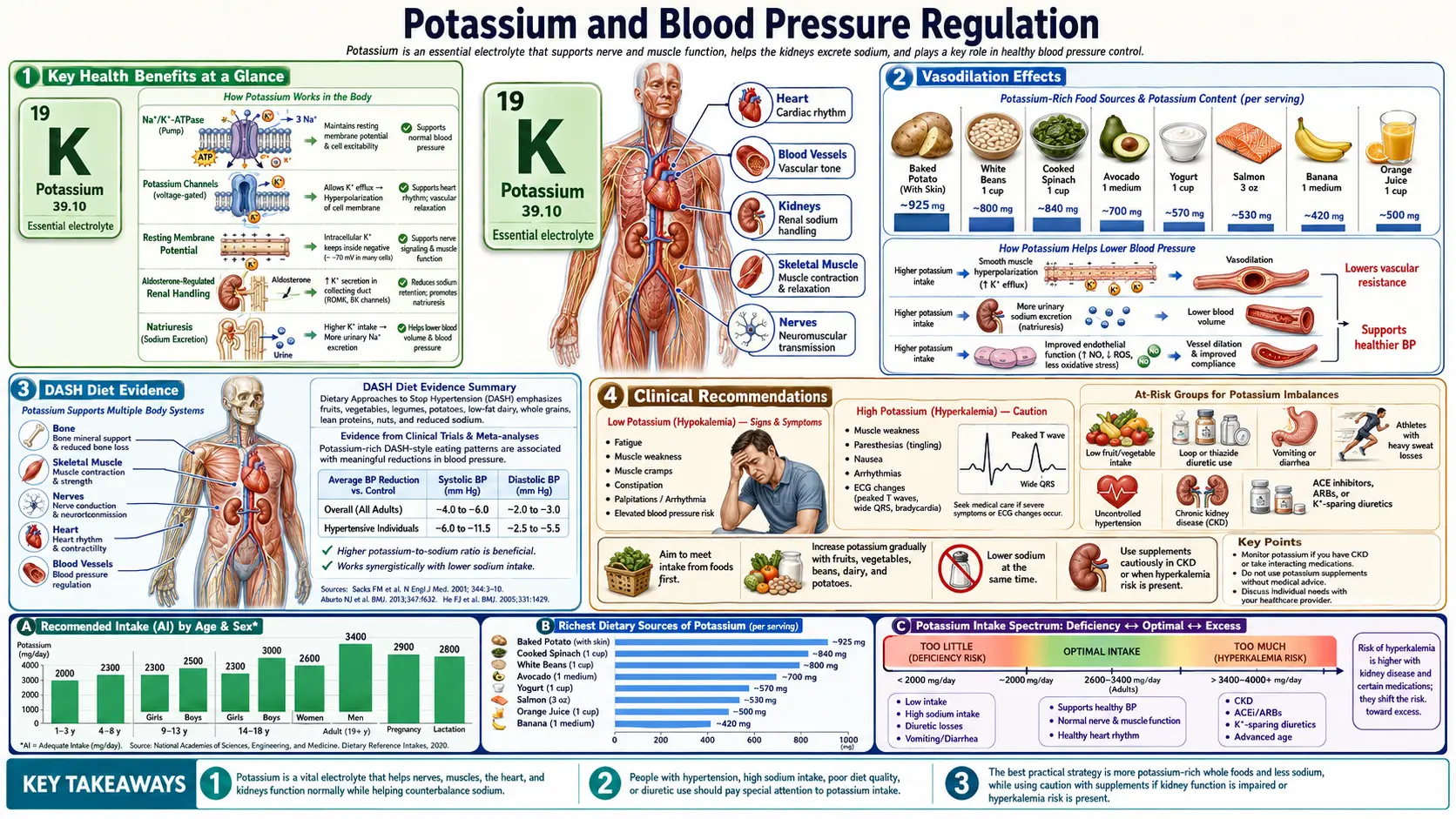
Hypertension affects more than one billion people worldwide and remains the leading modifiable risk factor for cardiovascular disease, stroke, and chronic kidney disease. While sodium restriction has long been the primary dietary recommendation for blood pressure management, a substantial body of evidence now establishes that potassium intake is equally important. The relationship between potassium and blood pressure is mediated through multiple physiological mechanisms — vascular smooth muscle relaxation, endothelial nitric oxide signaling, renal sodium handling, and autonomic modulation — and increasing dietary potassium represents one of the most effective nutritional strategies for reducing blood pressure at both the individual and population level.
Meta-analyses of randomized controlled trials consistently show that correcting inadequate potassium intake lowers systolic blood pressure by 3–5 mmHg and diastolic by 2 mmHg, with larger effects in hypertensive and high-sodium populations. Dietary patterns rich in potassium, such as the DASH diet, produce even greater reductions. This page examines the mechanisms linking potassium to blood pressure, the landmark clinical evidence, practical dietary recommendations, and safety considerations.
Interactive Visualization The Sodium–Potassium Pump — why you have a voltage Run the pump that gives every cell its charge — three sodium out, two potassium in, on Mg-ATP — then drop the magnesium and see exactly why low potassium refuses to correct. Launch →
Table of Contents
- Key Health Benefits at a Glance
- Sodium-Potassium Balance
- Vasodilation Effects
- Renal Sodium Excretion
- DASH Diet Evidence
- Potassium Deficiency and Hypertension
- Clinical Recommendations
- Research Papers and References
- Connections
- Featured Videos
Key Health Benefits at a Glance
The following is a high-level summary of the evidence-backed blood-pressure benefits of adequate potassium intake. Each is explored in more depth below, and every supporting study is linked in the Research Papers section.
- Lowers systolic and diastolic blood pressure – The Whelton et al. 1997 JAMA meta-analysis of 33 RCTs found that potassium supplementation reduced systolic blood pressure by 3.1 mmHg and diastolic by 2.0 mmHg overall, with larger effects in hypertensive individuals.
- Greater effect in hypertensives and high-sodium consumers – Blood pressure reductions are amplified in those with established hypertension, African ancestry, and high sodium intake — populations with the largest baseline burden.
- Reduces stroke risk – The Aburto 2013 BMJ meta-analysis documented that higher potassium intake reduces stroke risk by approximately 24%, independent of blood pressure.
- Improves the sodium-to-potassium ratio – The Na:K ratio is a stronger predictor of blood pressure and cardiovascular outcomes than either electrolyte alone.
- Promotes vasodilation – Potassium activates endothelial nitric oxide synthase and inward rectifier potassium channels, relaxing vascular smooth muscle and lowering peripheral resistance.
- Enhances natriuresis – High-potassium diets increase renal sodium excretion through WNK-SPAK-NCC signaling in the distal nephron.
- Reduces salt sensitivity – Potassium repletion can partially convert a salt-sensitive blood pressure phenotype to a salt-resistant one.
- DASH diet efficacy is largely potassium-driven – The DASH diet's 11 mmHg systolic reduction in hypertensives is attributed substantially to its ~4,700 mg/day potassium content.
- Salt-substitute trials confirm cardiovascular benefit – The SSaSS trial (2021, NEJM) showed a potassium-enriched salt substitute reduced stroke by 14% and major CV events by 13%.
Sodium-Potassium Balance
Blood pressure regulation cannot be understood by examining sodium or potassium in isolation. The two minerals operate as a physiological pair, and it is their ratio that most strongly predicts cardiovascular outcomes.
- Reciprocal relationship – Sodium and potassium exert opposing effects on blood pressure. Sodium promotes fluid retention and vasoconstriction, while potassium promotes natriuresis and vasodilation. A high sodium-to-potassium ratio in the diet amplifies the hypertensive effect of sodium, while a low ratio is protective.
- Epidemiological data – The INTERSALT study, which examined over 10,000 individuals across 32 countries, found that the urinary sodium-to-potassium ratio was more strongly correlated with blood pressure than either electrolyte alone. Populations with the lowest sodium-to-potassium ratios consistently exhibited the lowest blood pressure levels and the least age-related rise in blood pressure.
- Cellular mechanisms – At the cellular level, the Na+/K+-ATPase pump maintains low intracellular sodium and high intracellular potassium. When dietary potassium is insufficient, the pump operates less efficiently, allowing intracellular sodium to rise in vascular smooth muscle cells, increasing calcium entry through the sodium-calcium exchanger, promoting vasoconstriction, and elevating peripheral vascular resistance.
- Clinical implication – Correcting the sodium-to-potassium ratio through both sodium reduction and potassium augmentation produces greater blood pressure lowering than either intervention alone. The World Health Organization recommends a sodium-to-potassium molar ratio of less than 1.0 for optimal cardiovascular health.
Vasodilation Effects
Potassium exerts direct vasodilatory effects on blood vessels through several distinct pathways, reducing total peripheral resistance and thereby lowering arterial blood pressure.
- Endothelium-dependent vasodilation – Potassium stimulates the endothelial Na+/K+-ATPase, which hyperpolarizes endothelial cells and activates endothelial nitric oxide synthase (eNOS). The resulting increase in nitric oxide production causes relaxation of underlying vascular smooth muscle. Studies have shown that acute potassium infusion increases forearm blood flow by 40–50% in healthy volunteers, an effect that is abolished by NOS inhibitors.
- Potassium channel activation – Elevated extracellular potassium directly activates inward rectifier potassium channels (Kir) on vascular smooth muscle cells, causing membrane hyperpolarization. This closes voltage-gated calcium channels, reduces intracellular calcium concentration, and promotes vasodilation.
- Reduced vascular sensitivity to vasoconstrictors – Potassium supplementation has been shown to reduce the vasoconstrictor response to norepinephrine and angiotensin II in experimental models. This blunting of vasoconstrictor sensitivity contributes to lower vascular resistance during periods of adequate potassium intake.
- Anti-inflammatory and anti-proliferative effects – Adequate potassium intake reduces vascular inflammation and inhibits smooth muscle cell proliferation, processes that contribute to arterial stiffening and chronic elevation of blood pressure. Potassium suppresses the formation of reactive oxygen species in endothelial cells and reduces the expression of pro-inflammatory adhesion molecules.
Renal Sodium Excretion
The kidney is the primary organ responsible for long-term blood pressure regulation, and potassium profoundly influences renal sodium handling.
- Proximal tubule effects – High potassium intake reduces sodium reabsorption in the proximal tubule by suppressing the activity of the sodium-hydrogen exchanger (NHE3) and the sodium-phosphate cotransporter. This increases sodium delivery to the distal nephron and promotes natriuresis.
- Distal nephron mechanisms – In the collecting duct, potassium and sodium handling are linked through the epithelial sodium channel (ENaC) and the renal outer medullary potassium channel (ROMK). Increased potassium intake stimulates potassium secretion through ROMK, which creates a favorable electrical gradient for sodium excretion. Additionally, high dietary potassium suppresses the sodium-chloride cotransporter (NCC) in the distal convoluted tubule through a WNK kinase-dependent pathway, further promoting sodium excretion.
- Aldosterone modulation – While potassium loading stimulates aldosterone secretion (which would normally promote sodium retention), the concurrent direct effects of potassium on tubular sodium transporters override this aldosterone-mediated sodium retention, resulting in a net increase in sodium excretion.
- Pressure natriuresis – Potassium enhances the kidney's pressure-natriuresis relationship, meaning that for any given level of arterial pressure, sodium excretion is greater when potassium intake is adequate. This effectively shifts the set point for blood pressure regulation downward.
DASH Diet Evidence
The Dietary Approaches to Stop Hypertension (DASH) trials provide some of the strongest clinical evidence for the blood-pressure-lowering effect of potassium-rich diets.
- Original DASH trial – The landmark DASH trial (Appel et al., NEJM 1997) randomized 459 adults to a control diet, a diet rich in fruits and vegetables, or the full DASH diet (rich in fruits, vegetables, and low-fat dairy products with reduced saturated fat). The DASH diet, which provided approximately 4,700 mg of potassium daily compared to 1,700 mg in the control diet, reduced systolic blood pressure by 5.5 mmHg and diastolic blood pressure by 3.0 mmHg overall. In participants with hypertension, the reduction was 11.4 mmHg systolic and 5.5 mmHg diastolic.
- DASH-Sodium trial – The subsequent DASH-Sodium trial (Sacks et al., NEJM 2001) demonstrated that combining the DASH diet with sodium restriction produced additive blood pressure reductions. The greatest effects were seen in hypertensive individuals consuming the DASH diet with the lowest sodium level, who achieved systolic blood pressure reductions of up to 12.6 mmHg compared to the high-sodium control diet.
- Potassium as the key mediator – Analyses of the DASH data suggest that the high potassium content of the diet is one of its primary active components. The fruits-and-vegetables arm, which was high in potassium but not in calcium or protein, achieved approximately 70% of the blood pressure reduction seen with the full DASH diet, underscoring the importance of potassium.
- Long-term outcomes – Observational follow-up studies and meta-analyses indicate that DASH-pattern diets are associated with reduced risk of coronary heart disease events by 20–25%, stroke by 18–27%, and heart failure by 37%, effects that are largely mediated through blood pressure reduction.
Potassium Deficiency and Hypertension
Inadequate potassium intake is both a cause and an aggravating factor in the development and progression of hypertension.
- Prevalence of inadequacy – National dietary surveys consistently show that most adults in industrialized countries consume far less potassium than the recommended adequate intake. In the United States, the average potassium intake is approximately 2,400–2,800 mg/day, well below the 3,400 mg/day AI for men and 2,600 mg/day AI for women. The modern Western diet, with its emphasis on processed foods and reduced intake of whole fruits and vegetables, is inherently potassium-poor and sodium-rich.
- Experimental evidence – Controlled potassium depletion studies in normotensive individuals have demonstrated that restricting potassium intake to below 1,000 mg/day for as little as two weeks produces measurable increases in blood pressure, sodium retention, and intravascular volume expansion. These effects are fully reversed by potassium repletion.
- Salt sensitivity – Potassium depletion increases the sensitivity of blood pressure to dietary sodium. Individuals who are "salt-sensitive" (those whose blood pressure rises significantly with sodium loading) tend to have lower potassium intakes and lower urinary potassium excretion than salt-resistant individuals. Potassium supplementation can partially convert a salt-sensitive phenotype to a salt-resistant one.
- Diuretic-induced hypokalemia – Thiazide and loop diuretics, commonly prescribed for hypertension, cause renal potassium wasting. The resulting hypokalemia can partially offset the blood-pressure-lowering effect of the diuretic and increase the risk of cardiac arrhythmias. This observation underscores the importance of monitoring and maintaining potassium levels during diuretic therapy.
Clinical Recommendations
Based on the totality of evidence, several clinical and public health recommendations can be made regarding potassium and blood pressure management.
- Dietary potassium targets – Adults should aim for a potassium intake of at least 3,500–4,700 mg/day, primarily from dietary sources. This can be achieved by consuming 8–10 servings of fruits and vegetables daily, along with legumes, dairy products, and fish. Potassium-rich foods include bananas (422 mg per medium fruit), baked potato with skin (926 mg), spinach (839 mg per cooked cup), white beans (1,004 mg per cooked cup), and avocado (690 mg per whole fruit).
- Sodium-to-potassium ratio – Rather than focusing exclusively on sodium restriction, clinical guidance should emphasize achieving a favorable sodium-to-potassium ratio. Replacing processed foods with whole foods naturally increases potassium and decreases sodium intake simultaneously.
- Supplementation considerations – Potassium supplements (typically potassium chloride) may be appropriate for patients who cannot achieve adequate intake through diet alone, particularly those taking potassium-wasting diuretics. However, supplementation should be undertaken with medical supervision, as excessive potassium intake can cause hyperkalemia, especially in patients with impaired renal function, diabetes, or those taking medications that impair potassium excretion (ACE inhibitors, ARBs, potassium-sparing diuretics).
- Meta-analytic evidence – A comprehensive meta-analysis of 33 randomized controlled trials (Whelton et al., JAMA 1997) found that potassium supplementation (median dose of approximately 75 mmol/day, or about 2,900 mg/day of elemental potassium) reduced systolic blood pressure by 3.1 mmHg and diastolic blood pressure by 2.0 mmHg. The effect was greater in hypertensive individuals (systolic reduction of 4.4 mmHg) and in those with higher sodium intakes.
- Special populations – Patients with chronic kidney disease (eGFR below 45 mL/min) require individualized potassium guidance, as impaired renal excretion increases the risk of hyperkalemia. In these patients, the blood-pressure-lowering benefits of potassium must be balanced against the risk of dangerous potassium accumulation. Regular monitoring of serum potassium and renal function is essential.
- Population-level strategy – Reformulating processed foods to replace sodium chloride with potassium chloride-containing salt substitutes has emerged as a promising population-level intervention. The Salt Substitute and Stroke Study (SSaSS), a cluster-randomized trial of over 20,000 participants, demonstrated that a salt substitute containing 75% sodium chloride and 25% potassium chloride reduced the risk of stroke by 14% and major cardiovascular events by 13%, without a significant increase in hyperkalemia-related adverse events.
This content is provided for informational purposes only and does not constitute medical advice. Individuals with chronic kidney disease, those taking ACE inhibitors, ARBs, or potassium-sparing diuretics, and anyone with a history of hyperkalemia should consult a physician before initiating potassium supplementation.
Research Papers and References
The following are landmark and frequently cited research papers underpinning the claims on this page. Links resolve to the publisher DOI or PubMed record.
Landmark Clinical Trials
- Appel LJ, Moore TJ, Obarzanek E, et al. A clinical trial of the effects of dietary patterns on blood pressure (DASH). New England Journal of Medicine. 1997;336(16):1117-1124.
- Sacks FM, Svetkey LP, Vollmer WM, et al. Effects on blood pressure of reduced dietary sodium and the DASH diet (DASH-Sodium). New England Journal of Medicine. 2001;344(1):3-10.
- Whelton PK, He J, Cutler JA, et al. Effects of oral potassium on blood pressure: meta-analysis of randomized controlled clinical trials. JAMA. 1997;277(20):1624-1632.
- Neal B, Wu Y, Feng X, et al. Effect of salt substitution on cardiovascular events and death (SSaSS). New England Journal of Medicine. 2021;385(12):1067-1077.
Meta-Analyses and Systematic Reviews
- Aburto NJ, Hanson S, Gutierrez H, Hooper L, Elliott P, Cappuccio FP. Effect of increased potassium intake on cardiovascular risk factors and disease: systematic review and meta-analysis. BMJ. 2013;346:f1378.
- PubMed — Potassium intake and blood pressure meta-analyses
- PubMed — DASH diet and blood pressure meta-analyses
Mechanism Reviews
- PubMed — Potassium, vascular endothelium, and nitric oxide
- PubMed — WNK kinase, NCC regulation, and distal nephron potassium handling
- PubMed — INTERSALT Study and the sodium-potassium ratio
External Authoritative Resources
- NIH Office of Dietary Supplements — Potassium Fact Sheet for Health Professionals
- Linus Pauling Institute — Micronutrient Information Center: Potassium
- Harvard T.H. Chan School of Public Health — The Nutrition Source: Potassium
- PubMed — Potassium and blood pressure RCT search
Connections
- All Minerals
- The Sodium–Potassium Pump — interactive animation
- Potassium
- Potassium Benefits Hub
- Potassium-Rich Foods
- Potassium and Heart Rhythm
- Potassium and Muscle Function
- Hypertension
- Calcium
- Magnesium
- Magnesium and Heart Health
- Bananas
- Avocado
- Kidney Disease
- Heart Failure
- Atrial Fibrillation
- Stroke
- Vitamin D3
- Celery Juice and Blood Pressure
- Stress Management