Potassium: Food Sources & Daily Intake
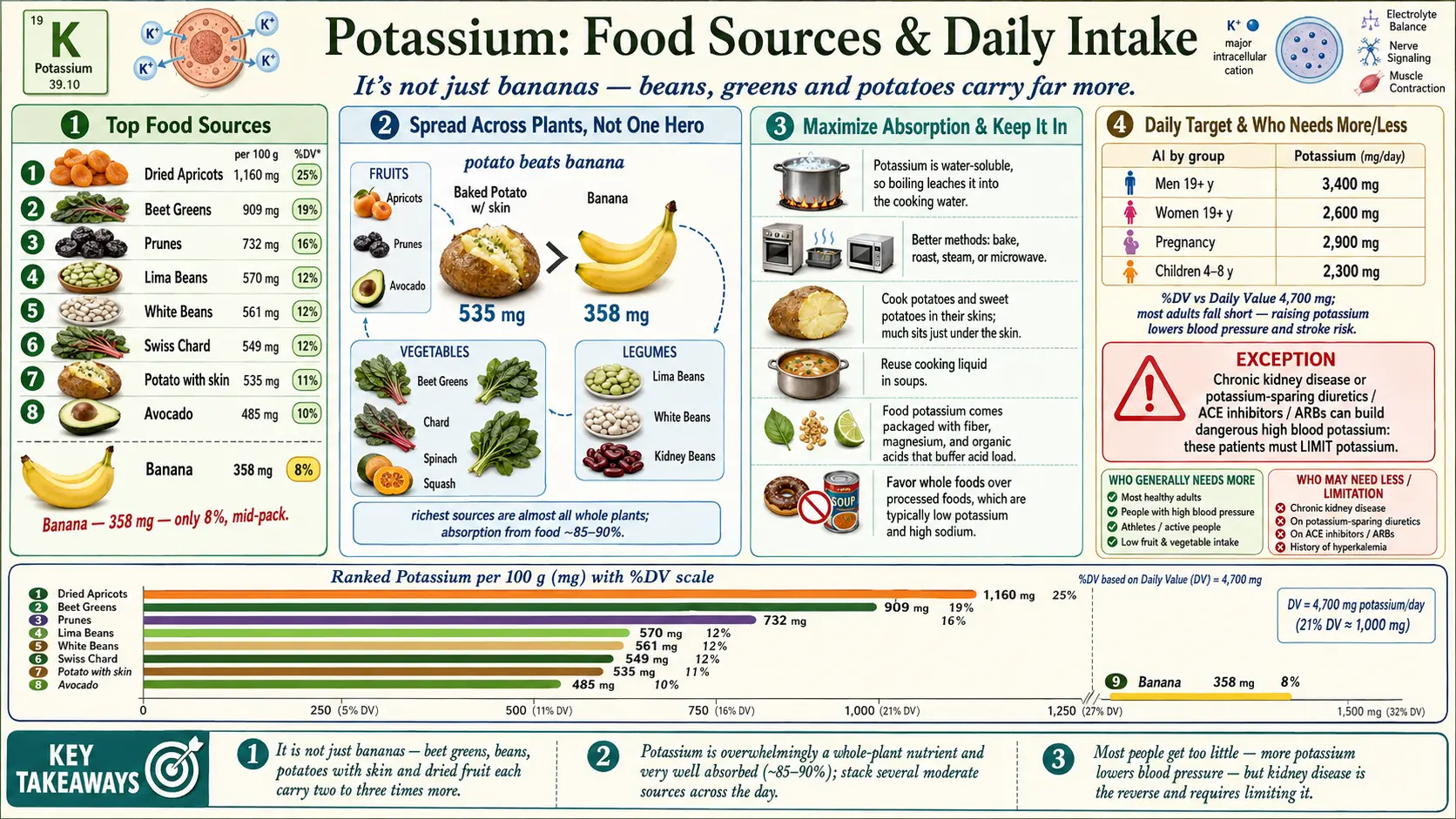
Potassium is the main mineral inside your cells, the mirror image of sodium, which sits mostly outside them. Health hinges on the balance between the two: a diet high in potassium and lower in sodium relaxes blood-vessel walls and helps the kidneys shed excess salt, which is why higher potassium intake is tied to lower blood pressure and stroke risk. It is overwhelmingly a whole-plant nutrient — beans, leafy greens, potatoes, squash and fruit dominate — and despite the banana’s reputation, plenty of everyday foods carry far more.
| Potassium: Food Sources & Daily Intake | ||||||
|---|---|---|---|---|---|---|
| Rank | Food (serving) | Per 100 g | %DV / 100g | Glucose | Fructose | Notes |
| 1 | Dried Apricots ½ cup / 65 g | 1,160 mg | 🟡 25% | 33.1 | 12.5 | Drying concentrates the mineral into a compact, snackable form. |
| 2 | Beet Greens 1 cup cooked / 144 g | 909 mg | 🟡 19% | — | — | One of the highest whole-food sources — far more than a banana. |
| 3 | Prunes ½ cup / 87 g | 732 mg | 🟡 16% | 25.5 | 12.4 | |
| 4 | Lima Beans 1 cup cooked / 188 g | 570 mg | 🟡 12% | — | — | |
| 5 | White Beans 1 cup cooked / 179 g | 561 mg | 🟡 12% | — | — | Beans, not bananas, are the quiet workhorses of potassium. |
| 6 | Swiss Chard ½ cup cooked / 88 g | 549 mg | 🟡 12% | — | — | |
| 7 | Potato (With Skin) 1 medium baked / 173 g | 535 mg | 🟡 11% | 0.4 | 0.3 | Most of the potassium sits just under the skin, so leave it on. |
| 8 | Salmon 1 small fillet / 119 g | 505 mg | 🟡 11% | — | — | |
| 9 | Avocado ½ fruit / 100 g | 485 mg | 🟡 10% | 0.4 | 0.1 | |
| 10 | Sweet Potato 1 medium baked / 114 g | 475 mg | 🟡 10% | 0.6 | 0.5 | |
| 11 | Spinach ½ cup cooked / 90 g | 466 mg | ⚪ 10% | — | — | Cooking shrinks the leaves, so a modest portion is concentrated. |
| 12 | Acorn Squash 1 cup baked / 205 g | 437 mg | ⚪ 9% | — | — | |
| 13 | Kidney Beans 1 cup cooked / 177 g | 403 mg | ⚪ 9% | — | — | |
| 14 | Banana 1 medium / 118 g | 358 mg | ⚪ 8% | 5.0 | 4.8 | Famous for potassium, but mid-pack — beans and greens beat it. |
| 15 | Halibut 3 oz cooked / 85 g | 344 mg | ⚪ 7% | — | — | |
| 16 | Coconut Water 1 cup / 240 g | 250 mg | ⚪ 5% | — | — | |
| 17 | Brown Rice 1 cup / 195 g | 86 mg | ⚪ 2% | 0 | 0 | Common staple. |
| 18 | Beef Organ Meats 3 oz / 85 g | 135 mg | ⚪ 3% | 0 | 0 | Nutrient-dense organ meat. |
| 19 | Pork Organ Meats 3 oz / 85 g | 143 mg | ⚪ 3% | — | — | Nutrient-dense organ meat. |
| 20 | Chicken Organ Meats 3 oz / 85 g | 153 mg | ⚪ 3% | — | — | Nutrient-dense organ meat (giblets). |
Interactive Visualization The Sodium–Potassium Pump — why you have a voltage Run the pump that gives every cell its charge — three sodium out, two potassium in, on Mg-ATP — then drop the magnesium and see exactly why low potassium refuses to correct. Launch →
Table of Contents
- How to Read These Tables
- Recommended Intakes & Upper Limits
- Bioavailability & Absorption
- Cooking & Storage
- Vegetarian & Vegan Sources
- Who Needs to Pay Attention
- Data Sources & References
- Connections
- Featured Videos
How to Read These Tables
- It is not just bananas. A banana is a fine snack, but it is mid-pack for potassium. A cup of beet greens, a baked potato with its skin, a cup of white beans or a serving of acorn squash each carries roughly two to three times as much. Variety beats relying on any one food.
- %DV vs your AI. The %DV column compares a serving against the FDA Daily Value of 4,700 mg — a single high benchmark used on labels. Your personal target is the Adequate Intake in the table below (3,400 mg for adult men, 2,600 mg for women), so a food can be potassium-rich even when its %DV looks modest.
- Per 100 g vs per serving. Per-100 g lets you compare foods fairly; the serving size shown beside each food is what you actually eat. Most people fall short of the AI, so the goal is to stack several moderate sources across the day rather than chase one big number.
Recommended Intakes & Upper Limits
Your personal target depends on age, sex and pregnancy. The Daily Value used for the %DV column above is a single label figure; the table below is the age-specific guidance.
| Life stage | RDA / AI (mg/day) | Upper limit (mg/day) |
|---|---|---|
| Infants 0–6 mo | 400* (AI) | Not set |
| Infants 7–12 mo | 860* (AI) | Not set |
| Children 1–3 y | 2,000* (AI) | Not set |
| Children 4–8 y | 2,300* (AI) | Not set |
| Males 9–13 y | 2,500* (AI) | Not set |
| Males 14–18 y | 3,000* (AI) | Not set |
| Males 19+ y | 3,400* (AI) | Not set |
| Females 9–13 y | 2,300* (AI) | Not set |
| Females 14–18 y | 2,300* (AI) | Not set |
| Females 19+ y | 2,600* (AI) | Not set |
| Pregnancy 14–18 y | 2,600* (AI) | Not set |
| Pregnancy 19–50 y | 2,900* (AI) | Not set |
| Lactation 14–18 y | 2,500* (AI) | Not set |
| Lactation 19–50 y | 2,800* (AI) | Not set |
Bioavailability & Absorption
Potassium from whole foods is very well absorbed — on the order of 85–90% — and the body is excellent at fine-tuning its own levels: healthy kidneys excrete whatever is surplus, which is why there is no Upper Intake Level for food. There is a meaningful difference between food potassium and supplemental potassium salts. The potassium woven into beans, greens and fruit comes packaged with fiber, magnesium and organic acids (which the body turns into bicarbonate, buffering acid load), and it raises blood potassium gently. Concentrated supplement doses, by contrast, hit the bloodstream faster and are capped by law at low amounts. For nearly everyone, the smart move is to get potassium from the plate, not a pill.
Cooking & Storage
Potassium is water-soluble, so the single biggest avoidable loss is boiling: the mineral leaches out into the cooking water and gets poured down the drain — a pot of boiled potatoes or greens can shed a large share of its potassium that way. To keep the most, bake, roast, steam or microwave instead, cook potatoes and sweet potatoes in their skins, and if you do boil, use the cooking liquid in a soup or sauce so the potassium isn’t wasted. (People who need to limit potassium for kidney reasons sometimes use boiling deliberately, for exactly this reason — see below.)
Vegetarian & Vegan Sources
This is one of the easiest nutrients for plant-based eaters — in fact the richest sources are almost all plants. Beans and lentils, leafy greens, potatoes and sweet potatoes, winter squash, avocado, tomatoes and dried fruit are potassium powerhouses, and a varied whole-food vegan or vegetarian diet typically delivers more potassium than a standard omnivorous one. There is no animal-source gap to plan around; the only caution is the same for everyone — favor whole foods over heavily processed ones, which lose potassium and add sodium.
Who Needs to Pay Attention
For most people the problem is too little, not too much: the large majority of adults fall short of the AI, largely because diets lean heavy on processed food (high sodium, low potassium) and light on vegetables, beans and fruit. Raising potassium toward the AI is one of the best-supported dietary moves for lowering blood pressure and easing the strain of a high-salt diet. The important exception runs the other way: people with chronic kidney disease, reduced kidney function, or on certain medicines (potassium-sparing diuretics, ACE inhibitors, ARBs) can build up dangerously high blood potassium, which strains the heart. If you have kidney disease you may need to LIMIT potassium and should follow the targets your care team sets — the general advice to eat more potassium does not apply to you. Everyone else is best served getting potassium from food, where overload is not a realistic risk.
Data Sources & References
- NIH Office of Dietary Supplements — Potassium Fact Sheet (AI by life stage; no UL)
- Linus Pauling Institute — Potassium Micronutrient Information Center
- PubMed — potassium intake and blood pressure (effect on hypertension and stroke)
- PubMed — sodium-to-potassium ratio and cardiovascular outcomes
Connections
- All Minerals
- The Sodium–Potassium Pump — interactive animation
- Potassium (Main Page)
- Potassium Benefits
- Potassium History
- Magnesium
- Sodium & Potassium Balance
- Calcium
- Cardiology & Blood Pressure