Potassium: History and Discovery
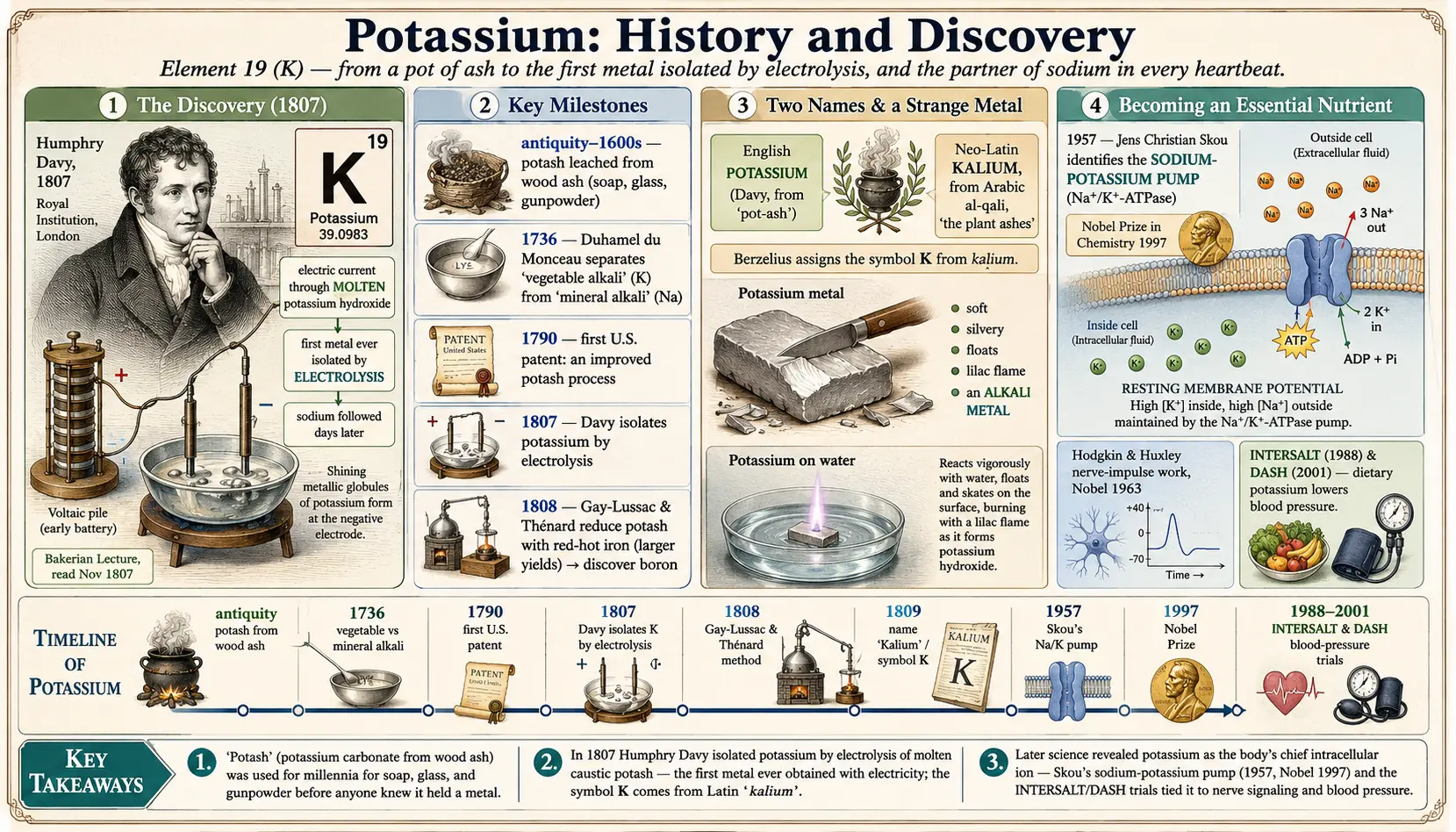
Potassium has a double history. As a substance — potash, the salt leached from wood ash and boiled down in iron pots — it was used for thousands of years to make soap, glass, bleach, and gunpowder long before anyone knew what it really was. As a chemical element, it has a precise birthday: in 1807 the English chemist Humphry Davy passed a powerful electric current through molten caustic potash and watched bright metallic globules appear — the first metal ever isolated by electricity. A second discovery, just as important for health, came much later: the slow recognition across the nineteenth and twentieth centuries that this same element is the body's principal intracellular mineral, the partner of sodium in every nerve impulse and heartbeat, and a key dietary factor in blood pressure. This article traces both stories — where the names "potassium" and the symbol K come from, who isolated the metal and when, a genuine question about who got there first, and how potassium came to be understood as essential to life. Where the record is firm we say so; where a claim is disputed or uncertain, we name it as such.
Interactive Visualization The Sodium–Potassium Pump — why you have a voltage Run the pump that gives every cell its charge — three sodium out, two potassium in, on Mg-ATP — then drop the magnesium and see exactly why low potassium refuses to correct. Launch →
Table of Contents
- Potash: The Substance Before the Element
- Two Names, One Element: Potassium and Kalium (K)
- Humphry Davy Isolates the Metal (1807)
- A Question of Priority: Davy, Gay-Lussac, and Thénard
- A Strange New Metal
- The Second Discovery: Potassium as an Essential Nutrient
- Skou and the Sodium-Potassium Pump (1957; Nobel Prize 1997)
- Potassium, Blood Pressure, and Modern Public Health
- Research Papers and References
- Connections
- Featured Videos
Potash: The Substance Before the Element
Long before potassium was known as an element, people used one of its compounds every day. Potash — chiefly potassium carbonate — was made by a simple, ancient recipe: burn wood or other plants, soak the ashes in water to dissolve the soluble salts, then boil the solution down in large iron pots until a whitish residue remained. That residue is the literal origin of the modern name: a pot of ash. The English word "potash" is documented by the mid-seventeenth century, and the practice it describes is far older.
Potash mattered economically because it was a workhorse alkali. It was used to make soap (boiled with fat), to manufacture glass, to bleach textiles, and — as saltpetre or potassium nitrate — to make gunpowder. In colonial North America, leaching wood ash for potash was a genuine frontier industry, and the first patent ever granted by the United States, in 1790, was for an improved method of making potash. None of this required knowing that potash contained a distinct metallic element; that knowledge came only later.
Eighteenth-century chemists did begin to suspect that the alkalis were not all alike. The German chemist Georg Ernst Stahl suggested in 1702 that the salts we now call sodium and potassium salts were fundamentally different substances, and the French chemist Henri-Louis Duhamel du Monceau is credited with demonstrating that distinction experimentally in 1736 — separating the "vegetable alkali" (from plant ash, our potassium) from the "mineral alkali" (soda, our sodium). What still eluded everyone was the deeper question: what were these alkalis actually made of? Answering that required a tool that did not yet exist.
Two Names, One Element: Potassium and Kalium (K)
Potassium is unusual in carrying two names that are both still in use, and this is the reason its chemical symbol — K — looks nothing like its English name. The split happened in the years right after the element was isolated.
The English name potassium was coined by Humphry Davy himself, built straightforwardly from "potash," the material he had decomposed. The competing name comes from a much older word for the same plant-ash alkali. Arabic al-qali (also rendered al-qalyah), meaning roughly "the plant ashes" or "the calcined substance," is the root of the European word alkali and, shortened, of the Neo-Latin name kalium. The German chemist Martin Heinrich Klaproth had used the term kali for the vegetable alkali in the late 1790s, and in 1809 Ludwig Wilhelm Gilbert proposed Kalium as the proper name for Davy's new metal. When the Swedish chemist Jöns Jacob Berzelius set out his influential system of one- and two-letter chemical symbols, he assigned potassium the symbol K, from kalium — the form that has been standard ever since.
The outcome was a lasting linguistic divide. English- and French-speaking countries adopted Davy's "potassium" (the French chemists Gay-Lussac and Thénard favoured it too), while German and several other languages kept "Kalium." That is why, to this day, an English speaker says potassium while the periodic table everywhere prints K: the name and the symbol simply come from two different traditions for naming the very same plant-ash alkali. Sodium tells the same story — English "sodium," symbol Na from natrium.
Humphry Davy Isolates the Metal (1807)
The decisive moment in potassium's history is well documented. In 1807, at the Royal Institution in London, Humphry Davy used the newly available power of the voltaic pile — the first electric batteries — to do something no one had managed before: pull a pure metal out of an alkali by electricity. He first tried passing current through water solutions of potash, but that only split the water into hydrogen and oxygen. The breakthrough came when he applied the current to molten caustic potash (potassium hydroxide), very slightly moistened so that it would conduct. Small, shining, intensely reactive globules of metal formed at the negative electrode. Davy had isolated potassium — the first metal ever obtained by electrolysis. A few days later, by the same method, he isolated sodium from soda.
Davy announced these results in his celebrated Bakerian Lecture, "On some new phenomena of chemical changes produced by electricity, particularly the decomposition of the fixed alkalies," read to the Royal Society of London in November 1807 and published in its Philosophical Transactions in 1808. It was a landmark not only for the two new metals but for the new science of electrochemistry that Davy was pioneering: he had shown that electricity could tear apart compounds previously thought to be simple, revealing the metallic "bases" hidden inside the common alkalis.
It is worth being precise about what Davy did and did not do. He did not discover potash, which had been in use for millennia, and he did not discover that potassium is in our food. What he discovered was the element: that the familiar alkali potash is the compound of a previously unknown, soft, silvery, violently reactive metal. That single experiment converted potassium from a useful powder into a named chemical element — and it is the reason potassium's "discovery" is dated to 1807 and credited to Davy.
A Question of Priority: Davy, Gay-Lussac, and Thénard
Davy's priority for the first isolation of potassium is not seriously disputed: he reached the metal first, in 1807, by electrolysis. But there is a genuine and interesting historical footnote about a rival method that followed close behind. When news of Davy's achievement reached Paris over the winter of 1807–1808, the French chemists Joseph Louis Gay-Lussac and Louis Jacques Thénard set out to obtain the new metals as well — explicitly spurred on by Davy's success.
In 1808 they announced a different, purely chemical route: heating potash with red-hot iron filings (iron turnings in a gun barrel), which reduced the potassium so that it could be collected. Their method had a practical advantage — it produced potassium, and sodium, in usefully larger quantities than Davy's delicate electrolysis, which yielded only tiny amounts. Gay-Lussac and Thénard then put their new supply of potassium to work: they used it as a powerful reducing agent to attack boric acid, and in late 1808 announced a further new element, boron.
So the honest picture is this. Davy achieved the first isolation of potassium, and the credit for its discovery is his. Gay-Lussac and Thénard independently developed a more productive chemical method for making it shortly afterward — an achievement worth remembering, but one undertaken in response to Davy's prior result rather than as a simultaneous, independent discovery. Calling it a "priority dispute" would overstate the case; it is better described as a fast and fruitful rivalry between London and Paris in the heady early years of electrochemistry.
A Strange New Metal
The metal Davy isolated was unlike anything in everyday experience, and its oddness is part of why its isolation was such a surprise. Pure potassium is a soft, silvery-white metal — soft enough to cut with a knife — and it is so light that it floats on water. It is also one of the most chemically reactive of all the common metals: a fresh-cut surface tarnishes almost instantly in air, and a piece dropped into water reacts so violently that the hydrogen released usually ignites, burning with a characteristic lilac flame. Because of this reactivity, potassium is never found free in nature; it always occurs locked up in compounds, which is exactly why it took the power of the electric battery to set it loose.
This reactivity also placed potassium in a family. Davy's work on the "fixed alkalies" helped reveal a group of similar soft, reactive, light metals — what we now call the alkali metals (lithium, sodium, potassium, and their heavier relatives), the leftmost column of the periodic table. Potassium and sodium, the two Davy isolated within days of each other, turned out to be chemical cousins whose similarities and differences would later prove central to physiology: in the body it is precisely the contrast between potassium (mostly inside cells) and sodium (mostly outside) that makes nerves fire and muscles contract, a point taken up in the sections below.
The Second Discovery: Potassium as an Essential Nutrient
Isolating the element answered the chemistry; it said nothing about biology. The second great strand of potassium's history — the discovery that it is essential to life — unfolded much more gradually, without a single dramatic moment or one obvious discoverer, across the nineteenth and twentieth centuries as physiology and analytical chemistry matured.
Several threads came together. Chemists analysing blood, muscle, and other tissues established that potassium is overwhelmingly an intracellular mineral — the great majority of the body's potassium sits inside cells — while sodium dominates the fluid outside cells. That single fact turned out to be the key to bioelectricity. As physiologists in the nineteenth and early twentieth centuries worked out how nerves and muscles generate electrical signals, the steep difference in potassium concentration across the cell membrane proved to be the foundation of the resting membrane potential, the electrical "charge" that every excitable cell must hold before it can fire. The mid-twentieth-century work on the nerve impulse — most famously the squid-axon studies of Alan Hodgkin and Andrew Huxley, recognised with the Nobel Prize in Physiology or Medicine in 1963 — placed potassium and sodium currents at the very heart of how nerve signals are made, though that prize honoured the mechanism of the nerve impulse broadly rather than the discovery of potassium itself.
Alongside the electrical story came the nutritional one. Clinicians came to recognise the syndromes of too little potassium (hypokalemia — muscle weakness, cramps, dangerous heart rhythms) and too much (hyperkalemia — equally threatening to the heart), and to understand that the kidneys, under the hormone aldosterone, are the body's master regulators of potassium balance. Out of all this, potassium was firmly established as an essential nutrient: a mineral the body cannot make, must obtain from food, and cannot function without. The detailed physiology — fluid balance, nerve and muscle signalling, heart rhythm, kidney handling — is covered on the main Potassium page; what matters historically is that "potassium is essential" was a hard-won scientific conclusion, not an ancient given.
Skou and the Sodium-Potassium Pump (1957; Nobel Prize 1997)
If one twentieth-century discovery deserves to stand beside Davy's in potassium's story, it is the identification of the molecular machine that keeps potassium inside cells and sodium out. In 1957 the Danish physiologist Jens Christian Skou (1918–2018), working at Aarhus University, published a study of an enzyme he had found in the leg-nerve membranes of the shore crab. He showed that this enzyme's activity depended on both sodium and potassium ions, and he proposed that it was the long-sought sodium-potassium pump — the membrane protein that uses the energy of ATP to push sodium out of the cell and pull potassium in, maintaining the gradients on which all nerve and muscle activity depends. The molecule is now known as Na⁺/K⁺-ATPase.
This was a profound link between Davy's element and everyday physiology: it explained, in concrete molecular terms, how the body holds potassium where it belongs. The pump is also strikingly costly to run — it consumes a large share of the body's resting energy, and an especially large fraction in the brain — which is why so much of what we eat is ultimately spent simply keeping potassium and sodium on their proper sides of the cell membrane.
Skou's discovery was honoured decades later with the Nobel Prize in Chemistry in 1997, which he shared with Paul D. Boyer and John E. Walker. Skou's half of the prize was awarded, in the committee's exact words, "for the first discovery of an ion-transporting enzyme, Na⁺, K⁺-ATPase." It is a fitting bookend to potassium's history: Davy named the element by tearing it out of an alkali with electricity in 1807; Skou, 150 years later, identified the tiny biological pump that makes that same element the currency of every heartbeat and thought.
Potassium, Blood Pressure, and Modern Public Health
The most recent chapter in potassium's history is a public-health one: the growing evidence, gathered over the last several decades, that how much potassium we eat affects blood pressure and cardiovascular risk. This is where potassium's ancient identity (a plant-ash salt, abundant in fruits and vegetables) meets modern medicine.
Large international epidemiological work pointed the way. The INTERSALT study (the International Cooperative Study on Salt, Other Factors, and Blood Pressure), reported around 1988, examined populations worldwide and found that potassium intake is an independent determinant of blood pressure — higher potassium tracking with lower pressure, separately from sodium. The landmark DASH trials of the 1990s and early 2000s (Dietary Approaches to Stop Hypertension) then showed in controlled feeding studies that a diet rich in fruits, vegetables, and low-fat dairy — and therefore rich in potassium — substantially lowered blood pressure, with the largest reductions when dietary sodium was also kept low. Later systematic reviews, including a widely cited 2013 analysis underpinning World Health Organization guidance, concluded that increasing potassium intake lowers blood pressure in adults with hypertension and is associated with a meaningfully lower risk of stroke, without harming kidney function or blood lipids in generally healthy people.
Two honest cautions belong here. First, this body of evidence is about dietary potassium, mostly from food, in the general population; it is not a blanket endorsement of potassium supplements, and people with kidney disease or on certain heart and blood-pressure medications can be harmed by extra potassium and must be guided by a clinician. Second, the public-health story is still being refined. But the broad arc is clear and rather elegant: a mineral first pulled from wood ash, then named as an element in 1807, then revealed as the body's chief intracellular ion, has in our own time become a centrepiece of dietary advice for the heart. The detailed clinical evidence, mechanisms, food sources, and dosing are covered in the companion Potassium Benefits articles; this history is concerned with how that understanding was built.
Research Papers and References
The list below pairs primary historical sources with key modern reviews of potassium in human health, plus curated PubMed topic-search links into the historical and physiological literature. Author names, titles, and journals are given as plain text; only the stable DOI, PMID, or archive link is hyperlinked, and each opens in a new tab. Each DOI and PMID below has been checked to resolve to the cited work.
- Davy H. The Bakerian Lecture: on some new phenomena of chemical changes produced by electricity, particularly the decomposition of the fixed alkalies, and the exhibition of the new substances which constitute their bases. Philosophical Transactions of the Royal Society of London. 1808;98:1-44. (Read to the Royal Society in November 1807; first isolation of potassium and sodium.) — doi:10.1098/rstl.1808.0001
- Skou JC. The influence of some cations on an adenosine triphosphatase from peripheral nerves. Biochimica et Biophysica Acta. 1957;23(2):394-401. (First description of the Na⁺/K⁺-ATPase, the sodium-potassium pump.) — Search PubMed
- The Nobel Prize in Chemistry 1997 — Jens C. Skou, "for the first discovery of an ion-transporting enzyme, Na⁺, K⁺-ATPase." The Nobel Foundation. — NobelPrize.org: Jens C. Skou, Chemistry 1997
- Sacks FM, Svetkey LP, Vollmer WM, et al. Effects on blood pressure of reduced dietary sodium and the Dietary Approaches to Stop Hypertension (DASH) diet. New England Journal of Medicine. 2001;344(1):3-10. — doi:10.1056/NEJM200101043440101
- Aburto NJ, Hanson S, Gutierrez H, Hooper L, Elliott P, Cappuccio FP. Effect of increased potassium intake on cardiovascular risk factors and disease: systematic review and meta-analyses. BMJ. 2013;346:f1378. — doi:10.1136/bmj.f1378
- Potassium — history and discovery of the element PubMed: potassium history and discovery
- Potassium homeostasis and the sodium-potassium pump PubMed: potassium homeostasis and Na/K-ATPase
External Authoritative Resources
- Encyclopædia Britannica — Potassium (chemical element)
- NIH Office of Dietary Supplements — Potassium
- NobelPrize.org — The Nobel Prize in Chemistry 1997
Connections
- All Minerals
- The Sodium–Potassium Pump — interactive animation
- Potassium
- Potassium Benefits
- Magnesium
- Calcium
- Phosphorus
- Hypertension
- Arrhythmia
- Bananas