Transferrin and TIBC Test
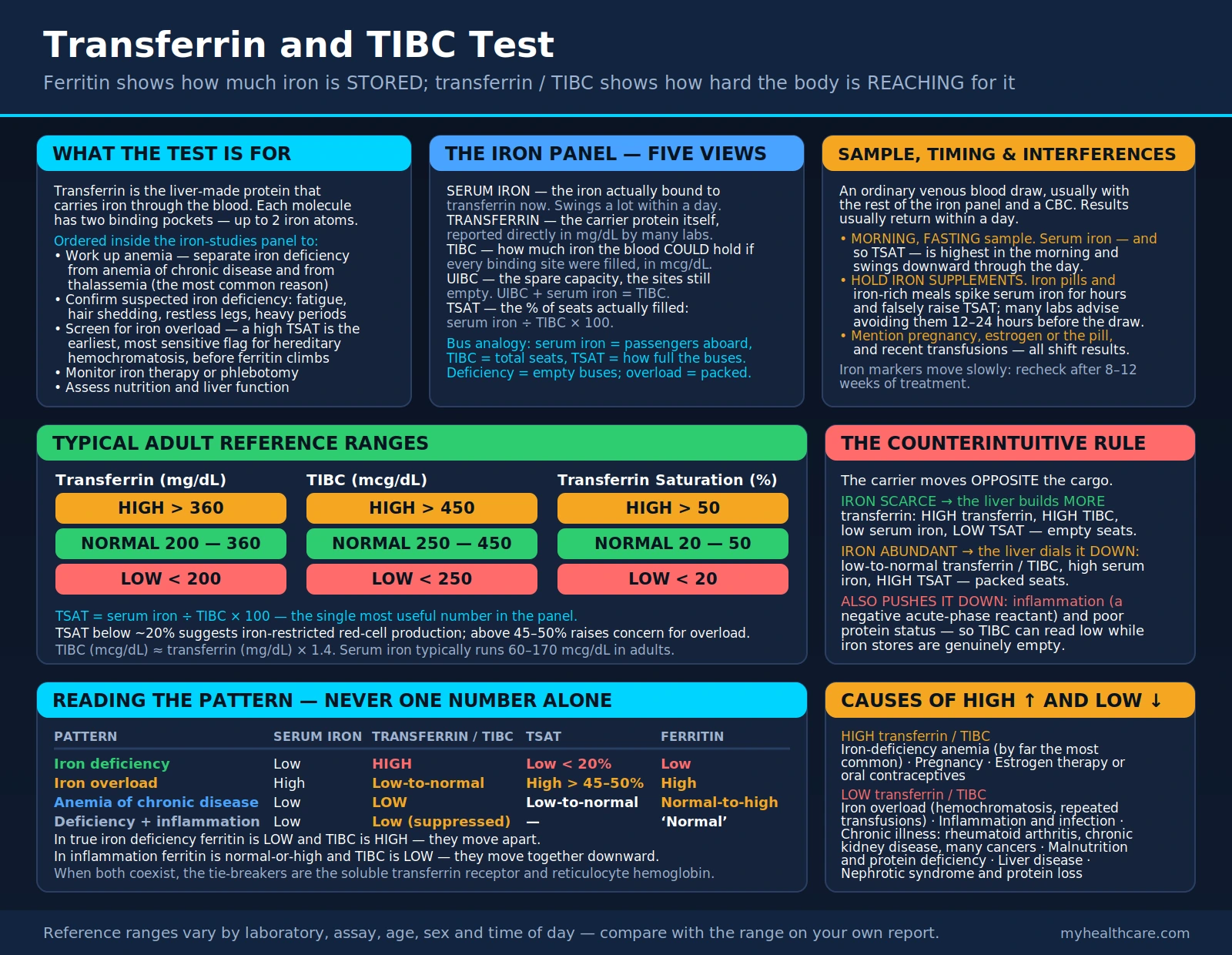
Transferrin is the blood protein that carries iron. Think of it as a fleet of taxis: iron is a reactive, potentially damaging metal, so the body never lets it float free in the bloodstream. Instead, iron rides safely from the gut and from recycled red blood cells to the bone marrow, locked inside transferrin. A transferrin (or TIBC) test measures how much of that carrier is in your blood, and it is almost always read together with two close relatives — serum iron and transferrin saturation (TSAT) — as part of an "iron studies" panel. This page explains what transferrin is, how it fits into the family of iron tests, and the one slightly counterintuitive rule that trips up most people: when your iron is low, transferrin usually goes up, and when iron is high or you are inflamed, transferrin comes down. Understanding that pattern is the key to reading these results with confidence.
Table of Contents
- What Transferrin Is
- The Family of Iron Tests: TIBC, UIBC, and TSAT
- Why the Test Is Ordered
- The Counterintuitive Rule: Transferrin Rises When Iron Falls
- Typical Reference Ranges
- Reading Transferrin With Ferritin and TSAT
- Causes of High and Low Transferrin
- Transferrin as a Negative Acute-Phase Reactant
- How the Test Is Done
- What Patients Should Ask
- Research Papers
- Connections
- Featured Videos
What Transferrin Is
Transferrin is a protein made mostly by the liver whose single most important job is to transport iron through the bloodstream. Each transferrin molecule has two binding pockets, so it can carry up to two atoms of iron at a time. It picks up iron from three main places — the cells lining the small intestine (dietary iron just absorbed), the spleen and liver macrophages (iron recycled from worn-out red blood cells), and the liver's storage pool — and delivers it to wherever the body needs it, above all the bone marrow, which consumes the lion's share to build new red blood cells.
Why bother with a dedicated carrier at all? Because free iron is dangerous. Loose iron catalyzes the formation of reactive oxygen species that damage cell membranes, proteins, and DNA. By keeping iron bound and hidden, transferrin both delivers a vital nutrient and protects your tissues from it. Cells that need iron display transferrin receptors on their surface; iron-loaded transferrin docks onto these receptors, is pulled inside, releases its cargo, and is recycled back out to fetch more. A single transferrin molecule may complete this round trip more than a hundred times in its roughly 8–10 day lifespan.
Because the liver adjusts how much transferrin it makes according to the body's iron needs, the transferrin level in your blood is not just a static number — it is a readout of how iron-hungry your body currently is. That is what makes it clinically useful, and also what makes it behave in a way that surprises people the first time they see their results.
The Family of Iron Tests: TIBC, UIBC, and TSAT
Transferrin rarely travels alone on a lab report. It belongs to a small family of measurements that all describe the same underlying reality — the balance between iron and its carrier — from slightly different angles. Understanding how they relate makes the whole panel click into place.
- Serum iron — the amount of iron actually bound to transferrin and circulating right now. This value swings a lot within a single day and after meals, so it means little on its own.
- Transferrin — the amount of the carrier protein itself, reported directly in mg/dL by many labs.
- Total iron-binding capacity (TIBC) — an indirect measure of transferrin. Rather than measuring the protein, the lab measures how much iron the blood could hold if every binding site were filled. Since transferrin supplies almost all of those sites, TIBC rises and falls essentially in step with transferrin. A rough rule of thumb many labs use is that TIBC (in mcg/dL) is close to transferrin (in mg/dL) multiplied by about 1.4.
- Unsaturated iron-binding capacity (UIBC) — the spare capacity, meaning the binding sites still empty and available. UIBC + serum iron = TIBC.
- Transferrin saturation (TSAT) — the single most useful number in the whole panel. It is simply the percentage of transferrin's seats that are actually filled with iron, calculated as serum iron divided by TIBC, times 100. If TSAT is 30%, then roughly one in three carrier seats is occupied.
Think of it as a bus system. Serum iron is the number of passengers on board. TIBC (or transferrin) is the total number of seats across the whole fleet. TSAT is how full the buses are on average. Iron deficiency looks like lots of empty buses driving around (high TIBC, low TSAT); iron overload looks like packed buses (high TSAT). A lab may report transferrin directly, or report TIBC, or both — they carry the same information, and TSAT is derived from them either way.
Why the Test Is Ordered
Transferrin and TIBC are almost never ordered in isolation. They are part of the iron-studies panel — typically serum iron, TIBC/transferrin, TSAT, and ferritin together — used to work out why a person's iron status is off. Common reasons a clinician orders the panel include:
- Working up anemia. When a complete blood count shows small, pale red cells (microcytic, hypochromic anemia), iron studies distinguish true iron-deficiency anemia from anemia of chronic disease and from other causes such as thalassemia. This is the single most common reason the test is run.
- Suspected iron deficiency in someone with fatigue, hair shedding, restless legs, breathlessness, or heavy menstrual periods — often before anemia has even developed.
- Screening for iron overload. A high transferrin saturation is the earliest and most sensitive flag for hereditary hemochromatosis, usually appearing before ferritin climbs. Persistently high TSAT prompts genetic testing.
- Monitoring treatment. Iron studies track whether oral or intravenous iron is working, or whether phlebotomy is bringing an overloaded patient's iron back down.
- Assessing nutrition and liver function. Because transferrin is made by the liver from dietary protein, an unexpectedly low transferrin can be a clue to malnutrition, protein loss, or liver disease.
The reason ferritin and TIBC are ordered together is that they answer different questions. Ferritin tells you how much iron is stored; transferrin/TIBC tells you how hard the body is reaching for iron. Read side by side, they usually point to a single clear answer.
The Counterintuitive Rule: Transferrin Rises When Iron Falls
Here is the point that surprises almost everyone: transferrin and TIBC go UP when you are iron-deficient, and DOWN when you have too much iron. The carrier moves in the opposite direction to the cargo. Once you see why, it makes perfect sense.
The liver regulates transferrin production based on how much iron it senses is available. When iron is scarce, the liver ramps up transferrin synthesis — it sends out more taxis to scavenge every last atom of iron it can find and rush it to the bone marrow. So in iron deficiency you see a high transferrin, high TIBC, low serum iron, and therefore a low TSAT (lots of empty seats). This is the body working exactly as designed: maximize the search when the resource is rare.
When iron is abundant — in hemochromatosis or repeated transfusions — the liver does the reverse and dials transferrin production down. There is no need for extra taxis when iron is everywhere. So iron overload shows a low-to-normal transferrin/TIBC with a high serum iron and a high TSAT (packed seats). A transferrin saturation above roughly 45–50% is the classic early warning sign of iron overload.
Two other situations also push transferrin down, and they are important because they can mask deficiency: inflammation (transferrin is a "negative acute-phase reactant," covered below), and poor protein status — malnutrition, liver disease, or protein loss through the kidneys or gut — because the liver simply lacks the raw material or capacity to build the protein. In those cases TIBC can be low even when iron stores are genuinely empty, which is exactly why no single iron test should ever be read alone.
Typical Reference Ranges
Reference ranges vary between laboratories, assays, age, sex, and even the time of day, so always compare your result to the range printed on your own report. The values below are common adult ballpark figures for orientation only.
Transferrin (mg/dL)
Total Iron-Binding Capacity (TIBC) (mcg/dL)
Transferrin Saturation (TSAT) (%)
A few practical notes on these numbers:
- TSAT is the number to watch. Below about 20% strongly suggests iron-restricted red-cell production (true deficiency or functional deficiency). Above 45–50% raises concern for iron overload and, if persistent, warrants investigation for hemochromatosis.
- Serum iron typically runs about 60–170 mcg/dL in adults, but it fluctuates so widely through the day (and rises sharply after iron supplements) that it is nearly meaningless without TIBC and ferritin alongside it.
- Transferrin and TIBC track together. If your lab reports one but not the other, they are describing the same thing; TSAT can be calculated from either.
- Pregnancy and estrogen (including oral contraceptives) raise transferrin/TIBC for reasons unrelated to iron deficiency — a normal physiological shift, not a red flag on its own.
Reading Transferrin With Ferritin and TSAT
The real power of these tests comes from reading them together. Any one value can mislead; the pattern across ferritin, TIBC/transferrin, and TSAT almost always tells the true story. Here is how the common patterns line up, described in plain language:
- Iron deficiency: low serum iron + high transferrin/TIBC + low TSAT (<20%) + low ferritin. The body is hungry for iron, has sent out extra carriers, and its stores are empty. This is the clearest and most satisfying pattern to read — every marker points the same way.
- Iron overload (e.g. hemochromatosis): high serum iron + low-to-normal transferrin/TIBC + high TSAT (>45–50%) + high ferritin. Seats are packed and the storerooms are overflowing.
- Anemia of chronic disease / inflammation: low serum iron + low transferrin/TIBC + low-to-normal TSAT + normal-to-high ferritin. This is the tricky one. Iron is low in the blood, yet stores are actually adequate — inflammation has locked iron away and simultaneously suppressed transferrin. The giveaway is the combination of low TIBC with a normal or high ferritin, the opposite of true deficiency.
- Both deficiency and inflammation together: a genuinely hard case. TIBC may be pulled down by inflammation while stores are truly empty, so ferritin sits in a confusing "normal" middle. Here clinicians turn to extra tests such as the soluble transferrin receptor or reticulocyte hemoglobin content, which stay reliable even when inflammation muddies the usual markers.
The single most useful mental shortcut: in true iron deficiency, ferritin is LOW and TIBC is HIGH — they move apart. In inflammation, ferritin is normal-or-high and TIBC is LOW — they move together downward. That contrast, more than any single number, is what lets a clinician tell the two apart.
Causes of High and Low Transferrin
Causes of HIGH transferrin / TIBC:
- Iron-deficiency anemia — by far the most common reason. The liver overproduces the carrier to hunt for scarce iron.
- Pregnancy — a normal rise driven by higher estrogen and increased iron demand.
- Estrogen therapy or oral contraceptives — estrogen stimulates hepatic transferrin production.
Causes of LOW transferrin / TIBC:
- Iron overload (hereditary hemochromatosis, repeated transfusions) — the liver dials the carrier down when iron is plentiful.
- Inflammation and infection — transferrin falls as a negative acute-phase reactant (see next section).
- Chronic illness such as rheumatoid arthritis, chronic kidney disease, and many cancers, which combine inflammation with other effects on the liver.
- Malnutrition and protein deficiency — the liver lacks amino acids to build transferrin. Because transferrin has a shorter half-life than albumin, it can fall early and has been used as a nutritional marker.
- Liver disease — a damaged or cirrhotic liver simply makes less transferrin.
- Nephrotic syndrome and protein-losing conditions — transferrin, a mid-sized protein, is lost through leaky kidneys or gut along with other proteins.
Notice that low transferrin has both "good news" and "bad news" causes — it can mean the body is comfortably iron-replete (overload) or that something systemic is going on (inflammation, malnutrition, organ disease). That ambiguity is precisely why transferrin is read in the context of ferritin, TSAT, inflammatory markers, and the clinical picture rather than on its own.
Transferrin as a Negative Acute-Phase Reactant
During inflammation, infection, or major tissue injury, the liver reprioritizes which proteins it manufactures. It ramps up "positive" acute-phase proteins such as C-reactive protein, fibrinogen, and ferritin, and it ramps down a handful of "negative" acute-phase proteins — albumin, prealbumin, and transferrin among them. So transferrin and TIBC characteristically fall when the body is inflamed.
This matters enormously for interpreting iron tests, because it is a big part of why anemia of chronic disease looks the way it does. In an inflamed patient you often see low serum iron (iron is deliberately hidden from invading microbes and shunted into storage), low TIBC (transferrin is suppressed), and a normal-or-high ferritin (which is itself pushed up by inflammation). Someone who did not know transferrin behaves this way might misread the low serum iron as simple deficiency and prescribe iron that will not help.
The practical takeaways:
- Always interpret a low TIBC in light of whether the person is inflamed. A simultaneous C-reactive protein (CRP) or ESR helps enormously.
- In true iron deficiency, ferritin is low and TIBC is high. When inflammation is present, that clean picture blurs — ferritin can look falsely reassuring while TIBC is falsely low.
- When inflammation and possible deficiency coexist, tests that are not distorted by the acute-phase response — such as the soluble transferrin receptor — become valuable tie-breakers.
How the Test Is Done
The test is a simple, ordinary blood draw — a small sample taken from a vein in the arm, usually alongside the rest of an iron panel and often a complete blood count. There is no special preparation for the blood draw itself beyond what your clinician advises, but a few timing details genuinely affect the numbers:
- Morning, fasting sample. Serum iron and therefore transferrin saturation are highest in the morning and swing downward through the day. Because of this daily rhythm, iron studies are best drawn in the morning after an overnight fast so results can be compared consistently over time. Transferrin/TIBC itself is fairly stable, but TSAT depends on serum iron, so timing matters for the panel as a whole.
- Hold iron supplements first. Iron pills and iron-rich meals can spike serum iron for hours and falsely raise TSAT. Many labs advise avoiding iron supplements for about 12–24 hours before the draw — ask which applies to you rather than guessing.
- Note your medications and status. Pregnancy, estrogen or oral contraceptives, and recent transfusions all shift the results and are worth mentioning so your clinician can interpret them correctly.
Results usually return within a day. The report may list transferrin, TIBC, UIBC, serum iron, and TSAT in various combinations depending on the lab; remember that transferrin and TIBC are two views of the same thing, and TSAT is calculated from serum iron and TIBC.
What Patients Should Ask
If your iron studies come back abnormal, a handful of focused questions will help you understand what the numbers actually mean for you:
- "Do my results point to iron deficiency, iron overload, or inflammation?" Ask your clinician to read the ferritin, TIBC/transferrin, and TSAT together as a pattern rather than reacting to one flagged value.
- "Was this drawn fasting in the morning, and had I taken any iron beforehand?" Timing and supplements can distort serum iron and TSAT; a borderline result may simply need a repeat under standard conditions.
- "Could inflammation be affecting these numbers?" If so, a CRP or ESR — and possibly a soluble transferrin receptor — can help separate true deficiency from anemia of chronic disease.
- "If I'm iron-deficient, what's the underlying cause?" Iron deficiency is a symptom, not a diagnosis. In adults it warrants a look for the source of loss — heavy periods, gastrointestinal bleeding, poor absorption — not just a bottle of iron pills.
- "If my transferrin saturation is high, should I be tested for hemochromatosis?" Persistently elevated TSAT is the trigger for genetic screening, and early-treated hemochromatosis has an excellent outlook.
- "How and when should we recheck?" Iron markers respond slowly; rechecking after 8–12 weeks of treatment usually shows whether things are moving in the right direction.
This page is general health information, not medical advice. Your own results should always be interpreted by a clinician who knows your history.
Research Papers
- Camaschella C. Iron-deficiency anemia. New England Journal of Medicine. 2015;372(19):1832–1843. doi:10.1056/NEJMra1401038 — authoritative clinical review of how iron studies, including transferrin saturation and TIBC, are used to diagnose and treat iron deficiency.
- Camaschella C. Iron deficiency. Blood. 2019;133(1):30–39. doi:10.1182/blood-2018-05-815944 — updated overview of iron-deficiency mechanisms and the laboratory pattern of low ferritin with high transferrin.
- Pasricha SR, Tye-Din J, Muckenthaler MU, Swinkels DW. Iron deficiency. The Lancet. 2021;397(10270):233–248. doi:10.1016/S0140-6736(20)32594-0 — comprehensive modern review covering diagnosis, transferrin saturation thresholds, and management.
- Weiss G, Goodnough LT. Anemia of chronic disease. New England Journal of Medicine. 2005;352(10):1011–1023. doi:10.1056/NEJMra041809 — explains why inflammation lowers TIBC and produces the confusing low-iron, normal-ferritin picture.
- Goodnough LT, Nemeth E, Ganz T. Detection, evaluation, and management of iron-restricted erythropoiesis. Blood. 2010;116(23):4754–4761. doi:10.1182/blood-2010-05-286260 — details how transferrin saturation and newer markers detect functional iron deficiency.
- Wish JB. Assessing iron status: beyond serum ferritin and transferrin saturation. Clinical Journal of the American Society of Nephrology. 2006;1(Suppl 1):S4–S8. doi:10.2215/CJN.01490506 — discusses the strengths and limits of transferrin saturation and ferritin, especially in inflammation.
- Cook JD. Diagnosis and management of iron-deficiency anaemia. Best Practice & Research Clinical Haematology. 2005;18(2):319–332. doi:10.1016/j.beha.2004.08.022 — practical guide to interpreting the iron-studies panel in anemia work-ups.
- Worwood M. Serum transferrin receptor assays and their application. Annals of Clinical Biochemistry. 2002;39(3):221–230. doi:10.1258/0004563021902152 — explains the soluble transferrin receptor, the tie-breaker test when inflammation obscures iron status.
- Muñoz M, García-Erce JA, Remacha ÁF. Disorders of iron metabolism. Part 1: molecular basis of iron homoeostasis. Journal of Clinical Pathology. 2011;64(4):281–286. doi:10.1136/jcp.2010.079046 — describes how transferrin, its receptor, and hepcidin regulate iron transport.
- Camaschella C, Nai A, Silvestri L. Iron metabolism and iron disorders revisited in the hepcidin era. Haematologica. 2020;105(2):260–272. doi:10.3324/haematol.2019.232124 — connects the transferrin–hepcidin system to both deficiency and overload states.
- Kernan KF, Carcillo JA. Hyperferritinemia and inflammation. International Immunology. 2017;29(9):401–409. doi:10.1093/intimm/dxx031 — clarifies why ferritin rises and transferrin falls during the acute-phase response.
- Powell LW, Seckington RC, Deugnier Y. Haemochromatosis. The Lancet. 2016;388(10045):706–716. doi:10.1016/S0140-6736(15)01315-X — review of iron overload in which elevated transferrin saturation is the key early screening flag.
- Bacon BR, Adams PC, Kowdley KV, et al. Diagnosis and management of hemochromatosis: 2011 practice guideline by the American Association for the Study of Liver Diseases. Hepatology. 2011;54(1):328–343. doi:10.1002/hep.24330 — formal guideline setting the transferrin-saturation threshold that triggers hemochromatosis testing.
External Authoritative Resources
- MedlinePlus — Iron Tests (iron-studies panel)
- MedlinePlus — Total Iron-Binding Capacity (TIBC)
- MedlinePlus — Serum Iron Test
- StatPearls / NCBI Bookshelf — Biochemistry, Transferrin
Connections
- All Lab Tests
- Iron Panel
- Ferritin Test
- Complete Blood Count
- Reticulocyte Count
- Inflammatory Markers
- hs-CRP
- Haptoglobin
- Liver Function Tests
- Iron
- Iron Deficiency
- Vitamin C
- Anemia
- Hemochromatosis
- Hematology
- Celiac Disease
- NAFLD
- Rheumatoid Arthritis
- Chronic Kidney Disease
- Restless Legs Syndrome
- Beef