Reticulocyte Count
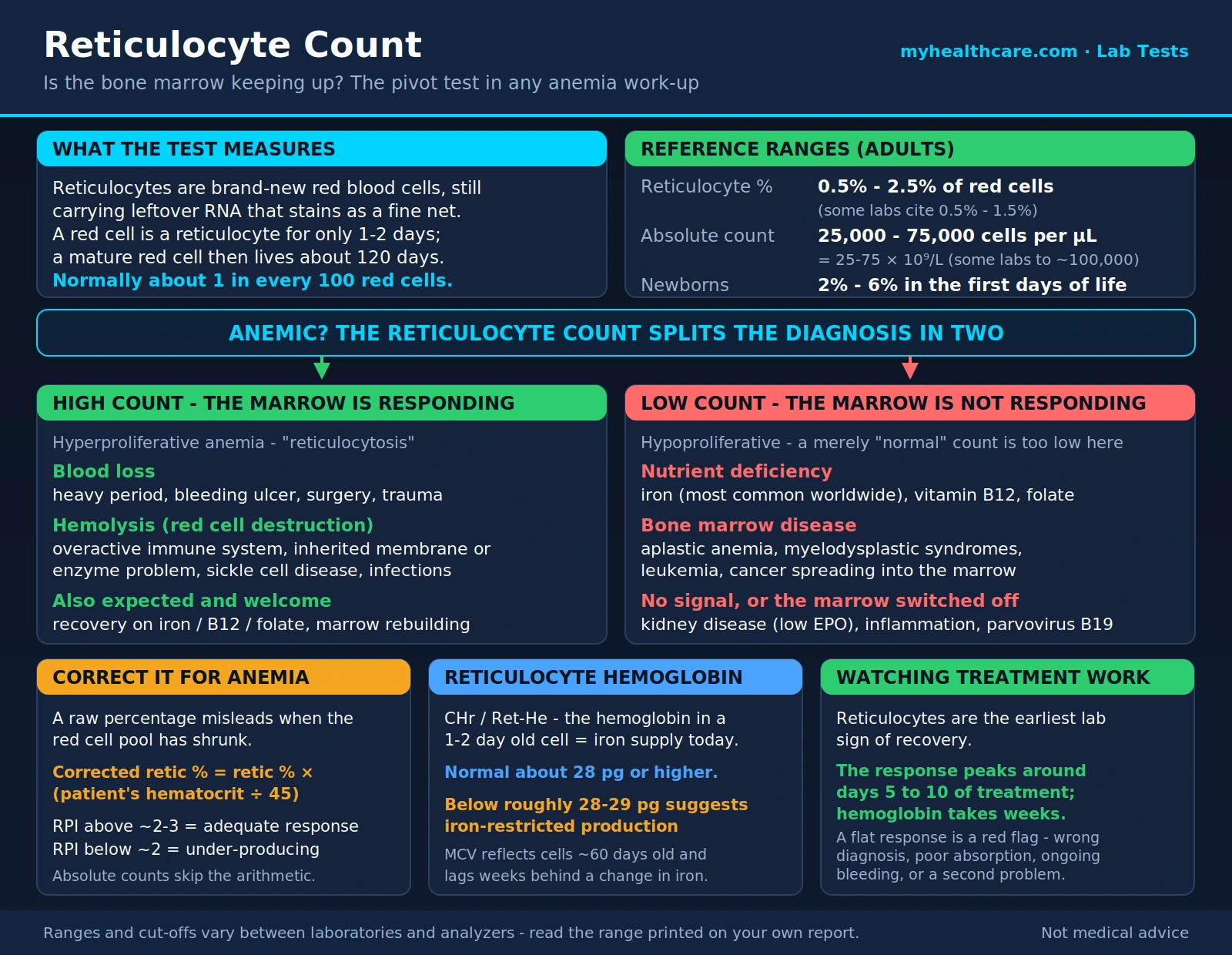
The reticulocyte count is a simple blood test that answers one of the most useful questions in all of medicine: is your bone marrow keeping up? Reticulocytes are brand-new red blood cells — so young they were made only a day or two ago. By counting how many of them are circulating, a doctor can tell at a glance whether your marrow is cranking out fresh red cells or falling behind. That single piece of information is the key that unlocks the diagnosis of anemia: it separates a marrow that is responding to a problem from a marrow that is the problem. This page explains what reticulocytes are, why the count is the pivot point of any anemia work-up, how the raw percentage has to be corrected, why a newer version of the test can catch iron deficiency early, and how doctors use the count to confirm that treatment is working.
Table of Contents
- What Reticulocytes Are
- Why It Is the Key Test for Anemia
- High vs. Low: What Each Points To
- The Corrected Count & Production Index
- Reticulocyte Hemoglobin (CHr / Ret-He)
- Monitoring Treatment Response
- Reference Ranges & What They Mean
- How the Test Is Done & Preparation
- Research Papers
- Connections
- Featured Videos
What Reticulocytes Are
Your red blood cells are made in the bone marrow, the spongy factory inside your bones. A red cell goes through several stages there before it is released into the bloodstream. In its very last step, just before and just after it leaves the marrow, it is called a reticulocyte — an almost-finished red cell that has already ejected its nucleus but still carries a bit of leftover machinery inside.
That leftover machinery is the key to the whole test. A reticulocyte still contains threads of RNA and ribosomes — the tools it uses to finish building its load of hemoglobin. Under the microscope, when the cell is treated with a special stain, that leftover RNA shows up as a delicate net-like mesh. The Latin word for "little net" is reticulum, which is exactly where the name comes from.
Reticulocytes are genuinely young. A red cell spends only about one to two days as a reticulocyte — roughly a day finishing up inside the marrow and about a day circulating in the blood — before its residual RNA is cleared and it becomes a fully mature red blood cell. A mature red cell then lives for about 120 days. So at any moment, the reticulocytes in your bloodstream are a snapshot of the red cells your marrow made in just the last day or two. That freshness is what makes the count so valuable: it is a near real-time report on the factory floor.
Because a healthy marrow is constantly replacing old red cells that wear out, a small, steady stream of reticulocytes is always present — normally about 1 in every 100 of your red cells. When something changes, that number moves quickly, which is exactly what doctors watch for.
Why It Is the Key Test for Anemia
Anemia simply means you do not have enough healthy red blood cells (or enough hemoglobin, the oxygen-carrying protein inside them). It shows up on a Complete Blood Count as a low hemoglobin or hematocrit. But "anemia" is a symptom, not a diagnosis — there are dozens of causes, and the treatments could not be more different. The reticulocyte count is the single most efficient test for sorting them, because it tells you which side of the problem you are on.
Here is the logic. When you become anemic, your body notices the drop in oxygen. Your kidneys respond by releasing a hormone called erythropoietin (EPO), which is a direct order to the bone marrow: make more red cells, now. A healthy marrow that has the raw materials it needs will obey — and within a few days it floods the bloodstream with extra reticulocytes. So a high reticulocyte count in an anemic person is a sign the marrow is working correctly and trying to fix the problem.
That flips the whole question. If the marrow is clearly responding, then the anemia is not being caused by a production failure — it must be caused by red cells being lost (bleeding) or destroyed (hemolysis) faster than even a hard-working marrow can replace them. But if a person is anemic and the reticulocyte count is low, or merely normal when it ought to be soaring, that tells you the marrow is not answering the call. The production line itself is broken or under-supplied.
Doctors use this to split anemia into two broad families before ordering another test:
- Hyperproliferative (high-reticulocyte) anemia — the marrow is responding. The problem lies outside the marrow: blood loss or red cell destruction.
- Hypoproliferative (low- or inappropriately-normal-reticulocyte) anemia — the marrow is not responding. The problem is production: missing nutrients, a diseased marrow, or a missing signal.
This one branch point saves an enormous amount of guesswork. Instead of ordering every anemia test at once, a clinician can look at the reticulocyte count and immediately head down the correct path. That is why hematology reviews describe the reticulocyte count as the natural first step in classifying any anemia (see Research Papers).
High vs. Low: What Each Points To
Once you know which family the anemia belongs to, the reticulocyte count points toward specific causes.
A high reticulocyte count (marrow responding)
A raised count — called reticulocytosis — means the marrow is pumping out young cells as fast as it can. The two classic reasons are:
- Blood loss. After bleeding — a heavy period, a bleeding ulcer, surgery, or trauma — the body races to replace what it lost, and reticulocytes climb.
- Hemolysis (red cell destruction). In hemolytic anemias, red cells are broken apart early — by an overactive immune system, an inherited membrane or enzyme problem, sickle cell disease, or certain infections. The marrow compensates by working overtime, so reticulocytes run high.
Reticulocytosis is also the expected and welcome sign when someone is recovering — for example, in the days after starting iron, vitamin B12, or folate for a deficiency, or as the marrow rebuilds after chemotherapy. More on that in Monitoring Treatment Response.
A low or inappropriately normal count (marrow not responding)
When an anemic person's reticulocyte count is low — or simply normal, which in the setting of anemia is not good enough — the marrow is failing to keep up. Common reasons include:
- Nutrient deficiencies. The marrow cannot build red cells without raw materials. A shortage of iron, vitamin B12, or folate stalls production. Iron deficiency is the most common cause worldwide.
- Bone marrow disease. Aplastic anemia (an empty marrow), myelodysplastic syndromes, leukemia, or cancer spreading into the marrow can all crowd out or shut down red cell production.
- Kidney disease. Because the kidneys make EPO, the hormone that tells the marrow to work, advanced kidney disease means the "make more" signal never arrives — the marrow is willing but never told.
- Anemia of inflammation (chronic disease). Long-standing infection, autoimmune disease, or cancer releases signals that both blunt EPO and lock iron away from the marrow.
- Other causes. Certain medications, thyroid disease, and viral infections such as parvovirus B19 (which can briefly switch off red cell production entirely) also depress the count.
The beauty of the reticulocyte count is that it turns a bewildering list of possibilities into a focused search. A high count sends the work-up toward bleeding and hemolysis; a low count sends it toward deficiencies, the kidneys, and the marrow itself.
The Corrected Count & Production Index
There is a catch that trips up a lot of people, and it is worth understanding because it changes how the result is read. The reticulocyte count is usually first reported as a percentage — what fraction of your red cells are reticulocytes. That percentage can be misleading in anemia, and here is why.
A percentage is a fraction: reticulocytes divided by total red cells. If anemia has shrunk the total number of red cells, then even a normal, unremarkable number of reticulocytes will look like a larger percentage — simply because the number you are dividing by got smaller. The percentage can appear reassuringly "normal" while the actual output of young cells is inadequate. To avoid being fooled, doctors use one of two corrections.
The corrected reticulocyte count
The first fix scales the percentage to how anemic the person actually is. The corrected reticulocyte count multiplies the raw percentage by the ratio of the patient's hematocrit to a normal hematocrit (around 45%):
Corrected reticulocyte % = reticulocyte % × (patient's hematocrit ÷ 45)
This pulls the number back down to what it would mean if the person were not anemic, so a "high" percentage that was really just an artifact of a small red cell pool is revealed for what it is.
The reticulocyte production index (RPI)
A second, subtler correction accounts for a trick the marrow plays when it is under stress. When the body urgently needs red cells, the marrow releases reticulocytes early — before they have finished maturing. These "stress" or "shift" reticulocytes then hang around in the bloodstream longer than the usual day or so (up to two or more days) while they finish up. Because they linger, they pile up and inflate the count, making the marrow look busier than it truly is. The reticulocyte production index (RPI) divides the corrected count by a maturation factor (which grows as anemia worsens) to cancel out this effect.
The payoff is a clean rule of thumb: an RPI above about 2 to 3 means the marrow is mounting an adequate response (think blood loss or hemolysis), while an RPI below about 2 confirms the marrow is under-producing (think deficiency, kidney, or marrow disease). In effect, the RPI turns the raw percentage into an honest measure of how hard the factory is really working.
Many modern laboratories sidestep the arithmetic altogether by reporting the absolute reticulocyte count — the actual number of reticulocytes per unit of blood, rather than a percentage. Because it counts cells directly, the absolute number does not get distorted by a shrunken red cell pool, and hematologists increasingly prefer it. If your report lists an absolute reticulocyte count, that figure already avoids the percentage trap.
Reticulocyte Hemoglobin (CHr / Ret-He)
Modern hematology analyzers can measure more than how many reticulocytes there are — they can measure what is inside them. One of the most useful of these newer numbers is the reticulocyte hemoglobin content, reported as CHr on some machines and Ret-He on others (the two are essentially equivalent). It measures the average amount of hemoglobin packed into each young reticulocyte, in picograms.
Why does that matter so much? Remember that a reticulocyte was made only a day or two ago. The hemoglobin inside it was therefore assembled with whatever iron was available to the marrow right now. So reticulocyte hemoglobin is a live readout of whether the marrow is getting enough iron today. By contrast, the standard red cell indices on a CBC — like the average cell size (MCV) — describe cells averaging 60 days old, and they lag weeks behind a change in iron supply.
That makes CHr / Ret-He an early-warning marker for iron-deficient red cell production. When iron runs short, reticulocyte hemoglobin falls before the hemoglobin level drops and before the older cells turn small and pale. A value below roughly 28–29 picograms is a common flag for iron-restricted production, though the exact threshold depends on the analyzer and laboratory. Landmark studies used this measurement to catch iron deficiency in children and infants earlier than traditional tests could (see Research Papers).
It has a second big advantage. The usual iron test, ferritin, is an "acute-phase reactant" — it rises with inflammation, infection, or chronic illness, which can mask a true iron shortage and make ferritin hard to interpret. Reticulocyte hemoglobin is not thrown off that way, so it is especially helpful for spotting functional iron deficiency in people with inflammation or chronic kidney disease, and for guiding intravenous iron therapy in dialysis patients. It is a natural companion to the full Iron Panel.
Monitoring Treatment Response
Beyond diagnosis, the reticulocyte count is one of the best tools for answering a practical question: is the treatment working? Because reticulocytes appear so quickly, they are the earliest laboratory sign of recovery — long before you feel better and well before the hemoglobin level itself climbs back to normal.
The classic example is treating a nutrient-deficiency anemia. When someone with iron-deficiency anemia starts iron, or someone with B12 or folate deficiency gets the missing vitamin, the marrow — suddenly handed the raw material it was starved of — springs into action. Within a few days it releases a wave of new reticulocytes. This reticulocyte response typically peaks around days 5 to 10 of treatment. Hemoglobin, by contrast, takes weeks to fully recover, because it depends on that whole wave of new cells maturing and accumulating.
This early spike is diagnostically powerful in two directions:
- A brisk reticulocyte rise confirms you were right. It proves the diagnosis was correct, the right nutrient was replaced, and the marrow is capable of responding. It is genuinely reassuring.
- A flat response is a red flag. If the count does not climb, something is off: perhaps the diagnosis was wrong, the person is not absorbing or not taking the supplement, there is ongoing bleeding, or a second problem is present. A missing reticulocyte response tells the doctor to re-examine the case rather than simply wait.
The same principle guides other treatments. Doctors watch the reticulocyte count to judge the effect of EPO-stimulating drugs in kidney disease, and to detect the return of the marrow — a rising count signaling recovery or engraftment — after chemotherapy or a stem cell transplant. In every case, reticulocytes are the first messengers that the factory is back online.
Reference Ranges & What They Mean
Reference ranges vary between laboratories and between the analyzers they use, so always read your result against the specific range printed on your report. As a general guide:
- Reticulocyte percentage (adults): roughly 0.5% to 2.5% of red cells (some labs cite a narrower 0.5% to 1.5%).
- Absolute reticulocyte count (adults): roughly 25,000 to 75,000 cells per microliter (25–75 × 10ⁿ/L, i.e. billion per liter), with some labs extending to about 100,000.
- Newborns: naturally higher — often 2% to 6% in the first days of life — then falling toward adult levels within the first week or two.
- Reticulocyte hemoglobin (CHr / Ret-He): normally around 28 picograms or higher; values below roughly 28–29 pg suggest iron-restricted red cell production (exact cut-offs differ by analyzer).
The single most important point is that a reticulocyte number means little on its own — it only becomes meaningful alongside your hemoglobin and hematocrit and, ideally, after the correction described above. A count of 2% is normal in a healthy person but far too low in someone who is severely anemic and whose marrow should be racing.
With that framing, the interpretation follows two broad patterns:
- A high count (reticulocytosis) suggests: acute or recent blood loss, hemolysis, a healthy response to iron/B12/folate treatment, recovery of the marrow after suppression, or adaptation to life at high altitude.
- A low count (reticulocytopenia) suggests: iron, B12, or folate deficiency; aplastic anemia or another marrow disorder; cancer or infection involving the marrow; chronic kidney disease with low EPO; anemia of inflammation; or a temporary shutdown from a virus such as parvovirus B19.
These are patterns, not verdicts. The reticulocyte count narrows the field; the final diagnosis comes from putting it together with the rest of the blood work and your clinical picture.
How the Test Is Done & Preparation
The reticulocyte count is done on an ordinary blood sample. A phlebotomist draws blood from a vein in your arm (in infants, sometimes a heel or finger stick) into a lavender-topped tube, and it is usually run at the same time as, or right after, a Complete Blood Count. The draw takes a minute or two and feels like any routine blood test.
Preparation is easy: there is essentially none. You do not need to fast for a reticulocyte count, and you can eat, drink, and take your usual medications normally. (If the same draw is being used for other tests that do require fasting, such as a glucose or lipid panel, follow the combined instructions your clinic gives you.)
A few things are worth mentioning to whoever orders the test, because they change how the result is read: any iron, B12, or folate supplements you are taking; a recent blood transfusion; treatment with EPO-stimulating drugs; and recent time spent at high altitude — all of which can raise the count on their own.
Behind the scenes, most laboratories now measure reticulocytes automatically on a hematology analyzer. A fluorescent dye binds the leftover RNA inside the young cells, and the machine counts them by flow cytometry — far more precise than the old method of hand-staining a smear with new methylene blue and counting cells under a microscope. Automated counting is also what makes the extra numbers possible, including CHr / Ret-He and the immature reticulocyte fraction (IRF).
The IRF is worth knowing about: it is the share of the very youngest, RNA-richest reticulocytes. Because those are the first cells to appear when the marrow revs up, the IRF often rises even earlier than the total reticulocyte count — making it one of the very first signals that treatment is working or that a transplanted marrow is beginning to engraft.
Research Papers
- Cascio MJ, DeLoughery TG. Anemia: evaluation and diagnostic tests. Medical Clinics of North America. 2017;101(2):263–284. doi:10.1016/j.mcna.2016.09.003 — A clinical overview that places the reticulocyte count at the start of the anemia work-up, dividing anemias into marrow-responding versus marrow-failing.
- Buttarello M. Laboratory diagnosis of anemia: are the old and new red cell parameters useful in classification and treatment, how? International Journal of Laboratory Hematology. 2016;38(S1):123–132. doi:10.1111/ijlh.12500 — Reviews how reticulocyte parameters, including the absolute count and reticulocyte hemoglobin, are used to classify anemia and guide treatment.
- Piva E, Brugnara C, Spolaore F, Plebani M. Clinical utility of reticulocyte parameters. Clinics in Laboratory Medicine. 2015;35(1):133–163. doi:10.1016/j.cll.2014.10.004 — A thorough survey of what the reticulocyte count and its newer indices reveal about erythropoiesis and iron status.
- Brugnara C. Iron deficiency and erythropoiesis: new diagnostic approaches. Clinical Chemistry. 2003;49(10):1573–1578. doi:10.1373/49.10.1573 — Explains why reticulocyte hemoglobin content reflects iron supply to the marrow in real time, ahead of conventional indices.
- Brugnara C, Zurakowski D, DiCanzio J, Boyd T, Platt O. Reticulocyte hemoglobin content to diagnose iron deficiency in children. JAMA. 1999;281(23):2225–2230. doi:10.1001/jama.281.23.2225 — Foundational study showing reticulocyte hemoglobin content detects iron deficiency early in children.
- Ullrich C, Wu A, Armsby C, et al. Screening healthy infants for iron deficiency using reticulocyte hemoglobin content. JAMA. 2005;294(8):924–930. doi:10.1001/jama.294.8.924 — Demonstrates reticulocyte hemoglobin content as an early screen for iron deficiency in infants, before hemoglobin falls.
- Mast AE, Blinder MA, Dietzen DJ. Reticulocyte hemoglobin content. American Journal of Hematology. 2008;83(4):307–310. doi:10.1002/ajh.21090 — A concise review of what reticulocyte hemoglobin content measures and how it is used to assess iron-restricted erythropoiesis.
- Thomas C, Thomas L. Biochemical markers and hematologic indices in the diagnosis of functional iron deficiency. Clinical Chemistry. 2002;48(7):1066–1076. doi:10.1093/clinchem/48.7.1066 — Shows how reticulocyte hemoglobin helps identify functional iron deficiency, where standard iron tests can mislead during inflammation.
- Fishbane S, Galgano C, Langley RC, Canfield W, Maesaka JK. Reticulocyte hemoglobin content in the evaluation of iron status of hemodialysis patients. Kidney International. 1997;52(1):217–222. doi:10.1038/ki.1997.323 — An early study using reticulocyte hemoglobin to assess iron status in dialysis patients, where ferritin is unreliable.
- Camaschella C. Iron-deficiency anemia. New England Journal of Medicine. 2015;372(19):1832–1843. doi:10.1056/NEJMra1401038 — An authoritative review of iron-deficiency anemia that situates reticulocyte indices among the modern diagnostic tools.
Connections
- All Lab Tests
- Complete Blood Count
- Iron Panel
- Ferritin Test
- Vitamin B12 Test
- Folate Test
- Kidney Function
- Iron
- Iron Deficiency
- Vitamin B12
- Folate (Vitamin B9)