Ginseng for Cognitive Function
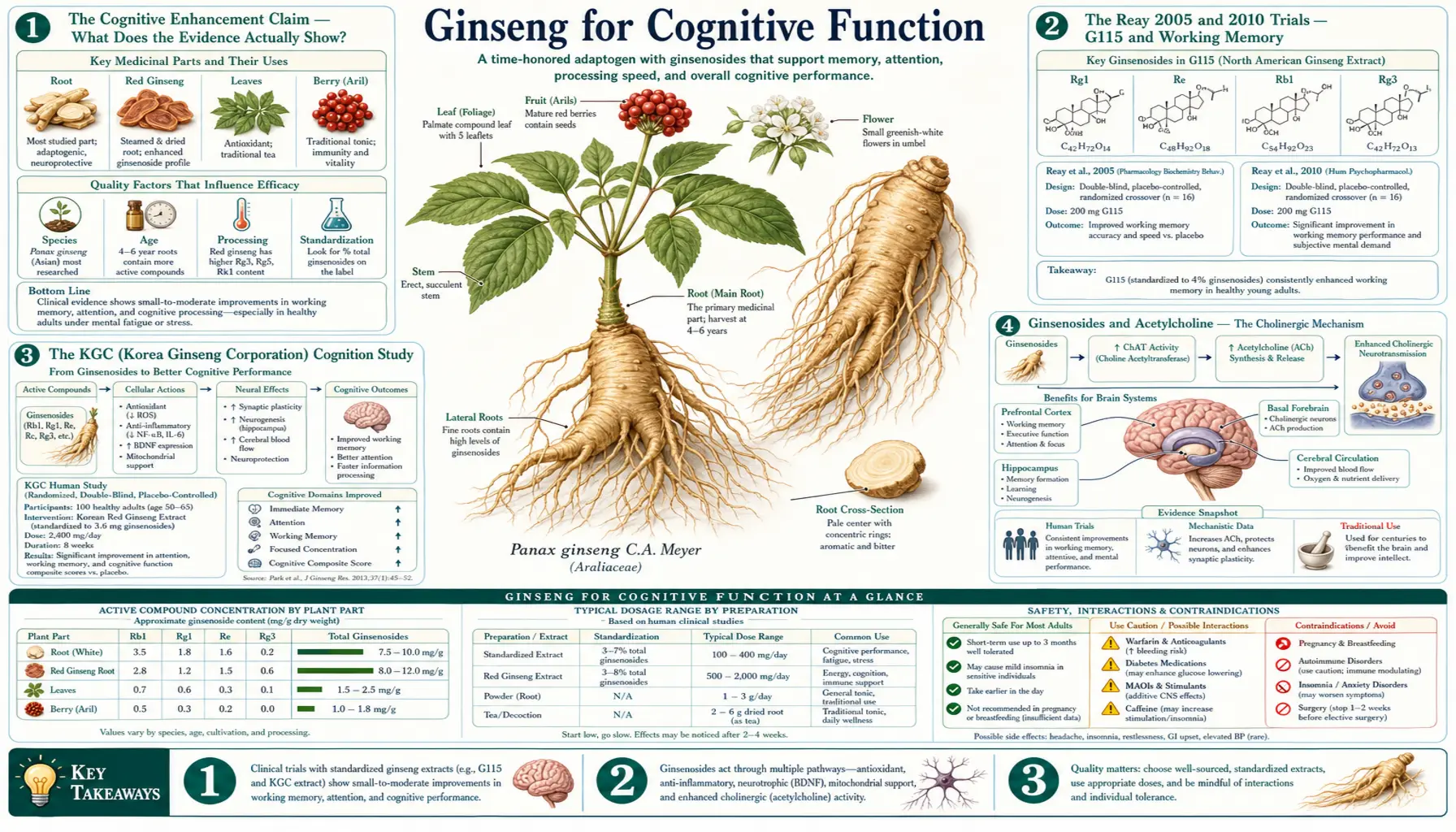
Ginseng is one of the few herbal cognitive enhancers with well-designed randomized trials at single-dose, multi-week, and standardized-extract levels. The Reay 2005 single-dose trial at the University of Northumbria demonstrated improved working memory and reduced mental fatigue during sustained cognitive load with 200 mg of G115 Panax ginseng extract; the Reay 2010 follow-up demonstrated that ginseng's cognitive benefits are partially independent of its blood-glucose-lowering effect. The Korea Ginseng Corporation (KGC) cognition study in healthy young and middle-aged adults found durable improvements in working-memory and attention measures after eight weeks of daily Korean red ginseng. Multiple preclinical studies confirm the mechanism: ginsenosides Rg1 and Rb1 increase acetylcholine release in hippocampal and cortical synapses, modulate NMDA glutamate receptor function, and reduce microglial neuroinflammation. The practical distinction between Asian ginseng (more activating, better for low-energy cognitive fog) and American ginseng (gentler, smoother, better for anxious or wired-tired cognitive complaints) holds in cognitive applications as it does in fatigue applications.
Table of Contents
- The Cognitive Enhancement Claim — What Does the Evidence Actually Show?
- The Reay 2005 and 2010 Trials — G115 and Working Memory
- The KGC (Korea Ginseng Corporation) Cognition Study
- Ginsenosides and Acetylcholine — The Cholinergic Mechanism
- NMDA Receptor and Glutamate Modulation
- Alzheimer Disease — Preclinical and Early Clinical Findings
- Mild Cognitive Impairment and Age-Related Cognitive Decline
- Asian vs American Ginseng for Cognition
- Practical Dosing and Forms for Cognitive Use
- Cautions, Limitations, and Drug Interactions
- Key Research Papers
- Connections
- Featured Videos
The Cognitive Enhancement Claim — What Does the Evidence Actually Show?
The "cognitive enhancer" supplement marketplace is full of bold claims and thin evidence. Ginseng is a partial exception: its cognitive trials, while not always large or definitive, are notably better-designed than most of the nootropic category. The pattern that emerges from the literature is consistent:
- Working memory and sustained attention — reliable improvements in trials lasting 1 single dose to 12 weeks. Effect sizes are modest but consistent across multiple research groups.
- Mental fatigue resistance — the most reliable cognitive effect. Ginseng helps people sustain cognitive performance during long, demanding tasks (the "8-hour cognitive day" phenomenon).
- Subjective alertness and mood during cognitive work — consistently improved.
- Reaction time, processing speed — mixed results; some studies show benefit, others null.
- Episodic memory (learning new material) — weak and inconsistent effects.
- Intelligence, executive function — no good evidence that ginseng changes underlying cognitive capacity, as opposed to current-day performance.
The translation: ginseng helps you do your existing best more reliably, especially when fatigue, stress, or sustained cognitive demand would otherwise degrade performance. It does not make you smarter. This is consistent with the broader adaptogen framing — ginseng helps the organism perform up to its baseline under stress, rather than raising the baseline.
The Reay 2005 and 2010 Trials — G115 and Working Memory
The most influential modern ginseng cognitive trials were conducted by Jonathon Reay and the Brain, Performance and Nutrition Research Centre at Northumbria University (UK). The 2005 paper randomized 30 healthy young adults to single doses of 200 mg G115 (standardized Panax ginseng extract), 400 mg G115, 25 g glucose, or matching placebo, then assessed cognitive performance on the Cognitive Drug Research (CDR) battery during a 1-hour sustained mental work load. Key findings:
- The 200 mg G115 dose significantly improved performance on serial sevens subtraction and serial threes subtraction (working memory tasks) compared to placebo
- The 200 mg dose also reduced subjective mental fatigue during the demanding task period
- G115 reduced blood glucose modestly, a finding the team explored further in the 2010 follow-up
- The 400 mg dose was less consistent than 200 mg — suggesting an inverted-U dose-response curve, common with cognitive enhancers
The 2010 Reay follow-up was designed to address the question of whether the cognitive effect was mediated entirely by the blood-glucose-lowering effect (and could therefore be reproduced with insulin or other glucose-lowering interventions) or whether it was independent. The team tested G115 alone, G115 with glucose co-administration, glucose alone, and placebo. The cognitive enhancement of ginseng was largely preserved even when glucose was co-administered to prevent the blood-sugar drop — demonstrating that the cognitive effect has a mechanism independent of glycemic modulation. (This was a useful finding because it ruled out the explanation that "any blood-sugar-lowering compound improves cognition," which is not true.)
The Reay trials established the 200 mg G115 dose as a reasonable single-dose cognitive enhancer in young healthy adults, and the same dose has been used as the comparator in subsequent ginseng cognitive trials.
The KGC (Korea Ginseng Corporation) Cognition Study
The KGC funded a series of trials in the early 2010s evaluating the cognitive effects of their proprietary Korean red ginseng (Panax ginseng, steamed) preparation in healthy young, middle-aged, and elderly adults. The studies used multi-week dosing protocols (typically 8 weeks of 1-4 g/day standardized root powder) and the same CDR cognitive battery used in the Reay trials, allowing comparison.
Key findings across the KGC series:
- Working memory and short-term memory measures improved consistently after 8 weeks of daily dosing
- Improvements were larger in middle-aged subjects (40-60) than in young subjects — consistent with ginseng helping recover age-related decline rather than enhancing a young brain at its peak
- Subjective alertness and mood improvements were larger than the objective cognitive improvements — suggesting some of the perceived benefit is mediated by mood and energy rather than cognition per se
- The cognitive improvements faded within 2-4 weeks of stopping ginseng, indicating that the effect requires ongoing dosing rather than being a durable structural change
- No accumulation of adverse effects with 8-week continuous dosing
The KGC studies, while industry-funded and therefore subject to the usual caveats, used reasonable methodology and produced results consistent with the independent Reay trials. The convergence of independent research groups, different ginseng species (American in the Mayo cancer-fatigue trials, Korean red in the KGC cognition trials), and different timeframes (single dose to 12 weeks) increases confidence that the cognitive effect is real.
Ginsenosides and Acetylcholine — The Cholinergic Mechanism
The dominant proposed mechanism for ginseng's cognitive effects is enhanced cholinergic signaling. Acetylcholine is the principal neurotransmitter underlying attention, working memory, and learning — the cognitive functions most reliably improved by ginseng. The cholinergic-deficit hypothesis of Alzheimer disease (Bartus 1982) led to the development of acetylcholinesterase inhibitors (donepezil, rivastigmine, galantamine) as the first FDA-approved Alzheimer treatments, all of which work by inhibiting the breakdown of acetylcholine in the synapse.
Ginsenosides act on the cholinergic system through several converging mechanisms:
- Increased acetylcholine release — ginsenoside Rg1 in hippocampal slice preparations increases stimulated release of acetylcholine from cholinergic terminals. The effect is dose-dependent and reversible.
- Increased choline uptake — choline (the dietary precursor to acetylcholine) is transported into cholinergic neurons by a sodium-dependent high-affinity transporter (CHT1). Several ginsenosides increase CHT1 expression and function, increasing the substrate pool available for acetylcholine synthesis.
- Modest acetylcholinesterase inhibition — some ginsenosides have direct, weak inhibitory activity on acetylcholinesterase. This is the same enzyme target as donepezil and other Alzheimer drugs, though ginsenosides are much weaker inhibitors.
- Choline acetyltransferase (ChAT) protection — ChAT is the enzyme that synthesizes acetylcholine from choline and acetyl-CoA. ChAT-producing cholinergic neurons in the basal forebrain are selectively lost in Alzheimer disease. In preclinical models, ginsenosides protect ChAT-positive neurons from amyloid-beta toxicity.
The net effect is enhanced cholinergic tone in the hippocampus and prefrontal cortex — the same neuroanatomical substrate targeted by the FDA-approved Alzheimer drugs, but through different mechanisms and with much smaller individual molecular effects. For more on choline metabolism, see Choline, and for the related lipid cofactor required for acetylcholine signaling integrity, see Phosphatidylserine.
NMDA Receptor and Glutamate Modulation
A second neurobiological mechanism for ginseng's cognitive effects involves modulation of the NMDA (N-methyl-D-aspartate) glutamate receptor — the principal receptor for learning and synaptic plasticity. Several ginsenosides act as weak NMDA modulators, with effects that vary by ginsenoside species:
- Ginsenoside Rb1 acts as a partial NMDA antagonist, reducing excitotoxic damage in models of stroke and traumatic brain injury
- Ginsenoside Rg1 in lower concentrations facilitates NMDA-mediated long-term potentiation (LTP), the cellular substrate of learning, while in higher concentrations it shows the protective antagonist profile
- Both ginsenosides modulate the glycine co-agonist site on the NMDA receptor
This bidirectional modulation, while complex, fits the broader adaptogen pattern: the same compound can have opposite effects depending on baseline state and dose, producing net normalization. In healthy adults, modest ginsenoside doses appear to facilitate normal NMDA-mediated learning. In pathological conditions involving excitotoxicity (stroke, TBI), the same compounds protect against excessive NMDA activation.
The clinical translation in humans is less direct than the cholinergic mechanism, but the NMDA-modulation work explains why ginseng has been investigated in stroke recovery, traumatic brain injury rehabilitation, and post-anesthetic cognitive dysfunction — all conditions where excitotoxic damage contributes to cognitive impairment.
Alzheimer Disease — Preclinical and Early Clinical Findings
The preclinical Alzheimer literature on ginsenosides is extensive and consistent. In transgenic mouse models of Alzheimer disease (APP/PS1, 5xFAD, and others), ginsenosides have demonstrated:
- Reduced amyloid-beta production and accumulation
- Increased amyloid-beta clearance through enhanced microglial phagocytosis
- Reduced phosphorylated tau accumulation
- Preserved cholinergic neuron populations in the basal forebrain
- Improved Morris water maze and other spatial memory performance
- Reduced neuroinflammatory cytokine release (TNF-alpha, IL-1-beta, IL-6) from microglia
The clinical translation, however, has been modest. The Lee 2011 trial enrolled 97 patients with mild-to-moderate Alzheimer disease (mostly on background acetylcholinesterase inhibitor therapy) and randomized to 4.5 g/day or 9 g/day of Korean red ginseng or placebo for 12 weeks. Both ginseng doses produced significant improvements on the ADAS-cog (Alzheimer Disease Assessment Scale, cognitive subscale) and the MMSE compared to placebo, with effects appearing by week 4 and sustaining through week 12. The 9 g/day dose was slightly better than 4.5 g/day. These are not dramatic effects — the absolute improvements were a few points on the ADAS-cog, comparable to or modestly better than what donepezil typically produces — but they represent a real effect in a hard-to-treat condition.
The follow-up 24-week Heo 2011 trial extended the same study, finding that the cognitive benefit was sustained as long as ginseng was continued. After ginseng was stopped, the ADAS-cog scores returned to placebo-arm levels within 12 weeks — consistent with ginseng providing ongoing functional support rather than slowing the underlying neurodegeneration.
Larger, more definitive Alzheimer trials are still needed, and ginseng should not be considered a substitute for the FDA-approved Alzheimer drugs. It may, however, be a reasonable adjunct in patients already on standard therapy, particularly those who tolerate it well and prefer to include herbal options. For more on dementia, see our Alzheimer Disease page.
Mild Cognitive Impairment and Age-Related Cognitive Decline
Mild cognitive impairment (MCI) — the prodromal stage between normal aging and dementia — is a more promising therapeutic window than established dementia, because the underlying brain has not yet sustained extensive neuronal loss. Several smaller ginseng trials in MCI populations have suggested benefit on attention and working-memory measures, though the trials have generally been underpowered for definitive conclusions.
For ordinary age-related cognitive decline in cognitively normal older adults (the "I just can't think as quickly as I used to" complaint of healthy 60- and 70-year-olds), the evidence supports modest benefit:
- Korean red ginseng 1-3 g/day for 8-12 weeks improves working memory and attention measures
- Effects are detectable but small — not a cure for aging, but a real and measurable functional support
- The benefit fades when ginseng is stopped, requiring ongoing dosing to maintain
- Tolerability is generally good in this population, with most reports of insomnia and overstimulation occurring with Korean red rather than American ginseng or with doses above 3 g/day
For combination strategies, pairing ginseng with other evidence-supported nootropics may produce additive effects. The most studied combination is Ginkgo biloba + ginseng, which has shown additive cognitive improvements in several trials. Bacopa + ginseng is another reasonable pairing, with Bacopa contributing memory consolidation and ginseng contributing attention/working memory support.
Asian vs American Ginseng for Cognition
The Asian-vs-American distinction discussed in the Energy and Fatigue article applies to cognitive use as well. In summary:
- Asian ginseng (Panax ginseng, particularly Korean red) — higher Rg1, more activating, better for cognitive complaints associated with low energy, low motivation, "brain fog of fatigue," or the post-lunch slump. Most cognitive trials have used this preparation.
- American ginseng (Panax quinquefolius) — higher Rb1, gentler, smoother, better for cognitive complaints associated with anxiety, ADHD-like distractibility, or wired-and-tired patterns. Less studied for cognition specifically but extrapolated from the fatigue literature and traditional pharmacology.
A practical heuristic: if morning caffeine helps your cognition, Korean ginseng is likely a good fit. If morning caffeine makes you anxious or jittery, American ginseng is likely better.
Practical Dosing and Forms for Cognitive Use
Standard cognitive dosing:
- Single-dose cognitive support (for an upcoming demanding task) — 200 mg G115 standardized Panax ginseng extract (or 1 g whole-root powder), taken 1-2 hours before the task. This is the Reay 2005 protocol.
- Multi-week cognitive support — 1-3 g/day Korean red ginseng root powder, taken in the morning (single dose) or split morning and early afternoon. Allow 4-8 weeks for the working-memory and attention benefits to develop fully.
- Mild cognitive impairment / age-related decline — 1-3 g/day Korean red ginseng, considered as one option among several (also evaluate sleep, exercise, hearing, vision, blood pressure, vitamin D, B12, thyroid, depression).
- Alzheimer adjunct (on background acetylcholinesterase inhibitor) — 4.5 g/day Korean red ginseng was the Lee 2011 lower dose; this requires physician oversight given the patient population's general medication complexity.
For best results, the same forms apply as for fatigue use: pure Korean red ginseng root powder, standardized G115 (or equivalent) extract, or a reputable third-party-tested American ginseng product. Avoid energy drinks and combination products that contain ginseng as a marketing ingredient at sub-therapeutic doses.
Take ginseng in the morning — cognitive benefits are immediate (single dose) or build over weeks (chronic dosing) and there is no need to dose multiple times per day. Evening dosing risks insomnia, particularly with Korean red.
Cautions, Limitations, and Drug Interactions
- Acetylcholinesterase inhibitor interaction — theoretical concern about additive cholinergic effects when ginseng is combined with donepezil, rivastigmine, or galantamine. In practice, the Lee 2011 Alzheimer trial used this combination without adverse interaction. Monitor for cholinergic excess (nausea, diarrhea, increased salivation).
- Warfarin interaction — as for any ginseng use, monitor INR closely if both warfarin and ginseng are used. The Yuan 2004 trial documented INR reduction.
- Insomnia from Korean red — cognitive benefits and insomnia trade off. If a patient is getting cognitive benefit but losing sleep, switch to American ginseng or reduce the dose.
- Stimulant-class interactions — ginseng is mildly stimulant. Co-administration with caffeine, methylphenidate, amphetamines, or modafinil can produce additive overstimulation, anxiety, or hypertension. Most patients tolerate moderate combinations; adjust by symptom.
- SSRI / serotonergic medications — rare reports of mania in case studies. Patients on SSRIs should approach ginseng cautiously, starting at low doses, watching for activation.
- Hypoglycemia — diabetics on insulin or sulfonylureas should monitor blood sugar more carefully when starting ginseng for cognitive use.
- Cognitive expectations — ginseng improves performance modestly. It does not provide stimulant-level alertness, does not substitute for sleep, does not reverse established dementia. Set realistic expectations.
Key Research Papers
- Reay JL et al. (2005). Single doses of Panax ginseng (G115) reduce blood glucose levels and improve cognitive performance during sustained mental activity. Journal of Psychopharmacology. — PubMed
- Reay JL et al. (2010). Effects of Panax ginseng, consumed with and without glucose, on blood glucose levels and cognitive performance during sustained mentally demanding tasks. Journal of Psychopharmacology. — PubMed
- Lee ST et al. (2008). Panax ginseng enhances cognitive performance in Alzheimer disease. Alzheimer Disease and Associated Disorders. — PubMed
- Heo JH et al. (2011). An open-label trial of Korean red ginseng as an adjuvant treatment for cognitive impairment in patients with Alzheimer disease. European Journal of Neurology. — PubMed
- Geng J et al. (2010). Ginseng for cognition (Cochrane systematic review). Cochrane Database of Systematic Reviews. — PubMed
- Scholey A et al. (2010). Effects of American ginseng (Panax quinquefolius) on neurocognitive function: an acute, randomised, double-blind, placebo-controlled, crossover study. Psychopharmacology. — PubMed
- Kim HJ et al. (2013). Effect of Korean red ginseng on attention, working memory, and cognition in healthy adults. Journal of Ginseng Research. — PubMed
- Wesnes KA et al. (2000). The memory enhancing effects of a Ginkgo biloba / Panax ginseng combination in healthy middle-aged volunteers. Psychopharmacology. — PubMed
- Kennedy DO, Scholey AB (2003). Ginseng: potential for the enhancement of cognitive performance and mood. Pharmacology Biochemistry and Behavior. — PubMed
- Benishin CG et al. (1991). Effects of ginsenoside Rb1 on central cholinergic metabolism. Pharmacology. — PubMed
- Chen XC et al. (2002). Ginsenoside Rg1 attenuates dopamine-induced apoptosis in PC12 cells. Acta Pharmacologica Sinica. — PubMed
- Chu S et al. (2014). Ginsenoside Rg1 improves spatial memory in transgenic Alzheimer mice. Neural Regeneration Research. — PubMed
PubMed Topic Searches
- PubMed: Ginseng cognition trials
- PubMed: Ginsenoside acetylcholine
- PubMed: KRG Alzheimer
- PubMed: American ginseng cognition
- PubMed: Ginkgo + ginseng combination
Connections
- All Herbs
- Ginseng Overview
- Ginseng Benefits Hub
- Ginseng for Fatigue
- Ginseng for Immunity
- Ginseng for ED
- Ginkgo Biloba
- Bacopa Monnieri
- Ashwagandha
- Rhodiola Rosea
- Choline
- Phosphatidylserine
- Alzheimer Disease
- Dementia
- Brain Fog
- Stress Management
- Fatigue