Ginseng: History and Traditional Use
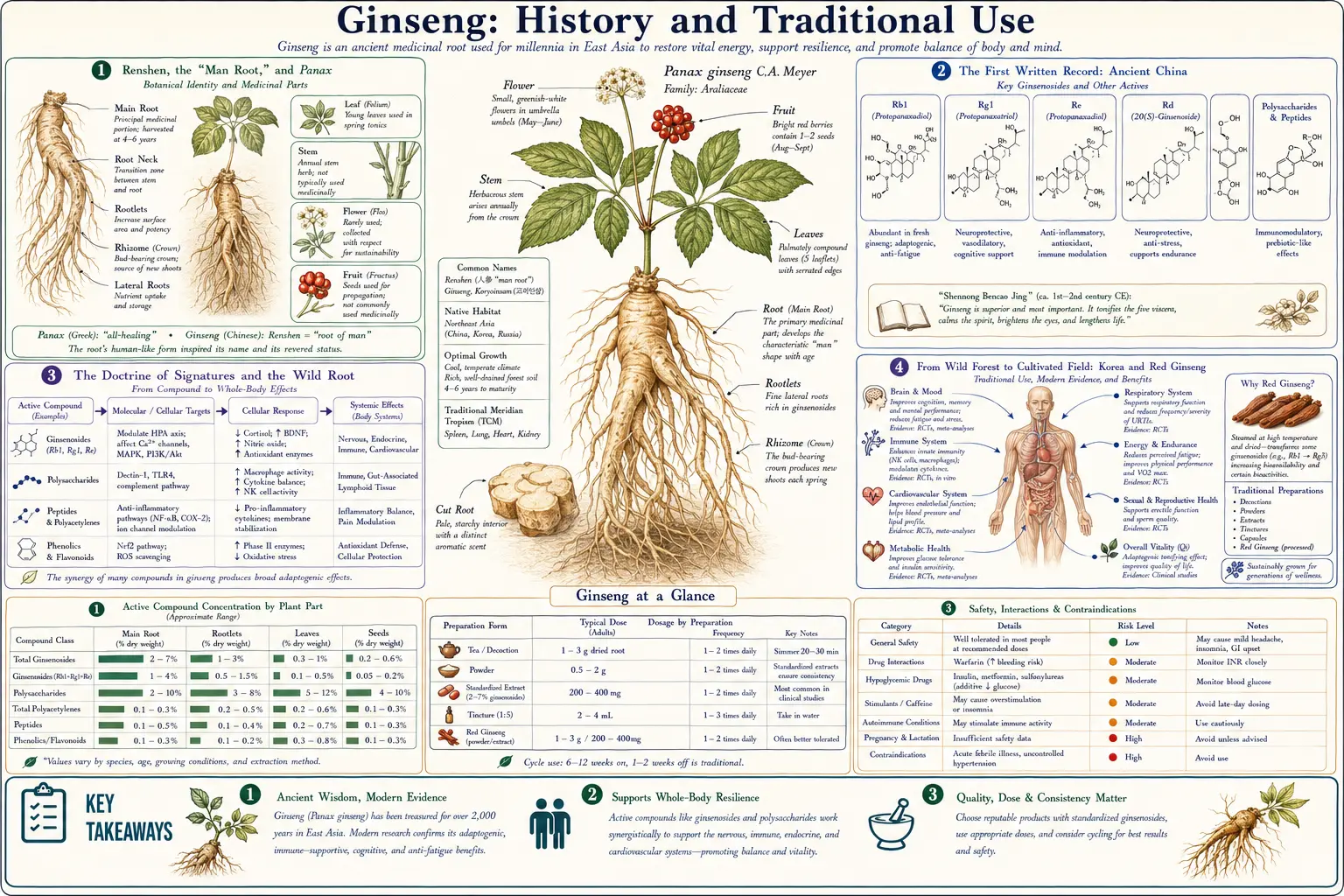
Few plants have been valued for so long, by so many people, as ginseng. For roughly two thousand years the forked, slow-growing root of Panax ginseng has been one of the most prized remedies in East Asian medicine — treasured enough to be fought over, smuggled, cultivated as a state monopoly, and carried across an ocean. This article follows what the historical record actually supports: where the plant's names come from, the first written mention of it in ancient China, how it moved from wild forest root to cultivated crop, the strange story of how a French missionary and the Iroquois found its American cousin, the moment European botanists gave it the genus name Panax ("all-heal"), and the day in the 1960s when chemists finally isolated the molecules behind its reputation. Where the record is firm, we say so; where a claim is tradition, folklore, or marketing, we name it as such.
Table of Contents
- Renshen, the "Man Root," and Panax
- The First Written Record: Ancient China
- The Doctrine of Signatures and the Wild Root
- From Wild Forest to Cultivated Field: Korea and Red Ginseng
- American Ginseng: A Jesuit, the Iroquois, and an Ocean Trade
- Naming the Genus: Linnaeus, Meyer, and "All-Heal"
- Isolating the Active Compounds: The Ginsenoside Era
- From Tradition to Modern Research
- Research Papers and References
- Connections
- Featured Videos
Renshen, the "Man Root," and Panax
The English word ginseng comes, by way of southern Chinese pronunciation, from the Mandarin rénshên (人参). The two characters mean, literally, "man root" or "person root." The name is usually explained by the root's habit of growing a forked, two-legged shape that can look uncannily like a tiny human body — a resemblance that, as we will see, shaped how the plant was understood for centuries. The same human-likeness is echoed half a world away: when French missionaries found a related plant in North America, the Iroquois name they recorded for it, garent-oguen, has been translated as "resembles man" or "a man's thigh."
The plant most people mean by "ginseng" is Panax ginseng, often called Asian, Chinese, or Korean ginseng. It belongs to a small genus of slow-growing perennials in the ivy family (Araliaceae). Close relatives that share the ginseng name and chemistry include Panax quinquefolius (American ginseng) and Panax notoginseng (also called sanqi or Tianqi, a separate Chinese medicinal). The unrelated plant sold as "Siberian ginseng" (Eleutherococcus senticosus) is in the same botanical family but is not a true Panax and contains different compounds — a distinction worth keeping in mind when reading labels.
The genus name Panax itself carries the plant's reputation in its etymology. As the review by Jia and Zhao explains, it is built from the Greek pan ("all") and akos/axos ("cure") — "all-heal," the very same root that gives us the English word panacea. That a European botanist reached for the word "cure-all" when naming the plant tells you how far its fame as a universal tonic had already traveled by the eighteenth century. The story of that name is taken up below.
The First Written Record: Ancient China
Ginseng's documented career begins in China. Its earliest secure appearance in the written record is in the Shennong Bencao Jing (神農本草經) — the "Divine Farmer's Classic of Materia Medica" — a foundational Chinese pharmacopoeia generally dated by scholars to roughly the first or second century CE (the Han period), compiled from older oral tradition. The text is attributed, by legend, to the mythical emperor-farmer Shennong ("the Divine Farmer"), who in Chinese folklore is said to have personally tasted hundreds of plants to learn their effects. No real individual "discovered" ginseng; the attribution to Shennong is a foundational myth, not a historical event, and is best read as China's way of honoring an inheritance whose true origin is prehistoric and anonymous.
In that classic, ginseng is placed among the "superior" or "upper" class of herbs — the tonics held to be nourishing and safe for long-term use, rather than the harsher drugs reserved for acute illness. The traditional indications attached to it there and in later Chinese medical writing center on what the tradition calls tonifying qi: restoring vital energy, supporting the digestion ("spleen") and lungs, generating fluids, and "calming the spirit" to settle the mind. These are descriptions within the framework of traditional Chinese medicine and are reported here as that tradition's own claims, not as modern clinical findings.
A separate early source, the Han-era clinical classic on cold-induced and miscellaneous disorders (the Shanghan Zabing Lun, attributed to Zhang Zhongjing), is reported by Kang and Kim to contain a substantial number of formulas using ginseng, showing that within a few centuries of its first mention the root was already woven into working clinical prescriptions, not merely listed as a tonic. From these beginnings ginseng became, and remains, one of the central herbs of East Asian medicine.
The Doctrine of Signatures and the Wild Root
Why a forked root? Much of ginseng's mystique flows from an old and cross-cultural idea often called the doctrine of signatures — the belief that a plant's appearance hints at its medicinal purpose. A root shaped like a little human, with a "body," "arms," and "legs," was taken as a sign that it could nourish the whole person and restore strength to every part. The very name "man root" encodes this reasoning. It is important to be clear that the doctrine of signatures is a historical interpretive idea, not a scientific principle; the genuinely active compounds in ginseng were not identified until the twentieth century, and a root's shape tells us nothing about its chemistry.
The most human-shaped wild roots were, accordingly, the most coveted, and wild ginseng from the mountain forests of Manchuria, Korea, and the Russian Far East became one of the most valuable plant products in the world. Old, large, well-formed wild roots were treated almost as treasure: graded, traded, hoarded, and (according to long-standing accounts) the object of dedicated seasonal foraging by specialist diggers. That extraordinary value is not merely historical — to this day exceptional wild roots can fetch very high prices at auction, while the herb sold in everyday supplements is overwhelmingly cultivated.
Over-harvesting is the predictable shadow of that demand. Centuries of digging steadily depleted wild stands across East Asia, which is one of the pressures that pushed growers toward deliberate cultivation (next section) and which, much later, drove the wild American species onto conservation and trade-control lists. The arc from a prized, scarce forest root to a farmed field crop is one of the central threads of ginseng's history.
From Wild Forest to Cultivated Field: Korea and Red Ginseng
Korea is central to ginseng's history, and the Korean record helps date the shift from wild-gathering to farming. According to the historical survey by Kang and Kim, a form of wild-simulated cultivation — encouraging ginseng to grow under managed forest conditions rather than simply foraging it — was already practiced on the Korean peninsula before about 1122 CE, during the Goryeo (Koryo) kingdom from which the Western word "Korea" derives. Korea's reputation for high-quality ginseng, especially from the Kaesong (Gaeseong) region, dates back many centuries and persists today.
The same history pins down the origin of red ginseng, the steamed-and-dried form that is so prominent in modern Korean products. Kang and Kim report that a processing method of steaming and drying fresh ginseng root is referenced as early as 1123 CE in the Goryeo Dogyeong (a Chinese envoy's account of Goryeo Korea), while the specific term "red ginseng" appears in a Korean record dated 1797. Steaming turns the pale root a translucent reddish-brown and, as modern chemistry later confirmed, changes its mix of ginsenosides — the traditional basis for regarding red ginseng as the more "heating" and concentrated preparation. The chemistry behind that change is covered on the main Ginseng page.
Ginseng also became a matter of statecraft and commerce. In the Joseon dynasty and afterward, Korean ginseng — particularly red ginseng — was a tightly controlled, high-value export, and at various points its production and trade were managed as a government monopoly. The image of ginseng as a near-magical tonic for vigor and long life is genuinely ancient and culturally pervasive; readers will often see it tied to specific royal anecdotes, but such individual longevity stories are best treated as tradition and folklore rather than documented medical fact. What the historical record firmly supports is that, by the time Europeans took serious notice, ginseng was already an established, prestigious, and commercially important medicine across Korea and China.
American Ginseng: A Jesuit, the Iroquois, and an Ocean Trade
One of the best-documented episodes in ginseng's history is the "discovery" of its American cousin — a story that genuinely turns on named people and dates. It begins with a French Jesuit missionary in China, Father Pierre Jartoux, who in 1711 wrote a detailed letter describing Asian ginseng (Panax ginseng), including where and how it grew. His account circulated widely in Europe through the Jesuits' published letters in the years that followed.
Reading Jartoux's description, another Jesuit working among the Mohawk near Montreal — Father Joseph-François Lafitau — noticed that the cold forests of New France closely matched the habitat Jartoux described, and reasoned that a similar plant might grow there. With the help of local Iroquois (Mohawk) people, who already knew the plant, Lafitau located American ginseng (Panax quinquefolius) near Montreal in 1716. The Iroquois name he recorded for it, garent-oguen, has been translated as "resembles man" or "a man's thigh" — an independent echo of the Chinese "man root," arrived at by a people who had no contact with China. Native American nations had their own established uses for the plant well before this European episode.
The consequences were swift and commercial. Once it was understood that the Chinese market prized ginseng and that an American species existed, a transatlantic trade ignited: by about 1720, ginseng harvested in Quebec was being shipped to China by the French Company of the Indies. Over the following century the export of wild American ginseng to China became a significant North American trade — one in which, famously, frontier diggers across the eastern United States (and, by tradition, figures associated with the early frontier economy) gathered roots for the China market. That intense harvest pressure is the reason wild American ginseng is today a protected, trade-regulated species, even as cultivated American ginseng remains an important crop in Wisconsin, Ontario, and the Appalachian region.
Naming the Genus: Linnaeus, Meyer, and "All-Heal"
As ginseng entered European scientific awareness, it acquired formal botanical names. The Swedish naturalist Carl Linnaeus, founder of modern biological nomenclature, validly described the American species as Panax quinquefolius L. in 1753 (the species epithet quinquefolius means "five-leaved," describing its characteristic leaf). The choice of the genus name Panax — Greek for "all-heal," the same source as panacea — reflects that Europeans were naming the plant in full knowledge of its towering reputation as a cure-all in Chinese medicine.
The Asian species received its now-standard botanical authority later. As Jia and Zhao record, the Russian botanist Carl Anton von Meyer established the genus treatment in 1843 in a publication of the St. Petersburg Academy — which is why the formal name of the East Asian plant is written Panax ginseng C.A. Meyer to this day. (The "C.A. Meyer" after the name is the botanical convention for crediting the author of a plant's accepted scientific name; you will see it on careful product labels and in the scientific literature.)
It is worth pausing on what these names do and do not mean. The label Panax ("all-heal") records a historical reputation, not a verified fact — eighteenth- and nineteenth-century naturalists were cataloguing the plant's fame, not certifying that it cured everything. The genuine science of what ginseng does, and how, would only begin more than a century after Linnaeus, with the chemical isolation of its active compounds.
Isolating the Active Compounds: The Ginsenoside Era
For most of ginseng's long history, no one knew why it might do anything; the root was used on the strength of tradition and observation. The turning point came in the twentieth century with the chemical isolation of its characteristic compounds — a genuinely documented scientific milestone with real, named researchers, exactly the kind of claim that can be pinned to specific people.
The decisive work was done in Japan in the early-to-mid 1960s by the natural-products chemist Shoji Shibata and his collaborator Osamu Tanaka at the University of Tokyo, who isolated and began to determine the structures of the individual saponins they named ginsenosides. Their group's structural studies — for example on the ginseng sapogenins and on individual ginsenosides such as Rg1 — appeared in the chemical literature of the mid-to-late 1960s and laid the foundation for essentially all modern ginseng pharmacology. (These mid-1960s papers by Shibata, Tanaka and colleagues are named here as historical primary sources; the molecular detail is summarized on the main Ginseng page rather than re-cited individually below.) Earlier nineteenth-century chemists had extracted crude "saponin" fractions, but it was the Shibata group's work that gave ginseng's activity a precise chemical address.
Today more than fifty ginsenosides have been characterized, and they remain the compounds to which standardized extracts are calibrated. The naming convention many people see on the main page — Rb1, Rg1, Rg3, and so on — descends directly from this line of mid-century chemical research. With the compounds in hand, the modern era of controlled trials and mechanistic study could finally begin to test the claims that tradition had been making for two thousand years.
From Tradition to Modern Research
The striking thing about ginseng's history is how much of it is genuinely documented — a written record stretching from a Han-dynasty pharmacopoeia, through dated Korean cultivation and processing references, a firmly attested transatlantic "discovery," formal botanical naming by Linnaeus and Meyer, and a clearly credited compound isolation in the 1960s. That is an unusually well-anchored story for a herbal medicine, and it is why ginseng has drawn so much serious scientific attention.
Modern research has tried to test the tradition rather than simply repeat it. Systematic reviews of randomized controlled trials — for instance the broad efficacy-and-safety review by Lee and Son, the fatigue-focused review by Jin and colleagues, and the wide-ranging umbrella review by Li and colleagues — have examined ginseng across fatigue, cognition, glucose control, immune function and more. The honest summary is that the evidence is genuinely promising in several areas (notably fatigue) and mixed or preliminary in others, with the recurring caution that trial quality and ginseng preparations vary widely. Tradition raised the questions; controlled research is the slow work of answering them. The detailed, benefit-by-benefit clinical evidence — with specific trials, doses, and mechanisms — is covered in the Ginseng Benefits deep-dive and on the main Ginseng page.
The thread that runs from a forked root called "man root" in a first-century Chinese classic, through the steaming vats of Korea, an Iroquois forest near Montreal, the naming pens of Linnaeus and Meyer, and a Tokyo chemistry laboratory in the 1960s, is remarkably continuous. A plant prized for two millennia as a restorer of vital energy is, at last, being studied with the tools to find out what is really there — and that continuity is what makes ginseng's history worth knowing.
Research Papers and References
The list below combines key peer-reviewed reviews of Panax ginseng with curated PubMed topic-search links into the historical and clinical literature. Historical primary texts (the Shennong Bencao Jing, the Shanghan Zabing Lun, the Goryeo Dogyeong, Father Jartoux's and Father Lafitau's eighteenth-century accounts, and the 1960s structural-chemistry papers of Shibata and Tanaka) are named in the article as historical sources rather than as modern citations. Author names, titles and journals are given as plain text; only stable DOI / PMID / URL identifiers are hyperlinked, and each opens in a new tab.
- Jia L, Zhao Y. Current Evaluation of the Millennium Phytomedicine—Ginseng (I): Etymology, Pharmacognosy, Phytochemistry, Market and Regulations. Current Medicinal Chemistry. 2009;16(19):2475-2484. — doi:10.2174/092986709788682146 · PMID: 19601793
- Kang HH, Kim S-K. Trailing the History of Korean Ginseng (Panax ginseng C.A. Meyer). Food Supplements and Biomaterials for Health. 2022;2(3):e20. — doi:10.52361/fsbh.2022.2.e20
- Lee NH, Son CG. Systematic Review of Randomized Controlled Trials Evaluating the Efficacy and Safety of Ginseng. Journal of Acupuncture and Meridian Studies. 2011;4(2):85-97. — doi:10.1016/S2005-2901(11)60013-7 · PMID: 21704950
- Jin T-Y, Rong P-Q, Liang H-Y, Zhang P-P, Zheng G-Q, Lin Y. Clinical and Preclinical Systematic Review of Panax ginseng C. A. Mey and Its Compounds for Fatigue. Frontiers in Pharmacology. 2020;11:1031. — doi:10.3389/fphar.2020.01031 Search PubMed
- Li Z, Wang Y, Xu Q, Ma J, Li X, Tian Y, Wen Y, Chen T. Ginseng and Health Outcomes: An Umbrella Review. Frontiers in Pharmacology. 2023;14:1069268. — doi:10.3389/fphar.2023.1069268 Search PubMed
- Panax ginseng history and traditional use PubMed: Panax ginseng history and traditional use
- Panax ginseng ethnobotany and Shennong Bencao Jing materia medica PubMed: Panax ginseng ethnobotany and traditional medicine
- American ginseng (Panax quinquefolius) history and trade PubMed: Panax quinquefolius American ginseng history
- Ginsenosides chemistry, isolation and structure PubMed: ginsenoside structure, isolation and chemistry
External Authoritative Resources
Connections
- All Herbs
- Ginseng Hub
- Ginseng Benefits Deep Dive
- Ashwagandha
- Astragalus
- Rhodiola Rosea
- Schisandra
- He Shou Wu