Cod — Benefits Deep Dive
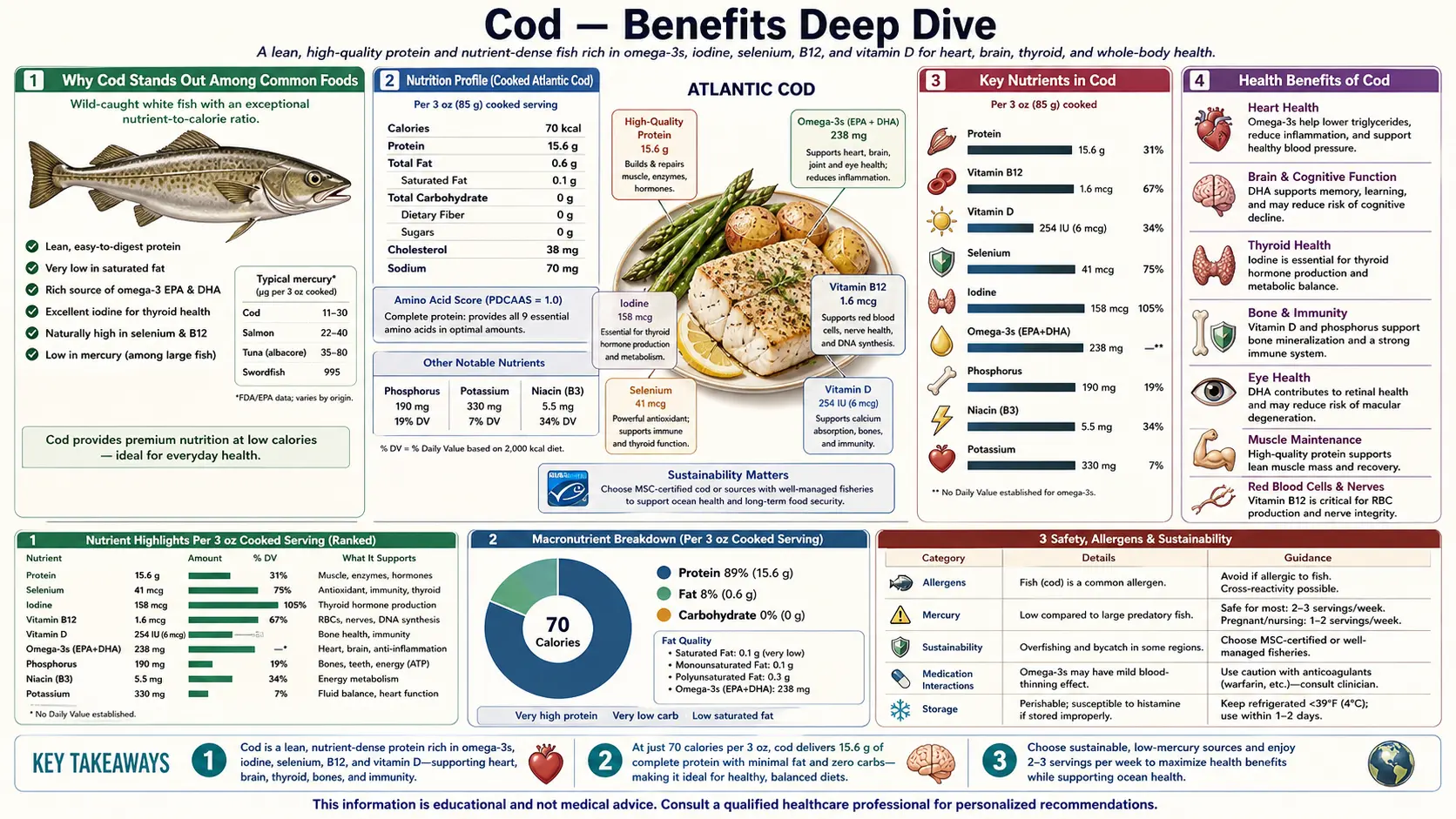
Cod (Gadus morhua in the Atlantic and Gadus macrocephalus in the Pacific) is one of the few foods that crosses several distinct nutritional categories at once: it is an exceptionally lean complete-protein source, the historical and current richest natural source of combined Vitamins A and D (through its liver oil), one of the highest-iodine foods in the modern Western diet, and consistently one of the lowest-mercury species of seafood available to consumers. Four benefit pages below explore each of these dimensions in depth — the lean-protein macronutrient profile that distinguishes cod from fatty fish like salmon and herring, the centuries of cod liver oil clinical evidence from rickets prevention to modern omega-3 trials, the iodine and selenium content that makes cod a thyroid-support staple, and the mercury comparison that explains why cod sits in the FDA "Best Choices" category for pregnancy and pediatric consumption while tuna and swordfish do not.
Deep-Dive Articles
Lean Protein Profile
Why cod delivers more protein per calorie than nearly any other whole food — 23 g protein in only 105 kcal per 100 g cooked fillet, with less than 1 g fat. The complete-protein amino acid profile, leucine content for muscle protein synthesis, DIAAS digestibility scores, and the practical implications for athletes in cutting phases, sarcopenia prevention in older adults, and high-protein weight management diets.
Vitamin D & Liver Oil
Cod liver oil as the original Vitamin D supplement — the Møller industrial process from 1854 Norway, the rickets-prevention public-health campaigns of the early 20th century, modern combined-A-and-D pharmacokinetics, the Bergen Cod Liver Oil trials, comparisons to fractionated fish oils, and dosing guidance with a hard upper-limit on Vitamin A in pregnancy.
Iodine & Thyroid
The largest single-food iodine source in most Western diets after iodized salt and dairy. Why ocean fish concentrate iodine from seawater, the 100 g cod serving that delivers approximately 100 µg (67% of the adult RDA), selenium content for deiodinase enzymes (T4→T3 conversion), and the relevance to hypothyroidism, Hashimoto's thyroiditis, pregnancy iodine requirements, and post-Chernobyl/post-Fukushima iodine prophylaxis.
Mercury vs Other Fish
Why cod is in the FDA "Best Choices" category alongside salmon and sardines while tuna, swordfish, king mackerel, tilefish, and shark are restricted or avoided entirely. The biomagnification ladder, methylmercury vs ethylmercury vs elemental mercury, half-life in the body (50-70 days), pregnancy and pediatric thresholds, the Faroe Islands cohort studies on neurodevelopmental effects, and the practical comparison table showing cod at ~0.10 ppm vs swordfish at ~0.99 ppm.
Table of Contents
- Deep-Dive Articles
- Why Cod Stands Out Among Common Foods
- Research Papers: Lean Protein & Body Composition
- Research Papers: Cod Liver Oil & Vitamin D
- Research Papers: Iodine, Selenium & Thyroid
- Research Papers: Mercury, Heavy Metals & Safety
- Research Papers: Cross-Cutting (Cardiovascular, Cognitive, Sustainability)
- External Authoritative Resources
- Connections
- Featured Videos
Why Cod Stands Out Among Common Foods
Most whole foods do one or two nutritional things well. Cod does at least four, which is why it has supported entire economies and populations for centuries — from the Basque whalers who pioneered Atlantic cod fishing in the medieval period to the Norwegian cod liver oil industry that prevented rickets in industrial Britain. Each of the four deep-dive pages below addresses one of these distinct dimensions, and the underlying biology is genuinely different in each case.
- Macronutrient density — the cod fillet itself (the flesh, not the liver) is one of the few foods that approaches a pure-protein source while still being a whole, unprocessed food. A 100-gram cooked Atlantic cod fillet provides 23 g of protein in 105 kcal, with less than 1 g of fat and zero carbohydrate. The protein-to-calorie ratio is approximately 0.22 g protein per kcal — higher than chicken breast (0.20), much higher than salmon (0.13 because of the fat content), and competitive with whey protein isolate as a whole-food source. See the Lean Protein Profile page for the full amino acid breakdown.
- Fat-soluble vitamin density (in the liver) — cod liver is one of the densest natural sources of Vitamins A and D simultaneously. Cod liver oil, the pressed extract, has been used as a clinical intervention since the 18th century. The Vitamin D and Liver Oil page traces the public-health history from Møller's 1854 Norwegian industrial process through the rickets-prevention era to modern combined-A-and-D pharmacokinetics, the Bergen trials, and dosing guidance.
- Trace mineral density (iodine and selenium) — ocean fish concentrate iodine from seawater at concentrations far above terrestrial foods. A 100 g cod serving delivers roughly 100 µg iodine (about 67% of the adult RDA of 150 µg/day) and approximately 33 µg selenium (60% of the RDA). Both are required for thyroid hormone synthesis and conversion. The Iodine and Thyroid page covers the relevance to hypothyroidism, Hashimoto's, pregnancy requirements, and post-nuclear-accident iodine prophylaxis.
- Low contaminant burden — cod sits low on the marine food chain compared to apex predators like tuna and swordfish, which biomagnify methylmercury. Average mercury content in commercial cod is approximately 0.10 ppm, well below the FDA action level of 0.30 ppm and roughly one-tenth the level in swordfish (~0.99 ppm). The Mercury vs Other Fish page walks through the comparison table, the Faroe Islands cohort studies, and the practical implications for pregnancy and pediatric consumption.
The therapeutic implication is that cod (and cod liver oil) can simultaneously address four distinct nutritional gaps that are common in modern diets: insufficient protein, insufficient Vitamin D, insufficient iodine and selenium, and excess mercury exposure from a fish-heavy diet centered on the wrong species. This is uncommon. Few single foods clean up that many problems at once, and the combination explains why cod has been a staple of public-health nutrition guidance from Norway to Japan for two centuries.
Research Papers: Lean Protein & Body Composition
- Cod protein and insulin sensitivity (Ouellet V et al., randomized trial in insulin-resistant adults) — PubMed: Cod protein and insulin sensitivity
- Cod protein hydrolysate and blood pressure (Vikoren LA et al.) — PubMed: Cod protein hydrolysate and blood pressure
- Cod protein vs casein on muscle protein synthesis (leucine and EAA comparison) — PubMed: Cod vs casein muscle synthesis
- Lean fish vs fatty fish on lipid markers (Aadland EK et al.) — PubMed: Lean vs fatty fish lipids
- DIAAS protein quality scoring of fish protein — PubMed: DIAAS fish protein
- Cod protein hydrolysate and satiety in weight management — PubMed: Cod protein and satiety
- Cod protein and glucose tolerance in older adults — PubMed: Cod and elderly glucose
- Fish protein intake and sarcopenia risk in observational cohorts — PubMed: Fish protein and sarcopenia
- White fish consumption and metabolic syndrome (Korean and Norwegian cohorts) — PubMed: White fish and metabolic syndrome
- Cod skin collagen peptides and joint/skin clinical applications — PubMed: Cod collagen peptides
Research Papers: Cod Liver Oil & Vitamin D
- Cod liver oil and prevention of upper respiratory tract infection in children (Linday LA et al.) — PubMed: Cod liver oil and respiratory infection
- Cod liver oil and type 1 diabetes risk (Stene LC, Norwegian birth cohort) — PubMed: Stene cod liver oil and T1D
- Maternal cod liver oil during pregnancy and offspring IQ (Helland IB et al.) — PubMed: Helland maternal cod liver oil and IQ
- Cod liver oil vs fractionated fish oil bioequivalence (Vitamin A and D recovery) — PubMed: Cod liver oil vs fish oil
- Historical use of cod liver oil for rickets prevention (Rajakumar K review) — PubMed: Cod liver oil and rickets history
- Bergen Cod Liver Oil trial and bone health — PubMed: Bergen trial
- Cod liver oil and inflammation markers (CRP, IL-6) — PubMed: Cod liver oil and inflammation
- Vitamin A teratogenicity risk from cod liver oil in pregnancy (Norwegian guidance) — PubMed: Cod liver oil and pregnancy safety
- Cod liver oil and asthma in children (case-control studies) — PubMed: Cod liver oil and asthma
- Cod liver oil and cardiovascular outcomes meta-analysis — PubMed: Cod liver oil cardiovascular meta-analysis
Research Papers: Iodine, Selenium & Thyroid
- Iodine content of cod and other ocean fish (Karl H et al., German federal database) — PubMed: Iodine in cod and fish
- Selenium content of cod and conversion to selenoproteins — PubMed: Cod selenium content
- Fish consumption and iodine status in pregnancy (UK and Norwegian cohorts) — PubMed: Fish, iodine, and pregnancy
- WHO iodine deficiency disorders (IDD) global epidemiology — PubMed: WHO iodine deficiency
- Iodine, selenium, and Hashimoto's thyroiditis interaction — PubMed: Iodine, selenium, and Hashimoto's
- Type 1 deiodinase (DIO1) selenium-dependent T4 to T3 conversion — PubMed: DIO1 and selenium
- Iodine prophylaxis after Chernobyl and Fukushima (potassium iodide protocol) — PubMed: Iodine prophylaxis
- Iodine intake and breast cancer epidemiology (Japanese vs Western dietary patterns) — PubMed: Iodine and breast cancer
- UK iodine deficiency resurgence in teenage girls (Bath SC et al. Lancet) — PubMed: UK iodine deficiency
- Selenium intake and autoimmune thyroiditis (van Zuuren EJ Cochrane review) — PubMed: Selenium and autoimmune thyroiditis
Research Papers: Mercury, Heavy Metals & Safety
- FDA / EPA joint advisory on mercury in commercial fish — PubMed: FDA/EPA mercury advisory
- Mercury content in cod vs other commercial fish (Hightower JM, Murray E benchmark series) — PubMed: Mercury benchmark studies
- Faroe Islands neurodevelopment cohort and methylmercury (Grandjean P et al.) — PubMed: Faroe Islands cohort
- Seychelles Child Development Study (counterpoint to Faroe findings) — PubMed: Seychelles study
- Methylmercury pharmacokinetics and biological half-life — PubMed: Methylmercury kinetics
- Hair mercury biomarker in pregnant women consuming fish — PubMed: Hair mercury biomarker
- Selenium-mercury interaction and Se:Hg molar ratio in seafood — PubMed: Se:Hg interaction in fish
- Microplastics and persistent organic pollutants in cod fillet — PubMed: Cod microplastics and POPs
- Inorganic arsenic in white fish species (cod, haddock, pollock) — PubMed: Inorganic arsenic in white fish
- Anisakis nematode parasites in cod and freezing inactivation — PubMed: Anisakis in cod
Research Papers: Cross-Cutting (Cardiovascular, Cognitive, Sustainability)
- Fish consumption and cardiovascular mortality (Mozaffarian D & Rimm EB pooled analysis) — PubMed: Mozaffarian fish and CV mortality
- Long-chain omega-3 EPA and DHA cardiovascular outcomes (REDUCE-IT and STRENGTH trials) — PubMed: REDUCE-IT and STRENGTH
- DHA and brain phospholipid membrane structure — PubMed: DHA in brain membranes
- Cognitive decline, dementia, and fish consumption (Rotterdam, Chicago Health and Aging) — PubMed: Fish and dementia
- Atlantic cod stock collapse and recovery (Grand Banks, Hutchings JA) — PubMed: Cod stock collapse and recovery
- MSC (Marine Stewardship Council) certified fisheries and sustainability outcomes — PubMed: MSC certified fisheries
- Wild vs farmed fish nutritional comparison (omega-3 ratio differences) — PubMed: Wild vs farmed nutrient comparison
- Vitamin D status in northern populations and dietary fish — PubMed: Vitamin D and northern populations
- Mediterranean dietary pattern and fish substitution effects — PubMed: Mediterranean and fish
- Sustainability of cod fisheries and climate change effects on North Atlantic stocks — PubMed: Cod fisheries and climate
External Authoritative Resources
- FDA — Advice About Eating Fish (mercury-based "Best Choices" categories)
- NIH Office of Dietary Supplements — Iodine Fact Sheet (Health Professionals)
- NIH Office of Dietary Supplements — Vitamin D Fact Sheet (Health Professionals)
- Monterey Bay Aquarium Seafood Watch — Cod sustainability ratings by source
- WHO — Iodine Deficiency Disorders Fact Sheet
- PubMed — All research on cod nutrition
Connections
- All Food
- Cod (Main Hub)
- Cod Lean Protein Profile
- Cod Liver Oil & Vitamin D
- Cod for Iodine & Thyroid
- Mercury vs Other Fish
- Salmon
- Herring
- Sardines
- Tuna
- Omega-3 Fatty Acids
- Creatine
- Vitamin A
- Vitamin D3
- Vitamin B12
- Iodine
- Selenium
- Phosphorus
- Mercury
- Cardiovascular Disease
- Dementia
- Arthritis
- Anti-Inflammatory Diet