Yellow 5 (Tartrazine): Allergies, ADHD, and Controversy
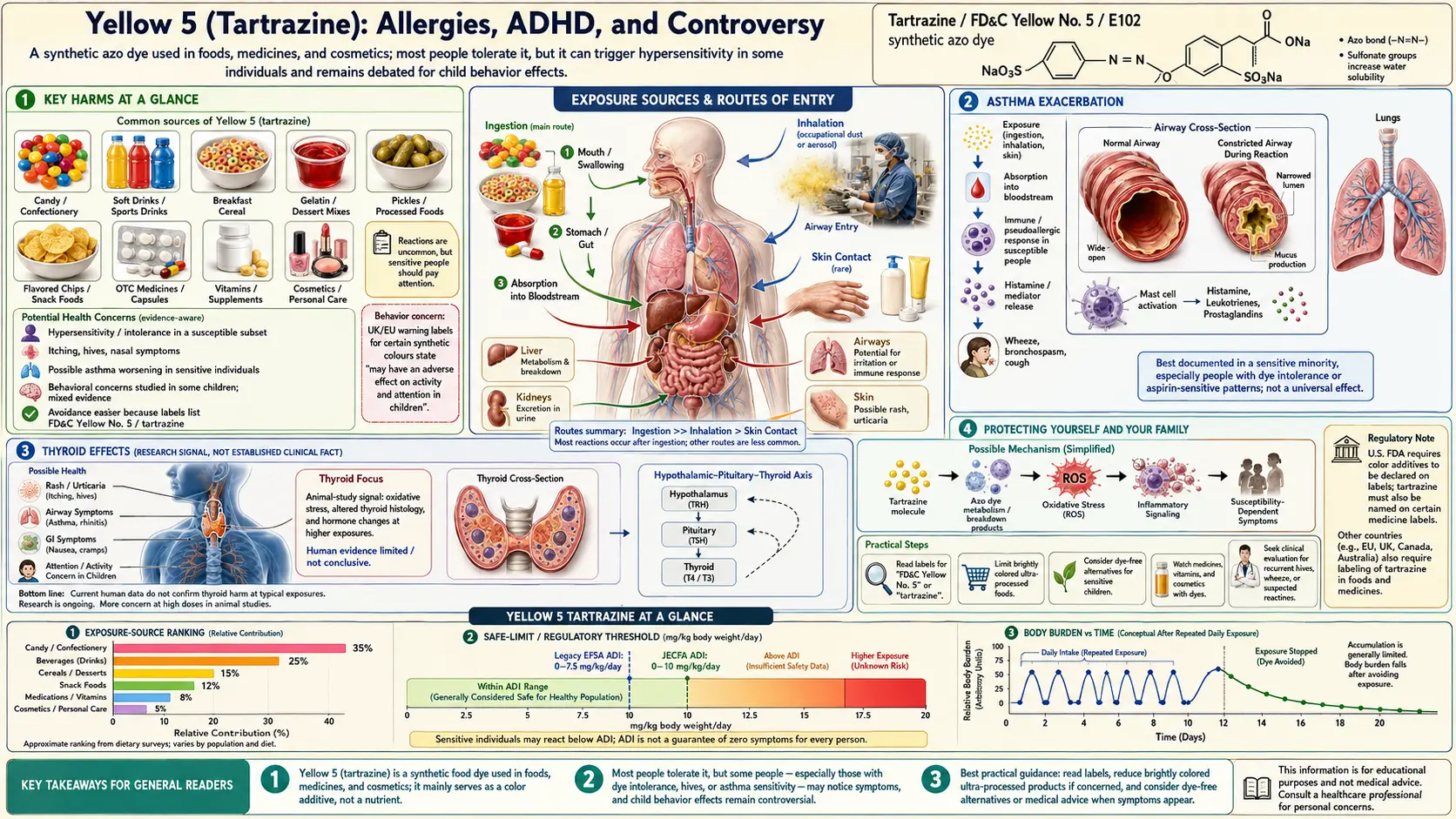
Yellow 5, known chemically as Tartrazine and designated E102 in Europe, is the second most widely used artificial food dye in the United States. This petroleum-derived azo dye imparts a vivid lemon-yellow color to thousands of food products, beverages, medications, and cosmetics. Tartrazine has a particularly troubling safety profile: it is a documented trigger for allergic reactions in aspirin-sensitive individuals, has been linked to hyperactivity in children, has shown genotoxic properties in laboratory studies, and is contaminated with the known human carcinogen benzidine. Norway and Austria have banned Tartrazine, and the European Union requires warning labels on all products containing it, yet the United States continues to permit its unrestricted use in food.
Table of Contents
- Key Harms at a Glance
- Chemical Structure and Properties
- Common Products Containing Yellow 5 (Exposure Routes)
- Aspirin-Sensitivity Cross-Reaction
- Asthma Exacerbation
- Urticaria and Skin Reactions
- Hyperactivity in Children
- Genotoxicity Research
- Thyroid Effects
- Benzidine Contamination
- International Regulatory Status
- Safety Thresholds & ADI
- How to Protect Yourself and Your Family
- Research Papers
- Connections
- Featured Videos
Key Harms at a Glance
- Aspirin-sensitivity cross-reaction – 20–50% of aspirin-sensitive individuals react to Tartrazine; FDA uniquely requires it be named on drug labels.
- Asthma exacerbation – Bronchospasm and decreased lung function in challenge studies of aspirin-sensitive asthmatics.
- Hyperactivity in children – 2007 Southampton Study (Lancet) led EU to mandate warning labels.
- Chronic urticaria – Commonly identified food-dye trigger.
- Benzidine contamination – A known human carcinogen present as azo-dye manufacturing impurity.
- Banned in Norway and Austria; EU requires warning labels.
- ADI – JECFA/FDA 7.5 mg/kg body weight/day; EFSA 7.5 mg/kg (lowered temporarily to 0–7.5 mg in 2009 re-evaluation).
Chemical Structure and Properties
Tartrazine is a synthetic monoazo dye with the chemical name trisodium 1-(4-sulfonatophenyl)-4-(4-sulfonatophenylazo)-5-pyrazolone-3-carboxylate. Its molecular formula is C16H9N4Na3O9S2.
- Chemical class: Pyrazolone azo dye, characterized by the nitrogen-nitrogen double bond (N=N) that creates the chromophore responsible for its yellow color
- Raw materials: Synthesized from petroleum-derived precursors through a multi-step process involving diazotization and coupling reactions
- Physical properties: Bright yellow powder, highly soluble in water; stable under heat and light, making it popular for a wide range of food applications
- Metabolism: In the human body, gut bacteria can cleave the azo bond, producing sulfanilic acid and aminopyrazolone, aromatic amine metabolites that raise toxicological concerns
Common Products Containing Yellow 5
Tartrazine is found in an enormous range of consumer products, often in items that consumers would not associate with artificial coloring.
- Beverages: Mountain Dew, Gatorade (lemon-lime), lemonade mixes, energy drinks, and flavored waters
- Snack foods: Doritos (especially Nacho Cheese flavor), Cheetos, tortilla chips, and flavored popcorn
- Candy: Candy corn, Skittles, Starburst, Life Savers, Peeps, and gummy candies
- Cereals: Lucky Charms, Froot Loops, and many other brightly colored breakfast cereals
- Condiments: Mustard, pickles, relish, salad dressings, and seasoning packets
- Boxed foods: Kraft Macaroni and Cheese, instant noodle seasoning packets, cake mixes, and pudding mixes
- Dairy products: Flavored yogurts, cheese-flavored products, and ice cream
- Medications: Many prescription and over-the-counter medications use Tartrazine in tablet coatings and liquid formulations; the FDA requires that Tartrazine be specifically listed on drug labels due to its known allergenicity
- Cosmetics: Shampoos, soaps, lotions, and makeup products
Aspirin-Sensitivity Cross-Reaction
One of the most well-documented adverse effects of Tartrazine is its cross-reactivity with aspirin sensitivity. Individuals who are intolerant or allergic to aspirin (acetylsalicylic acid) are at significantly increased risk of adverse reactions to Tartrazine. This connection was first identified in the 1960s and has been confirmed in numerous subsequent studies.
- Mechanism: Both aspirin and Tartrazine are thought to inhibit cyclooxygenase enzymes and alter leukotriene metabolism, leading to similar inflammatory and allergic responses in susceptible individuals
- Prevalence: Studies estimate that 20-50% of aspirin-sensitive individuals also react to Tartrazine, though some researchers believe the true prevalence may be higher
- Symptoms: Reactions can include urticaria (hives), angioedema, bronchospasm, asthma attacks, and in rare cases, anaphylaxis
- FDA labeling requirement: Because of this well-documented cross-reactivity, the FDA uniquely requires that Tartrazine be specifically identified by name on the labels of prescription drugs and drug products, not just listed generically as "artificial color"
Asthma Exacerbation
Tartrazine has been identified as a trigger for asthma symptoms in sensitive individuals, particularly those with aspirin-sensitive asthma (Samter's triad). Challenge studies have shown that ingestion of Tartrazine can provoke bronchospasm, decreased lung function, wheezing, and shortness of breath in susceptible asthmatics. Given that Tartrazine is present in many medications, including some asthma medications themselves, this represents a particularly insidious exposure pathway. Asthmatic individuals who experience worsening symptoms without clear triggers should consider evaluating their exposure to Tartrazine-containing foods and medications.
Urticaria (Hives) and Skin Reactions
- Chronic urticaria: Tartrazine is one of the most commonly identified food dye triggers for chronic idiopathic urticaria, a condition characterized by recurring hives lasting more than six weeks
- Angioedema: Deep tissue swelling, particularly of the face, lips, tongue, and throat, has been reported following Tartrazine ingestion
- Contact dermatitis: Skin contact with Tartrazine-containing products can cause redness, itching, and irritation in sensitive individuals
- Purpura: Some case reports have linked Tartrazine ingestion to purpura (purple spots caused by bleeding under the skin)
Hyperactivity in Children
Tartrazine was one of the six dyes tested in the landmark 2007 Southampton Study published in The Lancet. The study found that mixtures containing Tartrazine (among other dyes) and sodium benzoate significantly increased hyperactive behavior in both three-year-old and eight-to-nine-year-old children from the general population. This finding was instrumental in the European Union's decision to require warning labels on products containing Tartrazine, stating that the dye "may have an adverse effect on activity and attention in children."
- Mechanism: The exact mechanism by which Tartrazine affects behavior is not fully understood, but hypotheses include direct neurotoxic effects, depletion of zinc (which is essential for neurotransmitter function), and interference with dopamine and serotonin pathways
- Dose-response: Some studies suggest that behavioral effects may occur even at doses below the FDA's acceptable daily intake (ADI) of 5 mg/kg body weight per day
- Vulnerable populations: Children are particularly susceptible due to their lower body weight, higher per-kilogram consumption of dyed foods, and developing nervous systems
Genotoxicity Research
Multiple laboratory studies have investigated whether Tartrazine can damage DNA, with concerning results.
- Comet assay studies: Several studies using the comet assay (single cell gel electrophoresis) have found that Tartrazine causes DNA strand breaks in human lymphocytes and other cell types
- Chromosomal aberrations: Studies in both animal and human cell models have reported increased chromosomal aberrations following Tartrazine exposure
- Micronucleus test: Some studies have found increased micronucleus formation (an indicator of chromosomal damage) in bone marrow cells of animals exposed to Tartrazine
- Oxidative stress: Tartrazine has been shown to induce oxidative stress in various tissues, which can lead to indirect DNA damage through the generation of reactive oxygen species
- Inconsistent results: The FDA and EFSA note that genotoxicity results for Tartrazine are mixed, with some standard regulatory tests showing negative results; however, critics argue that the positive findings in multiple independent studies should not be dismissed
Thyroid Effects
Research has identified potential effects of Tartrazine on thyroid function, adding to concerns about endocrine disruption.
- Animal studies: Studies in rats have shown that chronic exposure to Tartrazine can alter thyroid hormone levels (T3 and T4) and affect thyroid gland histology
- Thyroid weight changes: Some animal studies have reported increased thyroid weight in animals exposed to high doses of Tartrazine
- Iodine interference: There is concern that Tartrazine's chemical structure may interfere with iodine metabolism, which is essential for thyroid hormone production
- Endocrine disruption: The cumulative effect of Tartrazine exposure combined with other endocrine-disrupting chemicals in the food supply and environment remains poorly understood
Benzidine Contamination
One of the most alarming aspects of Tartrazine is its contamination with benzidine, a compound classified as a known human carcinogen by the International Agency for Research on Cancer (IARC), the National Toxicology Program (NTP), and the Environmental Protection Agency (EPA). Benzidine is a potent bladder carcinogen that can be present as a manufacturing impurity in azo dyes, including Tartrazine.
- FDA limits: The FDA allows up to 1 part per billion (ppb) of free benzidine in food dyes, but this limit is based on analytical detection capabilities rather than a safety threshold
- No safe level: For known human carcinogens like benzidine, most toxicologists agree that no level of exposure can be considered truly safe, particularly with chronic daily exposure beginning in childhood
- Cumulative exposure: Because consumers are exposed to Tartrazine from multiple food sources daily, the cumulative benzidine exposure may be significantly higher than what any single food product would suggest
- Azo bond cleavage: Additionally, gut bacteria can cleave the azo bond in Tartrazine, potentially releasing aromatic amine metabolites that may be further converted to carcinogenic compounds in the body
International Regulatory Status
- Norway: Has banned Tartrazine from use in food products
- Austria: Has banned or heavily restricted Tartrazine in food
- European Union: Permits Tartrazine (E102) but requires mandatory warning labels on all products containing it, stating: "May have an adverse effect on activity and attention in children"
- United Kingdom: The UK Food Standards Agency urged voluntary removal of Tartrazine following the Southampton Study; most major manufacturers have complied
- United States: Freely permitted in food with no warning labels; the FDA requires it to be listed by name on drug labels due to its allergenicity but does not require similar identification on food labels beyond listing it in ingredients
- Canada: Permitted but subject to specific labeling requirements
Safety Thresholds & ADI
- JECFA ADI – 0–7.5 mg/kg body weight/day.
- FDA – 7.5 mg/kg body weight/day; mandatory labeling by name; additional labeling requirement on drug products.
- EFSA (2009 re-evaluation) – Confirmed 0–7.5 mg/kg ADI; required warning label for children’s attention/activity effects.
- EU warning label (Regulation 1333/2008) – “May have an adverse effect on activity and attention in children.”
- Banned in Norway and Austria; voluntarily removed by most UK manufacturers.
Protecting Yourself and Your Family
- Read all labels carefully: Look for "Yellow 5," "Tartrazine," "FD&C Yellow No. 5," or "E102" in ingredient lists
- Aspirin-sensitive individuals: If you have aspirin sensitivity, be especially vigilant about avoiding Tartrazine in both food and medications
- Asthma patients: Consult your physician about Tartrazine avoidance if your asthma is poorly controlled or if you have aspirin-sensitive asthma
- Choose natural alternatives: Products colored with turmeric, annatto, beta-carotene, or saffron provide yellow color without the risks of Tartrazine
- Check medications: Ask your pharmacist whether your medications contain Tartrazine and request dye-free alternatives when available
- Elimination diet: If you suspect Tartrazine sensitivity, try eliminating it from your diet for 2-4 weeks and monitor for symptom improvement
Research Papers
- McCann D, Barrett A, Cooper A, et al. Food additives and hyperactive behaviour in 3-year-old and 8/9-year-old children in the community: a randomised, double-blinded, placebo-controlled trial. Lancet. 2007;370(9598):1560-1567. (Southampton Study)
- EFSA Panel on Food Additives. Scientific Opinion on the re-evaluation of tartrazine (E 102). EFSA Journal. 2009;7(11):1331.
- PubMed topic search: tartrazine hyperactivity children
- PubMed topic search: tartrazine aspirin sensitivity asthma
- PubMed topic search: tartrazine genotoxicity lymphocyte
- PubMed topic search: tartrazine urticaria chronic
- PubMed topic search: azo dye benzidine contamination
- PubMed topic search: food dye ADHD meta-analysis
- PubMed topic search: Nigg artificial food color ADHD
- PubMed topic search: tartrazine thyroid rat
- PubMed topic search: Schab Trinh synthetic food color
- PubMed topic search: tartrazine oxidative stress rodent
Connections
- All Toxins
- Food Dyes
- Asthma
- ADHD
- Red 40 Allura Red
- Food Dyes Banned Worldwide
- Red 3 Erythrosine
- US vs EU Food Safety
- Preservatives
- Acesulfame Potassium
- Food Additives
- Allergies
- Oxidative Stress
- Iodine
- Cancer
- Elimination Diet
- Lead