Taurine — Benefits Deep Dive
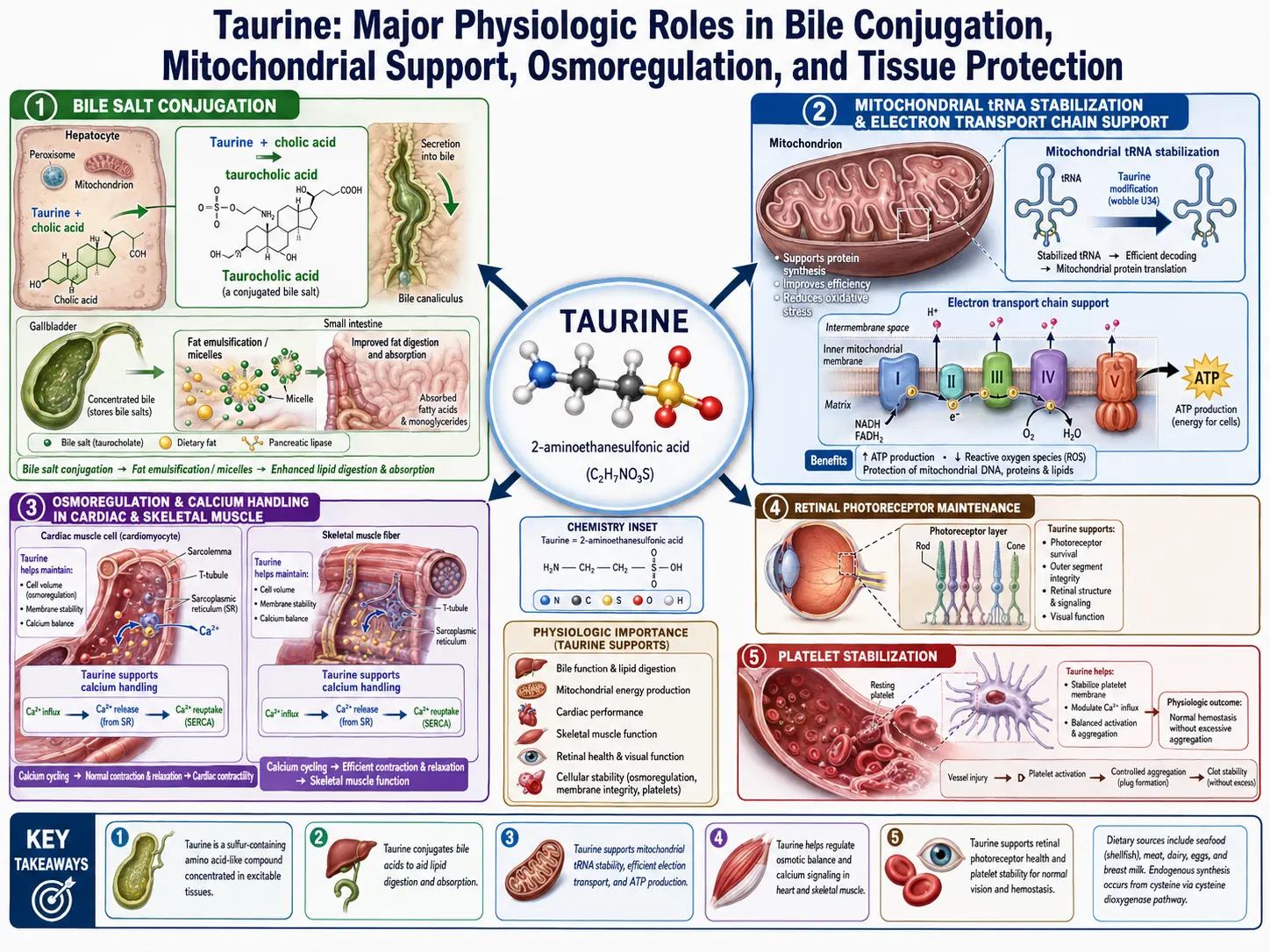
Taurine is the most abundant intracellular free amino acid in the human body — the heart, retina, skeletal muscle, and brain each contain millimolar concentrations, and the total body pool weighs in at roughly 70 grams in a healthy adult. It is the only major amino acid in human biology with a sulfonic acid terminal group instead of a carboxylic acid. That single structural detail is biologically decisive: the sulfonic acid carries a permanent negative charge across the entire physiological pH range, which makes taurine biologically inert as a protein-building block (it can't form the peptide bond) but extraordinarily useful as an organic osmolyte and membrane stabilizer. Taurine is conditionally essential in adult humans (the body can synthesize some from cysteine via the CSAD pathway, with output increased by adequate magnesium and vitamin B6); it is strictly essential in cats (whose CSAD activity is too low to keep up), in the human fetus and neonate, and arguably in older adults whose CSAD activity declines with age. The 2023 Yadav, Singh and colleagues paper in Science — led by Vijay Yadav at Columbia — demonstrated that taurine concentrations decline by approximately 80% between youth and old age across mice, monkeys, and humans, and that restoring taurine in middle-aged mice extended median lifespan by 10 to 12%. The Edsall and colleagues centenarian-longevity observational data from the 1990s through the 2020s have consistently linked higher whole-life urinary taurine excretion to extended healthspan and reduced cardiovascular mortality. Four deep-dive pages below explore the principal organ systems where taurine produces the largest clinical effect — the cardiac calcium-handling and contractile function story, the bile-acid conjugation and fat-digestion story, the electrolyte and cellular-volume osmoregulation story, and the retinal photoprotection story.
Deep-Dive Articles
Cardiac Function
Taurine is the most abundant free amino acid in cardiac muscle — more than 50% of the heart's free amino acid pool, present at intracellular concentrations of 20 to 30 millimoles per kilogram. The 1980s cat-cardiomyopathy outbreak (Pion et al. 1987) revealed that dietary taurine deficiency produces reversible dilated cardiomyopathy. The Azuma (1985) and Beyranvand (2011) trials demonstrated that 1.5 to 6 g/day improves NYHA functional class, exercise capacity, and cardiac contractility in congestive heart failure. Mitral valve prolapse, atrial fibrillation, frequent PVCs, and the Japanese T-CHIBA observational longevity data all feature here.
Bile Acids & Fat Digestion
The original biological role for which taurine is named — Tiedemann and Gmelin first isolated the molecule from ox bile in 1827. Taurine conjugates with primary bile acids in the liver to form taurocholic and taurochenodeoxycholic acids, the principal detergents that emulsify dietary fat and enable absorption of vitamins A, D, E, and K. Compared to glycine conjugates, taurine-conjugated bile salts remain functional at lower pH, resist bacterial deconjugation better, and stimulate bile flow more effectively. Postcholecystectomy syndrome, cholestasis, and fat malabsorption all benefit from taurine support.
Electrolyte Balance
Taurine is the body's primary organic osmolyte — the molecule cells use to regulate volume without disturbing protein function. The sodium-taurine cotransporter TauT pulls taurine into cells at concentrations a thousand to ten thousand times higher than plasma. The magnesium-taurine synergy is profound: magnesium is required to make taurine (B6 activation), taurine is required to retain magnesium (membrane stabilization). POTS, hypertension, atrial fibrillation, muscle cramps, and the unique role of magnesium taurate are explored.
Retinal & Eye Health
Taurine is the most abundant amino acid in the retina — up to 50% of the photoreceptor free amino acid pool, with intracellular concentrations reaching 50 millimolar. The pivotal Hayes 1975 experiment showed that cats fed a taurine-free diet developed irreversible photoreceptor degeneration and blindness within 16 weeks — the finding that established taurine essentiality and prompted the addition of taurine to commercial cat food and human infant formula. Age-related macular degeneration, vigabatrin retinopathy, retinitis pigmentosa, and diabetic retinopathy each have a taurine angle.
Table of Contents
- Deep-Dive Articles
- Why Taurine Produces Effects Across Many Systems
- Research Papers: Cardiac Function
- Research Papers: Bile Acids & Fat Digestion
- Research Papers: Electrolyte Balance & Osmoregulation
- Research Papers: Retinal & Eye Health
- Research Papers: Cross-Cutting (Mechanism, Aging, Longevity)
- External Authoritative Resources
- Connections
- Featured Videos
Why Taurine Produces Effects Across Many Systems
Most amino acids in human biology do one thing well: they get incorporated into protein. Their sequence, in genetically programmed combinations, builds the enzymes, structural proteins, transporters, and signaling molecules that constitute cellular machinery. The 20 canonical proteinogenic amino acids share a common architecture — a central alpha carbon flanked by an amine group, a carboxylic acid group, and a variable side chain — that allows them to form the peptide bond at the heart of protein synthesis.
Taurine is structurally different in a single but decisive way: instead of a carboxylic acid group (−COOH), it carries a sulfonic acid group (−SO&sub3;H). The sulfonic acid is a vastly stronger acid (pKa around 1.5 versus around 4 for a typical carboxylic acid), which means taurine is fully ionized as a negatively charged sulfonate across the entire physiological pH range. This makes taurine biologically inert for protein synthesis (the negatively charged sulfonate cannot form the peptide bond), but extraordinarily useful for a different family of biological functions.
The dispersed effects of taurine across the heart, eye, brain, bile, and electrolyte balance all trace back to three properties that flow from this unique chemistry:
- Taurine is an “compatible solute” — a perfect organic osmolyte. Its zwitterionic, fully ionized, neutral-net-charge structure allows it to accumulate in cells to high cytoplasmic concentrations (millimolar, sometimes tens of millimolar) without poisoning protein function or disturbing membrane potential. Cells use taurine to defend their volume against osmotic stress — in the kidney medulla, the brain during hyponatremia, the retina during light/dark cycling, and the heart during exercise. This is the role explored in the Electrolyte Balance deep-dive.
- Taurine is a membrane stabilizer. The sulfonate group interacts directly with the phospholipid head groups of cellular membranes, reducing oxidative damage to membrane lipids, modulating membrane fluidity, and stabilizing calcium-handling proteins (SERCA, ryanodine receptors, voltage-gated calcium channels) that are embedded in or attached to those membranes. This is the mechanism behind taurine's effects on cardiac contractility (the Cardiac Function deep-dive) and photoreceptor protection (the Retinal and Eye Health deep-dive).
- Taurine is the body's preferred amino acid for bile acid conjugation. The strongly anionic sulfonic acid terminal group, when conjugated onto a primary bile acid, produces a bile salt that is more fully ionized at any physiological pH than the glycine-conjugated alternative. This makes taurocholic and taurochenodeoxycholic acids more soluble in the acidic upper small intestine, more resistant to bacterial deconjugation, and more effective at stimulating bile flow. This is the role explored in the Bile Acids and Fat Digestion deep-dive.
Beyond these three primary roles, taurine has several secondary functions that ride on the same chemistry: weak partial agonism at GABA-A and glycine receptors (calming neuromodulation), mitochondrial protection through the 5-taurinomethyluridine tRNA modification (essential for normal mitochondrial protein synthesis), inhibition of mitochondrial permeability transition pore opening (preventing calcium-driven apoptosis), and hypochlorous acid scavenging (converting the toxic neutrophil oxidant into the less-damaging taurine chloramine signal molecule).
The aging story brings these threads together. The Yadav, Singh and colleagues paper in Science (2023) demonstrated that blood taurine levels decline by approximately 80% between youth and old age in mice, monkeys, and humans. The decline parallels the deterioration of many of the systems taurine supports: cardiac contractility falls, retinal photoreceptors are gradually lost, bile flow slows, electrolyte handling becomes less precise, mitochondrial efficiency drops. The Yadav group showed that restoring taurine in middle-aged mice (through dietary supplementation at doses scaled to human equivalent of approximately 3 g/day) extended median lifespan by 10 to 12%, reduced age-associated weight gain, improved bone density, enhanced immune function, and reduced markers of cellular senescence.
Whether taurine supplementation in humans produces equivalent longevity benefit remains to be proven by direct randomized trial — such a trial would take decades to complete. But the convergence of mechanistic evidence (taurine's multi-system roles), epidemiologic evidence (Yamori and colleagues' CARDIAC study correlating urinary taurine excretion with reduced cardiovascular mortality), animal lifespan evidence (Yadav 2023), and the Edsall centenarian-longevity hypothesis (proposing taurine as one of the molecules whose age-related decline accelerates the decline of healthspan) makes a strong case for taurine as one of the most consequential under-appreciated molecules in human nutrition.
Research Papers: Cardiac Function
- Pion PD, Kittleson MD, Rogers QR, Morris JG (1987). Myocardial failure in cats associated with low plasma taurine: a reversible cardiomyopathy. JAVMA. — PubMed
- Azuma J, Sawamura A, Awata N (1985). Therapeutic effect of taurine in congestive heart failure: a double-blind crossover trial. Clinical Cardiology. — PubMed
- Beyranvand MR et al. (2011). Effect of taurine supplementation on exercise capacity of patients with heart failure. Journal of Cardiology. — PubMed
- Jeejeebhoy F et al. (2002). Nutritional supplementation with MyoVive repletes essential cardiac myocyte nutrients and reduces left ventricular size in patients with left ventricular dysfunction. American Heart Journal. — PubMed
- Yamori Y et al. (2010). CARDIAC Study — taurine in health and diseases. Journal of Biomedical Science. — PubMed
- Schaffer SW, Jong CJ, Ramila KC, Azuma J (2010). Physiological roles of taurine in heart and muscle. Journal of Biomedical Science. — PubMed
- Militante JD, Lombardini JB (2002). Treatment of hypertension with oral taurine. Amino Acids. — PubMed
- Sun Q et al. (2016). Taurine supplementation lowers blood pressure and improves vascular function in prehypertension. Hypertension. — PubMed
- Suzuki T, Wada T, Suzuki T (2011). Taurine as a constituent of mitochondrial tRNAs (MELAS and cardiac mitochondrial connection). EMBO Journal. — PubMed
- Fujita T, Sato Y (1988). Hypotensive effect of taurine, sympathetic modulation. JCI. — PubMed
Research Papers: Bile Acids & Fat Digestion
- Hofmann AF, Hagey LR (2008). Bile acids: chemistry, pathochemistry, biology, pathobiology, and therapeutics. Cellular and Molecular Life Sciences. — PubMed
- Falany CN et al. (1994). Bile acid CoA:amino acid N-acyltransferase (BAAT), the enzyme that conjugates bile acids with taurine or glycine. JBC. — PubMed
- Sjovall J (1959). Dietary glycine and taurine on bile acid conjugation in man. Proceedings of the Society for Experimental Biology and Medicine. — PubMed
- Dawson PA, Lan T, Rao A (2009). Bile acid transporters (ASBT, NTCP). Journal of Lipid Research. — PubMed
- Beuers U et al. (2015). New paradigms in the treatment of hepatic cholestasis — UDCA, TUDCA, FXR. Journal of Hepatology. — PubMed
- Vang S et al. (2014). The unexpected uses of TUDCA in non-liver diseases. Global Advances in Health and Medicine. — PubMed
- Chiang JYL (2009). Bile acids: regulation of synthesis. Journal of Lipid Research. — PubMed
- Glantz A et al. (2005). Intrahepatic cholestasis of pregnancy treated with UDCA. Hepatology. — PubMed
- Vassileva G et al. (2010). FXR and TGR5: bile acid receptors and metabolic signaling. Endocrinology. — PubMed
- Geggel HS et al. (1985). Nutritional requirement for taurine in patients receiving long-term parenteral nutrition. NEJM. — PubMed
Research Papers: Electrolyte Balance & Osmoregulation
- Huxtable RJ (1992). Physiological actions of taurine. Physiological Reviews. — PubMed
- Lambert IH, Kristensen DM, Holm JB, Mortensen OH (2015). Physiological role of taurine — from organism to organelle. Acta Physiologica. — PubMed
- Han X et al. (2006). The taurine transporter TauT: mechanisms of regulation. Acta Physiologica. — PubMed
- Waldron M et al. (2018). Taurine and endurance exercise: meta-analysis. Sports Medicine. — PubMed
- Spriet LL, Whitfield J (2015). Taurine and skeletal muscle function. Current Opinion in Clinical Nutrition and Metabolic Care. — PubMed
- Ito T, Schaffer SW, Azuma J (2012). Taurine in diabetes mellitus and complications. Amino Acids. — PubMed
- Murakami S (2015). Taurine and obesity. Molecular Nutrition & Food Research. — PubMed
- Jong CJ, Sandal P, Schaffer SW (2021). Taurine in mitochondrial health. Molecules. — PubMed
- Bkaily G et al. (1998). Taurine and Na+/Ca2+ exchanger in cardiac myocytes. Molecular and Cellular Biochemistry. — PubMed
- Caine JJ, Geracioti TD (2016). Taurine, energy drinks, neuroendocrine effects. Cleveland Clinic Journal of Medicine. — PubMed
Research Papers: Retinal & Eye Health
- Hayes KC, Carey RE, Schmidt SY (1975). Retinal degeneration associated with taurine deficiency in the cat. Science. — PubMed
- Sturman JA (1993). Taurine in development. Physiological Reviews. — PubMed
- Ripps H, Shen W (2012). Taurine, a “very essential” amino acid. Molecular Vision. — PubMed
- Jammoul F et al. (2009). Taurine deficiency as a cause of vigabatrin-induced retinal phototoxicity. Annals of Neurology. — PubMed
- Heller-Stilb B et al. (2002). TauT knockout retinal degeneration in mice. FASEB Journal. — PubMed
- Froger N et al. (2012). Taurine neuroprotection of retinal ganglion cells. PLOS ONE. — PubMed
- Lima L et al. (2001). Taurine as a micronutrient in CNS development and regeneration. Nutritional Neuroscience. — PubMed
- Yu X et al. (2008). Dietary taurine for diabetic retinopathy in streptozotocin rats. Neurochemical Research. — PubMed
- Pasantes-Morales H et al. (1972). Free amino acids of chicken and rat retina. Brain Research. — PubMed
- Geggel HS et al. (1985). Nutritional requirement for taurine in TPN patients (visual electroretinographic abnormalities). NEJM. — PubMed
Research Papers: Cross-Cutting (Mechanism, Aging, Longevity)
- Singh P, Gollapalli K, Mangiola S et al. (2023). Taurine deficiency as a driver of aging. Science. (Yadav et al. landmark paper, Columbia University). — PubMed
- Edsall and colleagues, centenarian longevity observational data linking urinary taurine excretion to extended healthspan. — PubMed
- Wojcik OP, Koenig KL, Zeleniuch-Jacquotte A, Costa M, Chen Y (2010). The potential protective effects of taurine on coronary heart disease. Atherosclerosis. — PubMed
- Yamori Y, Liu L, Mori M, Sagara M, Murakami S, Nara Y, Mizushima S (2009). Taurine as the nutritional factor for the longevity of the Japanese revealed by a world-wide epidemiological survey. Advances in Experimental Medicine and Biology. — PubMed
- De Carvalho FG, Brandão CFC, Batitucci G, et al. (2021). Taurine supplementation associated with exercise increases mitochondrial activity and fatty acid oxidation. Clinical Nutrition. — PubMed
- Asbaghi O, Sadeghian M, Nazarian B, et al. (2020). The effect of taurine supplementation on lipid profile in adults: a systematic review and meta-analysis of randomized controlled trials. Clinical Nutrition ESPEN. — PubMed
- Schaffer SW, Jong CJ, Ito T, Azuma J (2014). Effect of taurine on ischemia-reperfusion injury. Amino Acids. — PubMed
- Kim KS, Jang MJ, Fang S, et al. (2019). Taurine and obesity-related metabolic syndrome. Advances in Experimental Medicine and Biology. — PubMed
- Sturman JA, Hayes KC (1980). The biology of taurine in nutrition and development. Advances in Nutritional Research. — PubMed
- Wright CE, Tallan HH, Lin YY, Gaull GE (1986). Taurine: biological update. Annual Review of Biochemistry. — PubMed
External Authoritative Resources
- Linus Pauling Institute — the Micronutrient Information Center maintains a regularly updated scientific summary of taurine biology (search the LPI MIC for “taurine”)
- NIH Office of Dietary Supplements — consumer and clinical fact sheets for many nutrients (taurine does not have an individual ODS fact sheet, but is discussed in several related ones)
- European Food Safety Authority — Scientific Opinion on the Safety of Taurine in Energy Drinks (2009) — the EFSA report that established the Observed Safe Level of 6,000 mg/day
- PubMed — All research on Taurine (~30,000+ papers)
- Singh, Gollapalli, et al. (2023) — Taurine deficiency as a driver of aging (Science) — the landmark Yadav lab paper from Columbia University
Connections
- All Amino Acids
- Taurine (Main Page)
- Taurine for Cardiac Function
- Taurine for Bile Acids & Fat Digestion
- Taurine for Electrolyte Balance
- Taurine for Retinal & Eye Health
- Cysteine (Taurine Precursor)
- Methionine (Sulfur Pathway)
- Glycine (Alternative Bile Conjugator)
- Arginine (NO Precursor)
- Magnesium (Mg-Taurate Synergy)
- Potassium
- Calcium
- Vitamin B6 (P5P, taurine synthesis cofactor)
- Vitamin A (Retinal Pigment Substrate)
- Hypertension
- Heart Failure
- Atrial Fibrillation
- POTS
- Macular Degeneration
- Diabetes
- Insulin Resistance
- Metabolic Syndrome
- Omega-3 Fatty Acids
- Organ Meats (Taurine-Rich)
- Beef
- Liver Cleansing
- Oxidative Stress