Vitamin D Deficiency: Fatigue and Low Mood
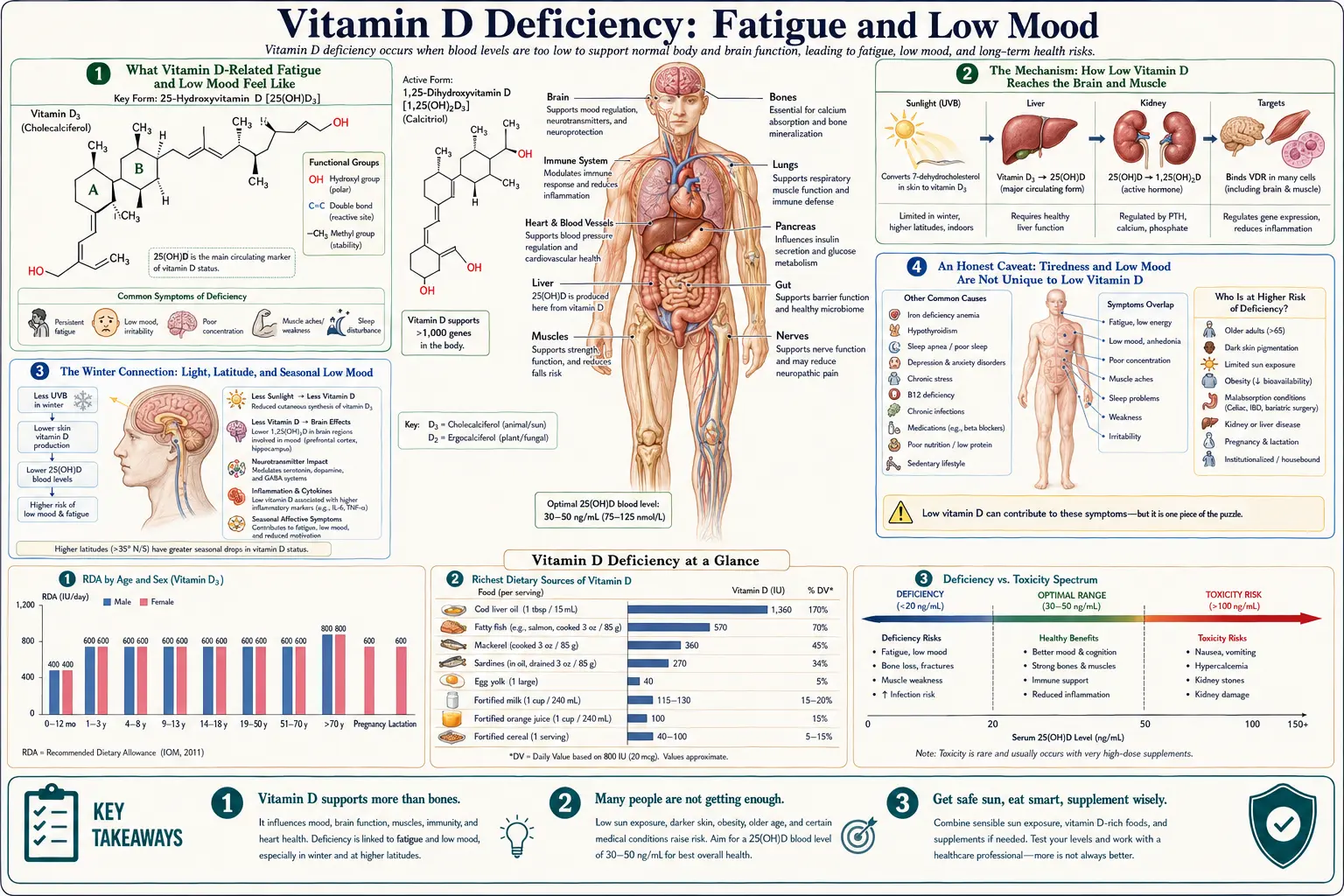
By the time many people learn their vitamin D is low, the only thing they noticed was that they felt flat — tired in a way that sleep didn't fix, and low in a way that no single bad day could explain. Especially through the short, grey days of winter, energy drains away, motivation thins out, and the mood follows the light down. Vitamin D deficiency is one of the most common nutritional shortfalls in the world, and fatigue and low mood are among its most frequently reported — and most frequently overlooked — symptoms. This page explains how a lack of vitamin D can plausibly sap your energy and dim your mood, why winter makes it worse, and — just as honestly — why tiredness and low mood are never proof of deficiency on their own, since so many other common conditions produce exactly the same feeling. The good news is that this is a cheap blood test away from an answer.
Table of Contents
- What Vitamin D-Related Fatigue and Low Mood Feel Like
- The Mechanism: How Low Vitamin D Reaches the Brain and Muscle
- The Winter Connection: Light, Latitude, and Seasonal Low Mood
- An Honest Caveat: Tiredness and Low Mood Are Not Unique to Low Vitamin D
- Clues That Point Toward Vitamin D
- Common Reasons Vitamin D Runs Low
- Getting Tested: The 25(OH)D Blood Test
- Correcting Low Vitamin D Safely
- What the Trials Actually Show
- When to Seek Care / Red Flags
- Key Research Papers
- Connections
- Featured Videos
What Vitamin D-Related Fatigue and Low Mood Feel Like
The tiredness people describe with low vitamin D is rarely the sharp, earned tiredness of a hard day. It is a persistent, low-grade depletion — a background heaviness that is there when you wake, lingers after a full night's sleep, and makes ordinary tasks feel like more effort than they should. People reach for words like flat, drained, running on empty, or “like I'm wading through treacle.”
- Unrefreshing sleep — sleeping a normal number of hours and still waking tired, with no obvious reason.
- Low stamina for ordinary things — the walk, the chores, the workday feel disproportionately tiring; some people also notice their legs and hips tire or ache, which overlaps with muscle weakness.
- A dimmed, withdrawn mood — not necessarily sadness as such, but a loss of brightness: less interest in things you usually enjoy, more irritability, a tendency to cancel plans and stay in.
- Mental fog — trouble concentrating or a feeling of being one step slow, which can blur with the energy problem (see brain fog).
- A seasonal rhythm — perhaps the most distinctive clue: the feeling deepens in late autumn and winter and lifts in spring, tracking the daylight rather than any life event.
It is worth naming the difference between the two symptoms, because people often run them together. Fatigue is about energy — the tank feels empty. Low mood is about emotional tone — the colour drains out of things. Low vitamin D is reported alongside both, and they frequently travel together, but they are distinct experiences, and (as the honesty section below stresses) each has a long list of possible causes beyond vitamin D.
The Mechanism: How Low Vitamin D Reaches the Brain and Muscle
To understand why a vitamin best known for bones might touch energy and mood, it helps to know that vitamin D is not really acting as a vitamin at all — it behaves like a hormone. The body converts it (in the liver and kidney) to its active form, calcitriol, which then docks onto a protein called the vitamin D receptor (VDR). The surprising fact is where those receptors are found: not just in bone and gut, but throughout the body — including in skeletal muscle and in regions of the brain involved in mood, among them the hippocampus and the hypothalamus. Where there is a receptor, there is the potential for an effect when the signal is missing.
In the brain, vitamin D appears to help regulate the machinery of mood chemistry. Work by Patrick and Ames proposed a concrete link: the active hormone helps switch on the gene for the enzyme that converts the amino acid tryptophan into serotonin — the neurotransmitter most associated with mood, calm, and a sense of well-being. If that model holds, then chronically low vitamin D could leave serotonin synthesis running below par in exactly the brain regions that govern mood. Vitamin D also influences inflammation and the production of nerve growth factors, both of which are independently tied to depression. None of this is fully settled science — but it is a biologically plausible chain, not a guess.
In muscle, the picture is clearer. Vitamin D receptors sit inside muscle fibres, and genuine deficiency is linked to a specific kind of weakness and aching in the large muscles closest to the trunk — the thighs and hips — that can read to a tired person as “no energy in my legs.” This is one reason the line between “fatigue” and “weakness” can blur in deficiency; the dedicated muscle weakness and falls page covers that thread in depth.
An analogy. Think of vitamin D as the building's facilities manager rather than a single light bulb. It doesn't power one room — it holds the keys (the receptors) to dozens of rooms across the body, and walks around making sure each is set up to run: the bone room, the immune room, the muscle room, the mood room. When the manager stops showing up, no single light goes out dramatically; instead the whole building runs a little dim and a little sluggish. That diffuse, system-wide under-running is exactly what “tired and flat for no reason” can feel like — and it is why the symptoms of deficiency are so vague and easy to attribute to something else.
The Winter Connection: Light, Latitude, and Seasonal Low Mood
The single most recognizable feature of vitamin D-related low mood is its seasonality, and there is a simple reason for it. Most of the vitamin D in your body is not eaten — it is made in your skin when ultraviolet-B (UVB) light from the sun strikes it. In late autumn and winter, especially at higher latitudes, the sun sits too low in the sky for enough UVB to reach the ground. For a band of the world roughly north of Boston, Madrid, or Beijing, skin synthesis of vitamin D effectively shuts down for months. People also cover up and stay indoors. The predictable result is that blood levels of vitamin D drift to their lowest point of the year in late winter — precisely when many people report feeling at their most tired and low.
This overlaps with, but is not the same as, Seasonal Affective Disorder (SAD) — a recognized form of recurrent depression that arrives with the dark months and lifts in spring. SAD is driven substantially by the lack of light itself acting on the brain's circadian and serotonin systems, which is why its best-established treatment is daily bright-light therapy, not a vitamin. Low vitamin D in winter and SAD share the same trigger — short days — and they often coexist, but they are separate stories: you can have winter SAD with perfectly normal vitamin D, and you can have low winter vitamin D without meeting the criteria for SAD. The honest position, reflected in reviews of the seasonal mood literature, is that the two are entangled and that shortage of daylight is the common thread.
The practical takeaway is reassuring: if your low mood and fatigue have a clear winter rhythm, that pattern is a genuine clue worth acting on — get your vitamin D checked and ask about light exposure and, where appropriate, light therapy. They are not mutually exclusive, and addressing both is reasonable.
An Honest Caveat: Tiredness and Low Mood Are Not Unique to Low Vitamin D
This is the most important section on the page, so it comes before the “clues.” Fatigue and low mood are two of the least specific symptoms in all of medicine. They are the final common pathway of dozens of conditions, and a low vitamin D result — while worth correcting — is very often not the whole explanation, and sometimes not the explanation at all. Because vitamin D deficiency is so common, it is easy for a low level and a vague symptom to appear together by coincidence, and easy to stop looking once you have a number to blame.
Before pinning persistent tiredness or low mood on vitamin D, these common causes deserve to be on the table:
- Clinical depression and anxiety — major depression itself causes profound fatigue, loss of interest, and poor concentration. Low mood that is severe, persistent year-round, or accompanied by hopelessness needs assessment in its own right (see Depression), not just a supplement.
- Iron deficiency and anemia — one of the most common and most missed causes of fatigue, especially in menstruating women; tiredness, breathlessness, and pallor point here (see Anemia).
- Thyroid problems — an underactive thyroid (hypothyroidism) classically causes fatigue, low mood, cold intolerance, and weight gain, and is easily checked with a blood test.
- Vitamin B12 deficiency — another fixable nutritional cause of fatigue, low mood, and brain fog, common in vegans, older adults, and people on certain stomach medications (see Vitamin B12).
- Poor or disrupted sleep — insomnia, sleep apnea, and shift work produce exactly this picture and are frequently the real driver (see Insomnia).
- Other minerals and stress states — low magnesium, ongoing stress and burnout, blood-sugar problems, medication side effects, and chronic infections can all present as “tired and flat.”
The honest bottom line: feeling tired and low is a reason to get checked, not a diagnosis of vitamin D deficiency. A sensible work-up looks at vitamin D alongside iron, thyroid, and B12 — usually on the same blood draw — rather than assuming the answer in advance. Correcting a genuinely low vitamin D level is worth doing on its own merits, but if the fatigue or low mood persists after the level is restored, the search should continue.
Clues That Point Toward Vitamin D
Given how non-specific the symptoms are, what actually tilts the suspicion toward vitamin D? No single clue is proof, but several together make it a strong candidate worth testing:
- A clear seasonal pattern — symptoms that deepen in winter and lift in spring, tracking daylight rather than life events.
- Little sun exposure — a mostly indoor life, living at a high latitude, consistent sunscreen use or full skin covering, or naturally darker skin (more melanin needs more UVB to make the same vitamin D).
- Accompanying bone or muscle symptoms — deep, aching bone pain or thigh/hip weakness alongside the fatigue points more specifically at vitamin D than fatigue alone, because these are more characteristic of true deficiency.
- A known risk factor or condition — older age, a malabsorption condition, obesity, or certain medications (covered next).
- A diet with essentially no vitamin D — few people eat enough oily fish, eggs, or fortified foods to make up for missing sun.
When two or three of these line up — say, an indoor worker at a northern latitude whose energy and mood sink every winter — vitamin D moves from “possible” to “please test this.” And because the test is cheap and the fix is safe, the threshold to check is low.
Common Reasons Vitamin D Runs Low
Vitamin D deficiency is extraordinarily common — estimates suggest a large fraction of the world's population has insufficient levels — precisely because so few of us live the sun-exposed, oily-fish-eating life our biology was tuned for. The usual reasons stack up:
- Not enough sun on the skin — the dominant cause. Indoor lifestyles, office work, higher latitudes, winter, pollution, sunscreen, and clothing all cut UVB exposure.
- Skin tone — melanin is a natural sunscreen, so people with darker skin make less vitamin D from the same sunlight and have higher rates of deficiency at temperate latitudes.
- Age — older skin makes vitamin D far less efficiently, and older adults often spend less time outdoors; deficiency and its fatigue are common and under-recognized in this group.
- Obesity — vitamin D is fat-soluble and gets sequestered in body fat, lowering the amount circulating in the blood; people with higher body fat often need more to reach the same level.
- Malabsorption — celiac disease, Crohn's disease, and other gut conditions impair absorption of this fat-soluble vitamin.
- Diet — few foods are naturally rich in vitamin D; the main ones are oily fish (salmon, sardines, mackerel), cod liver, egg yolks, and fortified foods. A diet without these contributes to deficiency, especially in winter.
- Certain medications and conditions — some anticonvulsants, glucocorticoids, and kidney or liver disease interfere with activating or retaining vitamin D.
Getting Tested: The 25(OH)D Blood Test
Confirming low vitamin D is simple, inexpensive, and the only reliable way to know — you cannot diagnose it from symptoms. The test is a blood measurement of 25-hydroxyvitamin D, written 25(OH)D. This is the circulating storage form and the agreed best marker of your overall vitamin D status; it is reported in either nanograms per milliliter (ng/mL) or nanomoles per liter (nmol/L), where 1 ng/mL ≈ 2.5 nmol/L. The dedicated Vitamin D Test page walks through the test in detail.
There is genuine debate about the exact cut-offs, but a widely used framework (reflecting the Endocrine Society's guideline) is roughly:
- Deficient: below 20 ng/mL (50 nmol/L).
- Insufficient: 20–29 ng/mL (50–74 nmol/L).
- Sufficient: 30 ng/mL (75 nmol/L) and above.
(Some bodies, such as the US Institute of Medicine, regard 20 ng/mL as adequate for most people's bone health, so a result in the low-20s may be labelled differently depending on whose criteria the lab uses.) Because fatigue and low mood are so non-specific, the smart move is to test vitamin D together with the other common culprits — a full blood count and iron studies (for anemia), thyroid function (for hypothyroidism), and often B12 — so a single visit can sort out which, if any, is responsible.
Correcting Low Vitamin D Safely
The encouraging part: a confirmed low vitamin D level is one of the easiest deficiencies to correct, and doing so is worthwhile for bone, muscle, and immune health regardless of what it does for your mood. The approach combines sensible sun, food, and supplements.
- Sensible sunlight — short, regular sun exposure on bare skin in the warmer months helps the body make its own vitamin D, but this has to be balanced against skin-cancer risk and simply doesn't work in winter at higher latitudes. It is a contributor, not a reliable winter fix.
- Food — build in the few good dietary sources: oily fish such as salmon and sardines, egg yolks, and vitamin-D-fortified foods. Food alone rarely corrects a true deficiency, but it helps maintain a level once restored. See the Vitamin D food sources page.
- Supplements — the mainstay. Vitamin D3 (cholecalciferol) is the preferred supplemental form. For maintaining levels, many guidelines suggest in the region of 600–800 IU/day for most adults (older adults at the higher end); correcting a documented deficiency typically uses larger doses for a defined period — for example, a course of several thousand IU daily or a weekly high dose — followed by a maintenance dose. Because the right correction dose depends on how low you are, your weight, and your other conditions, this is best set with a clinician who can recheck your level.
- Recheck — a repeat 25(OH)D test after about 3 months confirms you've reached a healthy level and lets the maintenance dose be tuned.
A word of caution. More is not better. Vitamin D is fat-soluble and stored in the body, so very high doses taken for long periods can cause harm — chiefly by raising blood calcium. Routine megadosing is unnecessary and carries real risk; the goal is a healthy level, not a sky-high one. The companion Vitamin D Toxicity hub explains where the line is. And the honest expectation-setting from the trials (next section) matters: if low vitamin D is contributing to your fatigue or mood, correcting it may help — but if your level was already normal, taking more is unlikely to lift your mood, and a low mood that doesn't improve after the deficiency is fixed should send you back for further assessment.
What the Trials Actually Show
Patients deserve a straight answer about how strong the evidence really is, because the headlines oversell it. The picture has three honest layers:
The association is real. Across many observational studies, people with low vitamin D are more likely to report depression and fatigue. A systematic review and meta-analysis by Anglin and colleagues found low vitamin D significantly associated with depression, and a large analysis by Milaneschi and colleagues reported the same link with depressive disorders. But association is not causation: low mood reduces the energy to get outside and eat well, which itself lowers vitamin D — so the arrow could point either way.
Trials of supplementation are mixed and, for prevention in healthy people, largely negative. The most rigorous test is the large VITAL-DEP trial (Okereke and colleagues, JAMA 2020): in over 18,000 older adults without depression, vitamin D3 did not prevent depression or improve mood scores compared with placebo. Some smaller trials in people who were both deficient and symptomatic have been more encouraging — Jorde and colleagues found high-dose vitamin D improved depressive symptoms in overweight, deficient adults — and Spedding's meta-analysis made the careful point that many “negative” trials were flawed because they dosed people who weren't deficient to begin with. A randomized trial by Nowak and colleagues found vitamin D3 reduced self-perceived fatigue in people who were deficient.
The reasonable synthesis is this: correcting a genuine deficiency in someone who is both low and symptomatic may plausibly help their fatigue or mood, and is worth doing anyway for overall health. Giving extra vitamin D to people whose levels are already adequate does not appear to lift mood. That is exactly why this page keeps returning to the same advice — test first, treat a real deficiency, and keep looking if the symptoms remain.
When to Seek Care / Red Flags
Most vitamin D-related fatigue and low mood is corrected calmly with testing and treatment. But fatigue and low mood are symptoms that can also signal something serious, and certain features mean you should seek medical help promptly rather than wait and self-treat:
- Thoughts of self-harm or suicide, or feelings of hopelessness or worthlessness — this is a medical emergency. Contact a crisis line or emergency services immediately; do not wait for a vitamin result.
- Depression that is severe, persistent, or disabling — low mood lasting most of the day, nearly every day, for two weeks or more, especially with loss of interest, changes in sleep or appetite, or inability to function, needs proper assessment for depression in its own right.
- Fatigue with alarm features — unexplained weight loss, fevers or night sweats, breathlessness, pallor, new lumps, or blood loss are signals that something other than a vitamin is going on and need investigation.
- Fatigue that doesn't improve after a confirmed deficiency is corrected — go back to your clinician; the original assumption may have been incomplete and another cause may be in play.
- Symptoms of vitamin D excess — if you have been taking high-dose supplements and develop nausea, excessive thirst, frequent urination, confusion, or constipation, stop and seek advice (see Vitamin D Toxicity).
The guiding principle is balance: low vitamin D is a common, fixable, and worthwhile thing to correct — but tiredness and low mood are too important and too non-specific to assume the answer. When the symptoms are severe, when there are alarm features, or when correcting the deficiency doesn't help, the right move is to be properly assessed.
Key Research Papers
- Holick MF (2007). Vitamin D Deficiency. New England Journal of Medicine;357(3):266-281. — DOI: 10.1056/NEJMra070553
- Holick MF, Binkley NC, Bischoff-Ferrari HA, et al. (2011). Evaluation, Treatment, and Prevention of Vitamin D Deficiency: an Endocrine Society Clinical Practice Guideline. Journal of Clinical Endocrinology & Metabolism;96(7):1911-1930. — DOI: 10.1210/jc.2011-0385
- Anglin RES, Samaan Z, Walter SD, McDonald SD (2013). Vitamin D deficiency and depression in adults: systematic review and meta-analysis. British Journal of Psychiatry;202(2):100-107. — DOI: 10.1192/bjp.bp.111.106666
- Milaneschi Y, Hoogendijk W, Lips P, et al. (2014). The association between low vitamin D and depressive disorders. Molecular Psychiatry;19(4):444-451. — DOI: 10.1038/mp.2013.36
- Spedding S (2014). Vitamin D and Depression: A Systematic Review and Meta-Analysis Comparing Studies with and without Biological Flaws. Nutrients;6(4):1501-1518. — DOI: 10.3390/nu6041501
- Jorde R, Sneve M, Figenschau Y, Svartberg J, Waterloo K (2008). Effects of vitamin D supplementation on symptoms of depression in overweight and obese subjects: randomized double blind trial. Journal of Internal Medicine;264(6):599-609. — DOI: 10.1111/j.1365-2796.2008.02008.x
- Okereke OI, Reynolds CF, Mischoulon D, et al. (2020). Effect of Long-term Vitamin D3 Supplementation vs Placebo on Risk of Depression or Clinically Relevant Depressive Symptoms and on Change in Mood Scores: A Randomized Clinical Trial (VITAL-DEP). JAMA;324(5):471-480. — DOI: 10.1001/jama.2020.10224
- Nowak A, Boesch L, Andres E, et al. (2016). Effect of vitamin D3 on self-perceived fatigue: A double-blind randomized placebo-controlled trial. Medicine (Baltimore);95(52):e5353. — DOI: 10.1097/MD.0000000000005353
- Patrick RP, Ames BN (2015). Vitamin D and the omega-3 fatty acids control serotonin synthesis and action, part 2: relevance for ADHD, bipolar disorder, schizophrenia, and impulsive behavior. The FASEB Journal;29(6):2207-2222. — DOI: 10.1096/fj.14-268342
- Melrose S (2015). Seasonal Affective Disorder: An Overview of Assessment and Treatment Approaches. Depression Research and Treatment;2015:178564. — DOI: 10.1155/2015/178564
- Office of Dietary Supplements, National Institutes of Health. Vitamin D — Health Professional Fact Sheet. — NIH ODS Fact Sheet
PubMed Topic Searches
- PubMed — Vitamin D deficiency and fatigue (randomized trials)
- PubMed — Vitamin D supplementation and depression (meta-analyses)
- PubMed — Seasonal affective disorder, vitamin D, and bright-light therapy
- PubMed — Vitamin D receptor, brain, and serotonin
- PubMed — 25-hydroxyvitamin D status and prevalence of deficiency
Connections
- All Vitamins
- Vitamin D Deficiency Hub
- Bone Pain & Osteomalacia
- Muscle Weakness & Falls
- Vitamin D Toxicity
- Vitamin D3 Overview
- Vitamin D and Mood & Depression
- Vitamin D Food Sources
- Vitamin D Test (25-OH)
- Depression
- Fatigue
- Brain Fog
- Insomnia
- Hypothyroidism
- Anemia
- Vitamin B12
- Magnesium
- Salmon
- Sardines