Red 3 (Erythrosine): Banned in Cosmetics But Still in Food
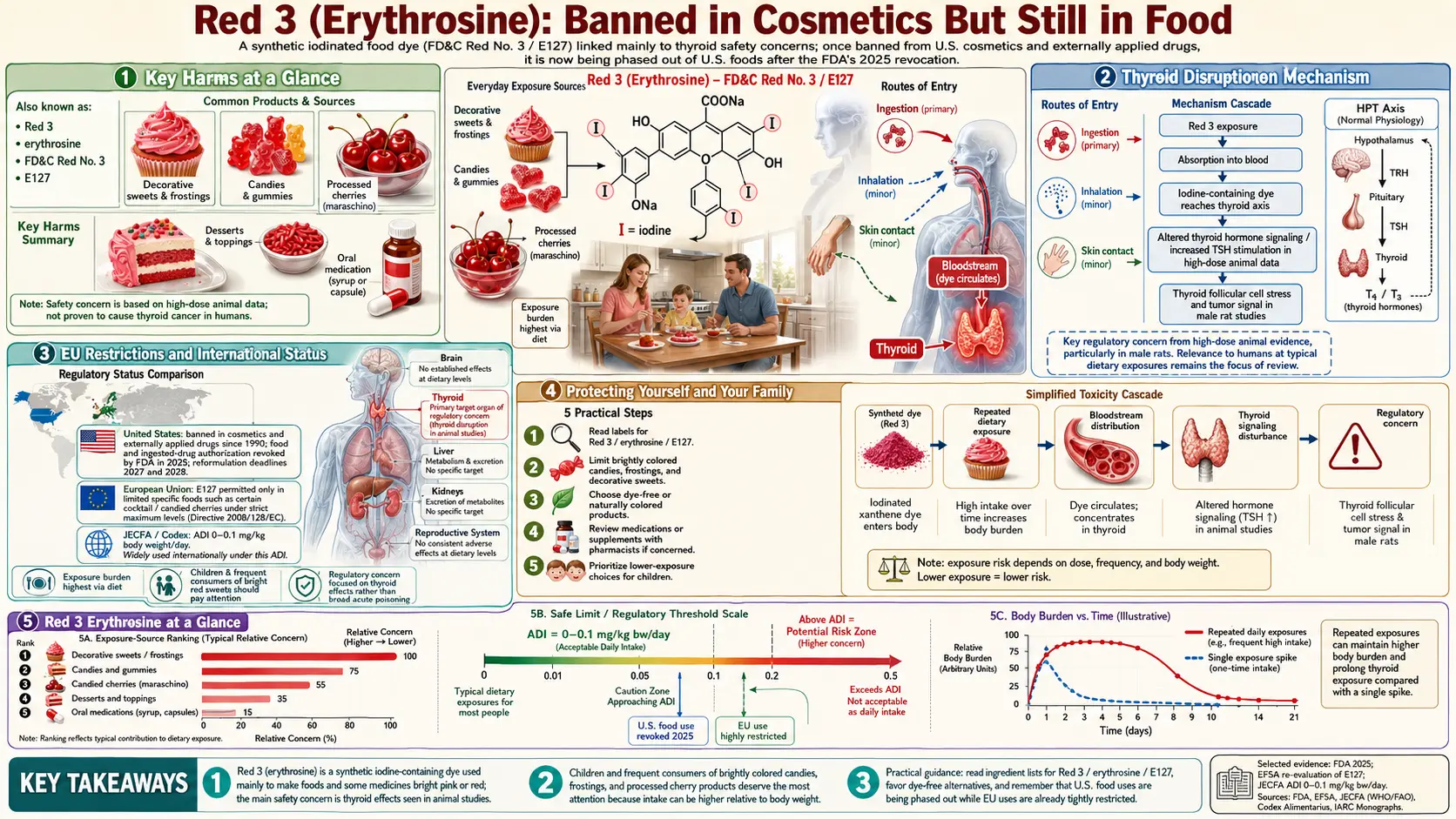
Red 3, known chemically as Erythrosine and designated E127 in Europe, represents one of the most glaring contradictions in American food safety regulation. In 1990, the FDA formally banned Red 3 from use in cosmetics and externally applied drugs after studies conclusively demonstrated that it causes thyroid cancer in laboratory animals. Yet despite this finding, the FDA has allowed Red 3 to remain legal in food and ingested drugs for over three decades. This means that while you cannot legally put Red 3 on your skin in a lipstick, you can eat it in candy, swallow it in a pill, and feed it to your children in cake frosting. This regulatory absurdity persisted until California took action in 2023, becoming the first state to ban Red 3 in food products.
Table of Contents
- Key Harms at a Glance
- Chemical Composition and Properties
- The FDA Contradiction: Banned on Skin, Allowed in Food
- Thyroid Disruption Mechanism
- Tumor Promotion
- California Food Safety Act of 2023
- Common Foods Containing Red 3 (Exposure Routes)
- EU Restrictions and International Status
- The Call for a Full FDA Ban
- Safety Thresholds & ADI
- How to Protect Yourself and Your Family
- Research Papers
- Connections
- Featured Videos
Key Harms at a Glance
- Thyroid carcinogen in animals – NTP studies found dose-dependent follicular adenomas/carcinomas in male rats.
- Banned in US cosmetics since 1990 under the Delaney Clause, yet permitted in food for 35+ years.
- FDA 2025 authorization revocation – Finally revoked food-use authorization; industry compliance deadline through 2027.
- California Food Safety Act (2023) – First state ban in food, effective January 1, 2027.
- ~58% iodine by weight – Releases iodine that disrupts thyroid hormone synthesis and TSH regulation.
- JECFA ADI – 0–0.1 mg/kg body weight/day (one of the lowest of any approved dye, reflecting known toxicity).
Chemical Composition and Properties
- Chemical name: Disodium 2-(6-hydroxy-2,4,5,7-tetraiodo-3-oxo-3H-xanthen-9-yl)benzoate
- Molecular formula: C20H6I4Na2O5
- Chemical class: Xanthene dye; unlike most other approved food dyes, Red 3 is not an azo dye but a fluorone dye containing four iodine atoms per molecule
- Iodine content: Approximately 58% of the molecular weight of Erythrosine is iodine, which is directly relevant to its thyroid-disrupting effects
- Color: Cherry-pink to red; provides a distinctive bright cherry-red color that differs from the orange-red of Red 40
- Solubility: Highly soluble in water; used in both food and pharmaceutical applications
The FDA Contradiction: Banned on Skin, Allowed in Food
The story of Red 3's partial ban is a case study in regulatory failure and industry influence over food safety policy.
The Evidence That Led to the Cosmetics Ban
In the 1980s, studies conducted as part of the National Toxicology Program demonstrated that high doses of Erythrosine caused thyroid follicular cell adenomas and carcinomas in male rats. The mechanism was identified: Erythrosine disrupts thyroid hormone regulation, leading to chronically elevated levels of thyroid-stimulating hormone (TSH), which in turn promotes the growth of thyroid tumors. The evidence was considered conclusive enough that in January 1990, the FDA invoked the Delaney Clause of the Federal Food, Drug, and Cosmetic Act to ban Red 3 from cosmetics and externally applied drugs. The Delaney Clause, enacted in 1958, states that no additive shall be deemed safe if it has been found to induce cancer in humans or animals.
Why It Was Not Banned in Food
The obvious question is: if Red 3 causes cancer in animals and was banned from cosmetics under the Delaney Clause, why was it not simultaneously banned from food, where exposure is far greater because the substance is actually ingested? The answer lies in a combination of industry lobbying, bureaucratic inertia, and legal maneuvering.
- Industry pressure: The food industry lobbied intensely against a food ban, arguing that the doses used in animal studies were far higher than human dietary exposure and that the thyroid tumor mechanism was specific to rats
- Interim listing: Red 3 was placed on a "provisional" or "interim" listing for food use, meaning the FDA acknowledged concerns but delayed a final decision; this interim status has now lasted over 35 years
- Delaney Clause technicality: The FDA argued that the Delaney Clause applied differently to cosmetics than to food additives under certain regulatory interpretations, allowing continued food use while banning cosmetic use
- Regulatory inertia: Once the initial political moment passed, there was insufficient institutional momentum to complete the food ban, and the issue was effectively shelved for decades
The Result
The result is a regulatory situation that defies common sense: a substance that the FDA itself determined causes cancer in animals is banned from being applied to the outside of your body but is perfectly legal to put inside your body through food. This contradiction has persisted for over three decades and has become a symbol of the FDA's failure to adequately protect public health from harmful food additives.
Thyroid Disruption Mechanism
The thyroid-disrupting properties of Red 3 are well-documented and directly related to its molecular structure.
- Iodine release: The four iodine atoms in each molecule of Erythrosine can be released during metabolism, flooding the thyroid gland with excess iodine and disrupting normal thyroid hormone synthesis
- TSH elevation: Erythrosine interferes with thyroid peroxidase activity and inhibits the conversion of T4 to T3, leading to elevated thyroid-stimulating hormone (TSH) levels as the pituitary gland attempts to compensate
- Chronic stimulation: Chronically elevated TSH acts as a growth signal to thyroid follicular cells, promoting hyperplasia (cell proliferation) and eventually tumor formation
- Hormone imbalance: Even at doses below those causing tumors, Erythrosine exposure can alter circulating thyroid hormone levels, potentially affecting metabolism, growth, development, and cognitive function
- Vulnerable populations: Children, pregnant women, and individuals with pre-existing thyroid conditions are particularly vulnerable to thyroid-disrupting substances; given the high prevalence of thyroid disorders in the United States, widespread Red 3 exposure is a significant concern
Tumor Promotion
- Thyroid adenomas: The National Toxicology Program studies found significant increases in thyroid follicular cell adenomas (benign tumors) in male rats exposed to Erythrosine
- Thyroid carcinomas: More concerning, there was also an increase in thyroid follicular cell carcinomas (malignant tumors) in exposed animals
- Dose-response relationship: Tumor incidence increased with dose, strengthening the case for a causal relationship
- Industry counterargument: The food industry has argued that the rat thyroid tumor mechanism does not apply to humans because rats are uniquely sensitive to TSH-mediated thyroid carcinogenesis; however, this argument is disputed by independent scientists who note that the precautionary principle should apply when a known carcinogenic mechanism is involved
- Additional tumor sites: Some studies have also reported increases in tumors at other sites in animals exposed to Erythrosine, though the thyroid findings are the most consistent and robust
California Food Safety Act of 2023
In October 2023, California Governor Gavin Newsom signed the California Food Safety Act (AB 418), making California the first state in the nation to ban Red 3 from food products. The law also bans potassium bromate, brominated vegetable oil, and propylparaben.
- Effective date: The Red 3 ban takes effect on January 1, 2027, giving food manufacturers time to reformulate products
- Scope: Applies to all food products manufactured, sold, or distributed in California
- National impact: Because California is the largest consumer market in the United States, the ban is expected to have a nationwide effect, as many manufacturers will reformulate products for the entire US market rather than maintain separate formulations for California
- Penalties: Violations can result in fines of up to $5,000 for first offenses and $10,000 for subsequent offenses
- Momentum: The California law has inspired similar legislative efforts in other states, including New York, Illinois, and Washington, potentially creating a patchwork of state-level bans that could pressure the FDA to act at the federal level
Common Foods Containing Red 3
Despite declining use as some manufacturers have voluntarily switched to alternatives, Red 3 remains present in many popular food products.
- Conversation hearts: The iconic Valentine's Day candy has historically been one of the most prominent uses of Red 3
- Candy hearts and candy corn: Many seasonal candies rely on Red 3 for their characteristic pink and red colors
- Maraschino cherries: The bright red color of maraschino cherries is typically achieved with Red 3
- Cake decorations: Sprinkles, colored sugar, and decorative icing often contain Red 3
- Popsicles and frozen treats: Many brightly colored frozen desserts contain Red 3
- Certain candies: Pez, Peeps, Dubble Bubble gum, and various other candies
- Medications: Some pharmaceutical products use Red 3 as a colorant in tablet coatings, capsules, and liquid formulations
- Canned fruit: Some canned fruit products, particularly cherries and fruit cocktail, may contain Red 3
EU Restrictions and International Status
- European Union: Red 3 (E127) is permitted in the EU only for specific limited uses, primarily in cocktail and candied cherries and in Bigarreaux cherries; it is not permitted for general food use as it is in the United States
- EU cosmetics ban: Like the US, the EU bans Red 3 from cosmetics
- Japan: Permits Red 3 in food but with stricter limits on acceptable daily intake
- JECFA (WHO/FAO): The Joint FAO/WHO Expert Committee on Food Additives has set an ADI of 0-0.1 mg/kg body weight per day, significantly lower than many other food dyes, reflecting its known toxicity
- Trend toward removal: The global trend is toward phasing out Red 3, with the United States being increasingly isolated in its continued broad approval of this dye in food
The Call for a Full FDA Ban
Consumer advocacy organizations, independent scientists, and a growing number of legislators have called on the FDA to complete the ban it started in 1990 by removing Red 3 from food and ingested drugs.
- Center for Science in the Public Interest (CSPI): Has petitioned the FDA multiple times to ban Red 3, arguing that the Delaney Clause legally requires a ban and that the FDA's failure to act is a violation of federal law
- 2022 CSPI petition: In October 2022, CSPI submitted a formal petition with support from numerous health organizations and scientists, urging the FDA to revoke authorization for Red 3 in food and ingested drugs
- Congressional support: Several members of Congress have introduced legislation that would ban Red 3 and other questionable food dyes at the federal level
- FDA response: In 2024 and 2025, the FDA began a formal review process for Red 3 in response to mounting public pressure and the California ban, but as of this writing, no federal ban has been finalized
- Industry reformulation: Many food manufacturers have already begun replacing Red 3 with natural alternatives in anticipation of broader bans, demonstrating that safe alternatives are readily available and commercially viable
Safety Thresholds & ADI
- JECFA ADI – 0–0.1 mg/kg body weight/day (among the lowest for approved dyes).
- EFSA (2011 re-evaluation) – Noted limitations in original data; maintained restricted uses.
- Delaney Clause (21 U.S.C. § 348(c)(3)(A)) – Prohibits approval of food additives shown to induce cancer in animals; the legal basis for the 2025 FDA revocation.
- California AB 418 (2023) – Bans Red 3 in food effective Jan 1, 2027.
- EU Regulation 1333/2008 – E127 restricted to cocktail/candied cherries only, not general food use.
Protecting Yourself and Your Family
- Read ingredient labels: Look for "Red 3," "Erythrosine," "FD&C Red No. 3," or "E127" in ingredient lists
- Avoid brightly colored candy: Particularly pink and cherry-red candies, seasonal confections, and cake decorations
- Check maraschino cherries: Opt for natural or organic cherries that do not contain Red 3
- Thyroid patients: Individuals with thyroid conditions should be especially vigilant about avoiding Red 3 due to its documented thyroid-disrupting effects
- Check medications: Ask your pharmacist whether your medications contain Red 3 and request alternatives
- Support legislative action: Contact your representatives to express support for federal bans on Red 3 and other harmful food dyes
- Choose organic: Organic products cannot contain synthetic food dyes, including Red 3
Research Papers
- National Toxicology Program. Carcinogenesis Studies of FD&C Red No. 3 (Erythrosine) in F344/N Rats and B6C3F1 Mice (Feed Studies). NTP TR 269.
- FDA. Color Additive Petitions — documentation of the 1990 cosmetics ban and 2025 food-use revocation of FD&C Red No. 3.
- PubMed topic search: erythrosine thyroid tumor rat
- PubMed topic search: erythrosine TSH pituitary
- PubMed topic search: FD&C Red No. 3 carcinogenicity
- PubMed topic search: erythrosine iodine thyroid hormone
- PubMed topic search: Delaney Clause food additive cancer
- PubMed topic search: food dye hyperactivity meta-analysis
- PubMed topic search: xanthene dye genotoxicity
- PubMed topic search: erythrosine neurobehavior children
- EFSA Panel on Food Additives. Scientific Opinion on the re-evaluation of Erythrosine (E 127) as a food additive. EFSA Journal. 2011;9(1):1854.
- California AB 418 (California Food Safety Act, 2023).
Connections
- All Toxins
- Food Dyes
- Iodine
- Yellow 5 Tartrazine
- Red 40 Allura Red
- Food Dyes Banned Worldwide
- US vs EU Food Safety
- Preservatives
- Acesulfame Potassium
- Food Additives
- Cancer
- Thyroid Cancer
- Thyroid Disorders
- Potassium Bromate
- Brominated Vegetable Oil
- ADHD
- Allergies