Potassium Bromate: The Banned Bread Additive Still Used in the US
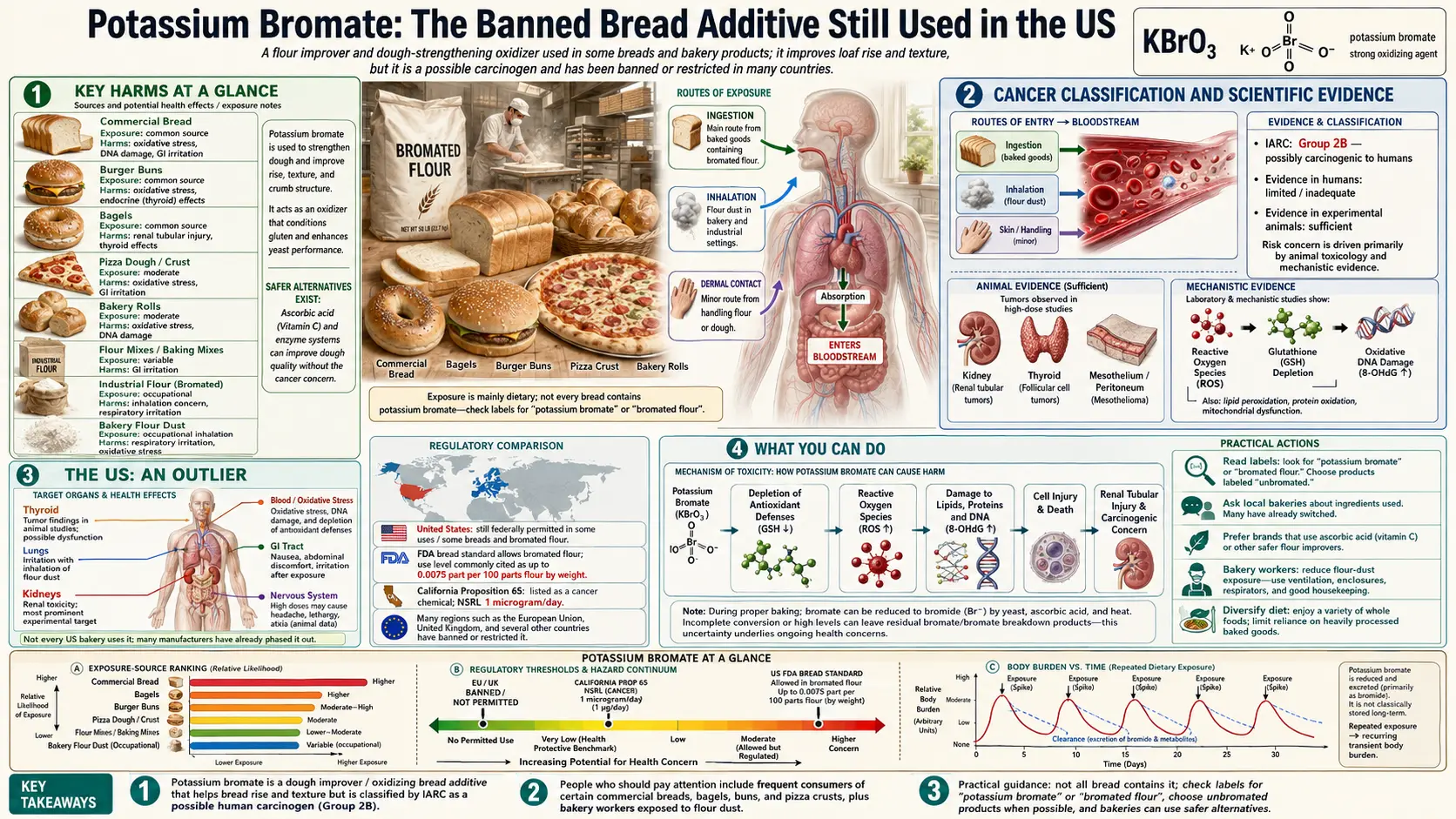
Potassium bromate (KBrO3) is a powerful oxidizing agent that has been used as a flour improver and bread conditioner since the early 20th century. It strengthens dough, allows it to rise higher, and produces bread with a whiter, more appealing appearance. The problem is that potassium bromate is a recognized carcinogen, and it has been banned in the European Union, the United Kingdom, Canada, Brazil, China, India, South Korea, Argentina, and many other countries around the world. Yet it remains legal in the United States, where it continues to appear in commercially baked bread, rolls, and other flour-based products.
Table of Contents
- Key Harms at a Glance
- What Is Potassium Bromate and How Is It Used?
- Cancer Classification and Scientific Evidence (Health Effects)
- The 'It Breaks Down During Baking' Argument
- Countries That Have Banned Potassium Bromate (Safety)
- The US: An Outlier
- Safe and Effective Alternatives
- What You Can Do (How to Avoid)
- Research Papers and References
- Connections
- Featured Videos
Key Harms at a Glance
- IARC Group 2B carcinogen — possibly carcinogenic to humans based on animal evidence.
- Kidney (renal cell) tumors — consistent in long-term rat feeding studies.
- Thyroid follicular cell tumors — bromine interferes with iodine uptake.
- Mesothelioma — peritoneal tumors in rats on bromate drinking water.
- Oxidative DNA damage and genotoxicity — positive across multiple assay systems.
- Residues persist in finished bread — the 'fully converts to bromide' claim is not reliable in real ovens.
- Banned in EU, UK, Canada, Brazil, China, India, South Korea, Argentina, Nigeria — the US is a global outlier.
- California AB 418 ban effective 2027 — first US state action.
What Is Potassium Bromate and How Is It Used?
- Chemical function — potassium bromate is an oxidizing agent that strengthens the gluten network in bread dough. By oxidizing the sulfhydryl groups in gluten proteins, it creates stronger disulfide bonds that trap gas more efficiently during rising, producing bread with greater volume, finer crumb structure, and improved texture.
- Appearance enhancement — bromated flour produces bread that is noticeably whiter than unbromated flour, which appeals to consumer expectations about bread appearance.
- Baking industry preference — potassium bromate is inexpensive, easy to use, and produces consistent results. It has been a staple of commercial baking in the US since the 1920s, and some bakers resist switching to alternatives despite the health concerns.
- Where it appears — potassium bromate is added to flour at the milling stage ("bromated flour") or directly to dough during bread production. It appears in white bread, rolls, buns, pizza dough, pastries, and other baked goods. It may be listed on labels as "potassium bromate," "bromated flour," or simply included in "flour" without specific disclosure.
Cancer Classification and Scientific Evidence
IARC Classification
The International Agency for Research on Cancer (IARC), a branch of the World Health Organization, has classified potassium bromate as a Group 2B carcinogen — meaning it is "possibly carcinogenic to humans." This classification is based on sufficient evidence of carcinogenicity in experimental animals and limited evidence in humans.
Animal Study Evidence
- Kidney cancer — multiple long-term animal studies have demonstrated that potassium bromate causes renal cell tumors (kidney cancer) in rats. These tumors appeared at doses relevant to potential human exposure through bromated bread consumption.
- Thyroid tumors — potassium bromate has been shown to cause follicular cell tumors of the thyroid gland in rats. Like BVO, the bromine in potassium bromate interferes with iodine uptake and thyroid function.
- Mesothelioma — some studies have found an increased incidence of peritoneal mesothelioma (a cancer of the abdominal lining) in rats exposed to potassium bromate in drinking water.
- Oxidative DNA damage — potassium bromate causes oxidative stress and DNA damage in cells, a well-established mechanism for initiating cancer. It generates reactive oxygen species that attack DNA, causing mutations that can lead to uncontrolled cell growth.
- Genotoxicity — potassium bromate has tested positive in multiple genotoxicity assays, confirming that it has the ability to damage genetic material. This is a key indicator of carcinogenic potential.
Human Health Concerns
- Kidney damage — cases of acute kidney failure have been reported in humans who ingested potassium bromate, either accidentally or intentionally. While these cases involved higher doses than typical dietary exposure, they confirm the compound's toxicity to kidney tissue.
- Hearing loss — potassium bromate exposure has been associated with sensorineural hearing loss in humans. The compound appears to damage the cochlear structures of the inner ear.
- Gastrointestinal effects — ingestion of potassium bromate can cause nausea, vomiting, diarrhea, and abdominal pain, indicating direct toxicity to the gastrointestinal tract.
The "It Breaks Down During Baking" Argument
The primary defense used by the baking industry and the FDA for continued use of potassium bromate is that it theoretically converts to potassium bromide (a much less toxic compound) during the baking process. The argument goes that if bread is baked properly — at the right temperature for the right amount of time — no detectable bromate residues should remain in the finished product. This argument is deeply flawed for several reasons.
- Residues are found in finished products — multiple studies, including those conducted in the UK before its ban, have detected measurable potassium bromate residues in finished bread products purchased from retail stores. The theoretical complete conversion does not always occur in real-world commercial baking.
- Baking conditions vary — the complete conversion of bromate to bromide requires precise temperature and timing. Under-baking, variations in oven temperature, thicker loaves, and other real-world factors can result in incomplete conversion, leaving carcinogenic bromate residues in the bread.
- Center of the loaf — the interior of a bread loaf does not reach the same temperature as the crust. Studies have shown that bromate residues are more likely to persist in the center of the loaf, where temperatures may not reach the threshold needed for complete conversion.
- The precautionary principle — even if bromate fully converted during baking most of the time, the possibility that it does not is sufficient reason to ban it, especially when safe alternatives exist. This is exactly the reasoning used by the EU, Canada, and other countries.
- Bromide itself is not harmless — even if all bromate converts to bromide, potassium bromide is not an inert substance. Chronic bromide exposure can cause bromism (neurological symptoms), thyroid disruption, and skin reactions.
Countries That Have Banned Potassium Bromate
The global consensus against potassium bromate is overwhelming. The following countries and regions have banned or effectively prohibited its use in food:
- European Union — banned since 1990. The EU Scientific Committee on Food concluded that potassium bromate should not be used as a flour treatment agent.
- United Kingdom — banned before EU membership, one of the earliest countries to prohibit potassium bromate in bread.
- Canada — banned potassium bromate in flour and bread products. Health Canada considers it an unacceptable risk.
- Brazil — ANVISA (Brazilian Health Regulatory Agency) banned potassium bromate in 2001 after determining it posed an unacceptable cancer risk.
- China — banned potassium bromate in flour in 2005, recognizing its carcinogenic potential.
- India — the Food Safety and Standards Authority of India (FSSAI) banned potassium bromate in 2016 after studies detected residues in bread sold in New Delhi markets.
- South Korea — banned potassium bromate in food products based on carcinogenicity evidence.
- Argentina — prohibited the use of potassium bromate as a flour additive.
- Nigeria — banned potassium bromate in bread in 2003 after finding widespread residues in commercially baked bread.
- Sri Lanka, Peru, Colombia — among many other nations that have banned or restricted potassium bromate.
The US: An Outlier
Current FDA Position
The FDA has not banned potassium bromate. Instead, the agency has taken a passive approach, "encouraging" bakers to voluntarily stop using it. In 1991, the FDA urged bakers to voluntarily cease using potassium bromate, but this encouragement carries no regulatory weight. The FDA has not initiated formal rulemaking to revoke potassium bromate's approval as a food additive.
California's Prop 65 Listing
- Proposition 65 — California listed potassium bromate as a chemical known to cause cancer under Proposition 65 in 1990. This means that products containing potassium bromate sold in California must carry a cancer warning label.
- AB 418 (California Food Safety Act) — in 2023, California passed legislation that will ban potassium bromate (along with BVO, Red Dye No. 3, and propylparaben) from food sold in the state, effective January 1, 2027. California became the first US state to take this step.
- Other states following — several other states have introduced or are considering similar legislation, creating a patchwork of state-level regulations in the absence of federal action.
Which US Bakeries Still Use It?
- Many regional and national commercial bakeries — despite voluntary FDA guidance, many commercial bakeries continue to use bromated flour because it is cheap and effective. Checking ingredient labels for "bromated flour" or "potassium bromate" is essential.
- Fast food chains — some fast food restaurants use bromated flour in their buns, rolls, and pizza dough. Ingredient transparency varies significantly among chains.
- In-store bakeries — supermarket bakery departments may use bromated flour without clear labeling, as in-store baked goods are often exempt from detailed ingredient disclosure requirements.
- Some major brands have reformulated — in response to consumer pressure and California's Prop 65, some large bakeries have voluntarily removed potassium bromate from their products. However, this is far from universal.
Safe and Effective Alternatives
The argument that potassium bromate is necessary for quality bread is demonstrably false. Bakeries around the world — including in countries where bromate has been banned for decades — produce excellent bread without it. Several safe alternatives are readily available:
- Ascorbic acid (Vitamin C) — a natural dough improver that strengthens gluten through a similar oxidation mechanism. It is widely used in European and Canadian baking as a direct replacement for potassium bromate. It is inexpensive, effective, and has no known adverse health effects at the concentrations used in baking.
- Enzymes (fungal amylases, xylanases) — naturally derived enzymes that improve dough handling, bread volume, and crumb structure. These are increasingly popular in commercial baking worldwide.
- Azodicarbonamide (ADA) — while sometimes used as a bromate alternative in the US, ADA has its own serious health concerns and is banned in the EU and other countries. It is not a truly safe alternative. Read more about ADA.
- Calcium peroxide — an oxidizing agent used as a flour improver, generally considered safer than potassium bromate.
- Longer fermentation times — traditional bread-making methods using longer fermentation and proofing times can achieve excellent texture and volume without chemical additives. Many artisan bakeries demonstrate this daily.
What You Can Do
- Read labels carefully — look for "potassium bromate" or "bromated flour" on ingredient lists. If either appears, choose a different product.
- Choose unbromated flour — when baking at home, buy flour that is explicitly labeled "unbromated." King Arthur Flour, for example, has never used potassium bromate.
- Buy from bakeries that don't use bromate — ask your local bakery whether they use bromated flour. Many artisan bakeries do not.
- Support legislative action — contact your congressional representatives and urge them to support federal legislation banning potassium bromate from the US food supply.
- Choose organic bread — USDA organic standards prohibit the use of potassium bromate, so organic bread is always bromate-free.
← Back to Food Additives Overview
Research Papers and References
Key peer-reviewed research and authoritative sources underpinning the claims on this page. Links resolve to DOI, PubMed, or the issuing agency.
- Kurokawa Y, Maekawa A, Takahashi M, Hayashi Y. Toxicity and carcinogenicity of potassium bromate—a new renal carcinogen. Environ Health Perspect. 1990;87:309-335.
- DeAngelo AB, George MH, Kilburn SR, Moore TM, Wolf DC. Carcinogenicity of potassium bromate administered in the drinking water to male B6C3F1 mice and F344/N rats. Toxicol Pathol. 1998;26(5):587-594.
- Chipman JK, Parsons JL, Beddowes EJ. The multiple influences of glutathione on bromate genotoxicity: implications for the dose-response relationship. Toxicology. 2006;221(2-3):187-189.
- Kasai H, Nishimura S, Kurokawa Y, Hayashi Y. Oral administration of the renal carcinogen, potassium bromate, specifically produces 8-hydroxydeoxyguanosine in rat target organ DNA. Carcinogenesis. 1987;8(12):1959-1961.
- IARC Working Group. Potassium Bromate. IARC Monographs on the Evaluation of Carcinogenic Risks to Humans, Vol. 73. Lyon: IARC; 1999. publications.iarc.fr
- Campbell A. Laboratory investigations into the effects of potassium bromate on bread quality. J Food Sci. 1988;53(4):1167-1170.
- Dodd DE, Layko DB, Cantwell KE, et al. Subchronic toxicity evaluation of potassium bromate in Fischer 344 rats. Environ Health Perspect. 2013;121(1):30-36.
- Kurokawa Y, Aoki S, Matsushima Y, Takamura N, Imazawa T, Hayashi Y. Dose-response studies on the carcinogenicity of potassium bromate in F344 rats after long-term oral administration. J Natl Cancer Inst. 1986;77(4):977-982.
- Moore MM, Chen T. Mutagenicity of bromate: implications for cancer risk assessment. Toxicology. 2006;221(2-3):190-196.
- FSSAI (Food Safety and Standards Authority of India). Banning of Potassium Bromate and Potassium Iodate as Food Additives, Gazette Notification. 2016. www.fssai.gov.in
- PubMed — search for recent research
Connections
- All Toxins
- Food Additives
- Azodicarbonamide
- Brominated Vegetable Oil
- BHA
- BHT
- Banned Additives
- Iodine
- Potassium
- Cancer
- Thyroid Cancer
- Gluten Free Diet Practical Guide
- Oxidative Stress
- Glutathione
- Vitamin C
- Carrageenan
- Polysorbate 80
- US vs EU Food Safety
- BHA and BHT