Brominated Vegetable Oil (BVO): Banned Worldwide, Recently Banned in the US
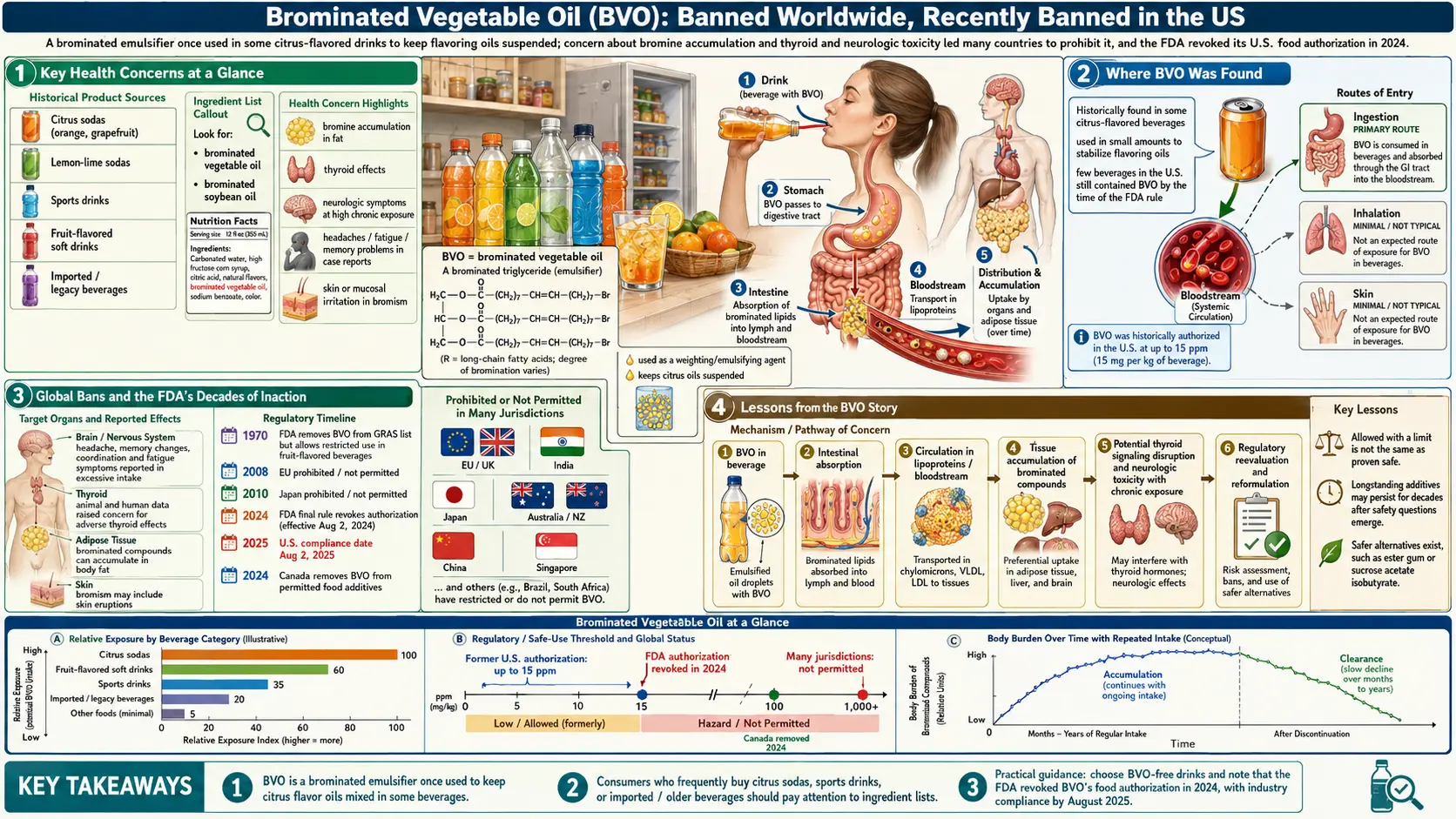
For more than half a century, Americans unknowingly consumed a chemical closely related to flame retardants every time they drank certain citrus-flavored sodas and sports drinks. Brominated vegetable oil (BVO) was used as an emulsifier in beverages like Mountain Dew, Sun Drop, Squirt, and various Fanta and Fresca formulations. While countries around the world banned BVO decades ago due to serious health concerns, the US Food and Drug Administration allowed its continued use until finally issuing a ban in July 2024 — a decision that was decades overdue.
In November 2024, the FDA formally revoked its authorization for BVO as a food additive, with the rule taking effect in August 2025. The agency cited toxicology studies showing thyroid effects and bromine bioaccumulation at levels near human dietary exposure. BVO had been in regulatory "interim" limbo for 54 years after the FDA revoked its GRAS status in 1970 — one of the longest delays between safety concern and definitive action in FDA history.
Table of Contents
- Key Health Concerns at a Glance
- What Is Brominated Vegetable Oil?
- Where BVO Was Found
- Health Effects of BVO
- Bromide Accumulation in Body Tissues
- Thyroid Disruption
- Neurological Damage
- Reproductive Toxicity
- Heart and Organ Damage
- Global Bans and the FDA's Decades of Inaction
- Industry Acted Before Regulators
- Lessons from the BVO Story
- Research Papers and References
- Connections
- Featured Videos
Key Health Concerns at a Glance
- FDA banned effective August 2025 — In November 2024 the FDA revoked its interim authorization for BVO, citing thyroid toxicity at exposures near human dietary levels. This ended 54 years of "interim" regulatory approval.
- Bromine bioaccumulation — BVO releases lipophilic bromide that concentrates in adipose tissue, heart, liver, kidneys, and brain; elimination half-life is approximately 12 days, so daily consumption builds progressively.
- Thyroid disruption — Bromide competes with iodine at thyroid receptors, impairing T3/T4 synthesis and contributing to hypothyroidism risk — especially worrying where iodine intake is marginal.
- Neurological bromism — Documented cases of headaches, memory loss, tremor, ataxia, and psychosis in heavy soda drinkers with BVO-containing products.
- Reproductive and developmental toxicity — Animal studies show impaired fertility, sperm quality, ovarian function, and fetal abnormalities; bromide crosses the placenta and transfers into breast milk.
- Heart and organ damage — 1970s animal studies that prompted FDA's GRAS revocation documented myocardial lesions, fatty-liver change, and kidney injury in BVO-fed animals.
- Banned globally long before the US acted — The EU, UK, Japan, India, Australia, and New Zealand prohibited BVO decades before the 2024 US ban.
- Previously found in — Mountain Dew (removed 2020), Sun Drop, Squirt, Fanta Orange (some formulations), Fresca, Powerade, and generic citrus sodas.
What Is Brominated Vegetable Oil?
BVO is created by bonding vegetable oil (typically soybean or corn oil) with bromine, a heavy, reddish-brown element in the halogen family. Bromine is the same element used in brominated flame retardants, fumigants, and certain pesticides. The bromination process makes the oil denser, which is why it was added to citrus-flavored beverages: it acts as an emulsifier that keeps the citrus flavoring oils evenly distributed throughout the drink rather than floating to the surface.
- Chemical nature — BVO is a complex mixture of triglycerides in which some of the unsaturated fatty acid chains have been reacted with bromine. The resulting compound contains approximately 60% bromine by weight.
- Originally a flame retardant — BVO was first patented as a flame retardant chemical. Its use in food was a secondary application that was never subjected to rigorous safety evaluation before becoming widespread.
- FDA interim status — BVO was originally classified as GRAS (Generally Recognized As Safe) in the 1950s. In 1970, the FDA revoked its GRAS status following safety concerns but allowed its continued use on an "interim" basis pending further study. That "interim" status lasted for over 50 years.
Where BVO Was Found
BVO was used primarily in citrus-flavored soft drinks and sports beverages. At its peak usage, it appeared in numerous popular products consumed by millions of Americans daily, including children.
- Mountain Dew — one of the most widely consumed citrus sodas in America, contained BVO for decades. PepsiCo removed BVO from Mountain Dew in 2020, years before the FDA ban, in response to consumer pressure.
- Sun Drop — a popular citrus soda particularly common in the southeastern United States.
- Squirt — a grapefruit-flavored soda that contained BVO for years.
- Fanta Orange — some formulations of this Coca-Cola product contained BVO. Notably, the European version of Fanta never contained BVO due to EU regulations.
- Fresca — another Coca-Cola citrus beverage that used BVO in its formulation.
- Various store-brand citrus sodas — many generic and regional citrus-flavored drinks also contained BVO.
- Some sports drinks and juice-flavored beverages — BVO appeared in certain Powerade formulations and other non-carbonated citrus beverages.
Health Effects of BVO
Bromide Accumulation in Body Tissues
When BVO is consumed, the body metabolizes it and releases free bromide ions. Unlike many substances that are quickly excreted, bromide accumulates in body tissues, particularly in fatty tissue (adipose tissue) and organs. This bioaccumulation means that even small daily doses build up over time to potentially toxic levels.
- Fat-soluble storage — because BVO is lipophilic (fat-loving), bromide from BVO accumulates preferentially in body fat. Studies have detected elevated bromide levels in the fatty tissue of regular soda drinkers.
- Organ accumulation — bromide has been found to accumulate in the heart, liver, kidneys, and brain. A case report published in a medical journal documented a patient who consumed 2-4 liters of BVO-containing soda daily and developed bromide levels in his body fat that were dramatically elevated.
- Long half-life — bromide has a biological half-life of approximately 12 days in the human body, meaning it takes nearly two weeks for the body to eliminate just half of an absorbed dose. With daily consumption, levels steadily increase.
- Breast milk transfer — bromide from BVO can be transferred to nursing infants through breast milk, exposing the most vulnerable population to this toxic chemical.
Thyroid Disruption
- Competitive inhibition of iodine — bromine and iodine are both halogens and compete for the same receptors in the thyroid gland. Excess bromide can displace iodine, impairing thyroid hormone production. This is particularly concerning given that iodine deficiency is already common in many populations.
- Hypothyroidism risk — by interfering with iodine uptake, BVO exposure can contribute to hypothyroidism (underactive thyroid), a condition characterized by fatigue, weight gain, depression, cognitive impairment, and cold intolerance.
- Thyroid hormone disruption — bromide interferes with the synthesis and metabolism of thyroid hormones T3 and T4, which regulate metabolism, growth, and development throughout the body.
Neurological Damage
- Bromism — chronic bromine exposure can cause a condition called bromism, characterized by headaches, fatigue, memory loss, lack of muscle coordination, tremors, and in severe cases, psychosis and hallucination. Cases of bromism from BVO-containing soda consumption have been documented in medical literature.
- Cognitive impairment — animal studies have demonstrated that bromide exposure causes measurable deficits in learning and memory. The accumulation of bromide in brain tissue is thought to interfere with normal neurotransmitter function.
- Developmental neurotoxicity — exposure during pregnancy and early childhood is particularly concerning because the developing brain is highly vulnerable to halogenated compounds. Brominated flame retardants, which share structural similarities with BVO, are known developmental neurotoxicants.
Reproductive Toxicity
- Fertility effects — animal studies have shown that BVO exposure can impair fertility in both males and females, affecting sperm quality and ovarian function.
- Developmental effects — bromide crosses the placenta and can affect fetal development. Animal studies have demonstrated developmental abnormalities in offspring exposed to BVO during gestation.
- Endocrine disruption — beyond thyroid effects, bromine-containing compounds can interfere with reproductive hormones, potentially contributing to early puberty, menstrual irregularities, and other endocrine disruptions.
Heart and Organ Damage
- Heart lesions — animal studies conducted as early as the 1970s demonstrated that BVO consumption caused heart lesions (myocardial damage) in test animals. These studies were part of the reason the FDA revoked BVO's GRAS status in 1970, yet the agency still allowed continued use.
- Liver damage — BVO exposure has been associated with fatty liver changes and liver cell damage in animal models. The liver, as the body's primary detoxification organ, bears a heavy burden from chronic chemical exposure.
- Kidney damage — elevated bromide levels can damage kidney tissue, impairing the body's ability to filter waste products and maintain electrolyte balance.
Global Bans and the FDA's Decades of Inaction
Countries That Banned BVO Long Before the US
- European Union — BVO has never been approved for use in food in the EU. European food safety regulations prohibited its use decades ago under the precautionary principle.
- Japan — banned BVO in food products, recognizing the risks posed by bromide accumulation.
- India — prohibited BVO in food and beverages due to health concerns.
- Australia and New Zealand — BVO is not permitted as a food additive under food standards regulations.
- Many other nations — BVO is banned or not approved in the vast majority of developed countries. The US was a glaring outlier.
Timeline of FDA Inaction
- 1950s — BVO enters the US food supply with GRAS status, meaning it was assumed safe without rigorous testing.
- 1970 — the FDA revokes BVO's GRAS status after animal studies reveal toxicity, including heart lesions. However, rather than banning it outright, the FDA allows continued use on an "interim" basis at concentrations up to 15 parts per million.
- 1970s-2010s — for over four decades, BVO remains in "interim" regulatory limbo. The FDA never completes its review. Meanwhile, scientific evidence of harm continues to accumulate, and country after country bans the substance.
- 2012 — a petition on Change.org by a Mississippi teenager garnered over 200,000 signatures calling on PepsiCo to remove BVO from Gatorade. PepsiCo complied, replacing BVO with sucrose acetate isobutyrate.
- 2014 — Coca-Cola announces it will remove BVO from all of its products, citing consumer concerns rather than FDA action.
- 2020 — PepsiCo removes BVO from Mountain Dew and its remaining products.
- 2023 — California passes AB 418, banning BVO (along with several other additives) from food sold in the state, effective 2027. This state-level action puts further pressure on the FDA.
- November 2024 — the FDA finally revokes its interim authorization for BVO, effectively banning it from the US food supply. The agency cites studies showing that BVO causes harmful effects on the thyroid at levels near those from human dietary exposure. The rule takes effect August 2025, giving companies one year to reformulate.
Industry Acted Before Regulators
Perhaps the most damning indictment of the FDA's approach to BVO is that the major beverage companies themselves removed BVO from their products years before the FDA acted. Both PepsiCo and Coca-Cola voluntarily reformulated their drinks, replacing BVO with alternatives like sucrose acetate isobutyrate and glycerol ester of rosin. These companies made business decisions based on consumer pressure and international regulations, while the federal agency tasked with protecting public health continued to allow the substance.
This pattern — where industry self-regulates faster than the FDA — is a recurring theme in US food safety and illustrates the fundamental dysfunction of the American regulatory approach to food additives.
Lessons from the BVO Story
- The GRAS system fails consumers — BVO's story is a textbook example of how the GRAS loophole allows harmful chemicals to remain in the food supply for decades. A substance that was recognized as potentially dangerous in 1970 was not banned until 2024.
- "Interim" means indefinite — the FDA's practice of allowing substances to remain in use on an "interim" basis while it conducts reviews is effectively a mechanism for avoiding regulatory action. BVO's "interim" status lasted 54 years.
- International bans are a warning signal — when the EU, Japan, India, and dozens of other countries ban a substance, it should trigger immediate review in the US, not decades of continued inaction.
- Consumer advocacy works — the removal of BVO from major soda brands was driven primarily by consumer pressure, particularly a viral petition by a teenager, rather than regulatory action. This demonstrates both the power of consumer advocacy and the failure of the regulatory system.
- The precautionary principle saves lives — Europeans were protected from BVO exposure for decades because the EU applies the precautionary principle. Americans were not, because the US system requires proof of harm before taking action.
Research Papers and References
The following sources document the thyroid toxicity, neurological effects, and regulatory history of brominated vegetable oil.
FDA Regulatory Action
- FDA — Food Additive Petitions (formal revocation of BVO authorization, November 2024)
- FDA — Food Additive Status List
Thyroid and Bromide Accumulation
- PubMed — brominated vegetable oil + thyroid (search)
- PubMed — bromide accumulation / halogen toxicity (search)
- PubMed — bromism / soda case reports (search)
Reproductive and Developmental Toxicity
External Authoritative Resources
- FDA Food Additive Status List
- European Food Safety Authority (EFSA)
- Center for Science in the Public Interest (CSPI)
- NTP Report on Carcinogens (National Toxicology Program)
Connections
- All Toxins
- Food Additives
- Potassium Bromate
- Azodicarbonamide
- BHA
- BHT
- BHA and BHT
- Sodium Nitrite
- Banned Additives
- Iodine
- Anti Inflammatory Diet
- Detox Protocols
- Thyroid Disorders
- Fatigue
- Milk
- US vs EU Food Safety
- Red 3 Erythrosine