Food Dyes Banned in Other Countries But Allowed in the United States
Table of Contents
- Dye-by-Dye International Comparison
- The Southampton Study
- Why the US Is Far Behind
- The Global Trend
- The Double Standard in Plain Sight
- What Needs to Change
- Summary Comparison
- Research Papers
- Connections
- Featured Videos
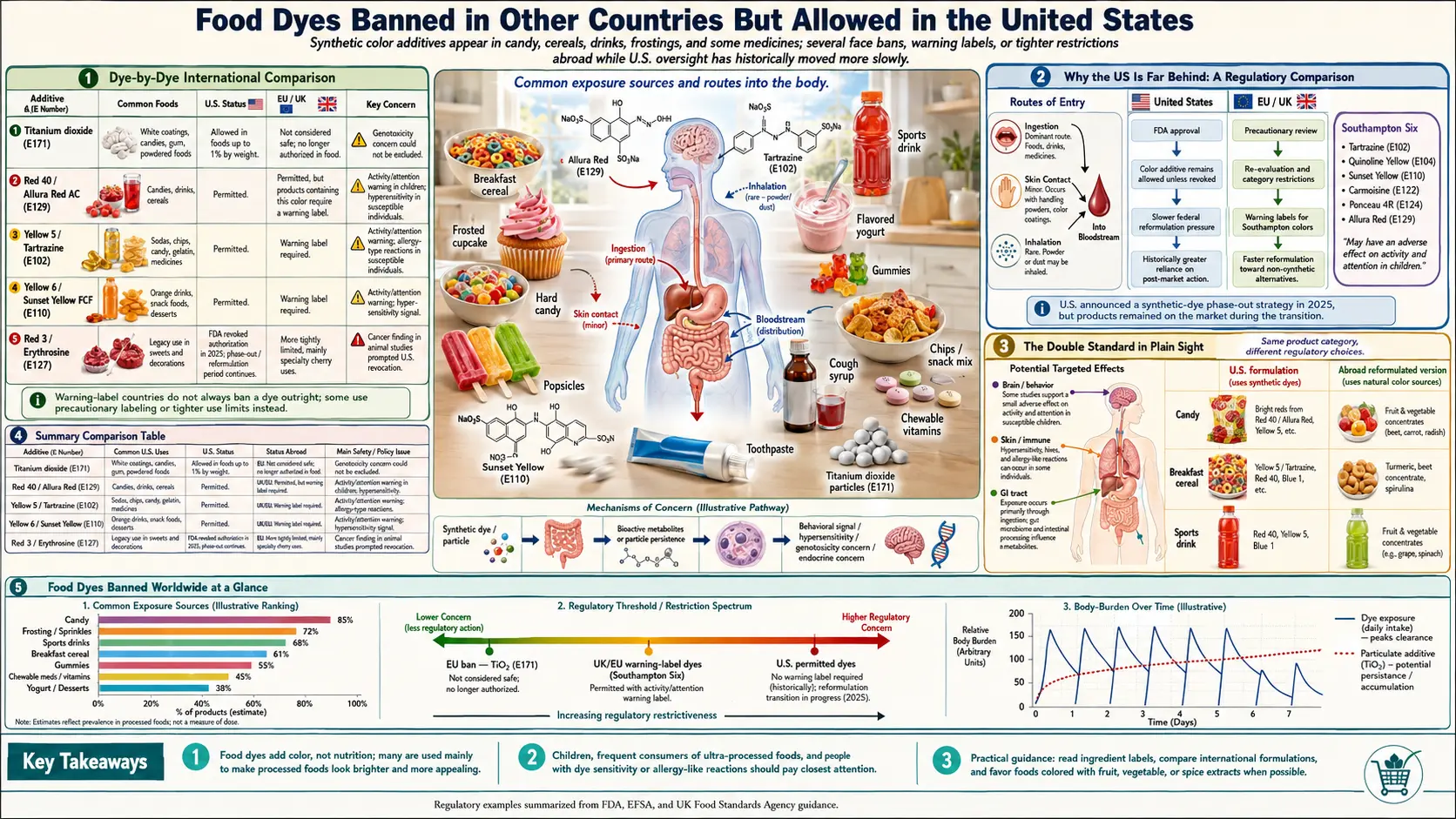
The United States stands increasingly alone among developed nations in its permissive approach to artificial food dyes. While the European Union, United Kingdom, Japan, Australia, and many other countries have banned, restricted, or required warning labels on synthetic food colorants, the US FDA continues to approve the same dyes with virtually no restrictions beyond listing them on ingredient labels. The result is a two-tier food system in which multinational food companies sell products with natural colors in Europe and petroleum-derived dyes in America. This page provides a comprehensive comparison of how each major food dye is regulated around the world and examines why the United States has fallen so far behind in food safety.
Dye-by-Dye International Comparison
Red 40 (Allura Red AC / E129)
- United States: Freely permitted in food, drugs, and cosmetics with no restrictions or warnings; the most widely consumed food dye in the country
- European Union: Permitted but requires mandatory warning label: "May have an adverse effect on activity and attention in children." This warning has led most major EU food manufacturers to voluntarily reformulate products using natural alternatives
- United Kingdom: The UK Food Standards Agency recommended voluntary removal of Red 40 following the Southampton Study; most major manufacturers have complied, making Red 40 rare in British food products
- Norway: Previously banned; current status is restricted with strong regulatory discouragement
- Japan: Permitted but subject to stricter regulations and lower acceptable daily intake limits than in the US
- Australia/New Zealand: Permitted but must be labeled by its specific number (E129); subject to review by Food Standards Australia New Zealand (FSANZ)
- Key concern: Linked to hyperactivity in children, allergic reactions, gut microbiome disruption, and potential carcinogenicity
Yellow 5 (Tartrazine / E102)
- United States: Freely permitted in food; the FDA requires it to be listed by name on drug labels due to its documented allergenicity, but no warning labels on food
- European Union: Permitted but requires mandatory warning label about adverse effects on children's activity and attention
- Norway: Banned from food products
- Austria: Banned or heavily restricted in food products
- United Kingdom: Voluntarily removed by most major manufacturers following FSA recommendations
- Japan: Permitted with restrictions
- Key concern: Cross-reactivity with aspirin sensitivity, asthma exacerbation, hyperactivity in children, contamination with the known human carcinogen benzidine
Yellow 6 (Sunset Yellow FCF / E110)
- United States: Freely permitted in food, drugs, and cosmetics with no restrictions or warnings
- European Union: Permitted but requires the same mandatory warning label as Red 40 and Yellow 5 about adverse effects on children's activity and attention
- Norway: Previously banned; currently restricted
- Finland: Has imposed restrictions on Yellow 6
- United Kingdom: Voluntarily removed by most manufacturers
- Key concern: Linked to adrenal tumors in animal studies, hyperactivity in children, allergic reactions, and contamination with carcinogenic compounds including benzidine and 4-aminobiphenyl
Red 3 (Erythrosine / E127)
- United States: Banned in cosmetics and externally applied drugs since 1990 due to thyroid cancer in animals, but still permitted in food and ingested drugs; this contradiction has persisted for over 35 years
- California: Banned in food under the California Food Safety Act of 2023 (AB 418), effective January 1, 2027
- European Union: Restricted to very specific limited uses (primarily cocktail cherries and Bigarreaux cherries); not permitted for general food use as in the US
- EU cosmetics: Banned
- Japan: Permitted with restrictions and lower ADI
- Key concern: Causes thyroid cancer in animals; the FDA's own determination led to the cosmetics ban; disrupts thyroid hormone function due to high iodine content
Titanium Dioxide (E171)
- United States: Freely permitted in food as a whitening agent; found in candy coatings, chewing gum, coffee creamers, icing, salad dressings, and many other products; also widely used in medications and supplements
- European Union: BANNED as a food additive since August 2022 after the European Food Safety Authority (EFSA) concluded that it could no longer be considered safe due to concerns about genotoxicity; nanoparticles of titanium dioxide were found to accumulate in organs and potentially damage DNA
- France: Was the first EU country to ban Titanium Dioxide in food in 2020, ahead of the EU-wide ban
- United Kingdom: Under review following the EU ban; many manufacturers have voluntarily removed it
- Key concern: Genotoxicity (DNA damage), nanoparticle accumulation in organs, potential carcinogenicity; the EFSA determined that a safe level of intake could not be established
Blue 1 (Brilliant Blue FCF / E133)
- United States: Freely permitted in food, drugs, and cosmetics
- European Union: Permitted with an established ADI; not subject to the same mandatory warning labels as the "Southampton Six" dyes but regulated under general food additive rules
- Norway: Previously banned; restrictions have been relaxed somewhat but oversight remains stricter than in the US
- France: Has imposed periodic restrictions
- Australia: Permitted but requires specific labeling
- Key concern: Can cross the blood-brain barrier; linked to chromosomal damage in vitro; kidney tumors in animal studies; reactions in sensitive individuals including rashes and breathing difficulties
Blue 2 (Indigo Carmine / Indigotine / E132)
- United States: Freely permitted in food, drugs, and cosmetics
- European Union: Permitted with an established ADI; subject to general food additive regulations
- Norway: Has historically restricted this dye
- Key concern: Linked to brain tumors (gliomas) in male rats; may cause nausea, high blood pressure, and skin rashes; some researchers argue the original safety studies had insufficient statistical power to detect tumor increases
Green 3 (Fast Green FCF / E143)
- United States: Permitted in food, drugs, and cosmetics
- European Union: NOT approved for food use; Green 3 is banned as a food additive in the EU
- Japan: Not permitted in food
- Many other countries: Not approved for food use; the US is one of relatively few countries that permits Green 3
- Key concern: Linked to bladder tumors and testicular tumors in animal studies; mutagenic in some in vitro tests; the fact that most other developed nations do not approve it raises serious questions about the FDA's continued approval
The Southampton Study: The Research That Changed European Policy
No single study has had more impact on international food dye regulation than the 2007 Southampton Study, formally published as "Food additives and hyperactive behaviour in 3-year-old and 8/9-year-old children in the community: a randomised, double-blinded, placebo-controlled trial" in The Lancet by McCann et al.
- Study design: A rigorous randomized, double-blind, placebo-controlled trial involving 153 three-year-old children and 144 eight-to-nine-year-old children from the general population of Southampton, England
- What was tested: Children were given drinks containing mixtures of artificial food dyes (including Red 40, Yellow 5, Yellow 6, and others) plus sodium benzoate, or an identical-tasting placebo drink
- Key findings: Both age groups showed statistically significant increases in hyperactive behavior when consuming the dye mixtures compared to placebo, as measured by teacher ratings, parent ratings, and computerized attention tests
- Significance: Crucially, the study demonstrated effects in the general population of children, not just those diagnosed with ADHD; this meant the behavioral effects of food dyes were a public health concern affecting all children, not just a clinical subpopulation
- Impact on EU policy: The Southampton Study directly led to the European Parliament mandating warning labels on foods containing six specific dyes (the "Southampton Six"), stating: "May have an adverse effect on activity and attention in children"
- Impact on UK policy: The UK Food Standards Agency issued voluntary guidelines urging manufacturers to remove the Southampton Six dyes; most major UK food companies complied within a few years
- Impact on US policy: Essentially none; the FDA convened an advisory committee in 2011 that voted narrowly against requiring warning labels, and no regulatory action was taken
Why the US Is Far Behind: A Regulatory Comparison
The Precautionary Principle vs. Risk Assessment
The fundamental difference between US and European food safety regulation lies in their philosophical approaches to risk. The European Union operates under the precautionary principle, which holds that if there is reasonable scientific evidence suggesting a substance may cause harm, regulatory action should be taken even in the absence of absolute proof. The burden is on manufacturers to demonstrate safety. In contrast, the United States uses a risk assessment approach that places the burden on regulators to conclusively prove that a substance is dangerous before it can be restricted. This means that the FDA requires a higher threshold of evidence before taking action, allowing potentially harmful substances to remain in the food supply for decades while the evidence accumulates.
Industry Lobbying and Political Influence
- Lobbying expenditure: The food and beverage industry spends billions of dollars annually on lobbying activities at the federal and state level; according to OpenSecrets, the food and beverage industry spent over $30 million on federal lobbying in 2022 alone
- Revolving door: A well-documented pattern of personnel movement between the FDA and the food and chemical industries creates conflicts of interest; former industry executives serve in regulatory positions, and former regulators take lucrative industry positions
- Campaign contributions: Food and chemical companies are major political donors, contributing to the campaigns of legislators who oversee FDA funding and authority
- Trade associations: Powerful trade groups such as the Grocery Manufacturers Association (now the Consumer Brands Association), the International Association of Color Manufacturers, and the American Chemistry Council actively lobby against dye restrictions
The "Generally Recognized as Safe" (GRAS) Loophole
The GRAS system is one of the most significant weaknesses in US food safety regulation. Under this system, food additives can be classified as "Generally Recognized as Safe" without undergoing the full FDA review process. The determination of GRAS status can be made by panels of experts selected and funded by the manufacturer of the additive itself, creating an obvious conflict of interest. While the seven certified food dyes are not technically GRAS-listed (they go through a formal certification process), the GRAS system reflects the broader regulatory culture at the FDA that prioritizes industry convenience over consumer safety. Additionally, many food additives that interact with or complement food dyes (such as preservatives) enter the market through the GRAS pathway with minimal oversight.
Outdated Safety Studies
- Decades-old data: Many of the safety studies used to justify continued approval of food dyes were conducted in the 1960s, 1970s, and 1980s using methods, sample sizes, and endpoints that would not meet modern scientific standards
- Missing endpoints: Older studies did not assess many outcomes that are now recognized as important, including effects on the gut microbiome, epigenetic changes, developmental neurotoxicity, and endocrine disruption
- Cumulative exposure: Safety assessments typically evaluate individual dyes in isolation, ignoring the reality that consumers are exposed to multiple dyes simultaneously from multiple sources every day
- Vulnerable populations: Historical safety studies often used adult animals and did not adequately assess risks to children, pregnant women, or individuals with pre-existing conditions
Economic Interests Over Public Health
Synthetic food dyes are dramatically cheaper than natural alternatives. Red 40, for example, costs a fraction of what beet juice concentrate or carmine costs per unit of color. For food manufacturers operating on thin margins across billions of units of product, the cost difference is significant. Reformulation also requires research, development, and testing investments. The food industry argues that these costs would be passed on to consumers, making food more expensive. However, the counterargument is straightforward: European consumers already buy reformulated products with natural colors at comparable prices, and the long-term health costs of continued exposure to synthetic dyes likely far exceed the short-term costs of reformulation.
The Global Trend: Moving Away from Synthetic Dyes
The worldwide trajectory is clear: nations are increasingly restricting synthetic food dyes, and the United States is becoming an outlier.
- EU warning labels (2010): Mandatory warnings on products containing six synthetic dyes, driving widespread voluntary reformulation
- EU Titanium Dioxide ban (2022): Complete ban on Titanium Dioxide as a food additive based on genotoxicity concerns
- UK voluntary removal (2009-present): Most major manufacturers removed the Southampton Six dyes from products sold in the UK
- California Food Safety Act (2023): First US state to ban Red 3, potassium bromate, brominated vegetable oil, and propylparaben from food
- Other US state legislation: Multiple states including New York, Illinois, Washington, and others have introduced bills to restrict or ban synthetic food dyes
- Consumer demand: Growing consumer preference for "clean label" products is driving reformulation even in the absence of regulation; major companies including Nestle, General Mills, and Mars have announced plans to reduce or eliminate synthetic dyes from some product lines
The Double Standard in Plain Sight
Perhaps the most damning evidence that US food dye regulation is inadequate is the behavior of multinational food companies themselves. The same companies sell identical products with different formulations in different countries:
- Fanta: Contains Red 40 and Yellow 6 in the US; colored with pumpkin and carrot extracts in the UK
- Starburst: Contains Red 40, Yellow 5, Yellow 6, and Blue 1 in the US; uses natural colorants including black carrot, safflower, and radish concentrate in the UK
- Nutri-Grain bars: Contain Red 40 and Blue 1 in the US; use beet red, annatto, and paprika extract in the UK
- M&Ms: Use artificial dyes in the US; use natural colorants in some European markets
- Kraft Macaroni and Cheese: Historically contained Yellow 5 and Yellow 6 in the US (reformulated in 2016 after consumer pressure); the European version used paprika and annatto
These companies have demonstrated that natural alternatives are viable, effective, and commercially successful. The only reason they continue to use synthetic dyes in the US is because American regulations allow it and the cheaper synthetic alternatives increase profit margins.
What Needs to Change
- Mandatory warning labels: At minimum, the FDA should require the same warning labels that the EU mandates on products containing synthetic food dyes
- Updated safety reviews: The FDA should conduct comprehensive, modern safety reviews of all approved food dyes using current scientific methods and endpoints
- Ban the worst offenders: Red 3 should be immediately banned from food, as the FDA's own evidence supports; Titanium Dioxide should be banned following the EU's lead
- Adopt the precautionary principle: The US should shift from requiring proof of harm to requiring proof of safety, particularly for additives consumed by children
- Eliminate industry conflicts of interest: Safety assessments should be conducted by independent scientists without financial ties to the food or chemical industries
- Assess cumulative exposure: Safety evaluations should account for the reality that consumers are exposed to multiple dyes from multiple sources simultaneously
- Protect children: Given that children consume disproportionately more food dyes per kilogram of body weight and are more vulnerable to their effects, child-specific safety standards should be established
- Support state-level action: Until the FDA acts, state legislatures should follow California's lead in banning the most harmful food additives
Summary Comparison Table
The following summary illustrates the stark contrast between US and international food dye regulation:
- Red 40: US allows freely; EU requires warning labels; UK voluntarily removed; Norway restricts
- Yellow 5: US allows freely; EU requires warning labels; Norway and Austria ban; UK voluntarily removed
- Yellow 6: US allows freely; EU requires warning labels; Norway restricts; UK voluntarily removed
- Red 3: US allows in food (banned in cosmetics); EU restricts to limited uses; California bans effective 2027
- Titanium Dioxide: US allows freely; EU BANNED in 2022; France banned in 2020
- Blue 1: US allows freely; EU permits with ADI; Norway historically restricted
- Green 3: US allows freely; EU does NOT approve for food use; Japan does not permit
- Blue 2: US allows freely; EU permits with ADI; Norway historically restricted
The pattern is unmistakable: the United States consistently maintains the most permissive stance toward synthetic food dyes among developed nations. American consumers, particularly children, are exposed to chemicals that other countries have determined are too dangerous to allow in food without at least a warning label. The question is not whether the science supports greater restrictions, but whether the political will exists to overcome the influence of the food and chemical industries.
Research Papers
PubMed topic-search links for the science behind international food-dye bans and labeling.
- Food dye regulation — EU vs. US comparisons
- Southampton food-additive hyperactivity trials
- Titanium dioxide (E171) food-additive genotoxicity
- Tartrazine (Yellow 5) adverse reactions
- Erythrosine (Red 3) and thyroid outcomes
- Sunset Yellow FCF (Yellow 6) toxicity
- Brilliant Blue FCF (Blue 1) safety
- Azo-dye benzidine contamination
- Food additives, children, and ADHD (meta-analyses)
- Precautionary principle in food safety
- GRAS food-additive pathway critiques
- Allura Red (Red 40) and colitis
Connections
- All Toxins
- Food Dyes
- Food Additives
- ADHD
- Yellow 5 Tartrazine
- Red 40 Allura Red
- Red 3 Erythrosine
- US vs EU Food Safety
- Banned Additives
- Allergies
- Inflammatory Bowel Disease
- Titanium Dioxide
- Thyroid Cancer
- Iodine
- Lead
- Preservatives
- Asthma
- BHA and BHT
- Sodium Nitrite