Red 40 (Allura Red): The Most Widely Used Food Dye
Table of Contents
- Chemical Composition and Manufacturing
- Prevalence in the Food Supply
- ADHD and Hyperactivity: The Evidence
- Allergic Reactions and Hypersensitivity
- Potential Carcinogenicity
- Gut Microbiome Disruption
- Immune System Effects
- Regulatory Status: US vs. Europe
- Natural Red Alternatives
- Protecting Yourself and Your Family
- Research Papers
- Connections
- Featured Videos
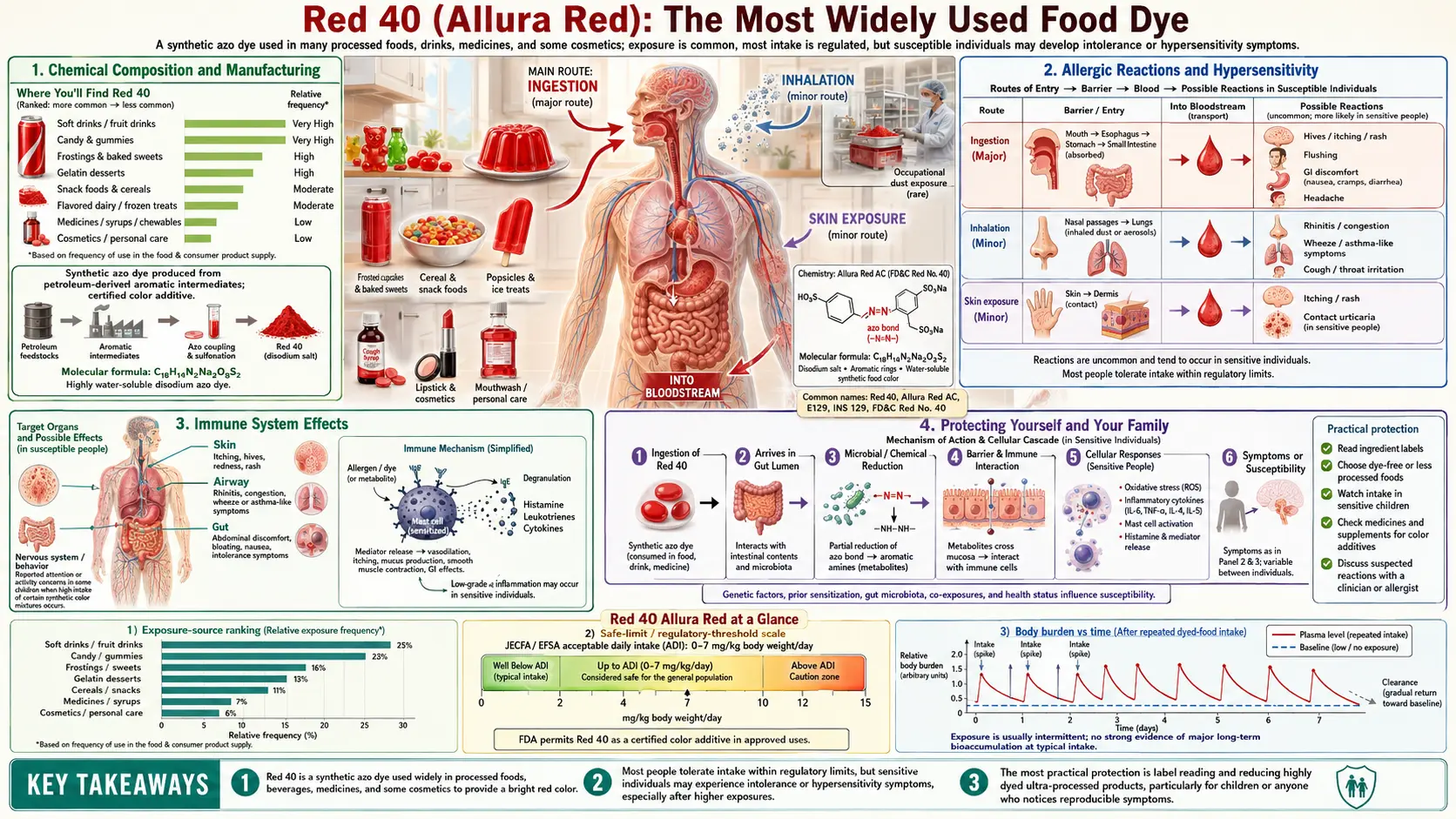
Red 40, also known as Allura Red AC, FD&C Red No. 40, or by its European designation E129, is the single most consumed artificial food dye in the United States. Accounting for roughly 40 percent of all food dye usage in the country, this petroleum-derived azo dye imparts a bright red-to-orange color to thousands of food products, beverages, medications, and cosmetics. Despite being the most widely consumed synthetic colorant, Red 40 has been linked to hyperactivity in children, allergic reactions, potential carcinogenicity, gut microbiome disruption, and immune system effects. The European Union requires warning labels on products containing Red 40, yet in the United States it remains freely used with no such warnings.
Chemical Composition and Manufacturing
Red 40 is a synthetic azo dye with the chemical name disodium 6-hydroxy-5-[(2-methoxy-5-methyl-4-sulfophenyl)azo]-2-naphthalenesulfonate. Its molecular formula is C18H14N2Na2O8S2. The term "azo" refers to the nitrogen-nitrogen double bond (N=N) at the center of the molecule, which is the chromophore responsible for the compound's red color.
- Raw materials: Derived from petroleum distillates, specifically from aromatic hydrocarbons extracted during crude oil refining
- Synthesis: Produced through diazotization of 5-amino-4-methoxy-2-toluenesulfonic acid, followed by coupling with 6-hydroxy-2-naphthalenesulfonic acid under alkaline conditions
- Contaminants: The manufacturing process can produce trace amounts of carcinogenic compounds, including 4-amino-5-methoxy-2-methylbenzenesulfonic acid, 6-hydroxy-2-naphthalenesulfonic acid, and potentially benzidine
- Physical properties: Dark red powder that is highly water-soluble; stable across a wide pH range, making it versatile for food manufacturing
Prevalence in the Food Supply
Red 40 is ubiquitous in the American diet. The Center for Science in the Public Interest estimates that Americans consume more than 14 million pounds of Red 40 annually. It is found in a vast range of products, many of which consumers might not suspect contain artificial dyes.
- Candy and confections: Skittles, Starburst, Swedish Fish, Twizzlers, M&Ms, and virtually all red or pink candies
- Beverages: Gatorade, Kool-Aid, Hawaiian Punch, Powerade, fruit punches, and many sodas
- Cereals: Fruity Pebbles, Froot Loops, Lucky Charms, and other brightly colored breakfast cereals
- Snack foods: Doritos, Flamin' Hot Cheetos, flavored chips and crackers
- Dairy products: Strawberry-flavored milk, yogurt, and ice cream
- Baked goods: Red velvet cake mix, frostings, cookies, and pastries
- Condiments and sauces: Ketchup, barbecue sauce, salad dressings, and pasta sauces
- Medications: Children's Tylenol, cough syrups, chewable vitamins, and numerous prescription tablets
ADHD and Hyperactivity: The Evidence
The Southampton Study (2007)
The most influential study linking Red 40 to behavioral effects in children was conducted by researchers at the University of Southampton and published in The Lancet in 2007. This randomized, double-blind, placebo-controlled trial studied 153 three-year-old children and 144 eight-to-nine-year-old children from the general population (not just children with ADHD diagnoses). Children were given drinks containing mixtures of artificial food colors (including Red 40) plus sodium benzoate, or a placebo drink. The study found statistically significant increases in hyperactive behavior in children who consumed the dye mixtures compared to placebo, as measured by both parental observation and objective computer-based attention tests.
The Southampton Study was groundbreaking because it demonstrated effects in the general population of children, not just those with pre-existing behavioral disorders. This finding directly influenced EU policy, leading to mandatory warning labels on products containing Red 40 and five other dyes.
Earlier Research and Meta-Analyses
- Feingold Hypothesis (1970s): Dr. Benjamin Feingold proposed that synthetic food dyes and certain preservatives caused hyperactivity in children; while initially controversial, subsequent research has largely supported the core finding
- Bateman et al. (2004): An earlier Southampton study found that artificial colors and sodium benzoate increased hyperactivity in three-year-old children
- Schab and Trinh (2004) meta-analysis: Analysis of 15 double-blind trials concluded that artificial food colors promote hyperactivity in hyperactive children
- Nigg et al. (2012) meta-analysis: Published in the Journal of the American Academy of Child and Adolescent Psychiatry, this analysis confirmed a small but significant effect of food dyes on behavior in children with and without ADHD
FDA Response
In 2011, an FDA advisory committee reviewed the evidence linking food dyes to hyperactivity. While acknowledging that some children may be sensitive to food dyes, the committee voted 8-6 against requiring warning labels, concluding that the evidence was not sufficient to establish a causal relationship for the general population. Critics argued that the committee applied an inappropriately high standard of proof and that several members had industry connections.
Allergic Reactions and Hypersensitivity
Red 40 is a documented trigger for allergic and pseudo-allergic reactions in sensitive individuals. As an azo dye, it can be metabolized in the body into aromatic amines, which may trigger immune responses.
- Urticaria (hives): Red 40 is one of the most common food dye triggers for chronic urticaria; symptoms include itchy, raised welts on the skin
- Angioedema: Swelling of deeper skin layers, particularly around the eyes, lips, and throat
- Respiratory symptoms: Asthma exacerbation, wheezing, and rhinitis have been reported in sensitive individuals
- Gastrointestinal distress: Nausea, abdominal pain, and diarrhea may occur in sensitive individuals
- Cross-reactivity: Individuals with aspirin sensitivity appear to be at increased risk for reactions to Red 40 and other azo dyes
Potential Carcinogenicity
While Red 40 has not been definitively classified as a human carcinogen, several lines of evidence raise concerns.
- Contamination with carcinogens: Red 40 may contain low levels of benzidine and other carcinogenic aromatic amines as manufacturing byproducts; the FDA permits up to 1 part per billion of free benzidine, but critics argue that any level of a known carcinogen is unacceptable
- Animal studies: Some animal studies have shown accelerated tumor appearance in mice fed Red 40, though the FDA concluded the tumors were not caused by the dye itself
- Genotoxicity: Several in vitro studies have found that Red 40 can cause DNA damage in certain test systems, though results have been inconsistent across studies
- Metabolic activation: Gut bacteria can cleave the azo bond in Red 40, producing aromatic amine metabolites that may have carcinogenic potential
Gut Microbiome Disruption
Groundbreaking research published in 2022 in the journal Nature Communications revealed that Red 40 can promote intestinal inflammation by disrupting the gut barrier and altering the composition of the gut microbiome. The study, conducted at McMaster University, found that Allura Red disrupted gut serotonin signaling and promoted experimental colitis in mouse models. Chronic exposure to Red 40 primed the gut for inflammatory responses, raising concerns about the dye's role in inflammatory bowel disease and other gut-related conditions. Given that the gut microbiome influences immune function, mental health, metabolic health, and virtually every organ system, these findings have implications that extend far beyond digestive health.
Immune System Effects
- Immune hypersensitivity: Red 40 has been shown to activate certain immune cells and promote inflammatory cytokine release in laboratory studies
- T-cell effects: Research suggests that Red 40 may interfere with T-cell function, which plays a central role in adaptive immunity
- Mast cell degranulation: Red 40 can trigger mast cell activation in sensitive individuals, leading to histamine release and allergic symptoms
- Autoimmune concerns: Some researchers have hypothesized that chronic exposure to food dyes may contribute to the rising prevalence of autoimmune conditions, though this connection remains under investigation
Regulatory Status: US vs. Europe
United States (FDA)
Red 40 is approved for use in food, drugs, and cosmetics in the United States with no warning labels or quantity restrictions beyond Good Manufacturing Practice guidelines. The FDA maintains that Red 40 is safe for the general population at current consumption levels, citing a lack of conclusive evidence of harm in humans. The acceptable daily intake (ADI) is set at 7 mg per kilogram of body weight per day.
European Union (EFSA)
While Red 40 (E129) is permitted in the EU, it requires a mandatory warning label stating: "May have an adverse effect on activity and attention in children." This labeling requirement, implemented in 2010 following the Southampton Study, has led most major European food manufacturers to voluntarily replace Red 40 with natural alternatives. As a result, many global brands sell the same product with natural colors in Europe and synthetic dyes in the United States.
Natural Red Alternatives
- Beet juice concentrate: Provides a deep red color and is widely used in European food products; heat-stable and effective across a range of applications
- Carmine (cochineal extract): Derived from cochineal insects, carmine provides a vibrant red color; used in many products though it may trigger allergic reactions in some individuals and is not vegan
- Anthocyanins: Natural pigments found in berries, red cabbage, and grapes that provide red-to-purple hues; rich in antioxidants
- Lycopene: A red carotenoid pigment from tomatoes; also an antioxidant with documented health benefits
- Paprika extract: Provides a red-orange color and is derived from red peppers
- Radish extract: An emerging natural red colorant gaining popularity in clean-label formulations
Protecting Yourself and Your Family
- Read ingredient labels: Look for "Red 40," "Allura Red," "FD&C Red No. 40," or "E129" on food labels
- Choose organic products: USDA Organic certification prohibits the use of synthetic food dyes
- Select natural alternatives: Look for products that use beet juice, carmine, or other natural red colorants
- Check medications: Ask your pharmacist for dye-free alternatives, especially for children's medications
- Be aware of hidden sources: Red 40 is found in products where you might not expect it, including white frosting (which may contain a small amount for brightness), sausages, and flavored oatmeal
- Monitor children's behavior: If your child shows signs of hyperactivity, consider an elimination diet that removes artificial food dyes for several weeks to assess whether behavior improves
Research Papers
PubMed topic-search links for Red 40 / Allura Red and related outcomes. Each link opens a live PubMed search.
- Allura Red AC — general toxicology literature
- Red 40 and hyperactivity in children
- Artificial food colors and ADHD
- Southampton food additives trials
- Allura Red, colitis, and the gut microbiome
- Azo dye genotoxicity
- Food dye and urticaria / hypersensitivity
- Benzidine contamination in food dyes
- Allura Red and inflammatory bowel disease
- Synthetic food coloring and child behavior
- Food additive mast-cell activation
- Azo-dye aromatic-amine carcinogenicity
Connections
- All Toxins
- Food Dyes
- ADHD
- Food Additives
- Inflammatory Bowel Disease
- Allergies
- Yellow 5 Tartrazine
- Food Dyes Banned Worldwide
- Red 3 Erythrosine
- US vs EU Food Safety
- Banned Additives
- Gut Brain Axis
- Preservatives
- Sodium Benzoate
- Asthma
- Elimination Diet