Daniel Bovet: Antihistamines, Curare, and Blocking the Body's Own Signals
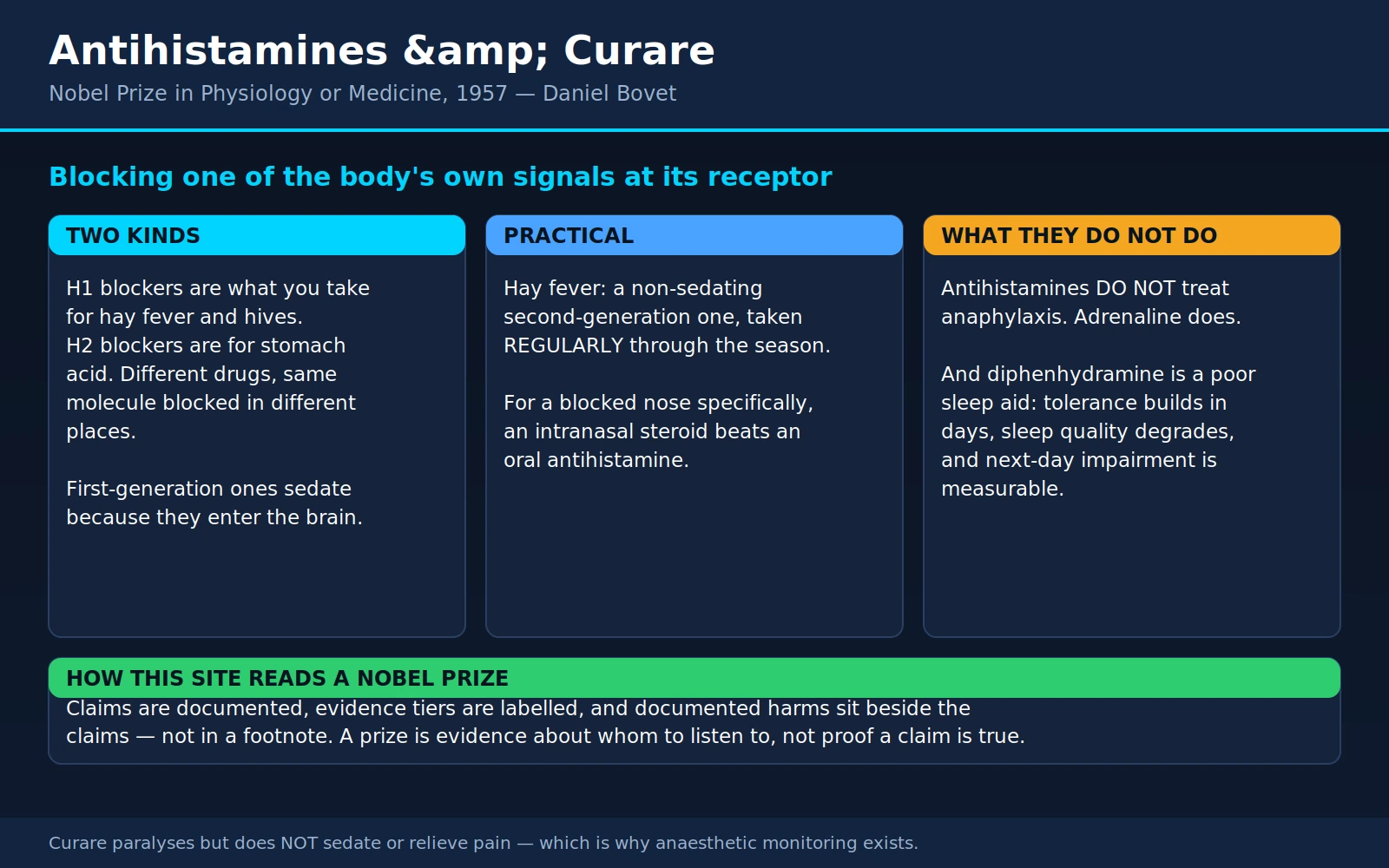
Almost everyone reading this has taken one of Daniel Bovet's ideas. If you have swallowed a tablet for hay fever, rubbed at hives, taken something for travel sickness, reached for a "PM" sleep aid, or been given a general anaesthetic for surgery, you have been on the receiving end of a way of thinking about drugs that barely existed before he started work — and that he was the first person to make work twice, in two entirely different parts of the body.
Bovet's Nobel Prize, awarded in 1957, was given for synthetic compounds that block the action of certain substances the body makes itself, particularly in the blood vessels and the skeletal muscles. Behind that dry phrasing sit two of the most-used drug classes in medicine: the antihistamines, and the muscle relaxants that made modern surgery possible. This page is about what he actually did, and — more usefully — what it means for the medicine cabinet in your bathroom.
Table of Contents
- The Man
- The Idea of a Receptor Antagonist
- Histamine, and What It Actually Does
- The First Antihistamines
- First-Generation Antihistamines and Their Real Cost
- Second-Generation Antihistamines
- What Antihistamines Do Not Do
- Curare, and the Other Half of the Prize
- Where This Shows Up in Your Life
- Bovet's Later Work, and Filomena Nitti Bovet
- Where Mainstream Medicine Agrees — and What Remains Debated
- Key Research Papers
- Connections
- Featured Videos
1. The Man
Daniel Bovet (23 March 1907 – 8 April 1992) was born in Fleurier, a small watchmaking village in the Swiss canton of Neuchâtel, and died in Rome sixty-five years later as an Italian citizen. In between he worked in two of the great pharmacology laboratories of the twentieth century and founded a third. He was Swiss by birth, French by training, and Italian by choice, and he published in all three languages — which, as we will see, is one reason his earliest and most important papers are almost impossible to find in modern databases.
His father, Pierre Bovet, was a professor of educational psychology in Geneva and a well-known figure in progressive education. That mattered later: Bovet grew up in a house where the study of how minds learn was ordinary dinner-table conversation, and in the last third of his career he came back to exactly that question. He took his doctorate at the University of Geneva in 1929 in zoology and comparative anatomy — not, notably, in chemistry or medicine — and then, at twenty-two, went to Paris to join the Pasteur Institute.
Fourneau's laboratory
At the Pasteur Institute Bovet joined the Laboratory of Therapeutic Chemistry, run by Ernest Fourneau. Fourneau is not a household name, but he ought to be: he was among the first people anywhere to treat drug discovery as a systematic craft rather than a lucky accident. His method was to take a molecule with some biological activity, make dozens of deliberate variations on it, and test them all — the approach that would later be called structure–activity relationship work. Bovet spent eighteen years there and ran the laboratory himself from 1937.
This is where a young Bovet got his first taste of demolishing a drug's mystique. In 1932 the German chemist Gerhard Domagk had found that a red dye, Prontosil, cured streptococcal infections in mice, and the finding launched the sulfa drugs and the entire antibacterial era. But Prontosil had a strange property: it worked beautifully in a living animal and did absolutely nothing in a test tube. In 1935 the Fourneau team — Jacques and Thérèse Tréfouël, Federico Nitti, and Bovet — took that paradox seriously and worked out why. The body was chopping the dye in half. The active drug was not the elaborate red molecule at all but a small, colourless, unpatented fragment of it: sulfanilamide, a compound that had been sitting in the chemical literature since 1908.
Our page on Gerhard Domagk tells that story from the other side, including what it cost the German patent that had been built around the dye. The point for Bovet's own career is that at twenty-eight he had already learned that the impressive-looking part of a drug is often not the part that does the work — and that the way to find out is to ask what the body does to the molecule, and what the molecule does to the body, as two separate questions.
Paris, then Rome
The antihistamine work described below occupied the years 1937 to 1944, in occupied and then liberated Paris. In 1947 Bovet accepted an invitation to Rome, to build a laboratory of therapeutic chemistry at the Istituto Superiore di Sanità, Italy's national health institute. He became an Italian citizen in 1947. The curare work — the second half of the Nobel citation — straddles the move, beginning in Paris and continuing in Rome.
The Nobel Prize in Physiology or Medicine came in 1957, unshared, "for his discoveries relating to synthetic compounds that inhibit the action of certain body substances, and especially their action on the vascular system and the skeletal muscles." His Nobel lecture was titled, with characteristic precision and characteristic lack of showmanship, The Relationships Between Isosterism and Competitive Phenomena in the Field of Drug Therapy of the Autonomic Nervous System and That of the Neuromuscular Transmission. He later held chairs at the University of Sassari in Sardinia and at Rome, and from 1969 to 1975 directed a psychobiology and psychopharmacology laboratory for Italy's National Research Council.
A note on the literature, because it explains something about this page. PubMed's coverage effectively begins in the mid-1940s, and Bovet's decisive antihistamine papers were published in French in Comptes Rendus des Séances de la Société de Biologie in 1937 and 1944. They are not in PubMed, and any citation that claims to give you a PubMed ID for them should be treated with suspicion. What is indexed is the tail of his career: dozens of papers from 1946 onward in Italian, French and English journals, including a 1956 study in the Journal of Pharmacology and Experimental Therapeutics on histamine and the cerebral circulation in which he uses two of the antihistamines his own field produced. Below, his early work is described in prose with search links; the reference list carries only citations that have been checked one by one against PubMed's own records.
2. The Idea of a Receptor Antagonist
Here is the conceptual move that earned the prize, and it is worth slowing down for, because it is now so completely ordinary that its strangeness in the 1930s is genuinely hard to feel.
Almost all of the drug triumphs of the preceding half-century had been anti-microbial. Paul Ehrlich had dreamed of a "magic bullet" that would poison a parasite and spare the patient, and delivered Salvarsan for syphilis. Domagk gave the world the sulfa drugs. Fleming's penicillin was moving toward the clinic. The mental model of a drug was: there is an invader; find something that kills the invader and not you.
Bovet asked a different question. What if the thing making you ill is not an invader at all, but one of your own signalling molecules, released at the wrong time or in the wrong amount? In hay fever nothing is infecting you. Your own mast cells are dumping histamine into your own tissues in response to a harmless grain of pollen, and it is the histamine — not the pollen — that makes your nose run and your eyes itch. You cannot kill histamine the way you kill a bacterium. It is supposed to be there.
So instead: build a molecule that looks enough like histamine to sit down in histamine's own parking space on the cell — its receptor — but that does nothing once it is there. It occupies the seat. The real histamine arrives and finds nowhere to bind. The signal is not destroyed; it is simply not received. This is competitive antagonism, and Bovet's word for the design principle was isosterism: building a molecule that is a near-copy in shape and charge distribution, close enough to fit, different enough to be inert.
Two things made this a genuinely radical proposal in 1937. The first is that nobody had ever seen a receptor. The word described an inference, not an object. Ehrlich had proposed "side-chains" on cells that drugs and toxins latch onto, and Henry Dale and John Langley had built up a body of indirect evidence that specific chemicals act on specific cellular sites. But receptors would not be isolated, sequenced or crystallised for another four decades. Bovet was designing keys for a lock that no one had ever held.
The second is that deliberately blocking a normal body signal sounded, to many people, like a very good way to make a patient worse. Physiology was understood to be finely balanced. Histamine, adrenaline and acetylcholine were there for reasons. Switching one off on purpose seemed closer to poisoning than to treating — and, as section 8 shows, in the case of the muscle relaxants it literally was a poison, borrowed from South American arrow tips.
How ordinary this became
Look at what is now in an average pharmacy and count how much of it is a blocked signal rather than a killed germ:
- Beta-blockers — propranolol, bisoprolol, metoprolol — sit in adrenaline's receptors on the heart. Sir James Black, who designed propranolol, was explicitly working in Bovet's tradition and won his own Nobel in 1988.
- Antihistamines, the subject of this page, in two distinct varieties.
- Opioid antagonists — naloxone, which reverses an overdose within minutes by ejecting the opioid from its receptor, and naltrexone for dependence.
- Angiotensin receptor blockers for blood pressure; antipsychotics, most of which block dopamine receptors; antiemetics that block serotonin 5-HT3 receptors; leukotriene receptor antagonists like montelukast for asthma; oestrogen receptor blockers such as tamoxifen for breast cancer.
- Proton pump inhibitors for reflux work by related logic, one step further down: rather than blocking the receptor that tells the stomach to make acid, they disable the pump that does the making.
One honest exception, because it is easy to lump everything together: statins are not receptor antagonists. They inhibit an enzyme, HMG-CoA reductase, which is a different mechanism — jamming a machine rather than occupying a mailbox. It happens to be another way of deliberately turning down one of the body's own processes, which is the broader family Bovet's thinking belongs to, but the mechanism is not his.
The list above is a fair share of everything a modern pharmacy dispenses. In 1937 it did not exist.
3. Histamine, and What It Actually Does
Bovet did not discover histamine, and he was careful to say so. That work belonged to Henry Dale and his colleagues at the Wellcome Physiological Research Laboratories, starting around 1910. Dale showed that this small molecule, made from the amino acid histidine, dropped blood pressure, contracted smooth muscle, and produced in an animal something eerily like the shock of a severe allergic reaction — the phenomenon Charles Richet had named anaphylaxis and won the 1913 Nobel for. Dale went on to share the 1936 Nobel Prize with Otto Loewi for the discovery of chemical neurotransmission; our Loewi and Dale page covers that story, and it is the direct foundation for everything on this page. Bovet started from a molecule Dale had already characterised and asked a question Dale had not: can we get in its way?
What histamine is for
Histamine is stored, pre-made, in granules inside mast cells (which sit in skin, gut lining, airways and around blood vessels) and basophils in the blood. When an allergen cross-links IgE antibodies on a mast cell's surface, the cell degranulates — it empties those granules into the surrounding tissue within seconds. Histamine is also made by certain stomach cells and by neurons in the brain, where it is a wakefulness signal. That last detail turns out to matter enormously for section 5.
Released into a tissue, histamine does four things you can feel:
- Blood vessels leak. Small vessels dilate and the gaps between the cells lining them widen, so fluid moves out into the tissue. In skin that is a wheal — the raised pale bump of a hive or a mosquito bite. In the nose it is congestion and a runny nose. Everywhere at once, it is the collapse in blood pressure of anaphylactic shock.
- Smooth muscle contracts. The involuntary muscle in airways and gut squeezes. This is why massive histamine release causes wheeze and cramping.
- Itch, and the red flare. Histamine directly stimulates sensory nerve endings, producing itch — a sensation with its own dedicated nerve pathway, not simply mild pain. Those nerves fire backwards along their own branches and release peptides that dilate nearby vessels, which is the red flare spreading around a hive.
- The stomach makes acid. Histamine released by cells in the stomach lining is the final common signal telling the acid-producing parietal cells to switch on.
H1 and H2: why one "antihistamine" is not another
Here is the single most confusing thing about this whole drug class, and the confusion is entirely reasonable, because the name is used for two different families.
By the 1950s pharmacologists had a problem. Bovet's antihistamines blocked the wheal, the flare, the itch and the smooth-muscle contraction beautifully. They did essentially nothing to histamine's effect on stomach acid or on heart rate. Either the drugs were mysteriously incomplete, or histamine was talking to more than one kind of receiver.
In 1966, Ash and Schild proposed exactly that, and defined the receptor blocked by the existing antihistamines as H1. Six years later, James Black's team at Smith, Kline & French confirmed the second receptor experimentally with a purpose-built blocking compound and named it H2. That paper led directly to cimetidine and then ranitidine and famotidine — the acid-suppressing drugs that turned peptic ulcer disease from a surgical condition into a prescription. Later work added H3 (mostly in the brain) and H4 (mostly on immune cells).
So, plainly:
- An H1 blocker — cetirizine, loratadine, fexofenadine, diphenhydramine, chlorphenamine — is what people mean by "an antihistamine". It works on the wheal, itch, sneezing and runny nose. It does not touch stomach acid.
- An H2 blocker — famotidine, and formerly ranitidine and cimetidine — suppresses stomach acid. It does nothing useful for hay fever.
Both are, technically, antihistamines. They share a target molecule and almost nothing else. If you have ever wondered why the "antihistamine" your relative takes for heartburn is a completely different tablet from the one you take for pollen, that is the answer — and it exists because Bovet's drugs worked so specifically that their failures revealed a second receptor nobody had suspected.
4. The First Antihistamines
In 1937, Bovet and a young doctoral student named Anne-Marie Staub began working through Fourneau's collection of compounds, looking for anything that would protect an animal against histamine. Their reasoning was structural: several of the laboratory's phenolic ethers and amines bore a passing resemblance to histamine, and if the receptor idea was right, resemblance was the whole game.
The compound that worked was thymoxyethyldiethylamine, laboratory number 929F. Guinea pigs are exquisitely sensitive to histamine — a dose that would barely trouble a person will send a guinea pig into fatal bronchospasm within minutes. Pre-treated with 929F, the animals survived doses of histamine that killed untreated controls, and the drug also protected them against anaphylactic shock. Staub's 1939 thesis, on synthetic bases antagonistic to histamine, is the founding document of the field.
929F was never a medicine. It was too toxic and too weak, and its protective margin was narrow. But it was proof of principle, and proof of principle is what a new field runs on: it demonstrated that a synthetic molecule could stand between a body's own mediator and the body's response to it. Everything after was optimisation.
What followed happened fast, and under difficult conditions — occupied Paris, with reagents scarce.
- 1942 — phenbenzamine (Antergan). Bernard Halpern, working at the Rhône-Poulenc laboratories, produced the first antihistamine good enough to give to patients. It was tested at the Hôpital Saint-Antoine in Paris and it worked: hives faded, hay fever eased. Halpern's report appeared in French in 1942 and, like Bovet's own early work, is not indexed in PubMed.
- 1944 — pyrilamine, also called mepyramine (Neo-Antergan). Bovet's own group produced the compound that made the field commercially real: more potent than Antergan, better tolerated, and effective in ordinary doses. Mepyramine became the standard against which every subsequent antihistamine was measured — so much so that for the next twenty years, "the H1 receptor" was operationally defined as the thing mepyramine blocks.
Then the field exploded. Diphenhydramine (Benadryl) reached the American market in 1946, tripelennamine the same year, chlorphenamine in 1949, promethazine in 1947, hydroxyzine in 1956. By the early 1950s antihistamines were among the most widely prescribed drugs in the world, and were being sold, with more enthusiasm than evidence, for the common cold.
One branch of that chemistry ran somewhere nobody expected. French researchers modifying the promethazine molecule — a phenothiazine antihistamine — produced chlorpromazine in 1950. It turned out to be a poor antihistamine and the first effective antipsychotic drug, and it changed psychiatry more completely than any medicine before it. It descends, structurally, from the antihistamine programme Bovet started.
Anne-Marie Staub
Staub deserves more than a footnote. She was the hands-on experimenter on the 1937 work, and it formed her doctoral thesis. She then spent a long career at the Pasteur Institute and became a distinguished immunochemist in her own right, publishing into the late 1970s on the structure and antigenic specificity of bacterial cell-wall polysaccharides — work that is thoroughly represented in PubMed under her name, and that has nothing to do with antihistamines. Her scientific life is a useful corrective to the idea that the people around a laureate were assistants. She was a scientist who happened to do her PhD on a problem that turned out to be historic.
5. First-Generation Antihistamines and Their Real Cost
This section and the next two are the practical heart of the page. If you read nothing else, read these.
The first-generation antihistamines — diphenhydramine (Benadryl, and the antihistamine in most products whose name ends in "PM"), chlorphenamine or chlorpheniramine (Piriton, Chlor-Trimeton), promethazine (Phenergan), hydroxyzine (Atarax, Vistaril), doxylamine (Unisom SleepTabs, the antihistamine in NyQuil), cyclizine and dimenhydrinate (Dramamine) — all share a chemical personality. They are small, fatty, and uncharged at body pH. That is exactly the profile of a molecule that slips through the blood-brain barrier.
Once inside the brain, they do to brain histamine what they do to skin histamine: they block it. And brain histamine is a wakefulness signal. Blocking it makes you sleepy. The sedation is not a quirky side effect of an impurity; it is the same drug doing the same thing in a different place.
They also block muscarinic acetylcholine receptors — they are, incidentally, anticholinergic drugs. That is the source of the dry mouth, blurred vision, constipation, difficulty passing urine (a real problem for older men with an enlarged prostate), and, in older people especially, confusion. In someone susceptible, they can precipitate acute angle-closure glaucoma.
As sleep aids: what the evidence actually says
Because they cause drowsiness, first-generation antihistamines — overwhelmingly diphenhydramine and doxylamine — are sold over the counter as sleep aids. They are the most-used non-prescription sleeping drugs in the world. Here is what has been measured.
Tolerance develops within days. This is the finding that ought to be printed on the box. In a randomised, double-blind crossover trial, fifteen healthy men took either diphenhydramine 50 mg twice daily or placebo for four days. On day 1, both subjective sleepiness and objective performance impairment were clearly worse on the drug. By day 4, both had returned to placebo levels — sleepiness on diphenhydramine was indistinguishable from placebo, and the performance impairment had completely reversed. The authors described the speed of tolerance as remarkable: complete within three days of dosing.
Read that the practical way round. If you take diphenhydramine every night for insomnia, then by roughly the fourth night it has stopped doing the thing you are taking it for. It is not building up a benefit; it is losing one. Anything you feel after that first week is largely the expectation of a pill, plus whatever anticholinergic fog is left over.
The drug is still in your brain the next morning, even when you cannot feel it. In a double-blind placebo-controlled crossover study, healthy men took diphenhydramine 50 mg at 11 p.m. and were scanned by positron emission tomography at 11 a.m. the following morning. Cortical histamine H1 receptor occupancy was still 44.7% — nearly half the brain's H1 receptors blocked, twelve hours later — compared with 16.6% for a second-generation comparator. And, crucially, subjective sleepiness the next morning was no different from placebo. The participants could not tell. That combination — substantial residual receptor blockade with no felt drowsiness — is precisely why "I feel fine" is not evidence that a night-time antihistamine has worn off.
Guidelines say don't. The American Academy of Sleep Medicine's clinical practice guideline on drug treatment of chronic insomnia in adults specifically recommends against using diphenhydramine for either sleep-onset or sleep-maintenance insomnia. That recommendation is graded weak and based on low-quality evidence — but the reason the evidence is weak is that the drug has never been shown to work well, not that nobody looked. For chronic insomnia, cognitive behavioural therapy for insomnia (CBT-I) is the first-line treatment and outperforms every drug in the class over any meaningful time horizon. Our insomnia page covers what does work.
Anticholinergic burden in older adults
This deserves a careful, honest treatment, because it is frequently overstated in one direction and dismissed in the other.
"Anticholinergic burden" is the running total of a person's exposure to drugs that block acetylcholine — some antidepressants, bladder drugs for overactive bladder, some antipsychotics, certain Parkinson's drugs, and first-generation antihistamines. The short-term effects on thinking are not disputed by anyone: these drugs measurably impair attention and memory while you are on them, and in a frail elderly person they can tip into frank delirium. The American Geriatrics Society's Beers Criteria list first-generation antihistamines among the medications older adults should generally avoid, for exactly these reasons plus the fall risk that comes with sedation.
The disputed question is whether long-term use raises the risk of dementia. Two large studies frame the debate:
- A prospective cohort of older adults found that cumulative use of strong anticholinergics was associated with a higher risk of incident dementia, in a dose-response pattern — more exposure over ten years, more risk. First-generation antihistamines were among the most commonly used strong anticholinergics in that population, alongside tricyclic antidepressants and bladder antimuscarinics.
- A much larger nested case-control study in English primary care — 58,769 people with dementia matched to 225,574 controls — found the overall association again (odds ratio 1.49 in the highest exposure category), but when the drugs were broken down by class, the significant increases were for anticholinergic antidepressants, antiparkinson drugs, antipsychotics, bladder antimuscarinics and antiepileptics. Antihistamines were not among the classes showing a significant association.
So the fair summary is this: the strongest dementia signal in the largest study does not point at antihistamines specifically, and anyone telling you that Benadryl causes Alzheimer's is going beyond the evidence. What is not in doubt is that these drugs impair cognition while you are taking them, raise fall and fracture risk in older people, cause urinary retention and constipation, and — per the section above — stop working as sleep aids within a week. That is already a sufficient case for not using them nightly, without needing the dementia claim at all.
The hidden-dose problem
Diphenhydramine's real trap is that people do not know they are taking it. It is the active ingredient in a long list of products that do not have "antihistamine" anywhere on the front of the box:
- Almost anything labelled "PM" — a painkiller plus diphenhydramine.
- Dedicated over-the-counter sleep aids, under many brand names.
- Night-time cold and flu preparations, which typically contain diphenhydramine or doxylamine.
- Anti-itch creams and after-bite products, some of which contain it topically — and applying a topical antihistamine over broken or extensively inflamed skin while also taking an oral one is a genuine way to overshoot.
- Motion sickness tablets (dimenhydrinate is, chemically, diphenhydramine paired with a stimulant).
Someone taking a night-time cold remedy, a "PM" painkiller for a sore back, and a travel-sickness tablet has taken three doses of essentially the same drug. Read the active ingredients, not the brand.
One more thing that should be said plainly: diphenhydramine is dangerous in overdose. At high doses it causes agitation, hallucinations, seizures and cardiac arrhythmias, and it has been the subject of a viral social-media "challenge" that has killed teenagers. It is sold without a prescription, which is not the same as being harmless at any dose.
Where first-generation drugs are still the right choice
They have not been abolished, and there are situations where the very properties that make them poor hay-fever drugs make them useful:
- Motion sickness and vertigo — cyclizine, promethazine, dimenhydrinate. Here the anticholinergic and central action is the mechanism; a non-sedating antihistamine does not work for this.
- Severe nocturnal itch — in eczema or urticaria that wrecks sleep, hydroxyzine at night is a legitimate short-term option, chosen deliberately for the sedation.
- Nausea and vomiting of pregnancy — doxylamine combined with vitamin B6 is a long-established, well-studied first-line treatment.
- Hospital settings — parenteral chlorphenamine or promethazine as an adjunct in allergic reactions, or as a pre-medication before certain infusions.
6. Second-Generation Antihistamines
The second generation arrived in the 1980s and answered a question the first generation had raised: could you keep the antihistamine effect in the body and leave it out of the brain?
The current agents are loratadine (Claritin), cetirizine (Zyrtec), fexofenadine (Allegra, Telfast), and their close relatives desloratadine, levocetirizine, bilastine and rupatadine. They are as effective as the older drugs at the H1 receptor, and they last long enough for once-daily dosing.
Why they mostly don't sedate
Two mechanisms, working together:
- They are worse at crossing the blood-brain barrier. These molecules are larger and more polar, and several carry an electrical charge at body pH. A charged molecule does not slide through a fatty membrane.
- They are actively pumped back out. The blood-brain barrier is not just a wall; it is a wall with bouncers. P-glycoprotein is an efflux transporter embedded in the barrier that grabs certain molecules and ejects them back into the blood. Laboratory work comparing first- and second-generation antihistamines found that most were P-glycoprotein substrates in cell assays, and that in brain perfusion experiments the first-generation drugs penetrated the brain substantially more than the second-generation ones — consistent with efflux being a major part of what keeps the newer drugs out.
The human-imaging evidence lines up. In the PET study described above, night-time diphenhydramine left 44.7% of cortical H1 receptors occupied the next morning; a second-generation comparator left 16.6%.
Cetirizine: the honest exception
Cetirizine has a reputation as the second-generation antihistamine most likely to make you drowsy, and it is worth being precise about how strong the evidence for that is, because it turns out to be more equivocal than the reputation.
A meta-analysis of 13 randomised placebo-controlled trials of cetirizine 10 mg daily found the somnolence signal depended almost entirely on trial design. In trials without a placebo run-in period, cetirizine caused somnolence 6.51% more often than placebo (95% CI 4.47% to 8.56%). In trials with a placebo run-in — a design that weeds out people who report drowsiness on anything — the difference shrank to 1.03% and was not statistically significant (95% CI −0.13% to 2.19%).
So the practical position, stated fairly: cetirizine is not a sedating drug in the way diphenhydramine is, and most people take it with no drowsiness at all. But a minority genuinely do feel it, the effect is real for those people, and cetirizine is the one of the three big second-generation drugs where this comes up. Fexofenadine is the least sedating of the group and is the sensible switch if drowsiness is a problem. If you are trying cetirizine for the first time, take the first dose in the evening rather than before driving.
Practical guidance for hay fever
Four things worth knowing, in descending order of usefulness:
1. For a blocked nose, an intranasal steroid beats an oral antihistamine — and it is not close. This is the single most useful fact on this page for anyone with seasonal allergies. A meta-analysis of 16 randomised controlled trials in 2,267 people with allergic rhinitis compared intranasal corticosteroids (fluticasone, mometasone, budesonide and similar) head-to-head against oral antihistamines. The steroids were significantly better for nasal blockage (standardised mean difference 0.63), and also for nasal discharge, sneezing, nasal itch, postnasal drip and total nasal symptoms. The authors concluded that intranasal corticosteroids should be first-line treatment for allergic rhinitis, and modern guidelines agree.
With one useful refinement, from the same analysis: there was no significant difference for eye symptoms. If your dominant misery is itchy, streaming eyes rather than a blocked nose, the oral antihistamine is not the inferior choice, and an antihistamine eye drop may serve you better than either.
2. Take it regularly through the season, not only on bad days. Antihistamines work considerably better used continuously than used reactively. Once mast cells have degranulated and the tissue is inflamed, you are trying to block a signal that has already been sent. Starting before the season and continuing daily keeps the receptors occupied in advance. Intranasal steroids reinforce this point — they take several days to reach full effect and are close to useless taken as a one-off, so start them a week or two before your usual season begins.
3. You can combine them. An intranasal steroid plus an oral antihistamine is a standard, safe combination for people whose symptoms are not controlled by either alone, and adding an antihistamine eye drop on top is fine.
4. Fexofenadine and fruit juice. Grapefruit, orange and apple juice measurably reduce fexofenadine absorption by interfering with the transporter that carries it out of the gut. Take it with water, and leave a couple of hours around fruit juice.
7. What Antihistamines Do Not Do
Bovet's drugs are very good at a narrow job. Most of the harm they are involved in comes from people expecting them to do a wider one.
They do not treat anaphylaxis
This is the most important sentence on this page. Anaphylaxis is treated with adrenaline (epinephrine), injected into the muscle of the outer thigh, immediately. An antihistamine is not a treatment for anaphylaxis and must never be used in place of adrenaline or as a reason to wait.
The reasoning is mechanical. Anaphylaxis is not a histamine problem alone — mast cells release tryptase, leukotrienes, prostaglandins and platelet-activating factor along with histamine, and the airway swelling and circulatory collapse are driven by all of them together. Adrenaline reverses the whole picture at once: it constricts the leaking blood vessels, relaxes the airways, and supports the heart. An oral antihistamine addresses one mediator, only at H1 receptors, and takes tens of minutes to be absorbed — time that a person with a closing airway does not have. Every major anaphylaxis guideline in the world places intramuscular adrenaline first and describes antihistamines as, at most, an adjunct for the skin symptoms after adrenaline has been given.
Delay in giving adrenaline is a repeated finding in reviews of fatal anaphylaxis. If someone has been exposed to a known trigger and is developing swelling of the lips or tongue, difficulty breathing, a hoarse voice, faintness or widespread hives with any of these — use the adrenaline autoinjector and call emergency services. Our anaphylaxis page covers recognition and management in detail, and the Charles Richet page tells the story of how anaphylaxis was discovered in the first place.
They do very little for asthma
Histamine is one of many bronchoconstrictors, and blocking it alone does not control asthma. Antihistamines are not asthma treatments, and using one instead of a prescribed inhaler is dangerous. Asthma is controlled by inhaled corticosteroids, with reliever inhalers, long-acting bronchodilators and, in some cases, leukotriene receptor antagonists such as montelukast — a different receptor, a different mediator. Where an antihistamine helps an asthmatic patient, it is usually by controlling the accompanying allergic rhinitis, which does modestly improve asthma control. See asthma.
They are not the answer to most non-allergic rhinitis
Plenty of chronically runny, blocked noses are not allergic at all. Non-allergic (vasomotor) rhinitis — triggered by temperature change, strong smells, alcohol, spicy food — involves no IgE and no mast-cell degranulation, and oral antihistamines do little for it. Intranasal azelastine (a topical antihistamine, which appears to work partly through non-histamine mechanisms at the doses achieved in the nose) and intranasal ipratropium are more useful. Rhinitis medicamentosa — rebound congestion from overusing decongestant nasal sprays — is another common cause that antihistamines will not touch. See allergic rhinitis for the distinction.
Histamine intolerance and low-histamine diets
This deserves care rather than contempt, because there is a real physiological entity underneath a large amount of internet commerce.
The claim, at its strongest. Histamine occurs in food, particularly aged, fermented and cured items — mature cheese, cured meats, wine, sauerkraut, fermented soy products, some fish. The enzyme that breaks down histamine in the gut wall is diamine oxidase (DAO). If DAO activity is low, the argument goes, dietary histamine passes into the circulation and produces symptoms that look allergic without any allergy: flushing, headache, hives, abdominal pain, diarrhoea, palpitations, nasal congestion. Genuine DAO deficiency does exist — it can be genetic, or acquired through gut inflammation, or caused by drugs that inhibit the enzyme. Some people also have mast cell activation syndrome or mastocytosis, where the problem is the body's own histamine release rather than diet.
The best supportive evidence. The strongest published result comes from a German study of 56 patients with chronic spontaneous urticaria who also had gastrointestinal symptoms. After at least three weeks on a low-histamine diet, 61% reached the study's primary endpoint of a substantial improvement in urticaria activity score, and the mean score fell from 9.05 to 4.23 (P = 0.004). The authors concluded the diet was a useful, simple and cost-free tool in that specific group.
The tier that evidence belongs to. That study had no control group, no blinding and no placebo diet. Elimination diets are among the most placebo-responsive interventions in medicine: people who commit three weeks to a restrictive regime, keep a daily symptom diary and return for review improve for many reasons that have nothing to do with histamine. And the study's own DAO measurements did not change across the diet, which does not support the proposed mechanism. It is a genuine signal worth following up, and its authors said as much. It is not proof.
The diagnostic test is the weakest link. Serum DAO is the test most commonly sold for this, and its performance has been measured directly. In a study of 249 patients with suspected histamine intolerance and 50 healthy controls, the manufacturer's cut-off of <10 U/mL gave 71% sensitivity and 92% specificity for separating high-probability patients from healthy controls — but only 61% specificity for separating them from other symptomatic patients with a low probability of histamine intolerance. That second number is the one that matters clinically, because nobody with no symptoms is being tested. The authors' own conclusion was that DAO can be an additional input but that a diagnosis should not rest on it. A review of the field reaches the same place: there is no validated biomarker, and diagnosis remains a clinical judgment supported by a supervised dietary challenge.
What this means for you. Most people who try a low-histamine diet do not have DAO deficiency, and there is a real cost to the attempt: the excluded list is long, overlaps heavily with the most nutritious and enjoyable foods, and a self-managed permanent version can drift into genuine nutritional inadequacy and a difficult relationship with eating. If you want to test the idea, the reasonable version is a time-limited trial — typically three to four weeks — with a diary, ideally supervised by a dietitian, followed by systematic reintroduction to find out which foods, if any, actually matter. A diet you never come off has not been tested. And first rule out the things that actually mimic it: true IgE food allergy, coeliac disease, mast cell disorders, and carcinoid. See food intolerance and chronic urticaria.
8. Curare, and the Other Half of the Prize
The Nobel citation mentions the skeletal muscles as well as the vascular system, and that half of Bovet's work has a stranger history: it starts with an arrow poison.
The poison
Curare is the name Europeans gave to a family of preparations made by indigenous peoples of the Amazon and Orinoco basins from plants including Chondrodendron tomentosum and species of Strychnos. Smeared on a dart or arrow, it causes flaccid paralysis in the animal that is struck. The prey stops moving, then stops breathing. Crucially, the meat is safe to eat, because curare is very poorly absorbed from the gut — it has to get into the bloodstream to work.
In the 1850s Claude Bernard established, in a set of beautifully designed experiments, exactly where curare acts. A curarised muscle still contracts when you stimulate the muscle directly. The nerve leading to it still conducts an impulse normally. What has failed is the handover between them. Bernard had localised a drug's action to the neuromuscular junction decades before anyone knew what crossed it.
What crosses it is acetylcholine, and that was established by Otto Loewi and Henry Dale — the same Dale of the histamine work — in research that won the 1936 Nobel Prize. Our Loewi and Dale page tells that story. Once acetylcholine was known to be the transmitter, curare's mechanism fell into place: it is a competitive antagonist at the acetylcholine receptor on the muscle. It sits in the receptor and does nothing. The nerve shouts and the muscle does not hear.
Which is to say: curare was already doing, in nature, exactly what Bovet was trying to design in the laboratory. His two Nobel-winning programmes are the same idea applied to two different signals. He said as much in his Nobel lecture, which treats autonomic drugs and neuromuscular drugs as one subject.
Curare entered clinical anaesthesia in January 1942, when Harold Griffith and Enid Johnson used a standardised preparation during an appendicectomy in Montreal. That was the demonstration that changed surgery. But natural curare was a botanical extract: variable in potency, in short supply, and dependent on plant material from the other side of the world.
Bovet's contribution: making it synthetic
Bovet applied the Fourneau method to the curare molecule — take the active structure, work out which features matter, and build simpler compounds that keep them. Two results stand out.
Gallamine triethiodide (Flaxedil), produced by his group in 1947, was the first entirely synthetic non-depolarising muscle relaxant to be used clinically. It made muscle relaxation a manufactured, standardised, reliably supplied medicine rather than a jungle extract. Gallamine is little used today, having been superseded by cleaner agents such as vecuronium, rocuronium and atracurium, but it opened the door to all of them.
Succinylcholine (suxamethonium) is the more interesting story. It works differently: rather than blocking the acetylcholine receptor, it over-stimulates it — a depolarising block, which is why it produces a brief flicker of muscle twitching before the paralysis. It is broken down within minutes by an enzyme in the blood, making it exceptionally short-acting, which is exactly what you want when you need to secure someone's airway quickly.
The compound itself had been synthesised in 1906 by Reid Hunt and René de M. Taveau, who were looking at something else entirely and tested it in rabbits that had already been curarised. Their animals were paralysed before the drug went in, so the single most important property of the molecule was invisible to them. It sat unnoticed for over forty years. Bovet's Rome laboratory characterised its neuromuscular blocking action in 1949, and it entered anaesthetic practice almost immediately. He was still publishing on succinylcholine's pharmacology a decade later.
Why muscle relaxation transformed surgery
This is easy to underrate if you have never thought about how abdominal surgery works.
The abdominal wall is thick sheets of muscle, and those muscles resist being opened and retracted. A surgeon operating deep in the abdomen needs them slack. Before relaxants, the only way to get that slackness was to push the anaesthetic much deeper — enough ether or chloroform or cyclopropane to abolish muscle tone. But the depth of anaesthesia that relaxes the abdominal wall is uncomfortably close to the depth that stops the heart. Deep anaesthesia meant depressed breathing, unstable blood pressure, prolonged and vomit-filled recoveries, and a real death rate from the anaesthetic itself rather than the operation.
Muscle relaxants split one problem into three, each of which can be dialled independently. This is balanced anaesthesia, and it is how essentially every general anaesthetic is now given:
- Hypnosis — being unconscious — from an anaesthetic agent, at a much lighter depth than before.
- Analgesia — blocking pain — from an opioid or other analgesic.
- Relaxation — from a neuromuscular blocking drug.
Longer, more complex operations became survivable. Cardiac and thoracic surgery, which require controlled ventilation with the patient's own breathing muscles deliberately silenced, became possible at all.
The safety fact that follows from all this
Now the part that everybody having surgery should understand, because it follows directly from the mechanism.
Muscle relaxants paralyse. They do not make you unconscious and they do not relieve pain. They act at the neuromuscular junction, out in the muscles. They do not enter the brain in any meaningful amount. A person given only a muscle relaxant would be fully awake, fully able to feel, and completely unable to move, speak, or open their eyes — unable, in fact, to signal distress in any way.
This is why accidental awareness under general anaesthesia is such a serious complication, and why it is overwhelmingly a complication of paralysis. The UK and Ireland's 5th National Audit Project (NAP5) measured it across the two nations' entire anaesthetic caseload. The findings are stark:
- Overall incidence of reported accidental awareness: about 1 in 19,600 general anaesthetics.
- Where a neuromuscular blocking drug was used: about 1 in 8,200.
- Where one was not used: about 1 in 135,900.
That is roughly a seventeen-fold difference, and the reports were, in the authors' words, overwhelmingly cases of unintended awareness during neuromuscular block. Two-thirds of episodes occurred during the dynamic phases — going under and waking up — rather than during the stable middle of an operation. And a specific, preventable pattern appeared at emergence: patients whose paralysis had not fully worn off experienced residual paralysis as awareness, awake and briefly unable to move.
That is why modern anaesthesia has the safeguards it has, and it is worth knowing they are not bureaucratic box-ticking:
- Quantitative neuromuscular monitoring — a nerve stimulator on the wrist that measures the response of the thumb, so paralysis is measured rather than guessed. Residual block after surgery is common when it is not monitored, and it causes weak breathing, airway obstruction and a risk of aspiration in recovery.
- Reversal agents — neostigmine, and sugammadex, which chemically encapsulates certain relaxants and can reverse even a deep block within minutes.
- Depth-of-anaesthesia monitoring in higher-risk cases, and rigorous checks that the anaesthetic agent is actually being delivered.
Succinylcholine in particular carries specific risks that are worth naming: it can trigger a dangerous rise in blood potassium in people with burns, prolonged immobility, denervating injuries or undiagnosed muscular dystrophy — which is why it is no longer used routinely in children — and it is a trigger for malignant hyperthermia. People with an inherited deficiency of the enzyme that breaks it down stay paralysed far longer than intended. None of these makes it a bad drug; it remains the fastest-acting relaxant available and is genuinely life-saving in emergency airway management. They are reasons it is used deliberately.
If you or a family member is having a general anaesthetic, none of this is cause for alarm — accidental awareness at 1 in 19,600 is rare, and the monitoring exists precisely because the risk was measured and taken seriously. But it is a reasonable thing to ask your anaesthetist about, and a good anaesthetist will be pleased you know why it matters.
9. Where This Shows Up in Your Life
A practical inventory of Bovet's descendants, and what to reach for.
Hay fever and allergic rhinitis
A second-generation oral antihistamine (loratadine, cetirizine or fexofenadine) taken daily through the season, plus an intranasal corticosteroid if the nose is blocked — and the steroid is the more effective of the two for nasal symptoms. Start the steroid a week or two before your season. Add an antihistamine eye drop for eye symptoms. See allergic rhinitis and allergies.
Hives and itch
Second-generation antihistamines are first-line for urticaria, and guidelines support increasing to as much as four times the standard licensed dose under medical supervision when the standard dose is not enough — something worth knowing, because many people conclude "antihistamines don't work for me" after a single 10 mg tablet. For chronic urticaria that resists this, omalizumab and other options exist. In eczema the itch is largely not histamine-driven, which is why antihistamines disappoint there; a sedating one at night can still help someone sleep through the scratching, which is a different benefit honestly described.
Motion sickness and some vertigo
Here the old drugs win: cyclizine, promethazine, dimenhydrinate, or the anticholinergic hyoscine patch. Central action is the point. Take them before travel, not once you already feel sick — nausea slows stomach emptying and a tablet swallowed at that stage may not be absorbed in time.
Sleep products
Covered at length in section 5. In summary: do not use diphenhydramine or doxylamine as a routine sleep aid. Tolerance to the sedative effect is complete within about three days, the drug is still occupying nearly half your brain's H1 receptors the next morning without your being able to feel it, guidelines recommend against it, and in older adults it belongs to a class flagged as potentially inappropriate. For persistent insomnia, CBT-I is the treatment with actual durable evidence behind it. See insomnia.
Surgery and anaesthesia
Section 8. The relaxant is one of three separate components, and the monitoring around it exists for a measured reason.
Stomach acid: the H2 blockers, and what happened to ranitidine
The H2 blockers — the other branch of antihistamine, descending from the receptor that Bovet's drugs failed to block — reduce stomach acid and are used for reflux, heartburn and ulcers. Famotidine is the one on the shelf now. Cimetidine still exists but interacts with a long list of other drugs. GERD covers the wider picture, including proton pump inhibitors, which suppress acid more powerfully by disabling the pump itself.
Ranitidine (Zantac) was for decades the most-used drug in the class, and it was withdrawn worldwide across 2019 and 2020. The story is more interesting than the headlines and worth getting right rather than dramatising.
In 2019 an independent laboratory reported finding N-nitrosodimethylamine (NDMA) in ranitidine tablets. NDMA is classified as a probable human carcinogen, and acceptable daily intakes for it are very low. Regulators investigated and found something specific: the ranitidine molecule is unstable, and it can break down into NDMA within the tablet itself over time, faster at higher temperatures. Levels rose with age and with storage conditions. Because there was no way to guarantee what a tablet would contain by the time someone swallowed it, the US Food and Drug Administration requested removal of all ranitidine products from the market in April 2020, and other regulators followed.
Two clarifications that are often lost:
- The feared "it turns into NDMA inside your stomach" mechanism did not hold up. A randomised clinical trial run by FDA scientists gave healthy participants oral ranitidine on both low-nitrite and high-nitrite diets and measured NDMA in their urine. Ranitidine did not increase urinary NDMA excretion. Separately, an earlier paper that had reported the opposite — that oral ranitidine increases urinary NDMA — was subsequently retracted. The problem was the drug degrading in the bottle, not the drug being converted in the body.
- Famotidine is a different molecule and is not affected. It does not carry the unstable structure that made ranitidine break down. Neither do the proton pump inhibitors.
What should someone who took ranitidine for years do? Nothing dramatic. The exposures involved were small and the excess cancer risk, if any, has not been demonstrated in the population data. The withdrawal was a precautionary action about a manufacturing and stability problem that could not be controlled — which is regulation working as intended, not evidence that harm occurred.
Other places you will meet them
Pre-medication before certain chemotherapy and contrast infusions (often an H1 and an H2 blocker together); anti-nausea use of promethazine; hydroxyzine for short-term anxiety; doxylamine with vitamin B6 for pregnancy sickness; and the topical antihistamines in after-bite creams, which are of modest benefit and can sensitise the skin with prolonged use — a hydrocortisone cream is usually the better choice for an inflamed bite.
10. Bovet's Later Work, and Filomena Nitti Bovet
The turn to behaviour
After the Nobel, Bovet moved away from synthesising drugs and toward asking what drugs do to behaviour and learning — the question his father had spent a career on from the other direction. From the 1960s in Rome and Sassari he built a programme in what he called psychobiology, and in 1969 took charge of a psychobiology and psychopharmacology laboratory for Italy's National Research Council.
The most durable strand of that work was on the genetics of learning. Bovet and his colleagues, notably Alberto Oliverio, compared inbred mouse strains on avoidance-learning tasks and showed that learning ability itself, and the response to drugs that modify it, differ systematically between genetic backgrounds. That was a genuinely early demonstration that behaviour has heritable architecture, and it is the foundation of a good deal of later behavioural genetics.
Nicotine. Within that programme, Bovet studied nicotine's effects on learning and memory in rodents, and reported that it could facilitate performance on some avoidance tasks in a dose- and strain-dependent way. Stated factually: the underlying observation is real and has been replicated many times since — nicotine acts at nicotinic acetylcholine receptors in the brain and has measurable effects on attention and some kinds of memory. It is also true that "nicotine improves cognition" became a rhetorically useful line for the tobacco industry in later decades, in arguments Bovet had no part in and did not control. Both things can be true at once, and the sensible reading is the boring one: a drug can have a measurable cognitive effect in a laboratory task and still be delivered, in the real world, by a product that kills a large fraction of the people who use it. Nothing in this literature is a reason to smoke or vape.
LSD and psychoactive compounds. Bovet's Rome laboratory also worked on LSD, mescaline and other psychotropic drugs during the 1950s and 1960s, studying their effects on animal behaviour and on brain electrical activity. This was thoroughly mainstream at the time. The decade after chlorpromazine was an era in which essentially every major pharmacology laboratory in Europe and North America was investigating psychoactive molecules, and the hallucinogens were regarded as tools for understanding the chemistry of perception. The work should be reported as what it was — academic pharmacology of its period — without either romanticising it or reading later controversies backwards into it.
Filomena Nitti Bovet
Filomena Nitti Bovet (1909–1994) was Bovet's wife from 1939, and his scientific collaborator for more than fifty years. She is named on a very large share of his publications, including the 1948 monograph Structure et Activité Pharmacodynamique des Médicaments du Système Nerveux Végétatif, the reference work that codified the structure–activity thinking behind both the antihistamines and the relaxants.
She was a scientist before she was a collaborator. She came from a formidable family — her father, Francesco Saverio Nitti, was Prime Minister of Italy, and her brother Federico Nitti was the bacteriologist who worked alongside Bovet on the Prontosil problem at the Pasteur Institute. She worked in the Pasteur Institute's laboratories in her own right, and moved with Bovet to the Istituto Superiore di Sanità in Rome.
Her contribution is routinely folded into his, which is a specific and recognisable pattern rather than an accident. Where a couple works together and only one of them holds the professorship and receives the prize, the joint work becomes, in the retelling, the work of the prize-holder with assistance. It is the same shape as the histories that had to be corrected for many women in twentieth-century laboratory science, and it is worth naming here for the plain reason that it is not accurate. The bibliography says two people.
11. Where Mainstream Medicine Agrees — and What Remains Debated
Settled, and not seriously disputed by anyone
- Competitive receptor antagonism is real and is a foundation of modern pharmacology. Bovet's central idea is not a historical curiosity; it underlies a large fraction of the prescription drug market.
- H1 antihistamines work for allergic rhinitis, urticaria and histamine-mediated itch. This is among the better-supported claims in all of therapeutics.
- Second-generation antihistamines are the correct default for allergy. Equal efficacy, far less sedation, once-daily dosing. There is no clinical reason to choose diphenhydramine for hay fever.
- Intranasal corticosteroids outperform oral antihistamines for nasal symptoms, blockage especially, with the honest caveat that they are not superior for eye symptoms.
- Antihistamines are not a treatment for anaphylaxis. Adrenaline is. This is unanimous across every guideline body in the world.
- Neuromuscular blocking drugs paralyse without producing unconsciousness or analgesia, and accidental awareness is overwhelmingly associated with their use. NAP5 quantified it and practice changed as a result.
- First-generation antihistamines impair cognition and psychomotor performance acutely, and are listed as potentially inappropriate in older adults.
Genuinely unsettled
- Do anticholinergic drugs cause dementia, and do antihistamines specifically? A dose-response association exists in cohort data for strong anticholinergics as a group. The largest study to break it down by class found significant signals for antidepressants, antiparkinson drugs, antipsychotics, bladder antimuscarinics and antiepileptics — but not for antihistamines. Confounding by indication is a serious problem in all of this research: people take these drugs for conditions (depression, insomnia, urinary symptoms) that can themselves be early markers of a developing dementia. The honest position is that the case for avoiding chronic first-generation antihistamine use is strong on other grounds and does not depend on this question being resolved.
- How much sedation does cetirizine really cause? Meta-analysis suggests the excess over placebo largely disappears in trials with a placebo run-in period. Reputation and trial data are not fully aligned, and individual variation appears to be genuine.
- Histamine intolerance. DAO deficiency is a real entity; its prevalence, its relationship to reported symptoms, and whether the low-histamine diet works beyond expectation effects are all open. There is no validated diagnostic test. Well-designed blinded challenge studies are what the field needs and mostly does not have.
- Are antihistamines useful in eczema? Meta-analyses have been unimpressive for the itch itself, but sedating agents plausibly help sleep during a flare. Whether that counts as treating the eczema is partly a definitional question.
- The clinical value of routine quantitative neuromuscular monitoring is now broadly accepted, but the threshold for adequate recovery, and how far sugammadex should displace neostigmine as default reversal, remain areas of active guideline revision.
- Long-term risk from historical ranitidine exposure. The withdrawal was precautionary and the in-body conversion hypothesis was not supported; whether cumulative exposure from degraded tablets produced any measurable population harm has not been demonstrated either way.
Claims that go beyond the evidence
- "Benadryl causes Alzheimer's." Overstated. The largest class-level analysis did not find the association for antihistamines. There are better reasons not to take it nightly.
- "An antihistamine is enough for a severe allergic reaction." Dangerous and wrong. This belief contributes to fatal delays in giving adrenaline.
- "Everyone should be on a low-histamine diet." Not supported. The entity is real and uncommon; the diet is restrictive; and the test used to justify it does not reliably separate suspected patients from other symptomatic people.
- "Antihistamines cure colds." A marketing legacy from the 1950s. They may modestly dry a runny nose through their anticholinergic action, at the cost of sedation. They do nothing to the virus.
12. Key Research Papers
Every citation below has been checked individually against PubMed's own record for journal, year, volume, issue and pages. Where a paper's title is more sceptical than its finding, or its finding narrower than its reputation, that is noted in the annotation rather than left for the reader to discover.
A note on Bovet's own key papers. The 1937 report by Bovet and Staub on protection against histamine, and the 1944 paper introducing pyrilamine (mepyramine), were published in French in Comptes Rendus des Séances de la Société de Biologie, and Halpern's 1942 report on Antergan appeared in the French literature the same way. None of them predate PubMed's coverage by accident — the database simply begins later. They are described in prose in section 4 above, and no PubMed identifier is given for them here, because any identifier offered for these papers would be invented. The live searches at the end of this section are the honest way to look for them.
Bovet himself
- Bovet D, et al. Action of histamine on the jugular venous pressure and cerebral circulation of the dog; effects of antihistaminic drugs (pyrilamine and chlorpheniramine) and a histamine liberating agent (48/80 B.W.) J Pharmacol Exp Ther 1956;118(1):63-76 — a genuine, indexed Bovet paper, from Rome, using two of the antihistamines his own field produced as pharmacological tools.
- Cozanitis DA. Daniel Bovet, Nobelist: muscle relaxants in anaesthesia — the role played by two neglected protagonists. Wien Med Wochenschr 2016;166(15-16):487-499 — historical review of Bovet's route into neuromuscular pharmacology.
- Emanuel MB. Histamine and the antiallergic antihistamines: a history of their discoveries. Clin Exp Allergy 1999;29 Suppl 3:1-11 — the standard historical account of the field Bovet opened.
The receptors
- Ash ASF, Schild HO. Receptors mediating some actions of histamine. Br J Pharmacol Chemother 1966;27(2):427-39 — the paper that named the H1 receptor as the one Bovet's drugs block, and proposed that the rest of histamine's actions belonged to another. (A reprint of this paper appears in a 1997 anniversary supplement of Br J Pharmacol; the 1966 record above is the original.)
- Black JW, Duncan WAM, Durant CJ, Ganellin CR, Parsons EM. Definition and antagonism of histamine H2-receptors. Nature 1972;236(5347):385-90 — the second receptor confirmed, leading directly to cimetidine, ranitidine and famotidine.
- Simons FER. Advances in H1-antihistamines. N Engl J Med 2004;351(21):2203-17 — the standard clinical review of the whole class.
Why the newer drugs stay out of the brain
- Obradovic T, Dobson GG, Shingaki T, Kungu T, Hidalgo IJ. Assessment of the first and second generation antihistamines brain penetration and role of P-glycoprotein. Pharm Res 2007;24(2):318-27 — most antihistamines tested were P-glycoprotein substrates in cell assays, and first-generation agents penetrated the brain substantially more than second-generation ones in brain perfusion.
- Du Q, Zhou Y. Placebo-controlled assessment of somnolence effect of cetirizine: a meta-analysis. Int Forum Allergy Rhinol 2016;6(8):871-9 — 13 randomised trials. Excess somnolence over placebo was 6.51% in trials without a placebo run-in but a non-significant 1.03% in trials with one. Read carefully: this is a more equivocal result than cetirizine's reputation suggests.
Allergic rhinitis: what to reach for
- Weiner JM, Abramson MJ, Puy RM. Intranasal corticosteroids versus oral H1 receptor antagonists in allergic rhinitis: systematic review of randomised controlled trials. BMJ 1998;317(7173):1624-9 — 16 trials, 2,267 subjects. Intranasal steroids significantly better for nasal blockage, discharge, sneezing, itch, postnasal drip and total nasal symptoms; no significant difference for eye symptoms.
The sleep-aid question
- Richardson GS, Roehrs TA, Rosenthal L, Koshorek G, Roth T. Tolerance to daytime sedative effects of H1 antihistamines. J Clin Psychopharmacol 2002;22(5):511-5 — diphenhydramine 50 mg twice daily for four days. Sleepiness and performance impairment on day 1; both indistinguishable from placebo by day 4. Tolerance complete within three days.
- Zhang D, Tashiro M, Shibuya K, et al. Next-day residual sedative effect after nighttime administration of an over-the-counter antihistamine sleep aid, diphenhydramine, measured by positron emission tomography. J Clin Psychopharmacol 2010;30(6):694-701 — 44.7% cortical H1 receptor occupancy at 11 a.m. after a 50 mg dose at 11 p.m., versus 16.6% for a second-generation comparator, with no difference in subjective sleepiness. You cannot feel it; it is still there.
- Sateia MJ, Buysse DJ, Krystal AD, Neubauer DN, Heald JL. Clinical practice guideline for the pharmacologic treatment of chronic insomnia in adults: an American Academy of Sleep Medicine clinical practice guideline. J Clin Sleep Med 2017;13(2):307-349 — recommends against diphenhydramine for sleep-onset or sleep-maintenance insomnia.
Anticholinergic burden
- Gray SL, Anderson ML, Dublin S, et al. Cumulative use of strong anticholinergics and incident dementia: a prospective cohort study. JAMA Intern Med 2015;175(3):401-7 — the cohort study in which first-generation antihistamines were among the most commonly used strong anticholinergics.
- Coupland CAC, Hill T, Dening T, Morriss R, Moore M, Hippisley-Cox J. Anticholinergic drug exposure and the risk of dementia: a nested case-control study. JAMA Intern Med 2019;179(8):1084-1093 — 58,769 cases, 225,574 controls. Overall odds ratio 1.49 at highest exposure, but the significant class-level signals were antidepressants, antiparkinson drugs, antipsychotics, bladder antimuscarinics and antiepileptics — not antihistamines. (Note: a 2019 correspondence reply in the same journal carries a near-identical title; the study is the record above.)
Histamine intolerance
- Comas-Basté O, Sánchez-Pérez S, Veciana-Nogués MT, Latorre-Moratalla M, Vidal-Carou MDC. Histamine intolerance: the current state of the art. Biomolecules 2020;10(8):1181 — review of the proposed entity, its mechanisms and the absence of a validated diagnostic marker.
- Arih K, Đorđević N, Košnik M, Rijavec M. Evaluation of serum diamine oxidase as a diagnostic test for histamine intolerance. Nutrients 2023;15(19):4246 — 249 suspected patients, 50 controls. At the usual <10 U/mL cut-off: 71% sensitivity, 92% specificity against healthy controls but only 61% specificity against other symptomatic patients. The authors conclude diagnosis should not rest on DAO alone.
- Wagner N, Dirk D, Peveling-Oberhag A, et al. A popular myth — low-histamine diet improves chronic spontaneous urticaria — fact or fiction? J Eur Acad Dermatol Venereol 2017;31(4):650-655 — note that the sceptical title is rhetorical: this study reported a positive result. 61% of 56 patients reached the primary endpoint and mean urticaria activity score fell from 9.05 to 4.23 (P = 0.004). But it was uncontrolled and unblinded, and DAO activity did not change — so it is the strongest supportive evidence available, at a low tier of evidence.
Muscle relaxants and anaesthesia
- Pandit JJ, Andrade J, Bogod DG, et al; Royal College of Anaesthetists and Association of Anaesthetists of Great Britain and Ireland. 5th National Audit Project (NAP5) on accidental awareness during general anaesthesia: summary of main findings and risk factors. Br J Anaesth 2014;113(4):549-59 — incidence ~1:19,600 overall, ~1:8,200 with neuromuscular block, ~1:135,900 without. (NAP5 was co-published simultaneously in Anaesthesia 2014;69(10):1089-101; the two records are the same report, not two studies.)
- Martyn JAJ, Richtsfeld M. Succinylcholine-induced hyperkalemia in acquired pathologic states: etiologic factors and molecular mechanisms. Anesthesiology 2006;104(1):158-69 — why succinylcholine is dangerous in burns, immobility and denervating conditions.
Ranitidine and NDMA
- Florian J, Tran D, Bertollini R, et al. Effect of oral ranitidine on urinary excretion of N-nitrosodimethylamine (NDMA): a randomized clinical trial. JAMA 2021;326(3):240-249 — the FDA-run trial finding that oral ranitidine did not raise urinary NDMA on either low- or high-nitrite diets, which undercuts the in-body conversion hypothesis and leaves in-tablet degradation as the explanation. An earlier paper reporting the opposite was later retracted.
Live PubMed Searches
- Antihistamine history and discovery
- Second-generation antihistamine sedation
- Diphenhydramine, sleep and tolerance
- Histamine intolerance and diamine oxidase evidence
- Residual neuromuscular blockade
13. Connections
- All Notable Doctors
- The Nobel Prize in Medicine — the full roll of laureates, 1901 to the present, and what each prize was actually for
- Charles Richet — discovered anaphylaxis and named it; the reaction Bovet's drugs cannot treat, and adrenaline can
- Otto Loewi & Henry Dale — Dale characterised histamine's actions, and the pair established acetylcholine as the transmitter at the very receptor curare blocks
- Gerhard Domagk — Prontosil and the sulfa drugs; the young Bovet was on the Pasteur team that showed the active agent was plain sulfanilamide
- Paul Ehrlich — the side-chain theory that first proposed cell receptors as drug targets, the intellectual ancestor of everything on this page
- Élie Metchnikoff — phagocytes and cellular immunity; the other half of how the immune system was worked out
- Pain & Allergy — the category index for allergy, urticaria, anaphylaxis and related conditions
- Immunology — immune-system disorders, including the mast-cell conditions that overlap with histamine problems
- Anaphylaxis — recognition and emergency management; adrenaline first, always
- Allergic Rhinitis — hay fever, and how to combine an intranasal steroid with an oral antihistamine
- Urticaria (Hives) — where H1 blockers are genuinely first-line, including higher-than-standard dosing
- Chronic Urticaria — when hives persist for six weeks or more, and what to do next
- Eczema — where antihistamines disappoint, because the itch is largely not histamine-driven
- Asthma — why blocking histamine alone does not control it
- Insomnia — what actually works, and why over-the-counter antihistamines stop working within days
- GERD & Acid Reflux — the H2 blockers and proton pump inhibitors, and the ranitidine withdrawal
- Food Intolerance — including where histamine intolerance sits among the better-established intolerances
- Mast Cell Activation Syndrome — when the problem is the body's own histamine release rather than diet
- Alpha-Gal Syndrome — the tick-acquired red-meat allergy, and a reminder that antihistamines are not the emergency treatment
- Histidine — the amino acid the body converts into histamine